Walter Panknin (1898 – 1977) and His Family Ch6 Part 11

Hard Work in the Golden West

Biene wrote this post.

Although the yard was neglected, it was an ideal play area for kids. We had plenty of safe space to engage in ball games, skip rope, play badminton, hopscotch, marbles, tag and even hide and seek in the bushes and behind the old trees. There were even grassy areas where we could put blankets to suntan, read or do gymnastics. We played outside in all kinds of weather until nighttime. The rooms in the Old House were too small for children to play in. Our parents struggled to cope under the primitive and restrictive conditions in the decrepit emergency shelter. However, we had lots of freedom, space and companionship with other kids. We were happy.
Velbert is a big town in North-Rhine Westphalia. Its primary industry is small-scale steel production. It is renowned worldwide for the manufacturing of keys, locks and fittings. You can see all kinds of exciting locks and keys in the local museum. Velbert has a primarily small-based metal industry that evolved from backyard forges. Right beside the Old House was such a small forge. At suppertime, we would see tired, and grimy-looking workers emerge from the dark, windowless stone building to trudge home.
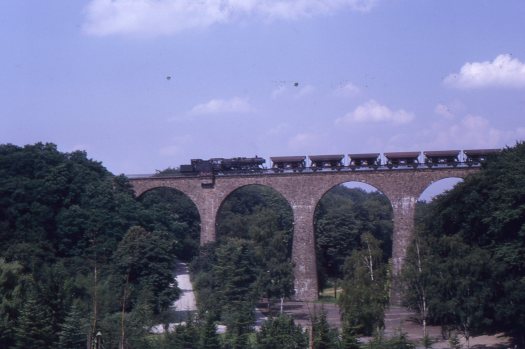
Peter took this photo near Velbert in 1968.

My mother had respect and pity for these hard workers looking emaciated and pale from working long hours in that hellish plant. North of Velbert is the city of Essen, where the largest steel manufacturing plant in Europe was located. My dad found employment in the dental laboratories of the 400-year-old Krupp dynasty of steel manufacturing.
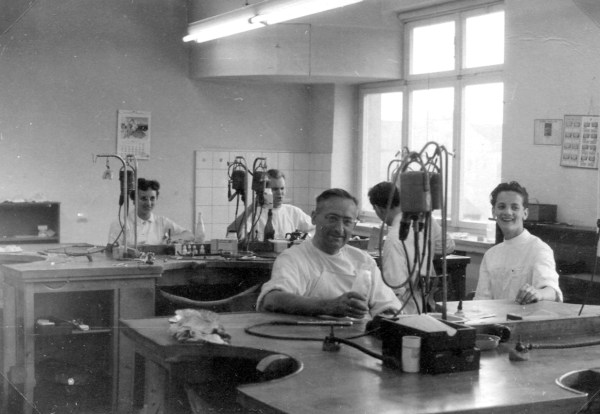
Papa Panknin Working in a Dental Lab

Every morning my dad would leave by bus around 6:00 a.m. to go to work. It would take him about an hour to get to his workplace in Essen. He would return at 6:00 p.m., dead tired but happy to have employment with a prestigious and socially progressive company that treated its employees well. For my parent’s 25th wedding anniversary, a representative of the Krupp management visited my parents at the Old House and delivered some gifts and well wishes. My parents were touched and honoured by my dad’s employer’s caring and generous treatment.
Walter Panknin (1898 – 1977) and His Family Ch6 Part 10

The New School

Biene wrote this post.

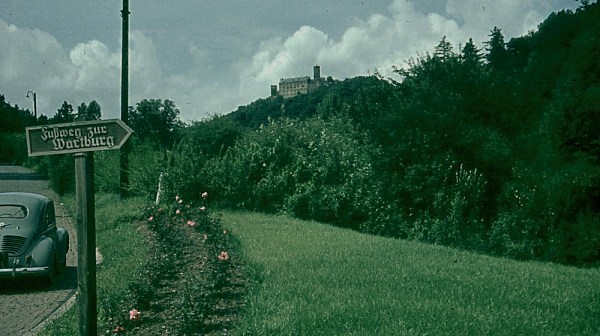
The school looked new and bright. Our teacher was a young, tall man with a severe expression. He didn’t smile at us once. About thirty students quietly stared at us when we entered the classroom. I recognized a girl and a boy I had seen last night at the Old House. When our teacher introduced us as refugee children from Thuringia, a tall girl with big brown eyes smiled at me. Gisela was her name, and she eventually became one of my best friends. She still lives close to Velbert, Germany. We have only seen each other twice after moving to Canada, but we have been corresponding for almost 50 years. I soon discovered that she was born in the “East” and from Eisenach, close to Gotha in Thuringia. Eisenach is renown for its imposing Wartburg castle.

Historical Photo of the Castle Wartburg (late 1960s)

When school was dismissed, a girl from one grade higher than us approached me and introduced herself as Margit. I had briefly seen her through the window at the Old House this morning. Margit smiled at me warmly and invited me to walk back with her. She became my closest friend when we lived at the Old House. Margit was mature beyond her age. She was a motherly type and a born leader. We liked her cheerful and outgoing personality. Fights amongst us kids never lasted long because she was a peacemaker, and we trusted in her judgement. 

About 15-20 kids about our age lived in the Old House, and we spent most of our time playing in the big yard around the old building. The Old House used to be a beer garden restaurant with a bowling alley in its younger days. The hedged-in yard with old trees had been the garden area of the venue where people would eat and drink on warm and sunny days.

Walter Panknin (1898 – 1977) and His Family Ch6 Part 9

Finally Regular School Again

Biene wrote this post.

When I woke up from a deep sleep the following day, I could see through the big window that a clean blanket of snow had covered the drabness of the yard outside the Old House of Rocky Docky.  My father had heard the famous song on the radio and aptly applied it to our new abode.  It would always cheer us up to listen to our “theme song,”  We would sing it with gusto to make the old house rock.

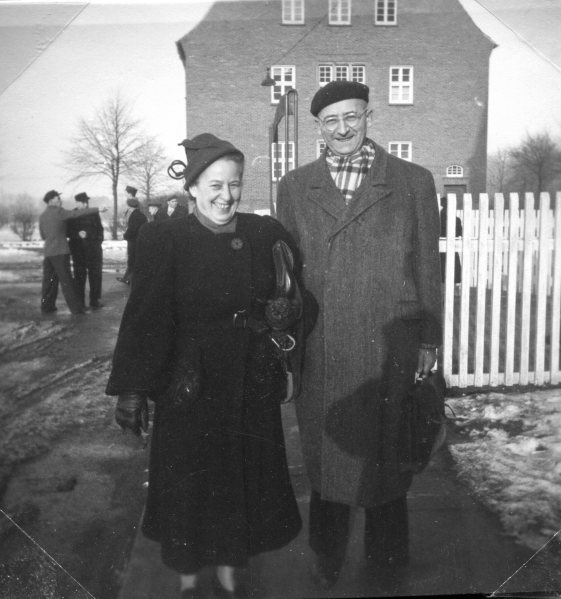
Walter and Elisabeth Panknin smile at the prospect of having their own apartment soon.

The bright morning sun made the snow crystals sparkle and dance; Despite the first signs of spring earlier, winter was not over yet. My parents were already dressed to go out. My mother told us that the manager of the refugee shelter had allocated them some funds to buy household items, utensils and other necessary equipment for everyday living. Our mother told us that before she would go shopping, she would enroll us in the nearby school called Elementary School at the Tree.   Since we had missed classes for more than a month in the transition camp in Massen,  we were looking forward to regular school life again.

Walter Panknin (1898 – 1977) and His Family Ch6 Part 8

Mama Panknin in Agony

Biene wrote this Post

At the end of it, there was a door leading to a small room with a large recessed window in the bare rock wall.  It looked like a prison cell, except there were no bars on the window.  There were two sets of bunk beds, a table with four chairs, a small table with a two-burner hotplate and a small dresser.  “This is your temporary place until your apartment is completed,” the manager told us.  And in response to my parent’s questioning glance, he added, “This may take up to two years.  We just don’t know where to house all you people,” he grumbled, leaving us to attend to the other families.

We all stood dumbfounded until my mother’s loud sobs broke the silence for a moment.  She collapsed on one of the beds and cried and cried.  I had never seen my mother cry like that before, which shocked me deeply.  My father looked helpless.  Eventually, he started stroking my mother’s back.  My brother and I climbed onto our top beds, completely bewildered.

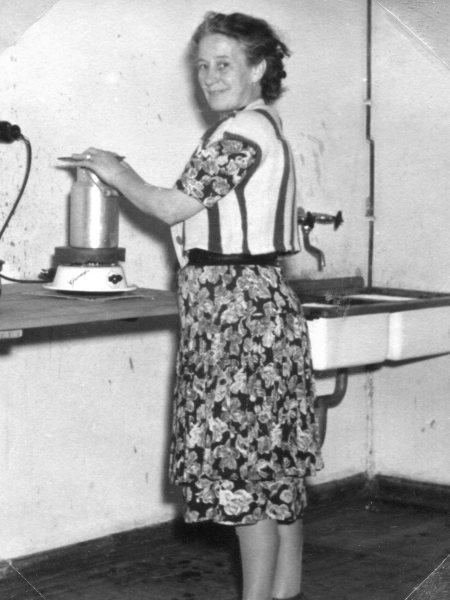
Mama Panknin Making Tea on the Hot Plate

Eventually, my mother’s crying stopped.  She rallied and took us to the outhouse.  She found a clean wash basin to scrub the grime off our face and hands’ long dusty truck ride.   She magically produced some bread, butter, cheese and jam. She also made some weak tea on the hot plate.   We were so starved; it tasted heavenly. Then she hugged us warmly and said,  “With God’s help, we’ll make it through.”

Walter Panknin (1898-1977) and His Family Ch6 Part7

This Old House

Biene wrote this post.

The driver jumped out of the cab, opened the truck ramp, and started unloading the luggage and helping us jump out.   Dazed and bewildered, numb from the cold and very hungry, we all stood speechless for a moment.  “Take your belongings and follow me,” the driver told us.

When the Panknin family had moved into this dingy, rundown place in 1954, the single ‘THIS OLE HOUSE” had just been released in the US and became very popular in Germany with the version in German. The song provided some joy despite the depressing living quarters.

He led us around the extremely long building to a courtyard with a row of several outhouses.  “You can go there in a minute,” he told us, “but let me show you your quarters first. This old building used to be a pub and a bowling alley,” he continued,  “now it has been converted into an emergency shelter for people like you.  I’ll introduce you to the manager of this establishment.” He laughed and pointed to a man who had just stepped out of the entrance to receive us.

THIS OLE HOUSE IN GERMANPapa Panknin liked this song as it gave a fitting description of the refugee camp they now had to live in until they had found an apartment.

We were the first ones to be led to our room.  We had to go through a long hall with several big sinks, laundry tubs and a wash line with a few rags drying.  There were brooms, mops, pails, garbage cans and other equipment stored along the walls.  The evening light coming in through oversized windows could hardly soften the drabness of this dingy hall.

Walter Panknin (1898 – 1977) and His Family Ch6 Part 6

Moving to Another Camp

Biene wrote this post.

One day in early spring, our mother told us that we would soon be leaving the camp in Aurich, East Frisia; we would move to Velbert, situated in the Rhineland region of  West Germany.  My mother sounded very excited and joyful because she was born and raised in the Rhineland, a beautiful part of Germany. It meant saying goodbye to my best friend Ingeborg and all our other playmates with whom we had shared so many exciting adventures and experiences.

However, before moving to Velbert, we first had to spend several weeks in a transitory camp in Massen,  a small town near Unna, close to Dortmund,  our second station in the “Golden West.”   I remember from that short stay that my mom was quite upset because we had to sleep in a big dormitory again with lots of strangers.  And to make things worse, we had to lie on straw mattresses.  But my parents consoled themselves with the prospect that we would soon move to Velbert.  That’s where apartment buildings for refugees were being constructed rapidly.

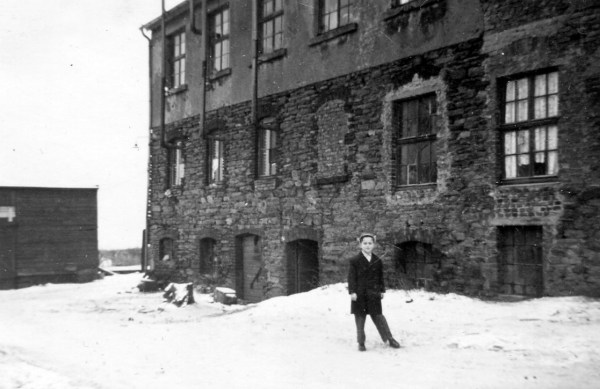
Biene’s Brother Walter Standing in Front of Transitory Camp in Massen

On a bright, sunny day in early Spring, we were loaded with all our luggage and several other families onto the open back of a big, old transport truck with makeshift benches. My brother and I had rarely ridden in a car.  This was my first time in a vehicle. For us, it was exciting!  My mom thought it was odd that we were transported like baggage. She didn’t like that we were all crammed together in this small, draughty and not too clean space. But my brother and I were laughing with the other kids and some boisterous men enjoying the cool breeze and the changing scenery. After a few hours, we were all shaken up by the bumpy ride.  The increasing cool drafts, the loud noise of the motor, and the vehicle’s rattling started to make us feel sick. Suddenly the truck came to an abrupt halt beside an old, dilapidated stone building that looked almost like a dungeon, dark and foreboding.