Chapter X of The P. and G. Story – Part II

Appearance and Reality

Dangerous Adventure on the Roof Top

In the summer holidays I traveled by train to Mother’s work place, the Senior Citizens Home in Rudersberg less than half an hour’s drive from the commercial hub and center of southwest Germany, the city of Stuttgart. Here I spent six carefree weeks alone or with a newfound friend, who spoke a similar dialect as the people in Rohrdorf. When it comes to language, I had and still have, to a lesser degree, the ability to quickly assimilate a new dialect. Looking back at the first few months at the Wesel High School, where very formal and standard German was spoken, I am amazed at the speed, at which I lay aside all traces of my southern dialect.
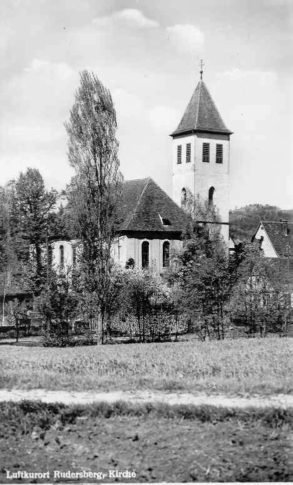
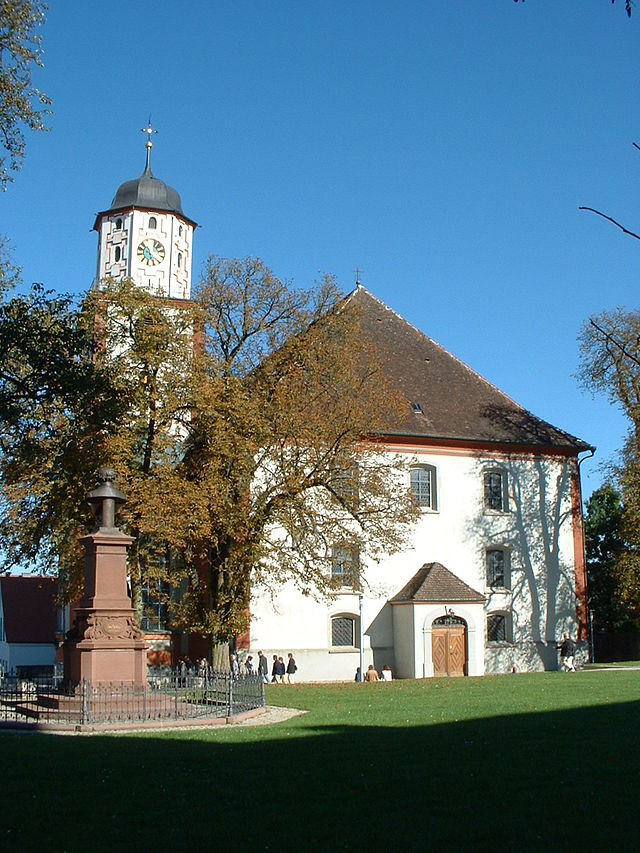
Church of Rudersberg

Church of Rudersberg

Right across from the Seniors Citizen Home was a small two-storied house with stone stairs leading up to the main entrance. Here a girl by the name of Ursula perhaps a year or two younger than I lived on the first floor. The two of us often sat on the steps chatting, swapping information about school life, our hobbies and the like. When the sun was coming around the building and it was getting too warm to sit on the stairs, we withdrew into the shade under the staircase. On a particularly hot afternoon we had spent quite a long time in our cool hiding place – perhaps a bit too long in the eyes of suspicious people who saw evil where there was none. When we eventually emerged and stepped into the glaring light, a barrage of angry words came raining down on us out one of the windows from the building across the street. An older woman all dressed in dark clothes shocked us with a seemingly endless tirade on the decline of morals, on the shameless and open display of inappropriate conduct between two, oh so young and already so corrupted individuals and all that so close to a Christian home for the elderly. “Shame on you! Shame on you!” she exclaimed, before she slammed the window shut. Apparently she had been following the invisible drama in her own imagination that was as far apart from reality as night is from day. We both were stunned by this outburst of incomprehensible accusations. Perhaps if we had been a few years older, we would have understood what this woman’s rage was all about. As for me, the unknown person in dark had already created an ever so vague impression that there was something unwholesome, sordid and morally questionable in dealing with the opposite sex, something I did not yet know what it was, but which came back to haunt me later in my adolescent years.
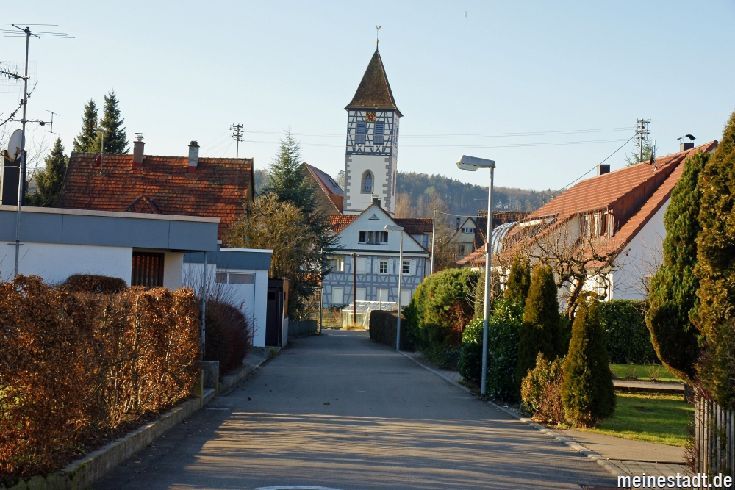
Town of Rudersberg - Photo Credit:

Town of Rudersberg

There happened to be a kermesse, in size and variety of entertainment, quite similar to the one I had attended in Messkirch the year before. This was a welcome distraction for me. Not having much money in my pocket, I simply enjoyed milling around in the crowds, going from booth to booth, from merry-go-round to roller coaster, listening to the rock n roll that was just beginning to penetrate the German pop music. I watched people play games or buy little toys and trinkets from noisy peddlers. As long as the kermesse lasted, I walked down to the fairgrounds every afternoon. One day I invited two elderly ladies who were sitting on a bench in front of the Seniors Home to walk with me down to the fairgrounds. From their reaction I could tell that this had never happened to these venerable old ladies before. A twelve-year-old boy offered to take them to the town square. After they had gotten over their surprise, they encouraged each other, and then nodded with a smile as a sign of acceptance. The scene that followed was quite comical, actually downright hilarious. Swaggering down the hillside sidewalk, one lady hooked in my arm on the left, the other one on the right, so full of joy, we were giggling and laughing all the way down to the fair grounds. What a wonderful feeling to bring happiness into people’s lives and not to care how crazy it might appear to bystanders or what they might think or say!

My desire to explore the things around me led me once into gravest danger. I had discovered by chance the stairs leading up to the huge unused attic space in the building of the Seniors Home. Inside the attic it was pitch dark. Overcoming my fear of darkness, I waited until my eyes had adjusted sufficiently to see that there was a hatch, which a storm perhaps may have pried open just a crack to let a shaft of sunlight shine through onto the wooden floor. Towards that single source of light I was directing my steps. When I had arrived near the far end of the attic, I discovered that the hatch had a simple locking mechanism. To let more light in, I pushed the hatch fully open. Now my eyes had to adjust again this time to the overpowering brilliance of the midday sun, which was flooding the beautiful landscape around the town before me. The ridge was less than three meters from the hatch. I thought that I would have a much better view if I climbed over the slate tiles onto the ridge. I immediately turned this daredevil thought into action, even though I severely suffer from acrophobia. It helped that the massive roof surface prevented me from seeing how high I was above from the parking lot below. So I slowly and carefully crept up on all fours until I reached the top and sat proudly on one of the ceramic ridge tiles. For extra measure of security I straddled the ridge and feasted my eyes on the magnificent panoramic view. Then the thought occurred to me that if I slid tile by tile forward I would reach the opposite end of the roof whence I could look down on the entire town of Rudersberg. Totally ignoring my fear of heights, I boldly went ahead. After thirty minutes of lifting and lowering alternately arms and legs in caterpillar-like fashion I arrived at the end of the roof. Far down below, people looked like ants and cars like matchbox toys. Had I before just seen mostly the roof surface with the lovely scenery on each side, it seemed to me now as if I was looking into a bottomless chasm. Three stories high on the rooftop I felt the first signs of a vertiginous attack making the world spin around me. Sensing the oncoming vertigo, I instinctively closed my eyes, lay prostrate with arms and legs straddling the ridgeline. I displayed, if anyone could see it, a picture of humble admission to my total stupidity and ignorance of the truism, what goes up must come down.

After the horrid sensation of twirling motion had ebbed away, I dared to open my eyes again. Then another fear far worse than the first seized me. I realized I was trapped. I could not get back to the hatch without turning around. And I could not turn around without falling off the roof. The thought crossed my mind to call for help. It would have been the most sensible thing to do in my situation. But what made sense, my pride did not allow me to do. So I lay there for a long time thinking and taking some comfort in the fact that as long as I did not move, nothing could happen to me. Many life-threatening situations require prompt decision and action. However, this one was different. After a long time that seemed like eternity I found the courage to sit up. Forcing myself not to look down in order to avoid another onslaught of dizziness, I moved my bottom backwards the short distance of a single ridge tile, stopped for a while, then encouraged slid back to the next tile a little further away from the house front. Now I knew that I had found the solution to my own rescue. Once the dizzying depth was out of sight, I regained my calm and retreated more quickly at a steady and rhythmic pace. Hands down, bum up, slip back one tile, bum down, short break and repeat. Finally I reached the hatch, climbed through it and felt at last the solid wooden attic floor under my feet.
Chapter X of the P. and G. Klopp Story – Part I

Problems with Latin and Yearnings of a Miller’s Maid


One cannot answer for his courage when he has never been in danger.
Francois de La Rochefoucauld


Mother had taken a new position in a senior citizens’ home in Rudersberg near Stuttgart. Aunt Mieze (Aunt Marie), her eldest sister, found a teaching position in Brünen near Wesel in the province of North Rhine Westphalia. In the mid-fifties the rebuilding of the 98% bombed-out Wesel was in full swing. Aunt Mieze had applied for an apartment and for a transfer to the Wesel Elementary School. About the same time she must have invited Mother to run the household in exchange for free lodging for her and me, the youngest son. This arrangement would become reality, as soon as the apartment already under construction would be available. How Father on a long-term basis would fit into these plans, I have never been able to figure out. While Mother was still working for another year in Rudersberg, I was going to live with my aunt at the farm-like residence across from the historical Wefelnberg mill that had lost its wings, but with the aid of electric motors was still turning grain into flour until the early seventies.

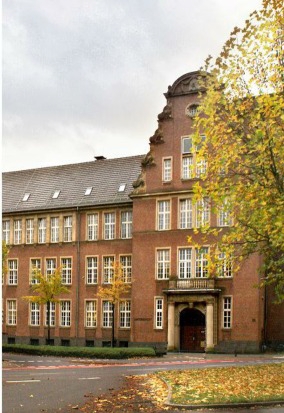
Staatliches Gymnasium Wesel

Staatliches Gymnasium Wesel

From here I took the bus to attend the high school for boys in Wesel. In those days smoking was still permitted on public transport. I often felt sick from breathing in the lingering smoke of cigarettes and cigars. Things did not go very well at school either. I had started with French as the first foreign language. Here at the ancient language school, Latin was taught first and carried on for nine long years. Although I had received some private tutoring in Latin, it became abundantly clear after my first report card with an F in Latin that I had to repeat the grade. In order to survive in a school, whose claim to fame was being the toughest in the region, there was no other option.

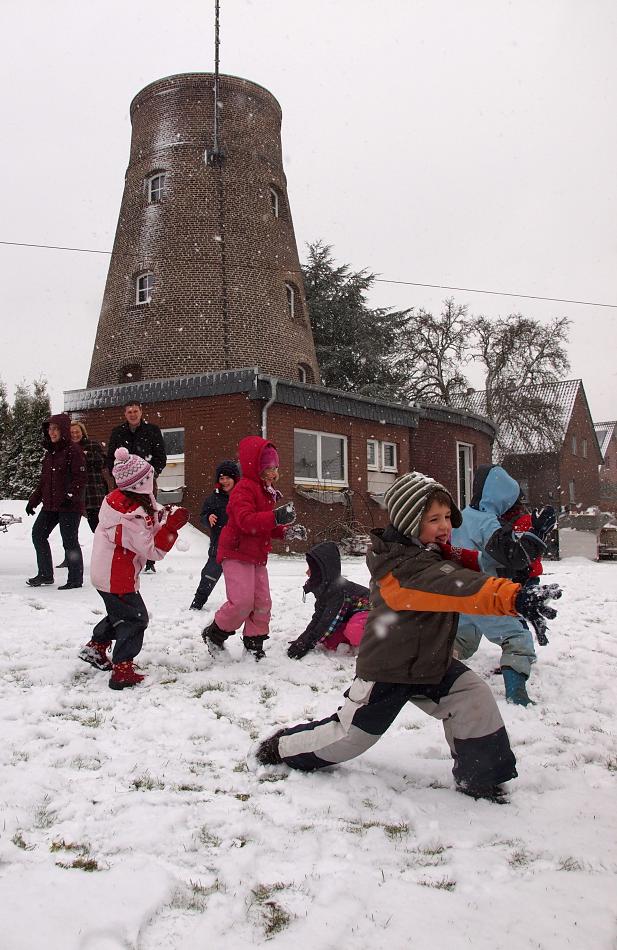
Historic Wefelnberg Mill now used for Kindergarten School

Historic Wefelnberg Mill now used for Kindergarten Classes

At the opening assembly Dr. Marx, the principal, announced that out of the hundred students there would only be one-quarter left at graduation nine years later. There was no doubt in our minds that the process of weeding out the feeble and incompetent would be ruthless and merciless. My high school years were going to be fraught with stress and anxiety. At least at the miller’s home in Brünen I had a good life. Aunt Mieze was strict, but fair. When she felt the needed to teach me a lesson, I deserved the punishment. When she gave me on rare and exceptional occasions a spanking, it was intended to correct unacceptable behavior. Love and care for her nephew were her main motivation, not anger and rage as I had experienced at the Stoll house.

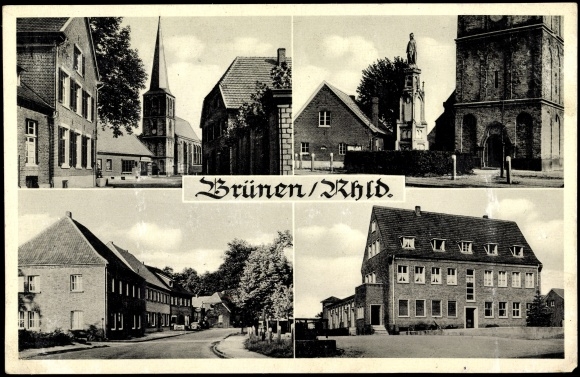
Post Card of Brünen near Wesel

Post Card of Brünen near Wesel

There were at least seven people in the Wefelnberg household: Aunt Mieze and I, robust widow Wefelnberg in her early sixties, her daughter, who had remarried, after she had lost her first husband in the war, a 10 year old daughter from her first marriage, and Leni, the maid. The couple had their bedroom next to mine. The new husband and experienced miller had taken over the duties of running the mill. With so many widows eager to remarry and competing for the few men that survived the war, it seemed that the young man had made a good choice. My tiny room of less than six square meters, even judged by the standards of the cramped living conditions in postwar Germany, would hardly qualify as a bedroom. It used to be a storage facility located under the slanting roof and was now skimpily furnished with a cot, a chair and a small desk on which I could do my homework. The door on the left of the wooden staircase was in the shape of a square just large enough for me to crawl through. On the upper floor to the right were Aunt Mieze’s office, living room and bedroom all combined in an area not larger than twenty-five square meters. At the far end on the right was Leni’s bedroom. She was responsible to assist Mrs. Wefelnberg with general household duties and was happy like most unmarried young women to have employment for free room and board and a little bit of extra pocket-money.

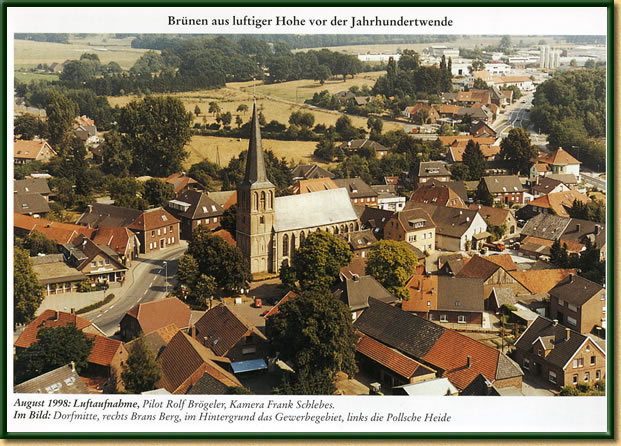
Protestant Church in the Village of Brünen - Photo Credit: See caption above.

Protestant Church in the Village of Brünen – Photo Credit: See caption above.

          Aunt Mieze’s room in spite of its shortcomings was a very cozy place and created with a comfortable sofa, coffee table, desk and books on the shelves a pleasant ambiance that my Spartan attic room could not match. Here I sat often in the evening hours, when my aunt, a very conscientious teacher, had gone back to school to prepare her lessons for the next day. Leni, who had taken a liking to me, often, especially when nobody was around, dropped in to chat or to play a game of checkers with me. The latter I liked very much. Although being at least ten years younger I was able to beat her by managing to convert my pieces into kings more quickly than she did. For someone who was at the time in school emotionally wrapped-up in a fierce struggle of survival, the survival of the fittest, our principal would say, these small victories and the praises Leni lavished on my battered ego were indeed balm for my soul.

          One day after being defeated again and providing heart-warming accolades for my strategic prowess, Leni unexpectedly slid over to my end of the sofa. What followed would have been a perfect scene for a comedy hour. The miller’s maid generously endowed by Mother Nature burning with desire of which I did not have the slightest inkling sat uncomfortably close to me, the twelve-year-old boy, and almost in a whisper asked me to kiss her. As for me having been raised in a family, where physical closeness, such as kissing, embracing and hugging, was rarely experienced, where aloofness and demureness were the norm rather than the exception, I was shocked at the maid’s incomprehensible request. For five marks as a prize I once ate an earthworm sandwiched between two slices of bread. But to touch those lips longing to be kissed, for my lips to make actual contact with her mouth was a most horrifying thought to me. When I refused, she pleaded with me, this time more urgently with a considerably louder voice, “Please do me this small favor. Please, please I want you to kiss me …” Suddenly the door burst open. At the door stood the miller’s wife and ordered Leni in a stern, authoritative tone to get into her room and never ever be seen again in Frau Kegler’s room. Whether she had been eavesdropping or even spying on us through the keyhole, I do not know. But to this day I am grateful to her for rescuing me from one of the most embarrassing moments of my life.

Chapter IX of The P. and G. Klopp Story – Part VI

Of Crime and Punishment

During the second half the school year Frau Stoll gave birth to a baby boy. With his arrival came also a dramatic change in my relationship with the Stoll family. Had I experienced until then a semblance of acceptance as being part of the family, I now felt completely out-of-place. I had become a nuisance, an irritant, a foreign obstacle that needed to be brushed aside to make room in their home and hearts for their newborn son. Old grandma Stoll with her gigantic, trumpet-like hearing aid pretended not to hear me anymore. Frau Stoll was now occupied with her own child and had no time to bring some cheer into my heart. Herr Stoll’s attitude towards me became more and more critical on everything that in his view was unacceptable behavior. He was meting out harsh punishments for my tardiness at suppertime. I had no watch and being a dreamer I easily lost track of time. He also spanked me harder and more frequently for associating with the ‘wrong’ friends.

messkirch_1

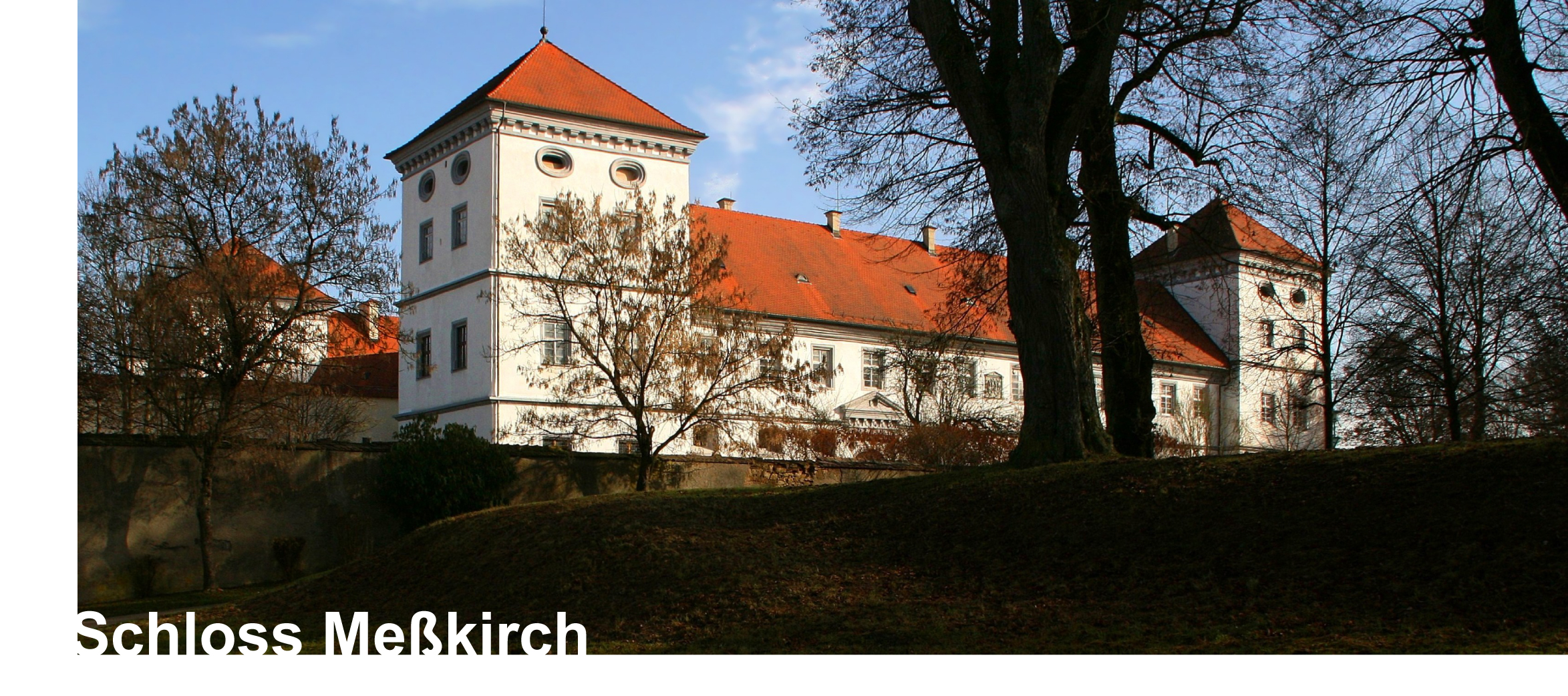
Castle and Park in Messkirch – Photo Credit: schloesser-bawue.de

Toughened up by the frequent spankings I often took on the role of the victim in the ‘Cowboys and Indians’ games I played with my friends in the beautiful park of the Messkirch castle. On one occasion I allowed myself to be captured and tied with ropes onto a tree. In a bizarre combination of fun and cruelty the ‘Indians’ were howling and dancing around the tree taking turns at punching me in a ritual of crime and punishment. Later on when they had released me, they praised me as their hero for so stoically and silently taking their punches. I delighted in their accolades. The role of the cooperative sufferer with real life experience in the domain of pain suited me well. However, its enjoyment was indicative of a character warped by the loveless and punitive atmosphere in the carpenter’s household.

Castle and Park in Messkirch - Photo Credit: schloesser-bawue.de

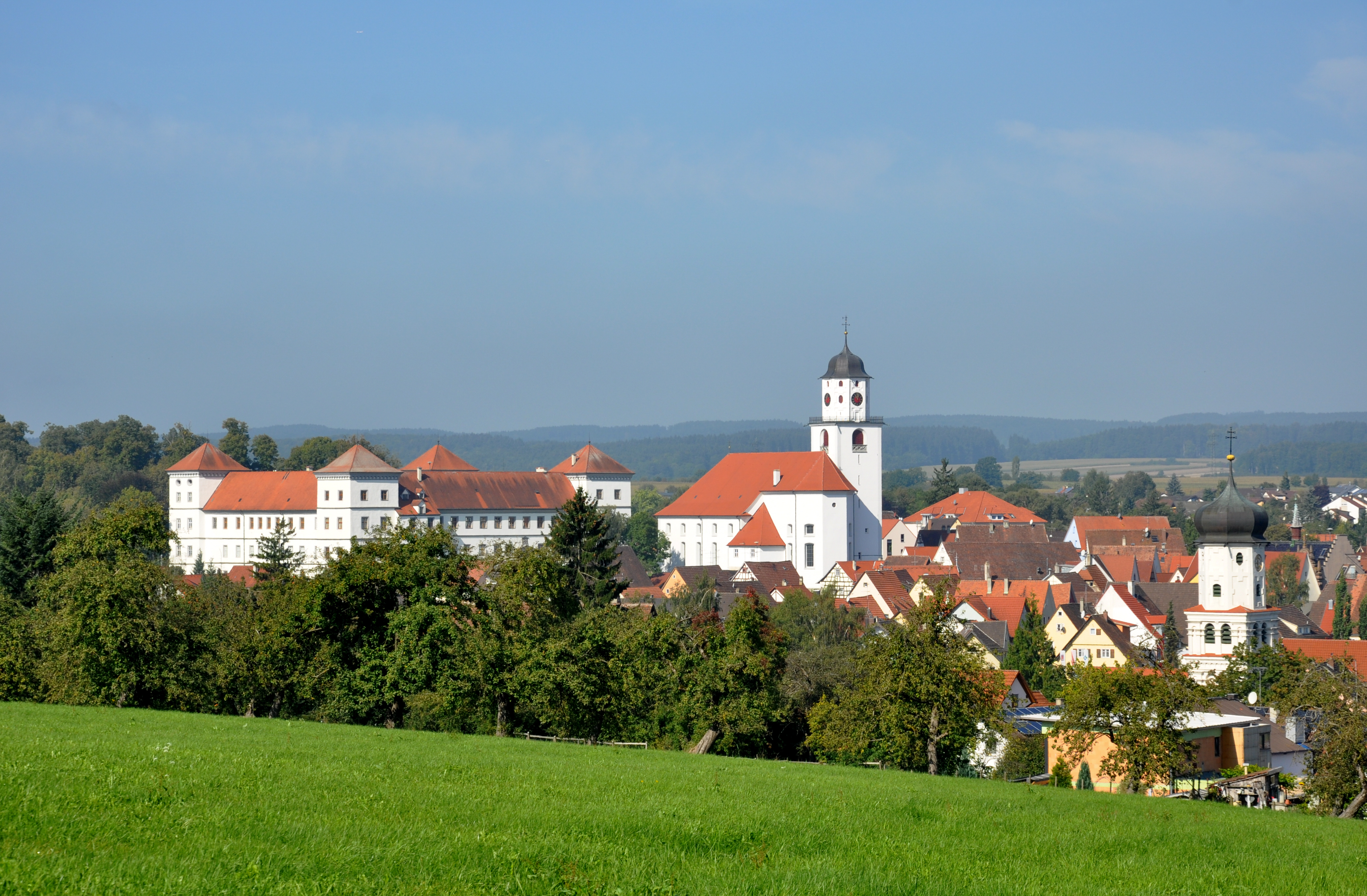
Messkirch – Photo Credit: schloesser-bawue.de

One rainy afternoon I had to stay indoors after school and spent time at the carpenter’s shop downstairs. Herr Stoll and his three apprentices had been working on various woodworking projects. I was standing next to the first-year apprentice at the very front of the workshop. He had taken a liking to me and often found time to chat with me. It was near closing time. While the young man was cleaning up his workplace, I teased him by hiding his plane he been working with just a few minutes before. The young man was puzzled by its sudden disappearance. While he searched for it, Herr Stoll like a raging bull came racing down the aisle. Without giving a simple word of explanation he grabbed me by the neck and dragged me to the back of the workshop, where he beat me in his furious anger, slapped me in the face, banged me around and threshed my behind. When my cries had turned into a mere whimper and then into silence, Herr Stoll decided that the first part of my punishment had been successfully completed. Nearby was a small storage room for plywood and other wood products. That’s where he threw me for the second installment of my punishment for distracting the apprentice from his all-important clean-up job. I sat on the bare floor aching all over. For how long I sat there I cannot remember. In the darkness of the storage room I contemplated on the crime I had committed against one of my master’s employee. I was still stunned by the traumatic experience, when after a very long time the door of my prison cell opened and the bright outside light made my eyes squint. The shadowy silhouettes of Herr and Frau Stoll like phantoms of the netherworld were looming in front of me. Looking down on this miserable human bundle, Frau Stoll glanced at me as if expecting a word of apology for my misbehavior. Wondering about my silence she remarked to her husband, “Look how guilty he must feel. He is not saying anything at all.”

From this time on I was desperately thinking of escape. Anxiety about this horrific life and homesickness often drove me to the balcony on the north side of the building. There I stretched out my arms towards my home village Rohrdorf as if to invoke some magical force to rescue me from this intolerable situation. But there was no rescue and no home to flee to. The Klopp family once so miraculously reunited was beginning to show signs of disintegration. The failure of the farming venture resulted in a debt load that created a lot stress. Father suffered under long episodes of backaches. From time to time he found temporary employment in the village, while Mother worked hard in a household in the town of Sigmaringen to make ends meet. Karl had gone to Göttingen to study economics. Adolf, who had worked at the Bizerba factory in Messkirch, emigrated to Canada in 1953. He was tired of handing over all his hard-earned money to cover family expenses. Eka (Lavana) had begun her nurses’ training in Hamburg and Gerry had moved to Switzerland to enter a toolmaker’s apprenticeship program. By looking back at the extended periods of separation between Father and Mother I am sure that their relationship was already greatly strained. At the time when I was desperately yearning for the comfort of an intact home, it had ceased to exist.

Chapter IX of The P. and G. Klopp Story – Part V

Of Caves and Bear Skeletons in the Swabian Alb

 At school we were looking forward to our first major field trip. We were going to see one of the great natural wonders, the Bährenhöhle (Bears Cave), a complex cave system located in the Swabian Alb north of the River Danube. Fräulein Welte explained to the eagerly listening class how it had been discovered quite by chance in 1834.

Bear Cave - Photo Credit: fotocommunity.de

Bear Cave – Photo Credit: fotocommunity.de

“A local schoolteacher by the name of Fauth was gathering herbs and was digging for roots when he was startled to see some stones roll into a gap between two large boulders. To his surprise he heard them land at an incredible depth and to verify this he threw several more stones down. As he bent forward his tobacco box fell from his pocket into a small crevice at the edge of the drop. Gently, he removed a small stone but in doing so he dislodged the box so that it fell into the cave. Peering into the depths his surprise turned into horror when he saw a human skeleton!” Now Fräulein Welte had our full attention.

She continued, “The following day he returned to the hole with several friends and the necessary ropes. He was soon lowered into the cave and his friends quickly joined him. In the glimmering light of their candles the more they saw, the greater was their amazement. The floor of the chamber was covered with human and animal skeletons. However, their passage was blocked by a great number of stalagmite formations. When they left the cave, they each took with them bones and stalagmites as proof of their discovery.

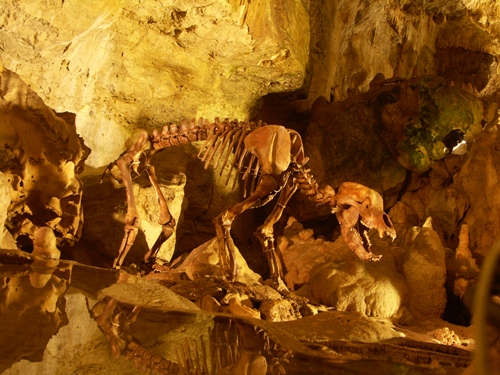
Bear Skeleton - Photo Credit: geopark-alb.de

Bear Skeleton – Photo Credit: geopark-alb.de

After the first exploration the news of their discovery spread. People from the surrounding villages came to visit the cave and nearly all the bones and formations were either destroyed or carried away. A report was made to the Royal Administration and the cave was placed under their supervision. In order to provide better access to the cave, a hole was dug at the western end. This proved quite practical as the cave at this point consisted of clay and boulders of Jurassic limestone, indicating that there had been an entrance here at earlier times, although it was probably blocked with glacial debris after the last ice age. The short excavated passage still leads to the First Chamber. Beneath “Fauthsloch”, the opening named after the teacher, there used to be a large mound of debris about 5 m high containing 50 skeletons of the Plague, together with the bones of horse, cow, pig, sheep, dog, polecat and hare. Evidence in the form of flints has also been found in this chamber proving that early man used this cave at the time of the Reindeer Hunters.”

I put this account into my teacher’s mouth. I gleaned the details of the cave’s discovery from the Internet. However, I remember the buzz and excitement of our class when Fräulein Welte gave us the introduction to one of the most remarkable caves in the world. How eager we were to learn about basic geology, the formation of these awe-inspiring caves, the origin of the bones, the story of early man, the difference between stalagmites and stalactites!

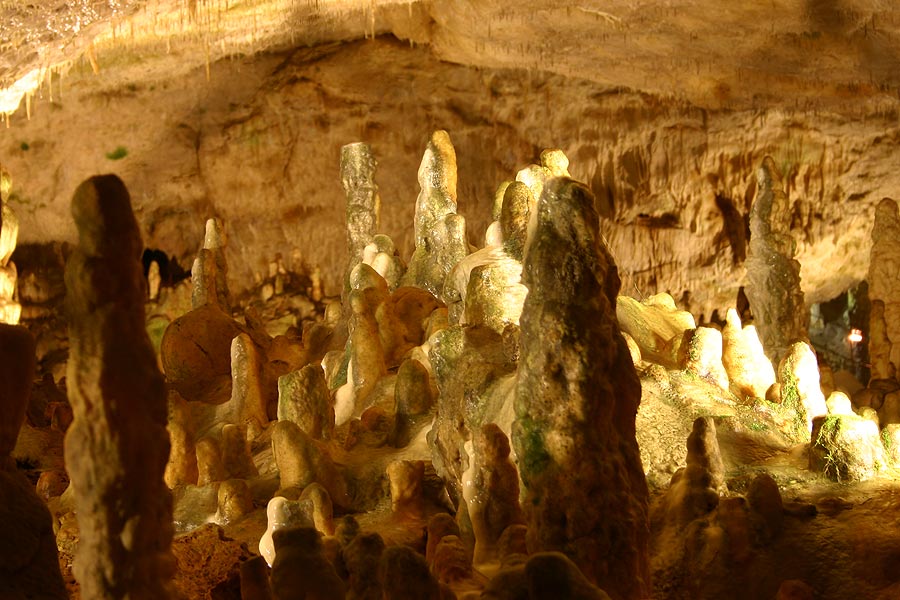
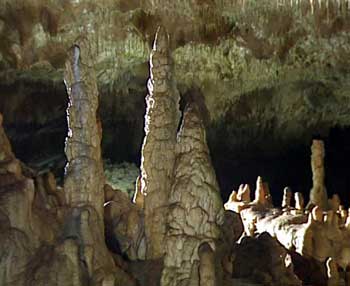
Stalagmites in the Bear Cave - Photo Credit: koestlichesdeutschland.de

Stalagmites in the Bear Cave – Photo Credit: koestlichesdeutschland.de

I recalled many of the details of our field trip so well that later on as teacher of the Fauquier Elementary School I often shared my impressions with my students when I took Europe as an option in our Social Studies program. There were seven chambers in all that we walked through during our field trip. The first thing we noticed was the large boulder that at one point must have fallen from the ceiling. A stalagmite growing on it indicated that this happened a long time ago. Scientists had discovered nearby an ancient fireplace. Here a large amount of wood-charcoal was found together with the bones of deer and pig, further evidence that early man lived in this cave. The Fifth Chamber, where the highlight was the large stalagmite called “The Peak”, which had a slender stalactite above it, attracted a lot of attention. The Sixth Chamber was the most beautiful in the old cave, being 15 m high and 20 m wide. This chamber is also called “The Old Cave Bear Cavern” for it was here that most of the Bear remains, skulls, bones, etc. were found. I remember this particular field trip as one that had kindled in me a lifelong interest in geology and anthropology.

Chapter IX The P. and G. Klopp Story – Part IV

 Succulent Peaches and Playful Friendship with a French Girl

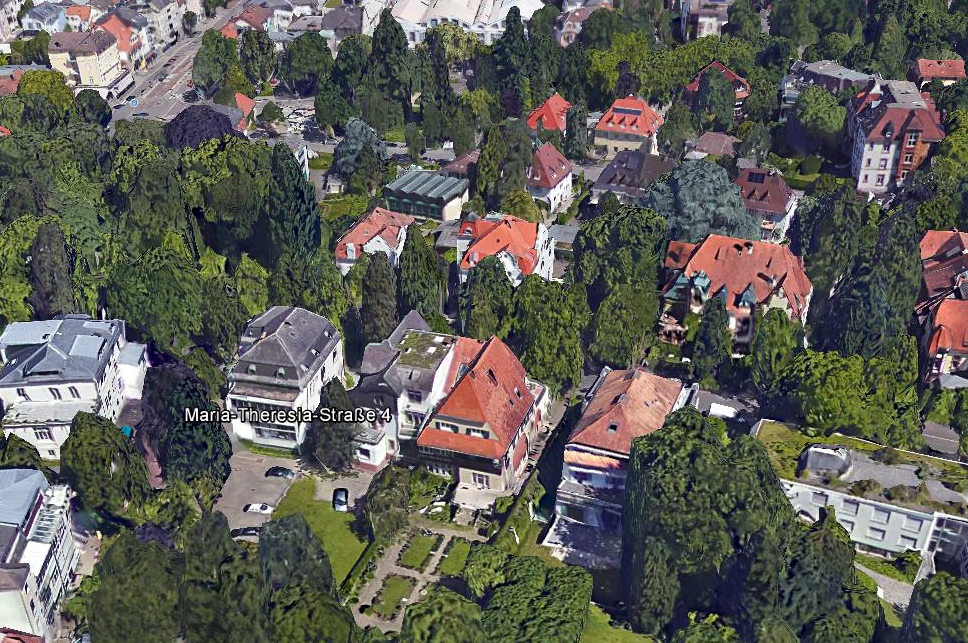
The yard around the house at Maria-Theresia-Str. 4 was beautiful indeed. A hedge completely surrounded the property except for the iron wrought gate near the main entrance of the house. Various fruit trees decorated a good part of the yard, and the peaches were reaching full maturity. There was nobody who expressly told me not to eat them. I ate them, because they were there and because they tasted delicious. With each new bite the juice was squirting into my face and running down on each side of my mouth. My taste buds were so delighted that I overindulged in the pleasure of eating the succulent fruits, until my stomach began to grumble and was sending warning messages, which I chose to ignore. Too late! At first I barely made it up the two flights of stairs to get to the bathroom on time. Then the visceral revolt became too strong, I ran behind a bush to relieve myself. A woman from a next-door balcony watched in horror the revolting sight and rushed over to complain to my aunt, “This boy did not have the decency to go to the washroom and he disgusted himself on the lawn.” This was the way she described it in her excessive sensibility regarding bodily functions with that the rare German expression ‘Er hat sich verekelt.’


House, where Aunt Meta lived - Photo Credit: Google Earth

House, where Aunt Meta lived – Photo Credit: Google Earth

On the ground floor lived a high-ranking officer of the French occupation forces with his wife and a daughter, who was about my age. She often came out on the yard to play with me. There was no language barrier. We played all the simple games we had learned in school that required no or very little equipment, such as hopscotch, throwing pebbles into a circle, hide-and-go-seek, etc. Prejudices of our two different nationalities did not exist in our young hearts. The extent of my French vocabulary after three months of instruction was still under one hundred. However, under the tutelage of this vivacious little girl bubbling over with words and gestures my stock of words grew by leaps and bounds. When I made my first attempt to use some of the new phrases I had learned from her, she giggled goodnaturedly over my enthusiastic effort to communicate in her mother tongue. I have very fond memories of my summer holidays in Freiburg, and they will remain as one of the pleasant highlights of my childhood years in Southern Germany.

St. Martin Church Messkirch - Photo Credit: wikipedia.org

St. Martin Church Messkirch – Photo Credit: wikipedia.org

Upon my return to Messkirch things were looking up for awhile. My homeroom teacher Fräulein Welte was quite pleased with my sudden interest in French and with the general improvement in the other subjects as well. My more positive attitude was in part prompted by the so-called ‘blue’ letter. It was sent home to inform parents about their child’s poor performance in school. Now I was no longer in danger of failing the grade. Also there was a more pleasant atmosphere at the Stoll family. They must have enjoyed the break from having to deal with me during the summer holidays. The focus was now on the upcoming joyful event. For the baby was due in less than two weeks.

The P. and G. Klopp Story – Chapter IX Part III

Stress-Free Summer Holidays in Freiburg


The summer holidays came as a relief from the mounting anxieties that I felt in school and at the Stoll’s. My parents put me on the train to Freiburg, where Aunt Meta lived at Maria-Theresia-Str. 4.

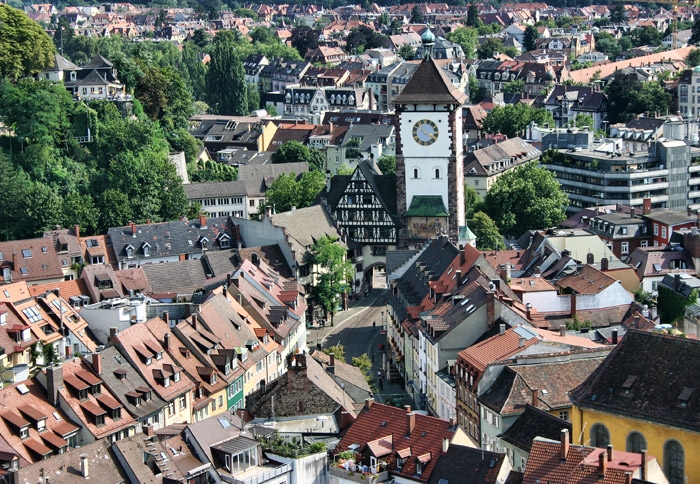
Freiburg - Photo Credit: newline-magazine.com

Freiburg – Photo Credit: newline-magazine.com

The city has now a population of 200,000 people. Historically, Freiburg has acted as the hub of the Breisgau region on the western edge of the Black Forest in the Upper Rhine Plain. One of the famous old German university towns, archiepiscopal seat, the city was incorporated in the early 12th century and developed into a major commercial, intellectual and ecclesiastical center of the region. Freiburg is located in the heart of a major wine-growing area and serves as the primary tourist entry point to the scenic beauty of the Black Forest.

When I arrived at my aunt’s apartment, I immediately felt that a great burden had been taken off my shoulders. Aunt Meta, Father’s youngest sister, cheerfully received me into her pleasant home and the love, which I had been so sorely missing for the last three months, she lavished upon the youngest child of her youngest brother Ernst. Her husband, Professor Vincenz Mülbert, had been suffering from a lengthy illness and was in the hospital during my entire stay. Meta Emma Klopp made me feel right away at home, and even though she had no children of her own, she was like a mother to me. And when I needed correcting for something in my conduct that she strongly disapproved of, her kind words flowing from a warm and understanding heart accomplished much more than the harsh treatment that I had endured at the carpenter’s house in Messkirch.

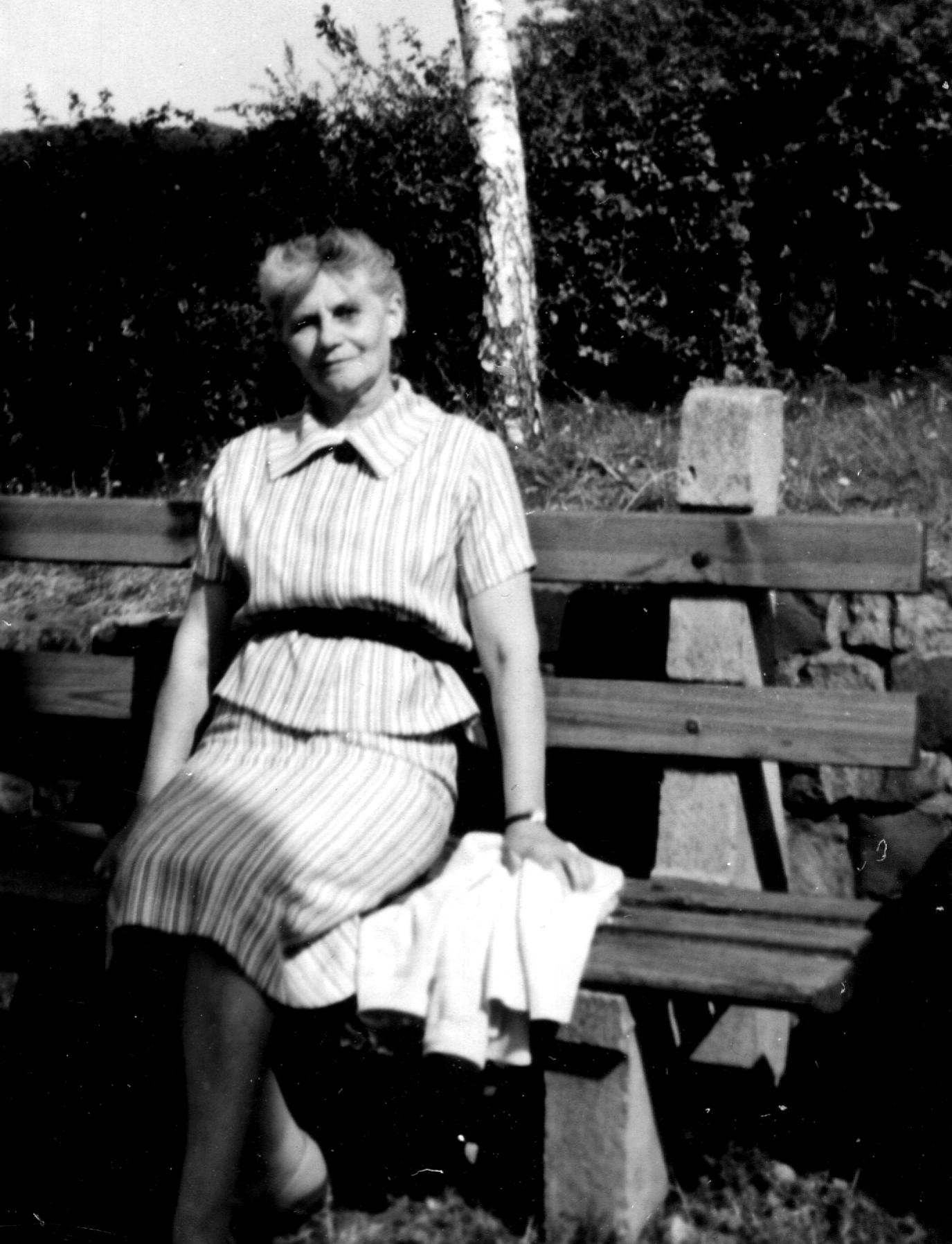
Aunt Meta

Aunt Meta

In the spacious living room stood a grand piano. Tante Meta allowed me to play on it, even though I had never received any lessons. What attracted me were not its sheer size and unusual shape and the looks of the mysterious white and black keys. Rather I was fascinated by the discovery that by simply pressing the keys of the piano I entered a world hitherto unknown to me, the amazing world of musical sounds. Each individual note or sequence of notes created a pleasant sensation, which made me search for other notes to reinforce it. I once sang Kindergarten songs to seek comfort from the fear of darkness, I played the kazoo to express the joy of being part of a group, but the notes I played on the piano had a more profound impact. They provided a first glimpse into the power of music to open the doors to my inner being, the very gateway to my soul. However, for someone else, especially for Aunt Meta my musical explorations on the keyboard must have been horrible to listen to. Her patience and understanding were truly admirable.

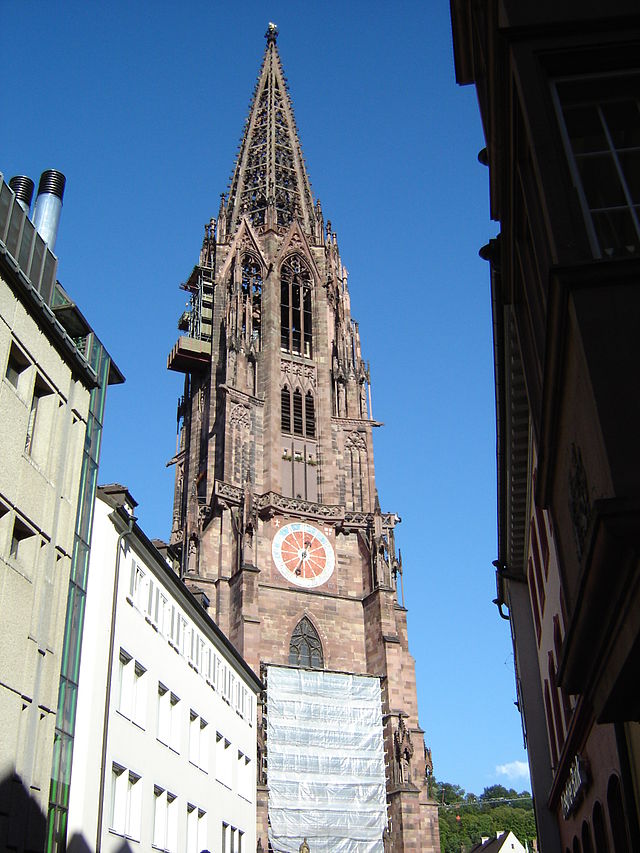
Freiburg Cathedral - Photo Credit: wikipedia.org

Freiburg Cathedral – Photo Credit: wikipedia.org

On Sundays, Aunt Meta took me to the church service in the famous Münster of Freiburg. Everything in the cathedral, the towering stone columns, the stained glass windows, the altar, indeed the entire building itself inside and outside pointed heavenward towards God. You stand there in awe of the splendour created to the glory of God by generations of craftsmen. The priest delivered a sermon whose content I have long forgotten. It must have been a very simple homily. For almost every sentence emphasized the need to pray and the need to be thankful. And that was I guess the essence of what the priest conveyed to his flock in church.