The P. and G. Klopp Story

Report by Gerhard (Gerry) Klopp – Chart I – III

1942 -1944 Gutfelde

A safe heaven for family and friends from threats of enemy bombings and other calamities
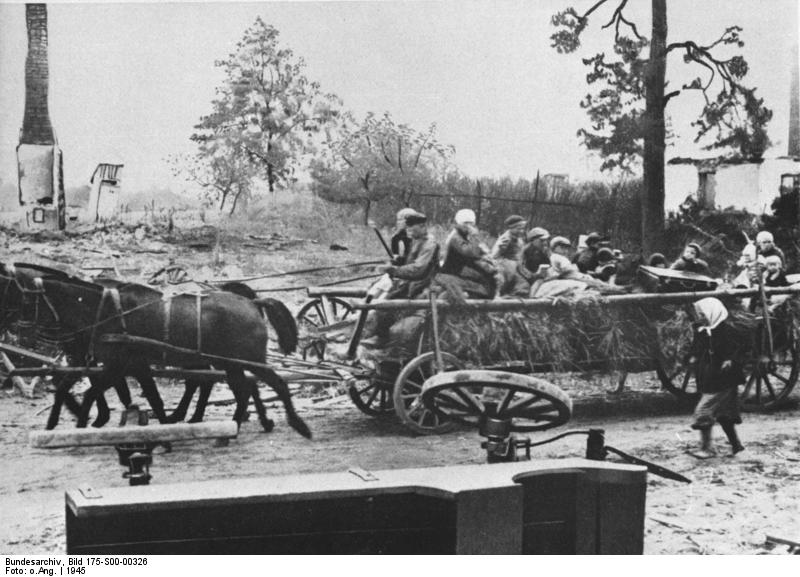
Refugees 1945

Refugees Fleeing from the Advancing Red Army 1945

Recall Karl’s visits. December 1944. We sat in a “bunker” that Karl built from scrap lumber and card board. He posted a picture of Rommel and told me about all his victories. We now know how Rommel died and why. Around Christmas time the family set around a small table with a small squeaky radio listening to Hitler’s last big gamble on the western front. The Battle of the Bulge. German tank units had smashed through the Ardennes forest and were headed to the coast cutting off all allied supply lines. Victory was our fearless leader’s Christmas gift to us. Karl: ”Mensch Pose. Wir gewinnen den Krieg”.

Again. We know how that went. Karl quickly rounded up boys and girls and organized war games, which would replicate those German victories and more to come. In order to keep up the high moral he instituted a system of executing deserters and cowards. To facilitate this he needed an example of what happened to such bad Germans. He convinced me to become an actor and become the first to be shot. He used an older army rifle and some carbide explosive to scare forced onlookers to witness my execution. As told, the bang occurred, I dropped to the ground. Onlookers ran screaming into the house. End of my acting career.

Recall a party our father put on for a group of volunteers from the Dutch speaking part of Belgium. They were eager to fight for Germany against the communist menace. They sang German war songs and enjoyed their good times. Likely their last one as well.

Christmas 1944 was still a lavish one. Huge tables set with gifts and all sorts of chocolate and cakes. Last of the good times. Shortly after, frantic packing and loading of wagons. Had no idea what this was all about. Thought this was great fun or some other entertainment. Father as ordered or expected by our glorious leader stayed behind. On the urging of our Polish friends advising: ”We know you, others do not” did he load up his one horse-drawn four-seater wagon. Beautifully decorated and with pneumatic tires. On his way to find us, he picked up 3 recently orphaned children by the side of the road. Their father was killed in the war and their mother shortly before the order came to flee to the west. Our mother now had 5 children to care for. Seemingly endless rows of wagons. Some motorized soon to be abandoned by the side of the road or simply broken down during very severe weather and road conditions. Not sure if we made 29 km a day. Food and fresh water often impossible to get. First some babies died to be buried by their mothers by the roadside in the snow. The sick and elderly soon followed. We were lucky. Our horseman and driver was experienced and knew the countryside well and most drivable side roads.
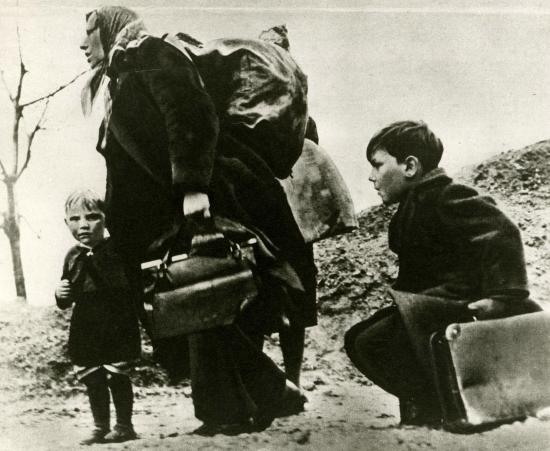
Mother and Children

Mother and Children

Father must have discussed that with him as he did meet up with us at a remote country location. Some days later we ended up at a large farm overrun with refugees from all over. Dead tired, I fell asleep in a haystack. Next morning as I awoke I realized that I was separated from all my family. Seemingly hundreds of people were running around looking for toilettes, water, food or a way to get moving west. I was terrified and lost. It was here in all the confusion Father appeared. Our good Polish friend and driver of our wagon urged us on as the presence of Russian tanks was heard all around us. Our next stop was at a remote small farm owned by a local forester. The owner Mr. Novac discussed what to do. Novac suggested to remain at his place together and to outwait the war. Still east of the Oder River, our chances of making it across alive were slim. Our good Polish horseman and wagon commander Wurblewski, likely spelled wrong, insisted on living in his own quarters. A small house on a top of a hill. We stayed with our family in the forester’s home.
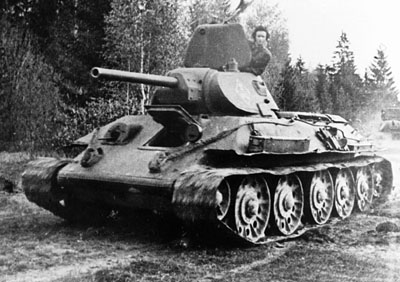
Russian T34 Tank

Russian T34 Tank

Situated at the bottom of a small valley. At night we heard gunfire. Did not make much of it, as it was now a common occurrence. Early next morning an exited and distraught Wurblewski knocked on our door holding his beautiful huge fur coat, his prize possession, up for us to see. A large hole in the middle of the coat. Clearly, a gun shell had smashed through the house barely missing the sleeping man. Father had to reassure him that we all are very happy that our chief navigator is still alive. On another day Russian soldiers with horse-drawn wagons showed up. They were confused and lost. They asked a Polish speaking elderly farm employee for directions. A boy about my age, possibly a relative of the farm woman was talking to the Russians. He hopped on the wagon and they departed in a hurry. Not knowing what it was about, I ran after the wagon hoping to go along for the ride. A Russian sitting on a bench facing backwards raised his gun and pointed it straight at me. Heard a click. I froze. Just stood there. He put his gun down and sternly waved pointing to the farmhouse. I ran as fast as an Olympic runner. Not certain if just another rumor. Very common under the circumstances. The boy was never seen again. Heard later that the boy led the Russians into an ambush. All were killed. German soldiers often separated from their units continued to harass the Russians behind the front lines. Some would visit our farm at night in search of food and other supplies. Few days later more Russians arrived. They ordered us out at gunpoint.
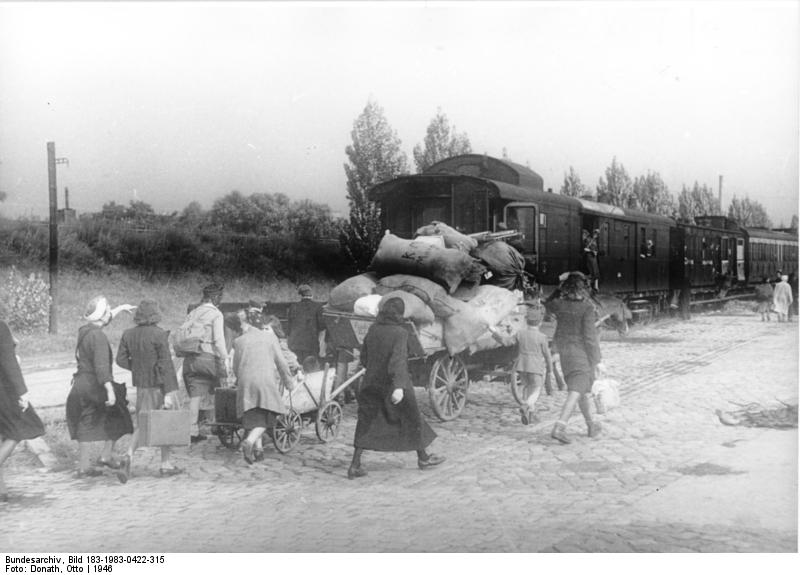
Being Brutally Resettled 1946

Being Brutally Resettled 1946

Burnt the complex down. We were once again homeless, cold and had nowhere to go. Not certain how we got to the next village intact. Our mother forever worried what may have happened to her two sons in Belgard. A city where they were boarding with friends in order to attend schools not available near Gutfelde. Her only daughter Erika was boarding with relatives in Silesia. Mother packed us up and took a train though Russian occupied territory to Belgard. The three orphans father had added to our family were still with us. The Meisner family, where both Karl and Adolf were boarding took us gladly in. But the reason for our journey was to be reunited with Karl and Adolf. They had left some time earlier to avoid the Russians advancing on Belgard. Their Odyssey is described with Karl’s report. Hope to remain in Belgard to await final outcome of the war ended when the Russian administration decided to deport us west. First to a camp in Stettin. They made us walk miles through snow-covered trails. Any luggage we could no longer carry was simply thrown away. We were then shipped in boxcars to a refugee camp in Schleswig-Holstein.

The Klopp Grandparents IV

Heraldry of Wolmirstedt

Heraldry of Wolmirstedt

Emma’s Father, Friedrich Wilhelm Bauer

1818 – 1868

Adapted from Eberhard Klopp’s Family Chronicle

F. W. Bauer’s job description ‘factory inspector’ goes back to government regulations, which were based on laws pertaining to safety and protection at the workplace. Factory inspectors with the authority of the local police ensured the prevention of child labor, enforced the labor law regarding the maximum number of hours permitted for day and night shifts, and generally were there to protect the safety and health of the workers. In addition to these duties, they made sure that all workers were provided with proper ID cards and that logbooks be kept with their employment records.

In other words my great-grandfather F. W. Bauer in Jersleben now belonged to that special organization of state employees, who in the interest of factories took up control functions for the protection of the workers. The scope of his responsibilities as a commercial policeman may have included the supervision of mills, sugar and starch plants of the region around Jersleben and Wolmirstedt.

About three years after their move from Rottendorf F. W. Bauer died in Jersleben on April 20, 1868 at the age of only 50. His wife Sophie Bauer (née Wegener), a woman of exceptional beauty in the memory of her descendants, outlived her husband by thirty years and died in 1898 at the age of 76 in the Wolmirstedt house of her grandson Friedrich Klopp (1875-1946).

Photo Credit: Museum Wolmirstedt

Photo Credit: Museum Wolmirstedt

The P. and G. Klopp Story


Chapter 6

Flight and New Beginning


Trek of Fugitives

Trek of Fugitives January 1945

Desperation is the raw material of drastic change. Only those who can leave behind everything they have ever believed in can hope to escape.  William S. Burrows


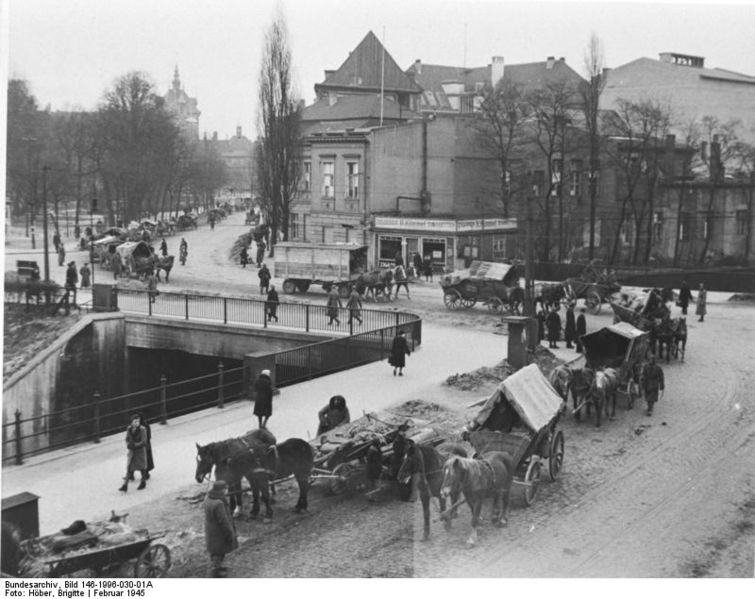
           The German management of Gutfelde under my father’s administration abruptly ended on the 12th and 13th of January 1945 with the family’s flight from the advancing Red Army. A few hours before, the attack began, which turned out to be the most massive offensive ever-recorded in international military history. Under the command of Marshal Schukow and Konjew the Soviet army groups conquered Warthegau and advanced within days all the way to Sagan, Silesia. Panic and chaos spread among the defending forces and the civilian population. The flight with as little baggage as possible succeeded in the direction of Landsberg in spite of bitter cold temperatures and icy, snowed-over roads, which were hopelessly overcrowded with people, horses and wagons. There was an agreement between the NS leader (Ortsgruppenleiter) in Seebrück (Rogowo) and the German farmers including all administrators of the region to join together in order to escape in one single trek. My father found out that the party leaders and NS officials had secretively taken off to safety on their own. He became quite enraged over this lack of leadership on the part of the very people who through courage and fearless guidance were supposed to set an example. While the lonely three trek wagons (Klopp, Kegler, and Dwinger) were slowly heading west, my father on a fast one-horse buggy was racing from farm to farm to warn stragglers of the impending danger and say good-bye to his Polish friends.

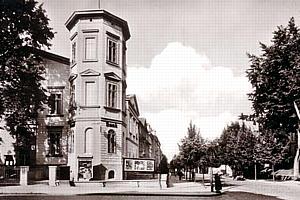
Arnswalde 1930

Arnswalde 1930

The trek managed to get as far as Arnswalde (Choszczno), Pomerania, where the family found temporary shelter in the forestry Kühnemühle. As the place appeared safe at least for the time being, Father decided to stay there longer than warranted by the critical circumstances created by the Soviet armies advancing westwards at lightning speed. Precious time was being wasted with useless discussions and playing Doppelkopf. Perhaps a trace of unfounded hope that the enemy on the eastern front could still be thrown back through a heroic effort by the German troops lingered at the back of everybody’s mind and caused them to dawdle. Suddenly in early February Red Army soldiers arrived at the forestry and took Father as prisoner of war although he was no combatant and assigned him to hard labor in the Soviet Union. In a forced march he returned to Posen (Poznan), to the very region whence he had escaped. Then the Russians shipped him by train to the Donbas area, where somewhere between Charkow and Rostow on the River Don he had to work in the coalmines.

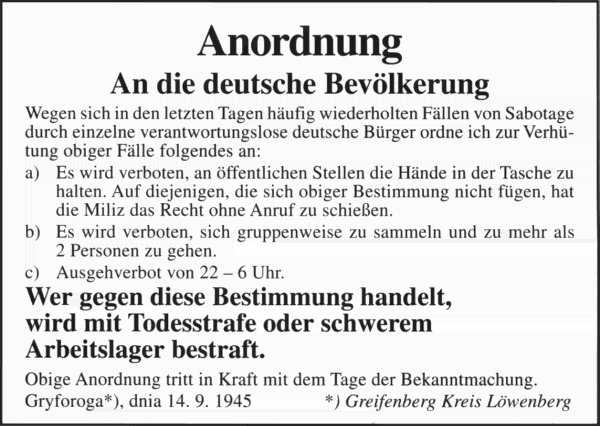
AnordnungThe decree  above states that the German population is not allowed to have their hands in their pockets nor to gather in groups of more than two people. Persons  who act against this regulation  face the death penalty or will be deported to a labor camp.

      In the following weeks and months, Mother had to endure indescribable hardships. Escape across the River Oder, where the area was still in German hands, was no longer an option. The Russian troops were heading in that direction and there was heavy fighting. She was left behind at the forestry with my brother Gerhard and me and the four orphans, whom she had taken along during the arduous trek from Gutfelde. That she and thousands of other women from West Prussia and Pomerania did not despair, did not give up and did not fatalistically slip into a state of utter hopelessness gives me cause for great admiration. After the forestry building burned to the ground, Mother wandered around in search of food, shelter, and relative safety. Eventually she obtained permission from a commanding Russian officer to travel with us children to Belgard in the hope of finding my brothers Karl and Adolf. To her great disappointment she discovered that they had decided to leave school and town, when they had heard that the Red Army would be in Belgard within days. While the town of Belgard remained relatively unscathed from the ravages of war, Mother had to suffer under the harassment and abuses of the new masters in town. In the secret treaty between Nazi Germany and the Soviet Union Stalin had acquired control over the eastern parts of Poland and wanted to keep them in compensation for the stupendous losses in life and material during the German invasion of Russia. So he ordered the Poles to leave their homes and their farms and settle in the German provinces east of the Rivers Oder and Neisse. Now in an ironic reversal of roles, the Poles were now the masters of former German farms and exercising control over the towns and cities. For the Germans, who wanted to stay or could not escape in time, it was now their turn to experience harassment and abuse. Mother refused to be forced into a role in which she would lose her dignity, especially, as it often occurred, if she felt that she was confronted with injustice. She knew about the century old animosity between the Russian and the Polish people. So whenever she felt that the Polish authorities had unfairly treated her, she would go straight to the Russian officer in charge of the district and complain about the incident. To her great satisfaction she received justice ironically from the hands of an enemy officer. Apart from her inner strength that allowed her to show courage where others would have meekly knuckled under, one must also consider the fact that Russian officers had a heart for the plight of little children. One could dismiss this thought as stereotypical and sentimental bias, if what Mother had experienced in Belgard with the six children in her care had been an isolated case of kindness. But such tender feelings on the part of Russian soldier had been documented so frequently as to attest to their truth.

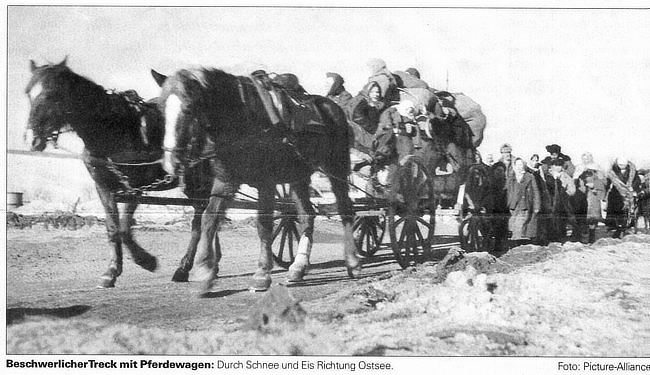
Through Snow and Ice

Through Snow and Ice towards the Baltic Sea

         The war came to an end with Germany’s unconditional surrender on May 8th, 1945. But nothing changed in Mother’s life for more than a year, until early in the summer of 1946 she was expelled along with tens of thousands of other Germans from her homeland. In a well-calculated program of ethnic cleansing all German nationals were forced to leave in order to make room for the Polish people who had been displaced in turn by the Russians in their eastern provinces. Thus, the Pomeranian lands that had once been settled and cultivated for a period of over 500 years by industrious German pioneers and farmers were put under permanent Polish administration.

         By now I was a little over four years old. What I have been writing about myself, I had gleaned from Mother’s diary, from my second-generation cousin Eberhard Klopp, who did extensive research on the Klopp family going back some four hundred years, from Uncle Günther’s Kegler Chronicles and other sources. I am especially thankful and greatly indebted to my brothers Karl and Gerhard (Gerry) and my sister Eka (Lavana) for their personal accounts of their incredible ordeals. I decided to insert them here as documents of a tumultuous period and as a testimony to their inner strength and courage without which they would not have survived.

To be continued …

The Klopp Grandparents Part III

Emma Christiane Klopp (née Bauer) – Chart I -I

1856 – 1941

Adapted from Eberhard Klopp’s Family Chronicle

The miller’s apprentice Peter Friedrich Klopp became acquainted with Emma Bauer, the daughter of the factory inspector Friedrich Wilhelm Bauer, born in Groß Ottersleben on March 3, 1818. Her father had moved to Jersleben, where he died on April 4, 1886. Emma at the time of his death was only 12 years old and was the fifth child out of her father’s marriage with Rebecca Sophie, who died in Wolmirstedt in 1898.

Würzburg Marienberg - Photo Credit: Wikipedia.org

Würzburg Marienberg – Photo Credit: Wikipedia.org

What brought Emma’s family originally from the Würzburg area to Jersleben, author Eberhard Klopp explains in his ‘Letter to the Descendants’ as follows:

Already blessed with four children Emma’s parents lived from at least 1855, most likely even sooner, in Rottendorf near Würzburg. In this village the wealthy Jewish Würzburg banker Joel Jakob von Hirsch managed an increasingly flourishing sugar factory. The socially conscious entrepreneur and owner of a large estate ‘wanted to provide a livelihood for lower class people, for he was kindhearted toward the poor people.’ Von Hirsch’s declared intention was to make  the South German market independent of ‘the dominant North German sugar factories.’ To this end he hired specialists from Magdeburg, Cologne, Baden and Holland. An additional incentive was the voluntary health insurance fund established by the factory owner for the workers and their family members of his Rottendorf plant. This, at that time, was a rare, but socially groundbreaking undertaking.

Attracted by such favorable and promising working conditions, the Bauer family settled in Franconia probably until the shutting down of the Rottendorf plant. There in House No. 3 (Dürrhof}, property of the aforementioned banker Emma Bauer was born,

Unfortunately, due to a shortage of water it was no longer possible to process sugar beets. The production was shut down, which was  a major cause for the Bauer family to relocate in the sugar beet region in the north near Magdeburg.

To be continued …

The P. and G. Klopp Story – Chapter 5 (Part I)

Chapter 5

Gutfelde (Zlotniki)


Home is people. Not a place. If you go back there after the people are gone, then all you can see is what is not there any more. Robin Hobb


At the time of my birth, Father as manager and inspector was in charge of the estates Silberberg, Oberhof and Gutfelde totaling an area of approximately 3000 ha. Although he must have been thankful to the authorities for landing him such challenging and prestigious position and therefore may have harbored a favorable disposition towards the Nazi regime, he always strove to keep his humanity in dealing with his fellow human beings, Germans and Poles alike. In particular, through his actions he distanced himself from the policy that forbade German citizens to fraternize with the defeated enemy. It is a great testimony to his moral independence from the dark and sinister sides of Nazi Germany that he allowed Polish men and women to live and work closely and cordially with the Klopp family at the Gutfelde residence and the agricultural headquarter for the region. He maintained an excellent working relationship with the former Polish estate manager Haluda, who after WW2 took over as director of the communist run state farm. From the stories I picked up from my mother I speculate that Father owed his survival to his reputation of treating fairly and equitably all the people who worked for the large estates under his directorship. Other inspectors notorious for their arrogance, cruelty and injustice in dealing with the Polish population were rounded up, lynched, hanged or shot in the closing months of the war. On a  Polish website with special focus on mansions, manors, and castles of Poland, I found an entire page devoted to Gutfelde – now an agricultural training center with orchards, wheat and corn under cultivation, 800 cows and 8000 pigs. The same page to my great surprise mentioned my father’s name as an administrator during WW2! The mansion-like imposing building was built around 1880 in the late-classical style and consisted of a body with a higher wing and ground floor extensions. It has not changed much in the last seventy years.

Family Photo 1941

Family Photo – The Klopp Children from Right to Left: Karl, Adolf, Gerhard and Eka

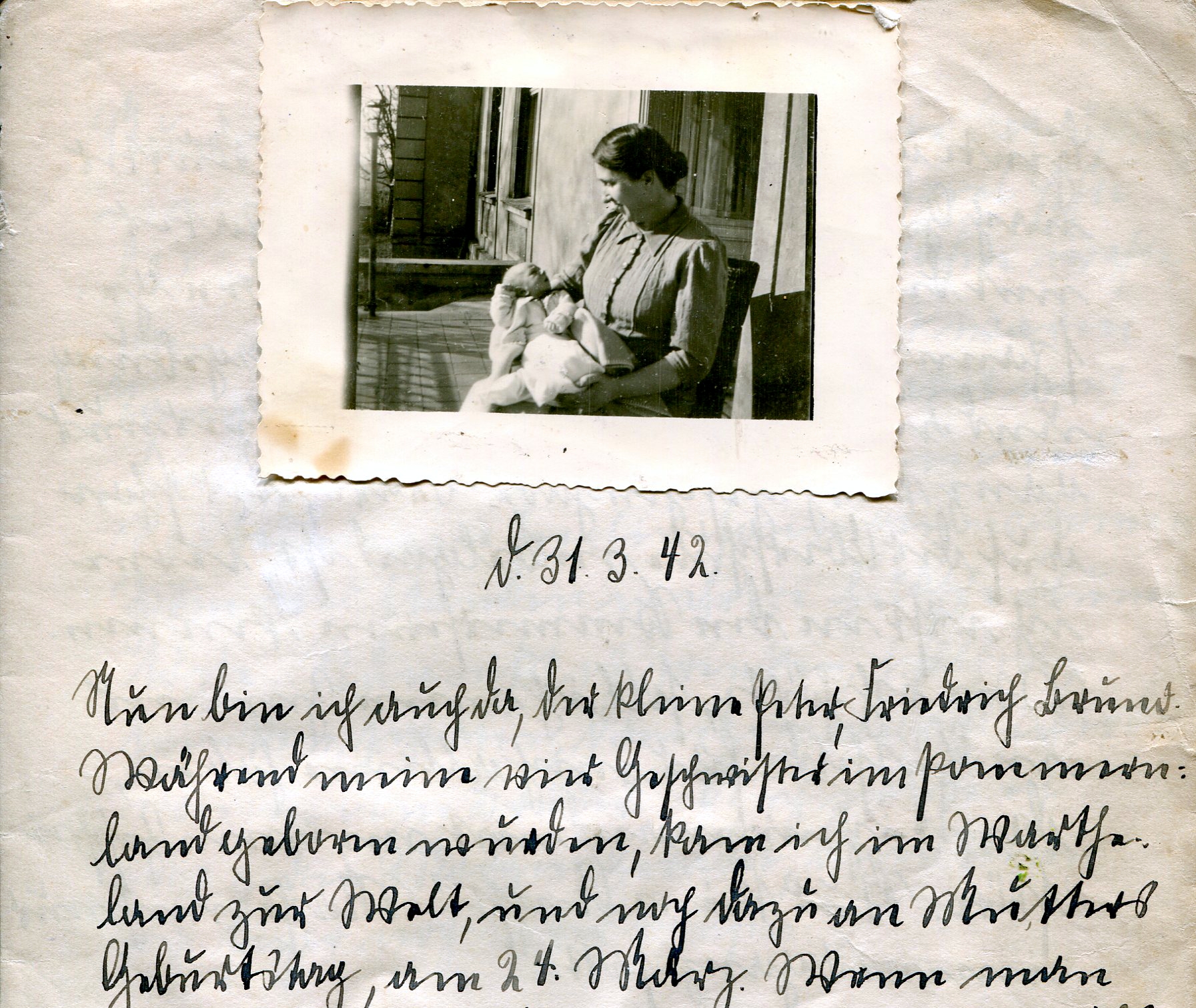
My three brothers Karl, Adolf and Gerhard and my sister Eka (short form of Erika) (now Lavana) were all born in Pomerania, whereas I began my life’s journey in the town of Dietfurt (Znin), Warthegau. There I spent the first eight days with four other babies in a warm hospital room. There were also two Polish babies born in the same county hospital. Later on in my early childhood I had to take quite a bit of good-natured teasing with made-up stories of a nurse who had accidentally placed a Polish baby into my crib, while I was being examined in another room.

First Page of Mother's Diary

First Page of Mother’s Diary about her Fifth Child Peter

When I arrived with Mother at Gutfelde, I received a truly royal reception. Karl, who attended a boarding school in Belgard (Bialogard), would see me a few months later at the beginning of his summer holidays. But the others including my proud father did everything to welcome the fifth child in the family. Flags were waving. Fir branches and a big welcome sign decorated the door to my very own room was. Inside the sunny and warm room several pots with beautiful flowers created a cheerful atmosphere for the latest arrival in Gutfelde. Continue reading

The P. and G. Klopp Story

Chapter 4

My Parents

Chart I – I & II, Chart II a – I

“We never know the love of a parent till we become parents ourselves.”

Henry Ward Beecher

          When I was born on March 24th, 1942 in Dietfurt (Znin) in the Reichsgau Wartheland, the superpowers of the world were at war with one another. Nazi Germany was in control of most of Western Europe. Hitler had not learned from Napoleon’s defeat in 1812 and invaded Russia in June 1941. Driven by his megalomania he thought himself to be the greatest military genius of all times and planned to conquer, subdue and rule over more territory than Alexander the Great, Hannibal and Napoleon put together. With Japan’s aerial strike and attack on Pearl Harbor in December 1941, the winds of war had invaded the Pacific Ocean and had suddenly engulfed the entire world. Yet, at the time of my birth, my family living in this remote corner of the Reich enjoyed a semblance of peace and security. The entire region was out of reach from the Allied bombers, which began with ever increasing intensity to terrorize the populace of the larger cities of Western and Central Germany. It was at Gutfelde near the small town of Dietfurt, where my father Ernst had recently been transferred to take over the administration of three large farming estates. Continue reading