STEEP AND CROOKED … by Late Writer, Artist & Castle Builder Bill Laux – Chapter V

STEEP AND CROOKED: THE MINING RAILROADS OF THE CANADIAN BORDER

 By Bill Laux

Please note if you are interested in reading an action packed adventure story, but don’t have the time to read the entire chapter, scroll down to the first word in blue and bold letters and read from there.

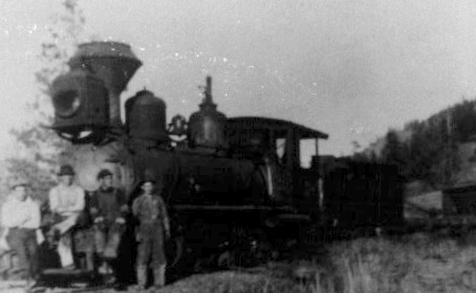
train-at-mine

CHAPTER FIVE

TWO RAILROADS — TWO SMELTERS 1896 – 1898

With the completion of Heinze’s Trail Creek Tramway, the future of the two communities, Trail and Rossland, seemed assured.   On June 19, 1896, editor Thompson of the Trail Creek News, rhapsodized, “It is marvelous — the amount of tonnage arriving at Trail this spring, with three steamers running into Trail, yet the C&KSN Co. cannot keep the consignments of freight to Trail cleaned up. In two days last week, the steamers of the C&KSN Co. landed in Trail 500 tons of coal, coke and lime rock and general merchandise.   Every day sees the steamers of this company in Trail loaded down to their full capacity.   Yesterday, the steamers, “Nakusp,” “Trail,” and “Lytton, ” and the train of the Columbia and Western Railway were all in Trail at one time, and the aggregate number of passengers served by the three boats and the train was over 400, while the tonnage handled in that day amounted to over 250 tons.   And this is a town not yet a year old, and the season has just begun.”

This was June, with a full river, and even steamers drawing a full four and a half feet of water, as did the Nakusp, could make it down the difficult channel from Robson to Trail.   In December the low stage of the water would hold the big boats at Robson, with the little Lytton relaying their cargoes down across the sandbars, and through the shallow riffles.   A smelter had to have uninterrupted supplies of coal, coke, and flux (lime and silica rock), to operate.   With winter steamer operations interrupted by ice and low water, Heinze had to find a better way to bring in his fuel. He could, of course, have Dan Corbin bring in Roslyn coal and coke to Rossland, and then have it hand shoveled into his narrow gauge cars.   But this would put him into Corbin’s hands, an unacceptable situation.   His trip to England to raise money for his Columbia and Western extension was a failure.   He therefore mortgaged some Montana properties and let bids on the first section of the new railway.   It was not to run through the mountains from Rossland.   Instead, it would run up the right bank of the Columbia from his smelter to Robson West. This would give him year round access to the deep water of the Arrow Lakes and an assured coal supply.

Although the new town of Trail was growing and prospering, things were not well with the three companions who had founded it.   Success had had an unfortunate effect on Frank Hanna.   He and Mary Jane became estranged over his increasingly blatant immorality.   He owned two brothels in Trail and his own daughter, Olive, complained of her father’s sexual misconduct with a Mrs. Crossman in the same bed in which Olive was sleeping.   Mary Jane applied to the court for sole custody of her children, and on the grounds alleged, it was granted.   In the interests of propriety, Colonel Topping found it best to move out of the Trail House hotel and set up living quarters behind his office.

With the new Le Roi Company smelter at Northport in operation, the Le Roi mine was paying a dividend every month, and its owners were rapidly growing very rich.   Le Roi stock, which the Colonels had bought up for 25 cents a share, was now selling for over $5.00.   The Rossland mines and in particular, the Le Roi, were becoming well known all over the world for their extraordinary richness.   In London, speculators begin to consider the Red Mountain mines for investment.

Whittaker Wright, one of the more successful of those speculators, had formed the British American Corporation to invest in B. C. and Alaska mining properties.   Wright was one of those flamboyant mendacities that flashed like meteors across the financial heavens at the end of the Victorian era, occasioning awe, moral outrage, and corrosive envy in the British public.   H.G. Wells was so fascinated by him as a symbol of the absolute sovereignty of the money power, as to use him as a model for Edward Ponderovo in his novel, Tono Bungay.

An Englishman, Wright came to the United States, worked in the Pennsylvania oil fields, and was present at the Leadville, Colorado silver boom.   He was in Philadelphia in the 1880s, forming companies to buy Colorado and New Mexico mines, and to market their stock to Pennsylvania investors.   Learning the techniques of stock jobbing, Wright moved to London in the 1890s and began floating mining companies based on the West Australian gold mines around Kalgoorlie.   Wright’s game was not to mine gold, but to organize the mine company and then to sell stock in it, a greater value of stock than there was gold in the ground.   This was enormously successful as long as he could pay huge dividends, most of which came out of stock sales, rather than from whatever bullion was being produced.   As long as new companies could be floated, with their stock sales covering the dividends of previous companies, the game could go on.

Wright’s ostentatious mode of living was legendary with the British public.   They could not hear enough of his private yacht, his private stable of fifty horses, his private observatory, his private velodrome, his private theatre, and his private hospital. He had built an artificial lake on his Surrey estate, and, at the bottom of it, had constructed an underwater billiard room with a glass ceiling through which his guests could view his private fish.

Such an obvious command of large sums of money seemed to signify to the British investors a soundness of his financial empire, which it did not deserve.   To keep on grossly overcapitalizing his mines, Wright required continuing press reports of bonanza finds and sensationally rich mines which he could market.   The Rossland mines were being reported in the London press in 1897 as being the richest in the world. It did not matter whether they were or not; the perception was enough to bring investors running. Wright needed to own these mines to inflate the value of his stocks. He capitalized his British America Corporation at 1,500,000 pounds sterling, and sold its stock at an unprecedented 5 pounds sterling par value.   Its prospectus boldly stated that the Corporation was acquiring the Le Roi and other Rossland and Alaska mines. The well publicized Le Roi name brought the investors crowding in; they bought up more than a million shares at the first offering.

As his managing director and confidence inspiring “Guinea Pig,” Wright brought in a man with Canadian connections, the Hon. Charles Mackintosh, retiring Lieutenant Governor of the Northwest Territories.   He then sent Mackintosh to Rossland by private railway car to acquire the mines his investors were told they owned. Mackintosh was an imposing figure, with all the social skills of the British upper class, but he knew next to nothing of practical mining.   The British Columbia Review commented,  “…of his many social qualities we are well aware, but there is no mining man in Canada but would laugh at the idea of ‘Charlie Mackintosh’ having any idea of the value of an ore body.”

In Spokane the Le Roi Colonels were astonished. They had not heard their mine was being bought. Colonel Peyton remarked quite accurately, “To my mind it looked much as if the people who drew that prospectus used the name of the Le Roi Mine to attract the attention of the English investing public.”

Mackintosh arrived in his private railway car, had it run up the steep Red Mountain line to Rossland, and, flush with Whittaker Wright’s money, began buying mines. He purchased the Josie, the Great Western, the Poorman, the Columbia and Kootenay, and the Nickel Plate mines. He then sent a pompous telegram to London, which Whittaker Wright read to the assembled B.A.C. investors to loud applause. “The British America Corporation has secured and holds the key to a majority of the golden treasure houses of British Columbia. We will practically control the mineral resources of this Province.”

This bombast, while applauded in London, was greeted with derision in British Columbia, and with wicked glee in Spokane. The Colonels now knew that Mackintosh had to make good on his boast; he was obliged to buy their Le Roi, whatever the price. What followed can be interpreted in two ways: either an honest disagreement, or a very clever hoaxing of Charlie Mackintosh and Whittaker Wright.   Historians have tended to accept at face value a bitter disagreement dividing the Le Roi directors, as reported in the press; mining men have tended to smile knowingly.   The author sides with the mining men; believing that Mackintosh, in what followed, was gloriously hoaxed.

Two of the Le Roi Company’s directors, Colonel Peyton and Judge George Turner, went to London to entertain offers for their company.   This is odd; Mackintosh was in Rossland, ready to buy their mine.   Apparently they wanted to see what other tenders might be made.   Colonel Peyton went directly to the B.A.C. and Whittaker Wright.   He was offered three million dollars cash, and accepted, pending agreement by the other directors in Spokane.   But Judge Turner, independently negotiating, reported that a mysteriously unspecified source had offered him five million.

On their return to Spokane, a director’s meeting was convened on June 27, 1898, and Colonel Peyton displayed a check for $500,000 as a down payment on their mine. By the rules of the company, the three principal directors had to agree on any action.

Colonels Peyton and William H. Turner (not the Judge, but the Colonel) accepted the check, but Judge George Turner refused it on the grounds that they could get more than the B.A.C. was offering.   The directors now split into two camps, the majority, led by Colonel Peyton, and Judge Turner’s minority, including Colonel Ridpath, Major Armstrong, Bill Harris, the flamboyant hotelier and Le Roi mine manager, and Frank Graves.   Ostensibly, the sale was blocked by the disagreement between the two groups.   While they argued, Le Roi mine manager, Bill Harris, halted all development work (tunneling for new deposits), and put his miners to work stripping the veins of what high grade ore was in sight, and shipping it to the Northport smelter.   The mine was going to be sold; the only dispute was about the price.   The more ore that could be removed before the sale, the more profit for the owners.   The longer the sale could be delayed, the more they would make.

At a second meeting, this time with Charles Mackintosh in attendance, the two groups displayed a mutual enmity for his benefit.   Colonel Peyton, of the majority group, revealed that he had already tendered the 284,000 shares of his group to Mackintosh at $6.00 per share.   Those shares constituted a majority interest, and Mackintosh then declared that under British law, the B.A.C., as majority stockholder, now had the right to control the company.   But Judge Turner rose for the minority, and pointed out that the Le Roi Company was a Washington Company, and governed by the laws of Washington State.   And further, that the laws of Washington held that aliens could not own real estate within the State of Washington.   Since the Le Roi Company’s Northport smelter was in Washington, the B.A.C., as alien, could not control it, although it could control the mine in Canada. On this basis, Judge Turner secured a court injunction restraining Colonel Peyton from making a legal transfer of his group’s shares.

At this point affairs took on a momentum of their own and events moved swiftly.   The following account is taken from the newspaper reports of the day in the Rossland Miner and Spokane Spokesman Review.   The author is responsible for the probable dialog hinted at in the press reports.

L. F. Williams, secretary of the Company and a member of Colonel Peyton’s group, realized that Judge Turner, using the Washington law was in an unassailable position, and made a quick call to Austin Corbin, President of the Spokane Falls and Northern Railway.   He ordered a fast special train to be made ready for a dash to Canada.   In haste, he gathered all the Le Roi Company records plus its official seal from the Spokane office, and jumped into a horse cab for the depot. The one car train whistled off, and Williams inside, relaxed, convinced he was removing the company records from beyond the reach of Judge Turner and U.S. law.   But, the cunning Bill Harris had not been deceived.   Suspecting Williams might attempt precisely this, he had taken the precaution of removing the Le Roi Company’s official seal from its accustomed hook above Williams’ desk, and substituted the seal of another company.   On his arrival in Rossland, Williams discovered to his horror, that he had the wrong seal, and that no company business could be transacted until a duplicate seal could be made.            Judge Turner’s group, in possession of the precious seal, now hired deputy sheriffs to enforce the Washington Court’s injunction against Mackintosh and the B.A.C. people.   Mackintosh decided that the whole matter of the sale of the Le Roi had best be taken out of the State of Washington where Judge Turner appeared to have the advantage, and moved to Canada where British law would prevail. He had his private railway car coupled to Austin Corbin’s fastest locomotive, No. 7, a 4-4-0 with 63 inch drivers and capable of forty miles an hour on good track. He invited the majority directors, including the three trustees of the pooled Le Roi shares, to accompany him to Rossland, where, with a majority of the directors present and voting, the sale of Colonel Peyton’s shares could be ratified, and company business conducted — as soon as a duplicate seal could be obtained.

Mackintosh, with his majority directors, boarded his private car, and gave the signal to depart.   But Spokane County deputy sheriff Bunce entered his car to display a County Court order obtained by Judge Turner, and to tell Mackintosh that he must not proceed.   Armed deputies, he told the Governor, were waiting at the city limits, with legal authority to stop any train headed for Canada.

Mackintosh, quite baffled by the machinations of the American Law as expounded by Judge Turner, was now in his element as a British gentleman. Calmly lighting a cigar, he offered the deputy one.   With exquisite politeness, he explained to deputy Bunce that under the Common Law of both Britain and the United States, “A man’s home is his castle,” and that a gentleman’s private railway car is just as much his castle in the eyes of the law, as any monument of ancestral English stone.   That being the case, would not the deputy, as a gentleman bound to be scrupulous in his observance of the law, realize that his presence here without a warrant was an unfortunate trespass?

Deputy Bunce, awed, backed himself out the door, which was locked behind him.   Then he descended, went forward to the engine, boarded it, and ordered the crew not to move the train.   The train crew referred the matter to Austin Corbin, president of the line.   Corbin came down from his office and explained to Bunce that his injunction was against foreigners, the B.A.C. Company, and not against a law-abiding American railroad.   Bunce might order the gentlemen in the car behind, not to leave the United States, but his injunction gave him no right to prevent a railroad not named in the order, from running its trains where so ever it chose.

Deputy Bunce boarded the platform of Mackintosh’s private car once more and pounded on the locked door.   The engineer whistled off and the train began to move.From inside the car Mackintosh shook his head reprovingly at Bunce; the door remained locked.   As the train gathered speed, deputy Bunce climbed up on the tender and standing uncertainly on top of the pile of coal, drew his revolver.   He pointed it at the engine crew and ordered them to stop.   His shouts were lost in the sharp exhaust of the accelerating locomotive.   He clambered down into the locomotive cab and gestured with his drawn pistol.   The engine men shook their heads.   Holding his gun on the two men, Bunce pointed to the group of deputies blocking the track ahead and ordered the engineer to halt.   In response, the engineer pulled the whistle cord and threw the throttle wide open.   Down on the track the deputies scattered for the lives, and the train raced out onto the prairie ahead.

No. 7 was running wide open on the rough track, the private car lurching and swaying behind.   Deputy Bunce, with pistol in hand, was no doubt reflecting that the engine crew belonged to the Rail Brotherhoods.   It had been that group, but a few years before, in the Coeur D’Alene mines, he had dragged Tom Kneebone off his job and shot him dead for testifying against a railroad engineer in the Frisco Mill bombing.   It was a period of extreme union militancy in the West, and the Brotherhoods’ contempt for the law was well established.   Bunce prudently holstered his revolver and climbed back across the coal pile in the tender to Mackintosh’s private car.   Standing on the platform in a shower of cinders and soot from the stack, he pondered what to do.Inside the car, he could see whiskey decanters passed around, and the directors, in wicker chairs, puffing on their cigars.   Bunce knocked.   The directors turned their backs to him.   He held his court order against the glass and pounded the door.   No one paid him any attention.

It was a hot June day across the grasslands of Stevens County.   The train raced on.   Back in Mackintosh’s car, the windows were opened to catch the breeze and fragrant fumes of the Governor’s best Havana tobacco streamed out across the farmlands and stump ranches.   Bunce, on the platform, turned up his collar against the rain of cinders from No. 7’s stack.

It was 147 miles, Spokane to Rossland.   Seven hours, 25 minutes by timetable.   The men in the private car had promised the engine crew a champagne dinner at the Allen Hotel in Rossland if they made the run in under five hours.   Loon Lake, Chewelah and Colville came up.   The scheduled trains were waiting in the sidings as the Special flashed by.   Past Colville, Number 7 screamed down the long grade to the Columbia at Marcus, and began the long series of S curves as the rails followed the east bank of the river.   Grimly, Deputy Bunce, coattails flying, clung to the swaying platform of Mackintosh’s private car, still determined to do his duty.   At mile 130, Northport came into view.   Here the engine would have to stop to take on water for the final, steep climb to Rossland, 2400 feet above.   Bunce swung down from the platform, as the engineer spotted the tender under the waterspout. Bunce planted himself in front of the locomotive, displayed his court order to the gathering crowd, and drew his revolver.   With the crowd as witnesses to his lawful act, he announced, the train would move again only over his dead body.

But here, in full frock coat and embroidered vest, his shiny silk hat on his head and gold watch fob bouncing on his paunch, came the sometime Lieutenant Governor of a Canadian Territory, which, though scantily populated, was still fully as big as the entire United States minus Alaska.     Mackintosh offered the deputy another cigar.   Bunce had to holster his pistol to accept it.   Mackintosh then explained, with that same charitable politeness, that the Canadian border was but eight miles ahead, and if the deputy persisted in his attempt to stop a lawful train by force of arms, he would be arrested at the border for carrying a deadly weapon into Canada, an offense that carried a severe penalty under Canadian law.   “A word to the wise, Sir,” His Honour remarked amiably, and with a friendly pat on the shoulder, made his way back to his private car.

The fireman raised the waterspout as the tender overflowed, and shouted at Bunce, still planted in front of the locomotive, “Well, what’s it going to be, deputy?   You going to shoot a Brotherhood man or get out of our way?” Deputy Bunce flourished his weapon, the crowd of small boys and station loungers looked on in fascination.   A few quick wagers were made.   The engineer blew three blasts, shoved the Johnson bar into its top notch, and opened the throttle. The train, to deputy Bunce’s great relief, backed away, backed toward Spokane.   Then the deputy holstered his pistol with a grin to the onlookers.   But why were they laughing?   What was the joke?   Bunce peered down the track. The train was still backing.   At the far end of town it disappeared around a curve.   An idler in the crowd remarked, “You sure stopped ‘em, mister.   Only you was at the wrong end.”   The crowd burst out laughing.   They were laughing at him, deputy Bunce realized.   What had happened?

Then, from down at the far end of town, came two derisive whistle blasts.   Bunce saw the train come into view again on the distant trestle, leading, he now realized, to the great Columbia River bridge.   The stop at the station was merely for water. The line to Rossland branched off a half mile south.   The engineer had backed his train to the switch and taken the line for Canada.   In the distance, the little one car train rumbled over the bridge, whistled once more and headed up Sheep Creek for Canada.       Bunce walked to the station platform, sat down, and lit up the Lieutenant Governor’s cigar.   To the assembled crowd he muttered contemptuously, “God damned foreigners, anyway!”   He puffed for a moment.   “Not a god damned thing to do with me,” he said, blowing smoke into the air. But the station platform was empty.

With the dispute now transferred to Canada, Mackintosh tried to settle it under Canadian law.   A directors’ meeting was called for July 3, in Rossland.   SF&N No. 7 was washed and polished, hitched to a parlor car, and then the Turner minority group came up to Rossland by special train.   At the meeting, Judge Turner managed to have the $500,000 check returned to the British America Company as premature.   Beyond that, there was stalemate, and No. 7 trundled the minority directors back down the loops of Little Sheep Creek to the U.S. A. and Spokane.

A second meeting was called for Spokane.   Another special train ran up to Rossland to bring the majority group down.   They were, as they reminded themselves, the owners of the richest gold mine in the world, and must travel as such.The railroad performed these services as perfectly as its rough track would permit, but the meeting was a total deadlock.

In Rossland, Mackintosh tried a new tactic.   Bill Harris, the mine manager, and member of the minority group, had had his men stripping the stopes of all the high grade ore they could find, and shipping it to Northport to be converted into dividends for the owners.   The delay in consummating the sale was not only embarrassing to Mackintosh; it was depleting the mine of valuable ore.   The Governor determined to get rid of Harris.   Lacking a company seal, and unable to perform official acts, the Governor applied to Judge Spinks, of the Kootenay County Court, to have the Le Roi Company placed in receivership.   The Judge agreed and W. A. Carlyle, a former Provincial Geologist, was appointed receiver.   Carlyle dismissed Bill Harris and appointed a new mine manager with instructions to reinstitute development work and reduce ore shipments to a minimum in order to starve the smelter of ore, and the owners of dividends, while the sale was still pending.

Bill Harris had been shipping 350 tons of the Le Roi’s best ore every day; the majority group had been obliged to watch this high grading before their eyes.   Their anger had become physical as Judge Turner and Colonel Peyton found themselves both occupying the same hotel, the Allen, in Rossland.   Accidentally meeting in the lobby, a scuffle took place, with Judge Turner attempting to bodily eject Colonel Peyton from the hotel.   Peace was restored; the combatants, or play actors –it is impossible to be sure which — were parted.

The minority group, with their manager removed from the mine, then went to Victoria, B.C. to institute a suit against Colonel Peyton, the B.A.C., Mackintosh, and Whittaker Wright, to recover $780,000 for an alleged conspiracy to buy Le Roi shares at less than their real value.   While this suit dragged on, the group were able to get a Victoria court to overturn Judge Spinks’ receivership.   Bill Harris was reinstated as mine manager, and at once he resumed stripping the Le Roi of its best ore.            This was intolerable to the B.A.C.   Their best ore was being removed out of Canadian jurisdiction, smelted at Northport, and the bullion recovered held in the U.S. for the owners.   The owners were making roughly $6,500 each day the sale was delayed.   To try to get the receivership reinstated by Washington law, the B.A.C. sent its lawyers down to Spokane — by special train, of course.   This time, the minority completely reversed its previous bellicose behavior.   They met their Canadian colleagues with profuse apologies for past incivilities, and solicitous concern for their comfort and well-being.   This they accompanied by a continuous series of toasts to amity and international cooperation.   So alcoholic was the fellowship, and so long continued, that the B.A.C. lawyers, in a boozy haze, completely lost track of time and missed their appointment at court.   With their non-appearance, the court dropped the case from the docket, and the rivals were once again plunged into teeth gnashing rage, real or feigned.

The news of these scandalous proceedings was gleefully reported in the mining papers, and reached London, where the effect was to depress the value of B.A.C. shares.   Soon they dropped below par.   Whittaker Wright was compelled to find some way to conciliate the minority directors, and complete the sale, or his B.A.C. would be in serious trouble.   Judge Turner was reporting he had received an offer from Wright of $8.12-1/2 for his shares.   This the B.A.C. vigorously denied.   The Judge responded by suggesting that another British consortium had offered him $8.50.   True or false, the publicity was becoming painfully embarrassing for Whittaker Wright. He would have to compromise.

Finally, on November 22, 1898, all the shares in what had been the world’s richest gold mine, changed hands at $7.40, plus payment for ore en route to the Northport Smelter.   The last of the minority hold-outs, Bill Harris, had to come down from Rossland to Spokane to sign the agreement.   He made the trip, as might be expected, by special train.

It is impossible to know whether or not the whole affair was a charade played out for the benefit of the pompous and gullible Mackintosh.   For 130 days, during the time the sale had been held up, Bill Harris had been Le Roi manager, stripping the mine of its best ore.   $845,000 of ore had been removed, smelted and sold, and monthly dividends paid, while Mackintosh was stalled.   This amounted to $1.69 per share realized from the high grading, while the compromise with Whittaker Wright added only an additional $1.40 per share.   The figures powerfully suggest that the protracted dispute played out in the courts, on special trains, and hotel lobby tussles, may have been a gigantic, profitable, and hilarious hoax.

With the final agreement and sale, the B.A.C. got full control of the mine and smelter, but the dubious look of the affair made Whittaker Wright’s mining empire look shaky in London.   The success of any stock jobbing operation depended on its shares rising in value.   Should they begin to fall, as had those of the B.A.C., the price of the stock could only be supported by the company’s assets.   B.A.C. investors now began to query just what were the Le Roi Company’s assets.   An answer was not forthcoming.

The B.A.C., on purchasing the Colonels’ Le Roi Company for $4,000,000, had formed a new British company, the Le Roi Mining Company, and sold the mine and smelter to it for $4,750,000.   Wright chose a former anti-union thug, Bernard Mc Donald, who had worked for him in the New Mexico mines, as Le Roi manager.  But now manager Mc Donald, began sending alarming reports to London.   The mine had no more high grade ore in sight.   Bill Harris had indeed stripped the mine.   The British investors who had bought up all 200,000 shares in the new Le Roi Company at $25 each, in just three days, wanted their dividends.   Monthly, they had been promised.

In Rossland, manager Mc Donald was obliged to report the shattering news that the mine was actually operating at a loss.   In 1899, the ore coming out of the Le Roi was netting $12.50 a ton, but mining, smelting and shipping costs totalled $15.14 a ton.   With the huge value of the shares outstanding, and an operating loss, the mine could pay no dividends at all.   Worse, after purchasing the mine from the B.A.C. for $4,750,000, the new Le Roi Company had but $250,000 left in its treasury for working capital, not nearly enough for a vigorous program of development to find new high grade ore bodies in the network of veins it owned.

At this time similar discoveries were coming to light in Whittaker Wright’s Western Australian mines, and a bear attack on his stocks began in London.   Furious investors, finding themselves to have been duped, lobbed the British Parliament for redress.   An official investigation of Whittaker Wright’s financial and mining empire began.

In Spokane, the Colonels, congratulating themselves on their coup, having sold their mine just as it was going barren, retired to their clubs and began to invest in other mining properties in B.C., notably the St Eugene mine on Moyie Lake.   Perhaps the game could be played again. Colonel Ridpath, and Judge Turner, no longer adversaries, bought the Sullivan mine in Kimberly, B.C., and planned a smelter there to handle its lead-zinc-silver ores.

Half way around the world, Whittaker Wright went on trial for frauds unrelated to the Le Roi affair.   He was found guilty, and sentenced to seven years imprisonment. He did not go to jail.   Immediately after the sentence was read, he conferred briefly with his lawyers over some last arrangements, then stepped into a side room and swallowed a capsule of cyanide.   Returning, he collapsed on the floor and died.   A loaded revolver was found in his pocket.

The collapse of Whittaker Wright’s stock jobbing empire damaged the reputation of the mining industry in the London market for years, but for a future American president, it presented a golden opportunity.   Herbert Hoover, a mining engineer, only 23 years years of age, was sent out to Western Australia by the engineering firm of Bewick-Moreing to see what could be done to rescue the mines that went down in the Whittaker Wright scandal.   There, Hoover met with the new chairman of the Lakeview mine.   Convinced that the Lakeview had an unrealized potential, Hoover convinced Bewick-Moreing to take over its management.   The Lakeview proved to be a solid success, and launched young Mr Hoover on an impressive career in mine engineering.   By 1928, he was President of the United States.   By 1985, Bewick-Moreing was boring the Channel Tunnel.            The sale of the Le Roi brought to an end the period of gaudy unreality in Rossland.   The mines were still there, but the ore was becoming leaner as they went deeper. For Rossland, the bonanza days were over. Conservative, scientific management was in charge, and profits could henceforth only be made from volume of ore shipped, not spectacular finds.

Down in Trail, Colonel Topping continued to insist that he expected to find another Le Roi very soon, and that in the meantime he had some very promising mining claims to sell.   He was planning a trip, he announced, to the newly formed mining districts in the Colville Indian Reservation to investigate some remarkable gold properties there. Deputy Bunce was looking for work.   A furious Judge Turner had seen to it that he was a deputy no longer.


Chapter 25 of the Peter and Gertrud Klopp Story – Part II

Mustering up the Courage to Talk about the Future

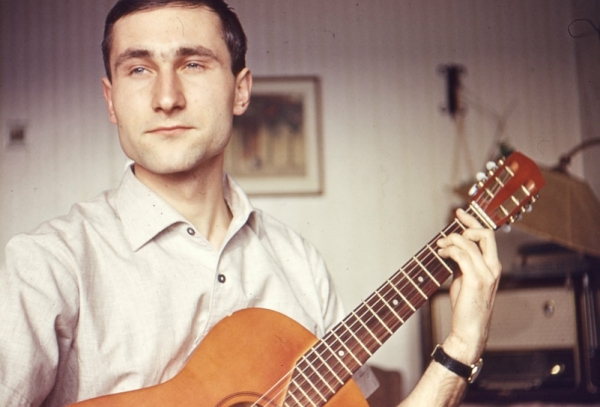
Peter Playing the Guitar for Biene

Peter Playing the Guitar for Biene

On Sunday morning Mother, like always, lovingly prepared a sumptuous breakfast. Then on Biene’s request I played a selection of a few very simple classical guitar pieces composed by Carulli. As I was nervous and excited, I made quite a few mistakes. Going as far back as my early childhood years I had never suffered from stage fright. I had taken on challenging rôles in Christmas concerts and other major school events. But this was different. Biene was the audience. While she listened to my renditions with an understanding heart, she lovingly ignoring my mistakes. The frequent boners I committed bothered me all the more, since I often managed to play the tunes perfectly, when I had been alone. Then it was Biene’s turn to perform. I set up the microphone and the Grundig tape recorder to capture her voice. She recited in her soft, sweet voice the two poems she had written for me at Christmas. Although at the pinnacle of total bliss, I was unable to push away the nagging thought of something unspoken that needed to be said

x291

This had so far been the very best get-together with Biene. Should we again with our hearts overflowing with wondrous feelings miss the golden opportunity for a good solid talk about our future. For the day was dragging on and Biene’s time to leave was rapidly approaching. Resolutely I invited Biene for a walk along the wintry trail behind the house. We were holding hands, as I began to talk.

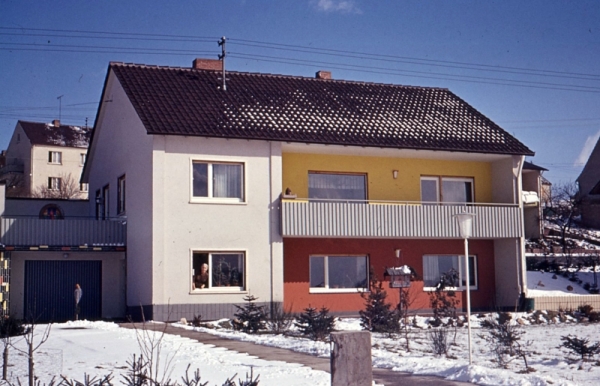
Mother Waiting for Peter and Biene

Mother Waiting for Peter and Biene

In just a few months I would be traveling to Canada on the Ryndam, a ship of the Holland America Line. It would not mean permanent separation. I would simply go and check out to see if it was true, as my brother Gerry asserted, that I could become a teacher with only two or three years of university training. If it was indeed true, my next step would be to get admitted to the University of Alberta at Calgary with my German high school diploma (Abitur). If successful in fulfilling all entrance requirements I would devote all my energies to acquire a teaching certificate in the shortest possible time.

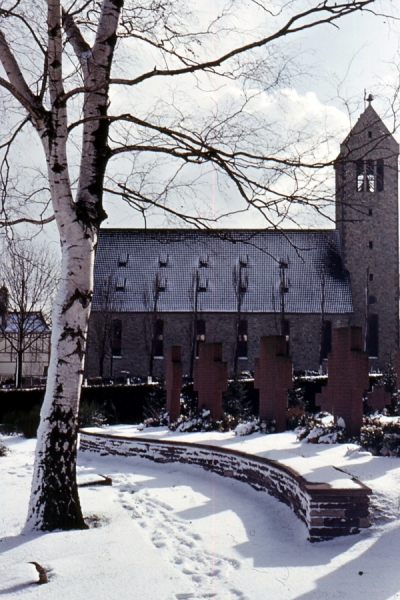
Church at Watzenborn-Steinberg (now Pohlheim)

Church at Watzenborn-Steinberg (now Pohlheim)

And then … I paused for a moment noticing in Biene’s dreamy eyes the expression of sweet anticipation of  words never spoken or written before, which she had been expecting from me, the slowpoke, for such a long time. “And then,” I continued almost choking with emotion, “I will ask you to come and be my wife.” Now she squeezed my hand and her face was beaming. Little did I know that with these words I fulfilled her secret wish, which at home in Velbert had been conceived in her heart on New Year’s Eve! So with all our hitherto hidden desires so plainly revealed with my promise to marry her we huddled a little closer together on our way back to the house. To be sure, this was not entirely due to the ice and snow and the wintry chill in the air.

STEEP AND CROOKED … by Late Writer, Artist & Castle Builder Bill Laux – Chapter IV

train

STEEP AND CROOKED: THE MINING RAILROADS OF THE CANADIAN BORDER

 By Bill Laux

CHAPTER FOUR

THE RED MOUNTAIN RAILWAY

1896 – 1922

Daniel Corbin’s Columbia and Red Mountain Railway was chartered to run from Northport to the Canadian border at Frontier. A Canadian charter covered the rest of the line from Patterson, on the Canadian side of the border, to Rossland under the title, Red Mountain Railway. The line was operated by Corbin, and later by the Great Northern, as a branch of the Spokane Falls and Northern. Red Mountain mileage are figured from the Northport station, which adds .6 miles to the actual distance, since trains departing from Northport had to back .6 miles to the junction, south of town. There, taking the switch, the trains climbed out on a long trestle approach to the Columbia bridge.

The construction of the great, six span Columbia bridge delayed completion of the line. To get a share of the Rossland ore traffic, Dan Corbin began operations before the bridge was complete. For the first six months, from December, 1896, the trains were run down a steep track from the Northport station to the water’s edge and a reaction ferry. There, the cars would be ferried across, two or three at a time. On the right bank the cars were hauled off the ferry and up a steep track to the permanent line near the southeast end of the present Lowry landing strip. A curving section of macadam pavement from the present gravel river road, leads to the original ferry landing which was also used briefly for an auto ferry in 1947 after the bridge collapsed.

Coming off the west end of the bridge, the Columbia and Red Mountain grade climbed on a 2-1/2 percent grade across the delta of Big Sheep Creek . A mile and a half (2.4 km) from the river it entered Big Sheep Creek canyon on its west wall, opposite the St Crispen mine. The tracks clung to a narrow ledge, sometimes 100 feet above the water, and passed above Sheep Creek Falls at mile 3 (km 4.8). A half mile (.8 km) farther upstream, Upper Sheep Creek Falls poured through a narrow cleft in the rocks. Here at the falls, the line crossed the creek on a single Howe truss span, 75 feet above the tumbling water. This was a favorite spot for photographers, the train pausing while they exposed their glass plates.

On the left (east) bank of the creek the grade steepened to 3 percent, and the line crawled out of the dark canyon to enter the valley of the tributary, Little Sheep Creek, at mile 6 (km. 9.6). At Velvet, mile 7(km. 11.2), a water tank was built and a siding laid out to receive ore from Olaus Jeldness’ Velvet mine. A wagon road led from the siding up Big Sheep Creek to Jeldness’ mine, across the border in British Columbia.

At the border, mile 8 (km. 12.8), the Great Republic and the Double Standard mines were developing ore on the slopes just above the track. Their waste dumps can be seen today, immediately south of the U.S. Border Station. On the Canadian side, at mile 8.4 (km. 13.4), was Patterson, with a depot and a 26 car siding for customs inspection. Ahead the valley steepened, so engineer Roberts had to swing his grade in a wide loop to the east to gain enough elevation to reenter Little Sheep Creek canyon at Silica, mile 13 (km.20.8). The OK mine, just beyond Silica, had ore ready to ship when the rails arrived. Here, for a short time, a transfer station existed where Rossland freight and Le Roi ore, coming down the wagon road, could be put on the cars while the slow work of blasting a grade through the granite bluffs ahead proceeded. Back of Silica, quarries were opened in a quartz deposit, and the product shipped as flux to the smelters at Trail and Northport.

In 1898, the imposingly named British Columbia Bullion Extraction Company built a large mill stepping down the slope from the Red Mountain rails north of Silica to Little Sheep Creek. Its developers planned to use the power from the West Kootenay Power and Light Company’s lines which crossed the canyon at this point, to extract gold from the Rossland ores by a patented electrochemical process. This was just one of the “secret gold saving devices” being hawked to naive investors. All promised to recover the gold and silver the smelters were allegedly “losing.” Like most “secret processes,” the B.C. Bullion Company’s process was not commercially successful, and the great mill was eventually closed.1

Past Silica, at mile 13.5 (km. 21.6), the line crossed the canyon to the west wall on a high, 21 bent trestle at the Midnight mine. The grade, even at 3 percent, could not stay above the even steeper grade of the creek, and Roberts was obliged to reversed it on a 22 degree loop over Little Sheep Creek to ascend the east wall of the canyon. Just above the stream-spanning trestle at the Midnight mine, the line crawled out on another high, curving trestle of 26 bents to loop around a handy granite knob and head upstream again. From here a ledge to carry the rails had to be blasted out of the sheer granite wall of Deer Park Mountain. This ledge brought the rails around the nose of the mountain and into the shallow pass leading to Trail Creek and Rossland.

With the extensive blasting and rock-work, the track layers did not get into Rossland until December, 1896. A box car was set off at mile 17 (km. 27.2) as a temporary station from which the first passenger train departed on the 19th. In the pass, two spurs were run into General Warren’s White Bear mine and mill. Warren could now ship his lower grade ores which he had been stockpiling, awaiting the railroad. Originally, Corbin planned to have the White Bear spur extended around to the east slope of Deer park Mountain and the “South Belt” of the Rossland mines. But with the Trail Creek Tramway already in place, and serving those mines, this line was never built.

Across the flat from the White Bear was the Black Bear mine. Sidings, loading tracks and a wye were laid here. The Le Roi was high above the Black Bear, but the workings were interconnected, and Le Roi ores could come out through the Black Bear tunnel. From the wye at the Black Bear, the track was run diagonally northeast through the upper part of Rossland with a spur to the Nickel Plate mine and a trestle across Centre Star (Acme) Gulch ( the two railroads could not agree on a name). A station was built on the flat at Spokane Street and Third Avenue. The track continued northeast to the Great Western mine at the top of St Paul Street. A water tank was put up here and a short spur served the town wood lot. As the Trail Creek Tramway (Columbia & Western) was still narrow gauge, no connection could be made. Freight had to be transferred by hand and dray wagon from one railway to the other.

Down at Northport the great Columbia bridge was built at the south end of town. Its east approach climbed on a long trestle to carry the line to the height required to clear steamers on the river at high water. The bridge was of composite construction, two 3/4 inch iron plates bolted between three 4 x 16 inch wood timbers. The iron carried the tension loads, the wood the compression loads. The bridge was 1200 feet long, six Howe truss spans, supported on iron cylinder piers filled with rocks and concrete. The cylindrical filling of these piers lies on the beach today, the iron casings having been sold as salvage. During construction the high water of spring, 1897, swept away some of the false work, and completion was delayed until October, 1897. At its west end, the track was carried off the bridge by a short trestle to the top of a gravel bench where several summer homes are now located.1

During the eleven months while bridge was under construction,the small reaction ferry carried locomotives, and freight and passenger cars across the river. The ferry was slung from an overhead 1-1/2 inch steel cable, 1500 feet long, that was made fast to wooden towers on each side of the river. Cables, from bow and stern ran up to a sliding sheave on the overhead line. By slacking or tightening these cables with a hand winch, the hull of the ferry would assume an angle to the current, and the fast running water would push the vessel across the river. Rail traffic on this ferry began on September 3, 1896.1

The Red Mountain Railway owned one locomotive, possibly two. No. 9, the engine most often seen on the line, was a powerful Baldwin 2-8-0 of 1896, with 19 x 24 inch cylinders and 47 inch drivers. It weighed 56 tons and was able to exert 26,000 pounds of pull. After the Great Northern takeover, it was classified GN Class F-4, and renumbered 1094. In 1925 the GN sold it to the McGoldrick Lumber Company of Pe Ell, Washington, and it disappears from the record.

In addition to No. 9, one passenger coach and twenty box cars were lettered for the Red Mountain Railway. All other locomotives and cars were leased from the parent Spokane Falls and Northern. To judge from early photos, SF&N 4-4-0 No.7 frequently worked passenger traffic on the line. No. 7 was the SF&N’s fastest engine. It was an 1883 Baldwin machine with 63 inch drivers, 18 x 24 inch cylinders, and was capable of 14,000 pounds of pull. 2

With the Red Mountain boom in full flower in 1900, the wealthy mine owners persuaded the Great Northern to put on a first class sleeping car service to Spokane.

The train left Rossland at 11:00 PM, just after the CPR train from Grand Forks and Robson West arrived at the CPR station a block away, down Second Avenue. The sleepers got into Spokane at 6:00 AM. Travelers had a full day for business, and an evening for recreation. They could then board the departing sleepers for Rossland at 1:00 AM, and arrive at the mountaintop city at 7:00 AM, jut in time to catch the departing CPR train for Trail, Robson West, Grand Forks and Greenwood. The extra fare for the sleeping car berths was $1.50, and, at the request of the passengers, speed was slowed to ten miles per hour over the rougher sections of track so that travelers did not need to be strapped into their beds.

James J. Hill bought the Spokane Falls and Northern Railway with its Red Mountain subsidiary in 1898, and dismissed Daniel Corbin. In 1907 Hill folded the SF&N, the N&FS,and the RMR into the Great Northern, with all equipment renumbered and re-lettered for the GN. D. C. Corbin went on to build another railroad with CPR financing, the Spokane International, to give the Canadian Pacific an entry into Spokane.

By 1909, the majority of Red Mountain mines had passed into Canadian/British ownership, and ore traffic to the Northport smelter was dwindling. It sought ore from Phoenix, B.C. and from Republic, Washington to make up the shortfall, bu it was not enough. With six smelters operating in the great Boundary-Kootenay boom before WWI, competition was vigorous. But at the end of the war metal prices slumped and in 1921 it was closed. As Rossland and its mines gradually became more and more Canadian, the important and bibulous comings and goings of the Yankee Colonels and the Canadian Honourables ceased, and the night train was withdrawn. Still, the families and ordinary working residents of Rossland and Trail took the day train to Spokane on regular shopping trips. Until the completion of the Kettle Valley Railway in 1916, linking the Kootenays with Vancouver, Spokane continued secure as the metropolis of the Kootenay – Boundary country.

After the Great Northern’s takeover of the SF&N with its Red Mountain branch, GN Class D-5, No. 471, a Brooks Mogul of 1896, usually handled the passenger run. F-4, No 1094 (ex RMR No. 9) which was the heaviest locomotive permitted on the increasingly shaky trestle loops, continued to take the freight runs, often with a snowplow on its pilot.1 Traffic up to Rossland included coal from Jim Hill’s Crowsnest Pass mines, coke from Michel, and limestone flux from the Evans quarry south of Northport for the Trail smelter.

In 1897 the morning freight of fifteen cars, leaving Rossland for Northport, derailed two of the cars on the trestle at the OK/Midnight mines. Luckily the cars did not fall off the trestle and a crew of men unloaded the heavy ore with shovels enabling the cars to be re-railed again.

After the Trail Creek Tramway (C&W) was standard gauged by the CPR in 1898, the lack of a physical connection between the two lines in Rossland was frustrating for the local population. Although the two stations were just a block apart, the unremitting hostility between Jim Hill of the GN and Shaughnessy of the CPR, prevented any joining of the tracks until the Rossland business community and mine managers forcibly agitated for one. The CPR did not want a connection that would permit mines on its rails to ship their ore out via the GN. And, the GN, of course, had identical considerations. Finally, after persistent public outcry, the two corporations gave in, and a single line of track was laid down Third Avenue from one station to the other. When the Northport smelter got contracts from some of the mines along the CPR “Highline, ” the GN laid a pair of switchbacks up from present Jubilee Park to connect with the CPR line on Mc Leod Avenue. Ore then came down the connecting switchbacks, avoiding the passenger stations.

Corbin’s Red Mountain line had cost him half a million dollars to build, a quarter of which went for the big Columbia bridge. When the Northport smelter went into operation on January 1, 1898, more and more of the ore traffic began to move out via Corbin’s line, attracted by J.J. Hill’s lower freight rates. High grade ore could be contracted to the smelters at Butte, and at Everett and Tacoma as well, and moved on GN rails. With horses and mules rawhiding the ore down the snowy trails in 1894, the mines had shipped 2000 tons. In the following year, with the wagon roads open, they shipped 19,600 tons. With the Tramway open for just half of 1896, 38,000 tons went down to the smelter. When both railroads were operating in 1897, 60,000 tons went out. The next year, shipments soared to 111,000 tons.

Chapter 25 of the Peter and Gertrud Klopp Story – Part I

An Unconventional Engagement

“Love does not consist of gazing at each other, but in looking together in the same direction.”Antoine de Saint-Exupery

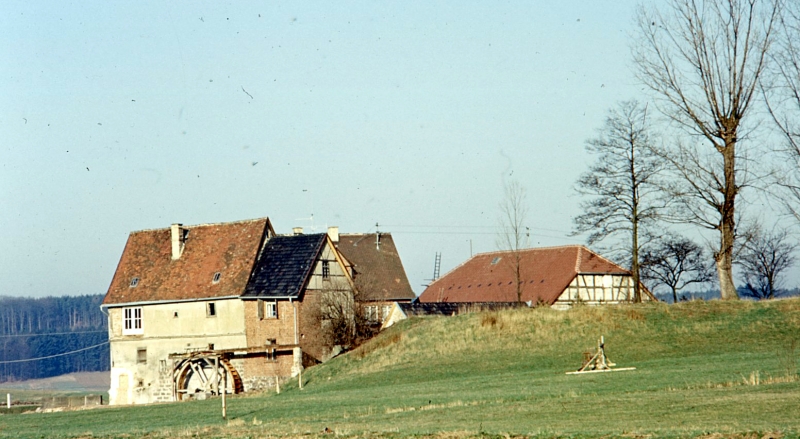
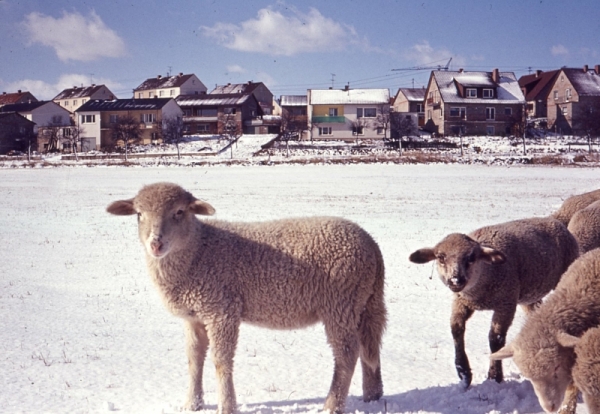
Pastoral Scene of Watzenorn-Steinberg (today's Pohlheim) near Giessen - January 1965

Pastoral Scene of Watzenorn-Steinberg (today’s Pohlheim) near Giessen – January 1965

Tense Moments on a Train Ride

On January 8th, 1965 I took the train to Cologne, where the Canadian Consulate was located. In those days it was relatively simple to become a landed immigrant of Canada. One had to be in good health, have useful skills or at least demonstrate to have the potential. In addition, one needed sponsors, who were willing to vouch for the new immigrant’s good character. My brother Gerry and sister-in-law Martha in Calgary were willing to take the risk of sticking their neck out on my behalf. So it happened that on that momentous Friday I received the official permission to enter as landed immigrant the country of my dreams.

On the same day I traveled to Wengern on the River Ruhr, where on account of Mother’s kind arrangements I received at her acquaintances a warm welcome, a fine meal and accommodation for the night. Frau Wolpert, a war widow, had a daughter about my age, who was still living with her mother in the small apartment. I was not too happy, when I heard that the young lady was taking the same train in the morning. Courtesy required that I sat with her in the same compartment. Lacking my brother Adolf’s outgoing character and social skills, which he could so easily employ in any situation, I kept mostly quiet except to ask where she was heading. And when she replied that she was attending a trade school in Siegen, I was dumbstruck and became more and more apprehensive, since I had made the arrangement with Biene that I would join her  on the train to Siegen with the plan of traveling together to my Mother’s place. The thought of being in the same compartment as Fräulein Wolpert greatly troubled me and a long embarrassing silence followed this shortest of all dialogues. While I was frantically searching for a way out of my dilemma, she may have been perplexed over my sudden shyness or may have wondered whether there was something about herself that I may have found offensive. I would have had plenty of time to explain to her that my girlfriend is already waiting for me in the train from Essen to travel home with me to meet my relatives. But unable to talk about things that I considered too private to share, I remained silent. However, when at the transfer station in Hagen she followed me hot on my heels and boarded with me the express train to Giessen, I couldn’t think of a good excuse to get rid of her and considered it best to tell the truth.

“Excuse me”, I spoke rather timidly, “I must say good-bye now. My fiancée is sitting somewhere in this train and I must go and find her.”

With this more than cryptic remark I hurriedly left Fräulein Wolpert in the compartment where she had just sat down on the bench and was in all likelihood puzzling over my strange behavior and the even stranger excuse. Regaining my calm I ambled from carriage to carriage, until I finally found Biene at the far end of the train.

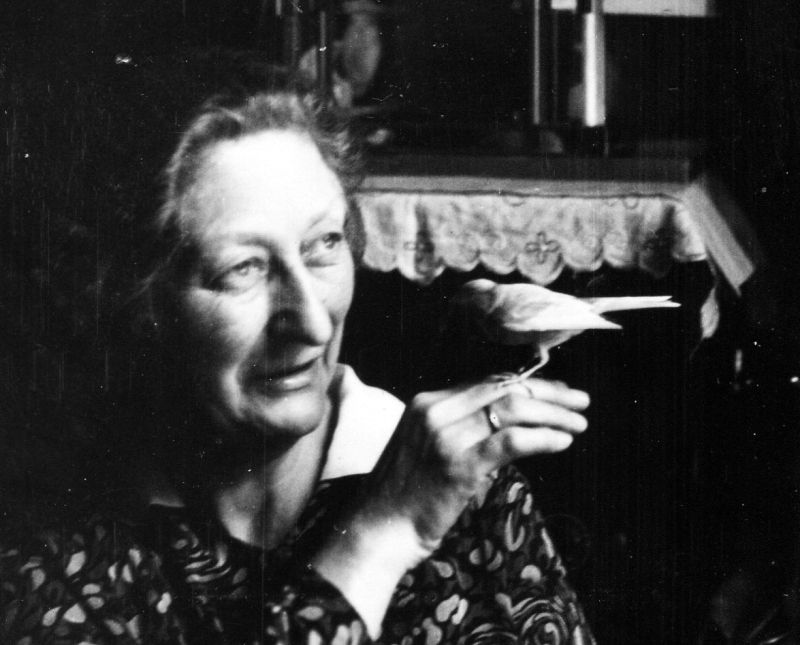
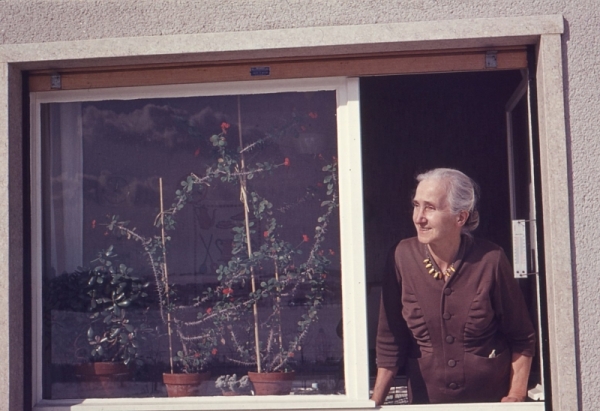
Mother (better known as Mutter Köhm)

Mother (better known as Mutter Köhm)

We were so happy to see each other that we forgot to talk about what was so important to us. On the three-hour train ride to Giessen we missed in our rapture the golden opportunity to make concrete plans, on which we could confidently hang our dreams and aspirations. Adolf picked us up at the station and took us to Watzenborn, where Mother, Aunt Lucie, Aunt Mieze and Uncle Günther gave us the customary  royal reception that made Biene instantly feel right at home. She was originally supposed to stay overnight at Philip XI, a small bed and breakfast establishment, but Mother insisted that Biene would sleep in the guest room, thus having a better chance to get to know her. Adolf and I were delighted to cede our bedroom to the finest and most beautiful young lady and we gladly slept on the downstairs sofas instead.

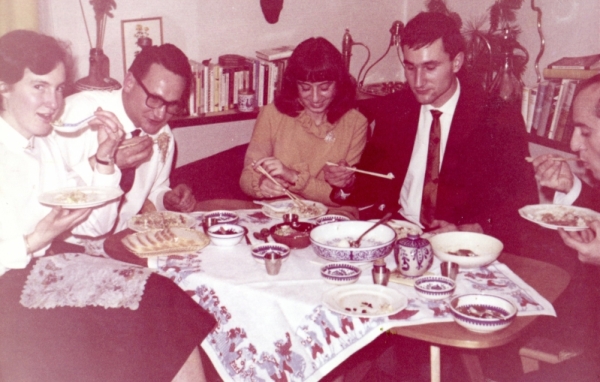
In a mysteriously worded note to Biene I had announced that I would take her, perhaps on a flying carpet, to a distant land and return home during the same evening. The distant exotic land turned out to be a Chinese dinner at my cousin Jürgen and his fiancée Inge. Jürgen impressed me with his sharp wit and exuberant jolly manner, with which he entertained his guests. I could see why he and Adolf got along so well with each other. He cracked a few jokes about the West German army, which I found as a member of the armed forces less amusing. For even though I had had bad experiences until very recently, I felt too much a member of the body to which I belonged to ignore my sensitivities about his jocular attacks. Like many of my friends in Wesel, Jürgen was exempt from military service, because his father Bruno had been killed in action at the beginning of WW2 in Alsace-Loraine.

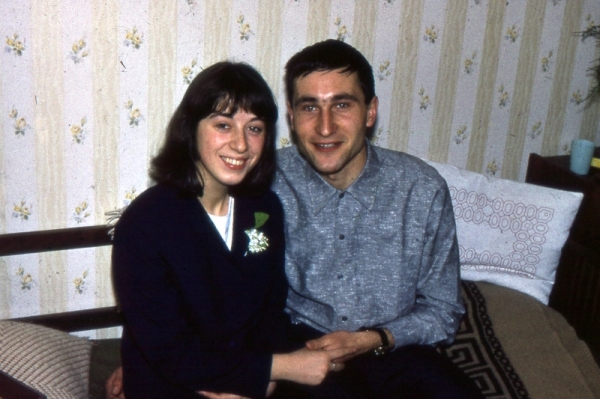
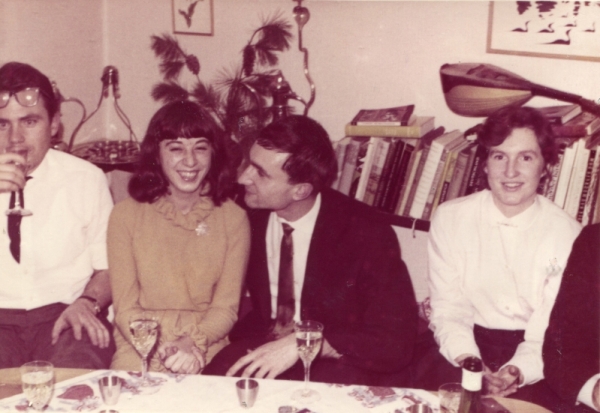
From left to right: Jürgen, Biene. Peter and Inge

From left to right: Jürgen, Biene. Peter and Inge

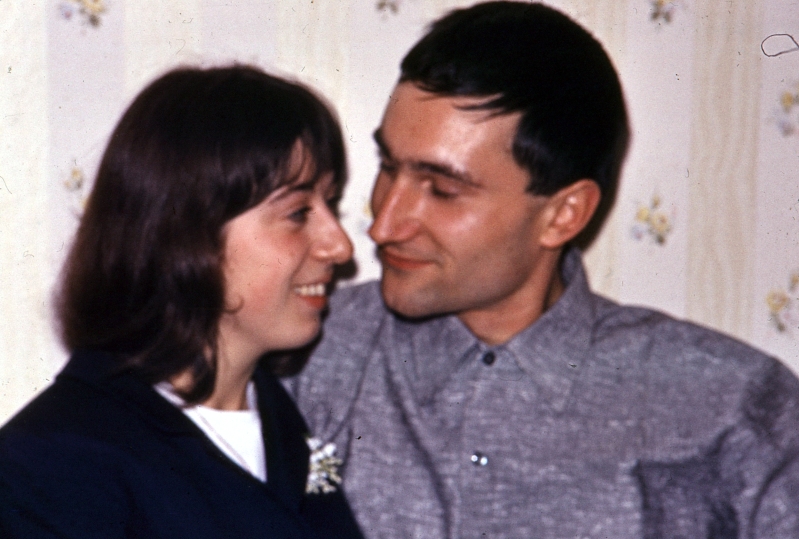
The Chinese dinner was a great success. Biene and I enjoyed every minute of it. It was here at Jürgen’s apartment that Adolf took the first photos of us two being together. Near the end of the party another guest probably from Egypt said that he had a culinary surprise for Biene. He wanted her to guess a mystery food from his North African country. He asked her to close her eyes and open her mouth. When she complied in great anticipation, he slid the mysterious object into her mouth. All eyes were focused on her facial expression. Having crunched it and tasted its flavor, she asserted that it was quite delicious and pleasant to eat. Great was her amazement when she learned that she had just swallowed a chocolate covered grasshopper, considered to be a delicacy in some African countries. Merrily we returned home to Watzenborn over the snowy wintry roads in Adolf’s old faithful Volkswagen beetle.

From left to right: Inge, Adolf, Biene, Peter and a Friend- January 1965

From left to right: Inge, Adolf, Biene, Peter and a Friend- January 1965

STEEP AND CROOKED … by Late Writer, Artist & Castle Builder Bill Laux – Chapter III

cid_image001

STEEP AND CROOKED: THE MINING RAILROADS OF THE CANADIAN BORDER

 By Bill Laux

CHAPTER THREE

THE TRAIL CREEK TRAMWAY

1895 – 1896

Rossland was a rough, muddy, woman-less, mining camp of just 75 miners when the year 1895 opened.   Then, in January, all over Red mountain the digging began to pay off.   First, the War Eagle, under the Clark brothers, struck the main vein. The ore was rich and the mine began to pay monthly dividends starting February First.   Soon after, the Centre Star found high grade ore, and it too became a paying mine. Following closely, came bonanza strikes in the Black Bear, the Josie, the Nickel Plate, the Iron Mask, and others. The mining world began to take notice of these remote diggings, and Rossland’s population jumped to 3,000 by the year’s end.   It was then a sprawling camp of shingle shacks, log cabins, and canvas tents, stretching across the head waters of Trail Creek, and to the astonishment of Coastal residents, the fifth largest city in British Columbia.

Frederick Augustus Heinze, of New York and Butte, had been invited to come to Trail to duplicate his success in Montana.   One of three sons of a prosperous Brooklyn dry goods importer, he had been educated in Germany and the Columbia School of Mines.   He had come to the Montana copper camp as a young mining engineer of 19, to work for Boston mining corporation.   The Butte copper mines were then the site of a bitter struggle between W. A. (later Senator) Clark, and Marcus Daly for control of the major mines.   Operating quietly between these two giants, Fritz Heinze saw that there was an opportunity for a custom smelter, which, using the new cupola furnace technology he had learned in Europe, would smelt the ores from the small independent mines at a lower charge than Clark’s and Daly’s works.   With the backing and participation of his brothers, Arthur, a lawyer,and Otto, a financier, the three of them founded the Montana Ore Purchasing Company and built their smelter.   Shortly, Heinze’s investigation of inactive and abandoned mines suggested that ore bodies remained in them which had not been developed.   The Montana Ore Purchasing Company put a down payment on the Rarus mine and quckly turned it into paying entrprise, feeding their smelter.   Heinze’s ability to locate ore bodies in supposedly worked out properties made him famous in Butte; he was either the luckiest or the most knowledgeable of its mining enginers.

British Columbia mining men had heard of his remarkable success in Butte and invited him to British Columbia in 1894.   A quiet examination of the Rossland mines persuaded him that here was an opportunity for a smelter. His brothers raised the $300,000 required, largely from the Heinze family, and he approached the Spokane Colonels offering to buy the Le Roi.   But when he could not produce the substantial down payment they insisted on, the deal fell through. He then sucessfully negotiated a contract to smelt the Le Roi ore. Using Rossland’s A.E. Humphries as his agent, he secured a site for his smelter and an association with Colonel Topping in the Trail townsite company.

As soon as the agreements were signed, he got underway at once, ordering 25,000 cords of firewood for roasting the ores, and 50,000 bricks to be made locally for the chimney and furnaces. The tramway to the mines had to be built as quickly as possible.   If D. C. Corbin should get his rails to Red Mountain, Heinze would have to bid against him for those Red Mountain ores.

Smelter construction got underway on September 13, 1895.   With the lack of adequate transportation facilities to bring in smelting coal at a reasonable price, Heinze prepared to roast his ores with cord wood on open piles and then smelt the mix of iron, copper and sulfur in a single furnace with charcoal.   It was not efficient, but the ore was rich and the process cheap.   Speed was essential, for a month after Heinze began building his smelter, the Hall Mines Syndicate began construction of its copper smelter at Nelson, where coal and coke could be delivered cheaply from U. S. sources on Corbin’s Nelson and Fort Shepherd line.

Quickly, Heinze bought up Peter Larsen’s proposed tramway company with its charter to give him the right to acquire right of way through public lands and give himself uncontested access up Trail Creek Gulch an ownership of Larsen’s pile of rails down on the beach.   An once he set his railroad superintendent, F. P. Gutelius, to surveying a scratch narrow gauge tramway up Trail Creek to the mines.[i]

Down at Northport, Daniel Corbin, stalled by the prohibition to enter the Colville reservation, was running out of time.   The Canadian charter he had obtained for the 9-1/2 miles of his line in Canada had a time stipulation: construction must commence immediately or the charter would be canceled.   He appealed to the government for a time extension.   It was denied.   He appealed for permission to build his line as a cheaper narrow gauge. The citizens of Rossland protested this niggardly maneuver. Trail was building a narrow gauge line; they insisted on standard gauge, as the charter specified. The government agreed and denied this request as well.

Frustrated and desperate, Corbin sent his engineer, E. J. Roberts, and a grading crew to Rossland in the summer of 1895 with instructions to begin grading out of Rossland down Little Sheep Creek toward the border.[ii]

Heinze was not deterred.   By November 9, 1895, the surveys for his Trail Creek Tramway were finished, and and on the 16th grading got underway with Nelson Bennett’s firm of Tacoma the successful bidder.   Bennett had built the Stampede Pass switchback line for the Northern Pacific and was experienced in this sort of pioneer construction.   He sent Charles King to Trail to take charge of the work.[iii]

As the news of Heinze’s invasion of the Kootenays spread, Van Horne of the Canadian Pacific, had to move, even though the company was short of cash.   In September, 1895, just a month after Fritz Heinze had announced his plans for a smelter and tramway, Van Horne proclaimed his railroad’s interest.   It was a defensive move for the CPR.   His first concern was to keep James J. Hill and his Great Northern feeder lines out of B.C. and strengthen the CPR’s transportation monopoly into the Kootenays.

That monopoly had suffered two defeats, the first in 1893, when Dan Corbin built to Kootenay Lake at Five Mile Point and began serving Nelson and the Toad Mountain mines with his Nelson and Fort Shepherd line.     Van Horne bought Colonel Baker’s B.C. Southern charter, the same that Dan Corbin had burnt his fingers on, but with the country in recession, there was no money to build the 200 mile line from Alberta that the CPR needed to secure the Kootenay traffic.   Until the CPR could negotiate land grants and cash subsidies for the line, Van Horne had to bluff. To counter Heinze and Corbin at one stroke, he announced a new line, the Robson – Rossland Railway, to be built by the CPR.   It would start directly across the Columbia from the Robson docks of the Columbia and Kootenay, and would run down the right (west) bank of the Columbia to Sullivan Creek.   From there it would begin a 3 percent climb to Rossland, contouring around the mountains, and entering the town from the east, to link all the producing mines in one, wide loop.   As an insulting afterthought, five miles north of Rossland, a minor spur would be run down to Heinze’s smelter to supply his works with Crowsnest Pass coal and coke.[iv]  Once the CPR line was built in from Alberta to connect with this line, he would cross Hill’s and Corbin’s lines with his own, and counting on government support, would freeze them out.

The second defeat came sureptitiously in 1894, when the locally chartered 29 mile narrow gauge line, the Kaslo and Slocan, building west from Kaslo to the silver- lead mines at Sandon, obtained quiet backing from Jim Hill.     Hill did not want to add the narrow gauge to his Great Northern lines, but he did want those ores to move out of the Kootenays over his Bedlington and Nelson branch to Bonner’s Ferry and his main line.   Financial control of the little K&S ensured this.

Fritz Heinze rightly assessed Van Horne’s Robson – Rossland line as a bluff. It would be several years before the CPR could bring a line in from Alberta.   But when it did, he knew he would be in a desperate squeeze between two hostile railways, the CPR and Dan Corbin’s SF&N.   In a bid to create his own outlet, he announced, on December 21, with his graders at work on the tramway, that he intended to apply for a provincial charter to extend his narrow gauge railway out west from Rossland all the way to Penticton in the Okanagan valley.[v]

Then he went to work on Dan Corbin, whose men were blasting their way around the narrow granite ledges southwest of Rossland.   Posing as a sworn enemy of the CPR, Heinze wanted Corbin to abandon his plans for his Red Mountain Railway.   The CPR was hostile to them both, he told Corbin.   See what it was doing to keep his N&FS out of Nelson. It was in both their interests to combine in order to be strong enough to resist the CPR when it came. If, instead of building his difficult Red Mountain Railroad from Northport up Big and Little Sheep Creeks, Corbin would build a branch from his Nelson and Fort Shepherd Railway at Sayward up the east bank of the Columbia to a point opposite Trail, his cars could be ferried across to Heinze’s tramway.   He would three rail his Trail Creek Tramway, Fritz Heinze promised, so that Corbin could supply him with the coal and coke he would need.   It sounded eminently reasonable; the Trail Times trumpeted its advantages.   Trail would have a direct, standard gauge connection to Spokane and the two transcontinentals there.   The smelter would have inexpensive coal and coke from Roslyn on the NP line, rather than the costly CPR coal from Vancuver Island, a supply that could be shut off by the Columbia freezing in winter.[vi]

Dan Corbin was not persuaded.   Heinze was keeping the ore haul from the mines exclusively for his own line, he observed.   Heinze upped his offer.   He would have Gutelius run a 3 rail line down Bay Avenue to a rocky bluff, the best site for a Columbia River bridge (in fact the site of the present Yellow Bridge). Here Corbin could bridge the river, a shorter and easier crossing than at Northport.   Corbin still refused.[vii]   Well, he would build the bridge himself, Heinze offered.   Dan Corbin still refused.

As Corbin continued hostile, Fritz Heinze knew that by the time the Red Mountain Railway and the CPR line from Alberta were complete, he would have to have his own rail connection to coal and to the markets for copper, or his adversaries would crush him.   In mid construction, he changed the name of his Trail Creek Tramway to the Columbia and Western Railway and prepared to win the backing of those Vancouver and Victoria merchants who were still agitating for a “Coast to Kootenay” rail line.

In March, 1896, the news came that the American President had signed the bill giving Dan Corbin the right to cross the Colville Reservation with his rails.   Corbin at once assembled his crews, and using a ferry to cross the Columbia at Northport until his bridge could be built, he had them begin grading up Big Sheep Creek.

Heinze pushed on. He announced bombastically in the Trail Creek News that,

“The smelter will start up in about a month and and will handle the entire ore supply             of this district, taking the whole output from the Le Roi and Iron Mask.   We now have 45,000 tons of Le Roi ore on hand valued at $30 a ton and will have 125,000 to 150,000 tons of ore in the smelter constantly.   We keep on hand supplies of 100,000 cords of wood and   $50,000 worth of coke of which we use three carloads a week.   We use from two to three       hundred cords of wood daily, the production of which will give employment to a small           army of men. We propose to do custom work and the poor man can bring his one ton              of ore and have it treated as cheaply as can the rich man with his thousands of                         tons.” [viii]

After this boast, Heinze had Herman Bellinger, his smelter manager, begin an outdoor roast of Le Roi ores brought down from the mines by wagon.   His graders were nearly half way to Rossland.   The sternwheeler Arrow brought a barge down from the Canadian Pacific at Revelstoke on March 26, 1896, with a used narrow gauge locomotive and four wooden coal cars from the Alberta Railway and Coal Company.   At the mouth of Trail Creek, where Larsen’s rails were lying, the locomotive was carefully levered off the barge and onto a hastily built line of Larsen’s rails and hand hewed ties. A team of horses pulled the fifteen ton locomotive and the cars up to a small yard Gutelius had improvised under the Bay Avenue bridge over the Trail Creek delta.

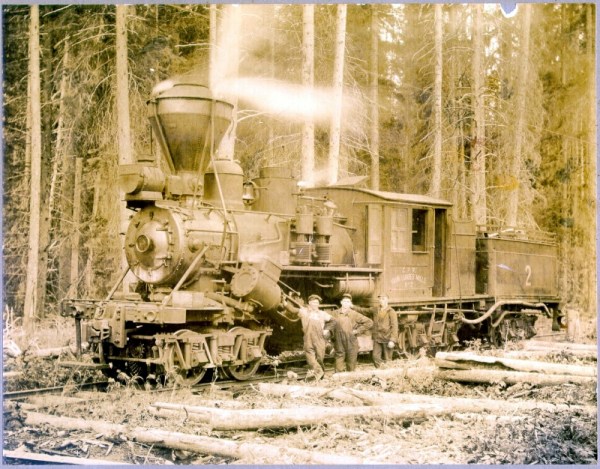
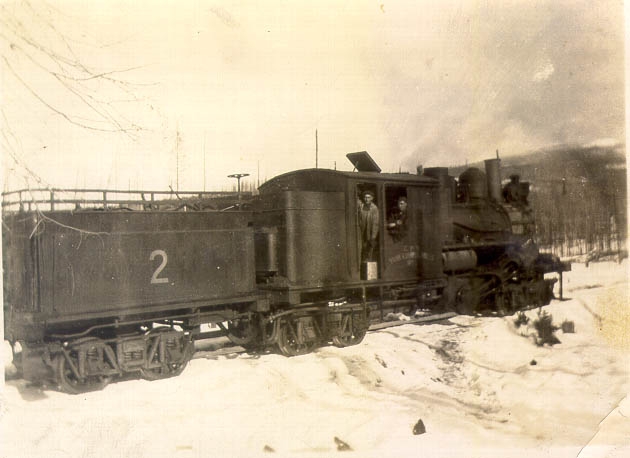
Before it could be operated, No. 2, a fat boilered Hinkley 2-6-0, had to be converted to wood firing.   No. 2 was turned out by Hinkley in Chicago in 1879 as an     0-6-0, with 12 x 18” cylinders and tiny, 31 inch drivers, giving it a tractive power of 13,000 pounds. No 2 was converted to a Mogul by the Alberta Railway and Coal Company with the addition of a pilot truck.     It ran on the Great Falls and Canada ern narrow gauge line, hauling Alberta coal down to the smelter at Great Falls, Montana.   This line, known as “The Turkey Trail,” was bought by Jim Hill when his Great Northern, pushing west, encountered it. In the 1890s it was standard gauged and its 3 foot equipment was being peddled all over the Northwest to the Kaslo and Slocan, the Trail Creek Tramway, and other narrow gauge lines.

In Trail a big Radley and Hunter stack with its wide spark arrestor netting was applied to No.2 . This was obligatory for all wood burning locomotives to reduce the hazard of sparks setting wildfires along the line. Wood burning grates replaced the coal grates in the firebox, and high sideboards were built on the tender to carry enough wood for a thirteen mile trip up to the mines.   The bearings needed to be checked as well, since the machine had been out of service for some time.

In the small yard a section of track was greased and steam was raised in No. 2 by fireman, Sam Stingley.   The Hinkley, in charge of W.H. Garlock, former Master Mechanic of the Seattle, Lakeshore and Eastern RR., was then run onto the greased rails and chained securely to two yellow pine tree stumps still present in the townsite.

To the intense interest of the idlers and small boys lining the rail of the bridge above, the throttle was opened and No. 2 spun her drivers on the slippery rails, lunging at the restraining chains and shooting a plume of steam and blue wood smoke high into the pale April sky.   Mechanic Garlock bent close to the churning drivers and listened for the pound of a loose bearing.   The throttle was closed. He pulled the cotter pin from an adjustment nut and tightened it just a fraction of an inch, then replaced the pin.   He signaled for power; the drivers spun again, and Garlock bent to listen.   Another adjustment was made.   When all was well, he went through the same procedure on the other side.   Bearings were tightened, the drivers spun, the valve settings checked, and checked again.   In the days before roller bearings, the brass journals of the locomotive axles were coated with a film of anti-friction metal known as Babbitt, a low melting point alloy of tin, antimony and copper.   Under load, this soft metal between the steel of the axle and the brass of the journal, formed a nearly frictionless metal film on which the locomotive rode.   The bearings needed to be tightened to the point where the Babbitt was snug against the brass of the journal, but not so tight that the soft metal would overheat, melt and throw out.   It was a delicate adjustment and could be made only by judging the sound and temperature of the bearing by ear and feel, as the wheels spun.

The tests went on most of the day.   Superintendent Gutelius was laying out a steep and crooked railroad, and only a locomotive in perfect condition was going to be able to operate it.   By late afternoon, No. 2 had passed all inspections, and the four wooden coal cars had had their coal boxes removed and been refloored by the carpenters as flats.   Locomotive and cars were now ready to move ties and rails up the line to the track laying crews.[ix]

On April 1, 1896, after posing for photographs with Colonel Topping, Superintendent Gutelius, Frank Hanna and the Hanna kids, Trail Creek Tramway No. 2, with her four cars, was ready to begin laying track, following the graders up the hill at the rate of a quarter mile per day with Gutelius’ improvised tracklaying machine.   A temporary track was first run up into the townsite from the beach where the barges would off-load more rails from Alberta and ties from the tie hackers up the river.  From near the present intersection of Farwell and Cedar in Trail, the permanent track was begun, laid with standard gauge ties, and with the rails offset to allow for a third rail to be spiked down later, as Heinze had promised Dan Corbin.   The grade ran up the right (south) side of Trail Creek on a 3 percent grade.   At a collection of shacks known as Dublin Gulch, the grade of the creek exceeded a practical grade for a railway and the first switchback was laid at mile 0.8.   The line reversed across the the creek and climbed its north bank on a 3.9 percent grade until it reached the top of the level bench where the smelter was under construction. Here Gutelius’ crews laid a wye and a small yard at mile 1.5.   This was to be the headquarters of the Trail Creek Tramway, now officially the Columbia and Western Railway.   An office was begun here with its second floor reserved for accommodations for President Heinze during the one week each month he spent in Trail.

The line reversed at the smelter wye, and now with six foot narrow gauge ties and no provision for a third rail, headed up the north bank of Trail Creek.   At Annable, at mile 3.1, the creek rose to meet the little line and Gutelius’ grade crossed it on what has been measured today as a 4.8 percent grade.   Gutelius, instructed by Heinze to get tracks up to those mines ahead of Dan Corbin, was building to the limit of his small locomotives’ capacity.   The line crossed the creek above Annable on a 25 degree loop, reversing direction to climb out of the creek onto the second bench at Warfield, mile 4.   A 25 degree curve is one on which a 100 foot chord along the curve intercepts a 25 degree central angle.   This awkward method of designating the sharpness of a curve comes from the way curves are laid out by the engineers.   A “hub” or center is chosen and lines of equal length run to every 100 feet of track to ensure the curve will be uniformly circular.   Common practice on main line standard gauge railroads is to limit curves to under 5 degrees.   A 25 degree curve on a grade severely limited a locomotive’s pulling ability. On a full half circle, and there were three of these 180 degree loops on the Trail Creek Tramway, the outside drivers of the little Hinkley had to turn nine feet, five inches farther than the inside drivers.   This meant nine and a half feet of wheel slippage in negotiating the loop.   On the following cars, the outside wheels had to slip as well, increasing the drag on the engine.   To compensate for this, Gutelius reduced the grade on the sharp curves .04 percent per degree of curvature.   This effectively reduced the grade on the 25 degree loops to 3 percent to keep up-bound trains from stalling.

At Warfield bench a second 25 degree loop reversed the line up Trail Creek again and it proceeded as it had from the smelter, up the north bank on a 4 percent grade until the creek rose to meet it at Tiger, mile 6.5.   Here Gutelius crossed the creek and laid a switchback on a 25 degree curve. The line then backed around the granite nose of Lake Mountain into Tiger Creek on a 4.6 percent grade.   Below the waste dumps of the Tiger and Crown Point mines, another switchback was set at mile 7.5 and called Crown Point.   Reversing here, the line swung back around the nose of Lake Mountain again with two levels of track below it, and proceeded up the south side of Trail Creek.

At Carpenter’s, mile 8.8, it crossed Gopher Creek and the old Dewdney Trail, climbing through Joe Moris’ Homestake claim into lower Rossland at the Spitzee Mine, mile 10.5, where a mine spur was laid out.   A passenger shelter was to be built here at Union Avenue for the residents of lower Rossland.   At Cook Avenue, the line looped across Trail Creek for the last time and climbed east between Kootenay and Le Roi Avenues through the steepest part of town, to curl around Rossland in a counter-clockwise spiral.   Author Peter Lewty, former Rossland resident, reports having found 12 x 12 timbers set vertically between the ties to hold the track to a piece of 4.8 percent grade.   This may well have been done later by the CPR when the line was standard gauged.

At the corner of St Paul street and Le Roi Avenue, a station site was located on a lot donated by the Rossland Townsite Company.   From this point the line had to be blasted through granite bluffs as it climbed into the upper part of town, crossing the Golden Dawn, Paris Belle and Golden Chariot claims amid the squatters of Sourdough Alley.     Gutelius’ grade stakes were now marching into Dan Corbin’s land grant, though it is not clear whether Superintendent Gutelius knew this or not. Most likely, he set his stakes and left it to Fritz Heinze to settle with Corbin.   Gutelius’ stakes outlined a wye to turn his trains on the small flat on Monte Cristo Street between Second and Third Avenues.   From this flat, the stakes made a wide, climbing loop to the east, and then turned west on present Mc Lead Avenue, passing above the Great Western Mine. Continuing west, spurs were staked to the Enterprise, Virginia and Idaho mines.   The stakes then turned up Centre Star (Acme) Gulch and indicated a high, curving trestle across it to the lower slopes of Red Mountain and the Centre Star mine at mile 13.   The Le Roi and the War Eagle were higher up on Red Mountain, so to reach their ore bunkers, a high line branch was staked out, beginning back at mile 12.7 and climbing into the same Centre Star Gulch on a higher alignment.   The gulch was crossed with a second trestle, this time on a 25 degree curve.   Parallel to the lower line, but 200 feet higher, the high line reached the War Eagle at mile 13.2 and the Le Roi at mile 13.3, and the end of the grade survey.

The Trail Creek Tramway was engineered to climb 2400 feet in 13 miles with long stretches of 4 percent grade, several climbs of 4.6 percent, and two short pieces of 4.8 pecent.   Nelson Bennett’s crews would lay out four switchbacks, Gutelius’ carpenters would have to build eleven timber trestles, and on those sharp 25 degree curves, ties would have to be cut to length and tamped in place to brace the curved rails against the mountain wall.   It was a pioneering railroad, steep and crooked, with the prudent consideration that all mines have a limited life and that the railroad might only be needed for five or six years.

Down at the Columbia River, another barge from Revelstoke brought in Locomotive No. 1, an Identical Hinkley 2 -6 -0, from the Alberta Railway and Coal Company, and more cars.   With Nelson Bennett’s men well up the gulch, digging and blasting grade, and Gutelius’ home-made track layer following with rails and ties, the little railroad was underway.   In Trail, track was laid down the center of Bay Avenue to the south end of town where a sawmill which was cutting ties and timbers for the line.  From the south end of Bay Avenue, a track angled down the riverbank with a switchback to keep runaway cars from plunging into the Columbia, and reversed down to the extreme low water level.   Here the transfer for passengers and freight from steamers and barges was made.   The original scratch line at the mouth of Trail Creek was taken up, since the spring floods would wash it away in any case, and its sole purpose had been to secure Larsen’s rails on the beach at that point.

Fritz Heinze had renamed his Trail Creek Tramway the Columbia and Western Railway to attract support for a rail outlet to the coast which would make his Trail smelter independent of both Corbin and Van Horne’s lines.   He had his engineers survey a line running from the Le Roi mine west, contouring around the slopes of Red Mountain and into the head waters of Little Sheep Creek, maintaining its elevation along Mt. Roberts, OK Mountain, and crossing the Rossland Range through the pass between Mt. Sophie and Record Ridge. From there it was to hold its elevation as it contoured to the head of Big Sheep Creek and then back south to cross the 5000 foot Santa Rosa summit, and down to Christina Lake on the Kettle River.   The line would have been 55 miles long, most of it snaking around the ridges and canyons of Big Sheep Creek, a fearfully cut up country where railroad construction would be extremely costly.   Once in the Kettle River Valley, his line was to use Dan Corbin’s route to Midway, Rock Creek and over the Rock Creek range to Penticton.

The Trail Creek Tramway had been built under Peter Larsen’s Trail Creek and Columbia River charter without land grants or subsidies.   But now Fritz Heinze intended a major railroad, and needed a more liberal Provincial charter which would grant him public lands along the right of way to sell or mortgage to provide the funds to build the line.   His methods demonstrate his mastery of public relations.

The charter he wanted was nearly the same as that which had been refused Dan Corbin a few years before.   Fritz Heinze, however, young, handsome and personable, seemed able to charm the very men that cold, grim, Dan Corbin had offended. Heinze’s campaign opened with an announcement that he would build a line from Rossland to the newly discovered copper-gold deposits above Greenwood, the claims that the young Jay Graves was being invited to invest in.   A smelter had been built in Vancouver in 1889, but was languishing for lack of ores.   Heinze led the owners to believe, that with his railway, they could bid for those ores.   His line would carry them to Penticton where they could be put on the CPR steamers to the Shuswap and Okanagan Railway at Okanagan Landing, and from there they would move to the CPR main line at Sicamous.

The Vancouver press was intrigued but suspicious.   Heinze’s proposal sounded to them like Captain Ainsworth’s scheme warmed over.   Or Dan Corbin’s proposal under another name.   But Heinze’s line did have one thing that the Canadians could approve: it did not have a Spokane connection.   Heinze said he would connect his line at Penticton end to end with that “Coast to Kootenay” line if it were built.   This would tie the Kootenays to Vancouver, not Spokane. At this enthusiasm built.   When public sentiment had swung his way, Heinze flashily presented himself at the Legislature, young, handsome, confident, impeccably tailored, and radiating charm.

In Victoria, Heinze was persuasive.   He merely wanted a charter, he told the members, not public money.   He invited the members and their wives to a great dinner at the Driard Hotel.   There was food and wine and oratory.   Fritz Heinze presented himself as a champion against the CPR’s greedy scheme to capture the Kootenay traffic for the hated East .   Why, he said, if he got the charter, he would build a copper refinery in Vancouver, and ship his copper matte there for finishing, and not to Montana as he was presently doing.

The combination of provincial patriotism and profit was as persuasive for Fritz Heinze as it had been for Captain Ainsworth.   He got his charter, where Dan Corbin had not.   Confident they were doing the right thing, the Legislature gave him a land grant as well.   Even further, as a sort of trophy, he got Lieutenant Governor Dewdney, the man who had contracted the trail, on his board of directors.

Yet, when the effects of fine wine and patriotic oratory had worn off, the legislators found themselves somewhat embarrassed by the immense tracts of land they were handing to this dandified American. As an afterthought, they required Heinze to post a bond of $50,000 that he would actually complete his railway to Penticton by 1900.   Cannily, Heinze gave them a $50,000 mortgage on his uncompleted tramway, now grandly called the Columbia and Western.   Much later, Heinze candidly admitted, “I went down there prepared to spend $50,000 among them, and all it cost me to get my bill through was $240 for a good dinner at the Driard.”[x]

Some British Columbians refused to be charmed.   They began asking how their legislators had managed to give away such valuable blocks of land for a promise and a mortgage on an uncompleted railway.   All admitted that there was a desperate need for a railway across the southern part of the Province, one that would funnel its trade to Vancouver.   But once again, their legislature had handed the project to an American.   Captain Ainsworth had tried to capture the Kootenays for Portland.   Dan Corbin was trying to grab its trade for Spokane.   The Canadian Pacific appeared ready to snatch it for Winnipeg and Toronto.[xi]   Now here was this glib fellow, Heinze, who said he wanted only a charter, but is already back in town asking for a cash subsidy.

The coast cities of B.C. were outraged by the Federal Government’s Crowsnest Pass agreement with the CPR, which promised a subsidy of $11,000 per mile for the Kootenay line if the CPR would reduce freight rates in Western Canada.   This was seen in Vancouver and Victoria as an outrageous reduction in rates to the East, which it was, while rates to Vancouver and Victoria remained unchanged.   Obviously, the CPR, in building just half way across southern B.C. to the mines would replace Spokane’s control with Winnipeg control.   Vancouver and Victoria would have no share in the bonanzas.   In angry response, Mayor Templeton of Vancouver, Dr. Milne of Victoria, and the Mc Lean Brothers, contractors, chartered the Vancouver, Victoria and Eastern Railway and Navigation Company in 1897 to build a line from Victoria to Sydney, on Vancouver Island, to operate a ferry service to Vancouver, and then lay rails on the Dewdney Trail route to the Kootenays.   These were evidently men who had never seen the notorious Dewdney Trail, or they would not have seriously suggested putting a railroad on it.

The railroad alliance between Vancouver and Victoria would not last.   The railroad was known in Vancouver as the “Vancouver, Victoria and Eastern,” while in Victoria, it was the “Victoria, Vancouver, and Eastern.”   In the rest of the Province, it was the “VV&E.”   Still, it was a B.C. attempt to challenge both the CPR and Dan Corbin with a locally owned railroad, serving local interests.   Heinze quickly responded. He would join his Columbia and Western rails to the VV&E at Penticton if they would build east to meet him.

To continue building his Kootenay Empire, Heinze now wanted access to the silver-lead ores of the Slocan and of Kootenay Lake for his smelter.   He intended to install lead furnaces and capture those ores which were going to Jim Hill via his Kaslo and Slocan narrow gauge railway, and then by water to his main line at Bonner’s Ferry.   But access to the Slocan Mines was by the CPR’s Columbia and Kootenay Railway from Robson to Nelson, and the CPR was implacably hostile to him.   So, in an effort to persuade the CPR to allow Slocan ores to be shipped to him via the Columbia and Kootenay line, he invented a fictitious railroad, the “Columbia River and Kootenay River RR.”   He had the cars being shipped to him from the Alberta Railway and Coal Company lettered, “CR&KRRR,” knowing the word would quickly reach Van Horne.   Of course, the CR&KRRR never existed. It was a pure bluff.   But Fritz Heinze was a Brooklyn boy with a wild sense of humor and a pugnacious self confidence.   He awaited Van Horne’s reaction to this supposed railroad, by its title pretending to parallel the Columbia and Kootenay line.   The Pilot Bay smelter on Kootenay Lake had failed.   The Hall Brothers were smelting their Silver King copper -silver ore at Nelson.   The CPR wanted the coal and coke haul from Vancouver Island, and the smelter matte haul out via the Columbia and Kootenay line to Robson, by steamer to Revelstoke, CPR rail to Montreal, and via ship to Swansea, Wales where it would be refined.[xii]     By threatening a rival railroad to bid for the Silver King ores, which being copper with silver, he could smelt in Trail, Heinze seems to have been bargaining for a favorable rate on Slocan ores moving west on the Columbia and Kootenay to the steamer connection to Trail.   Van Horne, however, was not a man to be bluffed.[xiii]   He instituted a wholly exorbitant rate on Slocan ores moving to Trail to make sure no mine owner could make a profit contracting his ores to Heinze.   Then he secured the ore haulage contract to the Hall Brothers’ smelter from the Slocan district for the CPR’s Columbia and Kootenay Railway which now had a branch to Slocan Lake and the mines.

On March 12, 1896, Heinze’s hastily built Trail smelter was blown in with Le Roi ore, wagon-hauled down the mountain.   On April 2, as the first rails were being laid on the Trail Creek Tramway, the first shipment of 20 tons of copper matte from the smelter was trundled aboard the steamer, Lytton, for Northport where Dan Corbin’s line would start it on its way to Heinze’s copper refinery at Butte.[xiv]   The Trail smelter was a crude operation, fed with cordwood rafted down the Columbia, and then hauled up the steep, high back to the smelter from the river. There were no electric motors.   A main steam engine, its boiler wood fired, supplied all the power for the furnaces, mill, sampling works and crushers with a 2 inch rope drive.   Power transmission technology, before electricity became available, depended on endless rope drives from the power house, running overhead to the various buildings where the moving ropes dived through the roofs to the grooved sheaves inside that turned the machinery. A rope splicer was present at all times to mend breaks in the rope which were frequent.[xv]     The water jacketed blast furnace was fired with coke which Heinze had to bring in from the coke ovens on Vancouver Island via rail to tidewater, ship to Vancouver, and CPR rail to Revelstoke.   From there it came down the Columbia through the lakes on barges to be transferred to the narrow gauge cars at Trail.   In winter, when the Columbia froze, coke was obtained from Roslyn in Washington via Dan Corbin’s line, put on sleighs at Sayward and hauled up the ice road to East Trail where it was ferried across the river.[xvi]

Once Heinze’s smelter and the Hall Brothers’ smelter in Nelson, began producing copper matte on a continuous basis, the competition for Kootenay traffic became intense, with announcements of great projects being made monthly in the newspapers.   An American company was proposing to build a smelter at Robson or at Blueberry Creek on the CPR’s proposed Robson – Rossland line, the Rossland Miner reported.[xvii]   Another was rumored to be built at Northport.   But Heinze was still in the lead.   His Columbia and Western charter had been issued that May, and he announced that the Directors of the Railroad would be himself, of New York and Butte, Frederick Ward, of Rossland, Chester Glass, a Spokane lawyer, and the ornamental Lieutenant Governor Dewdney.

Sometime that spring, Heinze’s engineers convinced him that it would be impractical to build west out of Rossland over Sophia Mountain and in and out of Big Sheep Creek to reach the Kettle River Valley. They suggested a route from Trail up the west bank of the Columbia to a point across the River from Robson and then west, climbing the bluffs along the south shore of Lower Arrow Lake to Dog Creek which could be followed to Mc Rae Pass, a lower crossing than Santa Rosa Pass. From there the line could descend down Mc Rae Creek to Christina Lake.   The line would be longer than the Santa Rosa line, but would have easier grades and but one summit.   Heinze was more concerned with blocking the CPR than with grades and passes.   He accepted the engineers’ proposal chiefly because it preempted the CPR’s Robson -Rossland line; if the Canadian Pacific wanted to reach Rossland it would have to do so over his rails.

The CPR, after the disastrous floods of 1894, had been obliged to rebuild much of its main line and replace weakened bridges in B.C.   Desperately short of funds, announced that it would not build its Robson-Rossland line that year, as it had promised.   Instead, the public was told, it would build to Trail instead, and three rail Heinze’s Tramway to Rossland to have its standard gauge cars pulled up the hill by Heinze’s narrow gauge locomotives.   This seemed to be a feeler put out by Van Horne to learn whether Heinze would consider an alliance with the CPR against Dan Corbin whose men were steadily grading up Little Sheep Creek, closer and closer to Red Mountain.

In Rossland, the Miner reported on April 25, that the blasts of Corbin’s graders could be heard daily from the west, while from the east, the whistle of Hinkley No. 2 could now be distinctly heard as it bustled up and down the track in the canyon below, forwarding timbers, ties and rails to the track gang.

As the graders neared the Rossland townsite, the principals in the Rossland Townsite Company broke a promise, and demanded that Heinze pay for the land his rails were to cross.   This infuriated Fritz Heinze, who had obtained a verbal agreement with the Townsite Company the year before when they were encouraging him by any means they could, to build his tramway. Now, with the tracks actually marching up the gulch toward their town, greed took over; they demanded $5,000.   Heinze swore and blustered.   He threatened to route his line east and north, circling outside the townsite, and put his Rossland station up on the Enterprise Claim, far above the business district.     The Townsite Company countered with an offer for a station lot at the corner of Victoria Avenue and Spokane Street, which was far below the business district.   A compromise put the station half way between the two extremes, at Le Roi Avenue between St Paul Street and Monte Cristo Street.   This was on the original survey and the grading could proceed as planned.[xviii]

But further trouble manifested itself.   As his graders entered the townsite, Dan Corbin, whose own graders were considerably behind Heinze’s, obtained an injunction from the court to prevent Heinze’s men from trespassing on his grant lands (everything north of First Avenue) with their grade.   Heinze had brashly ignored Dan Corbin’s ownership of these lands when he had Fred Gutelius make the original survey, counting on his own negotiating skills to somehow wrest a permission from Corbin. Now, in a race to Rossland, Corbin was his adversary, and would use any method to delay the Trail Creek Tramway from completing its line.   Fritz Heinze had to approach Corbin once again with an offer on that Sayward to Trail line to try to get him to lift his injunction.   Heinze promised to build a three rail line from Trail to Sayward, and guarantee Corbin a share in the Trail traffic if only his graders were allowed to proceed.   Corbin, not knowing Heinze that well, agreed.   Heinze could build his track, he promised, and then, with his habitual thin smile, he exploded a bomb under the young man.   It would not matter, he told Heinze, he was planning to build his own smelter at Northport; the Le Roi Company had already promised him their ores.[xix]

At this news it became more than ever essential for Heinze to build his C&W connection to the Coast.[xx]   With the Hall Mines smelter in Nelson in operation, and with a greater capacity than his own, and now with a third smelter planned for Northport, it was going to be extremely difficult to dominate the Kootenay mining industry unless he could connect himself to Vancouver.

With Corbin’s injunction lifted, Charles King’s graders moved onto the heights above Rossland and finished their work.   The track gangs, working behind them, laid the last rails the first week of June, 1896 at the Le Roi Mine and a “Last Spike” celebration was held.   Townspeople came up on foot and in buggies, and every small boy in Rossland was there with his dog.   Colonel Topping was present on his white horse, and his partner, Frank Hanna, in a new suit.   Fritz Heinze, looking like a college freshman, was in charge. The gentlemen of importance removed their coats and hung them on convenient posts.   In their shirtsleeves, they drove the final spikes, the sounds of their hammer blows echoing above the growing town, already spreading beyond its platted townsite.   From over to the southwest, the rumble of a blast was heard.   E. J. Roberts’ men were down in Little Sheep Canyon, chewing at the stubborn granite, ten feet at a blast.   The Canadians, a minority in the crowd, grinned; it would be months before the American railway arrived.   Heinze had won the race.

On June 6, 1896, the inaugural run was made.   Locomotive No. 1, another Hinkley 2-6-0, was coupled to three boxcars which had windows cut in their sides.   Inside, the cars each had a double bench down their centers, the passengers sitting back to back, facing outward, feet braced against the sides of the cars for what was expected to be a rough ride.   It was a crisp morning and stoves were lit in the makeshift coaches to keep everyone warm for the trip up to chilly Rossland, 2300 feet above. Every seat was taken when No. 1 whistled off and moved down the center of Bay Avenue where crowds were gathered on the wooden sidewalks and people waved from upstairs windows.   At Farwell street the 3.5 percent grade began and the train began its ascent of Trail Creek Gulch.   At Dublin Gulch, the switch was thrown and the Hinkley backed its train up the switchback to the smelter where blue sulfur flames flickered on the piles of roasting ore, and thick, yellow fumes swirled around the train. The train reversed and climbed into Trail Creek Gulch again.   Alongside, on the wagon road, teamsters scowled and cursed.   They were hauling their last loads of ore from the Le Roi.   In the following days they would move down to Bossburg or Marcus, Washington where work was to be had hauling mining machinery and supplies to Jay Graves’ new camp in the Monashees to the west.

Up at Rossland, on the granite bluffs east of town, men were watching with spyglasses, following the progress of the tiny train below and checking their watches.   At moments the cars were visible through the trees, but for the most part, a moving column of blue wood smoke sifting through the firs was the only indication of the event.

Up on the Lake Mountain switchbacks, the passengers crowded the right hand windows for a look down on the roofs of their houses, a thousand feet below.   On the crinkled surface of the Columbia, the Lytton, backing out into the stream, looked like a skittering water bug.   As they backed into the tail track of the Tiger switchback, the crew of the Tiger mine, high above them, let off a celebratory blast of black powder to mark the occasion, and cheered the tiny Hinkley.

The sidewalks and wooden steps above Le Roi Avenue were crowded with onlookers when the train entered the Rossland townsite, crossing Earl, Spokane, Washington and Queen Streets, and coming to a halt at the new St Paul Street Station.  The whistle blew, fireworks were let off, salutes were fired from every sort of firearm, and all made their way up the steep Rossland streets to a monster celebration at the Allen Hotel, complete with whiskey-garbled speeches and a barrel of phlegm-loosening punch, American Style.   For, small as it was, this was an American railroad, American owned, American built, and operated by American railroaders.   The Canadians, on the fringes of the crowd, let the Americans have their calithumpian celebration.   Now, they believed, Canadian Pacific would have to come to Rossland as well.   And it would bring Canadian capitalists from Montreal and Toronto to buy back their mines, it was hoped, from the Yankees.

The ore trains began service on the 16th.   The little Hinkleys could handle no more than eight cars each.   On the loaded trips down the mountain, with only hand brakes, the brakemen stood between the cars, with a foot on each, where they could apply brakes on two cars at once by using the leverage of a pick handle to twist the brake wheels.   Three ore trains ran each day, plus three passenger trains. [xxi] The Hinkleys were pressed to the limit, and in December, Heinze sent Master Mechanic Garlock to Utah, where the Utah and Northern had been standard gauged and the UP, its owner, now had yards full of narrow gauge equipment for sale.   Most western narrow gauge lines were reequipping themselves from the U&N; some of the older locomotives were going for as little as $250.   Garlock needed a powerful locomotive; he picked out another 2-6-0 which suited him.   It was a Brooks locomotive of 1881, originally Kansas Central, No. 8. There has been some confusion about this engine among rail historians.   Some have thought it to have been Utah and Western No. 2, another, smaller and earlier Brooks Mogul.   Utah and Western No. 2 was Brooks construction number 227, of April, 1875, with 36” drivers.   Trail Creek Tramway (Columbia & Western) No.3 was Brooks construction number 578, of 1881, with 14 x 18 cylinders and 42” drivers.   The narrow gauge Kansas Central, which had bought this engine new, had been acquired by the Union Pacific, and in 1890 it was standard gauged.   No 8 and the other narrow gauge equipment were transferred to other UP narrow gauge lines.   No 8 does not show up on the Colorado and Southern or the Denver, South Park and Pacific, nor on any of the UP controlled Utah narrow gauge lines.   It seems certain, then, that it went to the UP owned Utah and Northern. This would have been after the U&N roster of 1885 was published, so it would not show up there.     The U&N was standard gauged in 1887, and its three foot equipment put up for sale.   The author’s conclusion is that C&W No. 3 was found among those locomotives stored for sale at Pocotello, Idaho, or Salt Lake City.[xxii]

In addition to No.3, Garlock bought 11 flat cars, 6 boxcars, a first class class coach and a private car.   This last was the Brigham Young family’s car, dating back to the days when the Mormon Church owned the Utah and Northern and a number of other narrow gauge lines in Utah.   The car was reportedly decorated inside with paintings of angels, cherubs and seraphim.   In Trail it was rebuilt to suit President Heinze’s much more worldly tastes, with “one half fitted up as a drawing room with lounges.”[xxiii]   One may suppose that a “drawing room” for Fritz Heinze would have included a poker table, chip racks and a bar, appurtenances that the Trail Creek News chose not to specify.   Eyewitnesses testify, however, that the angels and seraphim were retained to look down on the antics below and to gratify Fritz Heinze’s irreverent sense of humor.   In December, the private car made its first run with the contractors from Butte who were bidding on the C&W extension to Robson West.

Once the Trail Creek Tramway was in operation, Heinze ordered a second furnace for his smelter to increase its capacity.   He went to the Spokane Colonels to negotiate a long term contract for Le Roi ore before Dan Corbin could complete his line. The Colonels refused.   They believed he was overcharging them for smelting their ores.   Dan Corbin had just made them an attractive proposal: one third of the Northport townsite if they would build a smelter there.   Henceforth, the Colonels told Heinze, they would mine and smelt their own ores.   The CPR, building slowly up the east side of Crowsnest Pass, and not likely to arrive in Nelson for another two years, tried to stay in the game by announcing a smelter to be built at Blueberry Creek, half way between Trail and Robson.[xxiv]

Heinze, with his revised plans for the C&W, went back to the B.C. Legislature for a cash subsidy for his line which his engineers had told him was going to be fearfully expensive to build.   His charter gave him a grant of 10,400 acres of public land per mile of narrow gauge railway built, or 20,000 acres if standard gauge.   The land grants would be handed over as the track was completed, and then could be mortgaged to pay the contractors.   Now he got an additional grant of $4,000 cash per mile.   This would still not be enough.   In the summer of 1896, taking the ornamental Governor Dewdney along, he sailed for England to try to raise money to build the C & W.   In England, he showed his prospectus claiming his tramway was grossing $25,000 per month and his smelter, $100,000.[xxv]   Governor Dewdney was displayed as the obligatory “Guinea Pig,” the sort of titled nonentity which gave Britishers confidence that their investments would be well looked after.[xxvi]    However, even Governor Dewdney’s assurances could not convince British investors that a railroad from Trail to Penticton — “from nowhere to nowhere” as it was said, was anything but a backwoods pipe dream.   Heinze and Dewdney returned empty handed, and Fritz Heinze mortgaged some of his Montana holdings for the funds with which to begin the first section of his Columbia and Western Railway, the line from Trail to Robson West, a steamer landing across the river from the Columbia and Kootenay terminal at Robson.

It was not until December, 1896, that Dan Corbin’s Red Mountain Railway was completed to Rossland.   Heinze had a six months start on him and seemed in no hurry to fulfill his promise to build that three rail line to Sayward.   He never did build it. No one did.   Today it is still an absurd gap in the ore haul from tidewater, which is filled with a truck haul from the BN transfer at Sayward to the Cominco smelter.