Chapter XII of the P. and G. Klopp Story – Part IV

Exploring Germany by Bike

Summer 1959

In preparation for our ambitious goal to travel by bike all the way down to Lake Constance with stopovers in Bad Kissingen and Freiburg at Aunt Meta’s place, Rainer and I had a lot of things to do. We planned to camp in the fields and woods along our route and stay away from the campgrounds to save money. I already owned a two-person tent, for which Mother had so lovingly sewn together a sheet of cloth that could be draped over the tent for extra protection against the rain. Rainer, being the son of the owner of a lucrative car repair shop, had access to telephone and quickly set the approximate date of our visit as promised by Christine’s father the previous summer. For food we limited ourselves to non-perishable goods, such as canned sardines, meat, even pumpernickel, and fruit for dessert. For entertainment I took along my harmonica and also a novel written by Jerome K. Jerome at the turn of the century with the title ‘Three Men in a Boat’. In English class we had to read excerpts from the book and we had so much fun with many of the hilarious passages that I decided to buy the book in German translation. At the end of a long and tiring day on the saddle we would crawl into the tent and I would read aloud from this delightful traveling book. We often had to pause to recover from our fits of laughter over a particularly comical description of the three boaters and their temperamental dog.
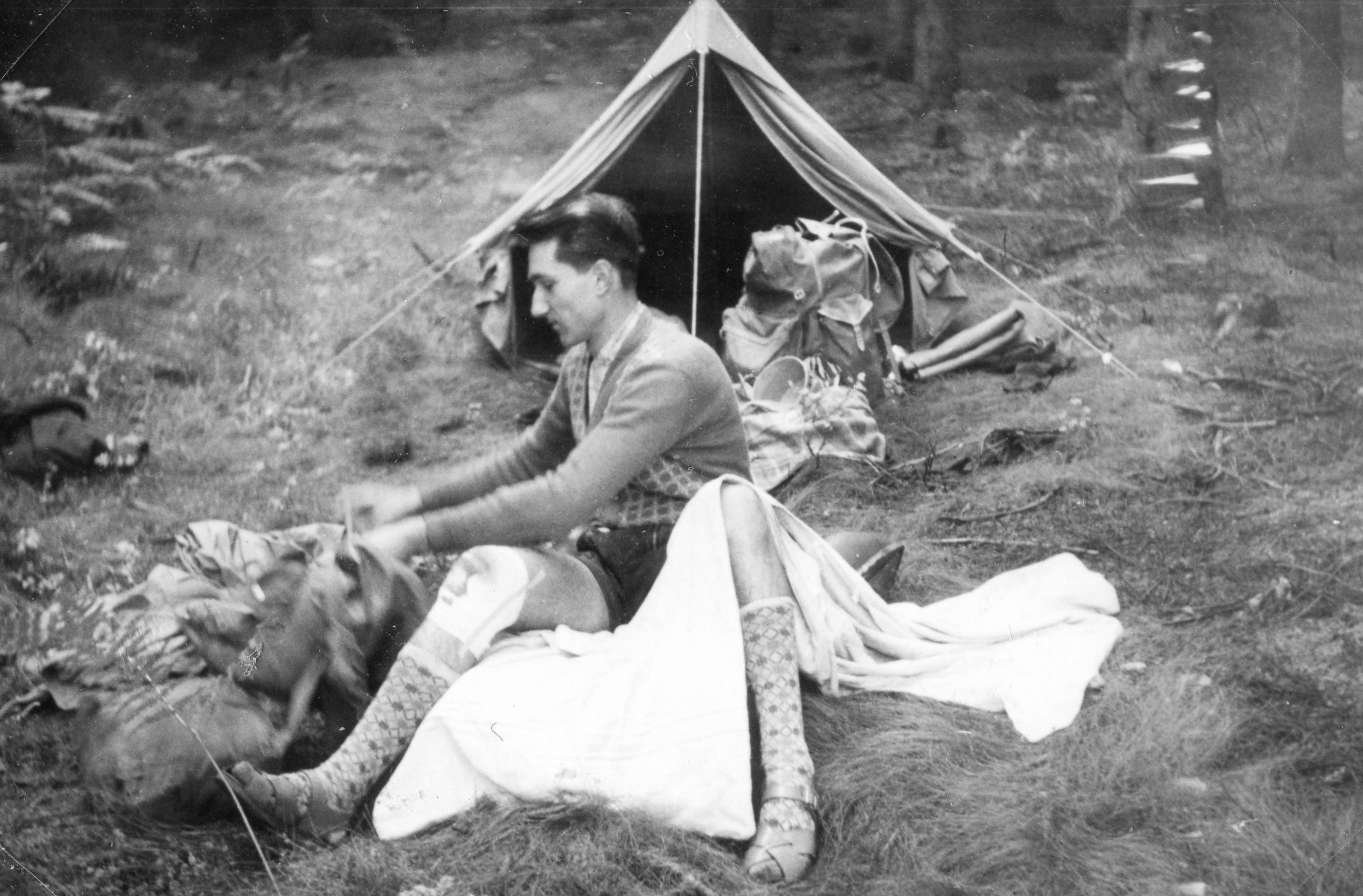
Peter after his Bike Accident

Peter after his Bike Accident

The Lower Rhineland and the adjacent Ruhr industrial area are almost level. So traveling was easy and light for the first couple of days, even though our bikes were loaded to the maximum capacity with supplies. But when we were nearing the halfway mark to Bad Kissingen we were in the hill country. The slope was getting steeper. Riding old-fashioned bicycles without being able to shift into a lower gear, we often had to get off our bikes and push them with the heavy luggage several kilometers uphill. Oh, how I wished then to be back again in the cool refreshing breeze of the Baltic Sea. Eventually though we were rewarded for our hard labor with a comfortable coasting down into the valley bottom. On one of these pleasant downhill rides not too far from our first stopover I lost control on a sharp curve and took a nasty spill over loose gravel. I badly scratched up my right knee and was bleeding profusely. Other than feeling the stinging pain I got away without any major injuries. Fortunately, the bike had not suffered any damage. So Rainer and I, disheveled and myself a little bit shaken up, arrived at our first major destination. Dr. Baudach took immediate care of my knee and applied a stinging disinfectant and a healing cream to my wounds from a little tube that was worth fifty marks, the equivalent of 10 days of my traveling budget. Bad Kissingen is a spa town and a world-famous resort town in the Bavarian region of Lower Franconia about 300 km southeast of Wesel. We were thankful for the opportunity to recover from our arduous climbs over the hill country and thoroughly enjoyed the hospitality in the doctor’s home during our three-day resting period. When we said good-bye and our heart-felt thank-you to Mr. and Mrs. Baudach, we promised to write as soon as we had finished our journey. We also promised Christine to start as pen pals a correspondence with her. After all she was the one who initiated our invitation from her dad in the previous summer.
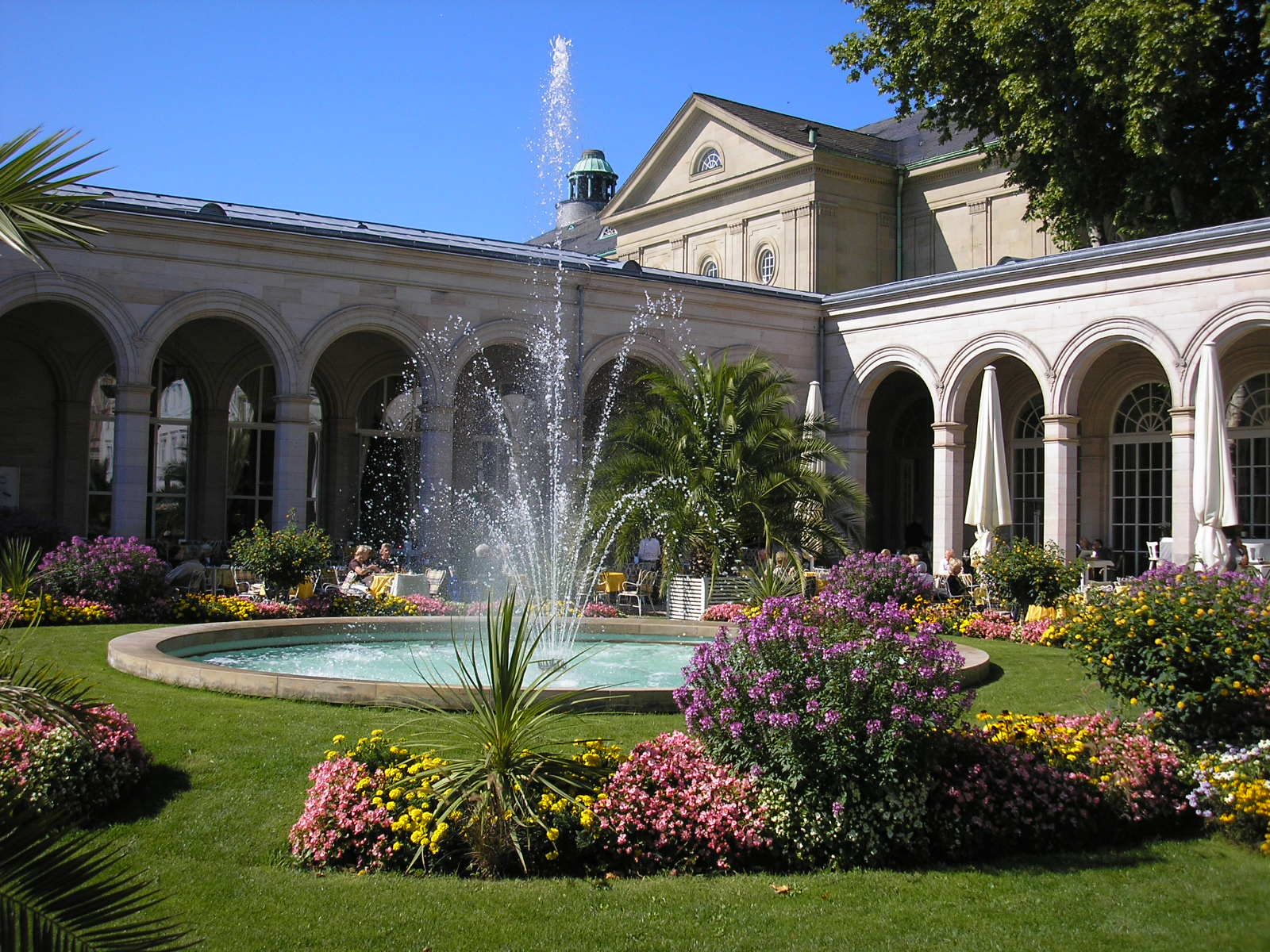
Bad Kissingen - Photo Credit: wikimedia.org

Bad Kissingen – Photo Credit: wikimedia.org

Having already been almost two weeks on the road, Rainer and I decided to drop Lake Constance from our itinerary and ride on in a southwesterly direction to Freiburg. Because of the sultry and hot weather we did not average more than sixty kilometers a day. More and more often we had to walk our bikes, as the road was getting steeper. When we had finally reached the famous Black Forest Highway, we realized that the toughest part was still to come. We had to overcome the difference in elevation of more than five hundred meters in order to reach the top of this arduous mountain road. Our progress dwindled to a mere thirty kilometers a day. We would need seven days or more to get to Aunt Meta’s place in Freiburg.

On a particularly long and steep stretch we almost despaired and were ready to buy train tickets in the next major town to escape what appeared to us to be self-inflicted torture rather than a fun-filled journey through one of the most beautiful parts of Germany. While we had parked our bikes on the roadside and contemplated what to do next, we noticed how sluggishly the big trailer trucks were crawling up the mountain road. Necessity is the mother of invention. Seeing the trucks rumbling by at a very slow pace sparked the idea. We would pick one with a trailer and attach ourselves to its back-end. At less than twenty kilometers per hour we figured we would be able to hang onto it with one hand and steer the bicycle with the other. Totally ignoring how dangerous and unlawful it would be, we tried out our plan on the next curve, where we could be sure not to be seen in the rear view mirror of the truck driver. It worked marvelously. Even though we had to switch trucks several times to give our arms a rest, we reached the summit of the North Black Forest road in a matter of a few hours. Tired and exhausted, but happy and content we set up our tent in a cool forest meadow near a mountain creek, whose gentle murmuring quickly lulled us into a deep and well-deserved sleep.
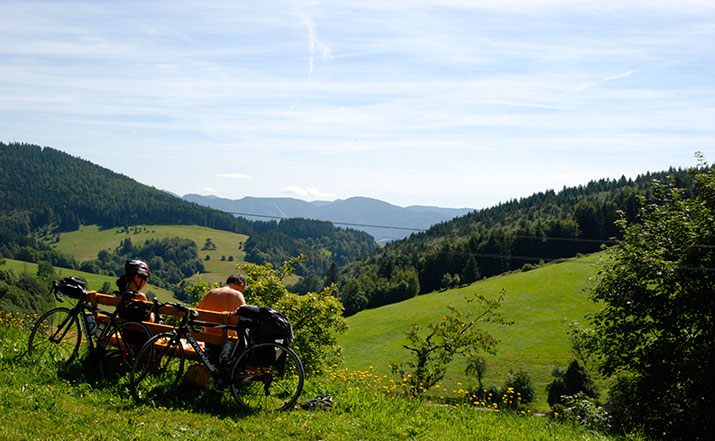
Blackforest with Mountain Bikers - Photo Credit: breisgau-schwarzwald.de

Blackforest with Mountain Bikers – Photo Credit: breisgau-schwarzwald.de

Well rested we made excellent progress on a relatively level stretch of highway on the Black Forest plateau. We refrained from hitching onto the much faster moving trucks this morning. Turning west near the picturesque town of Hinterzarten we were now heading toward the Höllental (Valley of Hell). Below these high-lying hollows of the town the federal highway B31 winds downhill in spectacular loops. Riding on this road turned to be a fantastic joyride, even though in hindsight it could have easily turned into a disaster, if the simple back pedal brakes had failed. After the railway station Hirschsprung with its steep slopes up to six hundred meters high came a section with towering cliffs known as the Höllenpass (Hell Narrows). The narrowest part of the gorge is called the Hirschsprung (Deer’s Jump). A common tale reports that a deer escaped hunters by jumping over the nine-meter wide gorge. Enjoying more the exhilarating high-speed ride than the magnificent scenery all around us we zipped by in typical teenage fashion toward the widening valley of the Freiburg district. It was late afternoon when we arrived at Aunt Meta’s place, where we received the warmest reception and for the first time in days had a decent meal again.

Since my last visit in 1953 Aunt Anna after the death of her husband Baron von Waldenfels had been living with Aunt Meta at the same apartment. Her colorful life as baroness, a very interesting piece of family history, can be read in the voluminous book ‘Familienchronik Klopp’ written by Eberhardt Klopp, a distant cousin of mine. Having grown up in the nationalistic era of Imperial Germany, she was still filled with the fervor of German patriotism. While we were savoring Aunt Meta’s delicious cake at the coffee table, her passionate plea to us strapping young men to embrace and adhere to the archaic concepts of blood and honor is still ringing in my ears after all these years.

Rainer made a phone call to his mother describing to her the fun we had but also the ordeals we experienced in pedaling through mountainous terrain. Whether it was compassion for her son or whether she just wanted to take a break from her household chores, I do not know. But she decided to pick us up in her VW beetle. We took our bikes to the railroad station and had them shipped to Wesel. The trip home with Rainer’s cheerful mom along the scenic River Rhine with its impressive mediaeval castles brought another adventure to a most pleasant conclusion.
Chapter XII of the P. and G. Klopp Story – Part III

Rowboat Adventure and a Visit to the Reeperbahn

Summer Holidays 1958

In the following summer Mother allowed me to return to Möltenort with my friend Rainer Schüler, a classmate in the modern language branch of our high school. I was thrilled by the degree of individual independence and trust that Mother had placed on me. She had reserved the same cottage we had rented the previous year. Breakfast was included and offered so much food to sustain us till early afternoon. We followed the German custom of eating our main meal at noon in the local resort restaurant. Rainer and I lived frugally to save money for purchases in Hamburg, where we were going to drop in later at Auntie Ella’s place. We bought two eating passes for our two-week stay at the Baltic Sea. When we dined together, we discovered that we were getting less meat, vegetables, dessert than if we had eaten separately. Therefore, we decided to eat our meals individually about thirty minutes apart. For the same cost we enjoyed larger portions and we both were very proud about our clever plan to get more for less.

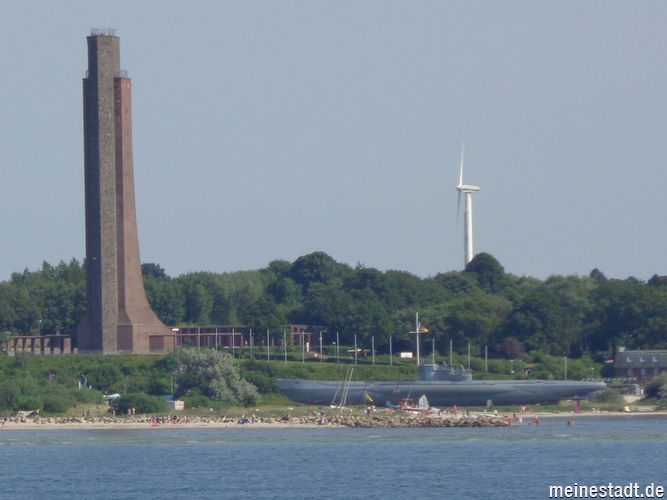
Modern Laboe - Photo Credit: meinestadt.de

Modern Laboe – Photo Credit: meinestadt.de

In the afternoons we spent many happy hours at the beach, where we soon became acquainted with an easygoing doctor, his wife and their five or six children. They had come all the way from Bad Kissingen for their vacation at the Baltic Sea. The Baudachs had rented a Strandkorb. And Rainer and I helped them build a large wall around it. It did not take very long to feel like being part of the family sharing their good company at the beach and as an extra bonus the snacks and refreshments of which there seemed to be an endless supply in the wicker basket. I no longer remember what Christine, the eldest 15-year-old daughter, looked like, but Rainer and I spent a lot of time with her. After our swim we would sit down on our towels and tell her about our ambitious plan to ride our bikes all the way to Southern Germany making a circle tour with Lake Constance being the farthest point away from home. Christine found it very exciting to listen to us, as we were dreaming aloud about our adventures the following summer. She must have talked to her dad about these plans, because Dr. Baudach surprised us with an invitation to drop in and use their home as a stopover on our bicycle tour. We gladly exchanged addresses and promised to write as soon as we had finalized the details of our trip.

The lady who was running the bed and breakfast business had an old decrepit rowboat that had definitely seen better days. The paint was peeling off, the ancient registration number, no longer valid, was barely visible, and as we found out later the vessel had a small leak and was hardly seaworthy. One day we asked the lady if we could drag it down to the seashore and take it for a little excursion. ‘As long as we hug the coastline within swimming distance’, was her somewhat vague reply. While we were rowing, we noticed that water was indeed penetrating through a hairline crack and collected in small puddles in the bottom of the boat. Staying close to the shore we proudly glided by the populated beach area heading south toward the Laboe Memorial Monument. Then Rainer, who acted as the temporary pilot at the stern, spotted a red buoy bobbing up and down in the waves about half a kilometer out at sea. Ignoring the cottage lady’s warning we immediately turned the boat into that direction thinking it would be an excellent place to tie up our vessel and go diving and swimming with the buoy serving as a diving board. Now it was Rainer’s turn to work at the oars. When we reached the buoy, we had trouble at first securing the boat with a rope as the wind was beginning to make the sea choppy. But eventually we succeeded, and with no danger of losing the rowboat we jumped onto the buoy. What an exhilarating feeling! We felt as if we had just crossed the sea and discovered our very own dream island. We had fun jumping off the buoy and swimming around it. Suddenly we detected a speedboat racing towards us. As it was looming larger, we recognized that a marine patrol boat was coming our way. The officer must have spotted us in his binoculars and apparently decided to give us a stern lesson on marine safety rules. When he saw that we were just foolish, young boys, he softened his approach and explained to us that a buoy is an important warning marker for ships and not a toy or some sort of water playground equipment. Then he let us go with a warning not to come back and with the request to tell the owner that the boat had no proper identification and therefore should not be used at sea. When we landed safely but somehow with dampened spirits, the lady, who had witnessed the entire scene from her cottage, was very angry with us and let us know in no uncertain terms that her boat would from now on be off-limits.

On our way home we stopped in at Auntie Ella’s in Hamburg. This was now the third year in a row that she had welcomed me into her home. Looking back I am amazed at her most generous hospitality and at myself taking her kindness for granted. On the first day of our arrival I noticed that her radio in the living room was not working. Upon hearing that I had some knowledge in electronics she gave me permission to remove the back cover of the radio and have a good look inside, where a bewildering array of tubes, transformers and coils would have frightened the uninitiated. I searched for the obvious prime cause of the breakdown. Hidden behind the main transformer was the pair of metal clamps that held the fuse in place. Sure enough it had blown and needed replacing. To get the radio working, I wrapped a tiny sheet of aluminum foil around it. Voilà, the radio came back to life. This was the first time that I applied my knowledge of basic electronic circuits in a useful fashion. Puffed up with infinite pride I announced my success to Auntie Ella, who instantly burst the bubble of my joyful but over-inflated ego by saying, “Yes, I know. The fuse had been blown. Thank you, Peter!”

Reperbahn in the 1950's - PhotoCredit: reeperbahn.uk.org

Reperbahn in the 1950’s – PhotoCredit: reeperbahn.uk.org

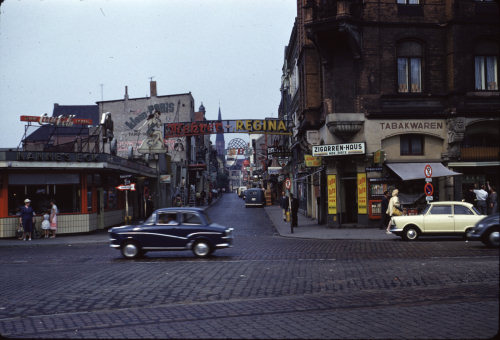
The Reeperbahn is the most famous street in Hamburg. To the tourist it offers bars, restaurants, shops, theaters and clubs, along with sex museums, erotic theaters and strip clubs. The district is the second most popular attraction of Hamburg after the harbor. In the 1960’s the Beatles wooed the German audiences in Hamburg and started their career in various music clubs along the street “Große Freiheit” (literally “Great Freedom”). At the corner of the Reeperbahn and Davidstraße is the most famous police station in Germany. The Davidstraße provides highly visible police protection and makes the area one of the safest ones in Hamburg. The name “Reeperbahn” comes from the old German word “reep” meaning heavy rope. In the 18th century heavy hempen ropes were produced here for sailing ships in the Hamburg harbor. The Reeperbahn does not come to life before the evening hours. So it was entirely safe and proper for us sixteen-year olds to visit this illustrious and somewhat notorious street during daytime hours. Under a heavy cloud cover the area appeared rather drab in the afternoon drizzle. With only a few tourists walking up and down the sidewalk, the street almost looked deserted. So it was not surprising that the employees of the various entertainment centers that were actually open at this time tried all the harder to get customers to come in to take in whatever titillating things there were to see. One of the attendants of such a steamy establishment boldly approached us and surreptitiously suggested that if we were eighteen years old we would be allowed in for free. Rainer and I just shook our heads as a sign of our refusal. We were neither eighteen nor had the desire to get a glimpse of whatever was lurking behind the garish-looking entrance. Besides we found out later that free meant one had to order a beer for twenty marks. No, we were driven by a totally different desire, the desire to spend our surplus money that we had saved up during the past two weeks. I had fifty marks in my pocket, and to my greatest delight I discovered a shop that specialized in radios and other small electronic gadgets. Before the summer holidays I had just ‘improved’ my latest receiver to the point of irreversible damage. Thus I was happy to see a radio within my anticipated price range in the display window. It was love on first sight. Even though guided by the bait-and-switch tactic the merchant did not succeed in convincing me to buy another ‘better’ model. I remained adamant. It was either the one in the display window or no purchase at all. Rainer did not find anything suitable to buy. So we strolled back to the bus station, passing by all those attractions for the pleasure-seeking night owls. With this excursion our vacation trip had come to a remarkable conclusion. Rainer had extra money in his pockets and I another radio in my possession.

Father’s Day Camp-Out

Three Days at Taite Creek

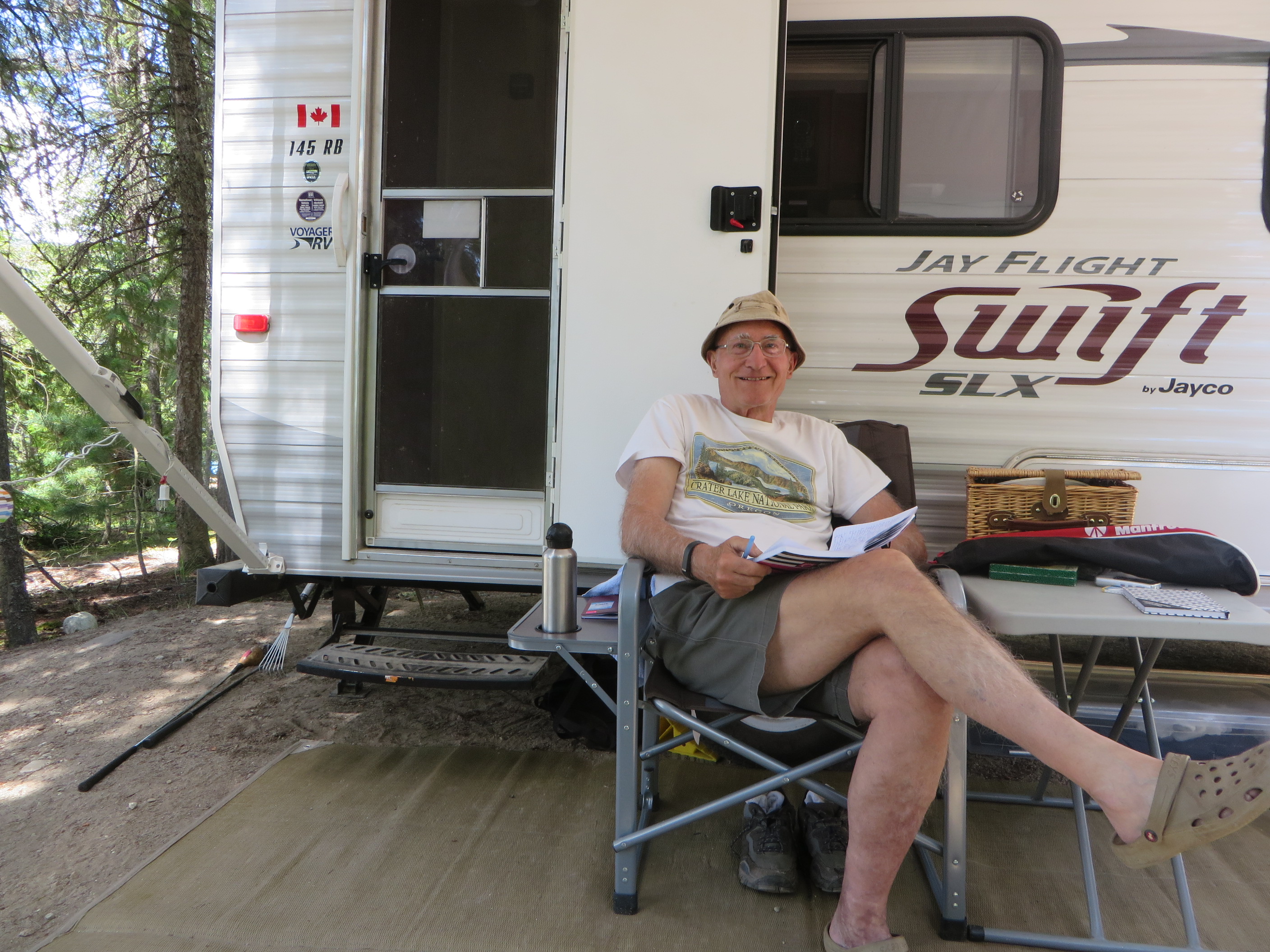
Biene took the school bus to Nakusp on Thursday, where the students attended a number of cultural sessions presented by the aboriginal people of the region. Our Ford Escape was therefore available for me to pull our trailer to the local campground at Taite Creek. I was lucky. Our favorite camp site was still vacant. It offers the most beautiful view onto the lake and is located right above the bocce field, which our son Tony had once built for us many years ago.

IMG_6595

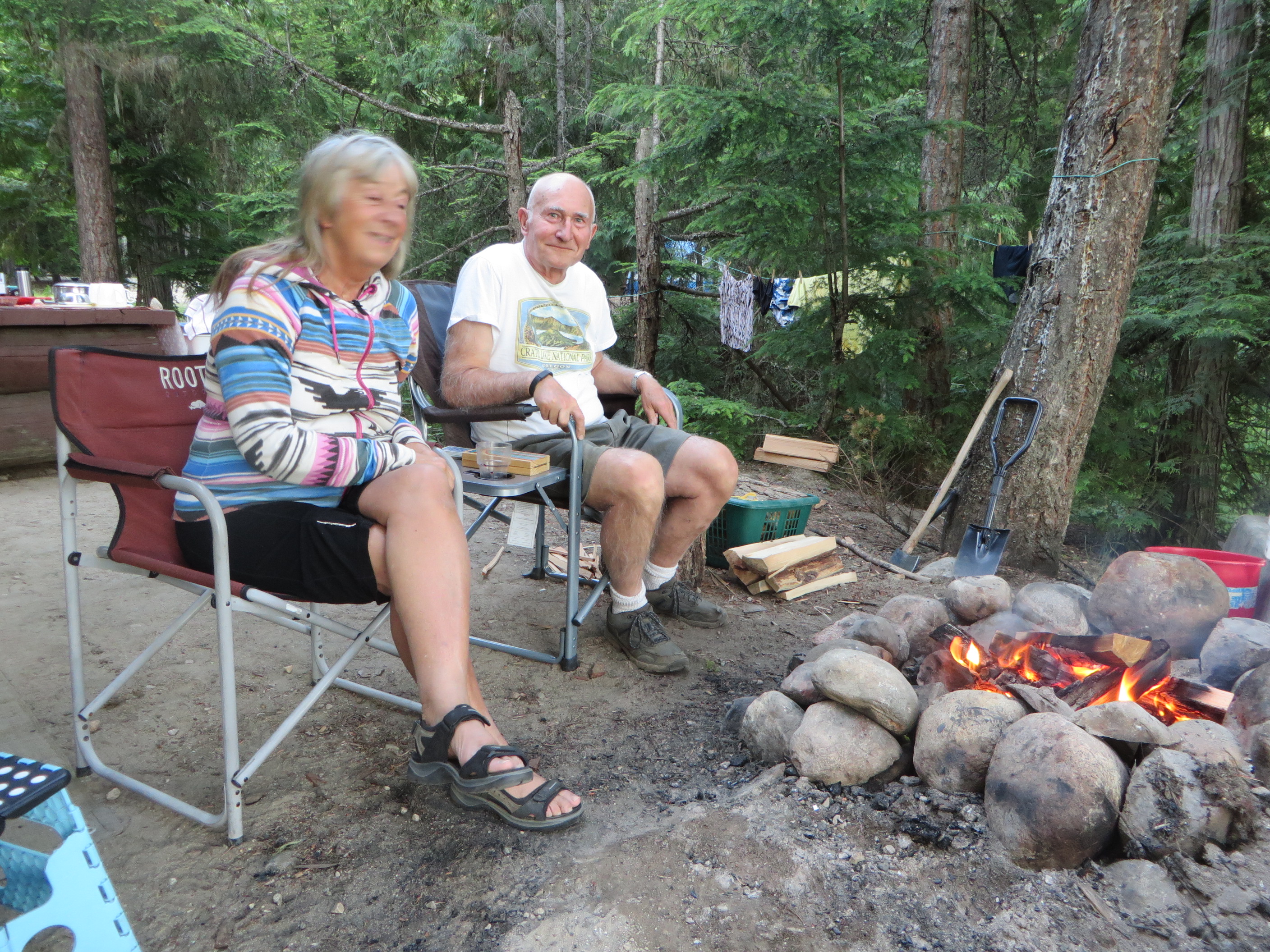
By setting up the trailer and having all supplies ready for a three-days stay, we had almost gained an additional day of camping. Right after Biene returned from Nakusp, we headed out to the lake. After a delicious chicken dinner I made a campfire. I played the harmonica and was amazed to discover how many of the folk songs and scout melodies I still remembered, while I was playing one tune after another. Later on at the crackling sound of the campfire, we started our outdoor crib competition. Soft popular classical music, a glass or two of red wine for Biene and a bottle of Pale Ale added a romantic touch to the relaxing evening atmosphere.

IMG_6655

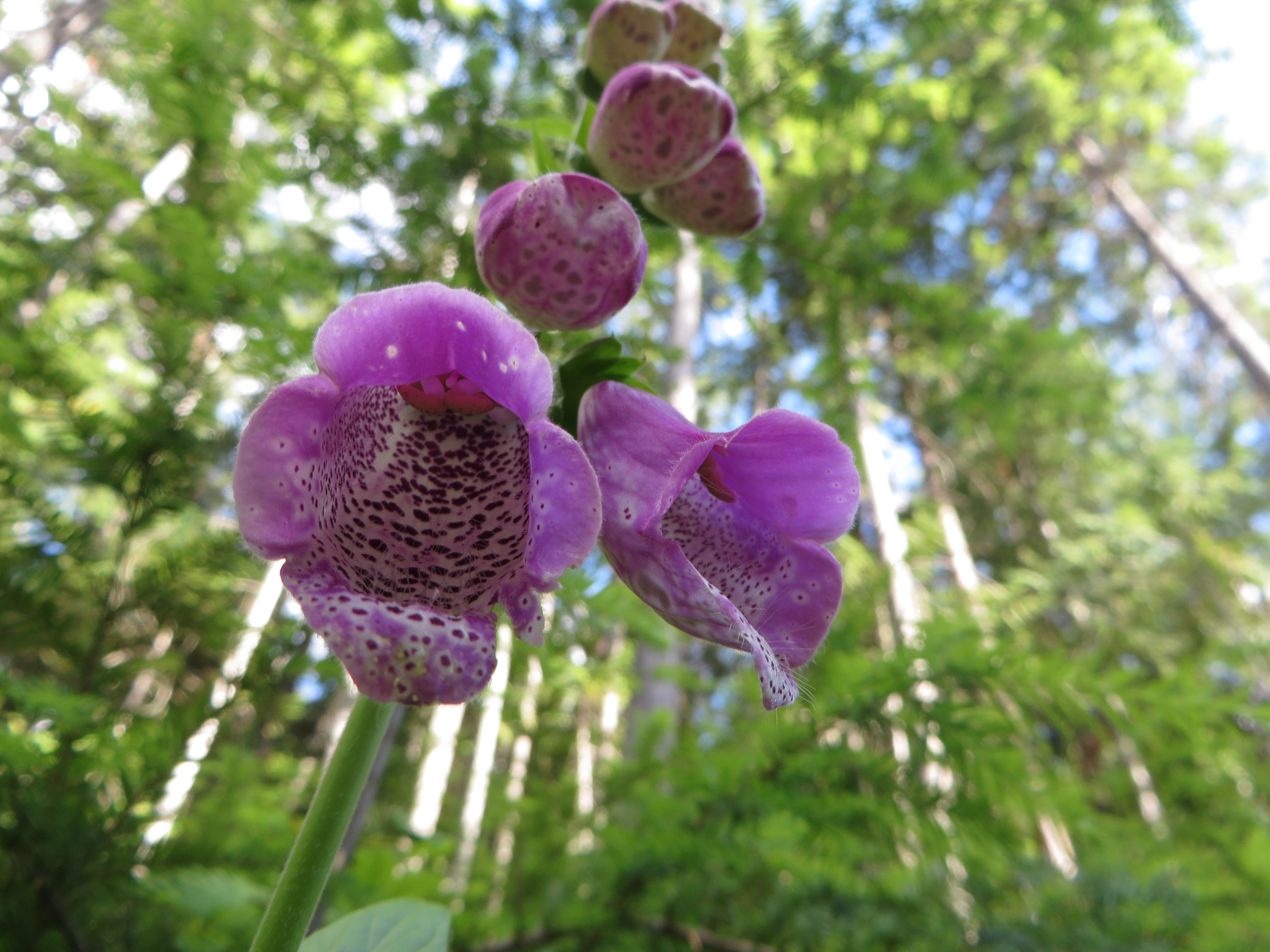
On the following days, which were mostly sunny and warm, Mother Nature provided for body and soul peace and tranquility at the lakeshore and in the nearby woods. In the shade of a pine tree, Biene immersed herself in the fascinating book ‘Suite Française’, while I took walks to the Taite Creek bridge, strolled along the rocky lakeshore, or ventured into the deep forest. Of course, my camera accompanied me on all my excursions capturing images of flowers, some so small that they would escape notice for most people walking by.

IMG_6630

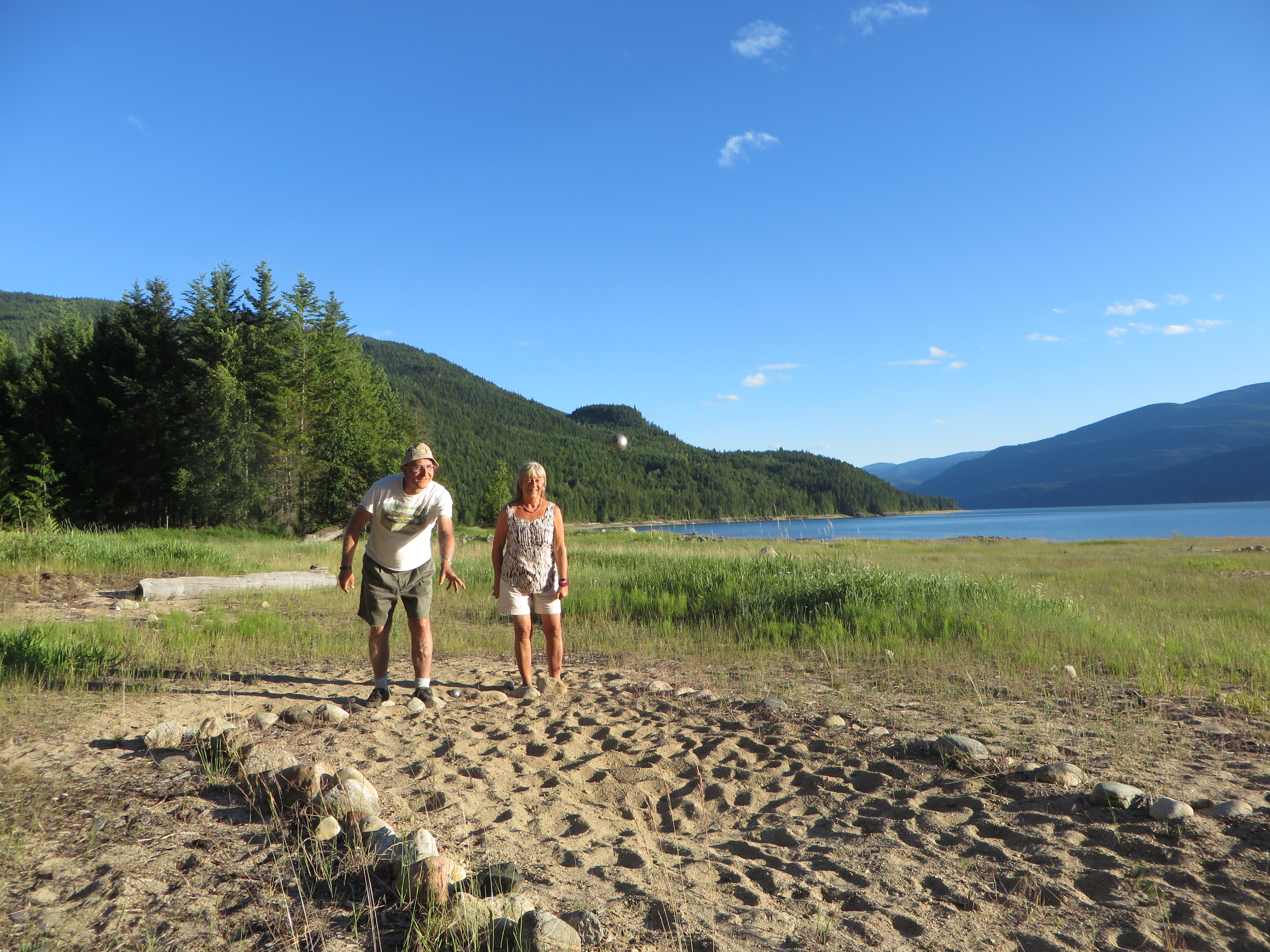
Early in the morning, well before the blazing sun could turn our gaming pleasure into pain, we played a round of bocce. Biene and I are very competitive by nature and often fiercely argue over whose ball is closer to the jack and score the point. However, at the end, we would congratulate each other for having played such an ‘amiable’ game.

IMG_6653

On the night before Father’s Day, we sat once more at the campfire. I opened a bottle of Henkell Dry. While we were chatting and sipping champagne, we listened to our favorite music of the 60’s. At the rhythmic beat of a particularly lively hit from our teenage years Biene spontaneously started to dance. When the rain came later on, we looked at the event as a blessing from above for the tinder dry forests all around us. Cheerfully we withdrew into the shelter of our cozy trailer and listened to the music of the raindrops on the trailer roof, while drifting off to sleep.

IMG_6677 Continue reading

A Most Touching Love Story Written in German – Chart IV – III & IV

Sein letzter Besuch

Beitrag von Norbert Werner

Nach einer Begebenheit „Weihnachtszeit 1942“, gewidmet von Elsbeth Panknin an Paul Werner.

                                                                   Gotha, im Jahre 1943

Sternenklar war der Abend, und pfeifend strich der Wind um die Ecken. Hart klang jeder Schritt, und wenn es nicht so bitter kalt gewesen wäre, so hätte man Lust verspürt, stundenlang spazieren zu gehen, den Blick nach oben, um die Millionen von Sternen zu bewundern. Man kann sich an ihnen einfach nicht satt sehen, so wie man immer und immer wieder ein schönes Bild betrachten muss.

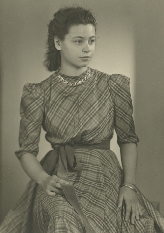
Elsbeth Panknin

Elsbeth Panknin

Das Mädchen ging raschen Schrittes und trug unter dem Arm ein kleines Päckchen. Flüchtig war das weisse Papier um die weihnachtliche Hülle gelegt, und der Wind zerrte daran, als ob er damit spielen wollte. Nachher wird sie das Papier zerknüllen und rasch in die Manteltasche schieben, als sei es nie dagewesen. Dann wird nur die hübsche Packung zu sehen sein. Gewiss wird er sich sehr freuen, und überhaupt sprachlos wird er sein, wenn sie ihn so unerwartet am Theater erwartet …

Das Bim-Bim der Trambahn riss die Gedanken des Mädchens auseinander. Nur im Eiltempo erreichte sie noch die Strassenbahn.- Es war noch sehr früh. „Ich werde einige Stationen weiter fahren, gehe dann langsam zurück, damit ich nicht so lange warten muss.“ So dachte das Mädchen und betrachtete die Fahrgäste, nur um etwas zu tun. Sicher wollten einige zum Bahnhof. Wer fährt sonst um diese Zeit in die Stadt? Das junge Mädchen dort hat sicher Nachtwache, und der Herr dort mit den Blumen will noch mit grosser Verspätung einer Einladung Folge leisten. Alles schaut langweilig und trübe. Es ist doch seltsam, dass man in der Strassenbahn immer dieselben gleichgültigen Gesichter sieht. Nur die Soldaten draussen sind lustig. Sie stehen bei der Schaffnerin und werfen Scherzworte hin, und schlagfertig werden sie zurückgegeben.

„Hindenburgstrasse“. „Ach, da steige ich aus, bis zum Bahnhof ist es doch ein wenig weit.“

Draussen umfing sie starre Dunkelheit, und einen Moment musste sie ruhig stehen bleiben, um sich daran zu gewöhnen. Dann schien es ihr wunderbar hell, und mit leichten unruhigen Schritten ging sie ein Stück des Weges wieder zurück. Im Geiste malte sie sich die Überraschung aus, wenn er sie so unerwartet unten in der Theaterhalle sehen würde. Draussen würde er rasch ihren Arm nehmen mit der ihm eigentümlichen Gebärde, und mit sprudelnden Worten wollte sie ihm den Grund sagen, der sie dazu bewogen hat, ihn abzuholen, und nicht wie verabredet zu Hause seinen Abschiedsbesuch abzuwarten. Dabei würden sie mit Bummelschritten heimwärts gehen. Sie würden sich irgendwie unterhalten über das Theater oder sonstwas, es wäre auch ganz belanglos. Auf jeden Fall würde sie sich die vielen Sterne betrachten und an etwas ganz Schönes denken. Er müsste das eben auch tun. So wäre es schön, und sein letzter Urlaubstag mit ihr fände dann einen romantischen Abschluss, wo sie sowieso die ganze Woche keine Zeit gehabt hatte.

Ja, und dann wären sie auf einmal schon zu Hause gewesen. Sie würde fragen, ob er nicht noch auf einen Sprung mit hereinkommen wolle, ihren Eltern Lebewohl zu sagen. Bestimmt würde er dankend ablehnen, es sei schon sehr spät. Vielleicht hätten sie noch eine Weile vor der Tür gestanden, dann hätte sie ihm zum Abschied rasch mit wenigen erklärenden Worten das Päckchen in die Hand gedrückt, und lachend hätte sie ihm dann ihre Hand entzogen, wäre raschen Schrittes ins Haus geeilt.. So malte sich das Mädchen alles aus.

Die Vorhalle im Theater war nur schwach beleuchtet. Einige Leute standen wartend in den Nischen. Sie warten genauso wie ich, dachte das Mädchen und fühlte eine innere Befriedigung dabei, dass sie nicht alleine war. Die Zeit verging sehr langsam. Manchmal kamen neue Leute hinzu. Eine Frau lief mit immer gleichmässigen Schritten auf und ab. Es klang furchtbar monoton. Einige Jünglinge unterhielten sich auffällig, leise dabei lachend. Sicher waren es Tanzstundenjünglinge und warteten hier auf ihre Damen. Jetzt tauschten sie wahrscheinlich Erlebnisse aus und machten sich über diese oder jene lustig. Es ist doch immer das Gleiche. Schon lange ist der Uhrzeiger auf 21 Uhr gewesen. Da sollte das Stück beendet sein. Aber die Logenschliesser machen noch nicht die geringsten Andeutungen. Gähnend stehen sie vielmehr bei den Garderobenfrauen und horchen manchmal gespannt auf das ersehnte Schlusswort. Unten in der Halle geht die Frau noch immer auf und ab, auf und ab. Ach, das Warten macht furchtbar müde. Es wird übrigens gar nicht so einfach sein, nachher die Menschenmassen zu überblicken, wenn sie alle den Ausgängen zuströmen. Man müsste statt zwei Augen vier haben, um gleichzeitig alle Ausgänge überblicken zu können. Das Mädchen dachte darüber nach, wo es wohl am günstigste sei, sich hinzustellen. Entweder gleich oben bei den Garderoben oder unten in der Mitte zwischen den Ausgängen.

Während sie noch hin und her überlegte, wurden oben die Türen geöffnet. Lautes Beifallklatschen ertönte und erreichte auch die Wartenden unten in der Halle. In die starren Gesichter kam Leben. Die Jünglinge hörten auf zu schwatzen, und auch die Frau stand jetzt still. Das Mädchen lief nach oben zu den Garderoben. Nur einzelne Menschen kamen jetzt. Es waren die Ersten, die gleich beim ersten Herablassen des Vorhanges sich von ihren Plätzen erheben und hinausstürzen. Nun kommen schon mehr, man kann sie bald nicht mehr überblicken, es ist der grosse Schwung. Das Mädchen wird unruhig. So geht das nicht, dachte es, ich stelle mich doch besser unten bei den Ausgängen hin.

Lärmend drängen sich die Leute den Ausgängen zu. Auch viel Militär ist darunter. Ob er Uniform oder Zivil trägt, überlegte das Mädchen verzweifelt. Man kann aber auch schier gar nichts erkennen bei der mangelhaften Beleuchtung. Wäre man doch wenigstens etwas grösser, ach es ist schrecklich. Angestrengt springen die Augen von einem zum andern. Alles geht so furchtbar rasch. Nun kommen schon die Letzten, die Bummler, und noch immer nicht hatte sie ihn entdeckt.

Leise schliesst sie die Haustür auf und legt fast mechanisch ihren Mantel und Hut an der Flurgarderobe ab. Der Besuch war nicht gekommen. Na, ist ja auch jetzt gleichgültig. Einfach sagt sie zu der Mutter: „Ich habe ihn nicht getroffen, es waren der Menschen zu viele.“

Verlassen liegt das Weihnachtspäckchen in der Küche. Es vergehen Minuten, eine halbe Stunde, und niemand kommt. Die Standuhr schlägt die volle Stunde aus. Still bei sich denkt das Mädchen: „Er hat doch noch ein Mädel nach Hause begleitet, sonst müsste er schon längst hier sein. Wie konnte ich nur einen Augenblick seine Natur verkennen.“ Laut sagt sie zu der Mutter: „Er wird nicht mehr kommen. Ich werde zu Bett gehen.“ Sie erhob sich, um Gute Nacht zu wünschen. In dem Augenblick klingelt es. Also kam er doch noch.

Freundlich, als hätte sie ihn so nebenbei erwartet, empfing das Mädchen ihn an der Haustür. Er legte trotz seinem Widerstreben an der Garderobe Mantel und Mütze ab. Dann trank man mit den Eltern noch ein Gläschen Wein zusammen, unterhielt sich dabei zwanglos, fragte nach dem Schauspiel, ob es gefallen hätte und bedauerte, dass der Urlaub schon zu Ende sei. Dann verabschiedete man sich, wünschte ein frohes Weihnachtsfest da draussen im Bunker, alles Gute für das neue Jahr, hoffte dabei auf baldigen Frieden und wünschte zum Schluss noch eine gute Reise. Das Mädchen half ihm draussen in den Mantel, probierte lachend seine Mütze auf und drückte ihm zum Abschied das Päckchen in die Hand. Seine Überraschung und Freude waren wirklich echt. „Du schreibst mir aber auch“, waren seine letzten Worte, die schon im Dunkel der Nacht verhallten, und dann klangen auch seine Schritte immer ferner.

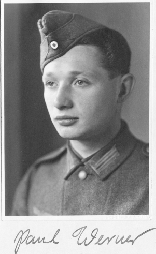
Paul Werner

Paul Werner

Und noch stand das Mädchen und versuchte, sich voll Verständnis in die Psyche des jungen Soldaten hineinzudenken.

Nachsatz

Mein Vater war ab 1940 beim Militär. Nach der Rekrutenzeit kam er 1941 zur Feldeinheit nach Frankreich an die Kanalküste und die Normandie. Im Juni 1944 geriet er bei der Invasion in Gefangenschaft. Von Frankreich ging es über England nach Boston/USA. Die Gefangenschaft verbrachte er vorwiegend im „Camp Perry/Ohio“. Die Rückführung nach Frankreich/Le Havre erfolgte 1946. In französischer Gefangenschaft war er bis Dez. 1947. 1948 heiratet er Elsbeth Panknin.

Sein Kriegstagebuch endet mit den Worten:

„Jetzt gilt es, meine ganze Kraft für den Aufbau des zerstörten Vaterlandes einzusetzen!“

Friedrich Klopp (1875 -1946) Conclusion – Chart I – II

The Last 5 Years of Friedrich’s Life (1941 -1946)

In the summer of 1941 Friedrich Klopp’s eldest son, Friedrich (1905 – 1988), the father of the author Eberhard Klopp, paid the only visit to his family in Gardelegen. During World War 2 family members exchanged a few postcards, which have been preserved and indicate that to a minimal extent some important information, such as deaths, was being passed around in spite of the prevailing family feud.

At one point Friedrich mentioned in his correspondence Emma Klopp, but did not know about her death in 1941, a clear indication that forty years after the deplorable events in Wolmirstedt his sister Anna von Waldenfels (1885 – 1967) had maintained her distance to her brother Friedrich.

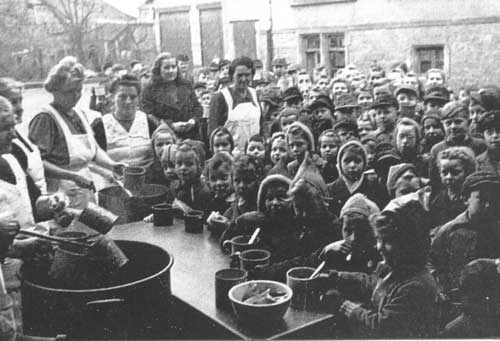
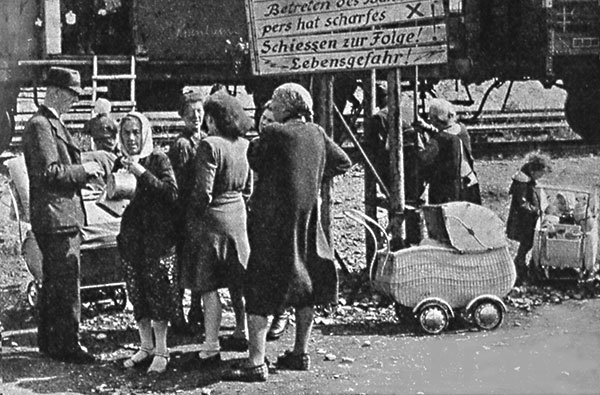
People Gathred around Soup Kitchens - Photo Credit: digada.de

Children Being Fed 1945 – Photo Credit: digada.de

The tragic death of his 9-year grandson Hermann badly shook him up. In the summer after the war Hermann and several of his friends had carelessly played with an anti-aircraft shell, which they had found lying around from old German army stocks. The shell went off with devastating effects. Hermann and several of his playmates were killed. (Chapter XIII of the P. and G. Klopp Story will also deal with the danger of playing with WWII ammunition, which still posed a threat to life and limb in the forests, where battles were fought near the end of war).

In Search of Food and Shelter 1945 - Photo Credit: kiel.de

In Search of Food and Shelter 1945 – Photo Credit: kiel.de

Grandfather  Friedrich died in Gardelegen on November 3, 1946. In the cold and wintry postwar period his eldest son Friedrich succeeded in making the perilous trip from Naumburg to the  funeral in Gardelegen. On his way he had to run the gauntlet of all kinds of armed guards of the Soviet Occupied Zone and also of the Russian military police. They were aggressively searching for former soldiers and ‘other fascists’, black market dealers and smugglers, people crossing the border and those fit to be deported into labor camps. All these men and perhaps women too were the preferred targets in the overcrowded, filthy and unheated trains of those days, Under such conditions in the former Soviet Zone Friedrich undertook the journey of almost two days in a life threatening experience. A special permit of the Leuna Works in Merseburg rescued Friedrich Klopp out of quite a few unpleasant situations. Two brothers and two sisters saw each other for the last time at their father’s grave site.

Here ends the story of Peter and Emma’s eldest child and my uncle Friedrich Klopp.

Chapter XII of the P. and G. Klopp Story – Part II

Baltic Sea 1957

This year marked the very first time that Mother and Aunt Mieze went on a longer vacation since the end of the war. Finances were tight and did not allow anything fancy for food and accommodation. It was decided to go to Möltenort, a small fishing village near Kiel at the Baltic Sea.

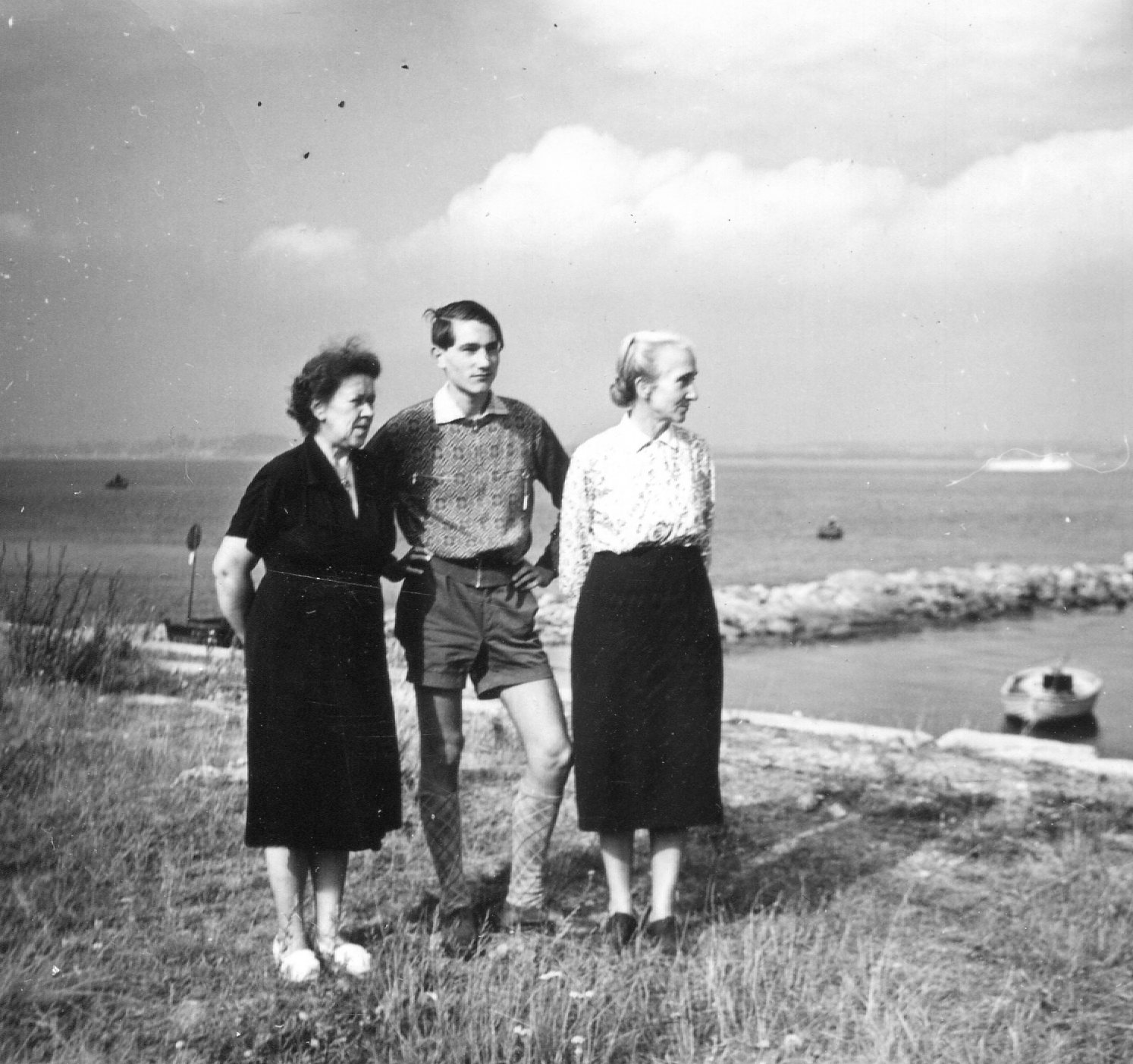
Our Hostess, Peter and Mother at the Baltic Sea

Our Hostess, Peter and Mother at the Baltic Sea

There we enjoyed a pleasant 3-week stay at a humble cottage at the north end of the village. We were blessed with mostly sunny weather that allowed us to spend the daytime hours at the sandy beach. When young and old had been frolicking enough in the shallow waters of the sea, we would withdraw to our roofed wicker beach chair (Strandkorb in German) that Aunt Mieze had rented for a small weekly fee. Apart from offering protection from the cold breeze, they were comfortable and large enough for people to change into dry clothes, sunbathe, read a book, or simply relax. The Germans are very possessive when it comes to claiming a place in the sun. If the less well-to-do tourists couldn’t afford the expense of these mini-cabins, they simply spread a towel on any free spot on the beach. And that was for the rest of the day their very own place that no one else was allowed to touch. But a true German Strandkorb is not complete and does not lend that sense of privacy and security unless you surround it with a wall of sand. Then you truly have that ‘my-home-is-my-castle’ feeling. I soon became friends with a young girl from Berlin whose parents had their Strandkorb next to ours. After swimming and playing around in the gentle waves of the Baltic Sea, we helped each other build the castle walls for our parents. We even thought of making out of wet sand the city crest of Berlin, the emblem of the bear, at the entrance of her castle. Upon Mother’s suggestion we decorated ours with the mystical griffin, the official coat of arms for Pomerania.

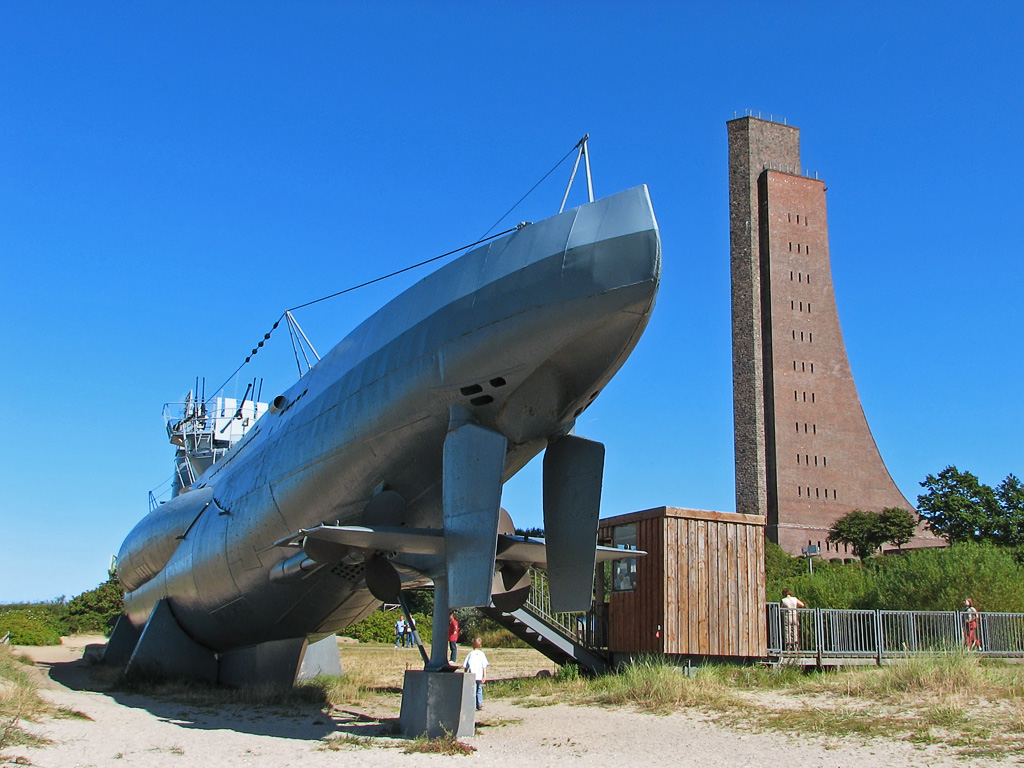
U-Boat 995 and Marine Memorial Tower - Photo Credit: wikipedia.org

U-Boat 995 and Marine Memorial Tower – Photo Credit: wikipedia.org

At the south end of the beach stood in a stark silhouette against the sky the Laboe Naval Memorial. The 72-meter monument originally memorialized the WW1 dead of the Imperial Marine, but now stands for all sailors in the world who died for their services at sea. The monument today consists of an observation deck on top of the tower, a hall of remembrance and a veritable tourist attraction, the German submarine U-995, the only submarine of this class that had survived WW2. I remember how on gray days not suitable for spending time at the beach I approached the awe-inspiring tower pointing its tall front to the sea that had swallowed up many a sailor both in peace and war times. The area around the monument was nearly deserted. Attached to the inside wall was a giant open staircase zigzagging to the observation platform. Leaving Mother behind who suffered even more than I from acrophobia, I climbed up the stairs first very boldly. Then I slowed down and anxiously clung to the railing with its large gaps, which opened up an intimidating view down to the concrete floor below. Near the top I had to stop frequently and close my eyes to fight the oncoming vertigo. But I could not admit to Mother that I was afraid, so in small frightening installments I climbed to the top and was rewarded with the most memorable view of the sea and proudly waved to Mother below as if I had just conquered Mt. Everest.

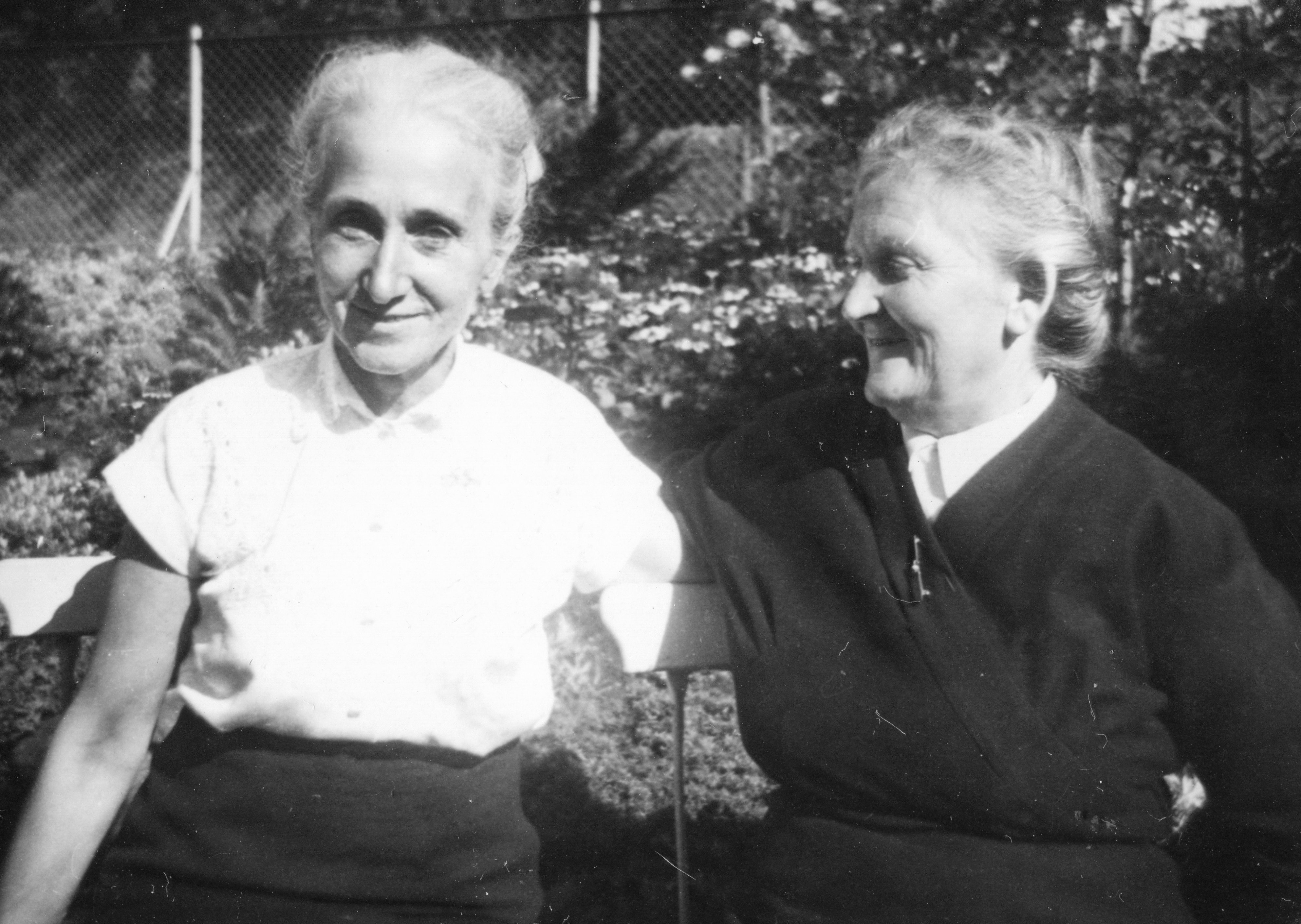
Mother and Tante Ella

Mother and Tante Ella

On the way home, Mother and I stopped by at Auntie Ella’s place. She received me very kindly, as if I had never caused her any grief with those horrendous telephone bills the year before. After a brief visit to the Hamburg harbor and shipyards, we traveled back to Wesel having enjoyed a most relaxing and very happy vacation.