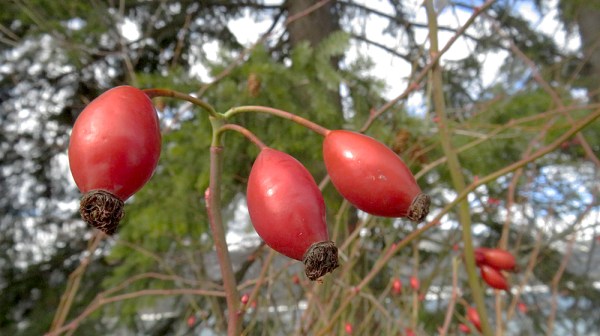
When the sky is gray and the mood is blue, our hearts and minds get a healthy boost at every bit of colour we discover walking over snow and ice. That happens every time the heavy cloud cover is rolled back, although just for a short moment, and the sun lights up the landscape from a blue sky. The rosehips, all dressed in red coats, are particularly pleasing to the winter-worn-out eyes Enjoy.
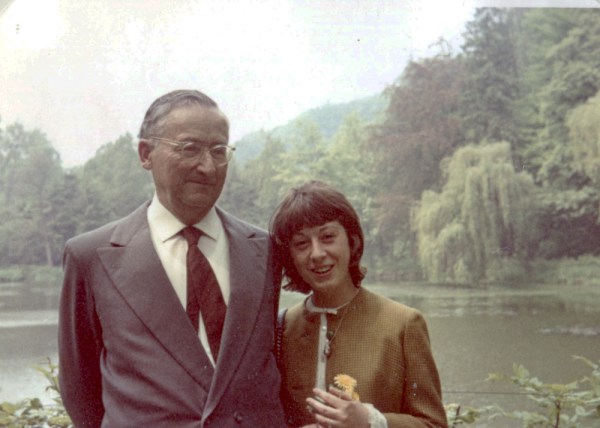
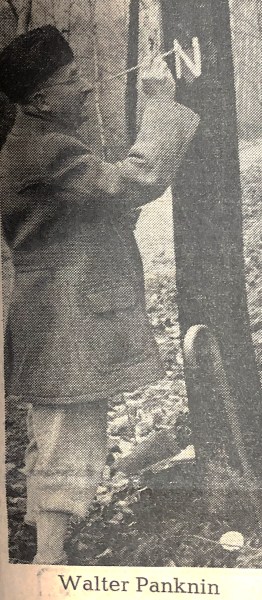
Retired Major Panknin enjoyed being out in nature and helping revitalize old trails that had fallen by neglect into disrepair and marking them by following strict environmental guidelines. While reading over the pamphlet on how to prepare a route for the enjoyment of the hiking community, I was impressed by how carefully the details were described, such as the kind of paint to use, where to place the sign, which trees to use and which trees to avoid. I liked the rule: Better to have no sign at all than a sign confusing by its inaccuracy. His daughter Biene often accompanied him in the rewarding outdoor activity.
What Papa Panknin enjoyed the most was serving as a hiking guide for the frequent excursions through the forested hill country of the Velbert territory. Biene tells me that the participants were primarily women. That may have also been part of the reason why he enjoyed becoming a trailblazer for his club.
During his involvement in the SGV Velbert, he received plenty of praise and recognition for his invaluable contribution from participating hikers, the press and the local club president. In a newspaper clipping, I read how much his work was appreciated. “So we see Walter Panknin walking through the woods with a can of paint and a brush as an apostle of a great idea, of the concept of hiking in the automobile age, leading us back to Mother Nature, to the source of healing power. Walter Panknin selflessly serves this idea for others from person to person.”
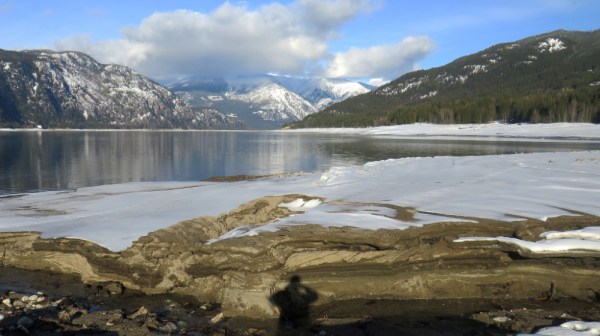
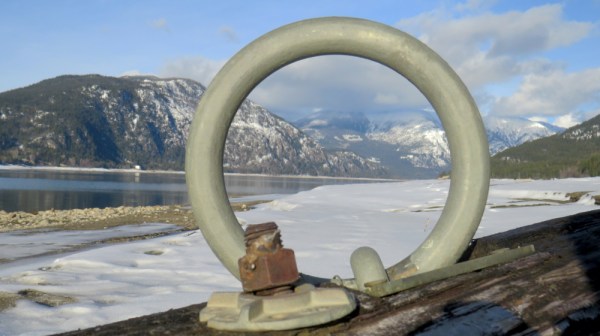
After last week’s ring-framed landscape photo, Steve gave me the idea of getting someone’s face behind the iron ring. So if my wife is willing, I might just try to do that on our next hike. Today I present another landscape photo from the same lakeshore location. While processing the picture, I discovered my shadow at the other side of the Fauquier Creek. Enjoy.
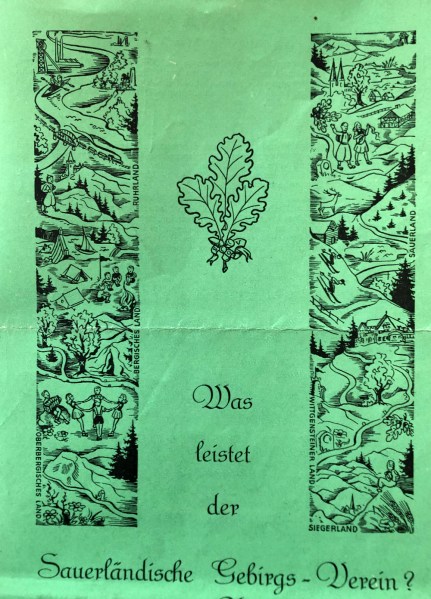
In 1962, my father-in-law joined the Sauerland Hiking Club and remained active until 1967. Living in Velbert, he became a member of the local subdivision founded in 1912. His new hometown is a green oasis surrounded by the big cities Essen, Düsseldorf, and Wuppertal. It is located at the northern border of the mountainous region of Sauerland. The entire organization SVG, of which the Velbert Club is a part, manages a hiking trail network of over 43,000 km. Hundreds of volunteers mark trails, create new ones, digitize maps for the modern hiker, and do the necessary paperwork to run this vast organization.
During his five-year involvement, Papa Panknin took on many tasks. Having had lots of practice with letter writing during his legal battle for justice years before, he did most of the organization’s correspondence, made sure that materials for the hiking trails were purchased and paid for, and even fought a few legal battles on behalf of the club. Like I experienced here in Canada, many landowners believed they owned all the roads, woods, and lakeshores surrounding their property.
The gist of one of the letters he wrote to a government agent, a copy of which is shown below, is the following. “Due to the lack of police officers and other persons in authority, farmers and property owners, to an intolerable extent, started to block the roads and trails leading through their property in various ways. These obstructions often occur without the knowledge of the local authorities ….”
The boat dock beams lie high and dry on the beach, waiting for the water level to rise at the beginning of the spring run-offs. They are connected with iron rings that can be moved in all directions. I turned one ring toward Mt. Ingersoll and took this landscape photo. Enjoy.
Three stories from the apartment of the Panknin family was the communal laundry room located another staircase down in the basement. The management set up a schedule to regulate its usage to avoid congestion and quarrels among the renters. Each apartment unit could only use the laundry room at a given time and day of the month.
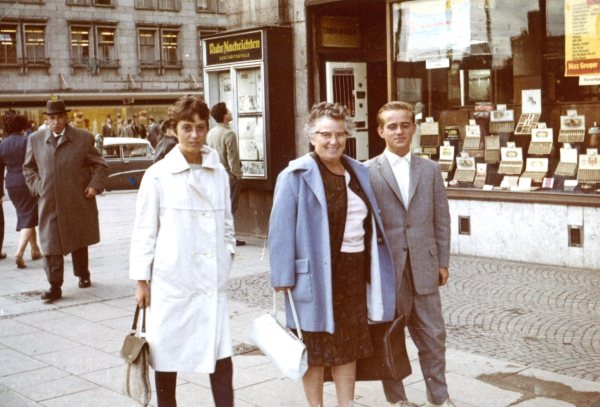
Mutti Panknin and her Twins Gertrud (Biene) and Walter Jn. 1962
So in addition to the shopping routine, Frau Panknin climbed down the three flights of stairs with a heavy load of clothes. In the early 1960s, many women still washed their clothes by hand. Coin-operated washers and dryers were unknown during the post-war years in Germany. For Frau Panknin, the task was laborious and time-consuming. But the worst part of the laundry was yet to come. She packed the wet wash into the basket. Climbing up the stairs with a load now twice as heavy as before, she frequently stopped on the way up to catch her breath. When she finally reached the top floor, there were more stairs to struggle with to get to the attic, where she hung up the clothes to dry. The reader may be inclined to say. Doing this exhausting chore a few times per month was not all that bad for the sixty-year-old housewife. After all, she would have the rest of the time to relax and recover from all that hard work. But wait before we jump to a conclusion.
The apartment had no central heating. The cost of electricity was and still is very expensive in Germany. To heat your home with coal as a source of heat, however, was relatively cheap. Like all the apartment dwellers, the Panknin’s had a small lockable storage facility, where all the things for which there was not enough room in the apartment would be stored. That was also the place where the coal for heating and cooking was located. When I look back some sixty years and ponder about a fair division of labour for this family of four, I must say that it was shocking to learn how Frau Panknin took on this burden without the help from the twins or her husband.

 The Peter and Gertrud Klopp Family