Albert Schweitzer – Seminar #3

Die Geschichte vom Tierbändiger, vom alten Pferd und vom Abendgebet

Die Familie Schweitzer hatte einen Hund. Der hieß Phylax. Dieser Hund mochte- keine Uniformen und biss deshalb Soldaten und Polizisten in das Hosenbein. Auch den Briefträger griff er an. Vater Schweitzer sagte deshalb zu Albert: „Pass auf, dass der Hund niemanden beißt!“ So schnitt sich Albert eine Weidenrute ab und drohte dem Hund damit. Er solle ja nicht auf den Briefträger zu rennen und ihn gar beißen! Der Hund schaute den Albert treuherzig an und wedelte mit dem Schwanz. Doch was Albert gesagt hatte, verstand er nicht.

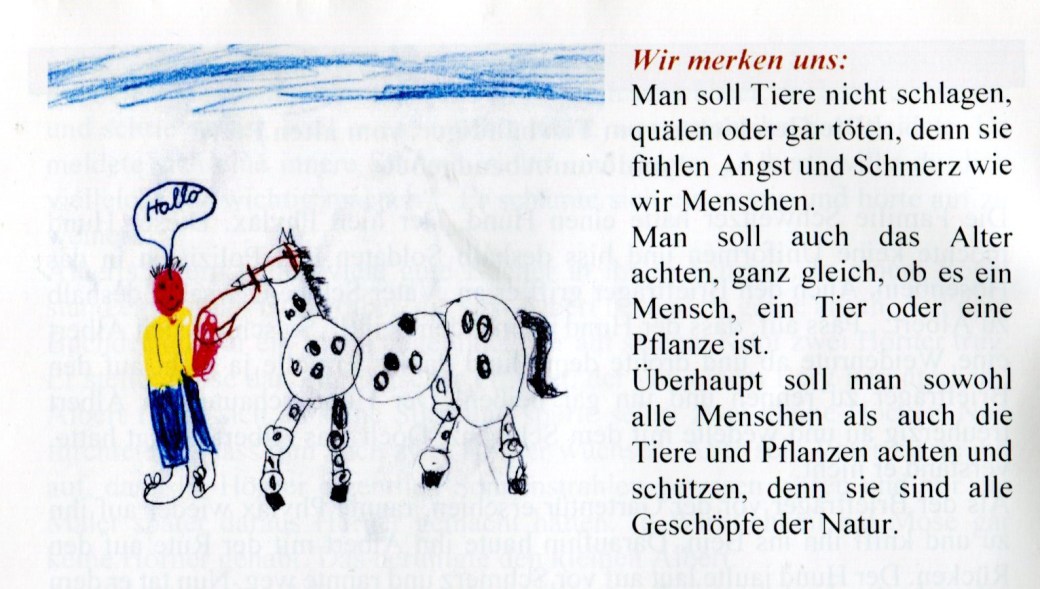
Als der Briefträger vor der Gartentür erschien, rannte Phylax wieder auf ihn zu und kniff ihn ins Bein. Daraufhin haute ihn Albert mit der Rute auf den Rücken. Der Hund jaulte laut auf vor Schmerz und rannte weg. Nun tat er dem Albert doch sehr leid und er machte sich Vorwürfe, dass er das Tier geschlagen hatte. Er hätte ihn ja einfach am Halsband festhalten können anstatt ihn zu schlagen. Dann zerbrach er die Rute und warf sie weit weg. Er streichelte das Tier und sagte zu ihm: „Verzeih mir, Phylax!“ Der Hund schaute den Jungen mit seinen großen treuen Augen an und legte seinen Kopf auf Alberts Knie. Er hatte ihm wohl verziehen und darüber freute sich Albert. Er flüsterte ihm ins Ohr: „Ich will nie wieder ein Tier schlagen, das verspreche ich!“

Eines Tages beobachtete Albert, wie zwei Männer ein altes, hinkendes Pferd die Dorfstraße entlang führten. Weil das Pferd nur langsam gehen konnte, haute es einer der Männer mit der Peitsche. „Wohin geht ihr mit dem Pferd?“, fragte Albert die Männer. „Zum Schlachthof1, antworteten sie ihm. Doch Albert tat das Pferd leid. Es lief mit gesenktem Kopf und schaute ganz traurig drein. Ein Leben lang hatte es fleißig gearbeitet, hatte schwere Wagen oder den Pflug gezogen. Nun aber, da es schwach war und nicht mehr arbeiten konnte, bekam es Schläge und sollte geschlachtet werden. War das nicht schlimm?

Als Albert abends in seinem Bett lag, musste er immerzu an seinen Hund und das arme alte Pferd denken. Eigentlich dachte er an alle Tiere, die von Menschen schlecht behandelt werden.

Deshalb betete er bevor er einschlief nicht nur für die armen und kranken Nachbarn, für die Menschen, die hungerten, überhaupt nur für die Menschen, sondern auch für die Tiere, die Not litten. Er sagte ganz leise: „Lieber Gott, schütze und bewahre alles, was Odem hat!“ Das heißt, er möge allem helfen, was atmet, also allen Lebewesen beistehen.

Seminar 3

THE MINING ERA ON THE CANADIAN COLUMBIA by Late Local Author Bill Laux

My apologies for having missed publishing Bill’s introduction to his book: The Mining Era on the Canadian Columbia. It is a part of Bill’s work and should be published before I continue with Chapter 2.

THE MINING ERA ON THE CANADIAN COLUMBIA

One must take the trouble to find out what is peculiar in each nation; and do it without being infected by its greed.   One must stand apart, a devotee of none, but profoundly and honestly interested in all of them.” 

Elias Canetti

INTRODUCTION

The Columbia River and it tributaries drain the mountainous southeast corner of British Columbia, an area roughly the size of Nova Scotia or the state of Maine.   This triangular region, of some 26,000 square miles, comprising the present East and West Kootenay districts plus the Boundary District, is closed off by the Rocky Mountains on the east and the Monashee Mountains on the west and north. Only to the south, along the international boundary, does the Kootenay-Boundary region lie open to easy entry up the river valleys which drain its mountain slopes.    Within this great triangle, moated by the encircling Kootenay and Columbia Rivers, the space is wholly filled by closely spaced, north-south trending mountain ranges, from east to west the Selkirks, the Purcells, the Valhallas, and the Rossland and Boundary Ranges of the Monashees, with their intervening lakes and river valleys.    It is a folded and crumpled landscape of high, forested mountains, and deep, narrow valleys with but very few riparian strips suitable for farming.     With scant agricultural potential, and formidably difficult of access, except from the U.S., it has always been one of the hinterlands of British Columbia.   Indeed, it should have remained as empty as the Omineca, but for one circumstance it contained rich deposits of valuable minerals.

Had it not been for the presence of gold, silver, copper, and coal in quantity, costly mountain railways would never have been built into Kootenay-Boundary.   Nor would the Americans have been interested in entering this isolated region to prospect and mine.   Without the mineral wealth which brought the railways, there would have been no settlement at all, save for perhaps a few ranchers shipping cattle into the Spokane market.      

The Mining Era on the Canadian Columbia, the period from 1854 until 1929, was largely  American inspired, American financed and supplied.   The mineral deposits of the Kootenay and Boundary Districts were close to the border, in some cases straddling it.   They were relatively easy of access by American trails, roads, steamer routes, and railroads from the growing inland entrepot of Spokane.    Capital to open and develop the mines was available in Spokane at a time when the coastal merchants of British Columbia had turned their backs on the Kootenays after two unfortunate experiences.   For them it was a district too isolated behind its mountains, and too dominated by Spokane interests to make it a worthwhile risk for their capital.

Only when Canadian railroads and steamer lines penetrated this mountain-ringed fastness did Canadian and British investors enter to buy back its mining assets from the Americans who had been first on the scene.

The period of American incursion and the great mining boom left its mark on the Kootenay-Boundary.   As the automobile era began in 1920, Interior British Columbians were driving on the right hand side of the road, as did the Americans, while motorists in Vancouver and Victoria drove on the left.   Kootenay and Boundary families did their Christmas shopping in Spokane, a few hours away by train or down easy roads, rather than take the longer train trip  to Vancouver.   If an auto trip to the Coast was necessary, one crossed the border, and used the U.S. highways.   There was no road connection at all between the Interior and the Coast until 1927.      

The easy entry into Interior British Columbia from the U.S., and the commercial aggressiveness of the Americans had always been a matter of anxiety to British Columbia governments, both Colonial and Provincial.    From the year the first group of Oregon-bound settlers laboured across the summit of the Blue Mountains in 1820 into the vast basin of the Columbia River, the Colonial officials of the British lands in the Northwest began to fear an American invasion and possible annexation.    These armed and often unruly American settlers were steeped in the doctrines of Republicanism, self government, and, especially dangerous in the British view, “Manifest Destiny,” the assertion that Americans alone had some special, quasi-divine right to rule and enlighten the entire North American continent, from the North Pole to Panama, and from the Atlantic Ocean to the Pacific.     In the mouths of their jingoistic politicians, “Manifest Destiny” became an incitement to military conquest, and a continuing nightmare to the rulers of British North America.

 Had the British reflected, they might have seen that “Manifest Destiny” was simply the American version of their own Imperial Doctrine, which held that the English, by virtue of their uniquely stable government, and supposed talent for wise rule, were favoured  by God as the prime civilizers and most capable administrators of the globe.

The lands that became the Colony and later the Province of British Columbia never suffered the feared American invasion, but were subject to successive incursions of preponderant numbers of  Americans with a single object in view the availability of gold, silver, and copper to the man who would dig it.     These sudden rushes of armed and populist Americans across the line, mouthing the slogans of greed, and ruthless exploitation,  changed the culture and customs of British Columbia.    From a lethargic Crown Colony, with a British Naval Base, ruled and dominated by a single London trading corporation, autocratic, class bound, and unashamedly monopolistic, British Columbia was suddenly plunged into a wild, fast-profit mining economy.   Its citizens,  influenced by the get rich quick values of San Francisco, became fierce exploiters of the hinterlands, grasping for huge, unrepeatable profits in minerals, fish, timber and ranch lands.  The province, for its first fifty years was a turbulent, unruly, scarcely governable region of unrestrained private plunder and  official corruption, obsessed by a piratical fever to rush in, seize the resource, and get out swiftly with the gains.

The Colonial Governments were obliged to bend their laws, and even to recast them to accommodate wishes of the overwhelming number of American miners moving onto their soil.        Imperial mining laws were revised to conform with those in the U.S.    In all but one of the the rushes, Americans outnumbered  British fifty to one, and were accustomed to making their own law as they had in California.   The Colonials had to accede or risk a confrontation with a superior force.   To the horror of the Colonial Office in London, coins were minted of miners’ gold in American denominations.    American dollars were the universal medium of commercial exchange, only the Government and the Hudson’s Bay Company kept their accounts in pounds sterling.     Further, as the merchants found their own bonanzas in provisioning the successive gold rushes, they actively catered to them, subsidizing ship passage for gold seekers, circulating handbills and advertisements in California and Oregon cities to solicit placer miners, and promising easy and well traveled routes to the gold fields.    To accommodate the miners and the B.C. merchants’ efforts to supply them, the government built roads and trails to the mines, and an armed Gold Escort service was maintained to transport the miner’s bullion to the B.C. mint.     

The scarcity of arable land and the severe disincentives put in the way of independent agricultural immigration by the Colonial Government prevented the Nineteenth Century province from developing a typically Canadian political base of independent farmers, stable and conservative.    Instead, a wholly exploitive society of speculators evolved, not seeking land, but rather its plunderable resources.   Miners, gamblers in their souls, later fishers, mining the coastal waters,  ranchers, exploiting ever larger acreages of public grasslands, and lumbermen, stripping the mountains of their forests, created the buccaneer values of this isolated Province, values which still dominate its turbulent and murky politics.

The first Colonial Governors had apprehended an American attempt to seize their Colony by force, and discouraged by restrictive legislation, any American immigration which they feared might lead to annexation.   The later Governors and Premiers sought to cash in on the gold rushes by advertising them in the manner of a World Fair.   Miners, they learned with relief,  seldom settled, and could be counted on to safely leave when the gold ran out.   Meanwhile they could be provisioned at great profit.    This continuing obsession with easy riches, with the high stakes gambles of mining, fishing, and lumbering, left an unacknowledged  mark, a looter’s mark, on the consciousness of British Columbians.

In the great railway building era from 1896 until 1916, the Provincial politicians dangled railway charters with huge land grants to entice Americans and Canadians alike to build a railway network into the southeast of the Province to develop the mineral potential there.    It became a somewhat cynical game, baiting with grants of cash and lands the American companies to build the lines which would force Canada’s reluctant national railway to extend its own competing tracks into the area.   The always commercially aggressive Americans built quickly; the more deliberate Canadian Pacific was forced to respond with tracks of its own.

  In the Kootenay-Boundary districts, the American incursion and the inauguration of the mining industry by American capital was chauvinistically forgotten as British and Canadian financiers after 1895 bought back the industry from the Americans, and with the exodus of U.S. mine owners, Kootenay-Boundary society became, for the first time, Canadian, only its distinctively U.S. architecture betraying its origin.

The mining era had brought in the costly railroads to move the ores out and coal and merchandise in.    With the decline of mining, the presence of this rail network on the ground encouraged the development of a forest industry utilizing these easy export routes to U.S. markets.     In a reversal of mining history, the major forest enterprises begun by Canadians in the 1920s were acquired by American firms in the 1950 – 1990 period.    When, as is bound to happen, the profitable timber is gone and the American firms, like their mining companies, leave, the Kootenay- Boundary will likely become another Yukon, living on seasonal tourist catering, and romanticized versions of its past for the entertainment of visitors.

It was the exploitation of minerals, and nothing else, that brought the railways, the population, and supported the tiny pockets of agriculture in this sea of mountains.   How that mining era began, flourished and declined, and the changes it wrought along the Columbia, the Kootenay and the Kettle Rivers is the subject of this work.    
Albert Schweitzer – Seminar #4

Die Geschichte von Alberts Schulanfang

Es war Herbst und die Blätter an den Bäumen färbten sich bunt. Der Wein an den Hängen der Berge begann zu reifen und die ersten Trauben schmeckten schon süß. Es war die Zeit, in der das neue Schuljahr begann. Der kleine Albert wurde eingeschult, das heißt, für ihn begann nun auch die Schulzeit. Eine Zuckertüte bekam er nicht, denn die kostete zu viel Geld. Ein Pfarrer verdiente ja nicht viel und außerdem hatte Albert noch vier Geschwister, die essen und trinken und angezogen sein wollten.

Aber Albert hatte keine Lust, in die Schule zu gehen. Er wollte lieber wie bisher draußen spielen. „Ich gehe nicht in die Schule und brauche nicht zu schreiben und will gar nichts lesen und schon gar nicht viel rechnen!“, brummte er.

Doch sein Vater schob ihm einfach die Schiefertafel unter den Arm, nahm ihn bei der Hand und ging mit ihm auf der Dorfstraße hin zur Schule. Auf dem ganzen Weg musste Albert weinen. Er brummelte vor sich hin: „Ich will aber lieber spielen und nicht immer nur auf der Schulbank sitzen!“

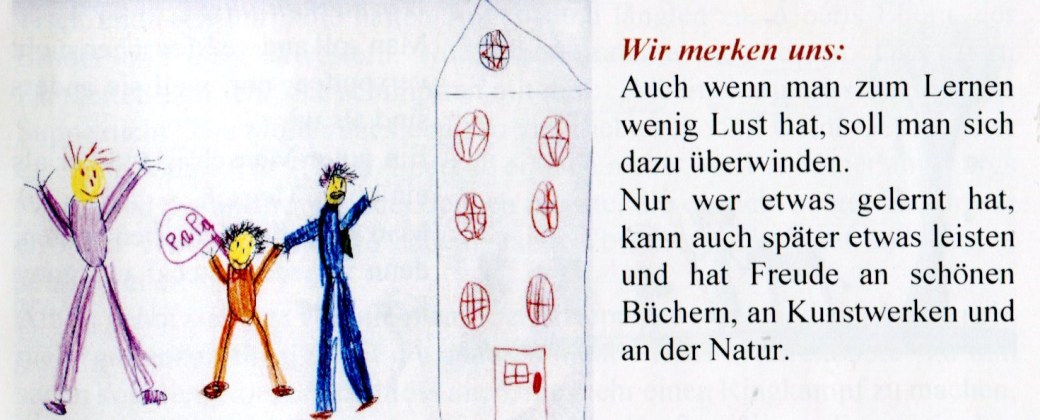
Albert gewöhnte sich aber dann doch an die Schule, weil alle seine Freunde im Klassenzimmer neben ihm saßen und er auch Spaß daran fand, lesen und schreiben und rechnen zu lernen. Manchmal träumte er aber auch im Unterricht und dachte an etwas anderes als der Lehrer gerade erzählte. Dann musste ihn der Lehrer ermahnen, aufmerksam zu sein und zuzuhören. Sonst würde er ja nichts lernen. An seinen Hund, an die Blumen auf der Wiese oder an die Spiele mit seinen Freunden könnte er nach dem Unterricht denken.

Später erkannte er, wie wichtig die Schule doch ist. So erlernte er nicht nur das Lesen, Schreiben und Rechnen, sondern auch fremde Sprachen, erfuhr von anderen Ländern und Menschen und viel über die Natur, was er bisher noch nicht wusste. Besonders die Geschichte interessierte ihn sehr, wie die Menschen früher gelebt und gearbeitet hatten, woher sie kamen und wohin sie zogen. Angst bekam er nur immer, wenn er von den vielen Kriegen hörte, die die Menschen gegeneinander geführt hatten.

family191

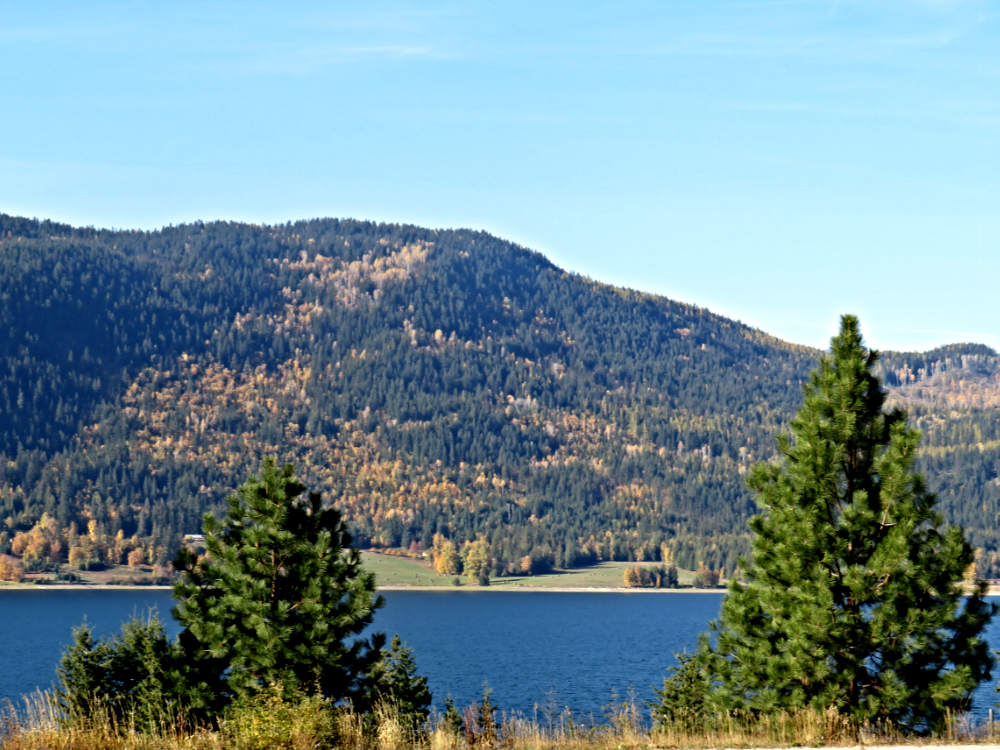
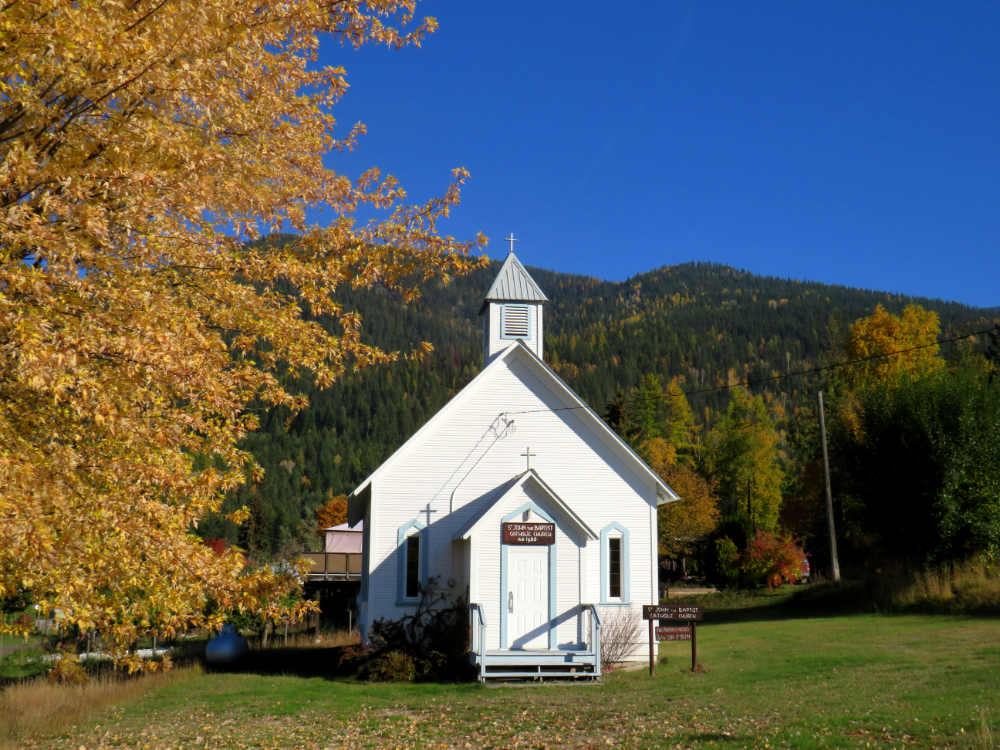
Natural Splendour of the Arrow Lake

Wednesday’s Photos

Autumnal Colours

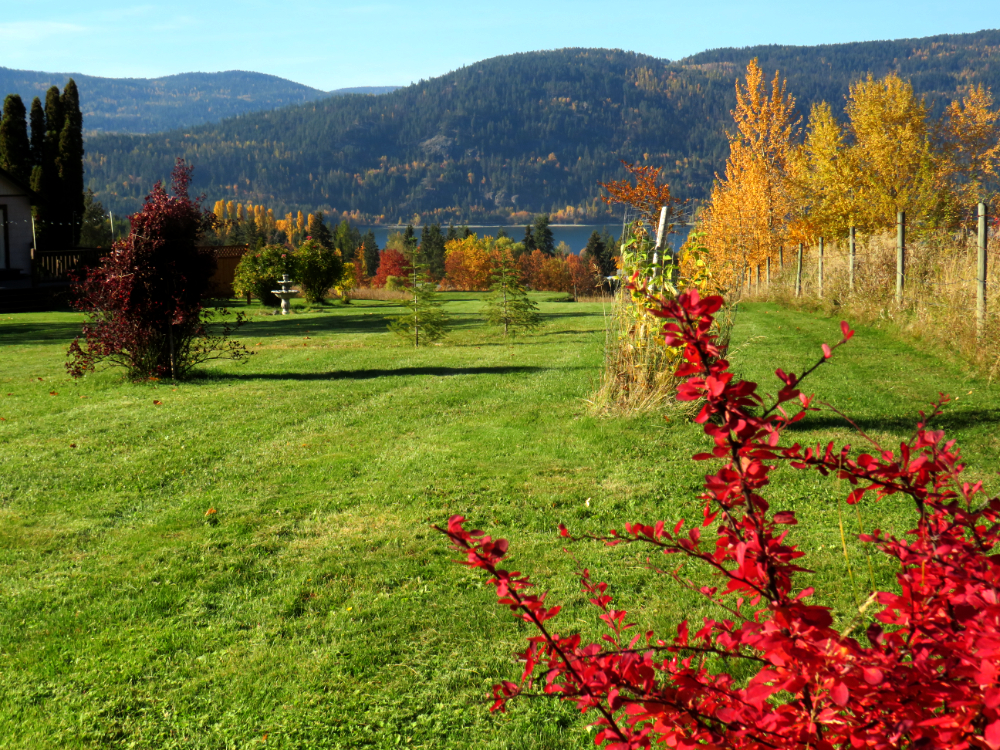
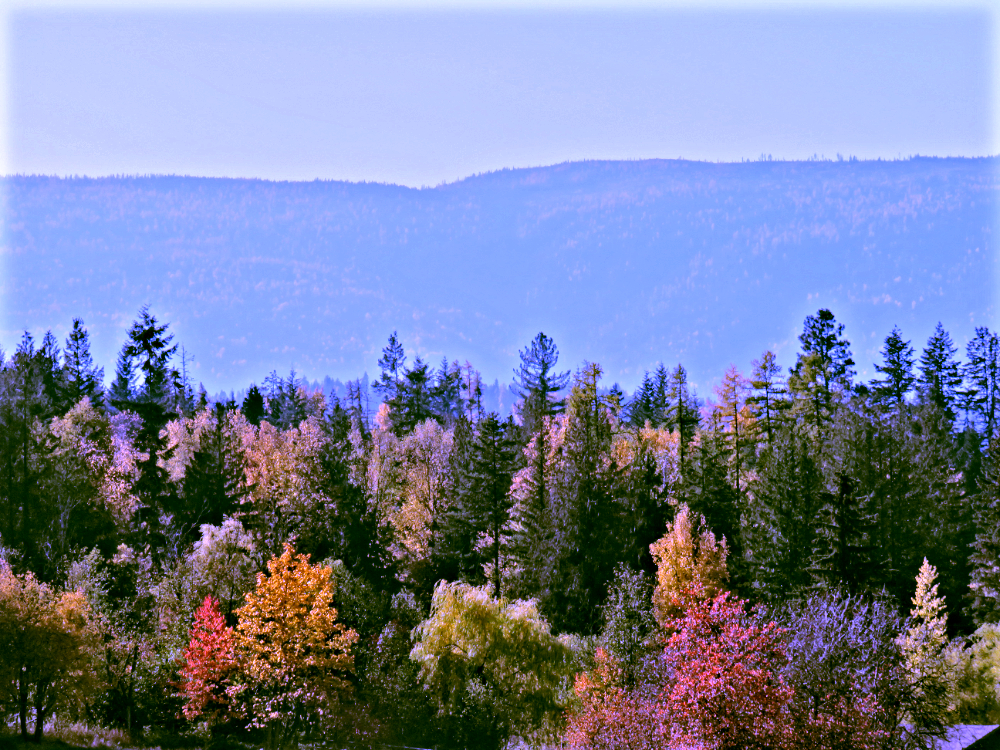
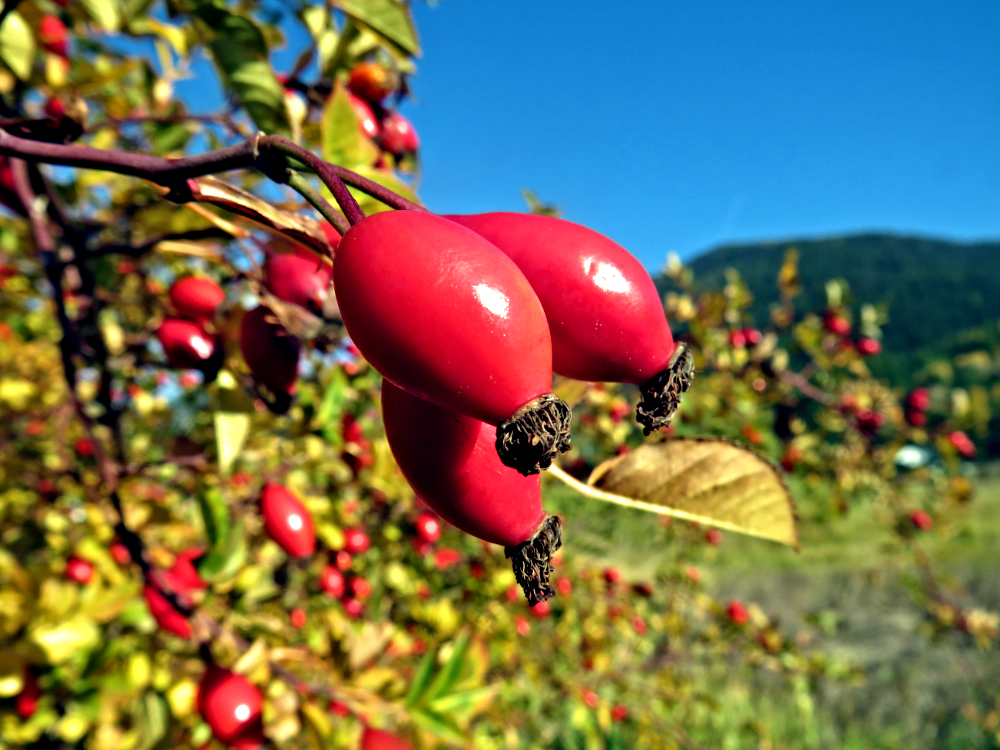
As Fauquier last week was basking under the bright sunshine with not a single cloud in the sky, I decided to go for a leisurely walk around our little community. We did not have a frost yet. So the fall colours did not include as much red as in other years. The rose hips helped a little to make a small contribution to my favourite fall colour. Enjoy.

IMG_4914EDIMG_4917EDIMG_4921EDIMG_4925EDIMG_4938ED

The Peter and Gertrud Klopp Story Chapter XIX

Alone at the Siemens Apartment Building

“Study hard, for the well is deep, and our brains are shallow.”

Richard Baxter

In search for a place to spend the next six months Mother had found a mini-apartment in a huge building complex that had been specifically built for single workers in the local Siemens factory. Small it was indeed. The room I called my own covered hardly an area of fifteen sq. m. I shared the hallway, which contained a few basic kitchen facilities, with an older man next door, who fortunately moved out before Christmas with no one moving in to replace him. On the right side of the hallway was the common bathroom with a shower instead of a bathtub. In spite of the limited space I was extremely happy to have my own four walls with a large window and even a tiny balcony facing the rising sun.

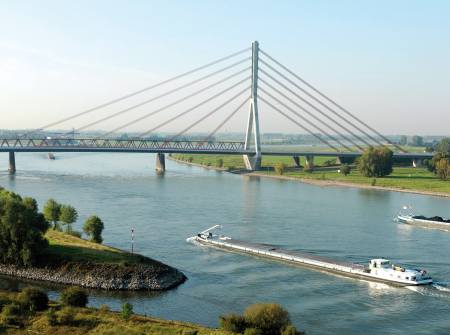
Wesel at the Rhine

It was from here that I wrote my first letter to Biene’s twin brother Walter at the end of August. As promised I included schematics of electronic circuits that I thought might be of interest to him. Of course, I had not forgotten Biene, whose image began to fade in my mind, but whose idealistic afterglow I cherished all the more. “And do not forget to greet your parents and Biene from me,” I ended this letter and all subsequent ones. Walter promptly replied and inserted an advanced RC transistor diagram that was far too complex for me to understand or to be useful for my simple projects. But the desired connection had been made, and before long Biene and I were corresponding with each other. There were two important aspects to the letters, which were traveling back and forth between Velbert and Wesel. One, they opened a window and brought bright sunshine and fresh air into the often gloomy, stuffy interior of my soul; two, due to the physical distance we could write about our thoughts and feelings, wrapped up in a flowery language, carefully worded and lovingly presented. We opened our hearts to each other and discovered that we both had a romantic vein that was rich and seemed to be inexhaustible. In short, the seeds of our developing relationship had fallen on fertile ground. For me in particular, the correspondence proved to be a journey into the wonderful world of self-discovery. I enjoyed creating written tableaus depicting dream-like, often melancholic scenes with fact and fiction imaginatively intertwined. They engendered in a perpetual cycle an ever increasing sense of self-awareness. Reminiscing about a stopover at a railroad station I once wrote her.

Wanne-Eickel 22:10

          Over the railroad station sways the moon. Its pale light flickers through dense patches of fog, and the moist shimmering rails vanish behind the impenetrable wall of uncertainty. I am pacing the empty platform up and down, three minutes forth, and three minutes back. Slowly, hesitatingly the heavy hand of the clock advances from one-minute mark to the next. Lost in thoughts I look up to the moon. The cold, damp forces of nature’s power attempt to snuff out its golden light. But it is not you, good moon, who are eluding me, you, the embodiment of all my happiness. No, around me lurk the cold forces; they seize me with their moist fingers. Oh happiness, you would always dwell among people, if darkness were not all around us that hides you and saddens my heart. Two lights emerge from out of the fog. They have a goal; they glide over solid tracks. I can put my trust in them. In vain the dense fog is clutching to hold the iron vehicle; it cannot delay its course. I step onboard. 22:20

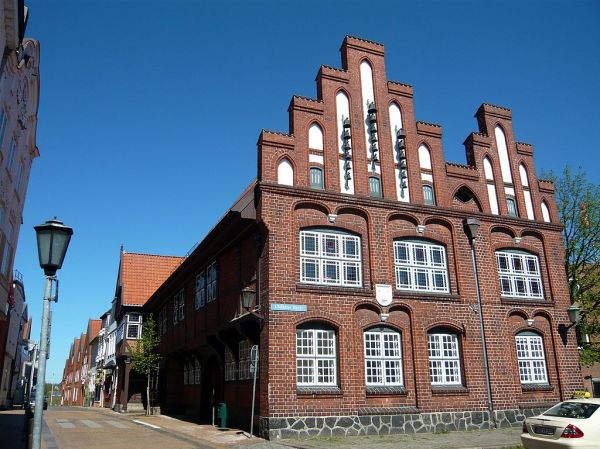
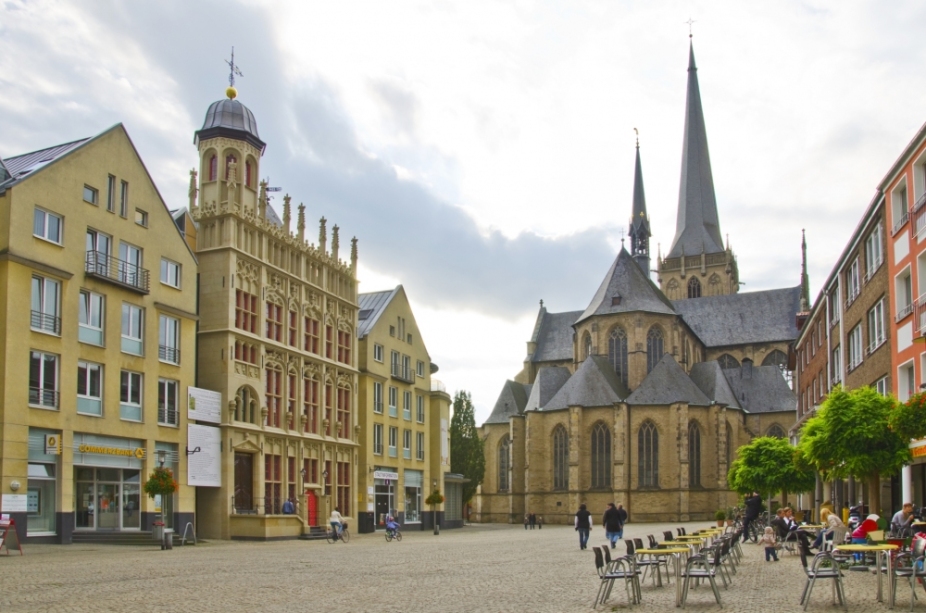
Old City Hall of Rendsburg - Photo Credit: wikipedia.org

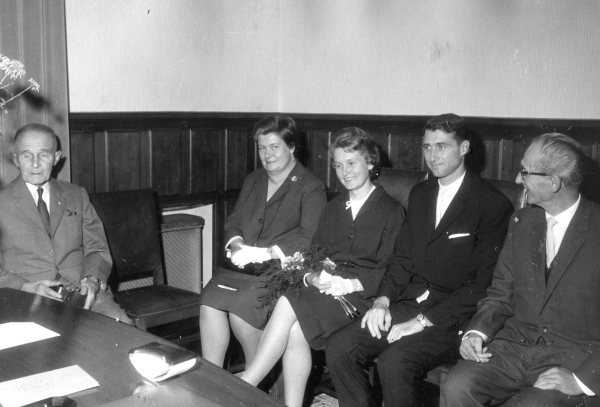
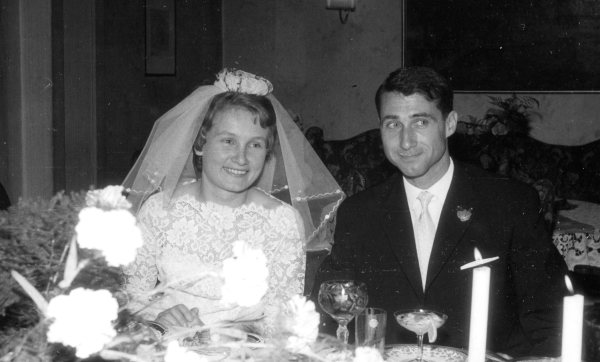
Shortly after I had written the letter to Biene with its sentimental railroad story, I traveled by train to Rendsburg in Northern Germany to attend my eldest brother’s wedding. Karl’s bride was Ingrid Lehmann, born in Königsberg (now Kaliningrad), East Prussia, whose father was a retired sea captain. Karl was making sure that everything was prim and proper for the festivities. He checked out my clothes and appearance very carefully and was quite pleased with the new suit I was wearing. Even though I had shaved in the morning, Karl spotted the beginning of new growth darkening the area around my chin and requested for the sake of the important event another shave. Putting my usual stubbornness aside, I complied with his request.

Wedding Ceremony at City Hall

With almost all close relatives present it was a memorable wedding. At the banquet Captain Lehmann and Uncle Günther solemnly delivered words of wisdom, reflections on their lost home provinces in the East, fine speeches, which were recorded on tape and can still be heard today on audio CD. It was here in Rendsburg that for the first time I was seriously contemplating about what it would be like to tie the knot and form a life-long partnership in marriage. I also began to see that hard work at school and university must come first to realize such dreams. I thought that as an electronics engineer I might have a fairly good income to support a wife and family.

Karl and Ingrid Klopp (Lehmann) at the Wedding Banquet

One Drink Too Many

550_6_historische-rathausfassade--grosser-markt-flaggschiff-film

When I returned from my brother’s wedding, I resolved to be more goal-oriented, to study hard, to raise myself above mere mediocrity to an academic achievement I could truly be proud of. On the wall hung the work schedule, which I had imposed upon myself outlining a rigorous timetable: getting up at six, attending school from 8 a.m. to 1:30 p.m., taking some time off till three, doing homework and studying till five. After supper followed another two hours of intensive study. I had a lot of catching up to do. An hour before it was time for me to go to bed. usually around ten o’clock, I critically reviewed my day. And if according to the work schedule I had passed the test, I rewarded myself (and only then) with a small shot of vodka and let the pleasant warmth penetrate my body as a form of instant relaxation. The master allowed the slave to temporarily forget the self-imposed burden. At moments like these I would grab my guitar, play a few simple classical pieces composed by Carulli, or take out the harmonica and strike up a potpourri of folksongs, pop music or my favourite scouting melodies.

Bild 62

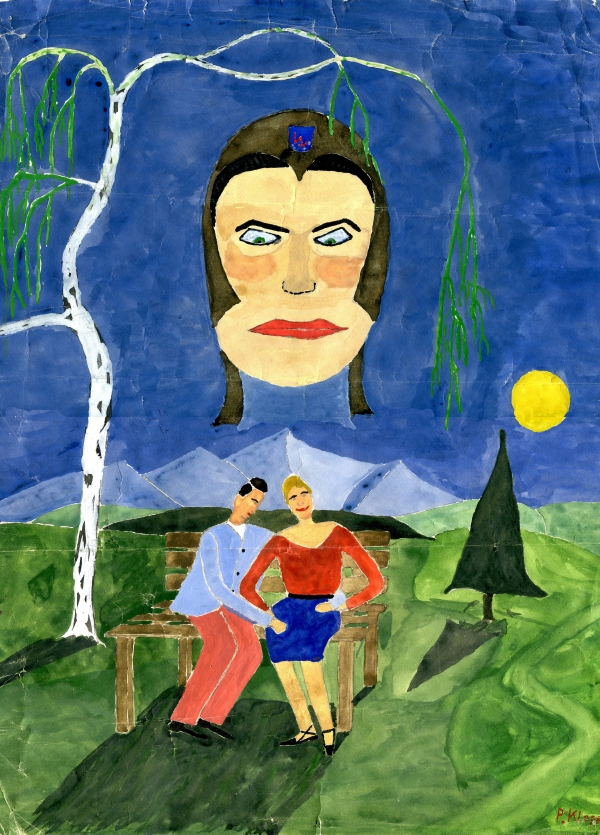
Water Colour by Peter Klopp 1962

At times when I felt in a creative mood, I would open the metal box with a dozen or so water colours and try my untrained hands to paint a picture often with a futuristic theme inspired by my voracious reading of science fiction novels. One picture (see above) depicts a romantic scene showing a young couple sitting on a park bench under the light of the full moon. High above the horizon towers the head of a helmeted space woman of a distant century in the future, whose envious eyes are glaring down on the romantic couple below.

          Wilhelm, my classmate, came to school from a neighbouring town. His father produced apple juice, with which he tried to compete with the popular Coca Cola product that was making economic inroads into the German beverage market. Wilhelm once demonstrated in our school how corrosive coke was by filling two glasses, one with his father’s apple juice and the other with coke. He then threw an iron nail into each glass. In the following week, when we entered the chemistry lab, we were astounded by what we saw. The nail in the glass filled with coke was completely encrusted with rust, whereas the one in the apple juice was still shiny and unaffected. However, we failed to see the connection to the possible ill effects that the popular drink might have on our sensitive stomach linings.

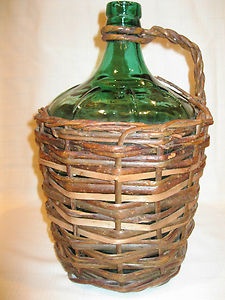
          It was about two weeks before Christmas, when Wilhelm came up to my apartment and brought me a 10-liter jug of apple juice. I placed it on the hot water radiator. Without the aid of a wine making kit with its expensive accessories we embarked on producing a cider by letting Mother Nature do the job. After only a few days I could report to my friends in school that bubbles were rising in the bottle, a certain indication that the process of fermentation had begun. Hans, Helmut, Wilhelm and I were already looking forward to our Christmas break party with the potent apple wine in the making. Soon the bacteria finding ample food in the juice and turning the sugar into alcohol multiplied a million times over generating COat first weakly fizzing, then growing into a crescendo very much like the sound of rushing waters. Finally the bacteria had done their duty, and the homemade cider was ready for the party. School was out. In the New Year the final race would come to the finish line. The dreaded written and oral exams were looming on the horizon. So we four all felt the need to let go and put aside for a while our worries and graduation blues. I had put the jar outside into the wintry air on the balcony to chill the brew into a refreshing drink. We made ourselves as comfortable as possible in my tiny room. My three friends were sitting on the couch that converted into a bed and I sat on the only chair at my desk, whose prominent occupant was the giant jug with its delicious content. I poured the cider into coffee mugs. There were no glasses in the mini-kitchen. At first we had a serious talk about our plans for the future. The classroom genius Hans wanted to enroll at the Marburg University to study nuclear physics; Helmut, the lawyer’s son, was seeking a position in economics; Wilhelm planned to embrace a teaching career, and I had set my eyes on becoming an electronics engineer specializing in high frequency technology.

Aus Elektronik 62

 I poured us another cup of that deceptive cider that tasted like a refreshing fruit drink but carried a powerful punch. Hans tuned my guitar and starting picking a few melodies. Most Siemens workers in the building had gone home to their families. The apartment building was almost devoid of people. So there was nobody we would disturb with our singing. After another cup we had reached the point where singing had become the necessary ingredient for the continued success of the party. The vocal chords well lubricated by the smooth drinks were ready to metamorphose us into a cheerful bunch of young men.

Wine Jug

To the great delight of my friends, after we had gone through our favorite scouting and traveling songs, I offered to sing a spiritual to express my sentiments over our oppressive teachers in school: “When Israel was in Egypt’s land, let my people go. Oppressed so hard, they could not stand …”, which I sang with the deepest voice I could muster without floundering. Now Hans injected rhythm into the life of the party and played masterfully one of the Flamenco style pieces with the beats being pounded vigorously on the guitar body. “That was the rendition of our friend and maestro worthy of another drink”, I said. By now the content of the 10-liter jug had dropped to about the halfway mark. Suddenly Helmut got up and said he had to go to the bathroom. The way he staggered into the hallway made it clear that he had already had too much to drink. Someone said, “I hope he’ll find the toilet in time. He looks ‘blau’ (German slang for drunk) to me!” Now one must know that in Germany you locked the bathroom door with a key. Poor Helmut must have taken it out and dropped it on the floor. All of a sudden we heard him call, “Let me out! You locked me in!” We rushed into the hallway and tried to convince him that he was the one who locked himself in and that he would have to find the key. “It is not in the lock”, he complained.

          “Then it must be on the floor. Look for it”, we replied. Finally he located the key. What came next is incredible. Helmut’s level of intoxication was so far advanced that his eye-hand coordination was severely hampered. He was unable to insert the key into the keyhole. Imagine the hilarious scene, in which we three friends tried very hard to give him directions how to put the key into the hole. I was just about going to call the janitor for help, when Helmut managed to open the door. He looked pale and disgruntled, whether it was out of embarrassment or intoxication, we could not tell. Without saying good-bye he took his coat and left. Needless to say the bathroom incident had put a damper on the jolly time we were having. Nobody felt like having another drink. The party was over.

From Graduation into Carnival

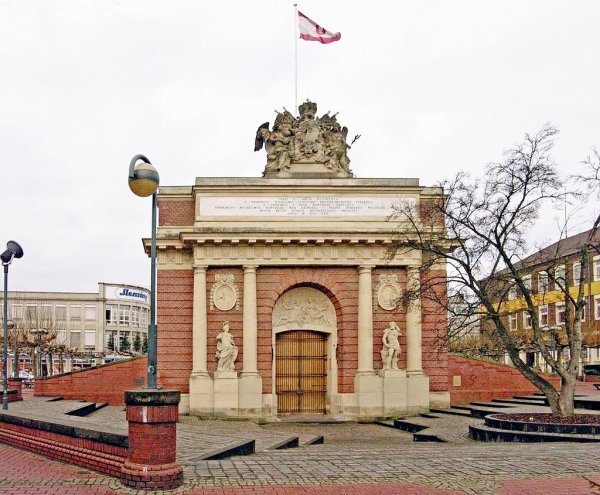
Wesel 'Berlin Gate' - Photo Credit: wikimedia.org

When school continued in the first week in January, I avoided all distractions and focused all my energies on last minute studies. By now the school administration had let us know the subjects and topics, in which we were to receive our oral examinations. For me it was Charles V in History and Calculus in Mathematics. In the remaining four weeks I emptied an entire bottle of vodka, which one could take as evidence for my industriousness. I rarely missed to fulfill my daily work quota. Indeed I would go sometimes overboard and even skip my time for relaxation with guitar or harmonica. One morning I woke up late. I was shocked to discover that I had forgotten to set the alarm clock. School had already started, so I quickly jumped into my clothes, grabbed my books, and without having had breakfast I raced to school in record time and barged into the classroom, where my homeroom and German teacher Herr Aufderhaar had just begun a lesson on German romanticism. Because he was bald and also taught religion, we had given him the nickname ‘Kahler Jesus’, which means Bald Jesus in English. He took one look at me and instead of being angry about my tardiness showed remarkable understanding for my circumstances. He teased me good-naturedly and remarked to the entire class, “Klopp is not just late for class. He did not even shave!”

Charles V

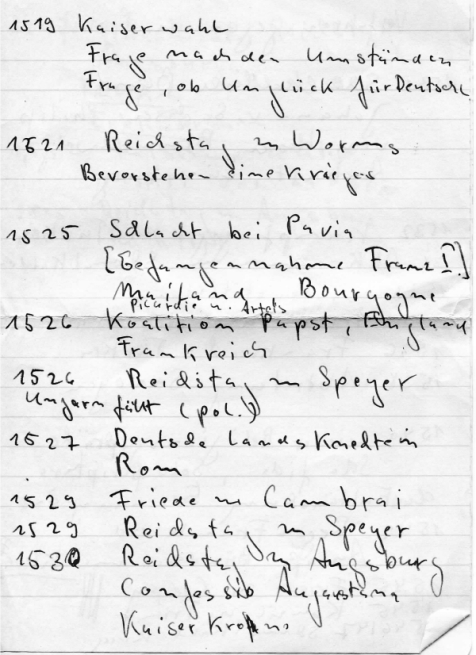
 For the oral exam in History I was well prepared. The main topic that I was given was the era of Reformation with special consideration to the way Emperor Charles V dealt with the schism that threaten to tear apart the Holy Roman Empire of German Nations. I had about thirty minutes to write down a few notes for my presentation. Then when my turn had come and I was led into the somber exam room, I described in poignant details the political struggles of the emperor against France and the Turks and the frustrations he, as a good catholic, experienced with the rapid spread of the protestant revolt against the corrupt Church of Rome. I was no longer the timid student who once stood trembling with fear in front of our history teacher. I boldly and convincingly expounded all the pertinent factors that determined Germany’s future historical and religious landscape. I took the entire time allotted for the oral exam. So the committee of principal and teachers had no time to ask any unsettling questions at the end. I walked away with the confident feeling that I had consolidated my satisfactory standing in History. Also in Math I was able to prove that I deserved a better final grade. My task was to find a solution for the total amount of work required to dig a cylindrical hole of a certain depth. Herr Müller, my beloved math teacher in the senior division, guided me through this difficult problem of integration. He so cleverly posed the right questions that they contained valuable hints allowing me to bring the session to a successful conclusion. It would have been nice to express my gratitude to an excellent teacher some fifty years later. Unfortunately, while I was searching the school Website I found out that he had passed away the year, before I started to write our family history.

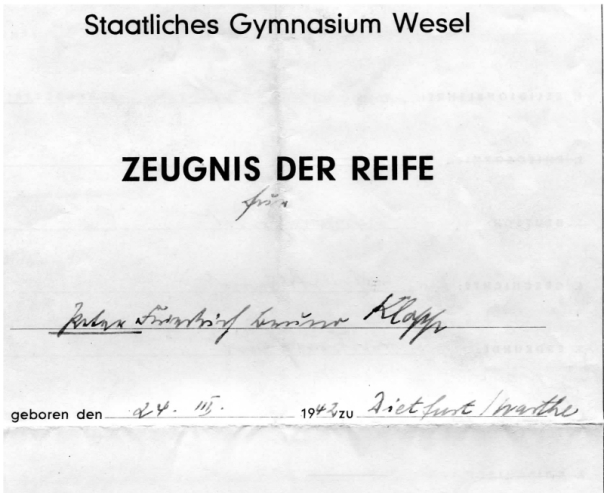
Front Page of my Graduation Diploma

With the prestigious graduation certificate (Abitur) in our possession we had access to many postsecondary programs offered by the German universities. As for me, two years of military service at the Bundeswehr (West German army) had to come first. In those days it was still possible to enlist as a volunteer for a period of 24 months instead of the mandatory 18 months with the advantage of receiving a handsome salary, becoming an officer of the reserve, and being able to choose an army unit in keeping with one’s technical abilities. I opted for service in the signal corps, a choice that definitely reflected my interest in electronics and communication technologies.

Newspaper

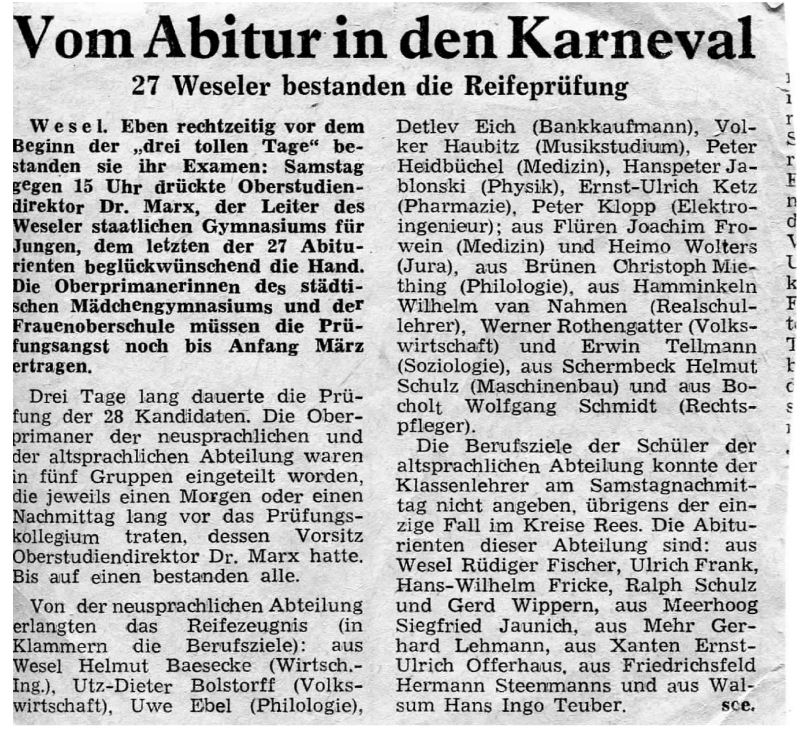
Newspaper Clipping with Names of the Graduates

It so happened that the graduation exercises had ended exactly at the start of the carnival season. Being together one last time with my friends and classmates, before we would scatter into all directions, I made full use of the golden opportunity to celebrate the great milestone and to lose myself in the relaxed atmosphere of the dance hall, forgetting the trials and tribulations before graduation and not worrying for the time being about the future. When the time of drinking, dancing and attending late night parties was over, I was physically exhausted, but for the moment I felt free as if a heavy burden had been taken off my shoulders.

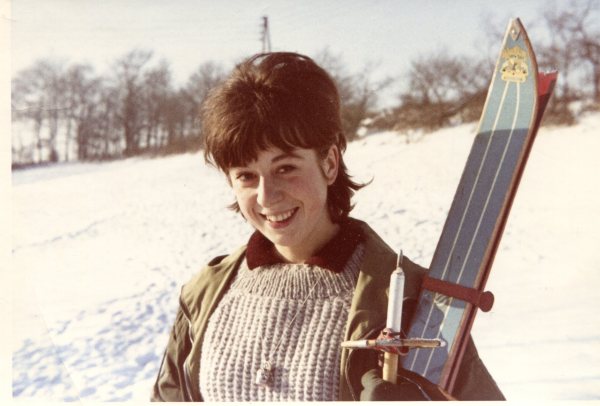
Biene with her first pair of skis - Winter 1963

I had not forgotten Biene. Now with more time at my disposal I wrote her a letter bringing her up to speed on my success at school and the tumultuous days at the carnival festivities. But what mattered the most I found the courage to express my feelings about what was so special about her in my mind. At the campground in the spring the year before I had discovered in her appearance the natural beauty that needed no cosmetic enhancement with rouge, lipstick or artificial hair colour. Biene for me embodied the ideal image of a girl. In the letter I gave her my father’s address hoping that she would reply.

Albert Schweitzer Seminar #2

Die Geschichte vom Bienenstich, von den Hörnern und vom Teufel

Zuvor muss ich euch erst einmal sagen, wann und wo Albert Schweitzer geboren ist. Der Ort heißt Kaysersberg und liegt im Elsaß. Es ist ein ebenso schönes französisches Städtchen wie Quedlinburg. Es war das Jahr 1875, als er zur Welt kam. Sein Vater war Pfarrer, der bald nach der Geburt seines Sohnes nach Günsbach im Elsaß versetzt worden ist. Albert war anfangs ein sehr schwaches Kind. Keiner glaubte, dass er lange leben würde. Doch bald wurde er kräftiger und wuchs heran. Davon werden wir noch hören.

Alberts Vater hielt in seinem Garten Bienen, damit seine fünf Kinder und deren Mutti schönen Honig essen konnten. Eines Tages schaute der kleine Albert seinem Vater zu, wie er an den Bienenstöcken hantierte. Da setzte sich plötzlich eine Biene auf seine Hand. Albert wollte sie streicheln, weil sie immer so fleißig Honig gesammelt hatte. Doch die Biene verstand das nicht und bekam Angst. Deshalb stach sie ihn in die Hand. Albert schrie laut auf, weil der Stich so schmerzte. Seine Hand wurde ganz dick und rot. Schnell eilten seine Mutter und die Hausgehilfin herbei und bemitleideten den Jungen.

Sie zogen den Stachel heraus und legten eine Zwiebel auf die Wunde, damit der Schmerz nachlässt. Er wurde auch wirklich schwächer, doch Albert weinte und schrie weiter, weil er es so schön fand, wenn man ihn bemitleidete. Da meldete sich eine innere Stimme in ihm und fragte: „Albert, willst du dich vielleicht nur wichtig machen?“ Er schämte sich ein wenig und hörte auf zu weinen.

Alberts Eltern hatten viele gute Bücher in ihrem Schrank. In einem Regal stand eine uralte Bilderbibel, die sich Albert besonders gerne ansah. Auf dem Buchdeckel war ein Mann abgebildet, der auf seinem Kopf zwei Hörner trug. Er stellte Mose dar, ein jüdischer Prophet, der von einem Berg herunterkam. Albert fasste sich an seine Stirn und spürte selbst zwei kleine Höcker. Nun fürchtete er, dass ihm auch zwei Hörner wüchsen. Aber sein Vater klärte ihn auf, dass die Hörner eigentlich Sonnenstrahlen gewesen waren und nur die Maler später daraus Hörner gemacht hätten. In Wirklichkeit hat Mose gar keine Hörner gehabt. Das beruhigte den kleinen Albert.

Am Sonntag ging Albert immer in die Kirche. Während des Gottesdienstes blickte er gerne mal zur Orgel hoch. Wenn die spielte, glaubte er in einem Spiegel den Teufel zu sehen. Doch wenn sein Vater predigte, war der Teufel wieder weg. Albert nahm nun an, dass der Teufel Angst vor Gottes Wort hätte und deshalb bei der Predigt schnell verschwand. Später erkannte er aber, dass der angebliche Teufel eigentlich der Orgelspieler war. Der war ein guter Mensch, der anderen Menschen half und Freude bereitete. Da er aber so struppiges Haar hatte und einen langen Bart trug, sah er von weitem wie ein Teufel aus. Alberts Vater erklärte ihm, dass es einen richtigen Teufel überhaupt nicht gibt. Das ist nur Aberglaube. Auch darf man einen Menschen nie nach seinem Aussehen beurteilen.

family190.jpg