After we came back from our mountain road trip to Mt. Scaia and a thorough review and culling of pictures on my photo card, I still had fifty photos left worthy of publication on my blog. I believe that you understand the pain from your own experiences how difficult it is to eliminate so many images in order not to overwhelm your followers. So I broke my five-picture rule and decided to publish seven. At 7000 ft altitude, we relished the clean mountain air, the alpine flowers and the busy bumblebees visiting them. Enjoy.
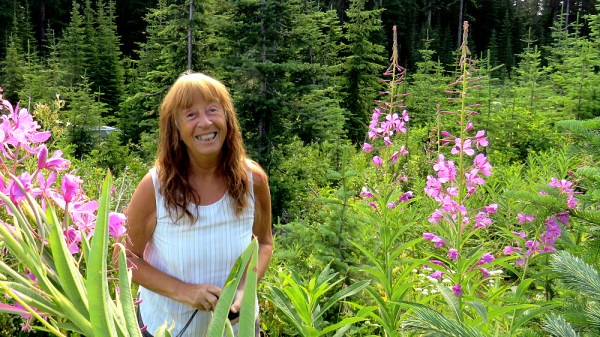
Among the wildflowers Biene (Bee) is all smiles.
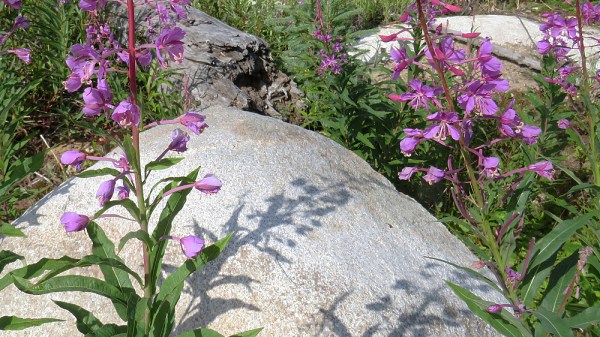
The Ubiquitous Fireweed in the Alpine Country
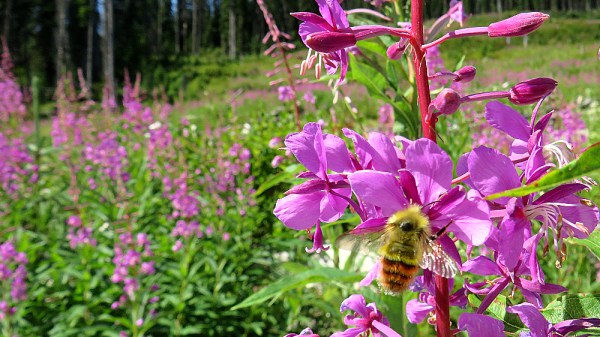
Bumblebee Visiting the Fireweed Flower
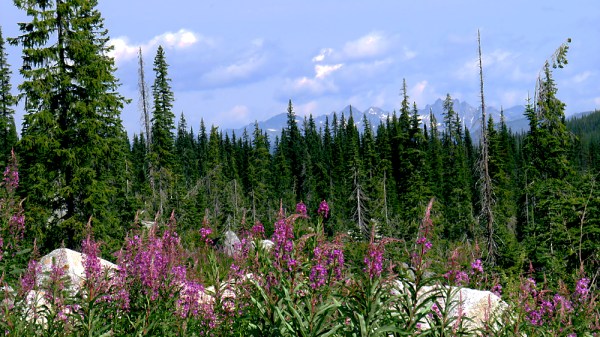
Looking North at the Monashee Mountains
Heading Straight to the Honey Pot
Gorgeous Mountain view
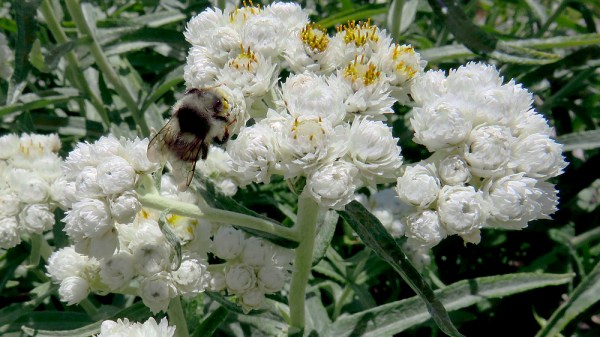
Different species of Bumblebee Feasting on a different Wildflower
Please note that my thoughts on my father’s life appear in green print. What is shown in regular print is translated from my cousin’s book on the Klopp family.
You may be puzzled about the title I have chosen for this episode of my father’s life. After all, in many parts of the world people were suffering under the horrific impact of World War II. After the Nazi aerial attacks on southern England came the Allied bombing raids of German towns and cities. Tens of thousands of people perished in the firestorms. Innocent people suffered, starved and got murdered in the Nazi concentration camps. Millions of soldiers gave their lives, on the Allied side in defence of freedom, on the Axis side for the illusion of the questionable honour of dying a hero’s death for the fatherland. So why would I chose such a seemingly inappropriate title for a period when the winds of war brought horror, death and destruction to many parts of the world?
Dresden after the Devastating Bombing Raids
Because at that particular time for the Ernst Klopp family, their workers, friends and relatives, Gutfelde and the entire county of Dietfurt (Znin) was an oasis of peace and tranquillity. Relatives from the big cities under the threat of constant bombardment came flocking to Gutfelde to spend weeks, often months far away and out of reach of the deadly bombing raids. Food was nutritious and plentiful. Even as late as December 1944 the family could celebrate a traditional Christmas with gifts for both adults and children, plates filled with Pfeffernüsse, nuts and all sorts of delicious baked goodies.
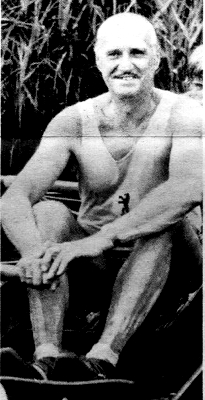
Artur Thiess at age 72. East Berlin Rowing Club
The first visitors came from Berlin in the summer of 1941. At that time my father Ernst Klopp had just started his first major assignment on the Silberberg estate in the Wartheland. Artur Thiess was the husband of Else, the daughter of aunt Alma. Later on because of the huge age difference (I was not yet born in 1941) I called him Uncle Artur, even though technically speaking he was my cousin. Artur spent his summer vacation with his wife Else and his two daughter Ingrid and Gerlinde at Silberberg. He wrote a one page type-written report, which my mother had passed on to me and which I will publish next week.
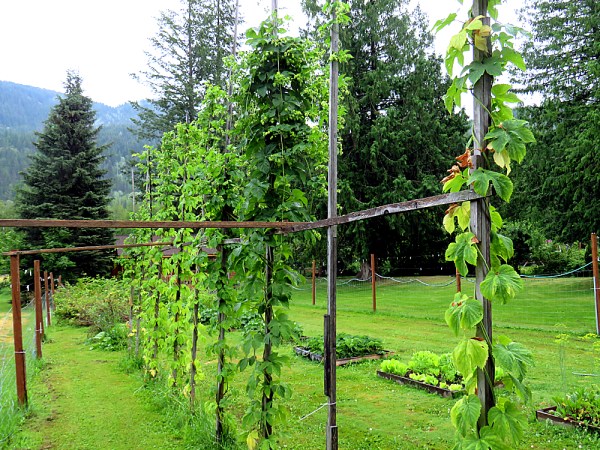
You will remember the video I presented on this blog that gave you some impressions of the simplicity of raised garden beds. At age 78 I strive to make things simpler, more efficient and ultimately more relaxing with gardening as one of the many areas of this lofty goal.
Weeding when needed at all has turned into a pleasurable activity. For the last four weeks or so my wife and I have been eating our own lettuce, beans, strawberries, with cucumbers and red beets recently added to the delicious mix of fruits and vegetables. As a bonus I added another photo of the various hops plants, which are beginning to develop those cones that are responsible for the fine refreshing taste of a homemade craft beer. Enjoy.
Please note that my thoughts on my father’s life appear in green print. What is shown in regular print is translated from my cousin’s book on the Klopp family.
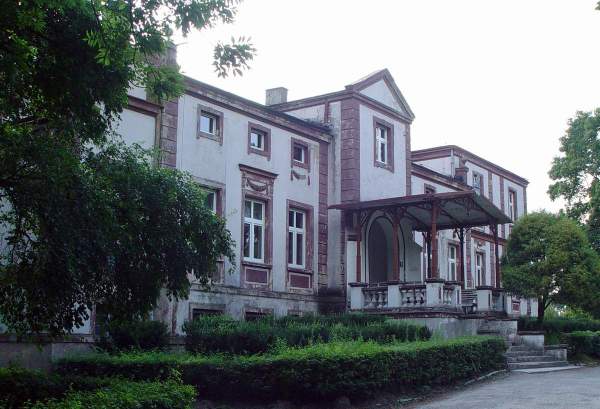
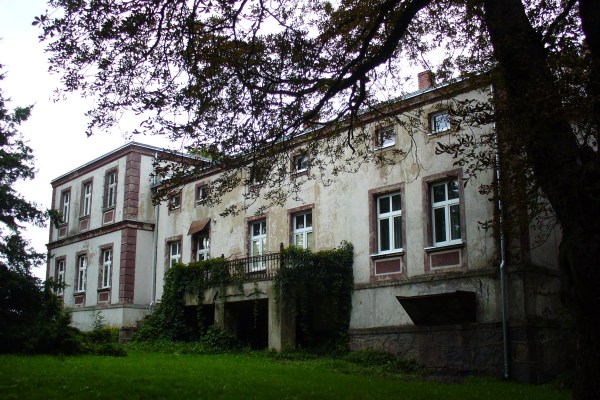
At the time of my birth, my father as manager and inspector was in charge of the estates Silberberg, Oberhof and Gutfelde totalling an area of approximately 3000 ha. Although he must have been thankful to the authorities for landing him such challenging and prestigious position and therefore may have harboured a favourable disposition towards the Nazi regime, he always strove to keep his humanity in dealing with his fellow human beings, Germans and Poles alike. In particular, through his actions he distanced himself from the policy that forbade German citizens to fraternize with the defeated enemy. It is a great testimony to his moral independence from the dark and sinister sides of Nazi Germany that he allowed Polish men and women to live and work closely and cordially with the Klopp family at the Gutfelde residence and the agricultural headquarter for the region. He maintained an excellent working relationship with the former Polish estate manager Haluda, who after WW2 took over as director of the communist run state farm. From the stories I picked up from my mother I speculate that Father owed his survival to his reputation of treating fairly and equitably all the people who worked for the large estates under his directorship. Other inspectors notorious for their arrogance, cruelty and injustice in dealing with the Polish population were rounded up, lynched, hanged or shot in the closing months of the war. On a Polish website with special focus on mansions, manors, and castles of Poland, I found an entire page devoted to Gutfelde – now an agricultural training center with orchards, wheat and corn under cultivation, 800 cows and 8000 pigs. The same page to my great surprise mentioned my father’s name as an administrator during WW2! The mansion-like imposing building was built around 1880 in the late-classical style and consisted of a body with a higher wing and ground floor extensions. It has not changed much in the last seventy years.
Gutfelde/Zlotniki 2012
The estate secretary was Czeslawa Pruszewicz. Due to Nazi marriage restrictions regarding Poles, she could not call herself Gromowska until much later. My late brother Karl (1929 – 2019) added in a footnote the following comment, “She maintained through correspondence with Erika Klopp regular contact for more than 40 years and died in Rogowo in 1986. Her granddaughter still keeps up the connection with the Karl Klopp family in Detmold to this very day (1997). Ernst Klopp did not tell much about his experiences as an estate administrator. However, it is safe to assume that the descendants of his former Polish estate personnel have kept him in a favourable light.
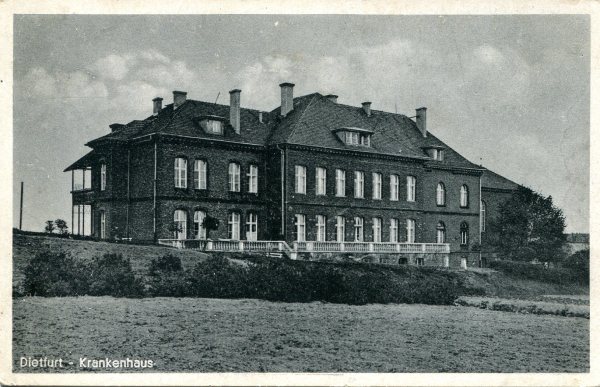
The Dietfurt Hospital, where Peter Klopp was born
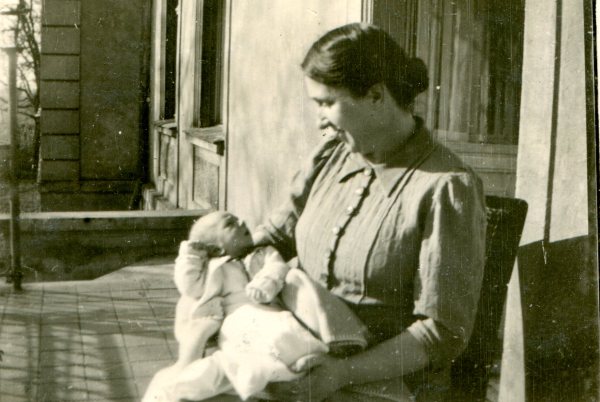
In the Dietfurt county hospital the last child, son Peter, was born on March 24, 1942. Contrary to family tradition and in comparison to his four older siblings, Peter for the time being remained unbaptized. It seems reasonable to assume that in view of Ernst’s positive attitude toward the system a certain alienation from the church institution may have played a major role in that decision.
Little Peter in Gutfelde
Even though Ernst Klopp was not a lawyer, he functioned never-the-less as a semi-independent within the county court system. In a sort of pseudo-independence acting in an honorary unsalaried function, he dealt with complaints among Nazi members against each other as well as with charges from outside the Nazi hierarchy against such individuals. In some individual instances, Ernst also dealt with cases of complaints coming from the Polish population. He was not a civil servant but was authorized to sign and authenticate documents such as marriage, birth and death certificates. He held his honorary position with the Dietfurt county system not on the basis of NS Party Membership, which he did not have, but rather on his reputation as a capable estate manager.
Across the Lake from Fauquier BC lies an island that used to be connected with the west side of the land south of the Needles ferry terminal. In the late 1960s BC Hydro built a dam near the American border to regulate the lake level and of course to generate power. As a result of this action many small communities were flooded and people were forced off their land. This is how this tiny island was created. I call this abandoned former farmstead our island, because very few people go there and we like to spend some time there all alone, explore its ancient apple orchards, relax and go swimming in the crystal-clear and refreshing waters in the heat of the summer. Recently I recorded such a canoe trip to this amazing little island on my movie camera. Enjoy.
In September 1939 Ernst Klopp was drafted into the army and took part in the attack on Poland, which triggered the beginning of World War II. Within days Great Britain and France declared war on Nazi Germany. In the fall of 1940 Ernst Klopp was released from military service to take on new civilian assignments. In October 1940 he took charge as an administrator of the recently incorporated agricultural estate Oberhof northeast of Posen (Poznan). The Polish owner’s name was Stanislaus Brodnicki and his inspector was Nowak. The estate’s size was 279 ha. In 1939 the building of the manor had already been in ruins. Ernst managed the farming area of this property until May 1941.
Subsequently he was assigned to administer until November 1941 the manor and lands of the former Polish Magnate Moszczenski in the village of Srebrna Gora/Siberberg (German) with a total agricultural area of 510 ha. Both estates now belonged to the newly created county of Dietfurt/Znin (Polish).
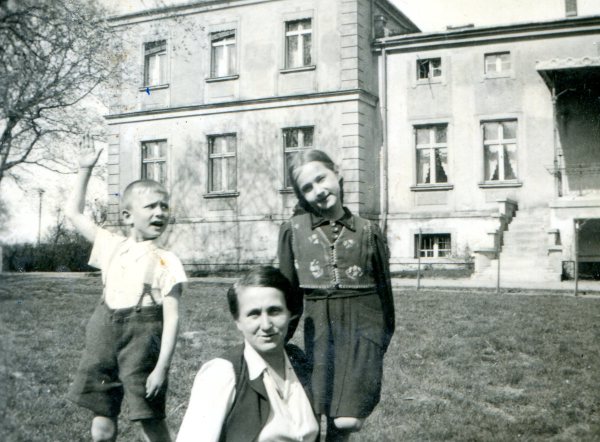
Gutfelde/Zlotniki 1942 – Mother Erika Klopp with her children Gerhard and Eka
In November 1941 the German Agricultural Society (renamed in 1942 ‘Reich’s Society for Agricultural Purposes) installed Ernst Klopp as an administrator of the farming and forestry domains, which belonged to the former Polish Estate Zlotniki/Gutfelde (German) in the county of Dietfurt. The estate belonged till 1939 to Zdenek Czarlinski and comprised 365 ha of arable land.
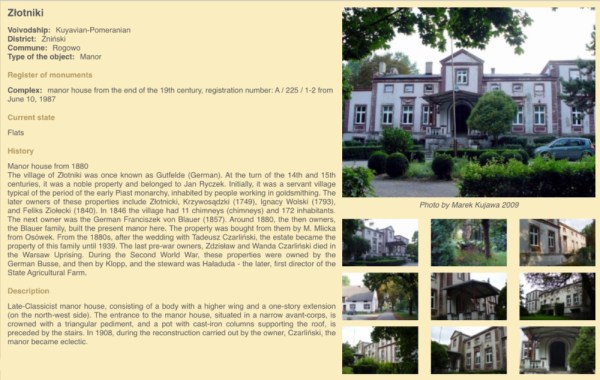
Peter’s commentary: To my greatest surprise I was able to find my father’s name and inspector Haladuda on a Polish website that deals with the history of Polish manors. Here is a brief excerpt from the article I found on the Internet and translated somewhat crudely by Google Translate:
Zlotniki 2012 – Credit: Polish Manors Website – There has been little change to the outside of the building since the time our family had to leave this beautiful place in 1945.
The constant change of Polish and German ownership of Gutfelde is very noticeable in this short history of the manor.






 The Peter and Gertrud Klopp Family