Carthage: Love Story Chapter IV Part 7

Carthage by Peter Klopp ©

The old sage introduces himself.

“As a 17-year-old youth, I saw Hannibal’s mercenary army at the gates of Rome. I fought in the Macedonian Wars and am now ending my retirement in the ruins of a Tarquinian pleasure palace, where I have made myself a makeshift hut to sleep in. During the day, I gather berries so that I don’t have to swallow the bread the Republic gives us so dryly. In the past, the state had provided for its war veterans more honourably. 

The spoils of war were certainly distributed more generously among the soldiers than in the past. But our company lost its entire allotted pay and booty in a storm on the crossing to Brundisium, saving nothing but its life. For you, however, everything I have told you so far is of no importance. But what I experienced after Paullus’s victory over King Perseus, when I was quartered with a Greek sage in Athens, should be of interest to you who are searching for truth will be of the greatest interest.

This man was one of the few in Greece who had read and understood the ancient sages. He waged a futile struggle against his country’s shallow, enlightened aspirations. He tried just as vainly to instill in his countrymen their ancient, genuine national spirit. And it was he who, one evening, revealed to me his understanding of the world and its origins. What I learned there seemed to stem less from his immense wisdom than from a divine inspiration of which he had every right to be proud.”

He paused briefly, as if to once again organize his thoughts, which he wanted to explain to the young men. The moon had now completely disappeared behind a dark bank of clouds. The sacred fire far below in the temple flickered in a dark red reflection on the snow-white marble steps.

Karthago von Peter Klopp ©

Der alte Weise stellt sich vor.

„Ich habe noch Hannibal Söldnerheer als 17-jähriger Jüngling vor den Toren Roms gesehen. Ich habe in den mazedonischen Kriegen gefochten und beschließe nun meinen Lebensabend in den Ruinen eines tarquinischen Lustschlosses, wo ich mir notdürftig eine Hütte zum Schlafen eingerichtet habe. Tagsüber suche ich mir Beeren, um das Brot, das uns die Republik schenkt, nicht so trocken herunterwürgen zu müssen. 

Früher hatte der Staat die alten Kriegsveteranen ehrenvoller versorgt. Wohl ist die Kriegsbeute unter den Soldaten großzügiger verteilt worden als in vergangener Zeit. Aber unsere Kompanie verlor auf der Überfahrt nach Brundisium im Sturm ihre gesamte zugeteilte Löhnung und Beute und rettete nichts als ihr Leben. 

Für euch jedoch ist das alles, was ich bis jetzt erzählt habe, nicht bedeutsam. Aber was ich nach Paullus’s Sieg über König Perseus erlebt habe, als ich bei einem griechischen Weisen in Athen einquartiert war, dürfte für euch, die ihr auf der Suche nach Wahrheit seid, von größtem Interesse sein. 

Dieser Mann gehörte zu den wenigen Griechenlands, die die alten Weisen gelesen und auch noch verstanden haben. Er führte einen vergeblichen Kampf gegen die aufklärerischen, seichten Bestrebungen seines Landes. Ebenso vergeblich versuchte er, seinen Landsleuten ihren alten, echten Nationalgeist einzuhauchen. Und er war es, der mir eines Abends seine Vorstellung über die Welt und ihre Herkunft verriet. Was ich da erfuhr, schien weniger seiner überaus großen Weisheit zu entstammen, als vielmehr einer göttlichen Eingebung, auf die er stolz sein durfte.“ 

Er machte eine kurze Pause, wie um noch einmal seine Gedanken zu ordnen, die er den jungen Männern auseinandersetzen wollte. Der Mond trat nun ganz hinter eine dunkle Wolkenbank. Das heilige Feuer weit unten im Tempel flackerte in dunkelroten Widerschein auf den schneeweißen Marmorstufen.

Chapter 22 of the Peter and Gertrud Klopp Story – Part V

Four Deaths in Four Months

President Kennedy, "Ich bin ein Berliner" - Photo Credit: cnn.com

President Kennedy, “Ich bin ein Berliner” – Photo Credit: cnn.com

But first I had to endure another blow. Death had given me in quick succession several reminders of our transitory life here on earth. On November 22nd at the Maxhof army residence. I was listening to the American Forces Network (AFN Munich). The DJ suddenly interrupted the Country and Western music and after a short pause announced that President Kennedy has been shot in Dallas, Texas. Later that night it was reported that he had died of his gun shot wounds. I was shocked over the news of this tragedy, as I had taken a liking to this great man, for his fortitude to force the Soviet Union to remove their missiles out of Cuba. I liked the way he had publicly committed himself to the security of West Berlin. His famous statement, ‘Ich bin ein Berliner.’ will remain in me for as long as I live. Then in January our staff sergeant Wohl had a fatal accident, when his VW beetle collided with a public transit bus on an icy hillside road in Feldafing. Gauke and I and two other comrades accepted the sad task of becoming his pallbearers. I will never forget the heart-rending sobbing of the widow in the front pew, when the officiating priest addressed her with a few consoling words. A couple of weeks later, almost if death intended to remind me again of its presence, I lent sixty marks to a comrade so he could buy a train ticket to attend his grandmother’s funeral. On the morning of February 26th I was called out of the office to see the captain for an important message. This time Gauke stayed behind at his typewriter, and I went a little puzzled and worried to captain’s office alone. After I sat down, he informed me with genuine regret that my father had died of a massive heart attack during the night of February 25th. The officer granted me a five-day compassionate leave, effective immediately. I was numb. I could not respond with a single word. The captain deliberately ignoring military protocol shook hands with me and spoke kind words of condolences. Only a small number of family members, aunts, Erna’s relatives and friends attended the funeral in Michelbach. I wrote and dedicated a poem to my dad. The poem ended with a line in Latin:

Viventium, non mortuorum misereor.
I mourn the living, not the dead.

Grieving Father’s death and attempting to overcome the blow, I wrote Biene that I needed time to respond to her wish to see me again. It also took me quite an effort not to mention her pen pal from Morocco in my letter. Perhaps I should not have suppressed my feelings. For jealousy although often portrayed as a negative force has its legitimate place. Just as we need fear to protect us from dangerous situations, a small dose of jealousy at the very least reveals that you care and are sincerely concerned about your partner’s affection.

Novella 'Carthage' Dedicated to Biene

Novella ‘Carthage’ Dedicated to Biene

Back at Maxhof I began to edit and to copy in my very best handwriting the novella ‘Carthage’ into a thick green covered notebook. I dedicated the more than 200-page book to Biene. As it was not only a historical novel but also a testimonial of my love to her, it turned out to be quite literally the longest letter I had ever written. More importantly it ended in such a way that Biene herself one day could write the final chapter not as a flowery addition to an imaginary tale, but a true story with Biene and me being the main characters in the real world. At the time of my transfer back to Koblenz I was back home to celebrate my 22nd birthday.  There I mailed the book to Biene, after I had mysteriously hinted in a previous letter that I would be mailing her a very interesting book portraying us as Claudia and Publius. In the accompanying letter I wrote, ‘Dear Biene, you have sensitivity and understanding, Even though in this book everything had happened over two thousand years ago, its content is so current and volatile that I would not dare to show it to anyone but you. Whoever opens his heart is twice as sensitive and vulnerable. You will read many a chapter filled with blood-curdling details about this fateful city. Just remember what happens here in terms of physical suffering and pain is to be understood at the psychological level. I have been writing the novella for a long time. Personal experience and history went hand in hand to create it. The shock I experienced last fall put a sudden end to the story. You will notice that the form of the narrative lost its formal structure and the story ends in a desperate monologue. About some of the things, which I have written, I think differently today. But I have not lost my idealism. I am searching for a world, where I can turn my hopes and aspirations into reality.’  I felt like a general, who in a last-ditch effort committed all his troops and resources and staked everything on one card to win the battle and claim the prize of victory.

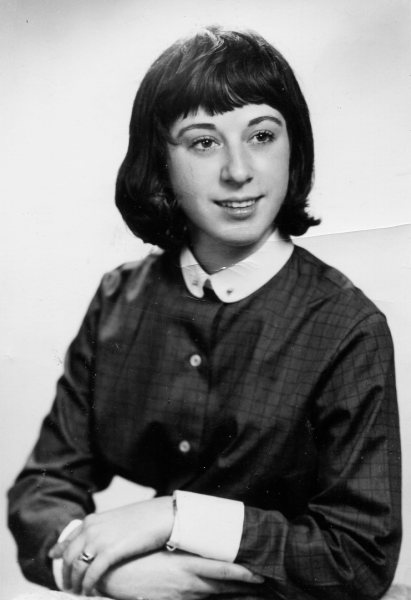
Gertrud (Biene) Panknin

Gertrud (Biene) Panknin