Walter Panknin (1898 -1977) and His Family Ch5 Part 5

Frau Panknin Accused of Theft

Tempora mutantur et nos mutamur in illis. This Latin adage, meaning “Times are changing, and we are changing with them,” rings especially true when examining cultural norms for human behaviour. When Papa was a police officer before and during the war, his elevated status in society did not allow him to have his wife working. A man of his rank was supposed to feed his wife and family. Now having been a former officer of the German army, he could not hope to find employment as a police officer in the Soviet-occupied province of Thuringia. Fortunately, he eventually found work as a dental technician at a friend’s dentistry lab. All of a sudden, the honour code of the former police force no longer applied, and his wife Elisabeth was working for a Russian officer who needed help to keep his rather large household organized and running well. For a few hours every day, Elisabeth Panknin had to do housework for him in exchange for a modest wage and some precious victuals from the kitchen. 
Elsbeth, Gertrud

One day when she reported for work, the whole household of the commander was in disarray and upheaval. The commander had lost his precious ring. An extensive search by all the members of the home had been unsuccessful. The ring was not found. Finally, mother Panknin was accused of having stolen it. The commander told her that she had to return the precious object by the following day or face dire consequences. Elisabeth was scared to death. She had seen and admired the ring but had no idea where it was. She spent the night in agony, not knowing what to do. Finally, after many prayers, she decided to offer the commander all her jewellery the next day to prove her innocence.
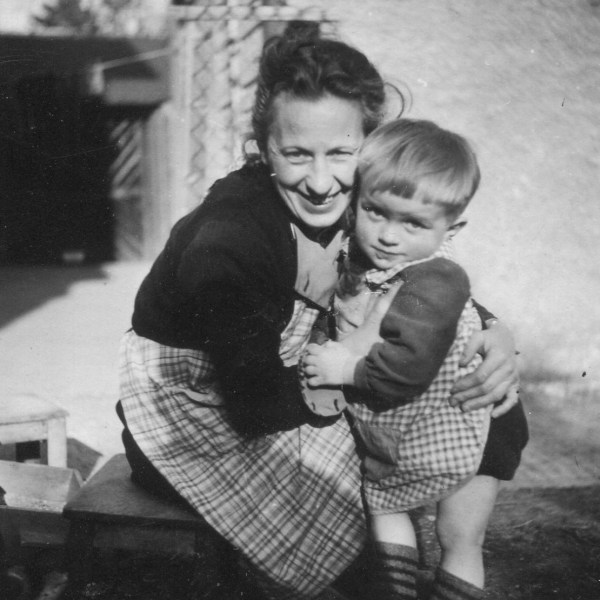
Mutti Panknin with Little Walter

The following morning, weak with fear and apprehension, she arrived at her workplace. She was immediately sent to the commander’s office, who was holding out his hand when she entered. Frau Panknin could not believe her eyes when she saw the precious ring sparkling on his finger. In his broken German, the commander explained how he had found the ring. When he was getting dressed that morning, he had felt a small object in the lining of his jacket. On further investigation, it felt like his lost ring. He suddenly remembered that he had put it in his jacket pocket for some reason Frau Panknin could not understand. His coat pocket had a small tear in the seam, and the ring had slipped through it into the silk lining. That the ring was found in the nick of time to save my mother-in-law from dire consequences was another miracle. From that day on, the commander rewarded her more generously for her work.
Walter Panknin (1898 – 1977) and His Family – Chapter 5 Part 2

Papa is Coming Home

Any part written in the first person singular has been contributed by my wife Gertrud (Biene) née Panknin

Great was Elisabeth’s joy when her husband suddenly and unexpectedly arrived at their home at Gotha. Papa could finally embrace his beloved wife, hug his stepdaughter Elsbeth, and hold the baby twins Walter and Gertrud in his arms. He had not seen them for over half a year.

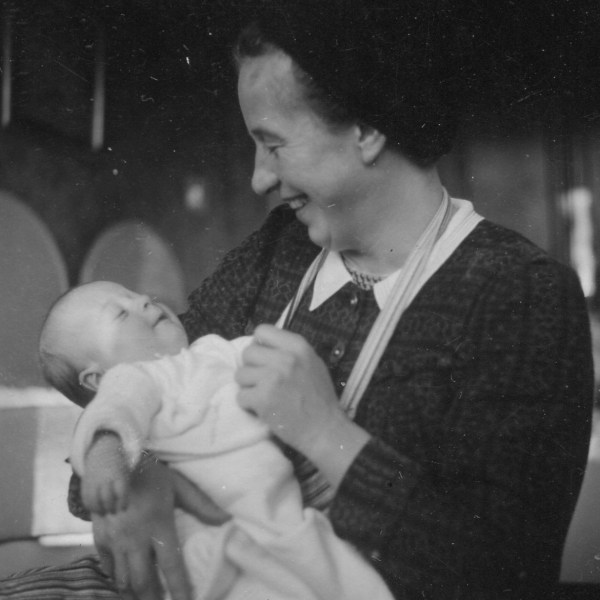
Mutti Panknin with One of her twins

Unfortunately, several flies in the proverbial ointment all too quickly disturbed the family bliss. The house owner had covered up his illegal black market dealings by having a high-ranking police force officer renting the ground-floor apartment in his house. As many essential items were getting scarce during the war, he used Captain Panknin’s status to deflect suspicion from his shady activities. Now that the war was over, the landlord found him no longer useful and tried to get rid of his tenants. Perhaps he knew some well-to-do people able to pay a much higher rent. With so many destroyed cities, Germany experienced one of the worst housing crises in history.

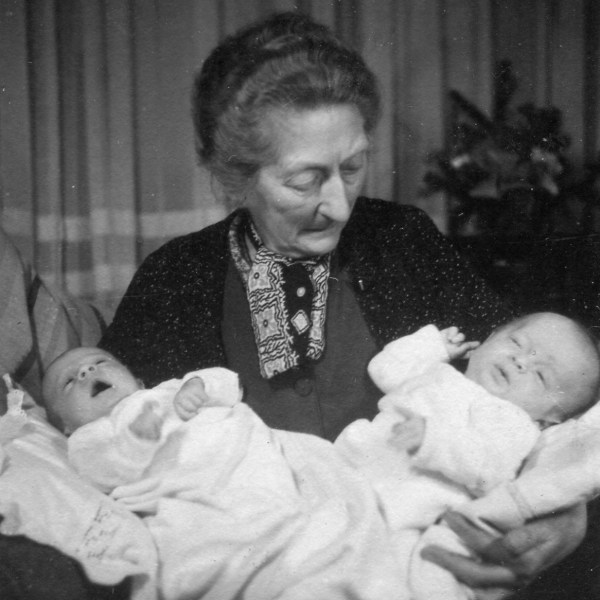
Oma Panknin with her Twin Grandchildren

Being without a job and having no regular income turned out to be a more significant problem. Papa got by for a while, trading in the plum brandy for things they were lacking. Indeed, his foresight and the effort of collecting and bringing home the liquid gold are remarkable.

Walter Panknin (1898 – 1977) and His Family – Chapter 5 Part 1

Mutti Panknin and her Three Children

Any part written in the first person singular has been contributed by my wife Gertrud (Biene) née Panknin

The American forces under General George Patton had advanced with lightning speed into Thuringia in April 1945. There, along with thousands of other German officers and soldiers, Walter Panknin became a POW. If the German high command had placed him at the Western front a month earlier, he would have enjoyed spending his captivity in the United States. Life, food and treatment would have been generally good for a German POW. 

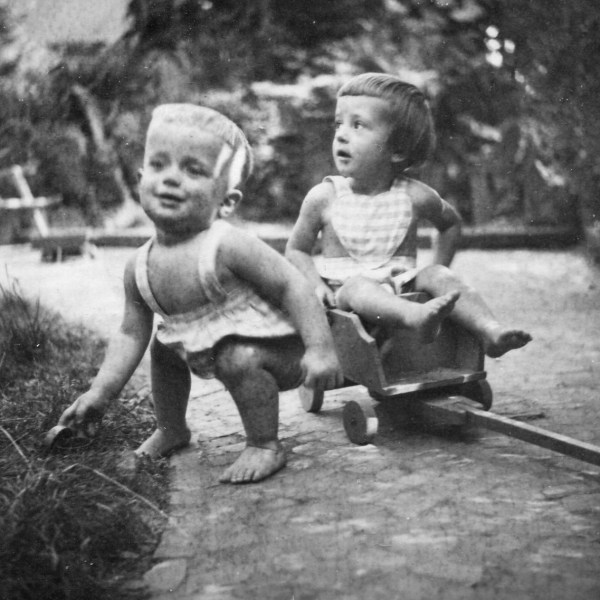
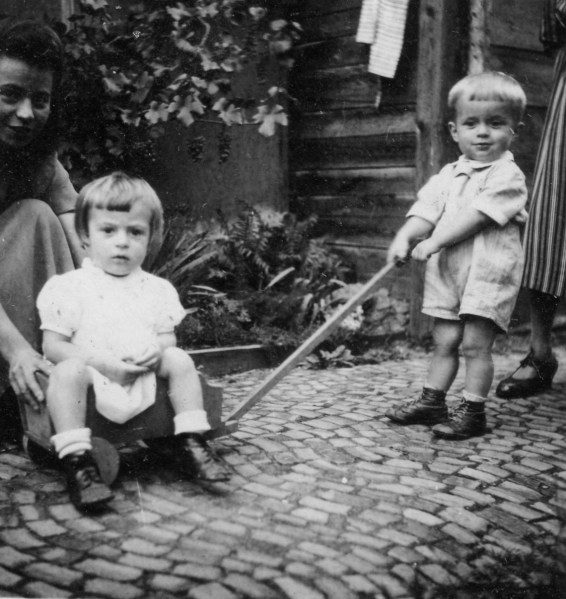
The Twins Walter and Gertrud Panknin

In the late summer or early fall, the notorious Rhine Meadows POW camps were shutting down. The western Allied Forces began shipping the POWs to their designated regions of occupied Germany. If you were a soldier with a permanent address in the Soviet-occupied zone, then there they would ship you. By now, the Americans had handed over Papa’s home province Thuringia to the Soviet administration. They had withdrawn their troops to the American Zone in Bavaria and Hesse. Before they left, food was already scarce. However, life was tolerable even in the bombed-out cities if you were among the lucky people who still had a roof over your head.

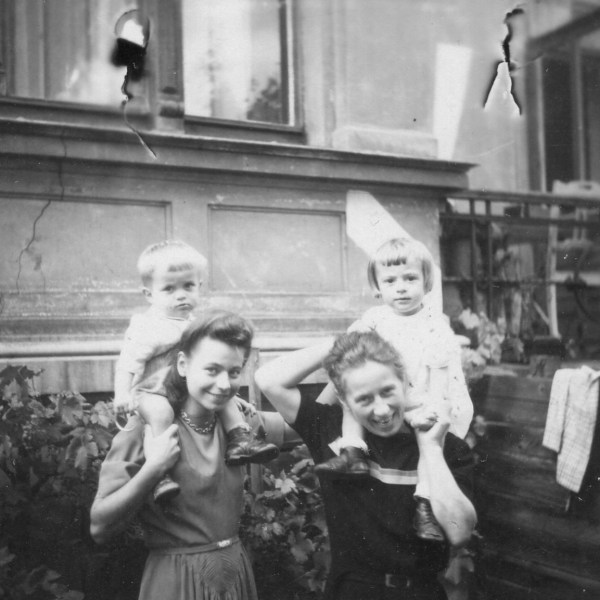
Mutti Panknin and Her Children Walter, Elsbeth and Gertrud

Papa’s wife Elisabeth recalled a heart-warming event in the spring of 1945, which she passed onto to her daughter Gertrud. An Afro-American G.I . regularly came by the house in Gotha. There she had been living with her family since the early 1930s. At first, Mutti was terrified and believed he was threatening her when he was wildly pointing as if wielding a gun at something at her doorstep. He kept shouting, “Milk for the babies!” Finally, she realized what the kind-hearted soldier intended to tell her when she saw the bottle of milk at her doorstep. Mama Panknin kept this miraculous story in her heart for the rest of her life.

Walter Panknin (1898 – 1977) and His Family – Part 6

Running Afoul with the Nazi Regime

While these were happy times for the Panknin family, storm clouds gathered over Germany’s political landscape when the Nazis took control of the government in 1933. Two incidents had an immediate disturbing impact on Papa and his family. During election times, at rallies, and on numerous other occasions, the stormtroopers of the SA, whose methods of violent intimidation played a key role in Hitler’s rise to power, carried out physical attacks on political opponents, Jews, communists and trade unionists. 

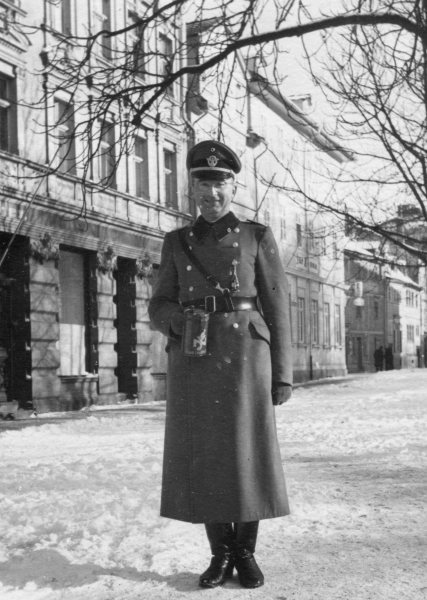
Police Officer Walter Panknin 1927

On the night when Hitler seized power, roughneck elements of this vast paramilitary organization overpowered practically every local government in the country.  In the small town Kamen near Dortmund, where Papa had been in charge of maintaining law and order for almost ten years, his police staff captured and arrested an unruly mob of some twenty SA men. On the next day, the newspapers, already under the control of the Nazi regime, requested the immediate dismissal of First Lieutenant Walter Panknin. Although he managed to keep his position, his refusal to go with the flow of the political current caused him much grief in the months and years to come. He based all his actions on following the law and his conscience. Rather than blindly following the ideology of a political party, he took a common-sense approach within the jurisdiction entrusted to him by his country. 

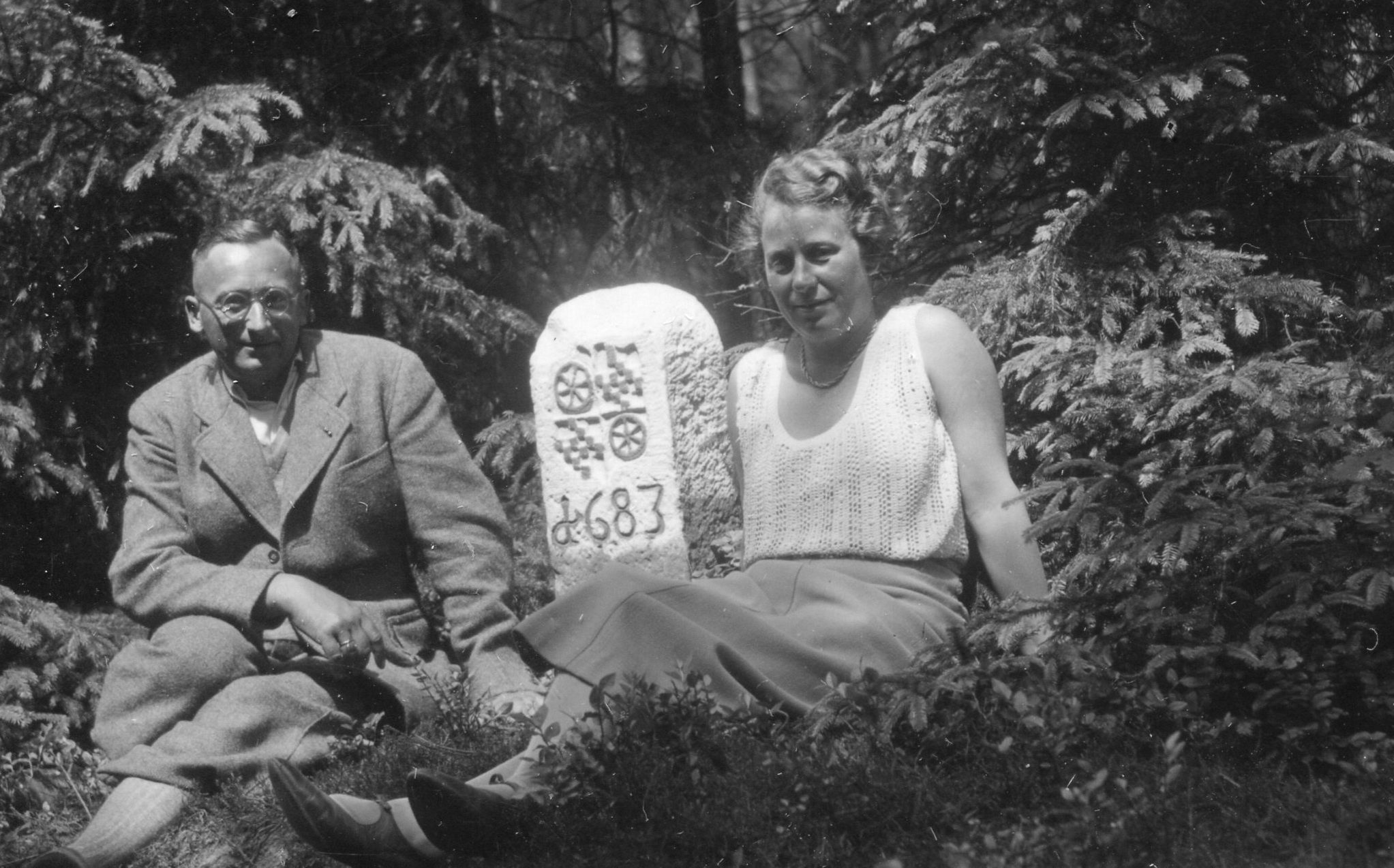
Hike in the Spessart Forests 1934

Even more severely affecting his professional advancement in the police force and ultimately safety for him and the family was the second incident. In their drive for complete control over the lives of German citizens, the Nazi authorities stripped the court system of its independent status, which had so far guaranteed a fair trial to all citizens no matter what crime they had committed. Equally sinister was the forced subordination of the arm of the law, the police force, into the new political system. All officers of the security forces were automatically and without exception registered as members of the NSDAP (National Socialist Party). They also asked Papa to leave the church, which he steadfastly refused despite threats of punitive actions and reprisals. Worse, all leaders of the various police departments were under pressure to join the infamous SS organization. When Papa declined, he knew that he would become suspect as someone not following the party line. He was fully aware that his refusal to join would appear to make him an opponent to the Nazi regime further down the road. Walter Panknin had to put up with constant harassment and ridicule by the party-liners. But fortunately, he had some influential colleagues who knew him as a friend and capable officer. They must have put in a word on his behalf. Papa spoke very little about his troubles in the privacy of their apartment. With great determination, he managed to maintain the feeling of peace and security, at least within the walls of their home. 

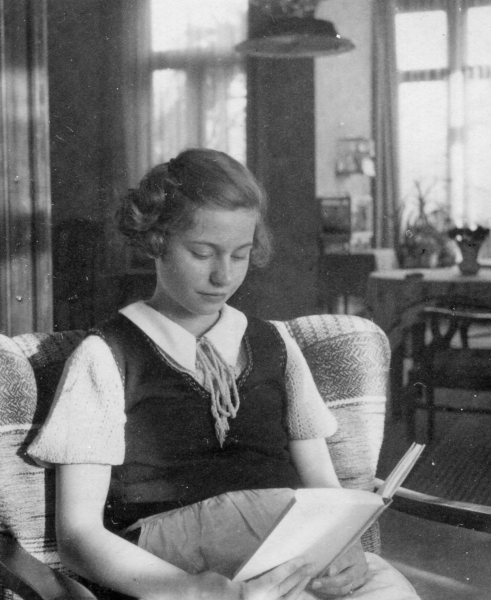
Daughter Elsbeth Panknin in their Home in Gotha 1936

Walter Panknin (1898 – 1977) and his Family – Part 5

Happy Times for the Walter and Elisabeth Panknin Family

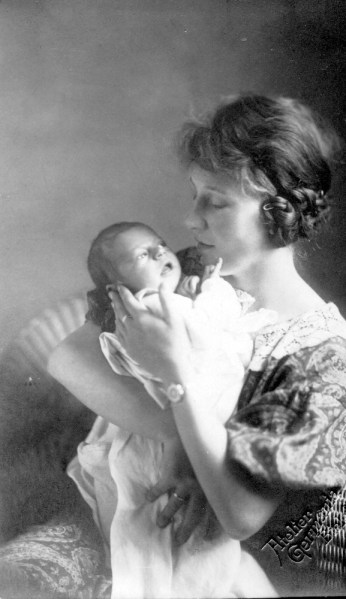
Biene’s Mother with Baby Elsbeth

When baby Elsbeth was born in 1924, her immediate family and relatives did not reject her, as one would have expected under the circumstances. They showed genuine compassion and forgiveness by helping her get on with her life. With their support, she found employment in a photo studio. Four years later, she met Papa and, after a brief courtship, married him. Thus, she put an end to the period of turmoil, grief and the grim prospect of raising alone her fatherless daughter. Not that Papa was the only one smitten with the attractive photo model. She must have had quite a few open and secret admirers who felt drawn to her irresistible charm and infectious cheerfulness. Among her memorabilia, I stumbled over a booklet with poems by Annette von Droste-Hülshoff. The poet’s given name, in all likelihood, became the second part of Biene’s double name, Gertrud-Anette. Significantly, Mutti had kept this book for such a long time. The well-worn pages and binding indicate that she frequently enjoyed reading the most romantic poems with its distinct Westphalian flavour. The handwritten dedication by a certain young man with a heartfelt message of regret about coming too late into her life made me recall my near failure to form a lifelong bond with Biene by ‘courting too slow.’

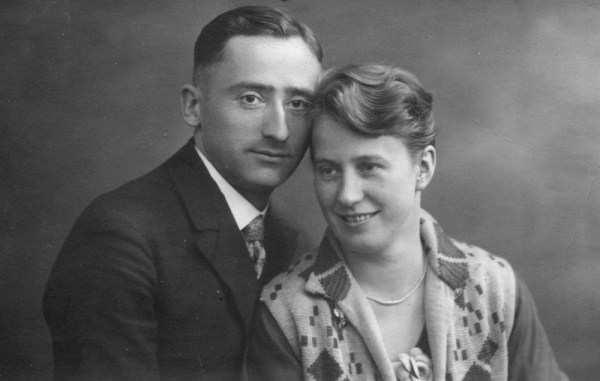
Walter and Elisabeth at the time of their Wedding
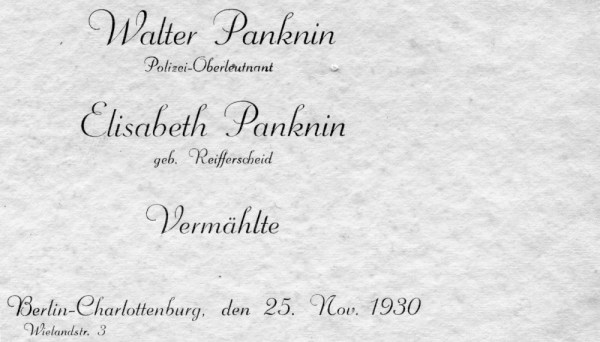
The Wedding Announcement

Before Papa and Mutti got married, Papa insisted that their personal life would follow the expectations that would satisfy the honour code of a German police officer. For one thing, to prevent tarnishing his image among his colleagues, he decided to adopt the ten-year-old Elsbeth as his daughter. Her name was subsequently officially changed in the family register to Elisabeth Panknin. For another, Mutti had to abandon her occupation as a photo model and give up her studio employment. State employees and civil servants were expected to support their wives and family fully. It was considered a disgrace to have one’s wife working. For Mutti, it was a new beginning. And if it had not been for the disastrous and chaotic times at the outbreak of WW2, one could have easily ended the story with the fairytale-like concluding sentence, ‘And they lived happily ever after.’

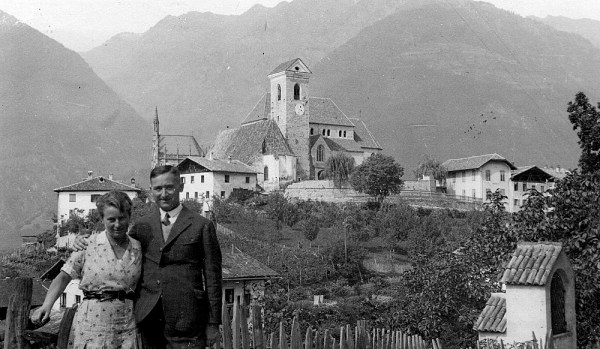
Honeymoon in Meran, Italy – 1930

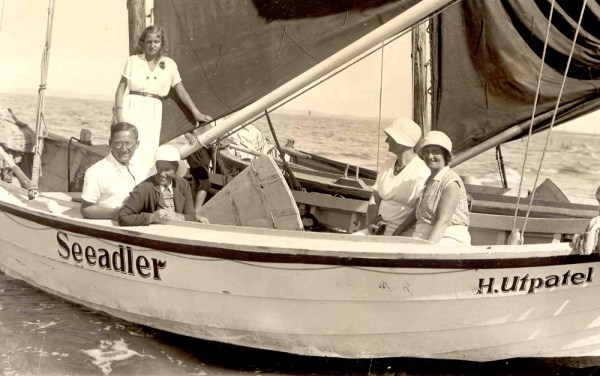
After their wedding, Papa and Mutti spent their honeymoon in Meran, Northern Italy. But this trip was just the start of a decade-long travelling experience. They went camping and boating together on all the major German rivers. Rain or shine, they paddled down the beautiful Danube into Austria. They explored the romantic stretches of the castle dotted banks of the Rhine. They also travelled down through the low-lying plains on the Ems and Elbe towards the North Sea. Swimming and sunbathing at the white beaches of the Baltic Sea became memorable events.
Whenever First Lieutenant Panknin made use of his vacation time or transformed some of the statutory holidays into long weekends, the young family was on the go. The decade before World War2 turned out to be the best time of their lives. Photos in the carefully documented albums, showing the newlyweds on their travels, attest to the happy days they were able to spend together. Papa was very fond of little Elsbeth and treated her as if she was his very own daughter. They included her in most of the travelling adventures on land and water, the little outings, the relaxing weekend picnics or the frequent hikes in the nearby forests.

Chapter 34 of the Peter and Gertrud Klopp Story – Part II

Ominous Rumblings from Biene’s Home Front

Peter copy

Key Player #2 in Chapter 34: Peter Klopp

As the drama unfolds I will introduce for each part of this chapter one person, who played a major role in our desperate struggle for being reunited in Canada.

After having dispatched my letter to Biene’s parents I felt very much at ease. With vim and vigour and guided by an indomitable desire to achieve high marks in my academic endeavours, I embraced a regime of self-denial, a kind of mental forced  labour. I cut my leisure hour of guitar practice in the evening, shortened my social lunch time with friends and fellow students at the university, and allocated an extra hour   to my studies at home in the morning. I had no idea about the potential danger to my health by placing so many burdens on my shoulder. But I was happy in the sweet knowledge that all the hard work would pay off in the end. Little did I know, however,  of the storm clouds gathering on the other side of the Atlantic and of the ominous rumblings coming from Biene’s home turf.

October 20th, 1965 Didsbury

My dear Peter, Life is like a brilliant symphony. Again and again I feel this. Every day has its special tune and color and atmosphere and you need to be a poet in order to give a vivid and colourful picture of it. Sometimes the melody of the day is light and joyful, in other times dark and full of melancholy.

Today was a bright and sunny October day, and pushing the carriage with the little laughing Paul through the park, I felt happy and at peace with the world. Here in England I have gained new aspects of life and I really feel for the first time free and independent. Two letters, which arrived with the second post, made me hurry to the place, where I usually have a little rest in the sun. I got your letter as well as my mother’s and I have a lot to tell you. At first, Peter, be assured that my parents got your long letter. Don’t worry about not having received an answer until now. I am going to tell you the reason although I rather would not like to speak or even think of it, because it makes me feel unhappy. My aunt (you know, I sometimes talked about her, because I loved her very much) died a fortnight ago. My parents went immediately to Berlin and stayed for a week to arrange everything for her funeral. All the tasks connected with my aunt’s death caused my parents much grief and my mother felt mentally and physically exhausted after the journey and she was not even able to write to me. As soon as she feels better she will let you know what decisions she and my father have made. She asks me to tell you that this is the reason for their long silence. My mother had to tell me so much about the last happenings that she only gave notice to me of the mere fact that she got the letter from you. Yet she did not discuss it. She only reassured me that she would stick to her promise and try to help us in any case…

In love yours forever, Gertrud

A day later, having not sent off the letter, she continued on in German, which I took as a bad omen, and so it was.

My dear Peter,

Today I received a long letter from my brother, which contained the main thoughts and arguments, which he as he told me had written also to you. It is quite impossible for me at the moment to delve into all the details. I didn’t know at all that you don’t find it easy to stay in Canada. This is in any case the way my brother interprets your words. As soon as I have answered my brother, I pass on his letter to you. Dear Peter, my decision is firm, and nothing can detract me from what I recognized as the right thing to do. I have no fear of an uncertain future. This just for today! As soon as I have a little more time and leisure I will write you everything, which I have considered and decided.

Your Biene

I knew all along that, when this moment came, everybody would be against our plans.

For the moment it was very easy for Biene to stick to her decision. To join me in Canada was not only the right thing to do, but also fulfilled the promise of love between the two of us. She was still far removed from the source of disapproving views on getting married to a young adventurer with an uncertain future in the far-off and hitherto unknown country of Canada. Thus, she was able to take a firm stand against the first volley shot by her twin brother Walter across the English Channel.