Ernst Klopp (1900 – 1964) – Part 1

My Father’s Childhood Years

Ernst was the sixteenth and last child of Friedrich and Emma Klopp. Within the short timespan from March till June 1900, four fateful events occurred in Wolmirstedt. In March the eldest son Friedrich (1875 – 1946) married Marie-Luise (née Weihe, 1880 – 1924), who was six months pregnant. At the end of May, Peter Friedrich Klopp (1852 – 1900) passed away. He was good-looking, handsome, slightly obese, and a giant of a man. He was generally of a cheerful disposition and was not disinclined to an occasional drink in the genial company of like-minded buddies every once in a while. 

In the middle of May not long before my father’s birth, he was riding home from a hunting party. It appears that he often left direction and speed to the discretion of his well-trained horse. Maybe on this chilly night, he had had just one drink too many. Falling asleep on horseback is never a good idea, especially when you are in that cozy state of inebriation. Inevitably, he slipped off the saddle, and the horse trod home without him. Early next morning travellers found him lying half-conscious on the roadside. He was sober by now but suffered from a severe case of hypothermia. Soon after, he acquired a kidney infection, from which he was unable to recover. He died on the 26th of June 1900 at the age of 48. 

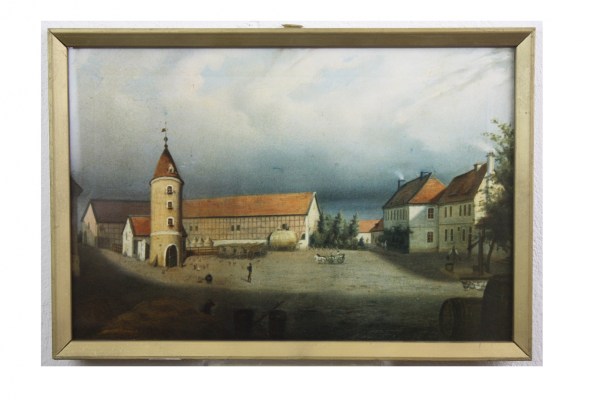
Photo Credit: Museum Wolmirstedt

At the beginning of June, the first child of the eldest son was born. Her name was Frieda (1900 – 1979). Finally, on June 28, 1900, the fatherless Ernst was born. Thus, Frieda and her uncle Ernst were of the same age. The two have never met again in later years.

These intersecting both joyful and painful events happened during those four months in the crowded conditions of the house in Wolmirstedt. The expulsion of the Klopp son Ferdinand (1879 – 1952) and his departure to the United States also occurred during the first half of 1900. All this wore down the family’s physical and psychological ability to cope. The acquisition of the mill Wehrmühle near Zieglitz by the forty-year-old widow appears almost like a desperate attempt to gain her freedom and independence from all these troubles at home.

Baroness Anna von Waldenfels (née Klopp) – Part III

The Long Arduous Road to the Panwitz Estate

While World War I was still raging and devastating Europe, Anna’s husband Ludwig von Waldenfels was reactivated into the military service on July 27th 1918 and served as supervising officer at a penal camp at Oberhaus near Dachau until demilitarization in May 1919. Now already 43 years old with a modest pension Ludwig had to worry about his family’s future. After his high school graduation in Munich he had taken a three-semester training course at the forestry college at Aschaffenburg between 1894 and 1896. Therefore, he had some basic agricultural knowledge. On the northern edge of Passau the couple acquired the estate Kastenreuth. On the hilly terrain the work in the fields was not very cost effective and the harvests appeared to have been quite meagre.  Already by 1922 Anna and Ludwig sold the property to the physician and researcher Professor Dr. Wilhelm Kattwinkel.

In the same year they acquired the estate Neuhof (today Polish Garbek) in the county of Schlochau. It was located right at the border of the newly formed ‘Corridor’ between the remaining part of German West Prussia and the new state of Poland. According to my cousin Eberhard Klopp’s research my Uncle Hermann (1892-1937) had passed on the 200ha property to his brother-in-law Ludwig. As a result of the Versailles Treaty the Polish border was moved within a few metres of the estate boundary. It ran about 300 metres east of the village street alongside a pond still existing today. In a 100 m direct line of sight was the Polish hamlet Zychce (German Sichts). In 1921 the West Prussian rural bank founded ten settlers’ places in Neuhof. Baron von Waldenfels and his wife Anna acquired the remaining parcel with the even today well-preserved estate building on the left side of the village street.

In the village of Neuhof of some 200 inhabitants Ludwig von Waldenfels worked the 810ha farming property and served at the same time as mayor until 1927. “The inhabitants originated mostly from the stolen parts of West Prussia and partly from Münsterland (Münsterland is a mostly flat, agricultural region in North Rhine-Westphalia, Germany).  Only 14 people were speaking Polish.” When the family von Waldenfels left Neuhof in 1927, their property was also parcelled into seven more settlements.

It is definitely unimaginable that the couple von Waldenfels accustomed to the big city life style of Metz and Berlin would feel at home in the solitude of a remote little border village. In the year of their departure in 1927 brother Ernst Klopp (1900 – 1964 my father) found employment and stay during the summer harvest. Mostly likely he participated in the preparations for the move out of the second agricultural venture. In the remote bush, heather, and meadow landscape with a few deciduous woods the family von Waldenfels managed to last barely five years.

Now brother-in-law Herman Klopp jumped into action as helper in a new government initiative. Having been the administrator of the copper mill near Meseritz, East Brandenburg (today Polish Miedzyrzcezc) he was familiar with all locally pertinent facts. He made a concrete proposal to the couple von Waldenfels, which turned out to be a stroke of luck.

Chapter 18 of the P. and G. Klopp Story – Part II

Joy at my Father’s Home

Right from the beginning of my visit Erna and I got along very well. Her cheerful and lively disposition did not allow me to lose myself in gloomy moods, as I was occasionally prone to do, especially during prolonged periods of idleness and aimlessness. I could even see, even though I was reluctant to admit it, that Erna was the right person for Father. She was the sunshine that had brought lightness and contentment to his sunset years. From her radiated a contagious joyous spirit that created the in-peace-with-the-world atmosphere so conducive to Father’s healing process from a torturous past, from which he only now began to recover. I definitely do not remember him as a man broken in body and spirit, as my distant cousin Eberhard Klopp described him in his book of the Klopp Family History.

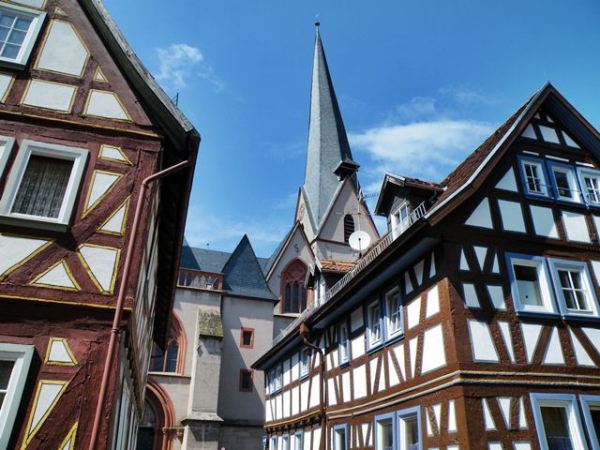
Schotten - Photo Credit: vogelsbergtourist.de

Town of Schotten – Photo Credit: vogelsbergtourist.de

Erna also had a moped of the same make and the same 49 cc class as mine, on which she would travel down the steep hill into the town of Schotten to buy the few things she needed for the small household in Michelbach. When there is company, one always seems to find the time to show off the beauty surrounding one’s home turf. Without visitors one tends to delay and leave such outings for another day. Erna was no exception. Now she was eager to travel with me to the nearby-forested hills, up the scenic Nature Park around Mount Vogelsberg, down winding country roads into the lush verdant valleys neatly tucked in between minor mountain ranges. There was no better form of transportation than our two mopeds. With a lunch pack clamped to the rear luggage rack we were ready to dart off into the wonderful Hessian landscape. Father a little overweight for these light machines gladly stayed behind looking after a few chores still to be done on this mini-farm with just a few goats to feed and milk,. Just as we were revving up the engines, Father came to the road to congenially shout over the noise, “Have a good trip!” At the end of my vacations thanks to our weekly excursions into the hill country, I had acquired a solid geographical knowledge of the region. As I was internally preparing myself to leave the Rhineland for good after my graduation, I had already created a new base to drop in as son and stepson, a place I could truly call home.

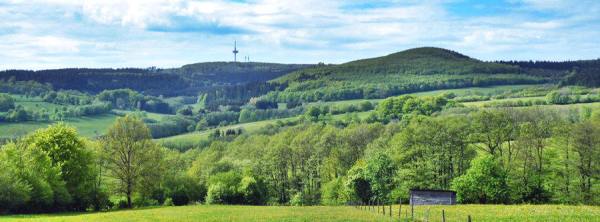
Landscape of Vogelsberg Hill Country - Photo Credit: vogelsbergtourist.de

Landscape of Vogelsberg Hill Country – Photo Credit: vogelsbergtourist.de

In the long summer evenings after supper we three would sit in the living room leisurely sipping homemade apple cider. We would talk until it was time to go to bed. More accurately speaking it was Erna, who did most of the talking. She truly had the gift of the gab. With the unerring memory for minutest details spiced up with colorful expressions and peppered with the melodious dialect of her village she was the born storyteller. I will never forget how she described the chaotic scene of the German Reichstag of the roaring twenties. She and her friends were sitting in the same living room forty years earlier and acted out the ugly political debates they had heard over the radio. And they did this with such exuberance, with so much mock yelling and screaming that the poor cats terrified by the brouhaha created by the inflammatory speeches sought refuge under the sofa and added to the parliamentary cacophony with much hissing and growling.

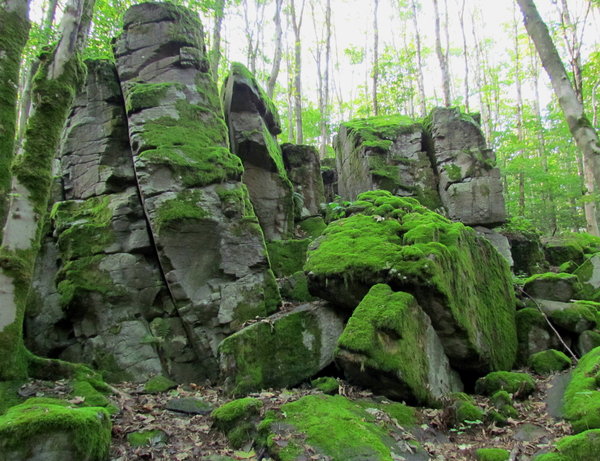
Incredible Rock Formations near the Top - Photo Credit: myheimat.de

Amazing Rock Formations near the Top – Photo Credit: myheimat.de

Chapter 18 of the P. and G. Klopp Story – Part I

On my Moped to Father in Michelbach


It doesn’t matter who my father was; it matters who I remember he was.

Anne Sexton


50

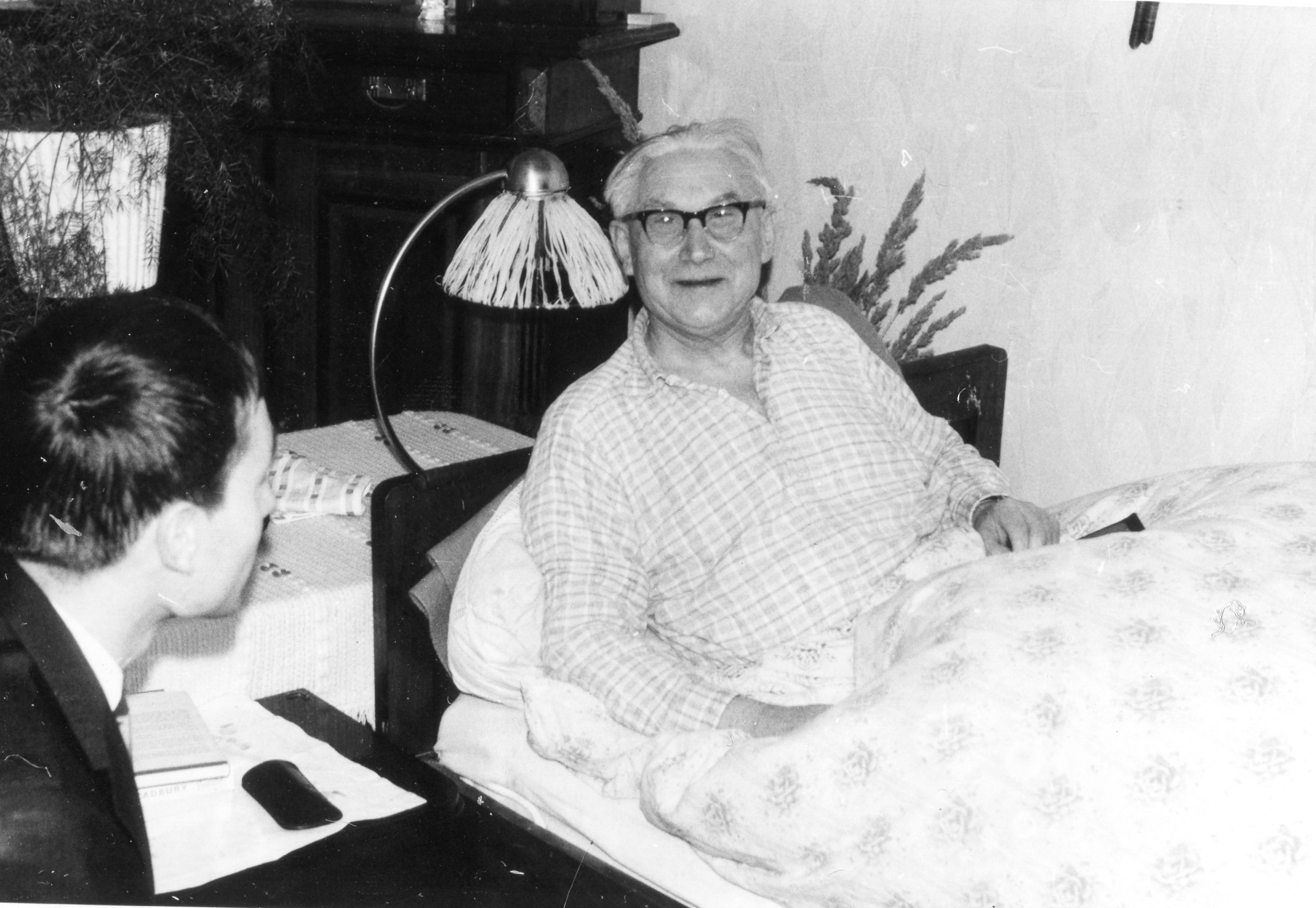
My Father in front of Erna’s House in Michelbach near Schotten

It had been more than five years, since I had seen Father. He had left one day looking for work at friends and relatives. Considering his poor health and age, he was faced with the dilemma of having to return to Wesel, where he would be dependent on Aunt Mieze’s financial support or else be content with the odd casual work, which barely supported his livelihood. Furthermore considering his intensive pride as a former successful agricultural administrator and the pain he must have suffered from the dismal failure of his farming venture in Southern Germany, I can understand his anguish and feelings of having become utterly worthless in his own eyes and in the eyes of his family. Pride and failure have never been good bedfellows in a man’s heart, and Father was no exception. As for me, I missed his presence a lot, but I was too timid to ask as to when he would come back and did not know what was going on behind the scenes. Much later I found out that with Uncle Günther’s support Mother had initiated divorce proceedings. On the basis of the law that required common residence and conjugal relations Mother was able to get a divorce in exchange for waiving any rights to financial support from Father. So to make this sad and depressing story short, Father after the divorce joined and not long afterwards married Erna Krämer, an old acquaintance from the Warthegau days, who lived in her rustic and cozy home in the village of Michelbach at the foot of Mount Vogelsberg north of Frankfurt.

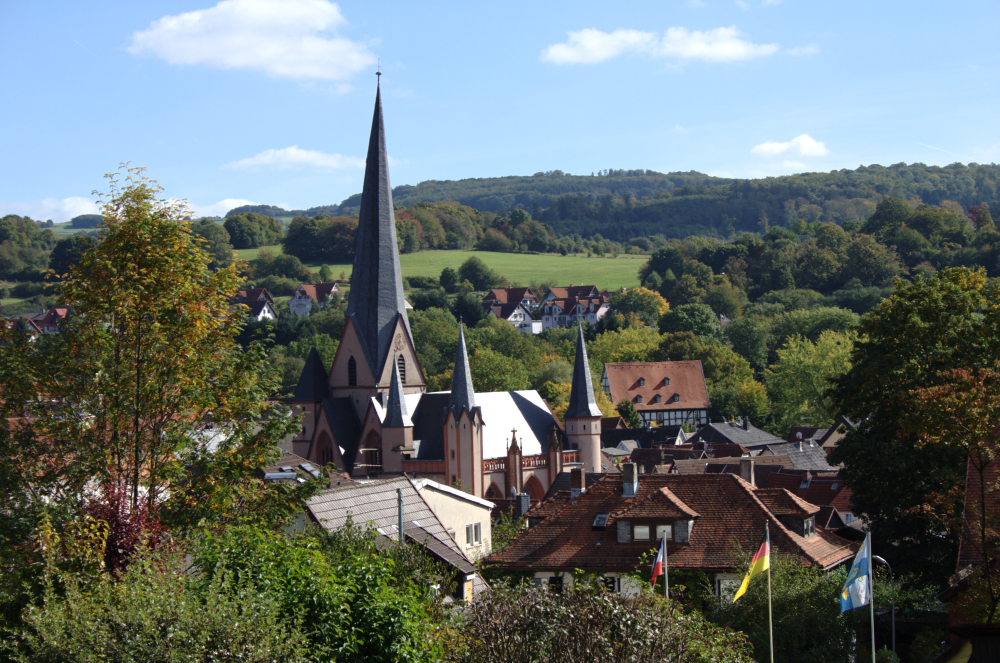
Schotten_Uebersicht_Kirche

Picturesque Schotten – Photo Credit: wikipedia.org

The last summer holidays before graduation were only a few weeks away. It was also to be the last year Mother and Aunt Mieze would reside in Wesel. Uncle Günther and Aunt Lucie had invited them to live with them in Watzenborn-Steinberg (now Pohlheim), where all four would share the rent of a brand-new house that had been built by a teacher as a retirement home in the distant future. Naturally there was a lot of joyful excitement among the three Kegler siblings having been raised together at the parsonage in Grünewald and now having the chance of living once more under one roof. There was just one problem. How would I fit into the grand plan of bringing the family members together? A transfer to a high school in another province with different graduation requirements was out of the question. The solution was an obvious one. I had to stay behind and continue my studies later on in the fall, while they would move to the land of the Hessians. The decision to finish my secondary education in Wesel proved to become one of the great milestones and turning points of my life.

34

Twenty-year Old Peter

But for now at the beginning of the six-week break from school I had other things on my mind. I had to think of visiting Father. One of my old scout buddies sold me his moped for DM 50.00, a true bargain at the equivalent of ten monthly allowances. It had a peppy engine and in spite of being quite old was in excellent shape. The best part was that I did not need a driver’s license. Having always envied Klaus for his scooter, I now had my very own motorized transportation with which I could travel to Michelbach to see Father and his new wife Erna.

60

Philosophical Discussions with my Father

At a maximum speed of 50 km/h it took me all day to reach the scenic hill country around Mount Vogelsberg. Father and Erna gave me a warm welcome alleviating immediately all fear that Father might have turned into a stranger. I had departed from Wesel with these somber feelings, which had been building up due in part to our long separation, but also due to Mother’s bitter and regretful remarks that she had sometimes made about the divorce. So it was a great relief to be greeted so cordially and be welcomed as son and friend into their cozy old farmhouse. Here then I was going to spend the next six weeks, would become reacquainted with a rural environment slightly reminiscent of Rohrdorf, would get to know Father more closely through our philosophical and historical discussions, would begin to like his wife, would be introduced to her friends and relatives in the village, would taste her hearty meals albeit a little too rich in fat, in short I was here to relax and feel completely at home in an atmosphere of genuine friendliness and camaraderie.

Chapter IX of the P. and G. Klopp Story – Part II

Progress at School with Father’s Help

Our school and its yard was surrounded by a brick wall about two meters high and looked more like a prison than a place of learning. The huge iron gate would open fifteen minutes before school started. At eight o’clock sharp the janitor locked the gate and any late student would have to ring the bell at the main entrance, over which was chiseled in stone ‘NON SCHOLAE SED VITAE’ (NOT FOR SCHOOL BUT FOR LIFE). The janitor would then take the delinquent scholar to the vice-principal’s office, where he had to explain the reason for his tardiness. After a severe dressing down and reprimand, he would receive a slip of paper signed and stamped which allowed him to enter his classroom.

15flip

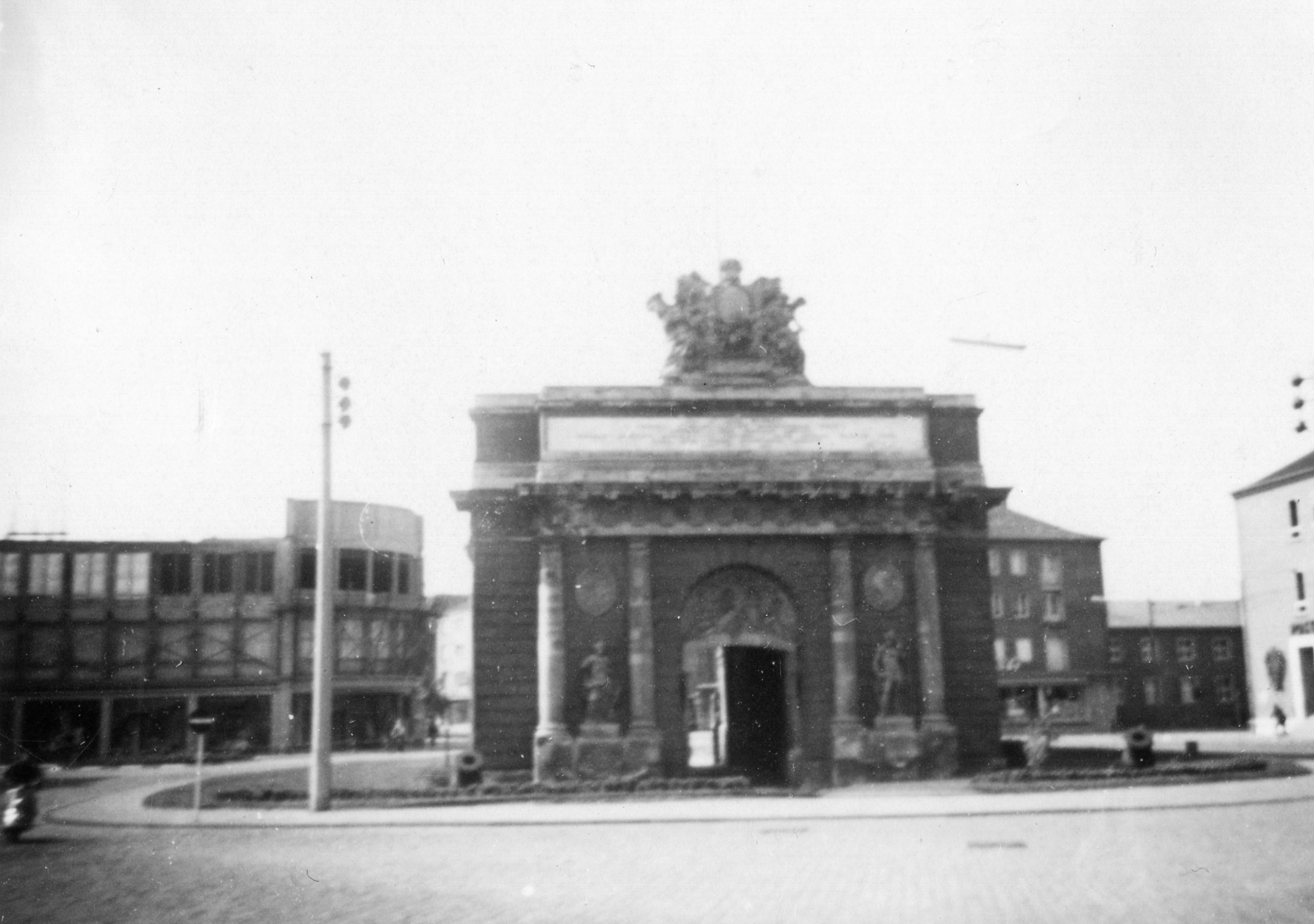
Berlin Gate at Wesel 1956

My second year at the Wesel High School turned out for me to be a very happy one. Having been placed back to the first high school grade the year before helped me overcome my deficiencies in Latin and made me feel superior in all other subjects, especially in Math. I quickly made friends with three other students. Being one year older and quite a bit taller, I took on the delightful role during recess and lunch breaks of the big, bad wolf and chased my friends, the three little piglets, all over the schoolyard. In the German comic books published under the worldwide license by the Walt Disney Company the wolf’s name was Ede. From this time on my nickname had been Ede for all those who belonged to the inner circle of my friends.

Berlin Gate at Wesel 2012 - Phot Credit: wikipedia.org

Berlin Gate at Wesel 2012 – Photo Credit: wikipedia.org

Great was my joy, when Father arrived. After two years of living only with Mother and Aunt Mieze this was a welcome change for me. What I didn’t know at the time was that my parents were drifting apart due to circumstances beyond their control. Mother having no employable skills had allowed herself to be bound completely to Aunt Mieze’s generous arrangement by taking over housekeeping duties in exchange for room and board, all expenses for herself and me. Father suffering from periodic back pains and other health issues could no longer find meaningful employment. His former administrative talents in agriculture were not in demand, especially not in the city of Wesel. Mother expected him to take up any employment. Even sweeping the streets or working for the sanitation department would have been all right in her eyes, she once confided to me. So as time went on, Father was facing a dilemma, either to continue to depend on Aunt Mieze’s charitable hospitality or to seek work completely out of line with his agricultural expertise.

But while he stayed with us, half a year or more, he did his best to create a sense of togetherness between himself and me, a kind of late bonding between father and son. He took great interest in my studies at the high school. He had heard of my difficulties in Latin and devised a motivational scheme to help me with grammar and vocabulary, which he himself had never learned. He also noticed that if I did get into trouble at school or at home it was primarily due to the fact that I, often wrapped up in my dream world, lost track of time. His plan, which I immediately embraced with great enthusiasm, was that I should earn my very first watch by studying Latin with him. For every exercise from my text-book, for every successfully completed vocabulary drill, for each translation into Latin he awarded me one point and recorded it meticulously with date and type of work into a little writing booklet. Once I had obtained the grand total of 500 points, he would give me the promised brand-new watch. When he left, I was not only the proud owner of a watch, but also more importantly my marks in Latin had soared to the second highest level one could get on the report cards. Moreover, I had accumulated so much knowledge that I was coasting along for four more high school years before slipping back to the more common satisfactory standing. It was also during Father’s short stay that he taught me how to play chess. His legacy was not only that I had developed a lasting passion for the ancient language of the Romans and the royal game of chess, but also that I harbor only the fondest memories of and feelings for my father. Little did I know that I was not going to see him again for six long years.

A Walk Through Wolmirstedt, Where Ernst Klopp Was Born (Written in German)

Bericht über Wolmirstedt und die Klopp’s

von Dieter Barge – Chart II a – IV

Also Chart I – I & II

Als ich in Peter’s Bericht über die Klopp’s das Bild der Seilerei Friedrich Klopp in Wolmirstedt gesehen habe, interessierte mich sehr, wo das wohl war.
Edda und ich lebten doch selbst von 1980 bis 1990 dort.
Ich hatte ein Buch von Otto Zeitke und habe mir noch 2 weitere Bücher antiquarisch besorgt, diese hat Otto Zeitke gemeinsam mit Erhard Jahn geschrieben. Die Beiden haben sich als Heimatforscher sehr verdient gemacht, Otto Zeitke ist 1924 geboren und versteht es gut, die Berichte der älteren Leute interessant wiederzugeben. Erhard Jahn ist um einiges jünger und hat in Wolmirstedt ein Ingenieurbüro für Architektur.

Im ersten Buch “Das alte Wolmirstedt” fand ich dann vermeintlich die Seilerei Klopp !
Um sicherzugehen, habe ich bei Erhard Jahn angerufen, habe ihn nach Klopp’s gefragt und da kam sofort die Frage zur Seilerei Klopp zurück. Ich habe ihm einiges erzählt und ihn gebeten, mal das Bild in einer Mail zu betrachten und meine Vermutung zu bestätigen.
Das hat er auch getan und mir bestätigt, daß das Gebäude links neben der Druckerei Grenzau die alte Seilerei Klopp ist. Beide Gebäude befinden sich in der Friedensstraße, das ist der neue Name für den nördlichen Teil der ehemaligen Magdeburger Straße Er kannte auch das Bild von der Seilerei schon. Daneben ein aktuelles Bild von Herrn Jahn mit dem ehemaligen Seilereigebäude in der Mitte.

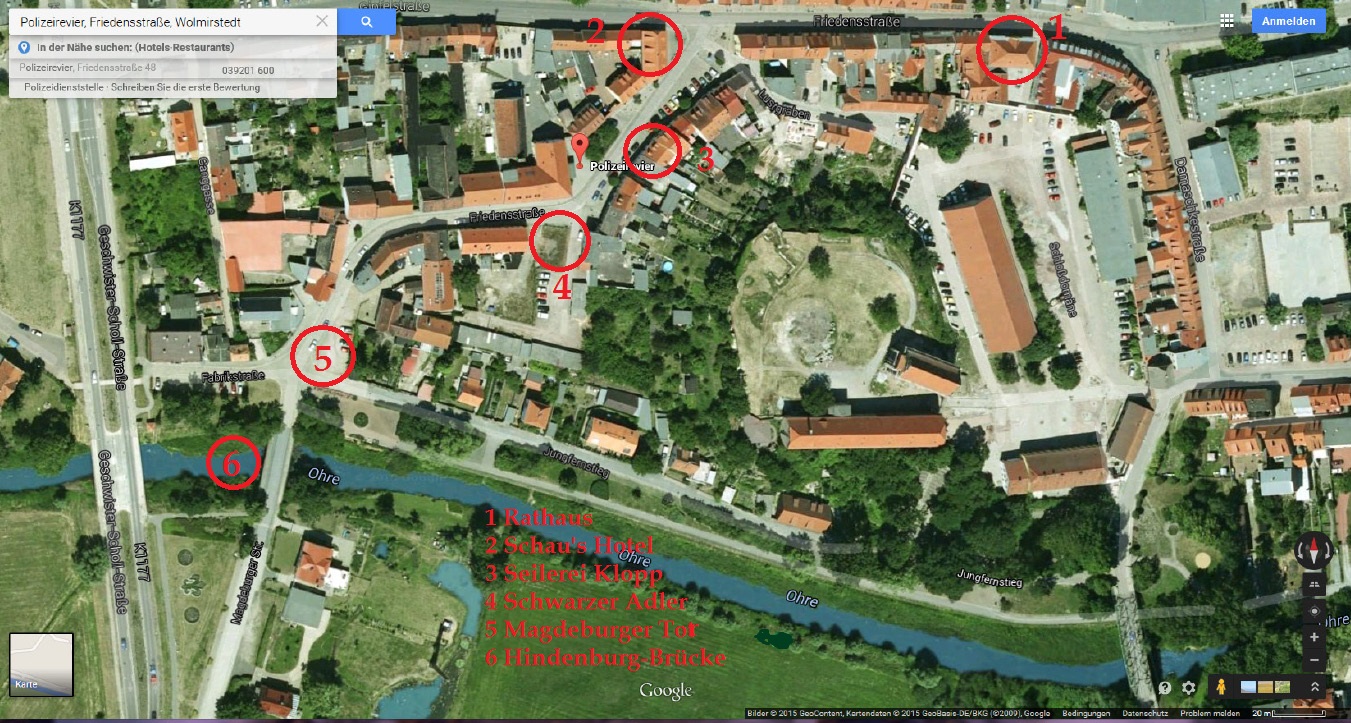
Ich stelle hier ein Google-Earth-Bild mit der Friedensstraße ein:

7 Bild Google-Earth

Herr Jahn hat mir auch erlaubt, Bilder aus den Büchern im Blog zu benutzen und erzählte, dass Anfang der 90-er Jahre ein etwa 60-jähriger Klopp bei ihm in Wolmirstedt war, nach Durchsicht seiner Aufzeichnungen fand er heraus, dass dies Eberhard Klopp war, also der Klopp, der das Buch:

“Ein Brief an die Nachfahren der Familie Klopp aus Altendorf/Brome und Wolmirstedt”
Teil 1   400 Lebensläufe zwischen 1590 und 1990
1997 Verlag Trier

geschrieben hat. Herr Jahn stand mit Eberhard Klopp an der Hindenburg- bzw. Magdeburger Brücke und dieser hat mit der Hand auf die Stelle gezeigt, wo von 1900-1912 die “Seilerbahn” der Klopp’s war. Inzwischen weiß ich, daß Eberhard der Großcousin von Peter Klopp ist.

Aus den 3 Büchern habe ich einen kleinen Abriß zur Geschichte von Wolmirstedt gemacht:

——————————————————————————————–
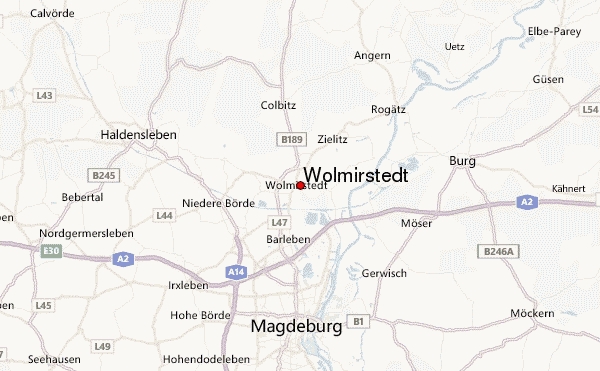
Das kleine Städtchen Wolmirstedt, 14 km nördlich von Magdeburg gelegen, wurde erstmals 1009 urkundlich erwähnt.
Wahrscheinlich während der Völkerwanderung bildete sich eine geschlossene Siedlung, die “Walmerstidi” genannt wurde, diese befand sich am Zusammenfluss von Ohre und Elbe und bildete unter “Karl dem Großen” einen östlichen Grenzort des großen Frankenreiches.
Am Ende des 13.Jahrhunderts änderte die Elbe ihren Lauf in Richtung Osten, heute mündet die Ohre bei Rogätz in die Elbe.
Im 30-jährigen Krieg wurde Wolmirstedt 1642 völlig zerstört, 1642 fand eine öffentliche Hexenverbrennung statt!
Einen Aufschwung gab es für den Ort nach der Besetzung 1807 durch die Truppen von Napoleon. Die Leibeigenschaft wurde abgeschafft, es gab mehr Freiheiten für Handel und Gewerbe und weniger Privilegien für den Adel!
1890 hatte Wolmirstedt 3868 Einwohner, nicht mitgezählt wurden die 50 Beschäftigten auf dem Junkerhof.
Die Magdeburger Straße, dort wo sich die Seilerei Friedrich Klopp befand, wurde 1365 noch als “Steinweg” benannt, sie war eine wichtige Durchgangsstraße von Magdeburg nach Norden. Die Passage über die Magdeburger Brücke der Ohre muss “sehr riskant” gewesen sein. Ein Fuhrwerk benötigte damals einen ganzen Tag, um nach Magdeburg und zurückzukommen.
1667 wurde die Torakzise (Wegezoll) eingeführt, das “Magdeburger Tor” wurde errichtet, 1812 wurde die Torakzise abgeschafft.
In der Straße siedelten sich Kaufleute, Handwerker, Fabrikanten, Handwerksmeister, ein Apotheker, ein Schmied und ein Kantor an. Die Straße war “420 Schritte” lang und endete am alten Rathaus, einem Renaissance-Bau.
1925 lebten 170 Familien in der Straße.
Die “Magdeburger Brücke” hieß zeitweise “Hindenburgbrücke”.
Markante Gebäude waren das Polizeiamt, die Buchdruckerei Grenzau, die den “Allgemeinen Anzeiger” herausgab (daneben die Seilerei Klopp), “Schau’s Hotel”, die Gaststätte “Schwarzer Adler” (1971 abgerissen), die Alte Schmiede, das Fachwerkhaus des Schlossermeisters Jänicke, die “Wildemanns Gaststätte und Pension”.
Einer von Wolmirstedt’s Originalen war der Wirt des “Schwarzen Adler’s, Kurt Güssefeld.
————————————————————————————————
Der heute über 90 Jahre alte Otto Zeitke ist ein toller Erzähler vom alten Wolmirstedt und seinen Bewohnern, da gibt es viele interessante Dinge zu lesen:

-Er berichtet, dass der Wirt einmal plötzlich sagte “Das kann’s doch nicht geben, wie der Schinder die Braunen hetzt”, dann lief er zum Fenster, sah auf die Straße, , schüttelte den Kopf und brummte unverständliche Flüche gegen den
Kutscher”.
-Auf dem Hof des Rathauses gab es den Karzer, das Gefängnis. Die Frau vom Polizisten Meier betreute und versorgte die Knastbrüder, der Volksmund sagte zu den Insassen, sie sind im “Cafe Meier”.

Ich habe mit Otto Zeitke lange nett telefoniert, er wirkt noch sehr jugendlich und berichtete mir, dass er die Kanuten in Wolmirstedt organisierte, er ist auch der Meinung, dass die Seilerbahn der Klopp’s am Ufer der Ohre gelegen haben muss.

Am 11.3.2015 war ich mit Edda in Wolmirstedt, wir haben die Friedensstraße von der Ohrebrücke bis zum alten Rathaus abgewandert und Fotos gemacht.

Ich stelle nun einige der Bilder neben den alten Aufnahmen aus den genannten Büchern ein. Den Anfang macht das Bild von Eberhard Klopp, das mir Herr Jahn freundlicherweise auch geschickt hat. Ich habe rot eingezeichnet, wo sich vermutlich die Seilbahn Klopp befand.

Vom ehemaligen Magdeburger Tor ging es dann aufwärts nach Wolmirstedt hinein.

Der nächste Abschnitt beginnt mit der Ecke “Schwarzen Adler”, führt am Haus der Seilerei Klopp und dem Polizeigebäude vorbei bis zum ehemaligen “Schau’s Hotel”.

Nun geht es im nördlichen Teil der Straße bis zum alten Rathaus.

Zum Schluß noch 4 sehr schöne alte Fotos aus dem alten Wolmirstedt.