Mystery Story in German

Kein Unterschied, Homunkulus!

By Peter Klopp

After Biene and I had met for the second time at Lake Baldeney (near Essen, Germany) in July 1964, I composed for her the following short story. I deliberately left out the final two paragraphs to give all my readers a chance to ponder about how the story will end. If you want to place your guess into the comment section, that would be cool. I will publish the end of the story on Wednesday’s post. My apologies to all, who don’t know German. But it would have been too time-consuming to translate such a lengthy piece of writing.

Paps war ausgegangen, Nahrung zu holen. Eigentlich war er noch kein Vater, aber sie nannte ihn so, und das war entscheidend. Tief unter dem Erdreich saß sie in der gemütlichen Stube und betrachtete liebevoll ihren Leib. Sie dachte an die Kinder, die da kommen würden, und horchte still in sich hinein, ob sie nicht vielleicht schon ein zartes Pochen der Herzchen vernehmen könnte. Ihre schwarzen Äuglein leuchteten zufrieden, sie ging ihrer Erfüllung entgegen.

Und wo aber auch?! Mit keinem Palast dieser Erde hätte sie die so nützlich und sicher angelegte Wohnung getauscht, die ihr Mann in unermüdlicher Arbeit aus dem Erdreich gestampft hatte. Er hatte für alles gesorgt: Die Kinderzimmer grenzten mit ihren niedlich ausgerundeten Eingängen an die gute Stube und das Schlafzimmer der Eltern. Mit ihnen verbunden war ein lang sich erstreckenden Gang wohl drei Körperlängen hoch und mehr als dreißig solcher Längen lang, in dem die Kinder ungestört herumtollen könnten, wenn sie erst einmal ein wenig größer geworden sind. Und was den kommenden Winter anbetraf, so hatte ihr Mann mehr getan als alle Männer dieser Welt. Die Kornkammer war zum Bersten voll, genug, um eine zwölfköpfige Familie den Winter durchzubringen. Das wäre alles jedoch kein Weizenkörnchen wert gewesen, wenn nicht der umsichtige Vater auch für die Sicherheit gegen Wetter und Feind gesorgt hätte. Continue reading

The P. and G. Klopp Story – Chapter 5 (Part I)

Chapter 5

Gutfelde (Zlotniki)


Home is people. Not a place. If you go back there after the people are gone, then all you can see is what is not there any more. Robin Hobb


At the time of my birth, Father as manager and inspector was in charge of the estates Silberberg, Oberhof and Gutfelde totaling an area of approximately 3000 ha. Although he must have been thankful to the authorities for landing him such challenging and prestigious position and therefore may have harbored a favorable disposition towards the Nazi regime, he always strove to keep his humanity in dealing with his fellow human beings, Germans and Poles alike. In particular, through his actions he distanced himself from the policy that forbade German citizens to fraternize with the defeated enemy. It is a great testimony to his moral independence from the dark and sinister sides of Nazi Germany that he allowed Polish men and women to live and work closely and cordially with the Klopp family at the Gutfelde residence and the agricultural headquarter for the region. He maintained an excellent working relationship with the former Polish estate manager Haluda, who after WW2 took over as director of the communist run state farm. From the stories I picked up from my mother I speculate that Father owed his survival to his reputation of treating fairly and equitably all the people who worked for the large estates under his directorship. Other inspectors notorious for their arrogance, cruelty and injustice in dealing with the Polish population were rounded up, lynched, hanged or shot in the closing months of the war. On a  Polish website with special focus on mansions, manors, and castles of Poland, I found an entire page devoted to Gutfelde – now an agricultural training center with orchards, wheat and corn under cultivation, 800 cows and 8000 pigs. The same page to my great surprise mentioned my father’s name as an administrator during WW2! The mansion-like imposing building was built around 1880 in the late-classical style and consisted of a body with a higher wing and ground floor extensions. It has not changed much in the last seventy years.

Family Photo 1941

Family Photo – The Klopp Children from Right to Left: Karl, Adolf, Gerhard and Eka

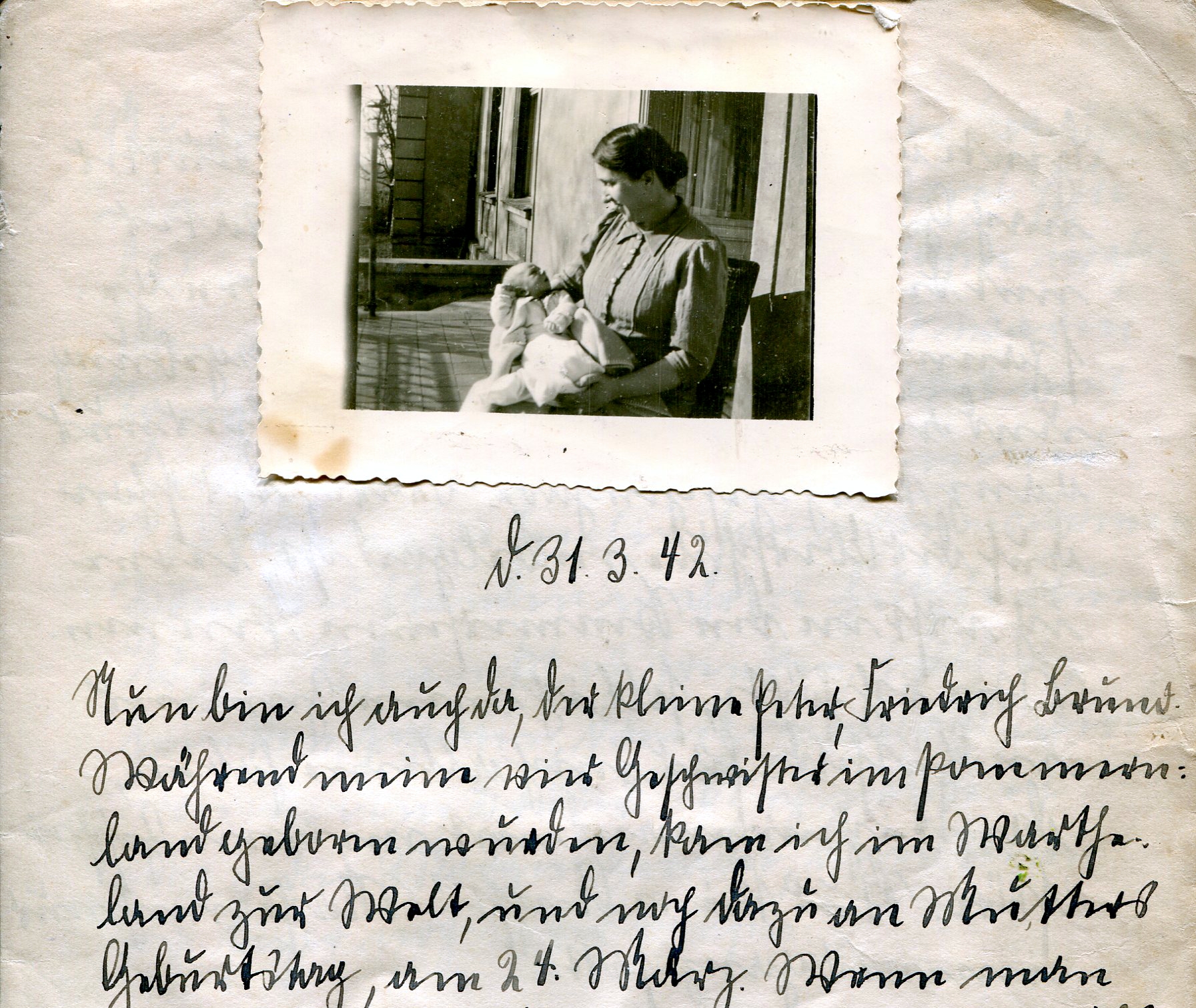
My three brothers Karl, Adolf and Gerhard and my sister Eka (short form of Erika) (now Lavana) were all born in Pomerania, whereas I began my life’s journey in the town of Dietfurt (Znin), Warthegau. There I spent the first eight days with four other babies in a warm hospital room. There were also two Polish babies born in the same county hospital. Later on in my early childhood I had to take quite a bit of good-natured teasing with made-up stories of a nurse who had accidentally placed a Polish baby into my crib, while I was being examined in another room.

First Page of Mother's Diary

First Page of Mother’s Diary about her Fifth Child Peter

When I arrived with Mother at Gutfelde, I received a truly royal reception. Karl, who attended a boarding school in Belgard (Bialogard), would see me a few months later at the beginning of his summer holidays. But the others including my proud father did everything to welcome the fifth child in the family. Flags were waving. Fir branches and a big welcome sign decorated the door to my very own room was. Inside the sunny and warm room several pots with beautiful flowers created a cheerful atmosphere for the latest arrival in Gutfelde. Continue reading

My Birthplace Znin (Dietfurt)

A Photo Gallery of Znin,

where I was born

Photo Credit: Wikipedia.org except for picture of the hospital

Chart I – III

Znin is a modern town in an area with a rich history going back to Roman times. The visitor will find more information on this beautiful town and its many cultural and touristic attractions on Wikipedia and many other sites. I will limit today’s presentation to just the pictures to give a sense of where I come from. You can read more in Chapter 5 of the P. and G. Klopp story to be posted soon. If anyone of the Polish visitors of our blog knows the town well and would be so kind to tell if the old hospital building still exists, I would be extremely grateful.