From Darkness into Light
Immature love says: ‘I love you because I need you.’ Mature love says ‘I need you because I love you.’ Erich Fromm
Filing a Complaint
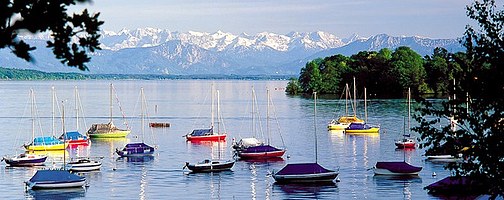
Beautiful Feldafing at Lake Starnberg – Photo Credit: bergfex.com
Soon after my return to Maxhof, Gauke and I received the order to report to the commanding officer. I wondered what could be so important that we would be sent away from our very first driving lesson in the New Year. The young clerk in uniform behind the massive office counter told us that the captain was expecting us in his office. With a heavy heart we entered. After the perfunctory military salute the captain asked us to take a seat. I had the ominous feeling that we might have unknowingly broken some rules resulting in a disciplinary issue that the sergeant at the driving school could not handle himself. Without giving any explanation the officer informed us that we would be transferred back to our unit in Koblenz as of April 1st. We were stunned. But when the officer asked us whether we had any questions, Gauke inquired, “Why are we being sent back, if the purpose of the transfer was to have us trained as certified truck drivers?”
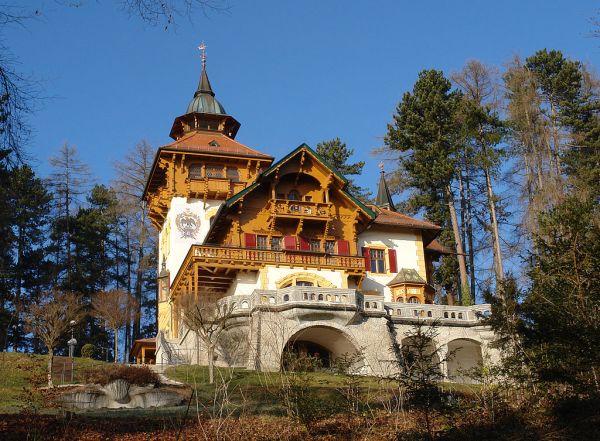
Villa Waldberta Feldafing – Photo Credit: wikipedia.org
The officer was a little taken aback, as soldiers are only allowed to ask questions, but not to question orders. But he must have realized that in this case we were entitled to know. For he said, “Soldiers that were transferred to my unit were supposed to be already fully trained as truck drivers. That was my request. Instead THEY send you! Dismissed!” From the furious tone of his voice, with which he pronounced ‘they’, it seemed to me that he was not angry at us, but at the system that cheated him out of two valuable truck drivers. Because of this ridiculous transfer I had not only lost out on the officer’s training program, but now I would also be deprived of the golden opportunity of getting my driver’s license. But what bothered my sense of justice the most was that we had been lied to, that the promise to provide driving lessons in January had been broken. In a violent outburst of angry words I released my frustration in a ten-page letter to Mother, which she acknowledged in a postcard expressing her hope that I had been able to calm down. In her motherly wisdom she had also destroyed the letter because of its incriminating content that she did not want anyone else to read.
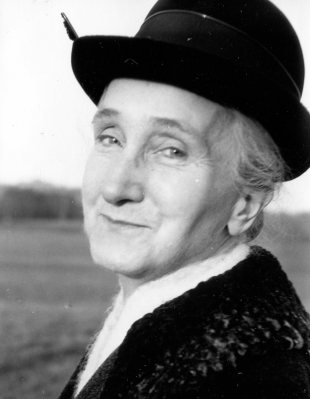
Portrait of my mother – Erika Klopp
Gauke and I had a good talk over a mug of beer in one of the local pubs and discussed what our next move should be to address the unfairness of our transfers. I suggested grieving the matter at the next higher authority. Gauke agreed and encouraged me to write the letter of complaint, since with all my novel-writing I should have the better writing skills. Then we ordered another beer to drink to what sounded to us as a good decision. Within less than a week our grievance to the major in charge of the signal corps was in the mail.
Challenging Times at Maxhof
In these turbulent days I now and then pulled out Biene’s letter and carefully read it over looking for a sign of encouragement, a key to her heart, but there was none except perhaps that she had written to me at all. Again I was in a dilemma. One side of me said, ‘In view of her engagement and promise of marriage to another, it is unfair for me to keep writing. Let her go! Leave her alone!’ The other more irrational side, which by definition is not persuaded by reason, urged, ‘You loved her; and you love her still. Cling to her as long as you can.’ So unable to keep the two warring parties apart within me, I wrote a short note intended to show that I was still thinking of her, but at the same time emphasizing that we were hopelessly drifting apart.
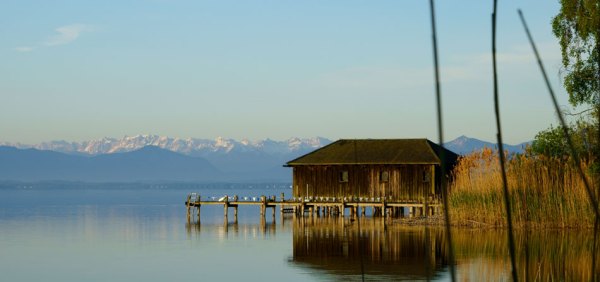
Feldafing – Photo Credit: immo-vilalta.com
In a poisonous blend of regret and resignation I wrote, “From month to month our tracks are more and more drifting apart, and what is left, as you write so correctly is the pain. But also pain eases over time. What seemed so devastating at first does not hurt as much any more. Only from time to time when I look at your pictures, melancholy sets in and spreads its debilitating influence. But even that will end like a river disappearing in the parched sands of the desert…”

Kegler Family: Helga. Gerhard, Günther, my mother Erika Klopp, Marie and Lucie Kegler
Picking up Biene’s very own words I continued, “Will we see each other again? Perhaps. But may Fate prevent this from happening! We met, played and laughed at Lake Baldeney. We were dreamy idealists, when we wrote each other! It was good that things turned out this way for you and also for me. We would have deeply disappointed each other; I would have certainly disappointed you. Believe me, there are a thousand sides to my personality, and in my letters I showed only one. Until next time! Farewell, dear Biene! Your Peter.” As soon as I had dropped off the letter in the mailbox, I called myself a fool. For I was sure that Biene after reading these confusing, despairing, heartless lines would not consider me worthy of another reply.
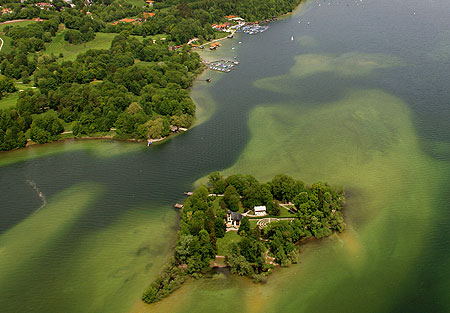
Feldafing from above – Photo Credit: bayern.de
The response to our complaint was swift, and realizing that most things in my life lately have turned out to be a surprise, I began to expect the unexpected. The way the army brass dealt with the transfer grievance was no exception. I wanted the major of the signal corps to deal directly with our problem, invite us to respond to more questions, and eventually serve justice by reinstating us into the driving school or even put us into the officer-of-the-reserve program. Instead, we were called in to see the very same officer we had filed our complaint against. If he was angry at the system on our first visit, he was now openly hostile at us. He resented that we had the audacity to bypass him and that we had gone straight to his superior to complain about him, even though we had not even mentioned him in our letter. With a calm voice calculated to instill fear he told us while pointing to our letter on his massive desk that we had two choices. Either we withdrew our grievance with no disciplinary action taken against us or we foolishly insisted on following through with our complaint before a hearing committee with most unpleasant consequences if it is determined that we had made false accusations. Barely concealing the intended threat he nevertheless spoke matter-of-factly almost in a conciliatory, amiable tone, “You must know, young fellows, we merely spoke of the possibility of getting you into the driving school. The office staff for some reason or other did not inform you of the impending transfer. That’s the whole story, regrettable for you, but true.” Gauke and I looked at each other. The threat had worked. We would have no leg to stand on, even if the hearing committee was going to lend us a sympathetic ear. Thus, we signed the document certifying the withdrawal of our grievance.
“Listen,” the officer said with a triumphant smirk on his face, “Enjoy your stay at Maxhof. You have more than two months left here. Most soldiers would only be too happy to trade with you.” So Gauke and I had accomplished nothing. We returned to our living quarters deeply disappointed.
A Good Friend’s Advice
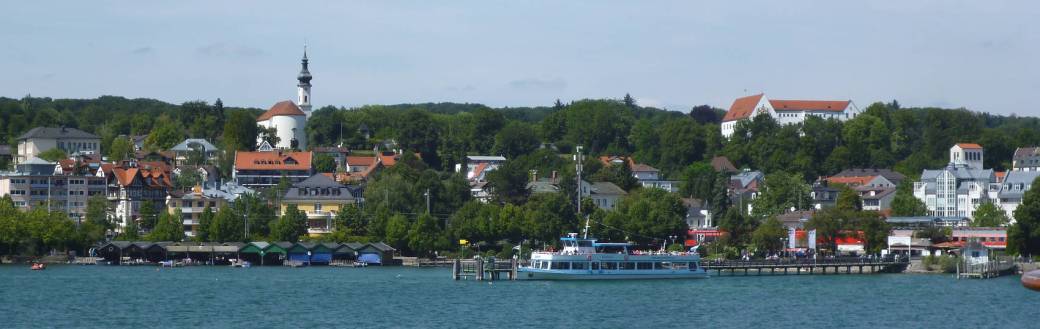
Starnberg – Photo Credit: starberg24.de
Gauke and I were dining at the Gasthof zur Post, a small inn not far from the beautiful Starnberg Lake. We savored the tender pork roast served with the traditional dumplings and salad. It was midweek and hardly any tourists ventured out from the big cities to see the lake country in the dead of winter. So we had the cozy dining area all to ourselves in the ideal ambience, where the refreshing Bavarian beer and conversation make a great pair to enhance friendship and companionship. We had decided to accept the captain’s advice and make the best of our remaining time in Bavaria. I was still reeling under the effect of the double whammy of a lost opportunity for advancement in the army and the specter of unrequited love. But the fine food and drink started to ease the tension and made me at least for the moment forget both the headaches and heartaches of the past three weeks. My friend started talking about his sweetheart in a town near Frankfurt, with whom he got together almost every other weekend. The previous summer they had gone on a bicycle tour out from the searing city of concrete and steel. Following the picturesque River Main they found an idyllic spot at one of its tributaries, where they pitched their tent. They had a most wonderful time at the campfire gazing at the stars, listening to the nearby murmuring brook, then huddled together, as the chill of the cloudless night made them seek each other’s warmth. Hearing Gauke so passionately describe his summer weekend with his girlfriend, I almost choked. There was my friend and comrade sitting across from me with a romantic spirit just like me although with one painful difference. What he had so vividly portrayed that I could almost sense their happiness, he had experienced in the real, tangible world in perfect harmony of body and soul. In my dream-like fantasies I had visions of similar experiences. But they were mere figments of my imagination coupled with the hope that somehow or someway, if I waited long enough, they would as if by the stroke of a magic wand become reality.
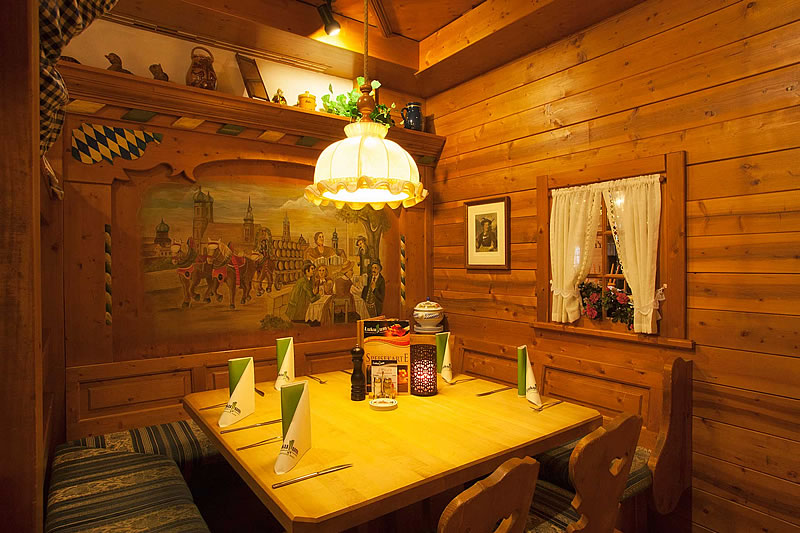
Bavarian Pub – Photo Credit: lukullum.de
Gauke not knowing the feelings he had stirred up within me kept on talking. “Now, Peter, do you know what the sweetest moment is when I come home on the weekends?” He was so eager to tell that he did not wait for me to answer. “When the train arrives at my hometown just a few minutes before midnight and I step off the train, I see at the end of that long empty platform behind the iron gate my girlfriend with her long black hair fluttering in the night breeze.”
I wanted to shout at him, ‘Stop it! You are torturing me with your romantic talk!’ Instead I quickly grabbed the stein of beer and gulped down the cool liquid in a desperate effort to quell my emotions. As if Gauke had read my mind, he briefly interrupted his ardent story telling and ordered two more mugs of beer. Then perhaps sensing my embarrassment and uneasiness over all this romantic talk he quickly added in conclusion that he was invited to meet her parents this coming weekend and being only an ordinary soldier he was quite a bit nervous about it. I was thankful to Gauke about his tactfulness. For his talk reminded me of everything I had done wrong in my relationship with Biene and it confirmed what Dieter Krug had already stated on our scenic bike tour up the Moselle valley. To capture the affection of a heart and to desire to be loved, the two need to be together to feel each other’s presence and to experience each other through the five senses. This can never happen in and through letters. Remove the sight of your love walking with you on a shady trail on a warm summer day, remove her cheerful laughter, pleasant voice, her songs, remove her touch, a walk with her arm in arm, remove the sweet taste of her kiss, remove the fragrance of her hair and skin, and you will have blocked the gateway to each other’s soul, doomed to wither and die. We had been drinking our beer in silence, when Gauke indicated that now it was my turn to talk. After a long pause I told him that I had nothing to say.
“I noticed that you were writing a novel about her. And you want to tell me that you have nothing to say?” he rebuked and teased me in a jokingly disarming manner. Then he began to extract bit by bit like an experienced lawyer the details of my relationship with Biene and in doing so put them like little pieces in a mosaic clearly before me. He was surprised to hear that I had met her only once; he was even more surprised to hear that I loved her on the basis of mere letters; and he was most surprised to hear that she was engaged to a young man in Holland. He shook his head in utter disbelief. He ordered another beer for us. Then he spoke kindly and softly no longer like a lawyer. With his balding head and the concerned looks on his face he actually looked more like a counselor.
“Peter, I urge you. Let go of her. The love you feel for her has no foundation. The love you think she feels for you is not based on reality but comes out of the make-believe world of sentimental novels or movies. Let go of her. You are heading for disaster. A girl who is engaged to marry another cannot possibly love you. And if she does, she is as crazy as you are, and she too will be heading for disaster. As a friend I give you my advice, let go of her, Peter.”
We sat for a while and silently finished our beer. Gauke was sensitive and kind. He did not speak another word. On the way back to the barracks I thanked him for his friendship and told him I would take his advice very seriously. I slept well that night as if a great burden had been taken off my chest. How could I have suffered so much about something that did not exist? With such rhetorical musings I drifted off to sleep.
Light at the End of the Tunnel
Late Sunday night Private Gauke entered our room after spending the long weekend at his girlfriend’s home. He was so excited about it that he felt justified in waking me up. Even though I was still half asleep I could tell that my friend was beaming with joy. He had good news to tell me. He had met his girlfriend’s parents who were delighted to get acquainted with the young man their daughter had been telling them about so much. He was amazed almost embarrassed how much they knew about him. For them the most important thing was to see their daughter happy. In their eyes he seemed to be the right man for her. My companion would have gone on to share his happiness with me, but when he looked at my sleepy and grumpy face, he stopped. I was annoyed and wondered why he could not have waited with all that chatter till next morning. Then I would have perhaps appreciated his latest romantic tale with a wakeful mind. I made no effort to suppress a loud yawn to indicate that I wished to get back to sleep. However, Gauke had still something else on his mind that was supposed to cheer me up.
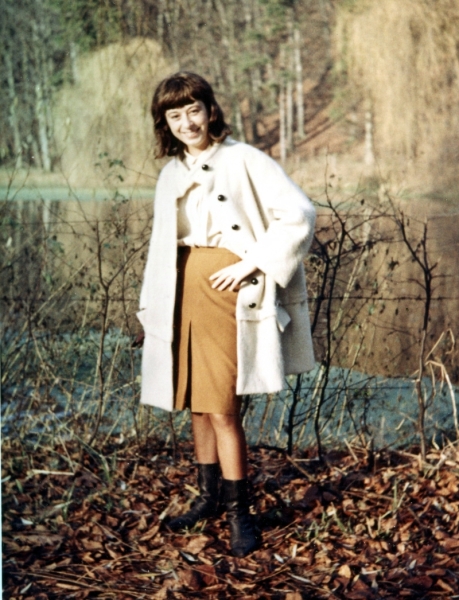
Biene quite in Tune with the Fashion of the Sixties
“Peter,” he started again with undiminished exuberance in his voice, ”my sweetheart back home has a wonderful girlfriend who is just like you; she loves poetry, even writes her own verses …”
“I’m not interested,” I interrupted him gruffly.
“Peter, don’t get me wrong. You need to break out of your doom and gloom. I invite you to come with and spend the weekend at my parents’. We could go out together and meet …”, I interrupted him again raising my voice just a notch higher to make it clear that I had enough of his idle talk.
“Well, suit yourself”, he replied. “All I wanted is to advise you to keep your options open. It is not a good idea to have just one egg in your basket. In case it breaks, you know.”
Poor Gauke, he tried so hard. He was a nice chap and a good friend. He was truly trying to help. I was stubborn or insanely in love, or both. It took me a long time that night before I managed to catch a few winks of sleep.
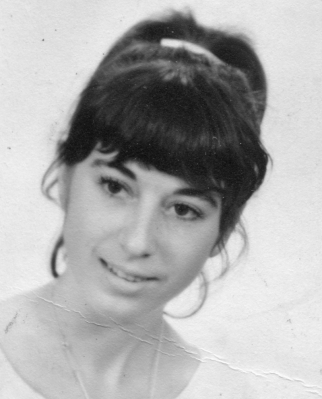
Biene (Gertrud)
In the second week of February, just when I had given up ever receiving a message from Biene again, her letter arrived, which I expected to be the final farewell letter. Instead it contained a bombshell. I read with relative calm that her engagement with Henk had been broken off. Her dream about a life together with him had been shattered through unfortunate events and circumstances, which she was unable to describe except to say that Henk had loved her so much that she for a while believed to love him too. However, what led up to the actual break-up, she left unsaid setting in motion an avalanche of speculations on my part. In vain I tried to penetrate the veil that shrouded the circumstances that she was alluding to. Had Henk revealed an aspect of his character that made her shudder? Had he been too aggressive and demanded of her too much, too soon? Many more questions were racing through my head, for which I found no answer, creating a jumble of mixed emotions. If she had given me a few concrete details no matter how shocking, I would eventually have accepted with love and understanding her tragic experiences. As I continued reading I noticed how much she was troubled by my plans to emigrate to Canada.
“How can we possibly meet again, when you are so far away,” she asked, “and disappoint each other? Do you really believe ‘disappoint’? I cannot imagine it; but I would not be afraid to see you again.” At that moment my heart beat a little faster. The horizon began to brighten up with the rays of hope and eager anticipation. Unfortunately, like a bolt out of the blue, without any merciful transition, Biene continued, “Imagine this, my pen pal from Morocco intends to come this summer to get to know me and Germany. Will he be like I imagined him to be? My parents don’t agree with the idea; for they fear we could fall in love with each other.” I felt that the tenuous thread that so far had held us somehow together was ready to snap. What prevented this from happening was a mental trick that moved my mind to a distant vantage point from which I looked down upon the bizarre soap-opera-like comedy show below. The Moroccan pen pal had miraculously risen from the dead and imbued with renewed zest for life was eager to see her, to meet her, to get to know her, while her poor parents having just been saved from one disaster were heading into the next. I could not help but internally smile and laugh. My friend Gauke would be laughing too, He was absolutely right in his urgent plea to let go of her and also in his opinion to have more options than one. In an ironic twist it was Biene, who obviously had more than one egg in her basket. One broke, but she had two or more eggs left to break. I tried to probe into the possible reasons as to why in this particular moment she would tell me this. Was she trying to goad me into action? Her concluding sentence seemed to confirm my speculation, “Sometimes, even though you wouldn’t like it, I would really like to see you again.” A new seed had been planted. It was now up to me to water it, to nourish it, to make it grow in the fertile soil of reality. To accomplish it, a rendezvous with Biene was the key and time was of the essence. To blaze a trail to the doorsteps of her heart, I made some unusual preparations.
Four Deaths in Four Months
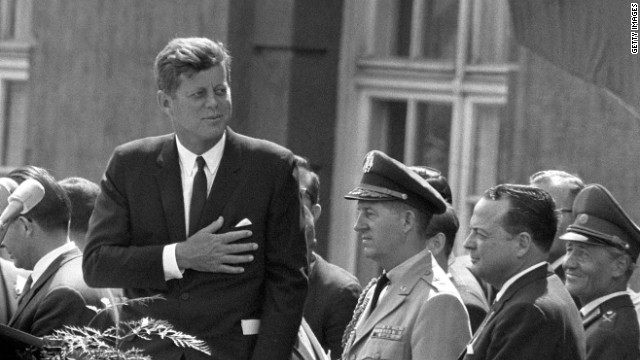
President Kennedy, “Ich bin ein Berliner” – Photo Credit: cnn.com
But first I had to endure another blow. Death had given me in quick succession several reminders of our transitory life here on earth. On November 22nd at the Maxhof army residence. I was listening to the American Forces Network (AFN Munich). The DJ suddenly interrupted the Country and Western music and after a short pause announced that President Kennedy has been shot in Dallas, Texas. Later that night it was reported that he had died of his gun shot wounds. I was shocked over the news of this tragedy, as I had taken a liking to this great man for his fortitude to force the Soviet Union to remove their missiles out of Cuba. I liked the way he had publicly committed himself to the security of West Berlin. His famous statement, ‘Ich bin ein Berliner.’ will remain in me for as long as I live. Then in January our staff sergeant Wohl had a fatal accident, when his VW beetle collided with a public transit bus on an icy hillside road in Feldafing. Gauke and I and two other comrades accepted the sad task of becoming his pallbearers. I will never forget the heart-rending sobbing of the widow in the front pew, when the officiating priest addressed her with a few consoling words. A couple of weeks later, almost if death intended to remind me again of its presence, I lent sixty marks to a comrade so he could buy a train ticket to attend his grandmother’s funeral. On the morning of February 26th I was called out of the office to see the captain for an important message. This time Gauke stayed behind at his typewriter, and I went a little puzzled and worried to the captain’s office alone. After I sat down, he informed me with genuine regret that my father had died of a massive heart attack during the night of February 25th. The officer granted me a five-day compassionate leave, effective immediately. I was numb. I could not respond with a single word. The captain deliberately ignoring military protocol shook hands with me and spoke kind words of condolences. Only a small number of family members, aunts, Erna’s relatives and friends attended the funeral in Michelbach. I wrote and dedicated a poem to my dad. The poem ended with a line in Latin:
Viventium, non mortuorum misereor.
I mourn the living, not the dead.
Grieving Father’s death and attempting to overcome the blow, I wrote Biene that I needed time to respond to her wish to see me again. It also took me quite an effort not to mention her pen pal from Morocco in my letter. Perhaps I should not have suppressed my feelings. For jealousy although often portrayed as a negative force has its legitimate place. Just as we need fear to protect us from dangerous situations, a small dose of jealousy at the very least reveals that you care and are sincerely concerned about your partner’s affection.
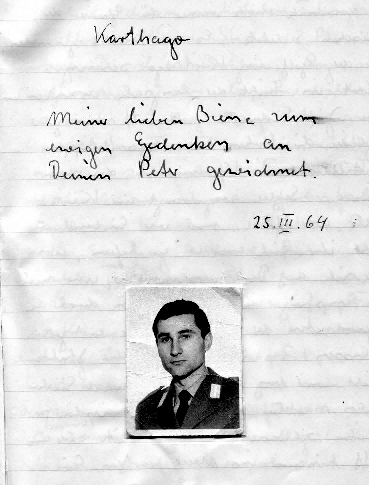
Novella ‘Carthage’ Dedicated to Biene
Back at Maxhof I began to edit and to copy in my very best handwriting the novella ‘Carthage’ into a thick green covered notebook. I dedicated the more than 200-page book to Biene. As it was not only a historical novel but also a testimonial of my love to her, it turned out to be quite literally the longest letter I had ever written. More importantly it ended in such a way that Biene herself one day could write the final chapter not as a flowery addition to an imaginary tale, but a true story with Biene and me being the main characters in the real world. At the time of my transfer back to Koblenz I was back home to celebrate my 22nd birthday. There I mailed the book to Biene, after I had mysteriously hinted in a previous letter that I would be mailing her a very interesting book portraying us as Claudia and Publius. In the accompanying letter I wrote, ‘Dear Biene, you have sensitivity and understanding, Even though in this book everything had happened over two thousand years ago, its content is so current and volatile that I would not dare to show it to anyone but you. Whoever opens his heart is twice as sensitive and vulnerable. You will read many a chapter filled with blood-curdling details about this fateful city. Just remember what happens here in terms of physical suffering and pain is to be understood at the psychological level. I have been writing the novella for a long time. Personal experience and history went hand in hand to create it. The shock I experienced last fall put a sudden end to the story. You will notice that the form of the narrative lost its formal structure and the story ends in a desperate monologue. About some of the things, which I have written, I think differently today. But I have not lost my idealism. I am searching for a world, where I can turn my hopes and aspirations into reality.’ I felt like a general, who in a last-ditch effort committed all his troops and resources and staked everything on one card to win the battle and claim the prize of victory.
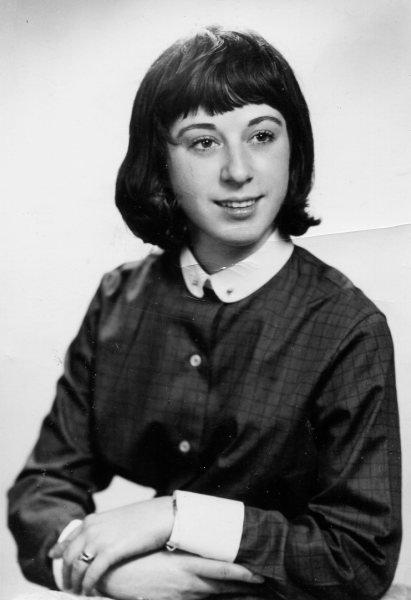
Gertrud (Biene) Panknin
Peter‘s Musing on the Nature of Platonic Love
Fortunately, I did not have to wait very long. Biene had expected a store-bought book that in content and style would bear a strong resemblance to our turbulent relationship, where the ending would perhaps provide an urgent plea to get our act together and leave our fantasy world behind. To put it mildly, the handwritten book had overwhelmed her. Never before had she received a gift like this, where every single page had been written exclusively for and about her. She did not insult me in the least (as a matter of fact I took it as a compliment), when she questioned for a moment the authenticity of the book’s claimed authorship. Then came the sentence I had been waiting for, ‘I believe we love each other.’ What all my letters in the lines and between the lines could not accomplish, it seemed to me the novel had succeeded in pronouncing my unequivocal and unmistakable message ‘I love you’ and that at last I had received the long-awaited, if somewhat faint echo, ‘I believe we love each other’. However, when she qualified the kind of love she had in mind, I realized that I had rejoiced too soon and that at best I had only scored a partial victory.

Biene’s Parents Mr. and Mrs. Walter Panknin
‘But it is a strange love’, she continued, ‘like a dream not bound to reality. I love your words, your soul, which your words express. I love you as a human being, Peter, but I am very much afraid to love you as a man, and I fear that you already love me as a woman. That will bring much pain. How shall I make it clear to you, so you will understand what I mean? I cannot yet belong to a man. It has been my greatest desire for a long time to love a man and to completely belong to him, and yet I know, and I have experienced it myself that I am not yet ready for it .’
‘Therefore, Peter’, she continued, ‘I must ask you, do not love me as a woman, for then we could quickly lose each other again! I would like to write to you the opposite and yet let us this time not go with our dreams any farther than what reality will be able to give us as fulfillment. I find it so hard to tell you this and yet, Peter, grant me this wish, let us be friends just as in the beginning.’
I reread her letter looking for clues in the bewildering plea to turn back the clock to the time, when we had started our friendship. But I found nothing apart from just a vague hint of something horrible that she had experienced in the recent past. It was obvious to me that she had not written the happy ending to the novel in real life, which I had so intensely been hoping for. It was a now-or-never situation for me. I realized that she was in a complete state of confusion and afraid of a man-woman relationship, so afraid that she risked losing the one whom she believed she truly loved. The spirit within me that so often in the past had said ‘one last time, try just one more time’ goaded me to write. I felt completely calm. I wanted to pass on to her that sense of tranquility, which would ultimately provide the pillar upon which she could rest her final decision without regret. It was either a life together with me, or the end of a friendship that could not be maintained. I was one step ahead of Biene in that I had felt the pain of jealousy over Henk and the Moroccan pen pal. She was in my opinion naïve to believe that she could find a broad-minded, speak indifferent husband, who would tolerate another soul mate in their marriage, no matter how platonic such a relationship would be.
So I wrote after some considerable time of reflection, ‘I have the feeling, you want to cut off the roots to a tree, but still want to harvest its fruits. You must not be so fearful, dear Biene. When one talks about love between a man and a woman, one must not think right away of its consummation. What I think about it will perhaps be to you a bit of a consolation. I can belong to only one girl. Then all the others vanish with time. If they don’t, they cause hard to solve conflicts within me. The girl that I mean was and is you, dear Biene. Don’t be shocked if I tell you that the love, which you are renouncing, took control of me from the moment I met you the first time. But in its purest form, as it finds expression through passion, it comes last. Many thousands of steps precede it. But it lives within me not strictly separated from all other human values. It plays its role in everything I am doing and thinking. In every sentence that I write to you it is there. Even if it is never mentioned, it is there. My entire being is woven into it through and through. And I feel happier now than in the times when I tried to suppress it as something evil.
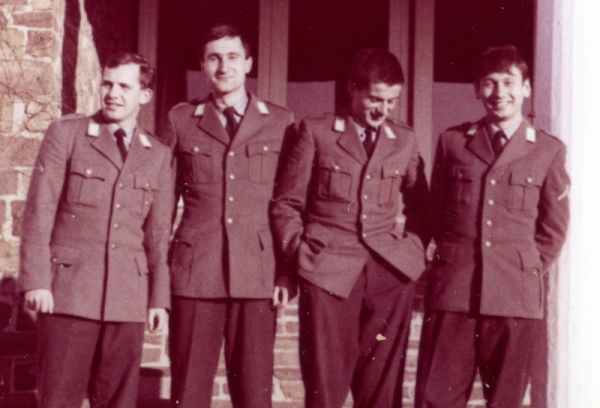
Peter with his Buddies at an Army Training Site
Dear Biene, you have a decision to make. But it is not difficult; I am not getting lost to you, at least not in the way you envision it now with a pure friendship between soul mates. What your attitude will be later does not matter now. The question for you is whether you will accept me with my love as a man. You can keep me just as I am or you set yourself and me free for the ‘love’ for somebody else that fate will bring into our lives. I give you complete freedom with your decision and accept everything. But I must have clarity! Take your time to answer my letter, just as I have taken my time.’
A few days later feeling sorry of having had the audacity to force a decision upon her, I thought it wiser to go back to Biene’s original plea for platonic love between the two of us and describe it vividly with a good measure of irony so that she could see at long last that this kind of love would not be worth pursuing.
‘I think I know now what is troubling you. Recently it stood before my eyes like a vision. It is the relationship between two souls pure, aiming upward, self-sufficient. This kind of love permits no passion; it wishes to be pure. That’s why you were afraid that our friendship would be in jeopardy, if you didn’t warn me. In your eyes we are two souls completely separated from our bodies in quiet distant solitude, eyes open for the wonders of nature and its beauty. Lovingly we exchange experiences we each had suffered from the blows of fate; we mature and rise upward towards ethical perfection. Earth with its horrors is no longer important; nothing bothers us any more. We let ourselves go, when we say farewell to our bodies. The day has arrived; we reach out for each other; the gate to our ideals opens. Who then should stop these innocent souls from entering the land of arts? One admires Spitzweg’s idyllic pictures, listens to romantically imbued poetry and goes into raptures over Beethoven’s Pastoral Symphony. One meets great spirits: Goethe, Lessing, and Schiller. We take flight and seek refuge at philosopher Seneca, who teaches us to relish contentment and happiness. But we are not so simple-minded as to ignore that even this is a dubious fabrication of human beings seeking escape from this odious world. Shuddering, we rise even higher, leaving everything behind. It feels so warm and fuzzy around our hearts; like a bridal veil our souls become transparent. Nothing weighs us down any more. Indeed, we are being lifted up; we melt into nothingness. You are I, and I am you. How magnificent and glorious! Our contours begin to blur. Eternally happy and content we have been transported into the heavenly realms. Dear Biene, with all that bliss why don’t we just go ahead and die?’
With this bitter-sweet rhetorical question I ended my letter and wondered about how Biene would respond to the imagery of my emotional diatribe.
Career Planning and a Painful Self-Assessment
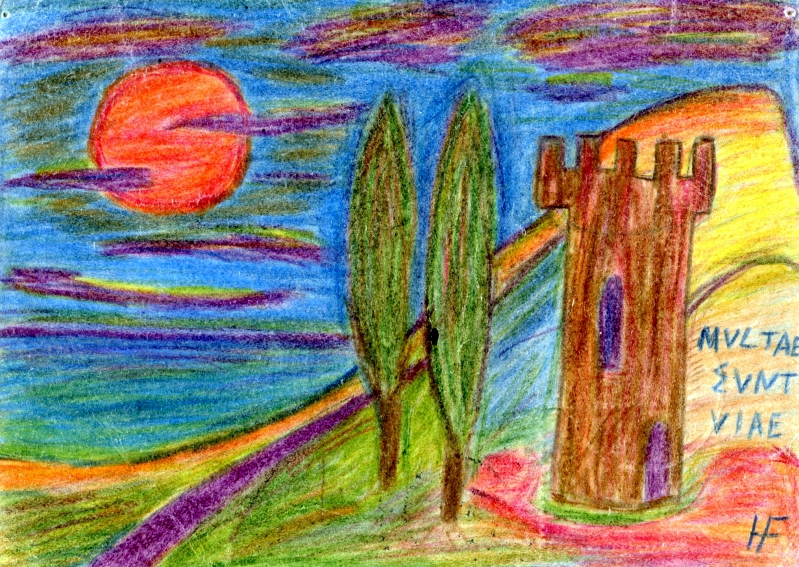
Art Work Entitled ‘There are many ways’ by my Friend Hans Fricke
My brother Gerry, who lived in Medicine Hat, while I was in the West German army, is not exactly known among family members as an avid letter writer. All the more I was surprised to receive a detailed answer from him to my inquiry regarding teacher’s training in Alberta, Canada. Driven by a youthful desire for adventure but also by a kind of escapism that was getting stronger with each additional month in the army I wanted to explore a possible teaching career in Canada.
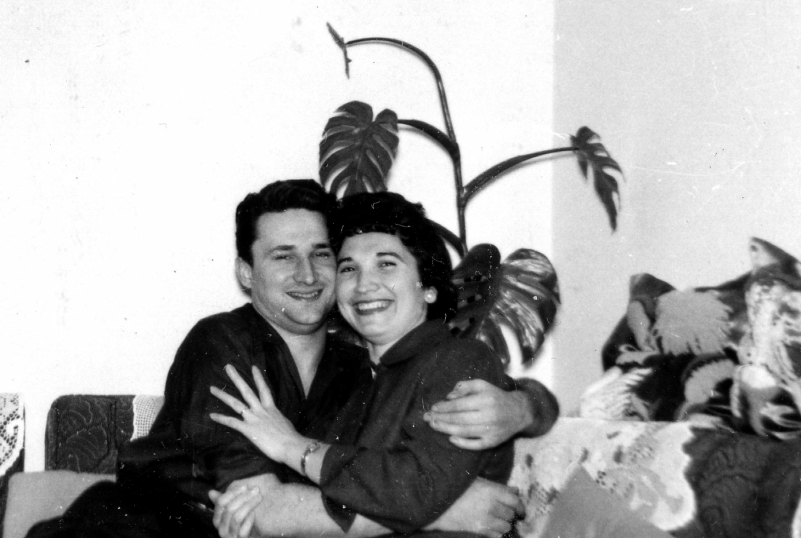
My Brother Gerry and his Wife Martha at Medicine Hat
Equally important for the understanding of my sudden interest in a totally different profession was that my staff sergeant in Koblenz had taken notice of my knowledge of basic electricity and electronics and had given me the task to instruct the new recruits. This went over so well that I was given more and more time off from regular duty to prepare my lessons and teach. So it happened that I discovered a talent, which I thought I did not have. Gerry accurately explained the current requirements for entering the teaching profession in Alberta. I had to have my German high school diploma validated, had to give evidence for proficiency in the English language, and to successfully complete a minimum of two years university training. With this information I was able to do some serious planning for the future. Suddenly a most fortuitous train of thoughts popped up in my mind that greatly increased my longing to go to Canada. Exciting ideas followed in rapid succession: immigration, teachers’ training at the University of Calgary, a teaching career, an income with the prospect of pay increases with more training, getting married to Biene and having a family.

Mother and Daughter-In-Law Martha at her Home in Medicine Hat
I am still thankful to the captain from the basic training period for instilling the desire for good planning in order to achieve a dream by visualizing all the necessary steps in-between. The target I aimed for was still years ahead. It was actually a twin target of a rewarding meaningful career and life with Biene at my side. To hit the bull’s eye at such a distance would require a great deal of determination and persistence. Would I have those qualities, but most importantly would Biene support me in something – I am ashamed to admit – that I had not even mentioned to her yet? So this would be a good time to have a critical look at myself. In my own eyes I had become a very mature young man years ahead of my comrades in terms of acquired wisdom and good planning. But when I looked at the erroneous assumptions I had made about the world around me, about Biene and myself, I marvel at the way all my dreams had eventually become a reality.
Firstly, in my letters to Biene I had written about love, but never about marriage. I assumed that my ‘I love you’ would translate into ‘Will you marry me?’
Secondly, what was Biene to make out of my long-winded flowery dissertation on love between a man and woman?
Thirdly, Biene had already been frightened by the painful events leading up to and following the break-up of her engagement with Henk. Now I came and frightened her some more by openly writing about my passion for her without revealing or at least hinting at my genuine intention to marry her.
Fourthly, it was preposterous to assume that just because I was willing to marry her she would want to marry me too. This was truly the mark of an egocentric ass that I was at the time.
Fifthly, twelve months in the army and my comrades’ boastful talk about their amorous adventures should have taught me that being married and making love do not necessarily belong together. How was Biene supposed to know what was on my mind about a topic that had been a taboo throughout our childhood years?
Last, but not least, was the foolish assumption that just because I had broken off the correspondence with my girl friend, Biene in turn should have done the same with her Moroccan pen pal. Or put differently, just because my heart from now on belonged to Biene did not mean that she should also restrict herself to a permanent commitment.
So in summary I had built a dream castle with love, marriage, family and career on the preconceived notion that Biene had read all this and much more between the lines. It was then one of the great miracles of our relationship that no storm tide came rushing in at that particular juncture and made the castle collapse like a deck of cards.
In a postcard Biene briefly assured me that she no longer wanted a mere soul-mate relationship. She wrote that many of the questions and problems that were troubling us would be resolved once we had met again. And indeed we met exactly two years after we had our first encounter at Lake Baldenay. This brought some sunshine into my heart. My brother Adolf contributed a great deal to enhance that joie de vivre, which I felt all the more intensely, whenever I went with him on an excursion in and around the Rhine, Moselle and Lahn valleys.
Exploring the Moselle Valley with my Brother Adolf

Moselle River – Summer 1964
My brother Adolf was in the final year of his apprenticeship program at the Honeywell Company in Hanau. This city north of Frankfurt was not far from Koblenz. When the weather was fine, Adolf would make it a weekend practice to pick me up at the gates of the Falckenstein barracks. From there we went on trips in his venerable old VW beetle to explore together the beautiful Lahn and Moselle valleys. The summer of 1964 brought an exceptionally long period of sunshine quite unusual for this western part of Germany, when cloudy skies and rain often drove sun-seeking German tourists south to the Mediterranean beaches of Italy and Spain. On one of these fabulous weekends Adolf suggested a wine sampling tour all the way up the River Moselle to Trier, the ancient location of the imperial summer residence of the Roman emperors.

Peter Relaxing in the Famous Wine Region of Germany
Having finally moved by two rendezvous with Biene at Lake Baldeney beyond a mere fantasy world to a more solid relationship, I felt carefree and cheerful. I readily agreed to Adolf’s proposal, and off we rolled into a westerly direction. Small towns and quaint villages, medieval castles on hill tops, the meandering river, the hills covered with the light green carpets of vineyards offered a magnificent view. At the town centres often located near the local fountain, vintners with samples from last year’s vintage were catering to the traveling tourists in the hope of selling their fine bottled wine. The labels on the bottles were just as alluring as they were their precious content. Some had grotesque, unusual, even titillating names, such as Zeller’s Black Cat, Bare Bottom, Dear Woman’s Milk, just to name a few. Adolf and I took full advantage of the incredibly inexpensive samples of the finest wines in the country. In high spirits we drove on to the next ‘watering hole’, sampled another exquisite wine, and kept on going from town to town, from sampling station to sampling station, like bees flitting from flower to flower savouring the delicious nectar. We happy-go-lucky brothers were singing, joking and drinking all the way up to Trier, where Adolf feeling generous invited me to have dinner in a cozy restaurant not far from the historic Porta Nigra and the famous ruins of the Roman thermal baths.
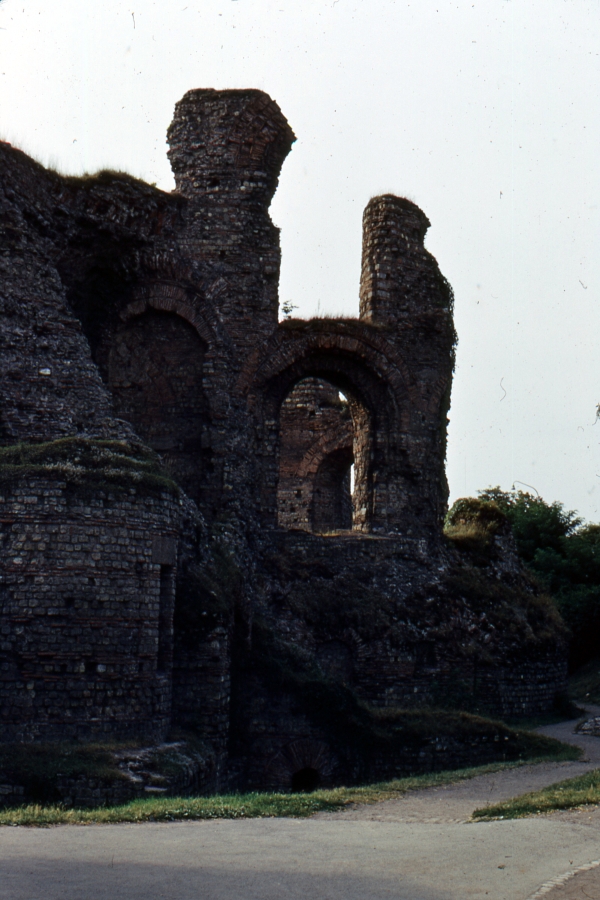
The Imperial Baths of Trier
It felt good to enter the cool premises of an inn after such a long ride through the sweltering summer heat. After a hearty meal we lingered over a cool refreshing beer while waiting for the heat in the valley to come down to a more tolerable level. Air conditioning in a VW was virtually nonexistent in those days.

My Brother Adolf at the Thermal Baths at Trier
There I sat, a bit sleepy and drowsy from the wine and beer, listening half-heartedly to Adolf’s tirades against the American imperialists, the war in Vietnam, the killing of innocent women and children perpetrated by the American ice cream soldiers as he contemptuously called the GI’s, the exploitation of the working people, the advantages of socialism for the common people and the evils of capitalism. When Adolf was talking politics, a passionate fervour seized his entire being; his words poured out as if he had experienced all these real and imagined injustices himself. When the verbose eruption of truths, half- truths and lies had finally subsided with no notable effect on me, the apolitical person that I was at the time, Adolf returned to his congenial and humorous self again, ordered another beer for us from the pretty and courteous waitress, whom he described benevolently as a ‘nice kid’. Now it was time to introduce me to the kind of vocabulary that would definitely not be very useful for my later academic career. The stock of swearwords coming from the oil patch environment was quite impressive.

Peter on a Sightseeing Tour with his brother Adolf
When he changed topics and began to talk with extravagant enthusiasm about Canada, I was all ears, even though he described a totally different country from the one I had learned from books. Adolf’s opening line for almost anything that had to do with Canada was, “Peter, with us in Canada things are like this.”
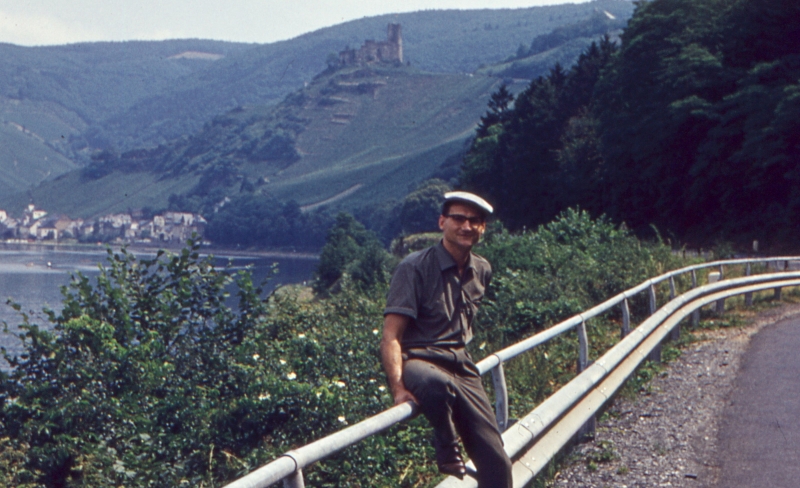
Adolf taking a Roadside Break at the River Moselle
Before coming to Germany for a three-year stay, he had worked in the oil fields at Swan Hills in northern Alberta, where work was hard and money was plentiful. He loved to tell me stories of the rough-and-tumble of camp life. At payday many workers would rush to Edmonton, the capital city of Alberta, to spend their hard earned money on booze, women, and cars. Adolf having a good grip over his finances was not entirely immune to the lure of owning a shiny new car. In a sudden wave of nostalgia for the good old days at camp he described how he had once walked into a car dealer’s showroom and pointed at the latest model of an eight cylinder muscle car that he wanted to purchase on the spot. When the delighted salesman asked him how he intended to pay for it, Adolf’s moment of glory had come, which he now revived by telling the story to his kid brother.
“Why,” Adolf answered, “in cash, of course!” And with these words he pulled out a bundle of hundred dollar bills and counted out the full amount of the purchase price on the counter of the astonished salesman. Adolf never failed to make critical remarks about the painfully slow German bureaucracy that he had to put up with, when he bought his VW beetle in Germany.
“Peter, with us in Canada things are like this,” he used his opening pet phrase again. “With all the paper work done and the registration and insurance papers signed I drove that beauty of a car out of the dealer’s parking lot within less than an hour.” Having learned how things were done in Canada, I remarked that it was time for me to return to the barracks. The evening sun flooded the eastern mountains in a sea of gold. When Adolf and I arrived in Koblenz, the sun began to set and only the pinnacles of the volcanic Eifel Mountains were still reflecting the last rays of the day.
The Romantic Soldier

Beautiful City of Koblenz – Summer 1964
I often wondered how it was possible that at certain times all troublesome events seemed to come together to create one powerful drama. Such was my deplorable situation between Christmas and Carnival, when I could barely stem the tide in a string of fateful events, such as the fatal accident of Sergeant Wohl on the icy roads of Feldafing, the loss of my father, emotional upheaval over the injustices caused by red tape in the army bureaucracy, and above all the almost certain demise of a shaky relationship with Biene. And now barely six months later, emerging from an apparently bottomless pit, it seemed as if all favourable currents had joined forces to lift me out of my deep depression into the blissful realm of true happiness in quick succession of small but significant steps: a book written exclusively for Biene, clarifications of the intentions of my heart and their acceptance albeit somewhat hesitatingly by Biene, two rendezvous to show that we were real human beings, not phantoms of our distorted imagination, the discovery of the joy of teaching, the instructional sessions in the afternoons, and the recognition of my newly discovered talents by my superiors. All these events in combination raised my self-esteem so much that I almost regretted having requested a transfer to the Tannenberg barracks in Marburg.
The most enjoyable outings with my brother Adolf on the weekends tore me away from my history books. With his congenial companionship he gave me a renewed spirit with emphasis on the social aspects of life that I had been neglecting far too long. When Adolf was unable to come and I for one reason or another wanted to spend the weekend in the barracks, I would still read Roman history books, but with a focus on topics that were more relevant to my own life and closer to my heart. Instead of dwelling on Roman conquest with the inevitable theme of death and destruction, I now learned about the importance of values, particularly of those pertaining to marriage, family and the raising of children. On sunny days I would find a cozy spot on the lawn near the 400 m oval racetrack. There I would open Mommsen’s chapter on the status and significance of the family in the Roman Republic and would read with increasing interest about the family as the smallest unit, upon which the entire state depended for its health and its very existence. I marvelled at the role that the wife (domina) played in running a large and complex Roman villa and in nurturing and imparting values onto her children, while her husband (dominus), being still intimately connected to the soil, would work the fields to provide food and income for the family. Like myriads of individual healthy cells make up a strong body, so the Roman family units protected by law and honoured by society provided the moral fibre, which made the early Roman republic so strong and powerful. After such undisturbed moments of contemplation on matters so distant and yet so relevant I returned to my room with the distinct realization that I had received valuable clues for the unfolding of my own personal life in the not too distant future.

Roman Family
If there was ever a period in my early adult years that reflected the spirit of 19th century German Romanticism, it was during the summer months of 1964, while I was awaiting my transfer to the Tannenberg barracks at Marburg. My new friend Josef Hegener and I made use of every free moment to escape the stuffiness of the poorly ventilated barracks rooms. Away from the noise and heat of the city we found refuge in the nearby wooded hills, where hiking trails invited us to explore nature in the cool of a Sunday morning. We delighted in the colourful sight of a mountain meadow bedecked with innumerable wild flowers. The buzzing of bees and bumblebees, the happy chirping of birds at the edge of the forest, the murmuring of a brook, the croaking of an army of frogs making their presence known from a pond were together with all the other joyful sounds music to our ears. From a footbridge we gazed at the athletic performances of water striders skimming gracefully over the surface of the gently flowing waters. Joyously we followed the trail to a hilltop, where our eyes feasted on the magnificent mosaic of woods, fields and villages below. Down in the valley a church bell was ringing inviting us to attend the church service and to give thanks to God for His wonderful creation. As we entered the village church, the congregation had just started singing ‘Now thank we all our God’, a hymn that became one of my favourite songs of praise both in German and in English. I felt elated after having been granted such a rare glimpse into the connectedness between the grandeur of nature and God’s presence in it. In my exuberance over this wonderful experience I quickly wrote a postcard to my folks back home in the form of a wedding announcement: We have been united in marriage signed Nature and I.

Dandelion Flower
The following Monday I met Sergeant Otto Schmidt, as I was crossing the huge centre yard on my way to the building, where I was going to deliver another lesson on basic electricity. The sergeant was beaming with pride, because he had just received praise and recognition from his superior officer for his success in running an outstanding instructional program for his unit. He was actually very generous in giving me some of the credit. Then I noticed how his facial expression suddenly changed. Otto Schmidt about a head shorter than I was no longer looking up into my eyes, but gazed straight ahead in utter amazement and bewilderment at my uniform jacket. Had a button come off or had I left the shirt collar too casually unbuttoned? No, these minor flaws in my outer appearance had never been a problem with this friendly sergeant. There was something that he had most likely never seen before. In total disbelief his eyes were fixed on the humble head of a dandelion flower, which I, following my current romantic inclinations, had placed conspicuously on my uniform. Sergeant Schmidt was almost speechless. All he could do was shake his head and stammer, “Klopp, Klopp, what is the meaning of this all?” To his great relief I removed the objectionable flower and hurried off to my electricity class. A symbol of love, a symbol of peace was on the uniform of a German soldier!
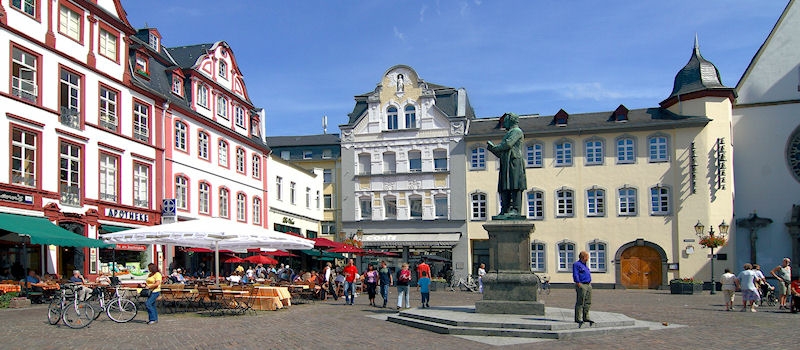
City of Koblenz – Photo Credit: Ferienwohnungen.de
Vittorio’s Entanglement in Sex, Love and Marriage
In our room there was a 17-year-old volunteer with the Italian sounding name Vittorio. At this tender age he was the youngest soldier in the signal corps. He had committed himself to a five-year service in the army and was obviously seeking a life long career with the Armed Forces. As a government employee in uniform he had a sizeable income at his disposal, which he squandered with his buddies in the local bars and in establishments of questionable reputation. So it was no surprise to any of us in the room that eventually he fell victim to one of the ladies of the night that was plying her trade in the lucrative barracks city of Koblenz. What I found bizarre, even shocking was that he was openly bragging about his amorous adventures with a prostitute, who had apparently singled him out as an easy target. Even the most hardened comrades in our room gave him contemptuous looks when he treated his sordid affair as if it was true love. At the end of a long weekend he felt especially inclined to proclaim from the top of his bunk his progress with the most wonderful woman he had ever met. I wondered how many women he could possibly have met considering that he was only seventeen. A more outspoken roommate asked him in a sarcastic tone, “Are you paying for her services?”
“Not any more than what you would if you took your girlfriend out on a date,” Vittorio was quick to reply.
“Well, well, you don’t seem to understand. Let me put the question to you a bit differently. Are you paying to have sex with her?” Everyone in the room was itching to know how the argument about this hot topic would end.
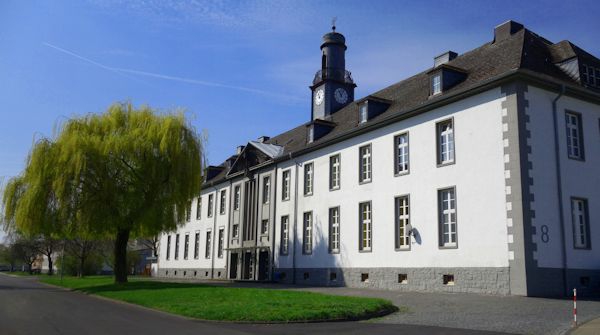
Falckenstein Barracks – Photo Credit: casino-falckenstein-kaserne.org
Vittorio was not easily intimidated. He knew how to fight back. He was aware of the saying that a good offense is the best defense. So he countered, “If you were a volunteer soldier and had a tidy income like me, wouldn’t you make her gifts and give her money because you love her?”
I was sure that our roommate must have felt a bit nettled by Vittorio’s suggestion that as a draftee with a mere pocket-money he would be in no position to argue with him on this point. Unable to respond to this powerful argument, he resorted to the most obscene and offensive language I had ever heard. If this had been the end of the story, I would not have considered it worthy of being part of my autobiography. As a matter of fact, the story was just beginning.
In the weeks that followed Vittorio was getting more and more quiet and was no longer bragging about his most wonderful woman. I thought that he was afraid of our unnamed roommate. But I was wrong. One Sunday evening he returned much earlier than usual to our room. He appeared to be in a very agitated state of mind. Not caring whether we wanted to listen to him, he started ranting and raving about the woman he once loved so dearly. We were stunned by the complete reversal of his opinion and wondered whether or not we heard him talk about the same woman. His language now was just as crude and offensive as if his antagonistic roommate was still lecturing him on the definition of women of ill repute. He described the most wonderful woman in the world as a crooked slut, who first was content with twenties, then wanted fifties, and now demanded his entire monthly income.
“I am finished with her,” he screamed, “I will not see her again; she is a whore; she can go to HELL!” Then he threw himself on his bed and cried like a little boy that he actually still was.
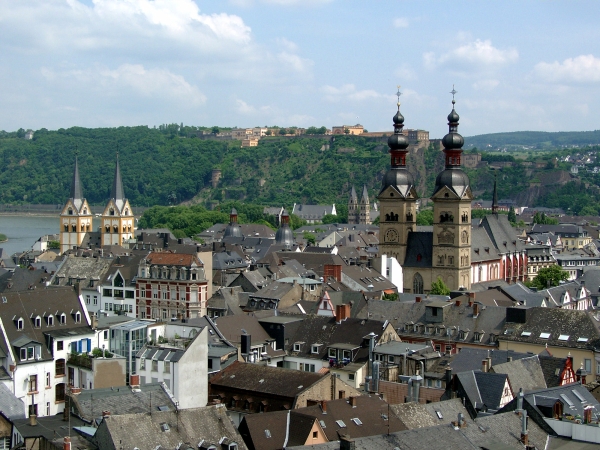
City of Koblenz – Photo Credit: Wikipedia.org
It was near the end of the summer shortly before my transfer to Marburg, when a woman walked through the barracks gate and requested to see the commanding officer of the second company of the signal corps. The above lieutenant learned that one of his soldiers, Private Vittorio to be exact, was the cause of her being with child. The officer concerned about the honour and respectability of the army in general and of his unit in particular had Private Vittorio called in and confronted him with the woman he had vowed never to see again. The officer after having established the truth of the woman’s claim suggested in unmistakable terms – one might say he decreed that Vittorio marry the woman who was expecting his child. Upon proof of marriage Private Vittorio would receive two weeks of paid leave for their honeymoon.
Vittorio told us later how things had been arranged in the office and that he was going to get married. Having flip-flopped once more he proudly announced that he was the happiest man in the world to have such a wonderful woman for a wife and soon to have a family. His words were gushing out in a sentimental torrent. This time nobody dared to interrupt him; even the quarrelsome roommate kept quiet. Vittorio had chosen a dubious path. I felt pity, even compassion for the young man who had in my opinion such a small chance of success in his upcoming marriage. I never found out what became of him and his wife to be.
Shortly afterwards I was on my way to Marburg. I left Koblenz with mixed feelings. Not aware that with the recommendations from the commanding officer I would soon be teaching again I looked back with regret at the rewarding instructional sessions, which I had enjoyed so much. I would also miss Josef Hegener and our nature excursions into the local hill country . On the other hand I felt relieved to get away from the revolting environment that our room had become of late. Even though I had been open-minded about listening to jokes, I knew that Vittorio’s story was not a joke. It was a personal tragedy that shocked me to the core. If there was one good thing that came out of this sordid affair, it made me more determined than ever before to seek and strive for a better world. While an ideal by its own definition remains unobtainable, it nevertheless provides a vision and a goal worth aiming for. To the extent we struggle and make the effort to approach the ideal, we define our character. With a fresh new sense of optimism I was looking forward to spend the remaining 180 days of my army time in Marburg. I promised myself to meet Biene again, as soon as an opportunity would present itself. For me she represented the embodiment of the light and the hope for a better future.




 The Peter and Gertrud Klopp Family