Die Geschichte von den armen Familien und Albert Schweitzers Entschluss
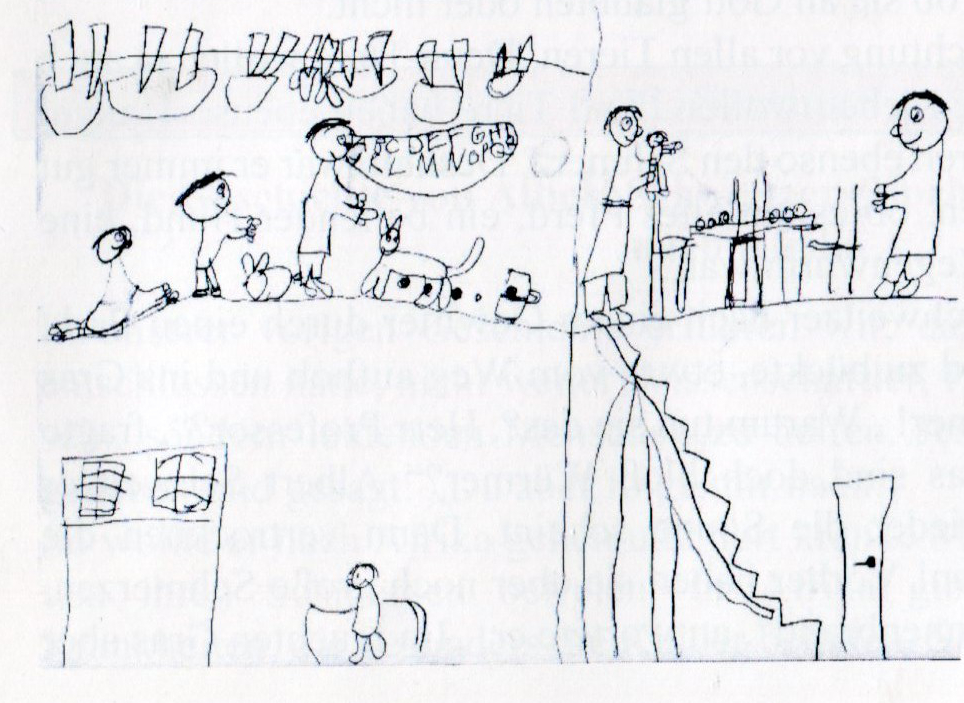
Als Albert das Abitur bestanden hatte, studierte er in Straßburg Theologie und Philosophie. Das eine Fach beschäftigt sich mit der Religion und das andere mit der menschlichen Weisheit. Wie sein Vater wollte auch Albert Pfarrer werden. Er wollte aber nicht nur auf der Universität lernen, sondern auch daneben anderen Menschen helfen. Deshalb besuchte er arme Leute, sprach mit ihnen und übergab ihnen Geld, das reiche Menschen gespendet hatten. Die armen Leute freuten sich immer, wenn er zu ihnen kam, denn ihnen half sonst niemand. Sie waren so arm, dass die Kinder schon arbeiten gehen mussten, um etwas Geld zu verdienen. Sonst hätten sie nicht einmal genug zum Essen gehabt. Spielzeug hatten die Kinder sowieso nicht, denn dafür hatten die Eltern kein Geld. Sie spielten in der Küche auf dem Fußboden mit kleinen Steinchen. In der Küche hingen an Bindfäden Windeln und andere Wäschestücke zum Trocknen. Woanders war dafür kein Platz. Der Vater der Kinder war krank und verdiente nun gar kein Geld mehr. Die Mutter fing an zu weinen, weil sie nicht wusste, ob sie in der Wohnung bleiben durften. Sie konnte ja nun keine Miete bezahlen. Das war alles sehr traurig. Da legte ihr Albert Schweitzer etwas Geld auf den Küchentisch, damit die Mutter wenigstens etwas Brot und Milch für die Kinder kaufen konnte. Mutter und Kinder freuten sich darüber sehr und bedankten sich. Aber Albert wollte keinen Dank und sagte ihnen, dass das Geld von anderen Menschen stammte, die ein Herz für arme Laute hatten. Er habe es nur für sie gesammelt.
Die Mutter erzählte auch dem Albert, dass ihr ältester Sohn in der Schule gut lernt und schon das „ABC“ aufsagen kann. Darauf war sie sehr stolz.
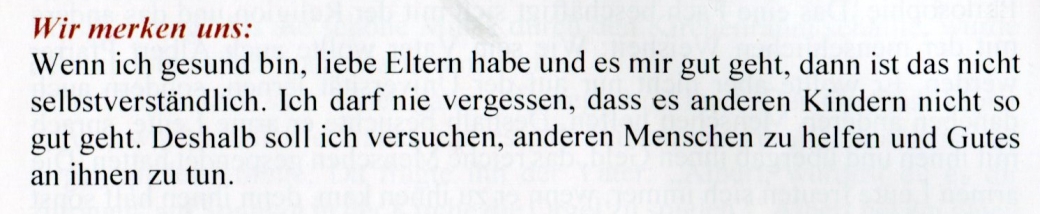
Als Albert wieder zuhause war. dachte er über alles nach, was er gesehen und gehört hatte. Er fragte sich: “Warum habe ich es so gut in meiner Kindheit gehabt? Ich konnte spielen und lernen, hatte ein eigenes Bett und brauchte nie zu hungern! Viele andere Kinder hatten das alles nicht. Mein Glück ist also nicht selbstverständlich.”
Darauf legte Albert ein Gelübde ab, das heißt, er nahm sich fest vor: „Bis ich dreißig Jahre alt bin, will ich für mich leben. Ich will studieren, Orgel spielen und Konzerte geben, Bücher schreiben und Vorträge halten und in der Kirche predigen. Aber danach will ich vor allem für andere Menschen da sein. Ich will all denen helfen, denen es nicht so gut ging wie mir, so wie es Jesus mir gesagt hat.“
British Columbia has from the beginning understood itself in quasi-Colonial terms. It built a commercial and political centre located in its lower left hand corner, the Island and the flood plain of the Fraser River.Behind this was a great, largely empty hinterland behind the formidable barrier of the Cascade Mountains, still today called, in the Colonial usage, “The Interior.”Only the Fraser penetrates that barrier, through an unnavigable canyon so precipitous that the original Indian foot trail required the traveler to find hand holds on rocks and shrubs to keep him from slipping down the cliffs to the tumbling waters below. Horse passage was impossible, a canoe was almost certain death unless lined through with ropes.
But beyond the great, green wall of the Cascades lay a vast land of wet and dry valleys, of rolling grasslands and of the boreal forests of the North. This land, nine parts of the Province, lay open to entry and exploitation from the South, from the Washington Territory, up the easy river valleys of the Columbia and its tributaries, the Okanagan, the Kettle and the Kootenay. The Hudson’s Bay Company, until cut off by the treaty of 1846 and the loss of the lands south of “49,” transported its furs and provisions, by pack train and freight canoe down these river valleys to the Pacific.
After the boundary was drawn, the HBC sent A.C. Anderson in 1846 to find a wholly British pack route from Fort Kamloops to the new depot at Fort Langley on the lower Fraser.Anderson explored a number of possible routes for a Brigade Trail. He went up Harrison Lake and through the Seton Lakes to Lillouette on the Fraser.On his return to Kamloops he went up the Coquihalla River and explored the possibilities of a Nicolum Creek, Sumallow Creek, and Skagit River route for a crossing to the Tulameen River.However that route crossed Punchbowl Pass at 5300 feet and would be closed by snow most of the year.
Anderson settled on a year round route fromKamloops to Nicola Lake, and down the Coldwater River to Spences Bridge; this bypassed Kamloops Lake where perpendicular granite bluffs precluded a lakeside trail.From Spences Bridge his trail ran down the Thompson to the Fraser, and down its left bank as far as Boston Bar. As the canyon below that point was impassible, he ran his trail up the Anderson River on the east to a point where he could cross the ridge between the Anderson and Fraser and regain the big river opposite Spuzzum. From there a horse trail could be built along the river bank to Ft. Langley.This Anderson River Trail was used by three brigades in June, 1848, one from New Caledonia, one from Kamloops, and one from Fort Colvile, when the outbreak of the Cayuse war made the old trail down the Columbia unsafe.However, their passage was a difficult one and the brigades lost 70 horses and 25 packs of merchandise on the precipitous slopes.
In 1848, Henry N. Peers built Fort Hope for the HBC, and explored up the Coquihalla for a shorter route to Kamloops which had been suggested to him by an Indian, “Old Blackeye”.Blackeye’s trail went up the river past Nicolum Creek and turned up Peers creek about 4 miles further up the Coquihalla. From the headwaters of Peers Creek it crossed Manson Mountain at 5600 ft., a steep scramble.The trailran along Manson Ridge, then dropped into Soaqua Creekand through the alpine meadows Peers called “The Garden of Eden” to a low pass into Vuich Creek, and down it to the Tulameen River. Blackeye’s trail cut across the bend of the Tulameen via Lodestone peak and came out at Otter Creek, and up that creek, which at its upper end opened out into the rolling country of the Fairweather Hills. An easy grade led down to Nicola Lake and Anderson’s trail to Kamloops.
Although this trail was a summer only trail with its high passes, it avoided the tricky ledges of treacherous shale rock above the Thompson River where so many horses had plunged to their death. Peers had not finished brushing out Old Blackeye’s trail in 1849, so the Fur Brigades from the Interior used the Anderson River trail on the way down and returned by way of Peer’s and Old Blackeye’s trail, completing the work on it as they passed through. There was now a practical all-British summer route, but a winter and spring communication between the Coastal communities and the Interior could only be had via the treacherous Anderson River trail or by going through the U.S.
In 1859 a gold discovery was reported on the Similkameen River, and another by Canadian Adam Beam at Rock Creek. To the fury of Colonel Moody of the Royal Engineers, Governor Douglas directed that the Indian, “Skyyou,” a famous bear hunter, should explore the mountains back of Hope for a reputed new pass direct to the Similkameen.On the fifth of June Douglas went himself to Hope to question the bear hunter who impressed Douglas by drawing a very creditable map of the region showing rivers, mountains, passes, and the buildings of the whites. There was already an HBC Brigade trail from Hope to the Similkameen which crossed Hope Pass, but this route included the westboundscramble down Manson Mountain with loaded pack horses, and according to Susan Allison who met one of these Brigades on the trail, was a most hazardous crossing.It was the practice of the HBC to bring twice as many horses as needed, in the expectation that many would be lost on the way. Lieutenant Palmer in 1860 reported the slope of Manson Mountain was still littered with horse bones.
The Governor was criticized in the press for entrusting the exploration to an Indian,
“It is a notorious fact that when a road is to be located or a district explored, a magistrate, a constable, a Hudson’s Bay servant,or peradventure, an Indian, is sent out to explore and report on the same, and after the location is decided upon, the Chief Commissioner with his staff or Royal Engineers is instructedto make the road.”
Governor Douglas’ opinion on the Royal Engineers was given by his friend, Donald Fraser in the London Times,
“…At the rate they have hitherto progressed it would take 50 years to complete the road they have begun…The fact is that soldiers cannot be expected to do this sort of work. The impedimentia they carry with them, the costliness of their provisions and of their transport, the loss of time in drilling and squaring them, make them the most expensive of laborers. They do their work well, it is true, better than civilians; but for all that it is a mistake to set them at it Soldiers we want and must have, but a cheaper soldier than a Sapper or a Miner or Engineer would answer our purposes better.”
After reviewing all that Skiyou could tell him of the mountains between Hope and the Similkameen, Governor Douglas offered to grubstake a mining party to prospect the Canadian Similkameen.John F. Allison, a California miner led the expedition which departed from Hope on June 26, 1860 on Skiyou’s trail which crossed Hope Pass and descended Whipsaw Creek to the Rouge (Upper Similkameen) River. Allison reportedto Douglas a month later that they explored 12 miles up the Tulameen River and found diggings yielding $6 per day to the hand. When this news was received at Hope three new parties of would-be miners were formed and left for the Similkameen on August 6.
THE ROCK CREEK RUSH
In 1859 gold was discovered, both on the Similkameen, south of 49 by a member of the U.S. Boundary Commission and at Rock Creek, just two miles north of the border, by Adam Beam, a Canadian in October. A small rush of Americans from Walla Walla and The Dalles came up the Columbia and Okanagan Valleys to these camps. Since the end of the Fraser rush Victoria business had been stagnant. Their newspapers hopefully seized on this new discovery as another Fraser River boom.
THE BEST NEWS YET
ROCK CREEK A SUCCESS
From $20 to $ 200 per day to the hand
At once Governor Douglas got complaints from the Victoria merchants that the Yankee traders were provisioning these men, and a direct supply route was needed. Rock Creek was but two miles from the boundary which was totally ignored by the American miners and merchants who paid no customs duty. Indeed, there was no official nearer than Kamloops to collect the sums due.
Governor Douglas appointed Peter O’Reilly Gold Commissioner and sent him to Rock Creek to enforce the Colonial law. The Rock Creek miners, however, knowing that they were just a short hike from American soil, ignored O’Reilly. When he demanded that they take out miners’ licences and file their claims with him, they showered him with verbal abuse and pelted him with stones. At this, O’Reilly prudently retreated to Victoria via Kamloops, Lillooet and Harrison Lake and reported a “Rock Creek War.” Governor Douglas, who was learning how to deal with the turbulent Americans, put Rock Creek on his itinerary for his Fall tour of the Interior.
He left on August 28 and travelled by way of the Harrison Lake – Lillooet trail toLytton, the Nicola River, to Vermillion Forks which he renamed “Princetown,” and then on to the trouble spot, Rock Creek. What he saw alarmed him; the whole of the Southern Interior was wide open to American exploitation, and U.S. ranchers were moving across the border to graze their cattle on British grass. He appointed John Carmichael Haynes from Yale as Magistrate for the area and ordered that a customs post be set up at the north end of Osoyoos Lake. Thenhe crossed Anarchist Mountain to the trouble spot of Rock Creek.
The Governor came into camp in full uniform accompanied by a new Gold Commissioner, William George Cox, and clerk, Arthur Busby.He found a full mining camp with stores, saloons and a hotel in operation, all supplied by pack trains from The Dalles. Three hundred American miners assembled in a saloon to hear what he would say. Governor Douglas began with good news. He promised a wagon road would be built to the camp from Hope and that the Kettle river would be bridged. After the cheers subsided, he delivered a warning: they must nowcomply with British law, take out miners’ licences from Commissioner Cox, and pay duty on all provisions brought in from the U.S. If they failed to do this he would return with 500 British Navy marines and compel their submission. Then he asked them to make way for him to the door where he wished to shake each of themby the hand as they filed out of the saloon . This gesture met the instant approval of the miners and the Governor was applauded to the door.As the Governor returnedvia the HBC Trail from Similkameen to Hope he met Edgar Dewdney working on the new Hope – Princetown trail, and asked what it would cost to convert it to a wagon road. To connect the mines with the Coast, Douglas proposed a “Queen’s Trail”, 70 miles long, be blazed and brushed out from Hope to Vermillion Forks (Princeton.)
The contract for this trail, which would follow Skiyou’s route, was given to Edgar Dewdney and Walter Moberly, both trained surveyors. Again, Col. Moody was furious that the contract had not been given to his Royal Engineers, and the hostility between himself and Governor Douglas increased. To mollify Moody, and yet not reduce the speed of trail building to the methodical, if thoroughgoing pace of the Engineers, Sgt. Mc Coll was assigned to supervise the actual construction of the trail. His work was superb; at no point did the grade exceed 8 per cent (eight feet of rise per 100 feet of distance) a slope exceeded today by many Provincial Highway mountain crossings. However, whether owing to Sgt. Mc Coll’s diligence or Dewdney and Moberly’s inexperience in the west, the money ran out while they were still only part way down Whipsaw Creek.Moody assuaged his anger at Governor Douglas by hurrying over the trail to preempt 200 acres west of Vermillion Forks. Four other Royal Engineers also filed land preemptions in the expectation that Vermillion Forks would become the centre of a prosperous mining district.
John Allison, who had begun ranching in the Similkameen, was disgusted with the slow progress of Dewdney, Moberly and Sgt. Mc Coll.He informed Governor Douglas that he had found a new and lower pass over the Cascades.Douglas authorized him to blaze a trail over this pass. Allison reported he cleared 36 miles of trail in 4 days, nearly half the distance.This was the Allison Pass trail, (called “Skatchet [Skagit] Pass” by Gustavus Epner in his 1862 map).
Another Cascade crossing had been established in 1859 by the American merchants in Bellingham.To eliminate the dangers the California miners were running in crossing the Strait of Georgia from Victoria to the Fraser River in Indian canoes and homemade boats, they hired Captain W.W. De Lacey to construct a trail on American soil (so far as possible) to the Fraser and Thompson River diggings.This Whatcom Trail, ran from Bellingham through Lynden, then up the Vedder and Chilliwack Rivers to Chilliwack Lake. At the time this was supposed to be in American Territory; the boundary was not yet surveyed. But even after the boundary was monumented, the customs officers were stationed at Langley, some miles distant, and miners using the Whatcom Trail would not encounter them. Liquor and provisions could thus be sent to the mines free of the 10% duty Governor Douglas had imposed. However, Captain De Lacy, in continuing the trail up the Chilliwack River was obliged to ascend Brush Creek to cross Whatcom Pass at 5000 feet to reach the Skagit River. His trail then ran up the Skagit ( back into British Columbia as it turned out). He ran out of money somewhere near Nepopkum Creek, and turned back to Bellingham in failure. There he found offered for sale to the miners, the map that A.C. Anderson had published in 1858 showing miner’s routes to the Fraser Diggings. On that map De Lacy discovered that just a few miles from the end of his work, he would encounter Anderson’s 1849 Brigade trail running to the Thompson River.He rushed back with fresh supplies and tied in his trail with Anderson’sThe Bellingham Bay merchants then advertised their Whatcom Trail to the Thompson and Fraser Rivers via the Skagit and circumventing British Customs.But in spite of their efforts, it was Hope, not Bellingham, that became the gateway to the mines and the Whatcom trail received little use. No doubt a good many miners heading back to San Francisco with their gold took the route from Hope up the Similkameen trail to its intersection with the Whatcom Trail, and that route to Bellingham to avoid the export tax on gold.
In 1863, De Lacy turned up in Wyoming exploringthe South Snake River.
Captain W. P. Grey leaves us an account of crossing the Cascades, probably on the HBC trail.
“When I was 13 years old we moved to British Columbia.This was in 1858.
“In the summer of 1860 we crossed the Mountains to the Similkameen River to prospect for gold.
We found gold on the south fork (the Tulameen).Father built two rockers, and for the next two months we kept busy. At the end of that time our supplies were running very short. I was (15) years old, and father decided I was old enoughto assume responsibility, so he sent me to Fort Hope to secure supplies.
“There was only an Indian trail, but Iknew the general direction. I had to ford streams and cross rivers, butI had learned to swim when I was 8 years old, so that didn’t bother me. As we were short of provisions, I took only two sandwiches, thinking I could make the 140 miles in two days.I had a good riding horse, and I was going to ride from daylight to dark. I had not gone over 20 miles when a rather hard character in that country called “Big Jim” met me in the trail. He stopped me and said, “Have you got anything to eat?’ I told him I had only two sandwiches. He said, ‘I haven’t had anything to eat in two days.Hand me those sandwiches.’ I looked at him and concluded it was safest to give him the sandwiches. He bolted them down, and grumbled because I had no more. He was on his way out to Fort Hope but his horse was almost worn out. I wanted to go by, but he wouldn’t let me. He said, ‘Oh, no you don’t – we will stay together for company. Your horse is a good deal fresher than mine and I may need him.’
“As we made our way across a high cliff his horse lost its balance and fell, striking the rocks more than 200 feet below. He made me get off my horse and mounted mine. We rode and tied from there on in to Fort Hope. It took us four and half days, and all we had to eat during that time was a fool hen he knocked down.My clothes were almost torn to shreds.
“When I got home, I went in the back door. My mother saw me. She raised her hands above her head and said, ‘Oh Willie, what has ahappened to your father?’ I told her my father was all right, but I was nearly starved. I secured two horses and loaded them with bacon and beans, rice and other supplies, and started back for our camp. When some prospectors in town learned that we were making $10 a day to the man, they followed me to our camp.
THE CARIBOO
As the rich bars of the Fraser and Thompson became exhausted, the miners who had done well headed back to California, while others who had not found success worked their way slowly upriver, testing the creeks and bars.They found small returns, but not enough to keep them from continuing up river.By 1860 they were 400 miles north of Yale at the mouth of the Quesnel, and still finding workable bars.But following the Quesnel upstream and over a low divide, they came on Williams, Lightning, and Antler creeks, and all turned out to be spectacularly rich in placer gold.Takings of $20 per day were reported;the news went out,and a new rush was on.
When the bulk of the American miners on the lower Fraser had left the two colonies for San Francisco in 1859, the boom deflated and business stagnated. The merchants had full warehouses in Victoria and New Westminster but no buyers.When the news of the Cariboo strike came, there was an instant determination to profit from it and revive the economy. Governor Douglas directed that a wagon road be constructed to the new diggings and gave it the highest priority.The detachment of Royal Engineers under Col. Moody were then at work out of Hope convertingthe Similkameen trail to a wagon road as the Governor had promised the miners to Rock Creek. Now they were pulled off and sent to Yale toconstruct the formidably difficult sections of the new Cariboo Road from Yale to Boston Bar, and along the Fraser past Spence’s Bridge.This was some of the most difficult road construction ever undertaken in North America. A 18 foot right of way had be blasted out of sheer bluffs and supported on log cribbing and trestle work over ravines and steep bedrock declivities.
An early traveler remarked of this section, ”No mud between Yale and Spence’s Bridge. Nothing to make mud..” Civilian contractors took contracts for the remainder of the work which could be done by ordinary hand labor. Construction began in 1860 and was complete to Barkerville, the mining center of the Cariboo by 1866.At Spuzzum, Joseph Truch called on Andrew Hallidie who built the San Francisco cable car system, to come to B.C. and build the Alexandra suspension bridge across the Fraser for him.Truch collected tolls on this and the Spence’s Bridge, becoming both a rich man and Commissioner of Lands and Works of British Columbia.
From Spences Bridge Gustvus Blin Wright built the next 280 miles to Soda Creek where a steamer connection was made. From Quesnelmouth another section ofroad was run into the mining district, again built by G.B. Wright. The tolls on the Cariboo Road were $3.00 per ton on leaving New Westminster, plus $7.40 per ton to cross the Alexandra Bridge, $44.80 per ton collected at Lytton and another $7.40 to cross Spence’s bridge across the Thompson, a total of $62.60 per ton. On small shipments the charge was 30¢ per pound, which was dropped in 1864 to 15¢.
With the outbreak of the American Civil War in 1861 American miners enlisted or were drafted; few came north. This made the Cariboo Rush the first truly Canadian gold rush. For the first time large numbers of Canadians came west to take the road up to Cariboo and learn the techniques of placer mining.
The California and Oregon miners swept up in the draft for the Union forces were usually sent to the western frontier posts as “Volunteers,”to replace the trained regular troops who were wanted on the battlefields of the east.In succeeding years, these drafted American miners, bored with the monotony of frontier duty, were prone to desert and head north into British Columbia whenever a new strike was announced. These deserters made up the largest part of the American contingent in Cariboo.
The Cariboo road, though virtually bankrupting the cash starved colony, was an immediate success.A fast stagecoach service was provided byBarnard’s Express, and a government run Gold Escort with armed men was instituted to bring out the miner’s gold safely and deposit it in a colonial bank.Most miners saw this, however, as an HBC sponsored scheme and preferred to send their gold out by Barnard who was able to transfer it directly to San Francisco banks. Ox drawn wagons carried the freight at a slow walking pace.On the steep and narrow section blasted out of rock, with a three ton limit on Joseph Truch’s Alexandra Bridge, wagons were hitched singly.When they reached Boston Bar they were doubled up on the 22 foot road surface and pulled in tandem the the rest of the way.
The richness of the Cariboo, far surpassing the Fraser-Thompson diggings, attracted American capitalists as well. The Portland, Oregon triumviate of Captain John C. Ainsworth, Simeon Reed, and Robert Thompson, who dominatedthe lower Columbia with their Oregon Steam Navigation Company, determined to get in on the Cariboo as well. Captain Ainsworth had already taken over Fraser River transportation in 1859 with his fast and powerful boats. Now the OSN Company put their sternwheeler, Colonel Wright, on the run from Celillo, at the head of the Dalles rapids on the Columbia, to White Bluffs, where the old HBC trail, now used to supply the Army post at Fort Colville, terminated. But was it possible to get across the lineinto British Columbia with boat transportation? Captain Ainsworth proposed to follow the gold seekers north, and establish an all-water route from Portland, Oregon to Kamloops, B.C. From Kamloops a steamer could connect on Kamloops Lake to Savona’s Landing and a good wagon road led from there to the Great Cariboo Road. If he could get boats to Kamloops, Captain Ainsworth proposed, he could seize the Cariboo trade for Portland.
The gold discoveries on the Similkameen and at Rock Creek were encouraging to the AinsworthSyndicate. As well, small diggings were opened on Mission, Cherry, White Man and Harris Creeks in the Okanagan. In the winter of 1860 the Ainsworth Syndicate had Captain W. H. Gray began construction of a boat on Osoyoos Lake, just south of the boundary line. Trees were felled and pit sawed by hand into lumber which was hauled to the lake. The vessel was 91 feet long with a 12 foot beam and built wholly with hand tools: saws, hatchets and chisels. The hull was caulked with wild flax (Linum lewisi) mixed with yellow pine pitch.She was launched on May 10, 1861, and used on the Okanagan river to supply the Rock Creek and Similkameen miners. The Ainsworths planned to install locks at Okanagan Falls to pass the boat through into Dog (Skaha) Lake and on into Okanagan Lake. From the head of Okanagan Lake a canal and locks were to lift the boat over the low height of land into the Shuswap River at Enderby. A run down the Shuswap and Thompson Rivers would bring it to Kamloops.
With the nearest railroad a thousand miles away at St. Joseph, Missouri, the thinking in the Northwest was still fixed on water transport.No one was sure a rail line could be financed and built to the Pacific Coast.The U.S. Congress was being lobbied by the Portlanders for canals and locks around the obstructions in the Middle Columbia at Bonneville and Celillo, andthe Army Engineers were examining the feasibility of clearing the Upper Columbia for steamboats.In British Columbia the Ainsworths could not expect government assistance to build canals and locks that would siphon off the trade to the U.S. If the Okanagan boom developed into a major rush, the Portlanders intended to construct the works themselves. The Okanagan Rush, however, was over quickly, with no major goldfields found. Except for Rock Creek, the miners moved on, and the small steamer was brought down the Okanagan and Columbia Rivers, passing all the rapids successfully, to Cellilo. Her machinery was removed there and she served as a sailing craft for many years after on the run between Walulla and Celillo. The name of this vessel has unfortunately been lost.
The Cariboo was the richest of the gold fields with perhaps 22 millions taken out in comparison to the million and a half taken out of the Fraser-Thompson. Again a sawmill, Baylor’s, was packed into the gold fields in pieces and set in up at Antler to supply flume boards. With only wagon transport to the Coast, sawmilling in the interior depended on the local miners’ market. As at Yale when the mines closed, the sawmill shut down.The immense timber resource of B.C. save that on tidewater, awaited cheap rail transportation to foreign markets. To the coastal merchants Cariboo, and the road that had plunged the Colonies so deeply into debt, symbolized the Interior for years, as the source of wealth and speculation for Victoria and New Westminster.
The small strikes on Similkameen and at Rock Creek, Mission and Cherry Creek in the Okanagan were ignored as trivial, and while a branch was built off the Cariboo Road to serve Kamloops, the Cascade trails remained unimproved and the wagon road never reached more then fifteen miles out of Hope.The promising townsite of Princetown was abandoned and filed on as a cattle ranch. American ranchers drove herds of cattle and horse up the Okanagan to sell in Cariboo.Judge Haynes collected duties at the border and kept the peace with a constable at Osoyoos, and Gold Commissioner Cox issued miner’s licences at Rock Creek, but that was all. Southeast B.C. was wide open for exploitation by the Americans whenever they should return from their war.
When the veterans did return from the war in 1865 there was great agitation among the Irish ex-soldiers to join the Fenian Brotherhood and invade British North America as a blow against the British and a means of calling attention to the Irish grievances.In 1866 a report reached Victoria that 40,000 Fenians in San Francisco were preparing to invade British Columbia.
In response the Colony of Vancouver Island raised a militia of 180 men. Fortunately the San Francisco Irish, though they paraded and cheered bellicose speeches by William D’ Arcy, let it go at that and the Vancouver Island militia was never tested.In 1868 the Fenians were marching again and the British Admiralty notified Rear Admiral Hastings at Esquimalt of a suspected Fenian attack on Vancouver Island with the object of abducting Governor Seymour and holding him for hostage in exchange for Fenian prisoners in Irish jails.Another group in Butte Montana was to invade the Kootenays and seize the gold of the Big Bend. Neither of these threats materialized, and the Big Bend gold was long gone, most of it already in the United States.
The Fenian threat and the extremely modest forces available to counter it: the British naval vessels, a tiny Island militia and, east of the Cascades, only a few hundred scattered miners and ranchers, once again made clear how vulnerable to invasion from the south the Colony was. In the following twenty years the American expansionists would take Alaska, the Hawaiian Islands, Cuba (for a time), and the Phillipines into their empire. The distraction of the Civil war and the lack of a U.S. naval base on the Pacific, probably saved British Columbia from annexation.
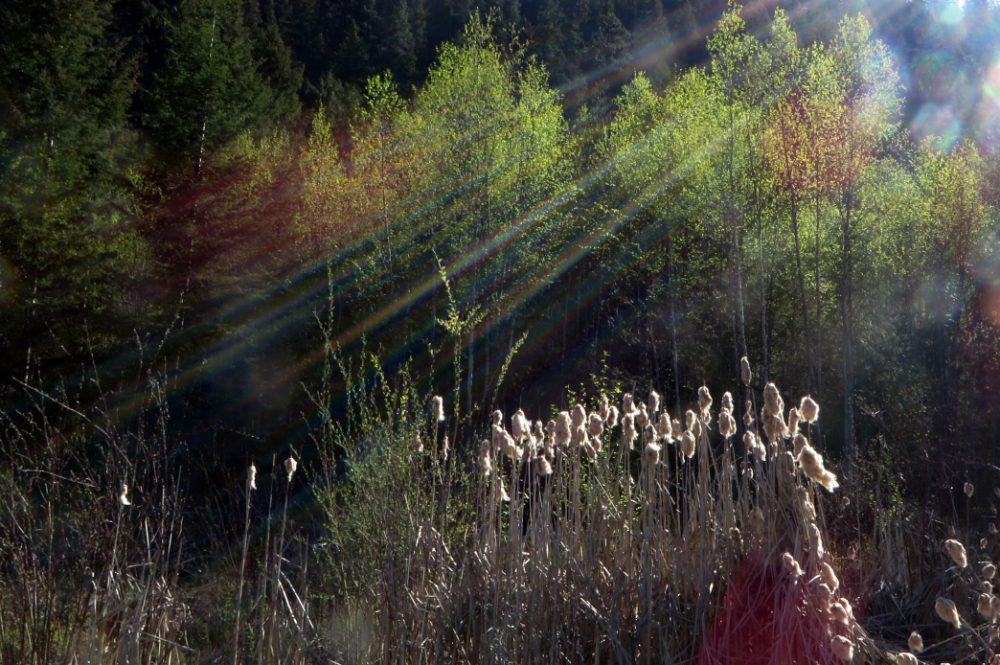
The fall season is very short in the Arrow Lake region. I collected a few images from past years to post them here with the emphasis on the beauty of the landscape with its autumnal colours. In another week or so winter will announce its presence with frost and snow. Enjoy the beauty of fall while it lasts.
“Love does not consist of gazing at each other, but in looking together in the same direction.” Antoine de Saint-Exupery
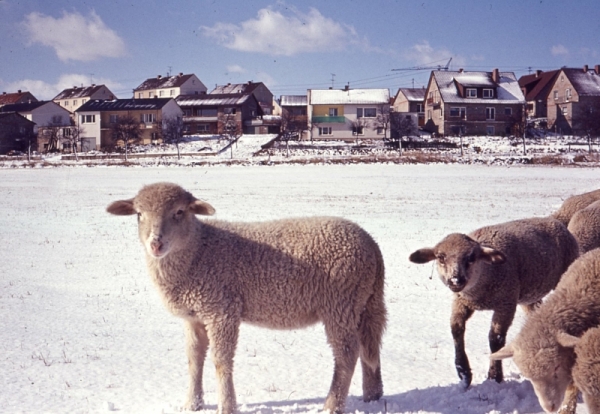
Pastoral Scene of Watzenorn-Steinberg (today’s Pohlheim) near Giessen – January 1965
Tense Moments on a Train Ride
On January 8th, 1965 I took the train to Cologne, where the Canadian Consulate was located. In those days it was relatively simple to become a landed immigrant of Canada. One had to be in good health, have useful skills or at least demonstrate to have the potential. In addition, one needed sponsors, who were willing to vouch for the new immigrant’s good character. My brother Gerry and sister-in-law Martha in Calgary were willing to take the risk of sticking their neck out on my behalf. So it happened that on that momentous Friday I received the official permission to enter as landed immigrant the country of my dreams.
On the same day I traveled to Wengern on the River Ruhr, where on account of Mother’s kind arrangements I received from her acquaintances a warm welcome, a fine meal and accommodation for the night. Frau Wolpert, a war widow, had a daughter about my age, who was still living with her mother in the small apartment. I was not too happy, when I heard that the young lady was taking the same train in the morning. Courtesy required that I sat with her in the same compartment. Lacking my brother Adolf’s outgoing character and social skills, which he could so easily employ in any situation, I kept mostly quiet except to ask where she was heading. And when she replied that she was attending a trade school in Siegen, I was dumbstruck and became more and more apprehensive, since I had made the arrangement with Biene that I would join heron the train to Siegen with the plan of traveling together to my Mother’s place. The thought of being in the same compartment as Fräulein Wolpert greatly troubled me and a long embarrassing silence followed this shortest of all dialogues. While I was frantically searching for a way out of my dilemma, she may have been perplexed over my sudden shyness or may have wondered whether there was something about herself that I may have found offensive. I would have had plenty of time to explain to her that my girlfriend is already waiting for me in the train from Essen to travel home with me to meet my relatives. But unable to talk about things that I considered too private to share, I remained silent. However, when at the transfer station in Hagen she followed me hot on my heels and boarded with me the express train to Giessen, I couldn’t think of a good excuse to get rid of her and considered it best to tell the truth.
“Excuse me”, I spoke rather timidly, “I must say good-bye now. My fiancée is sitting somewhere in this train and I must go and find her.”
With this more than cryptic remark I hurriedly left Fräulein Wolpert in the compartment where she had just sat down on the bench and was in all likelihood puzzling over my strange behaviour and the even stranger excuse. Regaining my calm I ambled from carriage to carriage, until I finally found Biene at the far end of the train.
Mother (better known as Mutter Köhm)
We were so happy to see each other that we forgot to talk about what was so important to us. On the three-hour train ride to Giessen we missed in our rapture the golden opportunity to make concrete plans, on which we could confidently hang our dreams and aspirations. Adolf picked us up at the station and took us to Watzenborn, where Mother, Aunt Lucie, Aunt Mieze and Uncle Günther gave us the customaryroyal reception that made Biene instantly feel right at home. She was originally supposed to stay overnight at Philip XI, a small bed and breakfast establishment, but Mother insisted that Biene would sleep in the guest room, thus having a better chance to get to know her. Adolf and I were delighted to cede our bedroom to the finest and most beautiful young lady. We gladly slept on the downstairs sofas instead.
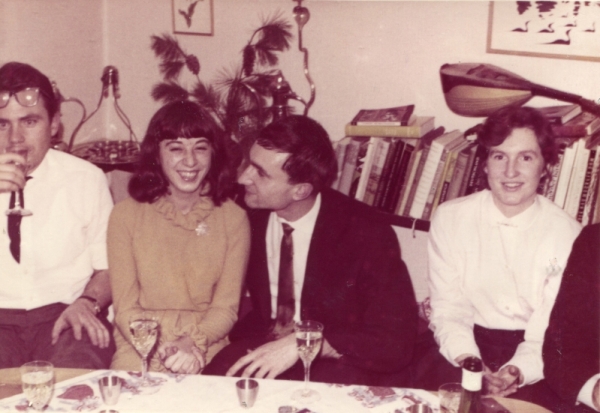
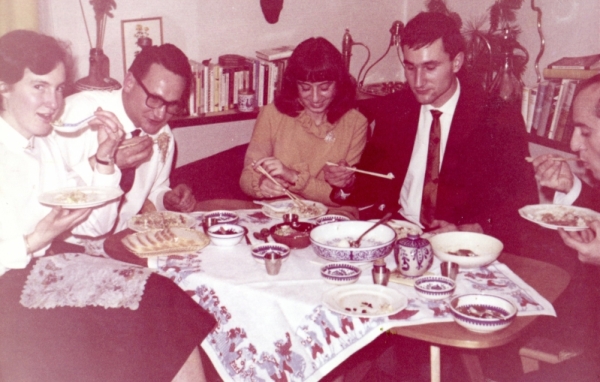
In a mysteriously worded note to Biene I had announced that I would take her, perhaps on a flying carpet, to a distant land and return home during the same evening. The distant exotic land turned out to be a Chinese dinner at my cousin Jürgen and his fiancée Inge. Jürgen impressed me with his sharp wit and exuberant jolly manner, with which he entertained his guests. I could see why he and Adolf got along so well with each other. He cracked a few jokes about the West German army, which I found as a member of the armed forces less amusing. For even though I had had bad experiences until very recently, I felt too much a member of the body to which I belonged to ignore my sensitivities about his jocular attacks. Like many of my friends in Wesel, Jürgen was exempt from military service, because his father Bruno had been killed in action at the beginning of WW2 in Alsace-Loraine.
From left to right: Jürgen, Biene. Peter and Inge
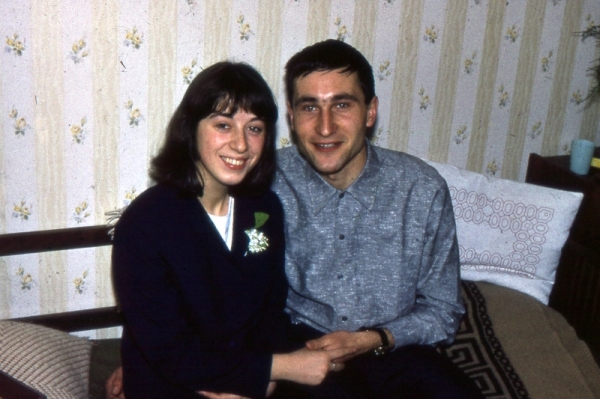
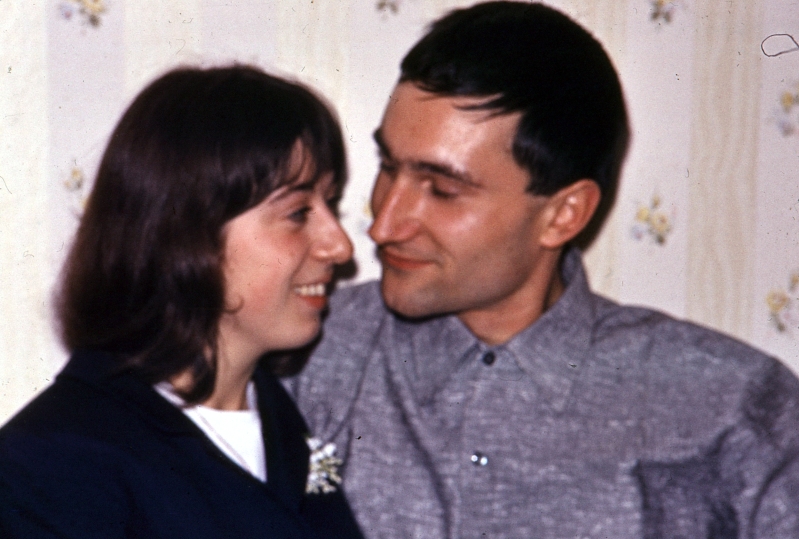
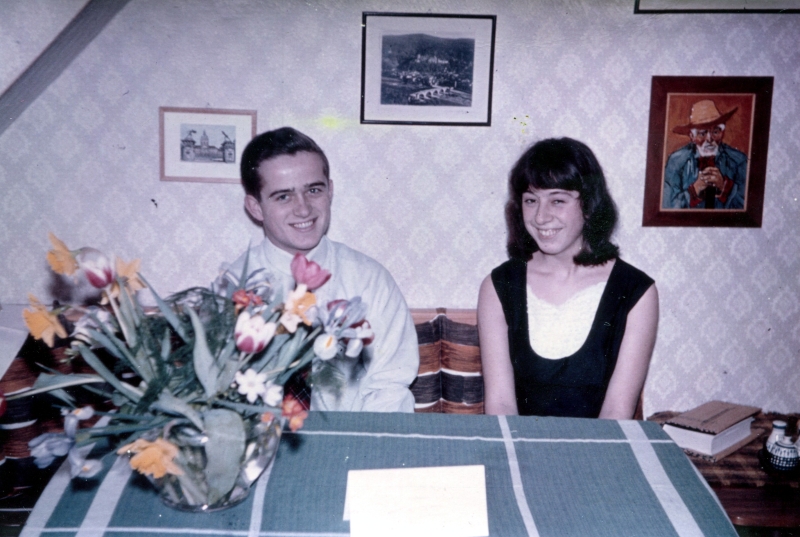
The Chinese dinner was a great success. Biene and I enjoyed every minute of it. It was here at Jürgen’s apartment that Adolf took the first photos of us two being together. Near the end of the party another guest probably from Egypt said that he had a culinary surprise for Biene. He wanted her to guess a mystery food from his North African country. He asked her to close her eyes and open her mouth. When she complied in great anticipation, he slid the mysterious object into her mouth. All eyes were focused on her facial expression. Having crunched it and tasted its flavour, she asserted that it was quite delicious and pleasant to eat. Great was her amazement when she learned that she had just swallowed a chocolate covered grasshopper, considered to be a delicacy in some African countries. Merrily we returned home to Watzenborn over the snowy wintry roads in Adolf’s old faithful Volkswagen beetle.
From left to right: Inge, Adolf, Biene, Peter and a Friend – January 1965
Mustering up the Courage to Talk about the Future
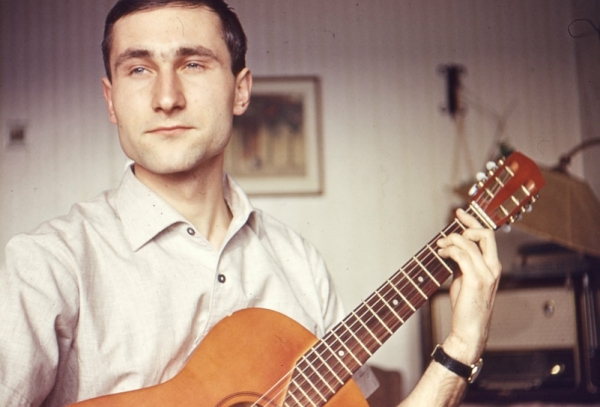
Peter Playing the Guitar for Biene
On Sunday morning Mother, like always, lovingly prepared a sumptuous breakfast. Then on Biene’s request I played a selection of a few very simple classical guitar pieces composed by Carulli. As I was nervous and excited, I made quite a few mistakes. Going as far back as my early childhood years I had never suffered from stage fright. I had taken on challenging rôles in Christmas concerts and other major school events. But this was different. Biene was the audience. While she listened to my renditions with an understanding heart, she was lovingly ignoring my mistakes. The frequent boners I committed bothered me all the more, since I often managed to play the tunes perfectly, when I had been alone. Then it was Biene’s turn to perform. I set up the microphone and the Grundig tape recorder to capture her voice. She recited in her soft, sweet voice the two poems she had written for me at Christmas. Although at the pinnacle of total bliss, I was unable to push away the nagging thought of words yet unspoken that needed to be said.
This had so far been the very best get-together with Biene. Should we again with our hearts overflowing with wondrous feelings miss the golden opportunity for a good solid talk about our future. For the day was dragging on and Biene’s time to leave was rapidly approaching. Resolutely I invited Biene for a walk along the wintry trail behind the house. We were holding hands, as I began to talk.
Mother Waiting for Peter and Biene
In just a few months I would be traveling to Canada on the Ryndam, a ship of the Holland America Line. It would not mean permanent separation. I would simply go and check out to see if it was true, as my brother Gerry asserted, that I could become a teacher with only two or three years of university training. If it was indeed true, my next step would be to get admitted to the University of Alberta at Calgary with my German high school diploma (Abitur). If successful in fulfilling all entrance requirements I would devote all my energies to acquire a teaching certificate in the shortest possible time.
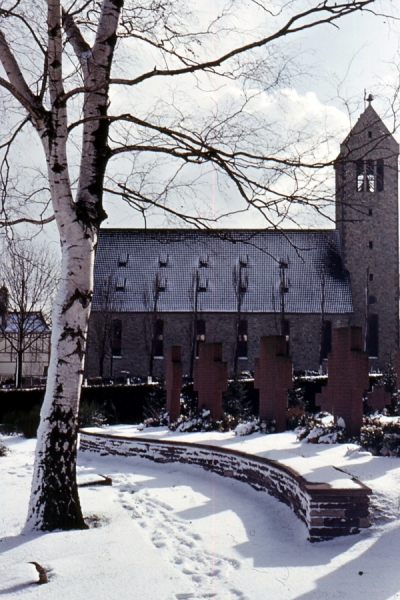
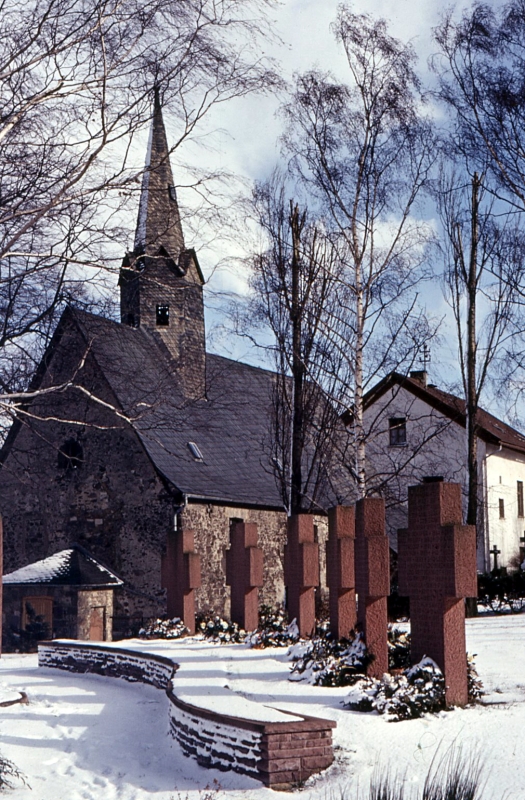
Church at Watzenborn-Steinberg (now Pohlheim)
And then … I paused for a moment noticing in Biene’s dreamy eyes the expression of sweet anticipation of words never spoken or written before, which she had been expecting from me, the slowpoke, for such a long time. “And then,” I continued almost choking with emotion, “I will ask you to come and be my wife.” Now she squeezed my hand and her face was beaming. Little did I know that with these words I fulfilled her secret wish, which at her home in Velbert had been conceived in her heart on New Year’s Eve! So with all our hitherto hidden desires so plainly revealed with my promise to marry her we huddled a little closer together on our way back to the house. To be sure, this was not entirely due to the ice and snow and the wintry chill in the air.
The Ring
A most unconventional, secret engagement had taken place. Biene and I did not feel any need to share the joyful news of our clandestine arrangement with anyone. While our parents, relatives and friends saw our love story unfolding before their eyes, they did not suspect anything more than what was normal at our age to do, to have a few dates, to meet at regular albeit long intervals. However, breaking well-established and meaningful conventions, such as a formal engagement, was not without peril, which we in our elevated state of romantic ecstasy did not foresee and whose warning signs we did not heed.
Another danger was lurking from deep within me, the tendency to fast forward into the future, then to look back from an imaginary vantage point and view in horror all the possible things that could go wrong. The worst of these mental acrobatics was that I was afraid that I would have to take the blame for Biene’s future hardships, suffering and pain. These were the thoughts that were passing through my convoluted mind. In simple terms, I was also a bit scared about having the boldness to ask her to marry me in the light of having ahead very little income, an uncertain future, and a long period of separation. So I wrote in a letter:
“Now I recall something else I wanted to tell you. I would very much like, when I am no longer in Germany, that you feel obligated by nothing except by your heart and feeling. Do you know what I mean? We have always striven to be honest even when we found it hard to do so. But it is exactly that honesty, which unites us so firmly. Perhaps you had expected to hear from me more concise plans on our walk through the snow to the old mill and back. See, my dear Biene, this was also the reason, why I found it so difficult to talk. I do not wish to exert any pressure on you. When I tell you, I need you –I really need you -, then in a sense I have already exerted pressure. Therefore, dear Biene, I urge you to let your heart decide.”
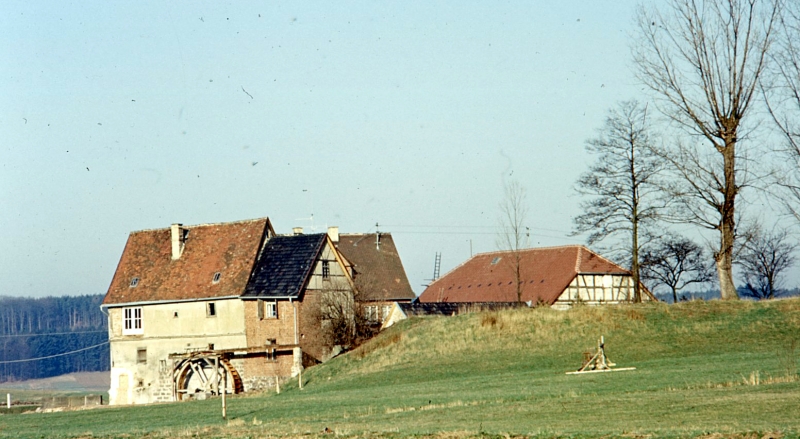
The Old Mill at the Edge of Town
The promise we made to each other on our wintry walk was barely one week old. And already I had cast doubts on the strength of our love for each other. I was very lucky that Biene did not take it as an insult. Even though it had never been my intention, one could have accused me of putting her love to the test. Of course, from her response I could tell that she felt saddened by the doubts I still had about her true feelings. But at the same time, my letter had compelled her to say that she loved me so much that she could belong to no one but me. I had to smile when I read the following lines,
“And if you were as poor as a church mouse, I would rather be a church mouse. Peter, don’t laugh, I really mean it. I would also like to give you a sign. May I give you my ring? It is the most precious thing I possess except for your letters and the book you wrote for me. Never would I have parted with it, but with you I find it easy to do. You must not think I am superstitious, but I believe it will bring you luck. And one day, dear Peter, when you write to me, ‘Biene, come to me!’ you can return it to me. Oh Peter, it makes me so indescribably happy to believe in a future with you. I am always thinking of us and I am indescribably happy about our secret. Dear Peter, I am so thankful that you have always stuck with me even though I so often hurt you, because I didn’t know that I loved you so much.”
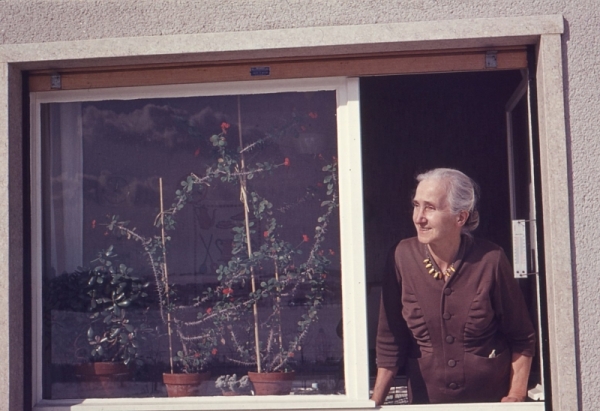
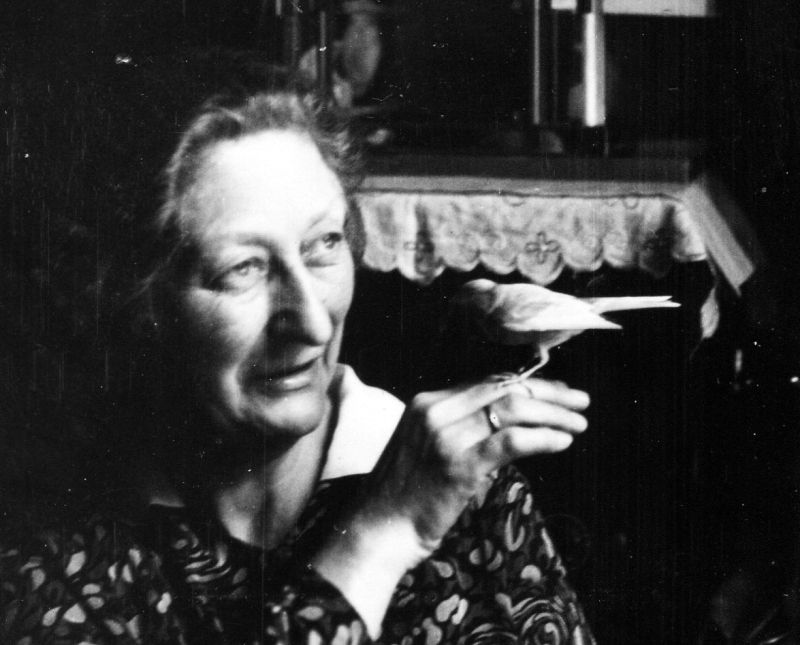
Gertrud Panknin, Biene’s Grandmother – 1931
The ring turned out to be a very precious family heirloom that was being passed down from Biene’s great-grandmother to her grandmother Gertrud and then, after the latter had passed away, finally to Biene. It was symbolic in more than one way. But the meaning as an engagement ring escaped me completely at the time. Of course, I was happy with it as a gift and as a token of Biene’s love. It was a bit too small to wear on my ring finger. To be sure, if I had, it would have raised a few eyebrows in my military environment. But I did wear it on my little finger during the night and turned it a few times to let it do its magic. Alas, in spite of all that talk about talking frankly and freely, I never understood the real meaning of Biene’s gift, and Biene did not have the courage to ask me for an engagement ring. If the reader thinks I needed to be rich and gainfully employed, before humbly falling on my knees to ask for her hand in marriage, he would have been misled by the Anglo-American custom of buying a diamond ring for one’s sweetheart. In Germany, all one needs is a golden ring, which one wears on the ring finger of the right hand for the engagement and on the left hand at the wedding. What a simple and affordable tradition! Yet, I was blind and did not interpret Biene’s gift as her most ardent desire to wear a ring from me, before we separated for a very long time.
The Vision
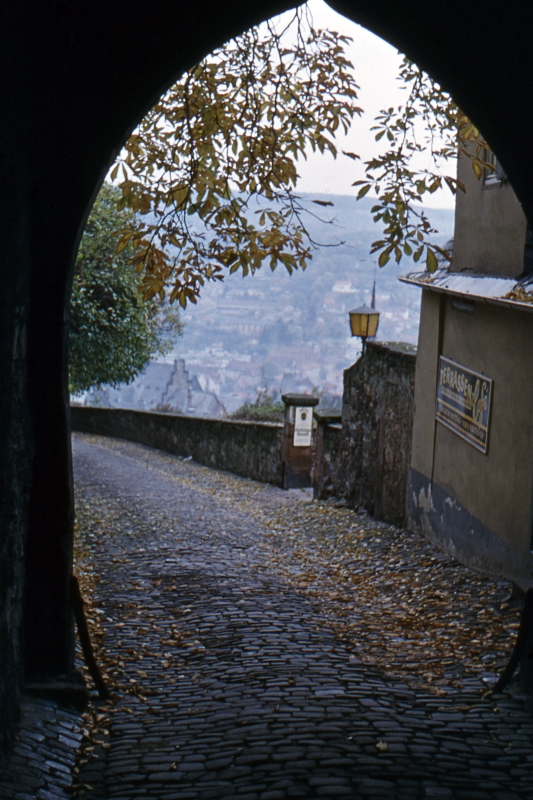
Romantic Medieval Town of Marburg
In a letter to Biene I wrote: “A long period of time will come, when we can no longer quickly step on a train and come for a visit. We will have to wait for a long time, before we see each other again. Yet I am confident, dear Biene. For you are no longer afraid you could lose me. One day I will ask you to come. Haven’t we written each other for two years without seeing each other? How much easier will I be able to endure everything, when I know for whom I work and also know that you will come! Dear Biene, you wrote so kindly that it wouldn’t matter to you whether I am poor or rich, if you could be with me and help me. I do not yet know for sure what to expect in Canada. But one thing I know; it is a thousand times more beautiful, if we start our life together than if I could immediately present you with a house and a car. The joy will be much greater, when you can say, ‘Peter, we deserve this sliver of happiness, which we were able to secure for ourselves, because we love each other and you without me and I without you would be unthinkable. In my mind I am propelling us so wondrously into the far away country but without danger, because I firmly believe in our future.
Since you have made your decision. I am looking farther still, beyond Alberta, where I will study at the University of Calgary, over and beyond the mighty Rocky Mountains westwards to British Columbia into the land, which like Germany lies between the mountains and the sea. It is not without reason that people call this province God’s country. Far away from the big cities, nature is still unspoiled by city life and industrial pollution. It appears to me incomparably more beautiful than Germany. Dear Biene, do not believe that I shut out our home country from my heart. Not only, because you need to stay behind for a while, do I depart reluctantly, but also because I must depart from people, who are dear to me. However, the world has become too crowded for me. I am searching for freedom, in close contact with nature, and for meaningful work in my future teaching profession. And should I not find them, I would be bitterly disappointed. But dear Biene, we both want to believe that I shall find after an eager search this envisioned, yes, almost ideal world in the reality of our life.”
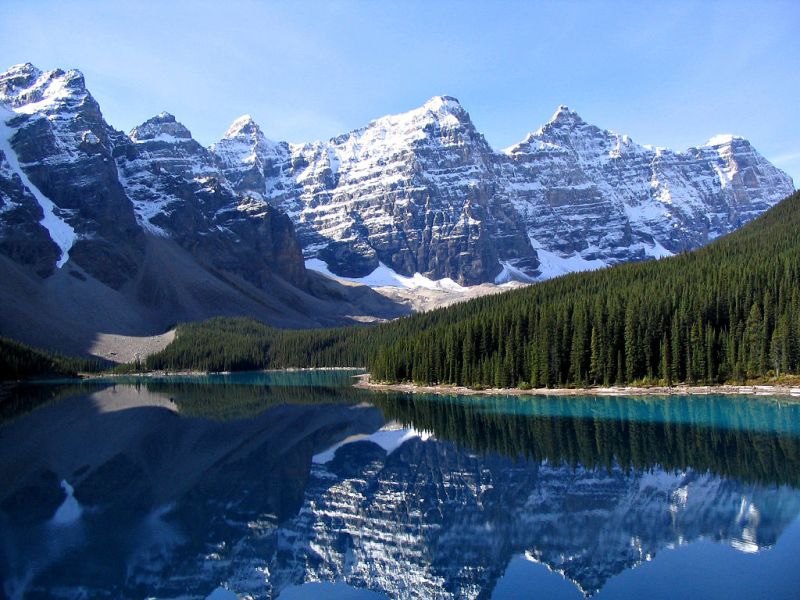
Banff National Park, Canada – Photo Credit: wikipedia.org
Biene replied: “My dear Peter, do you still remember your words, when you asked me to write to you one last time so that our friendship, which threatened to end in a discord, would dissolve in harmony. Sometimes I have to think about these words; for at that time they touched me deeply. For me it was as if this melody, which had always been in my heart, since I know you, must never fade away. Sometimes it only sounded rather timidly, but now my heart is full of music. I cannot express it in any other way. Was our correspondence during the two years not a good test whether the voice in our hearts that drove us together was genuine and true? Say, was it not also good that we had hurt each other and were saddened over it? I would rather be sad over you than feel nothing for you! Pain often carries the seed of deeply felt happiness. If we had never before been sad over each other, could we now fathom the happiness of having found each other?
I am hoping with you that you will find in Canada the freedom, for which you are longing, to be able to develop your abilities. But my dear Peter, you must not despair if you will be a little disappointed in certain things. Yes, you speak from my heart and soul when you say that it is far more rewarding and satisfying to build a future together based on our own strength than when everything just falls into our lap and one lives like in a golden cage. Through you I can now believe in a future, as I have always desired it. If we firmly believe in it and apply our strength, then our dreams, which we have always been dreaming, will become true.”
Biene had already written her final written exams before Christmas and sensing that she did well on them began the New Year in the knowledge that a major hurdle lay behind her and that her high school diploma was almost certainly within reach, although she still had to contend with a lingering anxiety about her upcoming oral tests in February. In contrast to the previous year when due to the emotional turmoil during her engagement with Henk and its sudden break-up her marks had dropped and for the first time in her entire school life she had been facing the spectre of failing the second last grade, now she was looking with a new sense of optimism into the future. She claimed that our love and the wonderful prospect of a life together as husband and wife in Canada gave her the strength and determination to face the challenges of the six remaining weeks at school.
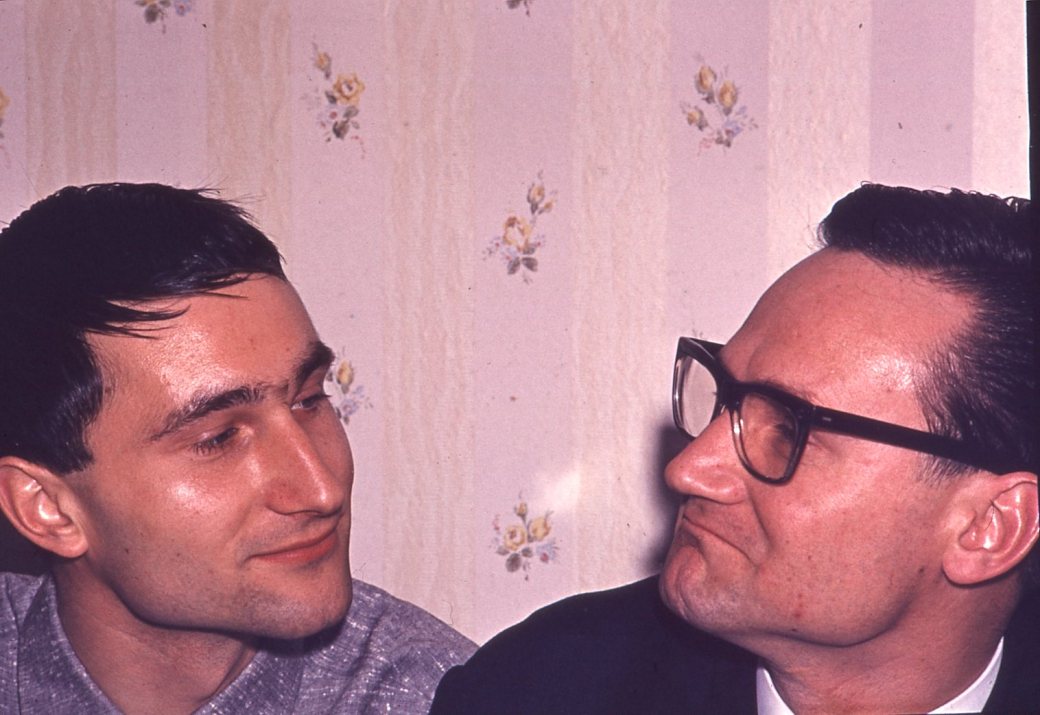
The Two Brothers Peter and Adolf – 1965
Of course, the ring, Biene’s most precious possession, which she had sent to me by mail and which I wore on my little finger at night, occupied front and center our thoughts and feelings and gave rise to reflections in our letters on its deeper meaning apart from being an heirloom from Biene’s great-grandmother. The first and foremost meaning, which Biene now openly declared, was that it symbolized faithfulness to which both of us from now on were committed through our love for each other. But there was also a hidden meaning, which I in my blindness for Biene’s subtle and unexpressed stirrings of the heart failed to see. I am certain that my roommates with their keen sense of perception would have immediately noticed the ridiculous reversal of roles I would have put openly on display with the ring, if it had indeed fitted on my ring finger. I was blind as a bat to Biene’s unspoken desire to receive an engagement ring in response to her precious gift. I could have prevented a lot of pain in the months that followed, if I had chosen to take the conventional route and on our next rendezvous in March had bought two rings for us. That way at least privately we would have had a semblance of a formal engagement. Alas, this thought never occurred to me.
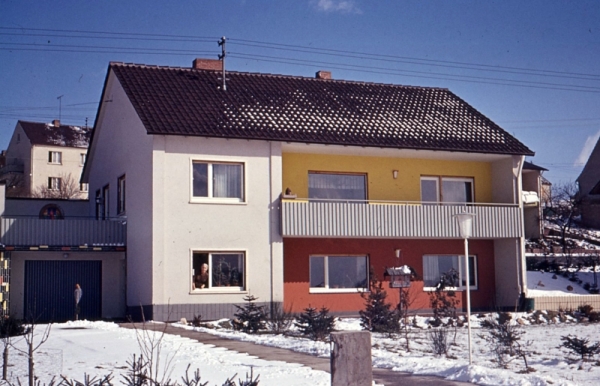
Biene’s Dream House
The Happy Twins Walter and Biene after Receiving their High School Diplomas
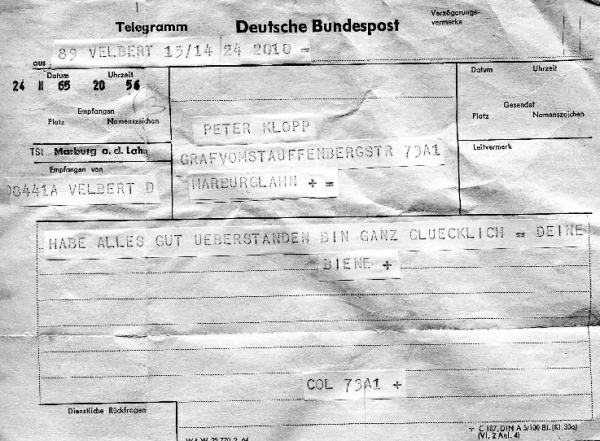
In the meantime Biene had graduated with reasonably high marks and sent me a telegram to the Tannenberg barracks to tell me the good news. Her parents were so delighted over her success that they granted her permission to visit me again in Watzenborn. Before she came, she had presented me with her idea of writing a family chronicle that would later enable us to look back at our roots.
Biene’s Telegram
In addition I had tossed in the proposal of starting a book with blank pages, which we would fill with our vision for the time, when we would be together in Canada. A description of our dream house would be part of this endeavour. Biene wholeheartedly embraced this idea and to this end immediately bought a leather-bound book, which could be locked with a tiny key. In spite of the hustle and bustle of the graduation festivities and inevitable farewell parties she had already made her first entry with the full force of her innate romantic creativity:
The Photo Biene was referring to
Our Little Dream House
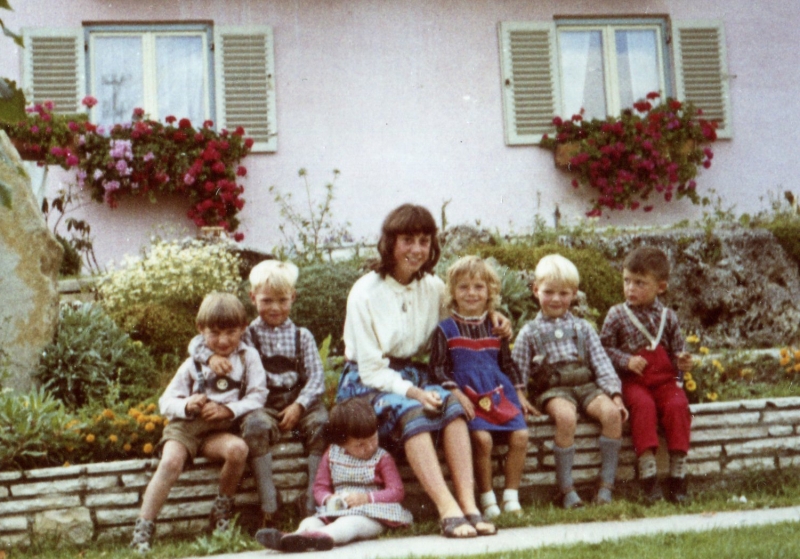
Now when under the first sun rays of spring the forces of nature begin to stir, I can hardly wait, until everything is blooming and the green, which is still slumbering in the swollen buds, breaks forth. Not too long ago I came across this photo and each time I look at it, dreams of a little home of my desires are awakening. You said indeed that we will set no limits to how far our fantasy will carry us, as long as it won’t do us any harm. This is how I imagine our little fantasy home to look like.
So picture this. It is spring. Only nature has progressed a little farther than here today. For everywhere fruit trees are already blossoming and in the sea of blossoms glimmers the first tender green of rupturing buds. You walk along the edge of a small town and are caught in the intoxicating scent of flowering splendour. All of a sudden you see out of the white shimmer a little house emerge. Sheer happiness makes your heart beat faster, and you believe to dream anew like on every day; for this is our little home embedded by this blooming island. It is as I said only a little house made entirely out of dark wood reminiscent a little of a log cabin. It looks neither opulent nor grandiose, but endearing and inviting instead.
Through the large windows the sun and the fresh aromatic air pours into the small cozy rooms. The sun glides over the furniture, which is not so ultramodern as to appear cold and nondescript, but every piece is reassuringly firm and solid and for that reason snug and comfortable. At this moment I must think of the chairs, which Aunt Lucie had painted. Such a piece of furniture is no longer dead, but in a small way radiates life.
Oh, I forget to mention that every window bedecked by a flower box is overflowing with flowers just like on that little photo. Our little home appears as if one day it would be overgrown by nature’s luscious growth, which should provide protection against the cold months, when icy winds drive us inside into the heated room.
Apart from that we spend most of the time in our little yard and even sleep there, when the summer nights are warm and the mosquitoes do not sting us too much. We sleep in hammocks and gaze at the starry sky before falling asleep.
In the winter when it is stormy and desolate, our large tiled stove or fireplace will radiate warmth into the small rooms just like the sun in the summer. Where the rooms are located, I am not so sure about it yet, but I think it would be best to place our bedrooms under the roof; for the slanted attic walls seem so cozy with a bed underneath. Also your study is upstairs, where you have the most quiet and can work fast. Thus, you can devote a lot of time to us. By us I mean everything that is dear to us, the plants and the trees in the yard, the little house, the animals and – I hardly dare to write it again – our children. I believe, if only a fraction of all this may become reality, I would be the happiest woman of the entire world!
Reading the description of Biene’s vision of our dream house, I was amazed at how far her thoughts and ideas had ventured forth with such precise details as if taken from a prophetic book. What astounded me the most, was how much the slow-moving train of life, in which we traveled together, had accelerated in recent weeks and months. Was is not only eight months ago that my novella ‘Carthage’ so fervently written and presented to her as a gift prompted here to say ‘I believe, we love each other’? And now her heart and soul envisioned us as husband and wife having a family in the home of her dreams.
Sitting on Mother’s sofa Biene and I shared these wondrous thoughts that have so prophetically crystallized into words written down in Biene’s special dream book. They were clear and easy to grasp and to attach our hopes to. They gave us a sense of purpose and direction, a blueprint for our entire lifespan.
The morning sun was shining brilliantly into the living room. Early spring was in the air and beckoned us to go for a stroll past the meadows behind the house towards the old mill into the nearby woods. There I once almost lost my way in the maze of trails and roads riding my new bicycle. We directed our path to a hunter’s lookout tower, which was overlooking a small clearing in the woods. We climbed up the wooden ladder to gain a higher vantage point for us. Once we had sat down on the sturdy bench, we no longer allowed our mind to dwell on our plans for the future, but had the strong urge to follow the ancient Roman saying ‘Carpe diem.’ We kissed. It was a very long and sweet kiss indeed. And if there were no other needs in this world, such as for food, drink, and shelter, you would in all likelihood still find us there today. So much we were wrapped up in enjoying the presence. The scene would have inspired the illustrious romantic English poet John Keats to compose a sequel to his famous poem ‘Ode to a Grecian Urn’ entitled ‘Ode to a Hunter’s Lookout’, where our bliss would have been frozen in time for all eternity.
Philosophical Musings on Love, Marriage and Family
Church in Watzenborn-Steinberg
Now it was my turn to write and lay out my philosophical musings on love, marriage, and family within the context of their place in society. Just like Biene, I allowed my thinking to go far, even taking a fanciful glimpse into a romantic notion of immortality.
When I think about two people, who love each other, I see two streams that arise from two different springs, wind through narrow ravines and then, free again, pour into a wide valley, sometimes wedged in, sometimes wide, yet steadily growing in power and strength, finally join and from then on flow together towards their goal, the sea. Who can say which is greater, more glorious and more beautiful? Perhaps an onlooker from one region would praise the charm of the first river, while another would be more pleased with the foaming waterfall in a gorge of the second. What the two have in common is not remarkable, because their charm lies in their difference. So it also appears to me between a man and a woman! For with them as well we see their intrinsic value in their being different from each other.
As we both are different and only when united have a common goal, so will different tasks occupy our entire being. Thus, dear Biene, I am certain, you will want to be wife and mother and you will see in this task your greatest and most beautiful role, and I would like to be husband and father and make sure that I put on a solid foundation, what you in your uniqueness will accomplish in the home through love and warmth for husband and children. And should someone ask us about our understanding of equality, we would simply reply that it is respect for each other’s uniqueness. We will then have said much more than if we had spoken longwindedly about the social position of man and woman in the human society. With it we express the idea that we do not wish to distort nature’s laws in our desire to be equal, but in responsibility for each other and for the family we are on par, of equal worth and value.
Each person, no matter how insignificant and low in the eyes of the world, influences his environment by his very being. His parents care for him and draw him into their thoughts and feelings. And so he also influences their decisions, as long as he in some way depends on them. Because of him they postpone perhaps a vacation trip or even cancel it; because of him there is perhaps a car accident or perhaps not. Few people are connected with him with their decisions, but the few are intertwined in a remarkable way with thousands of other people, who in turn have an impact with their actions on others. Thus, everyone makes a small contribution to the history of mankind. One need not be Caesar, Napoleon or some other great figure to change the world we live in. Everyone does it, whether he is aware of it or not. But it is good to know one’s power to this effect.
A teacher, who is ambitious and uses his subject areas to have good students graduate year after year, can say at the end of his career, ‘My knowledge and my thoughts did not remain buried in books or in my head, but have beneficially spread among so many people. He will be satisfied with his life, and after he will be long gone, his ideas and thoughts mysteriously live on in thousands of minds and produce for a long time to come precious results. Would he not catch through his work a tiny sliver of immortality? I find, if one looks at life that way, the world appears much brighter, even death loses some of its sting. Thoughts, ideas, knowledge are invisible and work in the shadow of the human spirit, until they step forth in action and then, even if it only happens on a small scale, change the world. You may wonder, dear Biene, what I’m driving at. I would like to lead a life with you and be there for you and the family. And that is only possible if I enter a profession, which first of all brings joy to my heart and secondly offers us financial security. Later on in my profession as teacher I hope to positively affect young people and, as much as I can, will follow with great interest their life’s journey. The question will always occupy my mind, ‘What will become of them?’ However, in my work I will never forget the family and leave its care and worry to you alone. You know, dear Biene, I believe that we live on through our children. And even if one day we will have become old and grey, part of us will always carry over to them, our flesh and blood, and after years of nurturing certainly also our way of life. I would like to cling to this idea, which in its realization will bring so much comfort to us, and it is my greatest desire that one day all this will become reality.
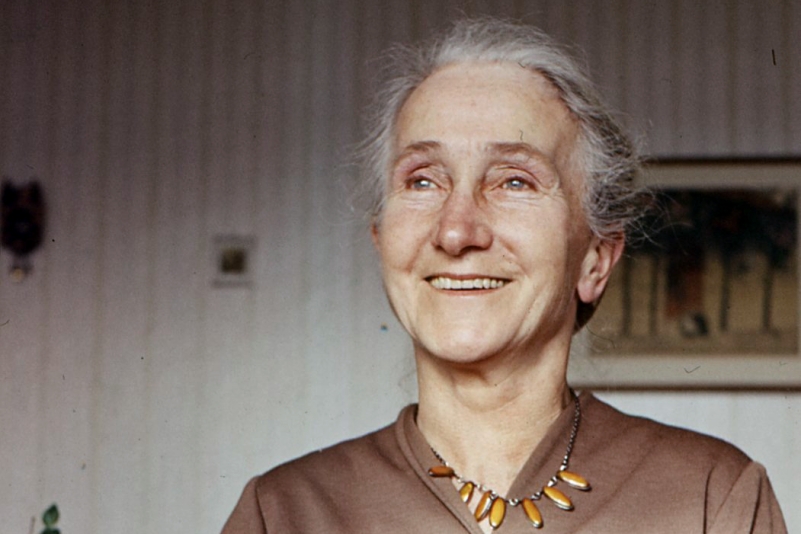
Mother
Sitting on Mother’s sofa, Biene and I shared these wondrous thoughts that have so prophetically crystallized into words written down in Biene’s special dream book. They were clear and easy to grasp, to which we could attach our hopes. They were destined to be the blueprint for our entire lifespan.
Albert war inzwischen schon neun Jahre alt geworden. Er besuchte die 3. Klasse seiner Dorfschule in Günsbach. Der Ort liegt im französischen Elsaß inmitten von den Bergen der Vogesen.
Eines Tages fragte ihn sein Lehrer: „Albert, möchtest du einmal Orgelspielen lernen?“ Albert pochte das Herz bei dieser Frage, denn er hätte zu gern ,ja“ gesagt. Er hatte ja schon mit vier Jahren begonnen, Klavier zu spielen. Sein Vater hatte ihm den ersten Unterricht erteilt, weil er frühzeitig erkannte, dass sein Albert sehr musikalisch ist. Schließlich antwortete Albert dem Lehrer und sagte ihm, dass er gerne auf der Orgel spielen würde. Er träumte schon lange davon, oben auf der Empore auf der Orgelbank sitzen zu können und Lieder und Choräle zu spielen.
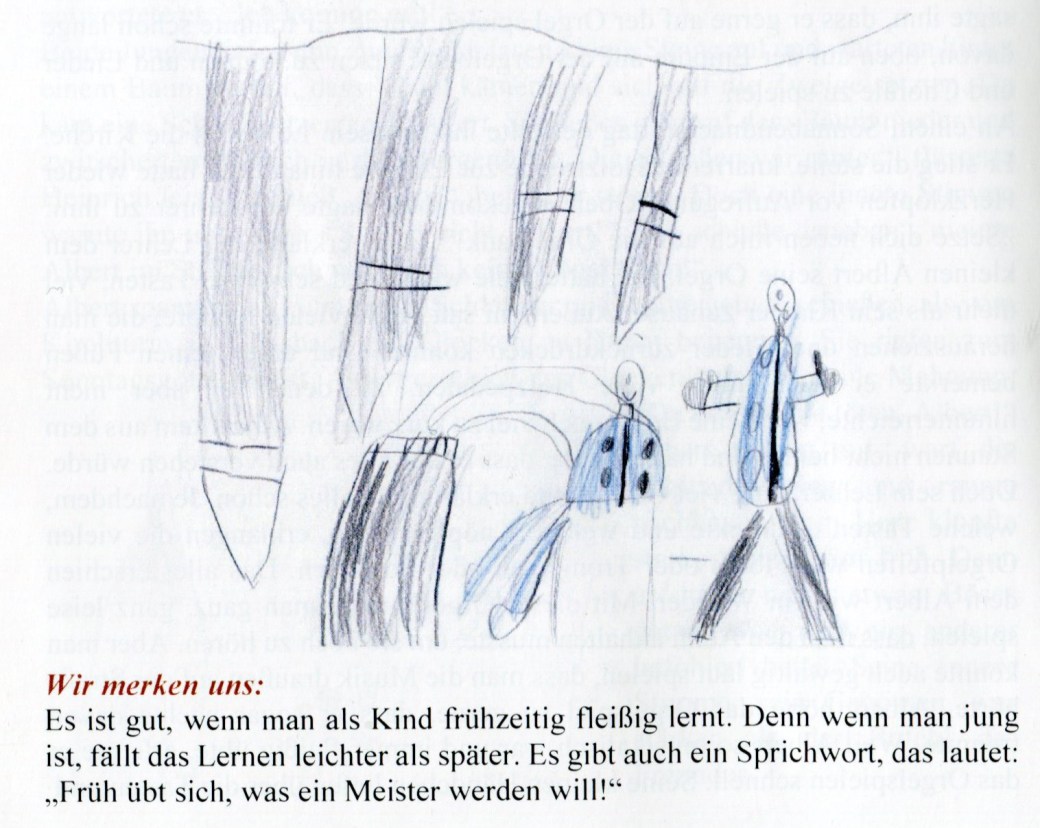
An einem Sonnabendnachmittag bestellte ihn nun sein Lehrer in die Kirche. Er stieg die steile, knarrende Holztreppe zur Empore hinauf und hatte wieder Herzklopfen vor Aufregung. Oben angekommen, sagte der Lehrer zu ihm: „Setze dich neben mich auf die Orgelbank!“ Dann erklärte der Lehrer dem kleinen Albert seine Orgel. Sie hatte viele weiße und schwarze Tasten, viel mehr als sein Klavier zuhause. Außerdem sah er die vielen Knöpfe, die man herausziehen und wieder zurückdrücken konnte. Und unter seinen Füßen bemerkte er auch noch viele Holzpedalen, zu denen er aber nicht hinunterreichte, weil seine Beine noch viel zu kurz waren. Albert kam aus dem Staunen nicht heraus und hatte Angst, dass er das alles auch verstehen würde. Doch sein Lehrer hatte viel Geduld und erklärte ihm alles schön. Je nachdem, welche Tasten er drückte und welche Knöpfe er zog, erklangen die vielen Orgelpfeifen wie Flöten oder Trompeten oder Posaunen. Das alles erschien dem Albert wie ein Wunder. Mit dieser Orgel konnte man ganz, ganz leise spielen, dass man den Atem anhalten musste, um sie noch zu hören. Aber man konnte auch gewaltig laut spielen, dass man die Musik draußen auf der Straße hörte. Albert hörte das Orgelspiel so gerne, dass er sogar nachts davon träumte. Weil Albert so musikalisch war und immer fleißig übte, erlernte er das Orgelspielen schnell. Seine kleinen Händchen liefen über die Tasten und ließen die Flöten schön erklingen. Nur die Fußpedalen konnte er noch nicht bedienen. Deshalb sagte sein Lehrer aus Spaß zu ihm: ..Du musst immer tüchtig essen, damit du schön groß wirst und bald an die Pedalen reichst!“ Schon nach wenigen Wochen konnte Albert Stücke seines Lieblingskomponisten Johann Sebastian Bach spielen. Er erinnerte sich daran, dass im Arbeitszimmer seines Vaters ein Bild von diesem großen Komponisten und Musiker hing. Als die schöne Musik durch den Kirchenraum schallte, wurde dem kleinen Albert ganz warm ums Herz.
Eines Tages kam sein Vater ganz aufgeregt zu Albert. Der Organist seiner Kirche war plötzlich erkrankt und es gab keinen, der zum Gottesdienst die Orgel spielen konnte. Da fragte ihn der Vater: „Albert, würdest du es dir zutrauen, am Sonntag in der Kirche die Orgel zu spielen?“ Albert bekam einen richtig roten Kopf vor Aufregung. Doch er sagte: „Ja!“ Endlich ging für ihn ein langer Traum in Erfüllung. Tatsächlich spielte Albert Schweitzer bereits mit neun Jahren im Gottesdienst zu Günsbach die Orgel und alle Leute lobten ihn, weil er so gut gespielt hat. Später wurde Albert ein weltberühmter Orgelspieler, der sich auch mit der Technik der Orgel so gut auskannte, dass ihn Orgelbauer um seinen Rat baten und er auch Bücher über den Orgelbau schrieb.



 The Peter and Gertrud Klopp Family