Chapter X of The P. and G. Story – Part II

Appearance and Reality

Dangerous Adventure on the Roof Top

In the summer holidays I traveled by train to Mother’s work place, the Senior Citizens Home in Rudersberg less than half an hour’s drive from the commercial hub and center of southwest Germany, the city of Stuttgart. Here I spent six carefree weeks alone or with a newfound friend, who spoke a similar dialect as the people in Rohrdorf. When it comes to language, I had and still have, to a lesser degree, the ability to quickly assimilate a new dialect. Looking back at the first few months at the Wesel High School, where very formal and standard German was spoken, I am amazed at the speed, at which I lay aside all traces of my southern dialect.
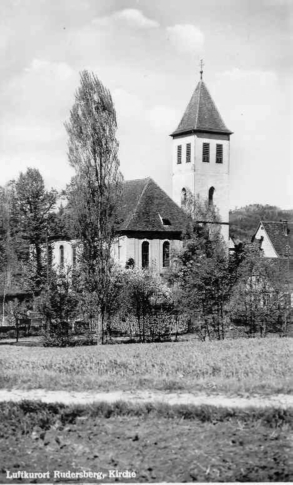
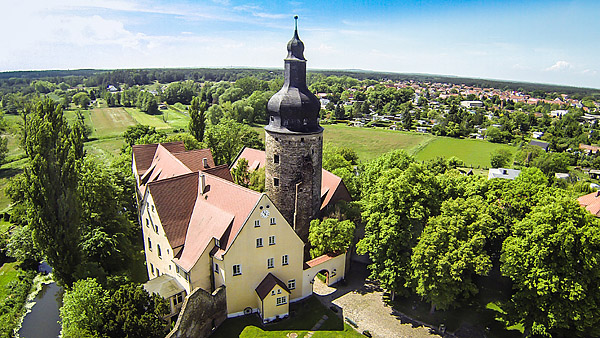
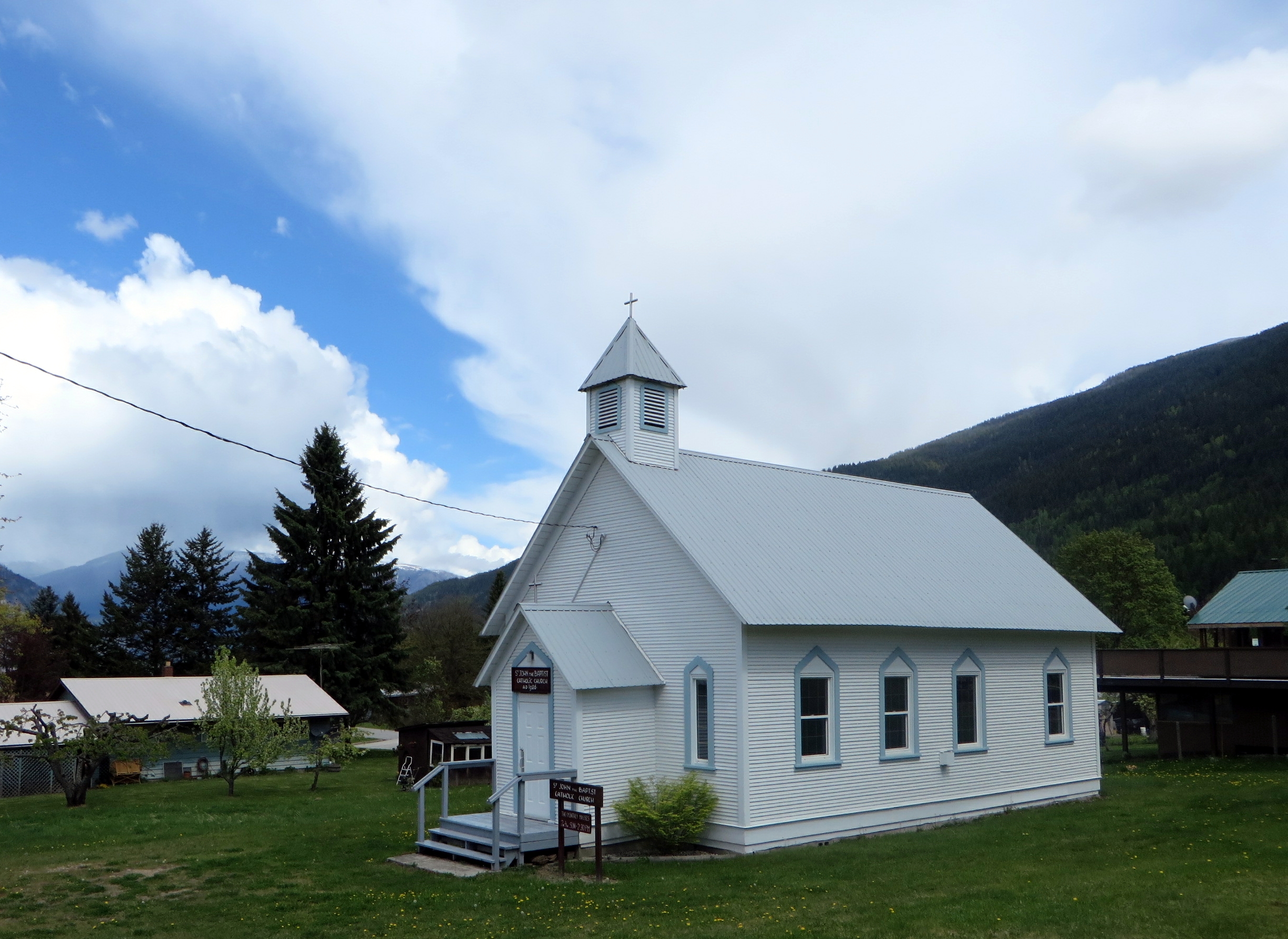
Church of Rudersberg

Church of Rudersberg

Right across from the Seniors Citizen Home was a small two-storied house with stone stairs leading up to the main entrance. Here a girl by the name of Ursula perhaps a year or two younger than I lived on the first floor. The two of us often sat on the steps chatting, swapping information about school life, our hobbies and the like. When the sun was coming around the building and it was getting too warm to sit on the stairs, we withdrew into the shade under the staircase. On a particularly hot afternoon we had spent quite a long time in our cool hiding place – perhaps a bit too long in the eyes of suspicious people who saw evil where there was none. When we eventually emerged and stepped into the glaring light, a barrage of angry words came raining down on us out one of the windows from the building across the street. An older woman all dressed in dark clothes shocked us with a seemingly endless tirade on the decline of morals, on the shameless and open display of inappropriate conduct between two, oh so young and already so corrupted individuals and all that so close to a Christian home for the elderly. “Shame on you! Shame on you!” she exclaimed, before she slammed the window shut. Apparently she had been following the invisible drama in her own imagination that was as far apart from reality as night is from day. We both were stunned by this outburst of incomprehensible accusations. Perhaps if we had been a few years older, we would have understood what this woman’s rage was all about. As for me, the unknown person in dark had already created an ever so vague impression that there was something unwholesome, sordid and morally questionable in dealing with the opposite sex, something I did not yet know what it was, but which came back to haunt me later in my adolescent years.
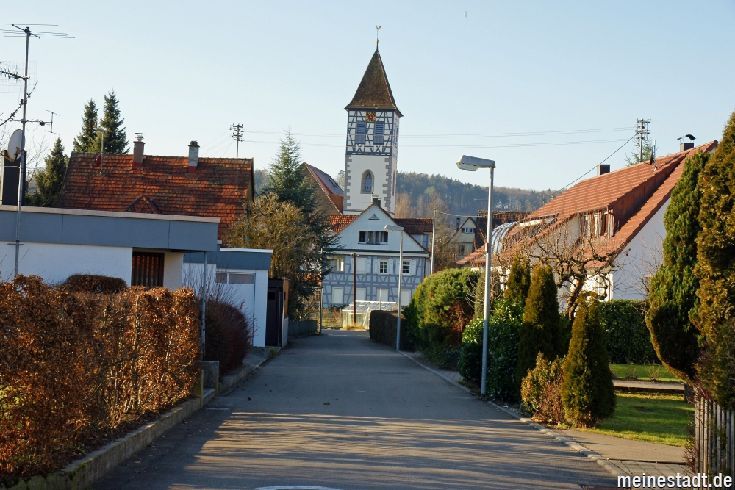
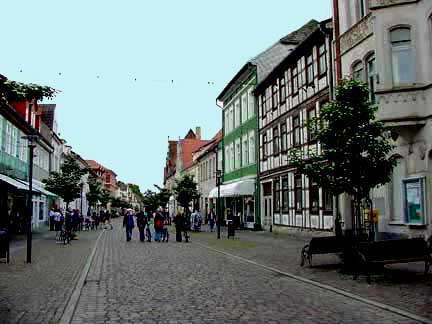
Town of Rudersberg - Photo Credit:

Town of Rudersberg

There happened to be a kermesse, in size and variety of entertainment, quite similar to the one I had attended in Messkirch the year before. This was a welcome distraction for me. Not having much money in my pocket, I simply enjoyed milling around in the crowds, going from booth to booth, from merry-go-round to roller coaster, listening to the rock n roll that was just beginning to penetrate the German pop music. I watched people play games or buy little toys and trinkets from noisy peddlers. As long as the kermesse lasted, I walked down to the fairgrounds every afternoon. One day I invited two elderly ladies who were sitting on a bench in front of the Seniors Home to walk with me down to the fairgrounds. From their reaction I could tell that this had never happened to these venerable old ladies before. A twelve-year-old boy offered to take them to the town square. After they had gotten over their surprise, they encouraged each other, and then nodded with a smile as a sign of acceptance. The scene that followed was quite comical, actually downright hilarious. Swaggering down the hillside sidewalk, one lady hooked in my arm on the left, the other one on the right, so full of joy, we were giggling and laughing all the way down to the fair grounds. What a wonderful feeling to bring happiness into people’s lives and not to care how crazy it might appear to bystanders or what they might think or say!

My desire to explore the things around me led me once into gravest danger. I had discovered by chance the stairs leading up to the huge unused attic space in the building of the Seniors Home. Inside the attic it was pitch dark. Overcoming my fear of darkness, I waited until my eyes had adjusted sufficiently to see that there was a hatch, which a storm perhaps may have pried open just a crack to let a shaft of sunlight shine through onto the wooden floor. Towards that single source of light I was directing my steps. When I had arrived near the far end of the attic, I discovered that the hatch had a simple locking mechanism. To let more light in, I pushed the hatch fully open. Now my eyes had to adjust again this time to the overpowering brilliance of the midday sun, which was flooding the beautiful landscape around the town before me. The ridge was less than three meters from the hatch. I thought that I would have a much better view if I climbed over the slate tiles onto the ridge. I immediately turned this daredevil thought into action, even though I severely suffer from acrophobia. It helped that the massive roof surface prevented me from seeing how high I was above from the parking lot below. So I slowly and carefully crept up on all fours until I reached the top and sat proudly on one of the ceramic ridge tiles. For extra measure of security I straddled the ridge and feasted my eyes on the magnificent panoramic view. Then the thought occurred to me that if I slid tile by tile forward I would reach the opposite end of the roof whence I could look down on the entire town of Rudersberg. Totally ignoring my fear of heights, I boldly went ahead. After thirty minutes of lifting and lowering alternately arms and legs in caterpillar-like fashion I arrived at the end of the roof. Far down below, people looked like ants and cars like matchbox toys. Had I before just seen mostly the roof surface with the lovely scenery on each side, it seemed to me now as if I was looking into a bottomless chasm. Three stories high on the rooftop I felt the first signs of a vertiginous attack making the world spin around me. Sensing the oncoming vertigo, I instinctively closed my eyes, lay prostrate with arms and legs straddling the ridgeline. I displayed, if anyone could see it, a picture of humble admission to my total stupidity and ignorance of the truism, what goes up must come down.

After the horrid sensation of twirling motion had ebbed away, I dared to open my eyes again. Then another fear far worse than the first seized me. I realized I was trapped. I could not get back to the hatch without turning around. And I could not turn around without falling off the roof. The thought crossed my mind to call for help. It would have been the most sensible thing to do in my situation. But what made sense, my pride did not allow me to do. So I lay there for a long time thinking and taking some comfort in the fact that as long as I did not move, nothing could happen to me. Many life-threatening situations require prompt decision and action. However, this one was different. After a long time that seemed like eternity I found the courage to sit up. Forcing myself not to look down in order to avoid another onslaught of dizziness, I moved my bottom backwards the short distance of a single ridge tile, stopped for a while, then encouraged slid back to the next tile a little further away from the house front. Now I knew that I had found the solution to my own rescue. Once the dizzying depth was out of sight, I regained my calm and retreated more quickly at a steady and rhythmic pace. Hands down, bum up, slip back one tile, bum down, short break and repeat. Finally I reached the hatch, climbed through it and felt at last the solid wooden attic floor under my feet.
Chapter X of the P. and G. Klopp Story – Part I

Problems with Latin and Yearnings of a Miller’s Maid


One cannot answer for his courage when he has never been in danger.
Francois de La Rochefoucauld


Mother had taken a new position in a senior citizens’ home in Rudersberg near Stuttgart. Aunt Mieze (Aunt Marie), her eldest sister, found a teaching position in Brünen near Wesel in the province of North Rhine Westphalia. In the mid-fifties the rebuilding of the 98% bombed-out Wesel was in full swing. Aunt Mieze had applied for an apartment and for a transfer to the Wesel Elementary School. About the same time she must have invited Mother to run the household in exchange for free lodging for her and me, the youngest son. This arrangement would become reality, as soon as the apartment already under construction would be available. How Father on a long-term basis would fit into these plans, I have never been able to figure out. While Mother was still working for another year in Rudersberg, I was going to live with my aunt at the farm-like residence across from the historical Wefelnberg mill that had lost its wings, but with the aid of electric motors was still turning grain into flour until the early seventies.

Staatliches Gymnasium Wesel

Staatliches Gymnasium Wesel

From here I took the bus to attend the high school for boys in Wesel. In those days smoking was still permitted on public transport. I often felt sick from breathing in the lingering smoke of cigarettes and cigars. Things did not go very well at school either. I had started with French as the first foreign language. Here at the ancient language school, Latin was taught first and carried on for nine long years. Although I had received some private tutoring in Latin, it became abundantly clear after my first report card with an F in Latin that I had to repeat the grade. In order to survive in a school, whose claim to fame was being the toughest in the region, there was no other option.

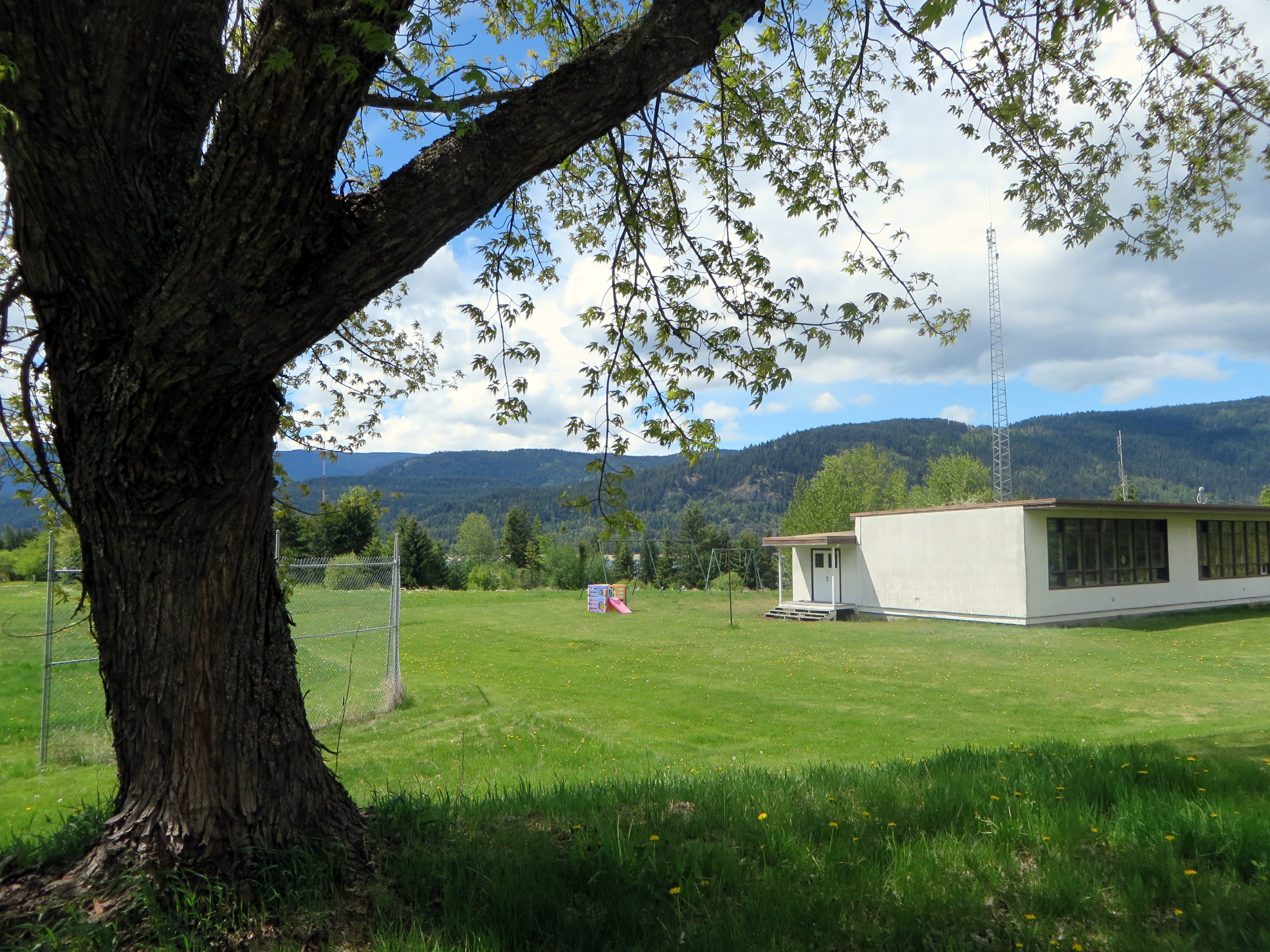
Historic Wefelnberg Mill now used for Kindergarten School

Historic Wefelnberg Mill now used for Kindergarten Classes

At the opening assembly Dr. Marx, the principal, announced that out of the hundred students there would only be one-quarter left at graduation nine years later. There was no doubt in our minds that the process of weeding out the feeble and incompetent would be ruthless and merciless. My high school years were going to be fraught with stress and anxiety. At least at the miller’s home in Brünen I had a good life. Aunt Mieze was strict, but fair. When she felt the needed to teach me a lesson, I deserved the punishment. When she gave me on rare and exceptional occasions a spanking, it was intended to correct unacceptable behavior. Love and care for her nephew were her main motivation, not anger and rage as I had experienced at the Stoll house.

Post Card of Brünen near Wesel

Post Card of Brünen near Wesel

There were at least seven people in the Wefelnberg household: Aunt Mieze and I, robust widow Wefelnberg in her early sixties, her daughter, who had remarried, after she had lost her first husband in the war, a 10 year old daughter from her first marriage, and Leni, the maid. The couple had their bedroom next to mine. The new husband and experienced miller had taken over the duties of running the mill. With so many widows eager to remarry and competing for the few men that survived the war, it seemed that the young man had made a good choice. My tiny room of less than six square meters, even judged by the standards of the cramped living conditions in postwar Germany, would hardly qualify as a bedroom. It used to be a storage facility located under the slanting roof and was now skimpily furnished with a cot, a chair and a small desk on which I could do my homework. The door on the left of the wooden staircase was in the shape of a square just large enough for me to crawl through. On the upper floor to the right were Aunt Mieze’s office, living room and bedroom all combined in an area not larger than twenty-five square meters. At the far end on the right was Leni’s bedroom. She was responsible to assist Mrs. Wefelnberg with general household duties and was happy like most unmarried young women to have employment for free room and board and a little bit of extra pocket-money.

Protestant Church in the Village of Brünen - Photo Credit: See caption above.

Protestant Church in the Village of Brünen – Photo Credit: See caption above.

          Aunt Mieze’s room in spite of its shortcomings was a very cozy place and created with a comfortable sofa, coffee table, desk and books on the shelves a pleasant ambiance that my Spartan attic room could not match. Here I sat often in the evening hours, when my aunt, a very conscientious teacher, had gone back to school to prepare her lessons for the next day. Leni, who had taken a liking to me, often, especially when nobody was around, dropped in to chat or to play a game of checkers with me. The latter I liked very much. Although being at least ten years younger I was able to beat her by managing to convert my pieces into kings more quickly than she did. For someone who was at the time in school emotionally wrapped-up in a fierce struggle of survival, the survival of the fittest, our principal would say, these small victories and the praises Leni lavished on my battered ego were indeed balm for my soul.

          One day after being defeated again and providing heart-warming accolades for my strategic prowess, Leni unexpectedly slid over to my end of the sofa. What followed would have been a perfect scene for a comedy hour. The miller’s maid generously endowed by Mother Nature burning with desire of which I did not have the slightest inkling sat uncomfortably close to me, the twelve-year-old boy, and almost in a whisper asked me to kiss her. As for me having been raised in a family, where physical closeness, such as kissing, embracing and hugging, was rarely experienced, where aloofness and demureness were the norm rather than the exception, I was shocked at the maid’s incomprehensible request. For five marks as a prize I once ate an earthworm sandwiched between two slices of bread. But to touch those lips longing to be kissed, for my lips to make actual contact with her mouth was a most horrifying thought to me. When I refused, she pleaded with me, this time more urgently with a considerably louder voice, “Please do me this small favor. Please, please I want you to kiss me …” Suddenly the door burst open. At the door stood the miller’s wife and ordered Leni in a stern, authoritative tone to get into her room and never ever be seen again in Frau Kegler’s room. Whether she had been eavesdropping or even spying on us through the keyhole, I do not know. But to this day I am grateful to her for rescuing me from one of the most embarrassing moments of my life.

The Wonderful Plant Called Hops

Growing Hops in our Garden

Hops Rhizomes Ready to be Planted

Hops Rhizomes Ready to be Planted

Stefan, our youngest son, has many great hobbies, traveling, photography, active hockey, playing board games, cooking and baking, designing websites, maintaining his own blog ‘This Timeless Moment’ at kloppmagic.ca, hanging out with friends, just to name a few. Three years ago he started making his own craft beer at his little home in Vancouver.

Tender Shoots Seeking a Foothold

Tender Shoots Seeking a Foothold at the Poles

When I heard about it for the first time, I had no idea that I would have any involvement in his latest passion. One day over the phone he announced that I would soon receive a parcel from a hops nursery in BC. It would contain hops rhizomes for me to plant in our garden. My attitude has always been this. When accepting a new task, do it right or don’t do it all. The idea of Stefan brewing beer with the hops I would be growing appealed to me, especially since I am a fan of good beer. In my mind I was already sampling his tasty, refreshing brew. So I accepted the challenge of growing a new plant in our garden. I won’t go into the details, as one can easily read up on the topic on-line.

Within less than four Weeks they are at the Top

Within less than four weeks they are at the top of the poles.

To find out which variety of hops plants would do best in our climate and soil, Stefan had ordered eight different kinds: Mt. Hood, Willamet, Fuggle, Chinook, Golding, Centennial, Cascades, and Sterling. The reader, who has knowledge of the Pacific Northwest, may recognize some of the names as bearing resemblance to geographical places in Oregon. That is no coincidence, as Oregon State boasts of having the most and best breweries in the States.

My Wife under the Roof of an Abundant Crop

My Wife under the Canopy of an Abundant Crop

The hops plant is quite modest in terms of maintenance and care. Also it grows in most types of soil, but needs a trellis system of poles and strings allowing it to grow 6 to 7 m high. It grows at an incredible speed. You can literally watch it grow some 30 cm in a single day. Later in the fall, you can marvel at the dense green canopy overhead with thousands of cones hanging from the side shoots of the hops plants.

Baskets and Baskets of Hops Cones

Baskets and Baskets of Hops Cones

Picking and plucking off the cones is time-consuming and quite tedious. They also need to be dried and then put in plastic bags, where they will stay fresh in the freezer. But the pleasure of drinking the finest beer that Stefan brews is well worth the effort.

Dreaming about the best Pale Ale turns this kind of work into pleasure.

Dreaming about the best Pale Ale in the World

A Visit to Hartmut and Gisela Kegler’s New Home in Kochstedt

Our Visit with Uncle Hartmut and Aunt Gisela

by Dieter Barge

Chart II a – II and III

From April 28th to April 30th, 2015, we paid a visit to Edda’s Uncle Hartmut and his wife Gisela in Kochstedt near Dessau.

Hartmut, the first child of Bruno and Johanna Kegler, was born in 1931 in Stettin (Szczecin). He attended the elementary and high school in Hirschberg (town in Lower Silesia). In Thuringia he graduated from an agricultural institute and took his post-secondary education in Rostock and Halle.

From 1955 to 1991 he worked as a scientist at the Institute of Plant Pathology Aschersleben of the German Academy of Agricultural Sciences of Berlin. In 1959 he pursued his doctoral studies, which earned him in 1964 the postdoctoral qualifications as professor. Gisela was born in 1931 in Havelberg and had an active career in the teaching profession.

Havelberg Dom

Havelberg Dom

After the reunification of Germany, Hartmut was dismissed and became unemployed and a pensioner. This came as a result of the closure of the institure. Both Hartmut and Gisela are occupied with keeping the cultural heritage of Nobel Prize winner Albert Schweitzer alive, hold conferences and publish works related to this theme. The lived in Aschersleben am Bäckerstieg 11, where we had often visited them in past.

One of Numerous Publications about Albert Schweitzer's Legacy

One of Numerous Publications about the Albert Schweitzer’s Legacy

In 2011 we celebrated their combined 160th birthday in the wonderful town of Havelberg at the confluence of the Havel River (great for going paddling) with the Elbe River.

160th Combined Birthday of Hartmut and Gisela Kegler

160th Combined Birthday of Hartmut and Gisela Kegler

In 2014 their son Harald procured for them accommodation with in-house care facilities in the Dessau city district of Kochstedt.

Hartmut and Gisela in their Cozy Livingroom

Hartmut and Gisela in their Cozy Livingroom

Here we visited them for the first time. Hartmut had reserved a room for us in the guesthouse ‘Heideperle’. We had lots of time for stimulating conversation.

Guesthouse Heideperle at Kochstedt

Guesthouse Heideperle at Kochstedt

A Young Boy’s Fatal Accident in 1949 and a Trophy in his Memory


The Story of the Danny Devlin Memorial Cup

Adapted from newspaper clippings at the Arrow Lakes Historical Society

Daniel Edward Devlin, five-year old son of Mr. and Mrs. W. Devlin of Fauquier met a tragic death Tuesday afternoon while playing on some saw logs decked on the beach. A log rolled and crushed him and he was rushed to the Arrow Lakes Hospital but he died en route. From a newspaper clipping of Thursday, April 14, 1949

Danny

Funeral services for Daniel Edward Devlin were held on Good Friday at 2:30 p.m. in the Community Hall, Rev. Hartley officiating. A large crowd of sorrowing friends and relatives were present to honor the memory of the sturdy, lively little fellow and the many floral tributes were token of their esteem.

Hymns sung were: “When He Cometh” and “Safe in the Arms of Jesus”. Mrs. Morrison acted as accompanist.

Burial was in the new Fauquier cemetery. Daniel Edward is the first to be laid to rest there. Pall bearers were Peter and Frank Bilinski, Raymond McTaque and Bill Maitland.

Daniel Edward Devlin, son of Mr. and Mrs. Wilfred Devlin, was born at New Westminster, April 27, 1943.

In a brief interview with his surviving brother Alan Devlin, I heard that Daniel liked the school (now the clubhouse at the Fauquier golf course)on the hillside, which was located not too far from the present Fauquier ferry landing. Even though he was not yet of school age, he often showed up at recess and lunch to play with the older kids. After his tragic death it was Mr. Wilkin, the principal and teacher of the Fauquier School, who came up with the idea of instituting a memorial cup for the school district.

Daniel was a very likable little chap and endeared himself to all those who came in contact with him. In donating the cup, Mr. Wilkin said in his letter, “We should like to have our little friend, still move in spirit among his friends and therefore we will promote a competition among the schools to foster the friendly play so characteristic of Daniel.”

The Danny Devlin Memorial Trophy

The Danny Devlin Memorial Trophy

From then on, at the end of each school year, a softball tournament was being held and the trophy named after the little boy, the Devlin Cup, was awarded to the winning school team of the district. For forty years Daniel’s memory was kept alive through this trophy. Then district school restructuring  and greater interest in soccer put an end to the softball tournament.

It is my hope that this post will make a small contribution in keeping Daniel’s memory alive.

Gertrud Kegler 1896 – 1957

Life-long Service to the Sick and Wounded

Chart II a – II

On March 27, 1896, Gertrud Kegler, second daughter of Pastor Carl Kegler, was born at home in the parsonage of Grünewald, Pomerania. She attended the local elementary school from 1902 to 1905. For the following three years she received private instructions in a neighboring village to prepare her for the all girls’ high school in Stettin (Szczecin). Like all the other Kegler children she was confirmed by her father in the village church of Grünewald. It must have been a great joy for Pastor Kegler to see his three lovely daughters sitting in the front pew, while he was delivering his Sunday sermon from the pulpit. He endearingly called Marie, Gertrud and Erika (my mother) his three lilies.

The Three 'Lilies'

The Three ‘Lilies’

After graduation from high school she took nurses’ training in Neustettin (Szczecinek) and obtained certification as a registered nurse in 1919. For almost 20 years she worked as a member of the sisterhood of the Johanniter Order. The Order’s regulations have worded this command as, “The Johanniter answers the call, where the suffering of his neighbor awaits his act of love, and where the irreligion of the afflicted demands that he witness his faith.”

Saint Catherine of Alexandria church Photo Credit: wikipedia.org

Saint Catherine of Alexandria church in Thorn – Photo Credit: wikipedia.org

During the Second World War she worked from 1939 to 1945 in a military field hospital at Thorn (Torun) tending to the needs to the sick, disabled and injured. This came to a sudden end, when the advancing Red Army forced the medical administration to close down the hospital. Gertrud fled with her colleagues and managed to reach Stolpmünde (Ustka), where my grandmother Elisabeth and Aunt Marie were renting a small apartment. Shortly after,through a kind of ethnic cleansing all Germans in Pomerania and all the other eastern provinces were expelled from their homeland. So the three eventually arrived in Middle Germany, what later  came to be known as the German Democratic Republic.

A276

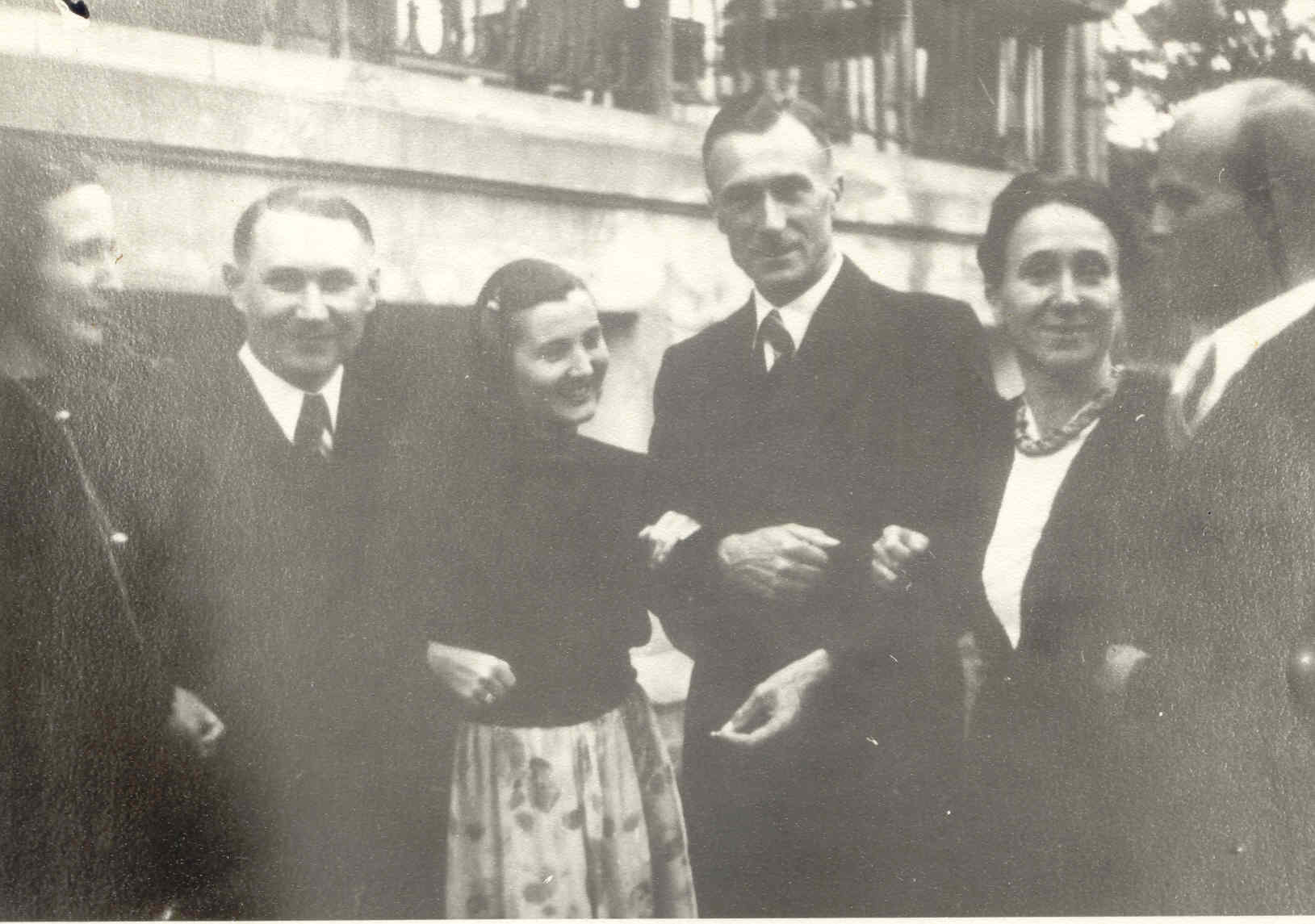
Mother and Aunt Gertrud on the Right

After the war from 1945 to 1947 Gertrud Kegler continued to work as a nurse in Belsen-Bergen, where nearby the infamous Nazi concentration camp was located. In 1948, the chief physician, who had worked with Gertrud in Thorn, West Prussia, remembered her as a highly qualified and competent nurse. He asked her to join his staff at the hospital in Malchin. There she was employed as head nurse. She helped under most difficult circumstances to build up the medical facilities of the hospital.

My wife Biene already described in her fascinating blog ‘This Miraculous Life’ at bieneklopp.com the lure of the ‘Golden West’. In addition to the attraction of greater freedom and prosperity in West Germany, there was a third factor that prompted my aunt to cross the Iron Curtain. Her sister Marie, who lived with my mother and me in Wesel from 1956 to 1962, had noticed an ad in the local newspaper for the position of a head nurse in a senior citizens’ home and alerted her Gertrud to the opportunity to start a new life in Wesel. When my aunt arrived in 1956, the three sisters were finally reunited.The Dom in 2001

However, what could have been a joyful period for the three, ended in tragedy. On her time off from work, Gertrud would often drop in at our small two-bedroom apartment on the street corner of ‘Auf dem Dudel 1’. Stress from the new and very challenging position as head nurse was written all over her face. It was not just the tremendous workload in a totally different environment that caused her a lot of grief. It was rather the envious and ill feelings her staff had toward the Ossie (slang for someone from East Germany) that gave her so much pain. Also they may not have liked the conscientious attitude of their supervising nurse, who put the care and well-being of the elderly front and center before comfort and ease at the work place. Gertrud did not mince words when it came to correct sloppiness and negligence in the treatment of the most vulnerable in her care. She may also have suffered under depression, which had struck on and off quite a few members of the Kegler family when they had been under great duress and mental strain. After one year of suffering she could not take it anymore. She committed suicide on February 21, 1957. I was not yet 15 years old at the time. Not having a concept of death as a final event for us here on earth, I was not overly shocked by her parting. I remember her as the kind aunt with enormous eye brows, who liked to listen to me, when I was reading aloud from my Latin reader.