Chapter X of the P. and G. Klopp Story – Part III

Creative Use of Margarine Cards and Early Insights into Marital Spats

When Mother had a day off, we were able to do things together. What I liked the most was to go with her on hikes through the wooded hill country surrounding the town. At the end of a two- or three-hour leisurely walk along the highways that were not plagued too much by traffic, we always found a cozy roadside inn, where we dropped in for some refreshment and relaxation. Mother would order a cup of coffee for herself and for me a glass of mineral water or some homemade apple juice. On one occasion the innkeeper, who was running a small farm on the side, was too busy to stay with us being the only guests. So Mother and I spent the afternoon alone in the guest room and watched a movie on the small b/w TV screen. This was the very first time that I watched TV. I was thrilled getting acquainted with the new media that was just beginning to conquer the German entertainment market. The film most likely boring by today’s standards caught my immediate interest with its simple but captivating story about an immigrant from Europe who was on death row in an US state prison. He asked for and was granted permission to write letters to his aging mother in the Old Country. Within two weeks he wrote more than a hundred post-dated letters describing his imaginary tale about his proud achievements leading him from rags to riches in the New World. After his execution a prison guard with a heart sent off a letter every few months to his mother. A sad, but compelling story I remember vividly to this day.
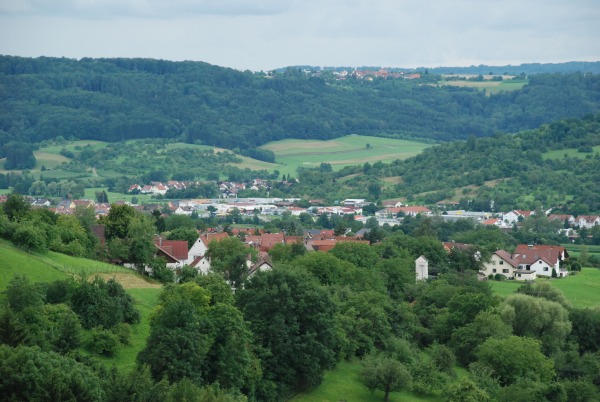
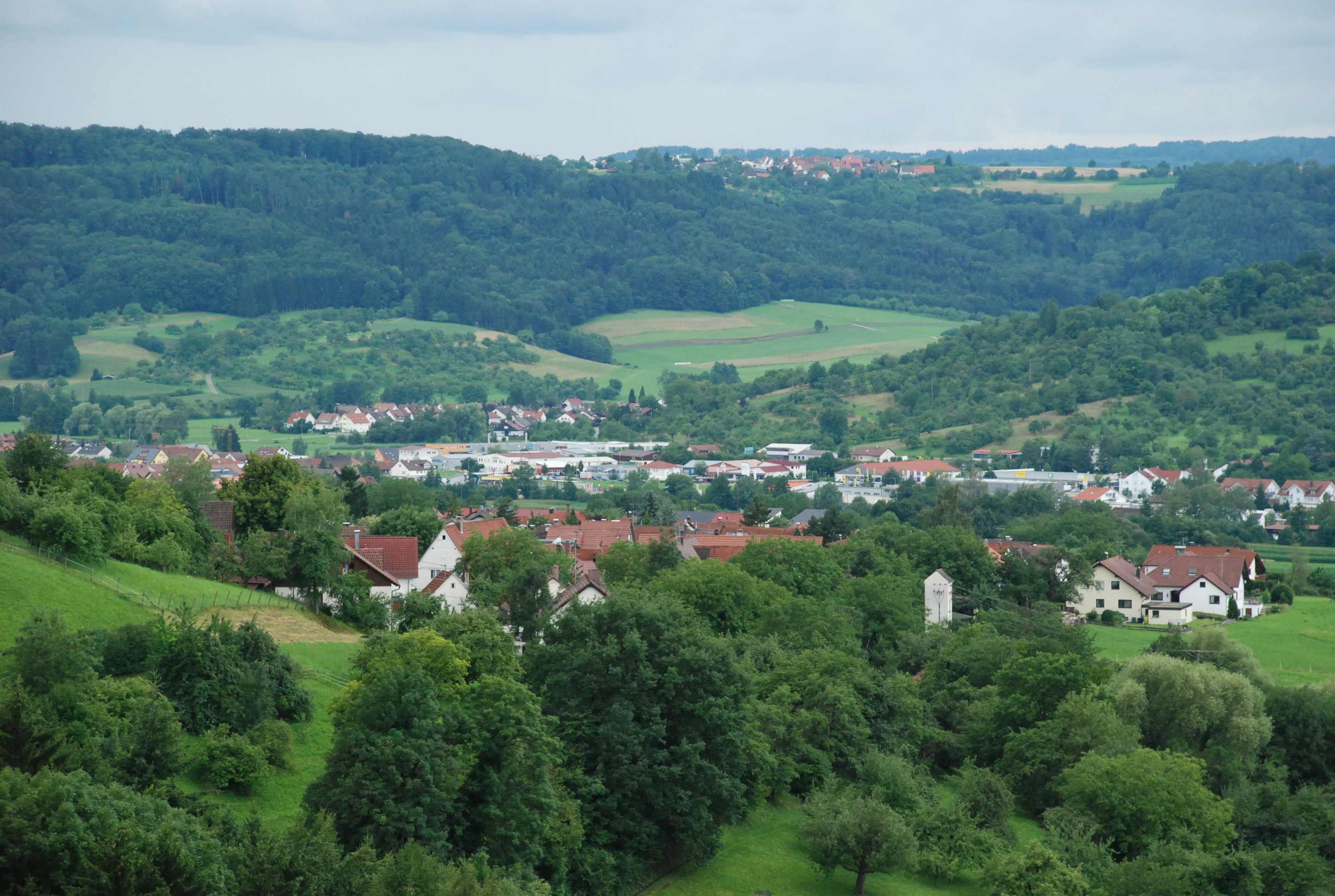
Rudersberg - Photo Credit: weather-forecast.com

Rudersberg – Photo Credit: weather-forecast.com

On the few rainy days, when we could not go on our beloved hikes, we stayed in Mother’s room and played her particular variation to the German card game ‘Six-and-Sixty’ with a double-deck of cards, which allowed us to unite in ‘marriage’ lots of queens and kings. Each marriage resulted in twenty more points than the marriage before. On these occasions Mother inspired by a glass of local wine or a satisfying victory in the card game would talk about her life in Pomerania, both sad and humorous stories. At times she would back to her childhood years in Grünewald. Proudly she told me that what she enjoyed the most. She liked horsing around and roughhousing with her brothers, which, although not becoming for a girl, was very much respected by her older brothers. Curiously she did not talk much about Father, nor did I ask any questions about him. I lived in the present; the future and the past did not yet have any meaning for me.

Back in Brünen, where the excellent food from the Wefelnberg country kitchen did miracles to the still slightly undernourished pre-teenage body of mine. In no time I gained enough weight so that I suddenly appeared quite chubby, perhaps even a little stout. There are no photos of the time, but I remember distinctly that I easily won wrestling matches with boys of my age by simply pinning them to the ground on account of my sheer weight.
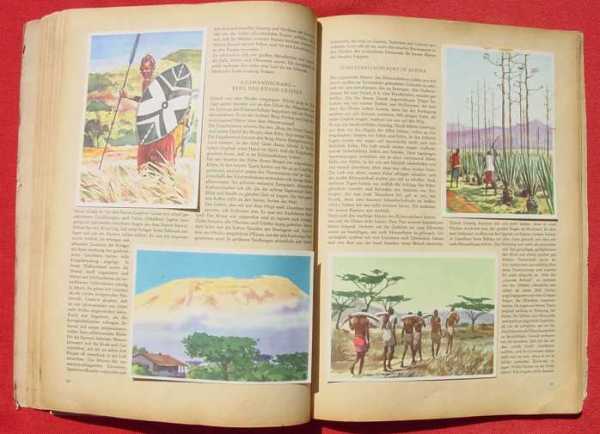
Sanella Album of Africa - Photo Credit: delcampe.net

Sanella Album of Africa – Photo Credit: delcampe.net

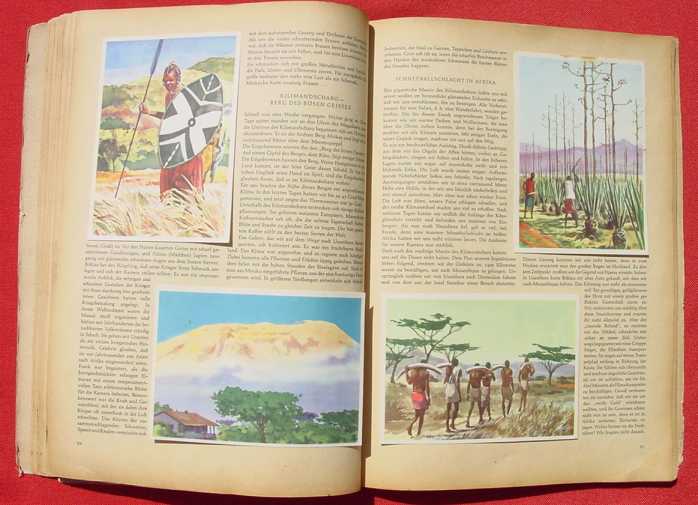
Butter was still expensive in the mid-fifties. Many households therefore were using margarine made of vegetable oil as an alternative to butter. One of the major margarine manufacturers added picture cards in the size of a standard 4 by 6 in. photo to their packaging and encouraged customers through their advertising to collect them and eventually paste them into booklets available from the company for a small fee. These booklets contained text and additional drawings, maps and illustrations for the cards and when completed represented a veritable treasure trove in the geography of Germany and other countries. I eagerly collected these cards. Frau Welfelnberg made sure that I would get them, when she opened another margarine package. Since there were many doubles, I traded them like stamps with many like-minded friends in the neighborhood. Since I had no money to order the corresponding booklets, I sorted them by themes of my own creation and glued them together to make a roll of forty to fifty pictures. Out of a sturdy cardboard box I fashioned a miniature stage. I cut out a rectangle roughly the size of one picture, inserted a round wooden peg on the right side of the box to serve as a pick-up spool for the roll of colorful images that would slip through the rectangular viewing area one picture at a time.

Now it was time to invite all my friends together with their younger brothers and sisters for the show that would take place in the natural theater of the backyard. The children sat on the lawn, while I presented the pictures very close to them on a small table taken out of the house for the performance. I invented the accompanying story and presented it extemporaneously in the form of a travelogue. The slide presentation became an instant success. The spectators not yet spoiled by children’s TV shows wanted to see more episodes. To help me they gathered as many picture cards they could scrounge up at home. What a creative way on the part of the Sanella margarine company to get people to buy their product!

One evening, while I lay on my bed that was wedged between the walls of my tiny bedroom, I overheard a conversation between the young miller and his wife, whose names I have completely forgotten. I witnessed a most peculiar spat between husband and wife behind the wall that separated their bedroom from mine.

Wife: How do like my new dress?

Husband: It looks beautiful on you.

Wife: Don’t you think it is VERY beautiful?

Husband: It is beautiful, indeed.

Wife: Now, now, you must admit that it is VERY beautiful.

Husband: There is nothing to admit here. It is my honest opinion that the dress is beautiful.

Wife: But you must see that my dress, the dress I bought with my own money, is VERY beautiful.

Husband: Whether you or I paid for it has nothing to do with its beauty. That’s illogical, my dear!

Wife: Leave me alone with your logic. Don’t you want me to look VERY beautiful?

Husband: Indeed, indeed! I want to …

Wife: So then, why don’t you say that the dress looks VERY beautiful on me?

Husband: Because there is a difference between beautiful and very beautiful.

Wife: So what you’re saying is that I look less than very beautiful. Why don’t you come right out and say I look VERY ugly in my new dress.

The conversation went on for a long time and became more and more animated and vociferous, but suddenly and rather abruptly ended with the wife sobbing quite miserably and with the husband deciding that it would be wiser to add no more fuel to the heated argument. It was time for the couple to make peace. A few minutes later the not so quiet springs of the marital mattress announced that love had overcome their verbal sparring. I had often pondered about the meaning of this curious episode.

Four Seasons Journey Through Our Yard – Part III

Four Weeks Later – What a Difference!

You may wish to go back to the previous post that showed the difference of two weeks. What the pictures show below is the contrast between April 12 and May 12 in our yard. The next comparison will happen in a month, when we will be approaching the beginning of summer here in Fauquier, British Columbia.

set 1set 2set 4set 3set 5

On the very last picture you can see the blossoms of the Grafenstein apple trees, which we will harvest in September. They produce the biggest and sweetest apples in the Kootenays. The only drawback is that they don’t keep too long. If all goes well with the weather this year, we will have a bumper crop.

Heart Creek Culvert in Fauquier Soon to be Replaced by a Bridge

Fish Enhancement Project on Heart Creek in Fauquier Gets Go-ahead

by Jan McMurray

Reprinted with kind permission by http://www.valleyvoice.ca

A project to eliminate a fish barrier at the mouth of Heart Creek in Fauquier is a go for this year. A large culvert will he replaced with a bridge, hopefully by the end of October.

Photo of Heart Creek Culvert on Highway 6 by Peter Klopp

Photo of Heart Creek Culvert on Highway 6 by Peter Klopp

“The fish want to go up that stream to spawn, but that culvert must be a six-foot jump,” said Hank Scown, president of the Nakusp Rod and Gun Club. “It’s an impossible height for those fish to leap up and get into the culvert.”

The Ministry of Transportation has partnered with the Nakusp Rod and Gun Club, the Fish and Wildlife Compensation Program, and the Department of Fisheries and Oceans through its Recreational Fisheries Conservation Partnership Program, to fund the project.

Scown says there are kokanee, Rainbow trout, and probably Dolly Varden that will spawn in Heart Creek once the culvert is replaced. “Every fish that spawns means potentially many fertilized eggs and more fish that enter the Arrow Lakes,” he said.

Phase two of the project, which Scown says will happen in the “not too distant future,” will see the removal of a second culvert further upstream, opening up an additional 1.2 kilometres of stream habitat for fish.’s

Scown says that if this project proves to be beneficial to fish, “perhaps other systems along the Arrow can be assisted in a similar way. If a creek can naturally produce fish, we should be allowing that to happen.”

He points out that human beings like to manage nature, but it’s been shown over and over that we can’t. “All spawning channels have proven that,” he said. “When things go bad, all your eggs are in one basket.”

Scown said the Nakusp Rod and Gun Club has been wanting to do something about the fish barriers on Heart Creek for a long time. He believes the culverts were installed back in the late 1960’s, when the highway was realigned to accommodate the flooding of the Arrow Lakes and the construction of the High Arrow Dam at Castlegar.

Let us hope that the Fish Enhancement Project will become reality at the Heart Creek in Fauquier, BC.

Gerhard Kegler, the German general, who dared to disobey Himmler – Part I

A Brief Overview of Gerhard Kegler’s Education and Military Background

1898 – 1986 (Chart II a – II)

On January 26, 1898, Gerhard Kegler was born in Grünewald, Pomerania (Province of Germany until 1945). Posts on his three older siblings Marie, Günther, and Gertrud can be found in the archives of this blog. They show how the children of Pastor Carl Kegler and his wife Elisabeth had a happy childhood in the small Pomeranian community of Grünewald. Also the third chapter of the P. and G. Klopp Story has more information on the Kegler family background, which therefore need not be repeated here. Like his brother Günther, Gerhard began his military career as a cadet in 1908. The outline of his comet-like rise in the ranks of the German army follows below.

  • 1904 -1908 Elementary School at Grünewald
  • 1908 – 1914 Military Academy at Plön
  • 1914 – 1917 Military Academy at Groß-Lichterfelde
  • March 1, 1917 Officer Cadet at the 149th Infantry Regiment in Schneidemühl
  • September 1917 On the Western Front at Champagne and Argonne
  • November 1, 1917 Lieutenant
  • 1918 Participated in the last major German offensive of World War I
  • 1919 – 1920 Border Patrol at the section between Schneidemühl and Bromberg
  • End of November 1920  Transfer to the 4th infantry regiment of the newly created army, which was limited by the Treaty of Versailles to 100,000 men
  • 1921 – 1922 Officer’s training in Munich
  • 1924 Teacher at the Officer’s Sports Training School in Berlin
  • 1925 Promoted to the rank of first lieutenant
  • 1926 – 1929 Trainer and Sports Teacher at the Infantry School in Dresden
  • 1929 – 1933 Leader of military courses for officers’ trainees in Berlin and Dresden
  • March 1, 1933 Advanced to the rank of captain
  • 1933 – 1934 In charge of the 11th Infantry Regiment 9 at Spandau
  • 1934 – 1938 In charge of the 3rd MG Battalion 8 at Züllichau
  • 1937 Promoted to the rank of major
  • 1938 Teacher at the Military Academy in Munich
  • 1939 At the beginning of World War II Battalion commander in the Infantry Regiment 282 of the 98th Division at the Western Front
  • 1940 Commander of Infantry Battalion in Training at Kreuznach; front-line duty in the attack on the French Maginot line in the Vosges Mountains
  • November 1, 1940 Commander of the Infantry Regiment  27 and promoted to the rank of lieutenant-colonel
  • 1941 – 1944 Invasion of the Soviet Union
  • February 1942 Promoted to the rank of colonel
  • October 1, 1944 Promoted to the rank of major-general
Gerhard Kegler on a Visit at Gutfelde 1944

Gerhard Kegler on a Visit at Gutfelde 1944 (the tall person in the middle)

In February 1945, Gerhard Kegler was condemned to death after being court-martialed for disobeying Himmler’s orders to defend the town of Landsberg on the River Warthe. The following posts will deal with the circumstances leading up to this terror verdict and will hopefully contribute to dispel the myth about all German officers blindly following the Nazi Regime without any moral backbone.

To be continued

A Salute to Marie-Louise Klopp, a Courageous and Fiercely Independent Woman

Midwife Marie-Louise Klopp (1880 – 1924)

Adapted from Eberhard Klopp’s Family Chronicle – Chart I – II

In response to her mother’s endless disturbing attacks, Marie-Louise told her with an oath, “I am going to move with my family so far away that you cannot visit and bother me any more.” She resolutely converted this intention into reality. The former seamstress took up nurses’ training at the Wolmirstedt hospital to become a qualified midwife. Even against this career choice her mother voiced her opposition, although Marie-Louise after 12 years of marriage has been out of her parental home for such a long time. According to her mother’s distorted and overheated fantasies, Marie-Louise was entering a field that somehow was connected to the world of the ‘wise women’ and ‘witches’ of the Middle Ages. Indeed, according to her opinion, this was an evil consequence of her daughter marrying into the Jewish Klopp clan. From this point on, the few remaining family connections broke off all together.

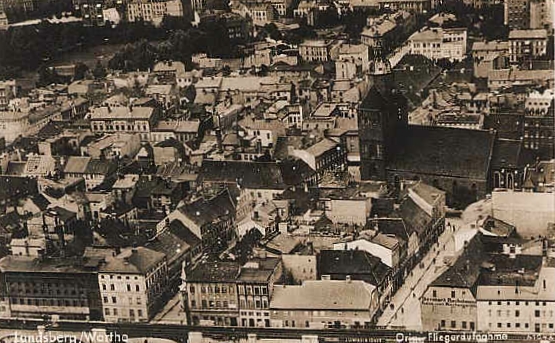
Gardelegen - Photo Credit: scrapbookpages.com

Gardelegen – Photo Credit: scrapbookpages.com

Marie-Louise started her work as midwife in 1912 in Algenstedt, north of Gardelegen, where the family had acquired a house at the outskirts of the village. Friedrich found employment as mason or rather as laborer here and in the neighboring towns and villages. Marie-Louise, by having chosen the profession of midwifery, displayed in this male-dominated world a high degree of personal independence. Her work proved to be highly useful in the following years, especially during World War I. While her husband Friedrich was fighting in the war, she became the major bread earner of the family of four children. Fortunately Friedrich returned unharmed from the war. In 1921/22 he got together with his brother-in-law August Diesing (1875-1939) to prepare for a construction business. The plan was to acquire an older, unused school building close to Gommern by putting in a bid for that property. The devaluation of money and the collapse of the German economy put a quick end to their dream.

Gommern - Photo Credit: wasserburg-zu-gommern.de

Gommern – Photo Credit: wasserburg-zu-gommern.de

On the other hand, from 1912 and 1924, his wife Marie-Louise built up an excellent reputation for being a competent and reliable midwife in the towns, villages and farms north of Gardelegen. Unheard of at a time, when men dominated the work place, she was the one in the Klopp family, who put bread and butter on the table. Her son Friedrich together with his siblings Liesbeth and Hermann attended the tiny one-room school at Algenstedt. The eldest sister Frieda took care of the younger siblings and general household duties during the frequent absences of their mother.

Jacob - Photo Credit: thefreequark.com

Jacob – Photo Credit: thefreequark.com

They all remembered the tame crow ‘Jacob’, which rain or shine sat on the bike’s mudguard of Mother Klopp and traveled along. In-between it would disappear in the long treed boulevards and waited there for her return. Hours later it would travel back with her to Algenstedt. One day a neighbor shot the poor crow, because it had pulled  the clothes pins off the wash line.

Night shifts, hardships, a weak physical constitution, last but not least, constantly recurring trouble with her mother brought about her premature death at the young age of 44. From the Zielitz family nobody showed up for the funeral of their ‘Jewish-affiliated’ daughter.

Hiking in the Spring – Part III

A Spring Walk around Fauquier, BC

 In February I tried very hard to show beauty on a foggy and drizzly day. But this time in the middle of a gorgeous spring, I don’t even have to try. Nature has fully sprung into action. With its dandelion-speckled meadows, the fragrance of apple blossoms in the air, birds twittering in the cedar trees,  with its glorious presence Nature is creating a more joyful mood. Today I suggest a more leisurely walk around our beautiful community. If you take the time to stop often to look at the landscape and listen to the birds chant their cheerful songs, you will need about 40 minutes to complete the loop.

IMG_1047

Google Earth Map of Fauquier with the red dot marking the starting and end point of the walk around the loop

01We start our walk at the General Store, where a bed of tulips adds color to the country store.

02Going west on the commercial street, we walk past a colonnade of trees.

03At the motel we turn left and begin a gentle climb.

05The St. John the Baptist Church looks beautiful any time of the year, but especially now in springtime.

06There is hardly a house in Fauquier that does not have trees and shrubs to beautify its yard.

10The trees have grown so tall you cannot see our house on Google Earth any more.

12A neighbor farther up the hill is completed surrounded by shrubs and trees.

13After you have reached this large property on the left at the top of the loop, the road begins to level off.

14Now it is going downhill with a wonderful view of the Arrow Lake down in the valley.

15You walk alongside a murmuring brook, where the first shoots of wild mint are emerging from the water.

17Turning around under a flowering chestnut tree, you look back on the hillside road you’ve just come from.

18Turning into the opposite direction, you see the Fauquier Elementary School, where I have been teaching from 1976 to 2000. It is now closed and houses the Fauquier Communication Centre.

19You now cross Highway 6 and savor the fantastic view of the lake across the Fauquier golf course.

20Taking the pathway parallel to the highway, you complete the loop by going past the club house.