Chapter IX of The P. and G. Klopp Story – Part VI

Of Crime and Punishment

During the second half the school year Frau Stoll gave birth to a baby boy. With his arrival came also a dramatic change in my relationship with the Stoll family. Had I experienced until then a semblance of acceptance as being part of the family, I now felt completely out-of-place. I had become a nuisance, an irritant, a foreign obstacle that needed to be brushed aside to make room in their home and hearts for their newborn son. Old grandma Stoll with her gigantic, trumpet-like hearing aid pretended not to hear me anymore. Frau Stoll was now occupied with her own child and had no time to bring some cheer into my heart. Herr Stoll’s attitude towards me became more and more critical on everything that in his view was unacceptable behavior. He was meting out harsh punishments for my tardiness at suppertime. I had no watch and being a dreamer I easily lost track of time. He also spanked me harder and more frequently for associating with the ‘wrong’ friends.
messkirch_1

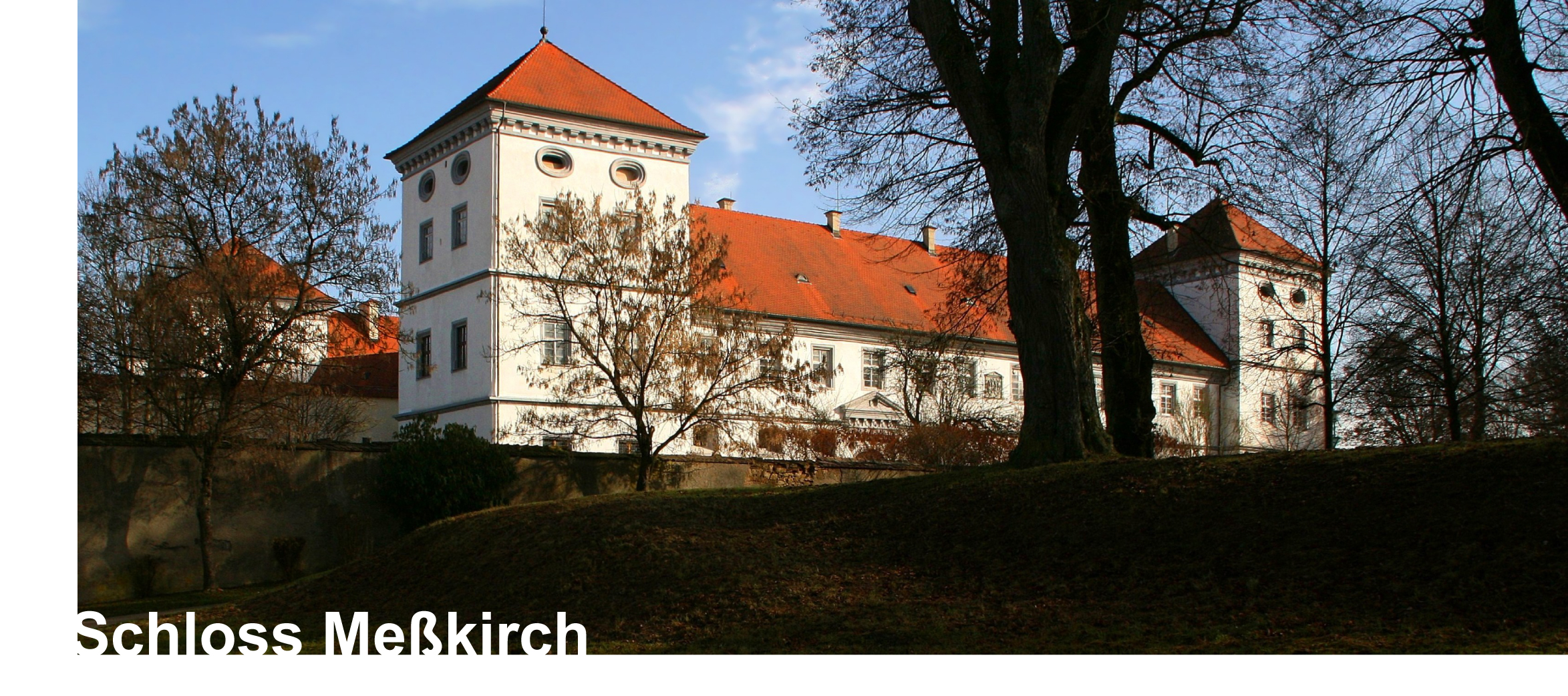
Castle and Park in Messkirch – Photo Credit: schloesser-bawue.de

Toughened up by the frequent spankings I often took on the role of the victim in the ‘Cowboys and Indians’ games I played with my friends in the beautiful park of the Messkirch castle. On one occasion I allowed myself to be captured and tied with ropes onto a tree. In a bizarre combination of fun and cruelty the ‘Indians’ were howling and dancing around the tree taking turns at punching me in a ritual of crime and punishment. Later on when they had released me, they praised me as their hero for so stoically and silently taking their punches. I delighted in their accolades. The role of the cooperative sufferer with real life experience in the domain of pain suited me well. However, its enjoyment was indicative of a character warped by the loveless and punitive atmosphere in the carpenter’s household.
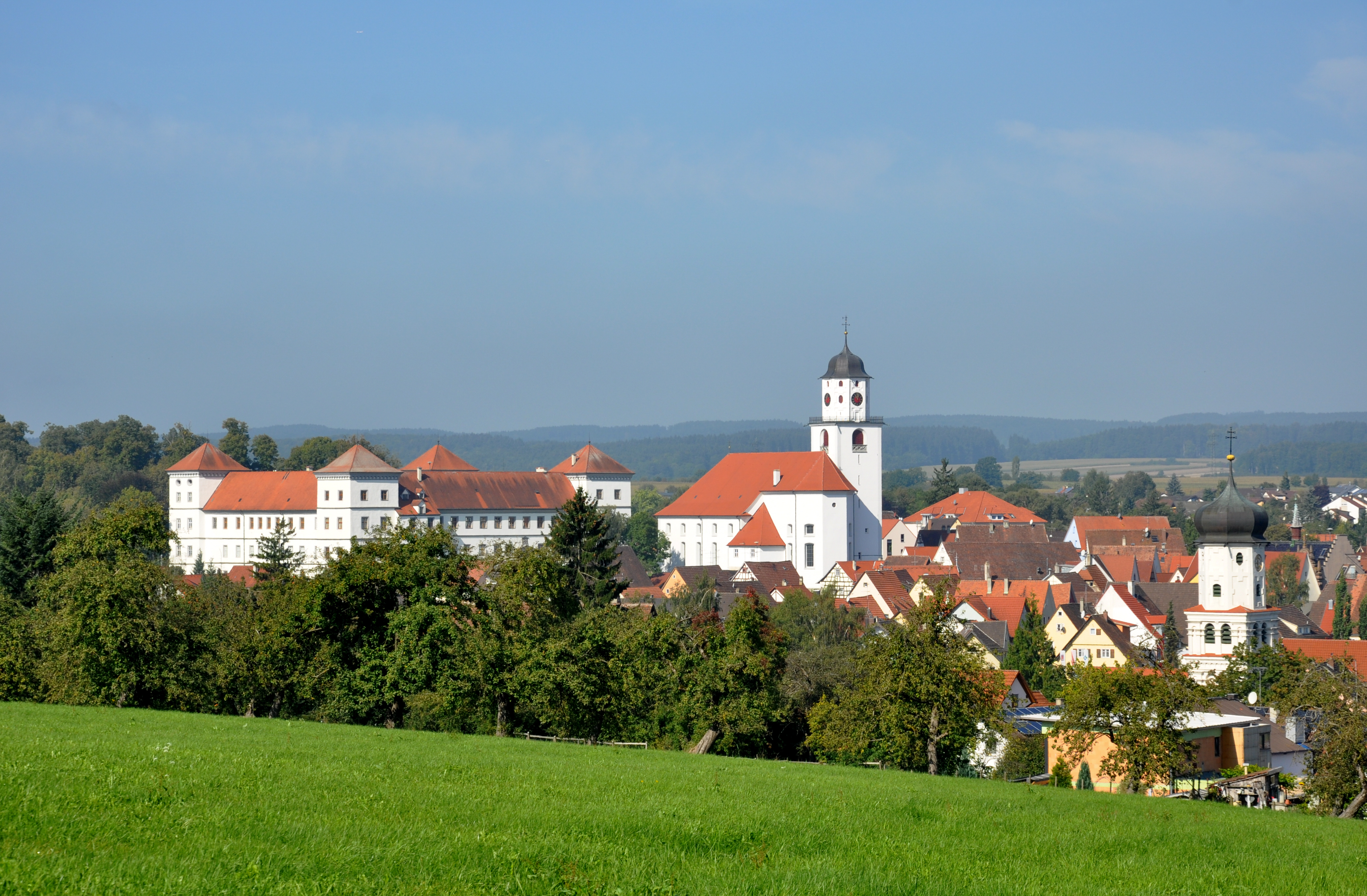
Castle and Park in Messkirch - Photo Credit: schloesser-bawue.de

Messkirch – Photo Credit: schloesser-bawue.de

One rainy afternoon I had to stay indoors after school and spent time at the carpenter’s shop downstairs. Herr Stoll and his three apprentices had been working on various woodworking projects. I was standing next to the first-year apprentice at the very front of the workshop. He had taken a liking to me and often found time to chat with me. It was near closing time. While the young man was cleaning up his workplace, I teased him by hiding his plane he been working with just a few minutes before. The young man was puzzled by its sudden disappearance. While he searched for it, Herr Stoll like a raging bull came racing down the aisle. Without giving a simple word of explanation he grabbed me by the neck and dragged me to the back of the workshop, where he beat me in his furious anger, slapped me in the face, banged me around and threshed my behind. When my cries had turned into a mere whimper and then into silence, Herr Stoll decided that the first part of my punishment had been successfully completed. Nearby was a small storage room for plywood and other wood products. That’s where he threw me for the second installment of my punishment for distracting the apprentice from his all-important clean-up job. I sat on the bare floor aching all over. For how long I sat there I cannot remember. In the darkness of the storage room I contemplated on the crime I had committed against one of my master’s employee. I was still stunned by the traumatic experience, when after a very long time the door of my prison cell opened and the bright outside light made my eyes squint. The shadowy silhouettes of Herr and Frau Stoll like phantoms of the netherworld were looming in front of me. Looking down on this miserable human bundle, Frau Stoll glanced at me as if expecting a word of apology for my misbehavior. Wondering about my silence she remarked to her husband, “Look how guilty he must feel. He is not saying anything at all.”

From this time on I was desperately thinking of escape. Anxiety about this horrific life and homesickness often drove me to the balcony on the north side of the building. There I stretched out my arms towards my home village Rohrdorf as if to invoke some magical force to rescue me from this intolerable situation. But there was no rescue and no home to flee to. The Klopp family once so miraculously reunited was beginning to show signs of disintegration. The failure of the farming venture resulted in a debt load that created a lot stress. Father suffered under long episodes of backaches. From time to time he found temporary employment in the village, while Mother worked hard in a household in the town of Sigmaringen to make ends meet. Karl had gone to Göttingen to study economics. Adolf, who had worked at the Bizerba factory in Messkirch, emigrated to Canada in 1953. He was tired of handing over all his hard-earned money to cover family expenses. Eka (Lavana) had begun her nurses’ training in Hamburg and Gerry had moved to Switzerland to enter a toolmaker’s apprenticeship program. By looking back at the extended periods of separation between Father and Mother I am sure that their relationship was already greatly strained. At the time when I was desperately yearning for the comfort of an intact home, it had ceased to exist.
Chapter IX of The P. and G. Klopp Story – Part V

Of Caves and Bear Skeletons in the Swabian Alb

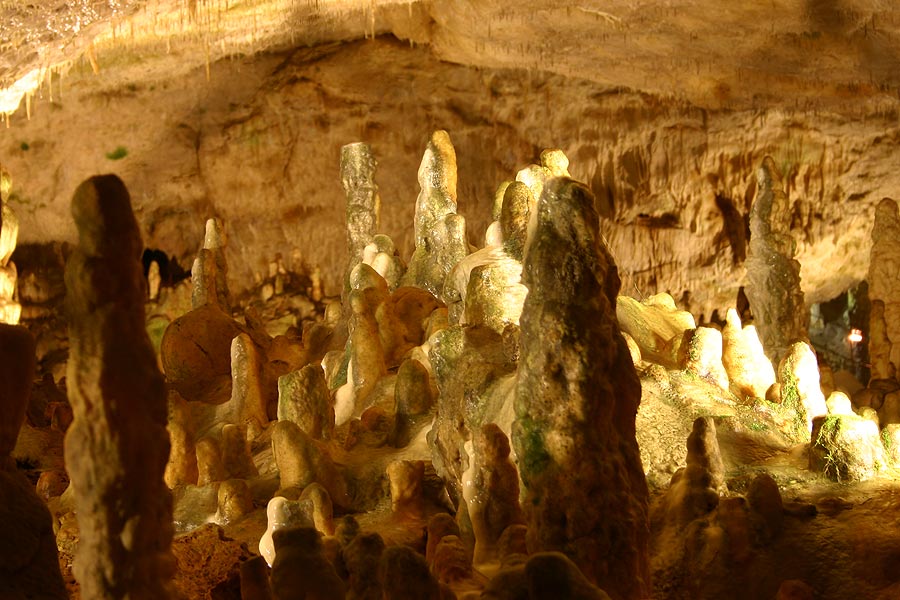
 At school we were looking forward to our first major field trip. We were going to see one of the great natural wonders, the Bährenhöhle (Bears Cave), a complex cave system located in the Swabian Alb north of the River Danube. Fräulein Welte explained to the eagerly listening class how it had been discovered quite by chance in 1834.

Bear Cave - Photo Credit: fotocommunity.de

Bear Cave – Photo Credit: fotocommunity.de

“A local schoolteacher by the name of Fauth was gathering herbs and was digging for roots when he was startled to see some stones roll into a gap between two large boulders. To his surprise he heard them land at an incredible depth and to verify this he threw several more stones down. As he bent forward his tobacco box fell from his pocket into a small crevice at the edge of the drop. Gently, he removed a small stone but in doing so he dislodged the box so that it fell into the cave. Peering into the depths his surprise turned into horror when he saw a human skeleton!” Now Fräulein Welte had our full attention.

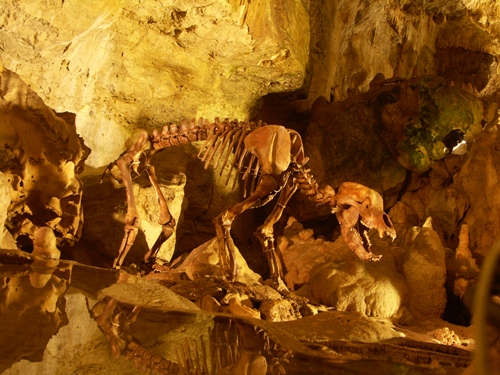
She continued, “The following day he returned to the hole with several friends and the necessary ropes. He was soon lowered into the cave and his friends quickly joined him. In the glimmering light of their candles the more they saw, the greater was their amazement. The floor of the chamber was covered with human and animal skeletons. However, their passage was blocked by a great number of stalagmite formations. When they left the cave, they each took with them bones and stalagmites as proof of their discovery.

Bear Skeleton - Photo Credit: geopark-alb.de

Bear Skeleton – Photo Credit: geopark-alb.de

After the first exploration the news of their discovery spread. People from the surrounding villages came to visit the cave and nearly all the bones and formations were either destroyed or carried away. A report was made to the Royal Administration and the cave was placed under their supervision. In order to provide better access to the cave, a hole was dug at the western end. This proved quite practical as the cave at this point consisted of clay and boulders of Jurassic limestone, indicating that there had been an entrance here at earlier times, although it was probably blocked with glacial debris after the last ice age. The short excavated passage still leads to the First Chamber. Beneath “Fauthsloch”, the opening named after the teacher, there used to be a large mound of debris about 5 m high containing 50 skeletons of the Plague, together with the bones of horse, cow, pig, sheep, dog, polecat and hare. Evidence in the form of flints has also been found in this chamber proving that early man used this cave at the time of the Reindeer Hunters.”

I put this account into my teacher’s mouth. I gleaned the details of the cave’s discovery from the Internet. However, I remember the buzz and excitement of our class when Fräulein Welte gave us the introduction to one of the most remarkable caves in the world. How eager we were to learn about basic geology, the formation of these awe-inspiring caves, the origin of the bones, the story of early man, the difference between stalagmites and stalactites!

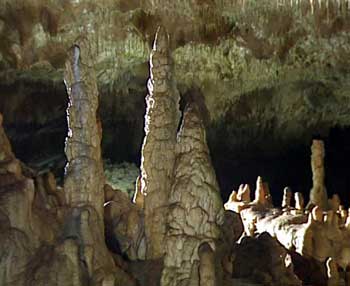
Stalagmites in the Bear Cave - Photo Credit: koestlichesdeutschland.de

Stalagmites in the Bear Cave – Photo Credit: koestlichesdeutschland.de

I recalled many of the details of our field trip so well that later on as teacher of the Fauquier Elementary School I often shared my impressions with my students when I took Europe as an option in our Social Studies program. There were seven chambers in all that we walked through during our field trip. The first thing we noticed was the large boulder that at one point must have fallen from the ceiling. A stalagmite growing on it indicated that this happened a long time ago. Scientists had discovered nearby an ancient fireplace. Here a large amount of wood-charcoal was found together with the bones of deer and pig, further evidence that early man lived in this cave. The Fifth Chamber, where the highlight was the large stalagmite called “The Peak”, which had a slender stalactite above it, attracted a lot of attention. The Sixth Chamber was the most beautiful in the old cave, being 15 m high and 20 m wide. This chamber is also called “The Old Cave Bear Cavern” for it was here that most of the Bear remains, skulls, bones, etc. were found. I remember this particular field trip as one that had kindled in me a lifelong interest in geology and anthropology.

Four Seasons Journey Through Our Yard – Part II

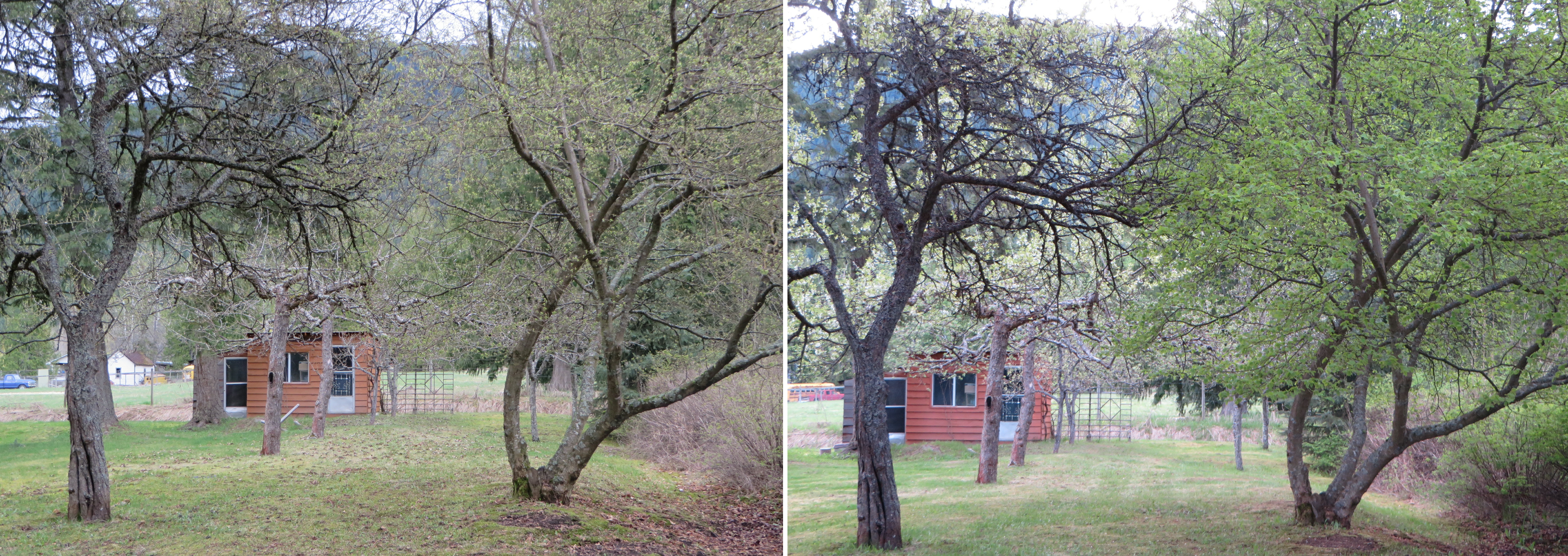
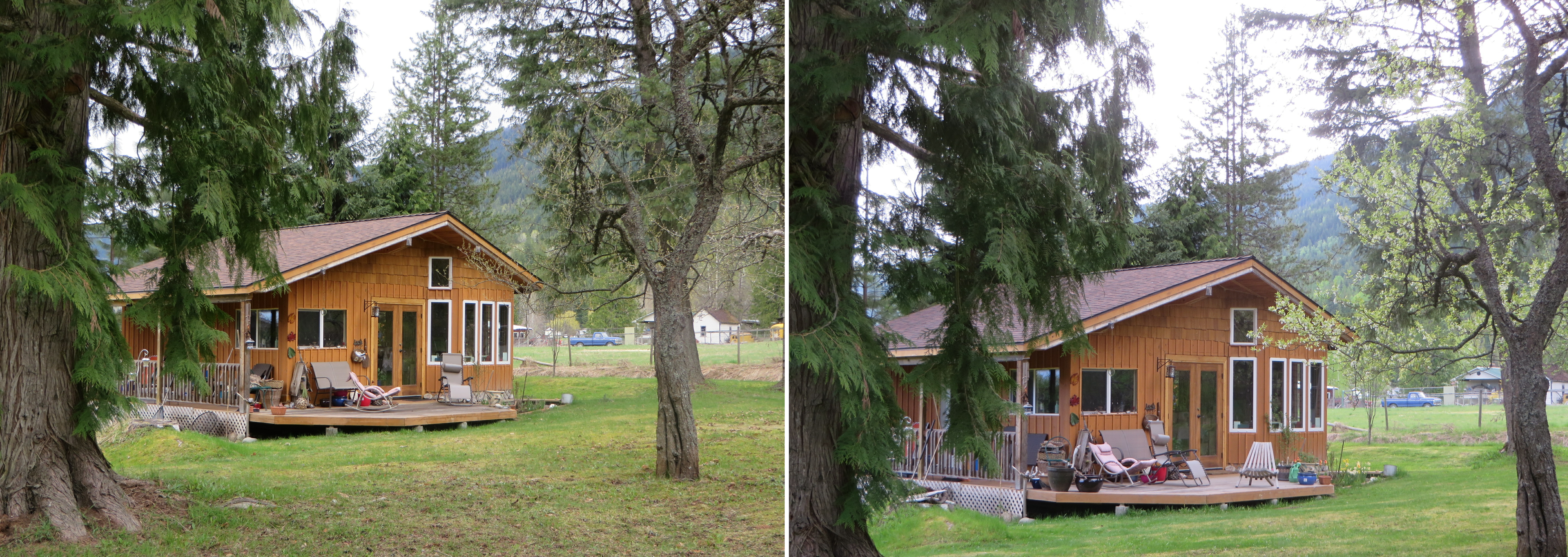
Two Weeks Later – What a Difference!

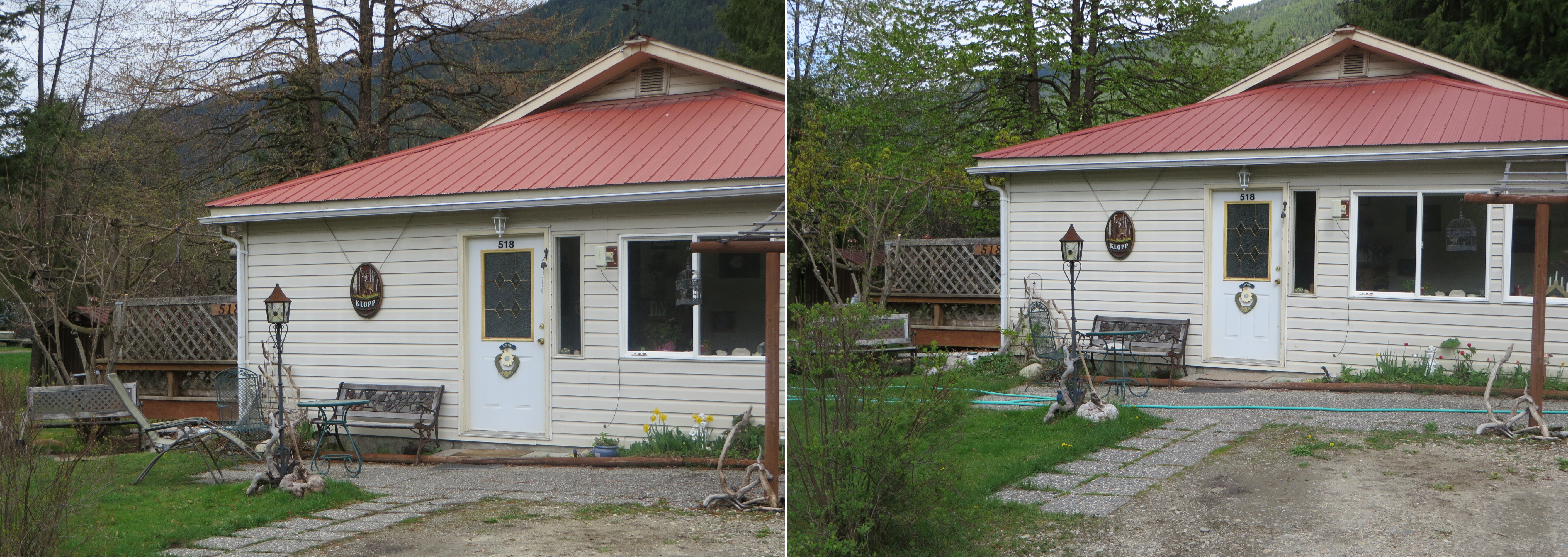
FrontNot too much change is noticeable here except for the greening of the little bush on the left. The tulips in front of the house are gradually replacing the daffodils.

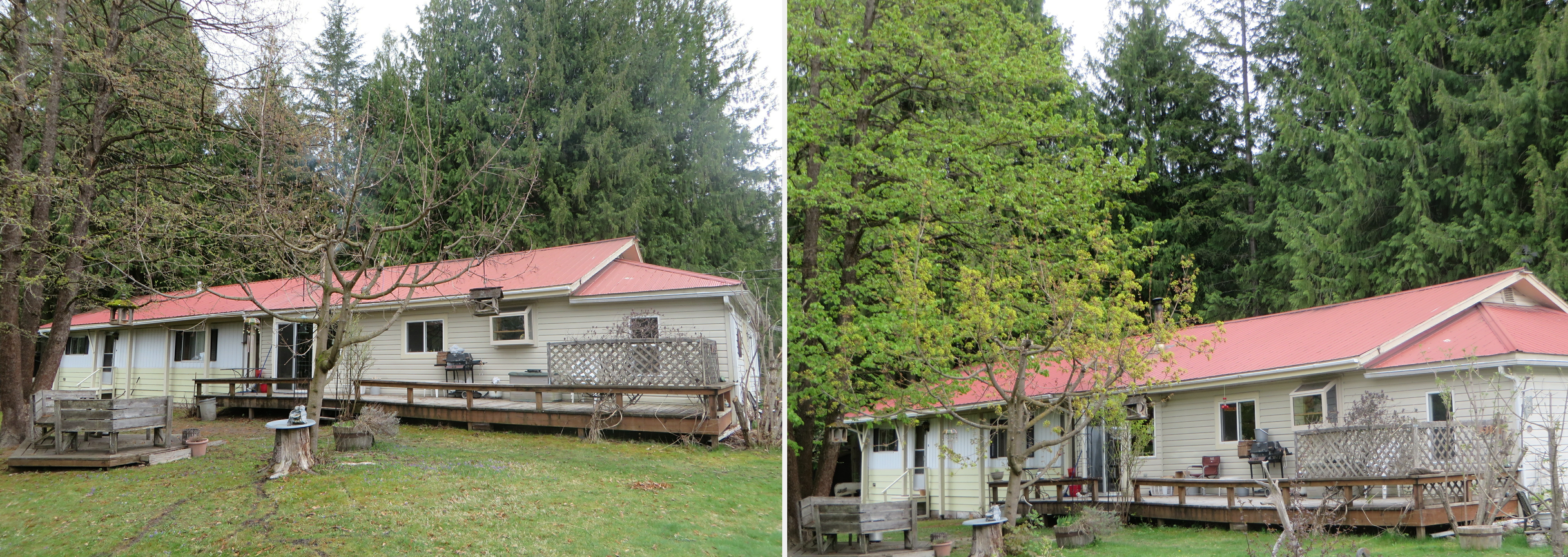
Side ViewOn the wild hazelnut and maple trees the tender light-green foliage – two weeks ago barely visible – is becoming dense and is preparing to provide shade for the summer.

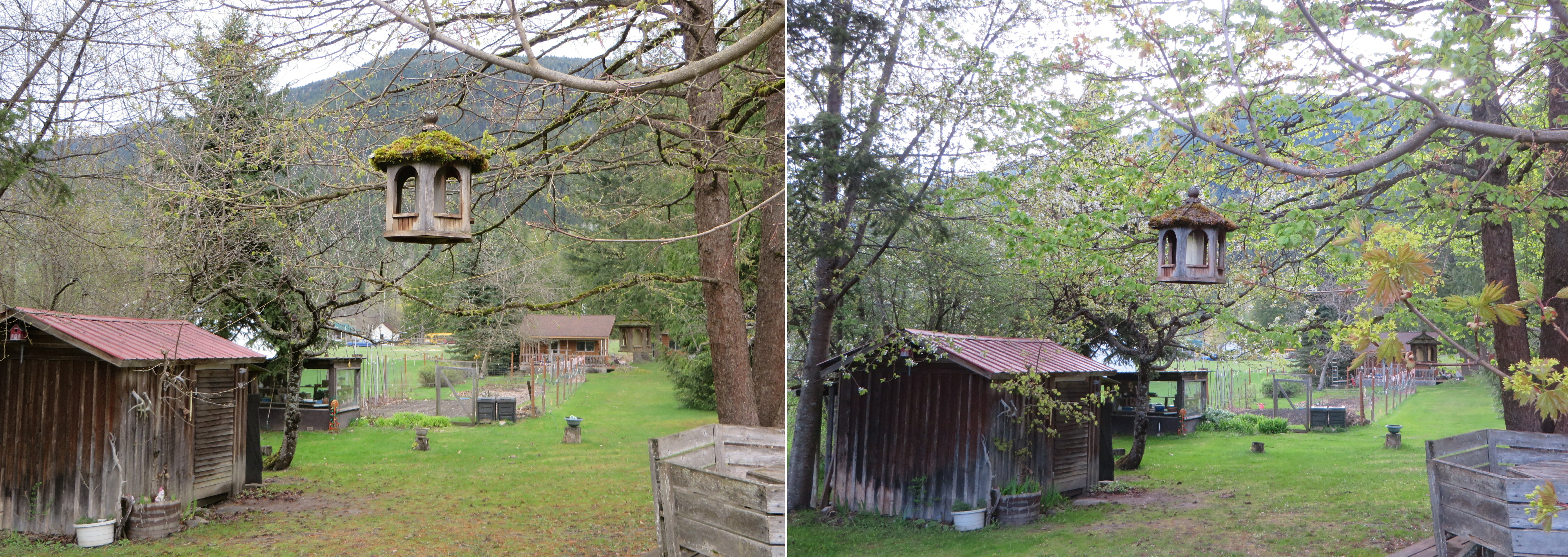
shedThe cherry tree behind the shed is beginning to show off its white flowery dress, while the plowed garden plot in the background is still waiting to be planted. Frost is still a menace at the beginning of May.

orchardIn our mini orchard the filbert bush is no longer bare, while the apple and pear trees seem to say, ‘Just wait ten more days and we will put our splendid aromatic blossoms on display.’

StudioOnly sharp eyes will detect the rich colors of the tulips. But the plum tree, which produces the biggest, roundest, and juiciest fruits in the fall, clearly marks  the difference  of two weeks with its blossoms.

The Rise and Fall of the F. Klopp Rope Making Enterprise

The Collapse of the Wolmirstedt Business Venture

Adapted and translated from Eberhard Klopp’s Family Chronicle

Chart I – II

Within five years the Klopp and Weihe families had added amongst and against each other so many wounds that only after a century one can look at them with a certain emotional detachment. They should not remain the last ones. Within the course of one generation, the two families had drifted apart and  the deep gulf of enmity between them was steadily widening. In the Weihe family the daughter did no longer communicate with her mother, in the Klopp family mother, brothers, sisters no longer with Emma’s eldest son. In the Klopp/Weihe family – no longer worth being called a family – all members completely acted out their mutual dislikes emerging out of the most varied and unlikely causes.

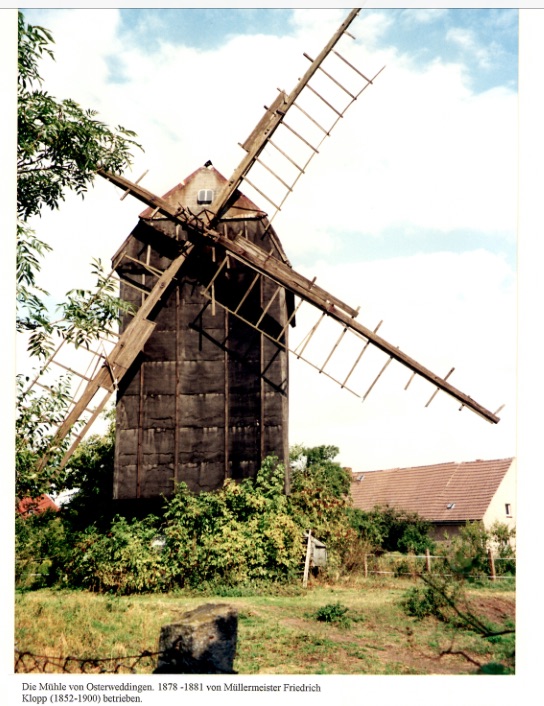
Windmill

The mill my grandfather Peter Friedrich Klopp owned and operated is now a German heritage site.

In the Klopp house in Wolmirstedt Friedrich devoted all his energies to the business. For the boat people on the River Ohre he produces ropes and cords, which the rope manufacturing plant ‘Seilerei von Friedrich Klopp’ kept ready for his costumers. Furthermore, he acquired a piece of land with a workshop south of the Ohre bridge on the right side on the road to Elbeu. There Friedrich and his workers twisted hemp fiber into ropes, The length of the ‘rope course’ was 15 m. In front of the bridge ramp the last house on the left at the Magdeburg Str. was the inn ‘At the Anchor’ (Zum Anker). It served as the meeting place for the Ohre boaters and was strategically located only 40 m from Friedrich’s factory and residence. Diagonally across stood ‘Fatje’s Hotel’, which served as a kind of exchange agency for goods and services, where the Wolmirstedt business elite would do their trading transactions. At the business table would often sit among other dignitaries Carl Loß (1865 – 1937), owner of a nobleman’s estate and of the largest sugar and starch factory of the region. Through him Friedrich primarily sold his various rope products. Ropes and nets were very useful and much-needed during harvest time. In order to secure the safe transport of sugar beets on the horse-drawn wagons they found much use in the Loß’s agricultural enterprise.

In these years 1907 and 1908 two more children were born to the Friedrich Klopp family. Under slowly deteriorating economic conditions Friedrich managed to provide food and shelter for his growing family until 1912, when he gave up his business. The steady decline of shipping  on the Ohre River reduced the profitability of his business. The taking down of the old wooden Hindenburg Bridge in 1908 and the long wait for the construction of the new stone bridge cut off Friedrich’s access to the market, further diminishing his already declining business. Add to these problems new attempts by his brother Ferdinand to seize house and business and we find the perfect recipe for financial ruin and disaster.

To be continued ….

Like-minded People of Applegrove Road – Conclusion

A BRIEF HISTORY OF APPLEGROVE ROAD

By late Bill Laux

In 1969 Elsje De Boer and her husband from Calgary bought the old Aspinall place at the Fauquier end of Applegrove Road. Starting in 1976 they used it for summer outings. The following year Elsje had Bill Jeffries build a sleeping cabin on the place. In 1987 her son built her a permanent house and after Jim Huth and Bill Laux completed the interior finishing, she moved in.

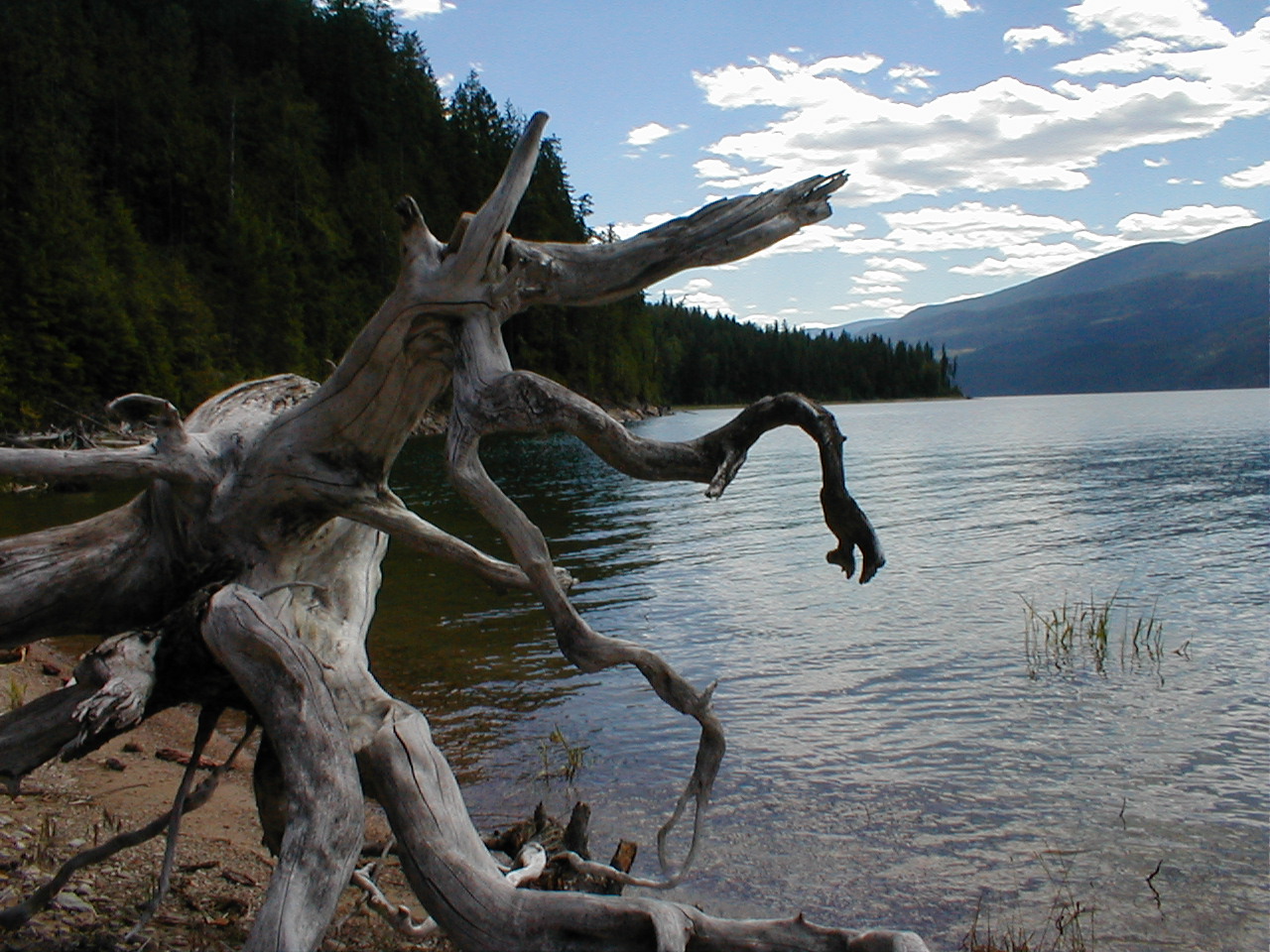
The Arrow Lake that attracted Like-Minded People on Applegrove Road

The Arrow Lake that attracted Like-Minded People on Applegrove Road

In 1979 Robin and Dorothy Huth, from Calgary, with the Madills and Stevensons were able to buy lakefront lot 8099 from Weinberg, a Portland, Oregon real estate speculator. This man had for years had an agent in Victoria instructed to put a $50 bid on every piece of waterfront property in British Columbia that came up for Tax Sale. By the time of the dam construction in 1967 it turned out that he owned between 100 and 200 properties on Arrow Lake. Robin Huth and his son, Jim, were able to put in a steep, many switch backed road to access it from Applegrove Road. In 1980 Jim and Rae Ann Huth built a lakefront cabin at the foot of this road and moved in. Jim began building his parents a house nearby. The Madills, rejecting the difficulties of the access road, bought in Fauquier instead. The Stevensons went to New Zealand.

Eric Arnold, a millwright from Squamish, bought lakeshore lot 8098, probably from Weinberg, about this time and built a small house on float logs, which he moored at the lakeshore. Unfortunately, a storm the next year wrecked the unprotected structure. His wife was not comfortable in so isolated a location, so the Arnolds left.

Jim and Rae Ann Huth left about 1990 for Vancouver Island and Robin and Dorothy lived in happy near-seclusion in their lakeshore home until medical problems required a move to Salmon Arm. They sold it as a retirement property to a German couple, Sabine and Karl-Heinz Mocikat, about 2000. Jim and Rae Ann’s cabin was rebuilt to a house by Bob and Monique Gellatly, an Ontario couple, who lived there for a few years, while he worked locally as a plumber. It was later bought as a summer place by Borowski, an engineer from Calgary, who is building a second house on it,

The first telephone line came up Applegrove Road in 1979 and BC

Hydro followed when the Burmeisters from Germany bought the Bruner place from Peter Makar’s wife in 1990. They had the lovely “cedar tunnel,” a true scenic treasure, felled on the lower part of the Applegrove Road and hydro poles run into their place. The Burmeisters set up resort accommodations down on the lake and operate as Kokanee Bay Resort and Farm.

In 1994 the Hydro lines were extended up Applegrove Road to Glasheens, Nila Campbell an4 Eichenauers. Jimmi Mead stuck with her solar power as she still does.

Lillian Liberty bought part of the old Sherwood property next to Lee Helle in 1989 and had a house built with a magnificent view of the lake below and Edgewood opposite. Like many earlier Applegrove residents she depends on solar and water power for electricity.

View from Taite Creek South to Helle's Lakeshore Propery

View from Taite Creek South to Helle’s Lakeshore Propery

In 1994 the Highways Department was still insisting on calling and signing Applegrove Road as “Fauquier Upper Road,” a vague and meaningless name. Bill Laux, having got agreement from all the landholders along the road, petitioned Highways for a change of name, as the Applegrove Site was still Iisted on B.C. Government maps. On November 23,1994, Highways conceded, and “Fauquier Upper Road” became officially “Applegrove Road” and was so signed.

Hydro power was extended from Burmeisters to Bumpus and Laux in 1996 and the days of kerosene lamps, carrying messages to town by horseback and noisy diesel generators were now over for them.

A new couple, Marney and Zane Kushniryk bought Nila Campell’s “Retreat Centre” in 1999 and moved in the next year to build two unique and secluded rental cabins as a source of income.

Ken and Denise Douglas arrived about the same time, buying one of the Haugland lots above Elsje De Boer’s.

Canadians, Americans, Germans, Dutch, there is still a strong and unique degree of like-mindedness among most of the residents of Applegrove Road. For nearly a hundred years the dusty road to Taite Creek and beyond has supported a succession of groups of homesteaders, communitarians and others eager to invent their own ways of living. They value the area for what it is, an unspoiled and undeveloped area of mountain slope and lakefront, whose residents still grow much of their food and live as their convictions have told them they must.

Salute to Günther Kegler (1894 – 1986) Chart II a II

Günther Kegler was a true patriot who dearly loved his fatherland. Historians made many attempts to trace back the causes of the two World Wars. By doing so they put the blame on Prussia. This German state with its military might was the driving force behind Germany’s first unification after the French-German War in 1871. To single out Prussia as being the root cause for the great wars of the 20th century is a gross oversimplification of history. It totally ignores the injustice done by the Treaty of Versailles, which imposed through its harsh economic measures incredible hardships on the German population. Thus, it created among millions of unemployed workers a fertile breeding ground for the radical ideas promoted by the Nazis, which were swept to power in 1933. There is a lesson to be learned. Social injustice leads to widespread unrest and turmoil, which is often taken advantage of by demagogues, who will gain control with their promises to bring prosperity and set things right.

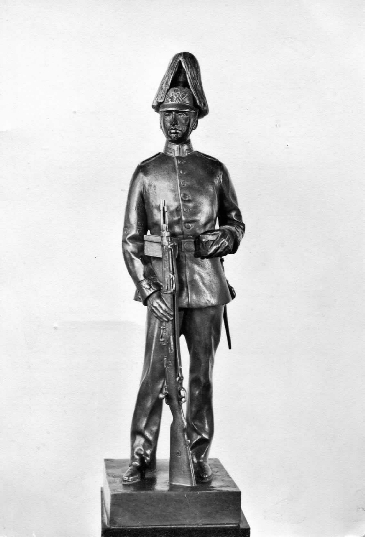
Prussian Cadet

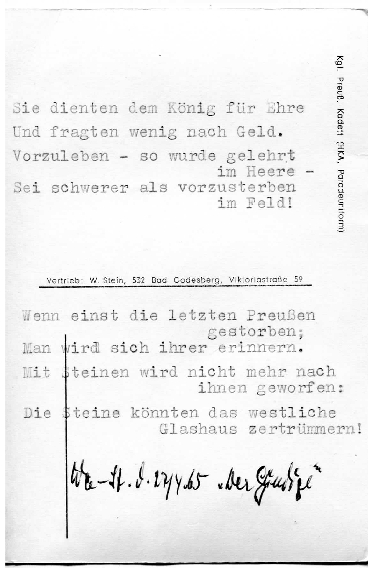
My uncle was deeply troubled by the prevailing historical claims in postwar Germany. They made the ideals of Prussia responsible for all the misery and horror of the two World Wars. When I immigrated to Canada in 1965, he gave me a postcard with a picture of a Prussian cadet and on the backside he typed a little poem, which I will attempt to translate into English.

Prussian Cadet Text

They served their king for honor

and did not much ask for money.

To live as model to follow – so it was taught in the army –

was more important than to die as hero in battle.

When one day the last Prussians have passed away;

One will remember them.

Stones will no longer be thrown at them:

The stones could shatter the Western glass house.

With these lines I conclude my report on my uncle. Looking at our present day world one might detect in them a somber warning, a prophecy perhaps we wish not to come true.