Chapter 23 of the Peter and Gertrud Klopp Story – Part II

Biene’s Visit to her Birthplace in Gotha

and her Vacation on the Island of Majorca, Spain

In the meantime Biene traveled to Gotha, where her half-sister Elsbeth and husband Paul Werner with their two children Norbert and Christian lived. Biene grew up in Gotha, until her parents and family escaped to West Germany. After a lengthy ordeal at the refugee camp in Aurich her parents eventually succeeded in receiving a decent apartment in Velbert.

Castle Friedenstein, Gotha - Photo Credit: thueringerschloesser.de

Castle Friedenstein, Gotha – Photo Credit: thueringerschloesser.de

Biene reported enthusiastically about her former home province Thuringia. They made many excursions into the surrounding area of Gotha, even visited the famous castle, the Warthburg, where Martin Luther within the safety of the massive walls translated the Bible into German. But what mattered most to Biene was that she and Elsbeth became close friends. They spent as much time as possible together.

While everyone was sound asleep, Elsbeth, twenty years her senior, would share her most precious memories with her. The two would often talk into the wee hours. Biene learned that Elsbeth loved to pen stories and even contemplated writing a book. After the wedding she was deeply saddened that her husband did not share her passion for writing. He was a very practical man with both feet on the ground and was focusing only on what had to be done to survive in the postwar communist society, where most basic consumer commodities were scarce. Paul ignored what was dearest to his young wife’s heart and treated with contempt what was in his eyes useless, sentimental tripe. He callously burned her entire portfolio of creative and much cherished writing leaving her nothing of her priceless collection except for a very few stories, which she managed to save from the senseless destruction. Their son Norbert kindly contributed for my blog one of her story in German entitled Sein Letzter Besuch (His Last Visit – Christmas 1942). Overall, Biene had spent a wonderful time at her birthplace, that quaint house and apartment, where little had changed, since Biene and her family had escaped from the socialist ‘paradise’ in 1954.

The House in Gotha - Biene's Birthplace

The House in Gotha – Biene’s Birthplace

Within barely a week upon her return to Velbert she was getting ready to fly with her friend Gisela to the Spanish Isle of Majorca. There in the company of other young girls and boys she enjoyed two relaxing weeks at the sandy beaches of the Mediterranean Sea. This was the first time Biene was allowed to travel alone without parental supervision. Her mother had always kept a watchful eye on her stunningly beautiful and romantically inclined daughter, who had given her in the past much grief with her dangerous, almost fateful attractiveness she exerted on her male admirers. But as it turned out, Biene returned home safe and sound, tanned by the southern sun so dark she could have easily been mistaken for a Spanish senorita.
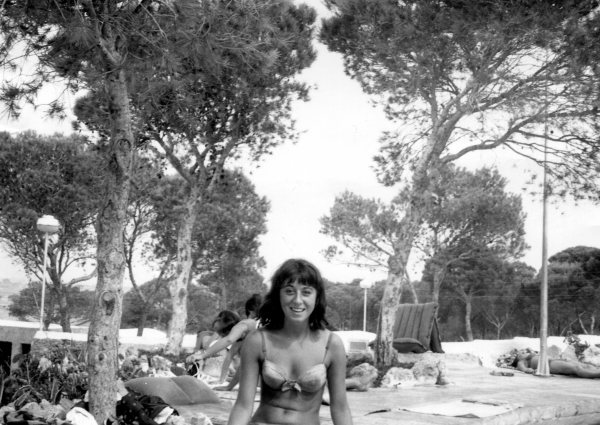
Biene on Vacation on Majorca Summer 1964

Biene on Vacation on Majorca Summer 1964

Apart from lounging at the beach and going swimming, Biene had once gone scuba diving in the crystal clear waters to explore the mysterious seascape, which gave her quite a thrill. However, as she soon discovered, diving and depending on the vital air supply from the oxygen tank on her back was not entirely without danger. While she took in the wonders of the strange world under the sea, the air supply suddenly dwindled forcing her to quickly surface. There was plenty of oxygen left in the tank. Perhaps Biene had put a kink into the connecting hose. Fortunately she had kept her cool and after being confronted with imminent danger did not panic. After this scary experience Biene decided that it was safer to stick with the more relaxing beach routine. Their flight back to Germany had been delayed by more than a day due to the loss of a plane, which the small tourist airline had suffered in a plane crash elsewhere. When they finally arrived in the dead of night at the Düsseldorf Airport, no busses were running any more to take them home. Biene and her friend were stranded. They were waiting at the dreary railroad station for the morning to come. Then a small miracle happened, which I let Biene describe in her own words.

Beach on Wild Coastline of Majorca - Photo Credit: wikipedia.org

Beach on Wild Coastline of Majorca – Photo Credit: wikipedia.org

          “In the bungalow village was also a young girl who was teased by all, especially by the boys. She was strutting about in an extravagant attire entirely too dressed up. Nobody liked her. I had only once exchanged a few words with her. When Gisela and I were now waiting at the station for the morning and had gone outside to catch a little bit of fresh air, she suddenly walked up to us. She knew that our plane had landed late. When she learned that our bus would arrive only in the early morning, she took us without hesitation to her place not far from the station. She gave us each a couch, where we totally exhausted slept until she woke us with coffee and buns. You wouldn’t believe how lovingly she cared for us. I had never before noticed so prominently how much one lets outer appearance deceive oneself. I was really stunned by such kindliness.”
Chapter 22 of the Peter and Gertrud Klopp Story – Part X

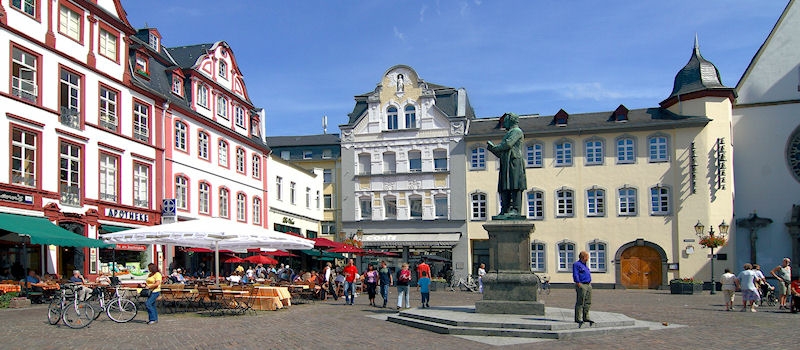
koblenz-altstadt

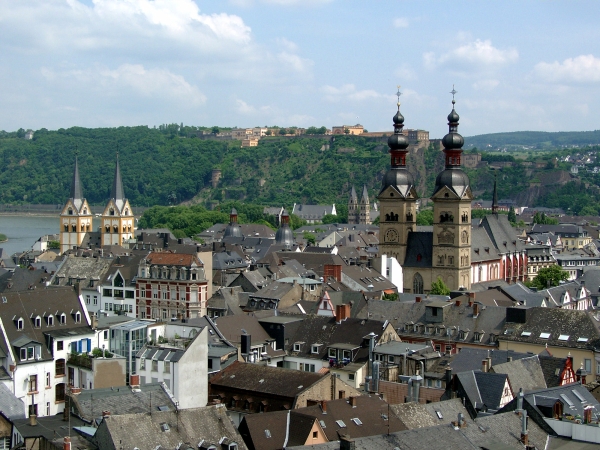
City of Koblenz – Photo Credit: Ferienwohnungen.de

Vittorio’s Entanglement in Sex, Love and Marriage

In our room there was a 17-year-old volunteer with the Italian sounding name Vittorio. At this tender age he was the youngest soldier in the signal corps. He had committed himself to a five-year service in the army and was obviously seeking a life long career with the Armed Forces. As a government employee in uniform he had a sizable income at his disposal, which he squandered with his buddies in the local bars and in establishments of questionable reputation. So it was no surprise to any of us in the room that eventually he fell victim to one of the ladies of the night that was plying her trade in the lucrative barracks city of Koblenz. What I found bizarre, even shocking was that he was openly bragging about his amorous adventures with a prostitute, who had apparently singled him out as an easy target. Even the most hardened comrades in our room gave him contemptuous looks when he treated his sordid affair as if it was true love. At the end of a long weekend he felt especially inclined to proclaim from the top of his bunk his progress with the most wonderful woman he had ever met. I wondered how many women he could have possibly met considering that he was only seventeen. A more outspoken roommate asked him in a sarcastic tone, “Are you paying for her services?”

“Not any more than what you would if you took your girlfriend out on a date,” Ramona was quick to reply.

“Well, well, you don’t seem to understand. Let me put the question to you a bit differently. Are you paying to have sex with her?” Everyone in the room was itching to know how the argument about this hot topic would end.

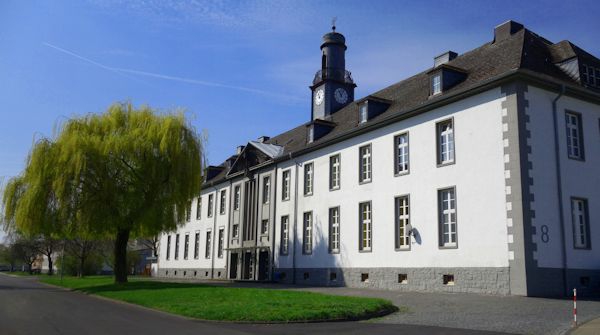
falckenstein-army-barracks-koblenz-casino-falckenstein-kaserne-koblenz-org

Falckenstein Barracks – Photo Credit: casino-falckenstein-kaserne.org

Vittorio was not easily intimidated. He knew how to fight back. He was aware of the saying that a good offense is the best defense. So he countered, “If you were a volunteer soldier and had a tidy income like me, wouldn’t you make her gifts and give her money because you love her?”

I was sure that our roommate must have felt a bit nettled by Vittorio’s suggestion that as a draftee with a mere pocket-money he would be in no position to argue with him on this matter. Unable to respond to this powerful argument, he resorted to the most obscene and offensive language I had ever heard. If this had been the end of the story, I would not have considered it worthy of being part of my autobiography. As a matter of fact, the story was just beginning.

In the weeks that followed Vittorio was getting more and more quiet and was no longer bragging about his most wonderful woman. I thought that he was afraid of our unnamed roommate. But I was wrong.  One Sunday evening he returned much earlier than usual to our room. He appeared to be in a very agitated state of mind. Not caring whether we wanted to listen to him, he started ranting and raving about the woman he once loved so dearly. We were stunned by the complete reversal of his opinion and wondered whether or not we heard him talk about the same woman. His language now was just as crude and offensive as if his antagonistic roommate was still lecturing him on the definition of women of ill repute. He described the most wonderful woman in the world as a crooked slut, who first was content with twenties, then wanted fifties, and now demanded his entire monthly income.

“I am finished with her,” he screamed, “I will not see her again; she is a whore; she can go to HELL!” Then he threw himself on his bed and cried like a little boy that he actually still was.

aaltstadt_koblenz

City of Koblenz – Photo Credit: Wikipedia.org

It was near the end of the summer shortly before my transfer to Marburg, when a woman walked through the barracks gate and requested to see the commanding officer of the second company of the signal corps. The above lieutenant learned that one of his soldiers, Private Vittorio to be exact, was the cause of her being with child. The officer concerned about the honor and respectability of the army in general and of his unit in particular had Private Vittorio called in and confronted him with the woman he had vowed never to see again. The officer after having established the truth of the woman’s claim suggested in unmistakable terms – one might say he decreed that Vittorio marry the woman who was expecting his child. Upon proof of marriage Private Vittorio would receive two weeks of paid leave for their honeymoon.

Vittorio told us later how things had been arranged in the office and that he was going to get married. Having flip-flopped once more he proudly announced that he was the happiest man in the world to have such a wonderful woman for a wife and soon to have a family. His words were gushing out in a sentimental torrent. This time nobody dared to interrupt him; even the quarrelsome roommate kept quiet. Vittorio had chosen a dubious path. I felt pity, even compassion for the young man who had in my opinion such a small chance of success in his upcoming marriage. I never found out what became of him and his wife to be.

Shortly afterwards I was on my way to Marburg. I left Koblenz with mixed feelings. Not aware that with the recommendations from the commanding officer I would soon be teaching again I looked back with regret at the rewarding instructional sessions, which I had enjoyed so much. I would also miss Josef Hegener and our nature excursions into the local hill country . On the other hand I felt relieved to get away from the revolting environment that our room had become of late. Even though I had been open-minded about listening to and jokes, I knew that Vittorio’s story was not a joke. It was a personal tragedy that shocked me to the core. If there was one good thing that came out of this sordid affair, it made me more determined than ever before to seek and strive for a better world. While an ideal by its own definition remains unobtainable, it nevertheless provides a vision and a goal worth aiming for. To the extent we struggle and make the effort to approach the ideal, we define our human character. With a fresh new sense of optimism I was looking forward to spend the remaining 180 days of my army time in Marburg. I promised myself to meet Biene again, as soon as an opportunity would present itself. For me she represented the embodiment of the light and the hope for a better future.

Gerhard Kegler – Military and Civilian Hero (Guest Post in German)

Gerhard Kegler – ein militärischer und ziviler Held

Biographische Skizze
Beitrag von Dietrich Kegler


Die militärische Laufbahn meines Vaters ist hinreichend bekannt und verschiedentlich nachzulesen, nicht zuletzt im Internet, wo die Generale der Wehrmacht ausführlich vorgestellt werden. Bekannt wurde Generalmajor Kegler in Deutschland vor allem durch die Ereignisse am Ende des Krieges, als er in hoffnungsloser Situation die Stadt Landsberg (ehemals in der Neumark gelegen, heute polnisch) auf Befehl Himmlers verteidigen sollte, der sich die Befehlskompetenz der 9. Armee anmaßte, die eigentlich dem Kommandeur der Armee, General Busse, zustand. Wie man weiß, weigerte sich mein Vater, diesen unsinnigen Befehl auszuführen, wurde sofort zum Kriegsgericht nach Torgau bestellt und dort in einem Schnellverfahren zum Tod durch Erschießen verurteilt.

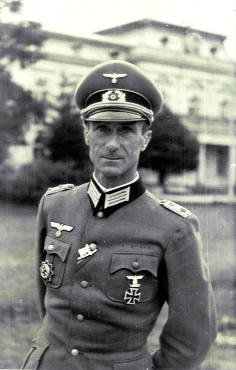
Generalleutnant Gerhard Kegler - Gutfelde 1944

Oberst Gerhard Kegler – Gutfelde 1944

Nur dem Untersuchungsrichter Freiherr von Dörnberg ist es zu verdanken, dass mein Vater überlebte. Er wurde zum Schützen degradiert und als einfacher Soldat wieder an die Ostfront geschickt, die sich bereits an der Oder befand. Dort, unweit von Frankfurt/Oder, wurde er verwundet und in einem langen und sehr beschwerlichen, immer wieder aus der Luft beschossenen Bahntransport nach Eutin in Schleswig-Holstein gebracht. Da hatte sich die ursprünglich kleine Wunde (ein Granatsplitter in der linken Schulter) derartig verschlechtert, dass der linke Arm abgenommen werden musste. Mein Vater blieb noch eine kurze Zeit der Rekonvaleszenz in Eutin und wurde dann aus englischer Gefangenschaft noch 1945 nach Gießen entlassen, wo unsere Familie im Jahre 1947 wieder zusammenfand.

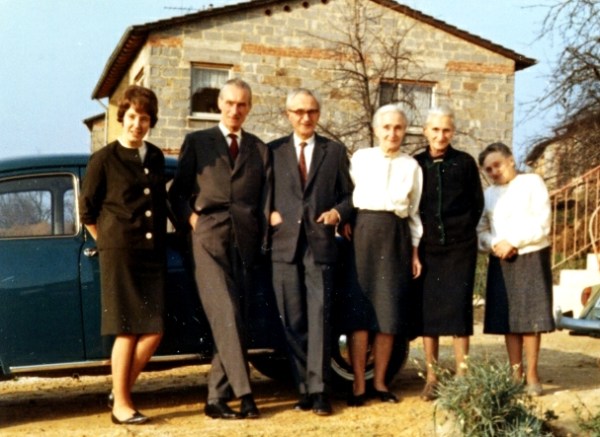
Gerhard Kegler between his Daughter Helga and Brother Günther 1964

Gerhard Kegler zwischen Tochter Helga und Bruder Günther Kegler; rechts folgen die beiden Schwestern von Gerhard, Erika Klopp und Maria Kegler, und Günter Keglers Frau Luci (1964)

Da die Bundesrepublik sich noch lange auf das von Himmler befohlene Urteil des Kriegsgerichts (Degradierung vom Generalmajor zum Schützen) berief und meinem Vater die ihm zustehende Pension verweigerte, bedurfte es erst einer großen Pressekampagne, um die Behörde zu bewegen, das Urteil aufzuheben, was schließlich durch den Bundespräsidenten geschah. Dann konnte mein Vater seine Pension erhalten.

Die große Pressekampagne zeitigte noch eine andere positive Folge. Freunde und Bekannte, die in den Wirren des Kriegsendes, durch Flucht, Ausbombung usw. überallhin verschlagen worden waren, wurden aufmerksam und nahmen Kontakt zu unseren Eltern auf. Ich erinnere mich an viele Besuche ehemaliger Freunde, Kameraden oder Untergebener meines Vaters. Und immer hörten wir großes Lob und große Anerkennung, wenn diese Menschen von den Ereignissen erzählten, die sie zusammen mit meinem Vater erlebt hatten.

Die tapfere und verantwortungsvolle Handlungsweise meines Vaters bei Landsberg ist nicht das einzige Ereignis dieser Art. Immer wieder wagte er, Vorgesetzte zu kritisieren, wenn sie unsinnige Befehle gaben. Dafür wurde er mitunter durch Versetzungen bestraft.

Umsichtiges Handeln in schwierigen Situationen berichtet auch schon die Regimentsgeschichte des Westpreußischen Infanterieregiments 149, dem mein Vater im Ersten Weltkrieg angehörte. Eine dieser Aktionen war die nächtliche Aushebung eines französischen Doppelpostens bei Reims in der Champagne, die dem Regiment wertvolle Informationen lieferte und, wie ausdrücklich betont wird, größere Verluste ersparte. Mein Vater hat uns auf einer Frankreichreise in den sechziger Jahren die Stelle gezeigt, wo er mit ein paar freiwilligen Leuten die Franzosen nachts überraschte, gefangen nahm und hinter die deutschen Linien brachte, wo man sie verhören konnte.

Soweit der militärische Teil im Leben meines Vaters. Aber das Leben ging ja nach dem überstandenen Krieg in Gießen weiter und gewährte meinen Eltern nach der ersten harten und entbehrungsreichen Zeit auch noch schöne Jahre.

Unsere Mutter hatte ebenfalls seit Kriegsbeginn Schweres durchgemacht. Aus München, wo das Leben durch die Luftangriffe immer unsicherer wurde, zog sie mit uns Kindern in den Warthegau. Von dort musste sie sich mit Jutta und mir wie Millionen anderer Menschen auf die wochenlange winterliche Flucht begeben. Wir fuhren zunächst in einem Planwagen mit polnischem Kutscher durch das winterliche Westpreußen, bis der Pole irgendwo in Pommern umkehrte. Ein Offizier nahm uns mit seinem Fahrzeugkonvoi bis nach Berlin mit, von dort ging es in überfüllten Zügen nach Dresden zu meiner Großmutter. Helga und Nati waren vorher schon nach Augustusburg (bei Chemnitz) gebracht worden. Bevor wir aber dort sein konnten, erlebten wir die drei verheerenden Bombenangriffe, an die ich mich lebhaft erinnere.

Im Sommer 1947 verließen wir die sowjetische Besatzungszone und gingen bei Philippstal an der Werra schwarz über die grüne Grenze, wobei uns die ortskundige Tante Lucie half. Unsere Familie fand nun in Gießen wieder zusammen. Wir wohnten zunächst in zwei Zimmern der Bergschenke, einem Hotel und Restaurant, das ursprünglich zum Kruppschen Bergbaubetrieb gehörte. Vater hatte in der Bergschenke eine vorläufige Bleibe gefunden und die Aufgabe eines Hausmeisters und Betreuers der dort wohnenden Studenten übernommen. Diese Studenten waren zumeist bereits Kriegsteilnehmer gewesen und studierten an der Universität Gießen Tiermedizin. Als Familie Stolcke, Onkel Werner, Tante Anni und ihre drei Kinder, nach Argentinien auswanderte, konnten wir aus der Bergschenke in die relativ komfortable „Baracke“ auf dem Bergschenkengelände umziehen, die sie bewohnt hatten.

Die Lebenssituation war in dieser Zeit zwischen Kriegsende und Währungsreform (1948) bekanntlich äußerst prekär. Als Vater uns in jenem Sommer 1947 in Gießen erwartete, sammelte er in einer ehemaligen Munitionskiste eine Menge von Lebensmitteln, die er sich vom Mund abgespart hatte, um seiner Familie einen guten Empfang zu bereiten. Das ist eine Tatsache, die ich selbst nicht bezeugen kann, Helga mir aber erzählte.

Besser wurde die Situation erst, als Vater die Stelle eines Stadtjugendpflegers der Stadt Gießen übernehmen konnte. In dieser Zeit, Anfang der fünfziger Jahre, erfolgte auch seine Rehabilitierung, wodurch sich unsere Lebenssituation entscheidend verbesserte.

164_69

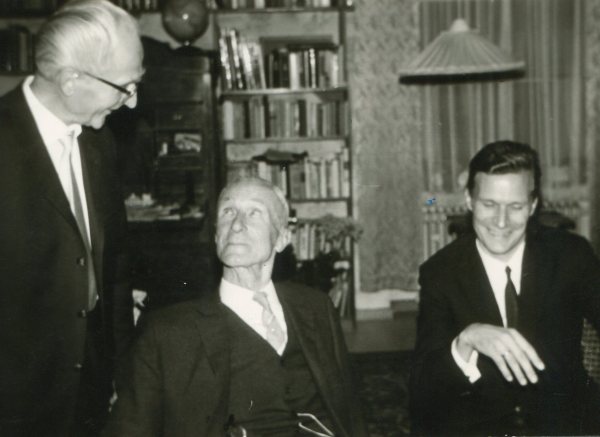
Gerhard Kegler zwischen Bruder Günther und Sohn Dietrich (1969)

Das Leben mit der Einarmigkeit verlangt sehr viel Geduld und Geschicklichkeit. Durch Geduld zeichnete sich unser Vater gewiss nicht aus, aber er war sehr geschickt bei allen Verrichtungen, wozu ein Mensch normalerweise beide Arme braucht. Und der Stolz über die relative Unabhängigkeit und Selbständigkeit, die Vater sich trotz der Einarmigkeit erworben hatte, kam zum Beispiel in einem Reim zum Ausdruck, den Helga und Nati zum 50. Geburtstag unseres Vaters in einem Gratulationsgedicht formulierten. Sie legten ihrem Vater folgende Worte in den Mund, die er sicherlich in „Prosa“ geäußert hatte: „Was ich mit einer Hand kann richten, macht Ihr mit zweien stets zunichten.“ Vater brauchte nur zu wenigen Handlungen im Alltag Hilfe, so etwa zum Schnüren der Schuhe. Aber Rasieren, Schlips binden, Schreibarbeiten usw. erledigte er ohne Hilfe, auch Autofahren in Fahrzeugen, die dafür nicht besonders präpariert waren. In den Wagen mit Schaltgetriebe, die er zuerst fuhr, musste er zum Schalten das Steuer loslassen. Er fuhr sicher, aber ich erinnere mich, dass mir als Mitfahrer immer etwas mulmig wurde, wenn er schaltete.

In der einsam am Waldrand gelegenen Baracke hatte der General natürlich auch an mögliche Einbrecher gedacht. Die Fenster waren sehr niedrig und stellten kein Hindernis für kriminelle Besucher dar. Vater hatte einen kurzen dicken Knüppel an seinem Bett und sagte mir, als wir uns einmal über die “militärische Lage“ der Baracke unterhielten, dass er hart zuschlagen würde, wenn ein Bursche es wagen sollte, einzusteigen.

Und als Held zeigte sich unser Vater später wieder einmal, als die Eltern in Leihgestern (Am Hasenpfad) wohnten. In einer Sommernacht schlief er allein in seinem Zimmer im ersten Stock. Die Balkontür stand offen, es war eine warme Nacht. Vater wird durch ein Geräusch geweckt und sieht von seinem Lager aus, wie sich ein Einbrecher, der über den Balkon in das Zimmer gekommen war, am Kleiderständer an der Jackentasche des schlafenden Generals zu schaffen macht und sie untersucht. Vater erkennt sie Situation sofort und brüllt ihn noch im Bett liegend an, worauf der Dieb sofort das Weite sucht. Die Reaktion unseres Vaters ist erstaunlich und bewundernswert, denn aus dem Schlaf direkt zum Angriff überzugehen, erfordert Mut, und in schlaftrunkenem Zustand ist man normalerweise moralisch nicht gerade stark.

Die Krankheit, die ihn dann im Jahre 1986 auf das Krankenbett warf, hat er tapfer ertragen. In dieser Zeit war auch unsere Mutter kränklich und pflegebedürftig. Unsere Eltern waren nun auf Hilfe angewiesen, die ihnen vor allem Helga treu und fürsorglich zukommen ließ. Mittlerweile lebten sie in einem kleinen Haus am Alten Friedhof in Gießen.

Der ältere Bruder meines Vaters, Onkel Günter, mein Patenonkel, war schon im Januar desselben Jahres verstorben, und Vater hat ihn noch bis zum Juli 1986 überlebt. Vaters langjähriger Freund, Horst Schubring, ebenfalls Hinterpommer, den er in den ersten schweren Gießener Jahren zufällig kennengelernt hatte – damals Gemeindepfarrer in Wieseck, dann Propst von Oberhessen – begleitete unseren Vater auf dem letzten Gang. Sein Grab, das einige Jahre später auch unsere Mutter und in jüngster Zeit unsere Schwester Renate aufnahm, liegt auf dem Neuen Friedhof in Gießen.

Ein tapferer Mann, dessen Leben im Pfarrhaus von Hinterpommern begonnen hatte, der in den Kadettencorps von Plön und Berlin seine Erziehung zum Offizier erhalten und zwei Kriege und große Belastungen durchlitten hatte und der nach allen Katastrophen noch viele friedliche und gute Jahre erleben durfte, war an sein Ende gekommen.


Dormagen (Gohr) im September 2016

  Dietrich Kegler


Chapter 22 of the Peter and Gertrud Klopp Story – Part IX

The Romantic Soldier

x305

Beautiful City of Koblenz – Summer 1964

I often wondered how it was possible that at certain times all troublesome events seemed to come together to create one powerful drama. Such was my deplorable situation between Christmas and Carnival, when I could barely stem the tide in a string of fateful events, such as the fatal accident of Sergeant Wohl on the icy roads of Feldafing, the loss of my father, emotional upheaval over the injustices caused by red tape in the army bureaucracy, and above all the almost certain demise of a shaky relationship with Biene. And now barely six months later, emerging from an apparently bottomless pit, it seemed as if all favorable currents had joined forces to lift me out of my deep depression into the blissful realm of true happiness in quick succession of small but significant steps: a book written exclusively for Biene, clarifications of the intentions of my heart and their acceptance albeit somewhat hesitatingly by Biene, two rendezvous to show that we were real human beings, not phantoms of our distorted imagination, the discovery of the joy of teaching, the instructional sessions in the afternoons, and the recognition of my newly discovered talents by my superiors. All these events in combination raised my self-esteem so much that I almost regretted having requested a transfer to the Tannenberg barracks in Marburg.

The most enjoyable outings with my brother Adolf on the weekends tore me away from my history books. With his congenial companionship he gave me a renewed spirit with emphasis on the social aspects of life that I had been neglecting far too long. When Adolf was unable to come and I for one reason or another wanted to spend the weekend in the barracks, I would still read Roman history books, but with a focus on topics that were more relevant to my own life and closer to my heart. Instead of dwelling on Roman conquest with the inevitable theme of death and destruction, I now learned about the importance of values, particularly of those pertaining to marriage, family and the raising of children. On sunny days I would find a cozy spot on the lawn near the 400 m oval racetrack. There I would open Mommsen’s chapter on the status and significance of the family in the Roman Republic and would read with increasing interest about the family as the smallest unit, upon which the entire state depended for its health and its very existence. I marveled at the role that the wife (domina) played in running a large and complex Roman villa and in nurturing and imparting values onto her children, while her husband (dominus), being still intimately connected to the soil, would work the fields to provide food and income for the family. Like myriads of individual healthy cells make up a strong body, so the Roman family units protected by law and honored by society provided the moral fiber, which made the early Roman republic so strong and powerful. After such undisturbed moments of contemplation on matters so distant and yet so relevant I returned to my room with the distinct realization that I had received valuable clues for the unfolding of my own personal life in the not too distant future.

roman_family

Roman Family

If there was ever a period in my early adult years that reflected the spirit of 19th century German Romanticism, it was during the summer months of 1964, while I was awaiting my transfer to the Tannenberg barracks at Marburg. My new friend Josef Hegener and I made use of every free moment to escape the stuffiness of the poorly ventilated barracks rooms. Away from the noise and heat of the city we found refuge in the nearby wooded hills, where hiking trails invited us to explore nature in the cool of a Sunday morning. We delighted in the colorful sight of a mountain meadow bedecked with innumerable wild flowers. The buzzing of bees and bumblebees, the happy chirping of birds at the edge of the forest, the murmuring of a brook, the croaking of an army of frogs making their presence known from a pond were together with all the other joyful sounds music to our ears. From a footbridge we gazed at the athletic performances of water striders skimming gracefully over the surface of the gently flowing waters. Joyously we followed the trail to a hilltop, where our eyes feasted on the magnificent mosaic of woods, fields and villages below. Down in the valley a church bell was ringing inviting us to attend the church service and give thanks to God for His wonderful creation. As we entered the village church, the congregation had just started singing ‘Now thank we all our God’, a hymn that became one of my favorite songs of praise both in German and in English. I felt elated after having been granted such a rare glimpse into the connectedness between the grandeur of nature and God’s presence in it. In my exuberance over this wonderful experience I quickly wrote a postcard to my folks back home in the form of a wedding announcement: We have been united in marriage signed Nature and I.

dandelion

Dandelion Flower

The following Monday I met Sergeant Otto Schmidt, as I was crossing the huge center yard on my way to the building, where I was going to deliver another lesson on basic electricity. The sergeant was beaming with pride, because he had just received praise and recognition from his superior officer for his success in running an outstanding instructional program for his unit. He was actually very generous in giving me some of the credit. Then I noticed how his facial expression suddenly changed. Otto Schmidt about a head shorter than I was no longer looking up into my eyes, but gazed straight ahead in utter amazement and bewilderment at my uniform jacket. Had a button come off or had I left the shirt collar too casually unbuttoned? No, these minor flaws in my outer appearance had never been a problem with this friendly sergeant. There was something that he had most likely never seen before. In total disbelief his eyes were fixed on the humble head of a dandelion flower, which I, following my current romantic inclinations, had placed conspicuously on my uniform. Sergeant Schmidt was almost speechless. All he could do was shake his head and stammer, “Klopp, Klopp, what is the meaning of this all?” To his great relief I removed the objectionable flower and hurried off to my electricity class. A symbol of love, a symbol of peace was on the uniform of a German soldier!


Chapter 22 of the Peter and Gertrud Klopp Story – Part VII


Career Planning and a Painful Self-Assessment

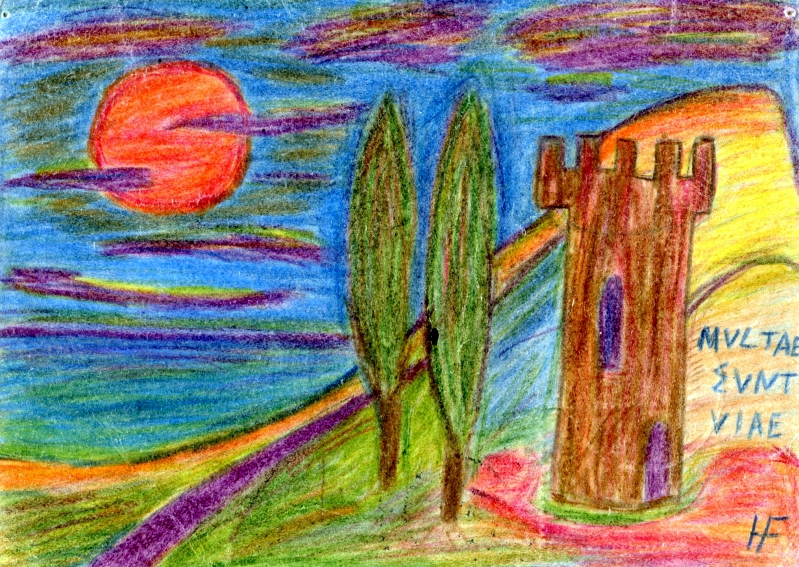
creative-work-by-my-friend-hans-fricke

Art Work  Entitled ‘There are many ways’ by my Friend Hans Fricke

My brother Gerry, who lived in Medicine Hat during my service in the West German army, is not exactly known among family members as an avid letter writer. All the more I was surprised to receive a detailed answer from him to my question regarding teacher’s training in Alberta, Canada. Driven by youthful desire for adventure but also by a kind of escapism that was getting stronger with each additional month in the army I wanted to explore a possible teaching career in Canada.

my-brother-gerry-and-wife-martha-in-the-early-60s

My Brother Gerry and his Wife Martha at Medicine Hat

Equally important for the understanding of my sudden interest in a totally different profession was that my staff sergeant in Koblenz had taken notice of my knowledge of basic electricity and electronics and had given me the task to instruct the new recruits. This went over so well that I was given more and more time off from regular duty to prepare my lessons and teach. So it happened that I discovered a talent, which I thought I did not have. Gerry accurately explained the requirements for entering the teaching profession in Alberta. I had to have my German high school diploma validated, had to give evidence for proficiency in the English language, and had to  complete a minimum of two years university training. With this information I was able to do some serious planning for the future. Suddenly a most fortuitous train of thoughts popped up in my mind that greatly increased my longing to go to Canada. Exciting ideas followed in rapid succession: immigration, teachers’ training at the University of Calgary, a teaching career, an income with the prospect of pay increases with more training, getting married to Biene and having a family.

mother-and-daughter-in-law-martha-in-medicine-hat

Mother and Daughter-In-Law Martha at her Home in Medicine Hat

I am still thankful to the captain from the basic training period for instilling the desire for good planning in order to achieve a dream The target I aimed for was still years ahead. It was actually a twin target of a rewarding career and life with Biene at my side. To hit the bull’s eye at such a distance would require a great deal of determination and persistence. Would I have those qualities, but most importantly would Biene support me in something – I am ashamed to admit – I had not even mentioned to her yet? So this would be a good time to have a critical look at myself. In my own eyes I had become a mature young man years ahead of my comrades in terms of acquired wisdom and good planning. But when I looked at the erroneous assumptions I had made about the world around me, about Biene and myself, I marvel at the way all my dreams had eventually become a reality.

Firstly, in my letters to Biene I had written about love, but never about marriage. I assumed that my ‘I love you’ would translate into ‘Will you marry me?’

Secondly, what was Biene to make out of my long-winded flowery dissertation on love between a man and woman?

Thirdly, Biene had already been frightened by the painful events leading up to and following the break-up of her engagement with Henk. Now I came and frightened her some more by openly writing about my passion for her without revealing or at least hinting at my genuine intention to marry her.

Fourthly, it was preposterous to assume that just because I was willing to marry her she would want to marry me too. This was truly the mark of an egocentric ass that I was at the time.

Last but not least, twelve months in the army and my comrades’ boastful talk about their amorous adventures should have taught me that being married and making love do not necessarily belong together. How was Biene supposed to know what was on my mind about a topic that had been a taboo throughout our childhood years?

So in summary I had built a dream castle with love, marriage, family and career on the preconceived notion that Biene had read all this and much more between the lines. It was then one of the great miracles of our relationship that no storm tide came rushing in at that particular juncture and made the castle collapse like a deck of cards.

In a postcard Biene briefly assured me that she no longer wanted a mere soul-mate relationship. She wrote that many of the questions and problems that were troubling us would be resolved once we had met again. And indeed we met exactly two years after we had our first encounter at Lake Baldenay. This brought some sunshine into my heart. My brother Adolf contributed a great deal to enhance that joie de vivre, which I felt all the more intensely, whenever I went with him on an excursion in and around the Rhine, Moselle and Lahn valleys.

Chapter 22 of the Peter and Gertrud Klopp Story – Part VI

Peter‘s Musing on the Nature of Platonic Love

Fortunately, I did not have to wait very long. Biene had expected a store-bought book that in content and style would bear a strong resemblance to our turbulent relationship, where the ending would perhaps provide an urgent plea to get our act together and leave our fantasy world behind. To put it mildly, the handwritten book had overwhelmed Biene. Never before had she received a gift like this, where every single page had been written exclusively for and about her. She did not insult me in the least (as a matter of fact I took it as a compliment), when she questioned for a moment the authenticity of the book’s claimed authorship. Then came the sentence I had been waiting for, ‘I believe we love each other.’ What all my letters in the lines and between the lines could not accomplish, it seemed to me the novel had succeeded in pronouncing my unequivocal and unmistakable message ‘I love you’ and that at last I had received the long-awaited, if somewhat faint echo, ‘I believe we love each other’. However, when she qualified the kind of love she had in mind, I realized that I had rejoiced too soon and that at best I had only scored a partial victory.

47

Biene’s Parents Mr. and Mrs. Walter Panknin

‘But it is a strange love’, she continued, ‘like a dream not bound to reality. I love your words, your soul, which your words express. I love you as a human being, Peter, but I am very much afraid to love you as a man, and I fear that you already love me as a woman. That will bring much pain. How shall I make it clear to you, so you will understand what I mean? I cannot yet belong to a man. It has been my greatest desire for a long time to love a man and to completely belong to him, and yet I know, and I have experienced it myself that I am not yet ready for it .’

‘Therefore, Peter’, she continued, ‘I must ask you, do not love me as a woman, for then we could quickly lose each other again! I would like to write to you the opposite and yet let us this time not go with our dreams any farther than what reality will be able to give us as fulfillment. I find it so hard to tell you this and yet, Peter, grant me this wish, let us be friends just as in the beginning.’

I reread her letter looking for clues in the bewildering plea to turn back the clock to the time, when we had started our friendship. But I found nothing apart from just a vague hint of something horrible that she had experienced in the recent past. It was obvious to me that she had not written the happy ending to the novel in real life, which I had so intensely been hoping for. It was a now-or-never situation for me. I realized that she was in a complete state of confusion and afraid of a man-woman relationship, so afraid that she risked losing the one whom she believed she truly loved. The spirit within me that so often in the past had said ‘one last time, try just one more time’ goaded me to write. I felt completely calm. I wanted to pass on to her that sense of tranquility, which would ultimately provide the pillar upon which she could rest her final decision without regret. It was either a life together with me, or the end of a friendship that could not be maintained. I was one step ahead of Biene in that I had felt the pain of jealousy over Henk and the Moroccan pen pal. She was in my opinion naïve to believe that she could find a broad-minded, speak indifferent husband, who would tolerate another soul mate in their marriage, no matter how platonic such a relationship would be.

So I wrote after some considerable time of reflection, ‘I have the feeling, you want to cut off the roots to a tree, but still want to harvest its fruits. You must not be so fearful, dear Biene. When one talks about love between a man and a woman, one must not think right away of its consummation. What I think about it will perhaps be to you a bit of a consolation. I can belong to only one girl. Then all the others vanish with time. If they don’t, they cause hard to solve conflicts within me. The girl that I mean was and is you, dear Biene. Don’t be shocked if I tell you that the love, which you are renouncing, took control of me from the moment I met you the first time. But in its purest form, as it finds expression through passion, it comes last. Many thousands of steps precede it. But it lives within me not strictly separated from all other human values. It plays its role in everything I am doing and thinking. In every sentence that I write to you it is there. Even if it is never mentioned, it is there. My entire being is woven into it through and through. And I feel happier now than in the times when I tried to suppress it as something evil.

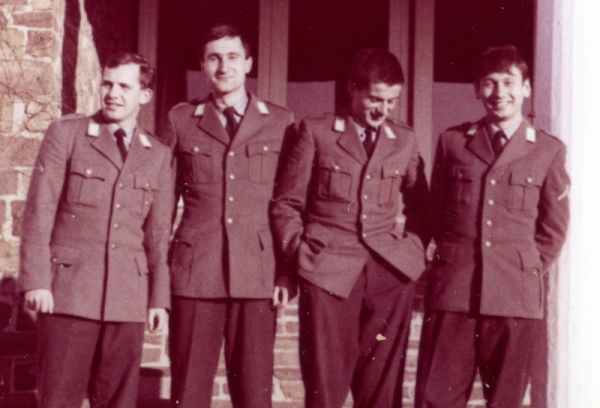
Peter with his Buddies at an Army Training Site

Peter with his Buddies at an Army Training Site

Dear Biene, you have a decision to make. But it is not difficult; I am not getting lost to you, at least not in the way you envision it now with a pure friendship between soul mates. What your attitude will be later does not matter now. The question for you is whether you will accept me with my love as a man. You can keep me just as I am or you set yourself and me free for the ‘love’ for somebody else that fate will bring into our lives. I give you complete freedom with your decision and accept everything. But I must have clarity! Take your time to answer my letter, just as I have taken my time.’

A few days later feeling sorry of having had the audacity to force a decision upon her, I thought it wiser to go back to Biene’s original plea for platonic love between the two of us and describe it vividly with a good measure of irony so that she could see at long last that this kind of love would not be worth pursuing.

‘I think I know now what is troubling you. Recently it stood before my eyes like a vision. It is the relationship between two souls pure, aiming upward, self-sufficient. This kind of love permits no passion; it wishes to be pure. That’s why you were afraid that our friendship would be in jeopardy, if you didn’t warn me. In your eyes we are two souls completely separated from our bodies in quiet distant solitude, eyes open for the wonders of nature and its beauty. Lovingly we exchange experiences we each had suffered from the blows of fate; we mature and rise upward towards ethical perfection. Earth with its horrors is no longer important; nothing bothers us any more. We let ourselves go, when we say farewell to our bodies. The day has arrived; we reach out for each other; the gate to our ideals opens. Who then should stop these innocent souls from entering the land of arts? One admires Spitzweg’s idyllic pictures, listens to romantically imbued poetry and goes into raptures over Beethoven’s Pastoral Symphony. One meets great spirits: Goethe, Lessing, and Schiller. We take flight and seek refuge at philosopher Seneca, who teaches us to relish contentment and happiness. But we are not so simple-minded as to ignore that even this is a dubious fabrication of human beings seeking escape from this odious world. Shuddering, we rise even higher, leaving everything behind. It feels so warm and fuzzy around our hearts; like a bridal veil our souls become transparent. Nothing weighs us down any more. Indeed, we are being lifted up; we melt into nothingness. You are I, and I am you. How magnificent and glorious! Our contours begin to blur. Eternally happy and content we have been transported into the heavenly realms. Dear Biene, with all that bliss why don’t we just go ahead and die?’

With this bitter-sweet rhetorical question I ended my letter and wondered about how Biene would respond to the imagery of my emotional diatribe.