Bloody War or My Father’s Continued Journey (in German)

Verdammter Krieg

Der Weitere Weg Meines Vaters

von Klaus-Dieter Barge – Chart II a – IV

Die 807 meines Vaters agierte mit der 557. ID ( XXV. AK) unter Generalleutnant Kuprion im Elsaß nördlich von Colmar und westlich von Rhinau im Bereich der 5. französischen Armee bis zur Kapitulation der französischen Truppen am 22.Juni 1940, da wurden etwa 200.000 Mann der französischen Heeresgruppe 3 (2., 3., 5. und 8. Armee) gefangen genommen.
Damit waren die deutschen Truppen noch einige Wochen beschäftigt.

Es gibt verschiedene Fotos in Fotoalben von Soldaten der Abteilung 806 vom Chateau de Thanvillé (deutsch Tannweiler) und weiteren Orten.
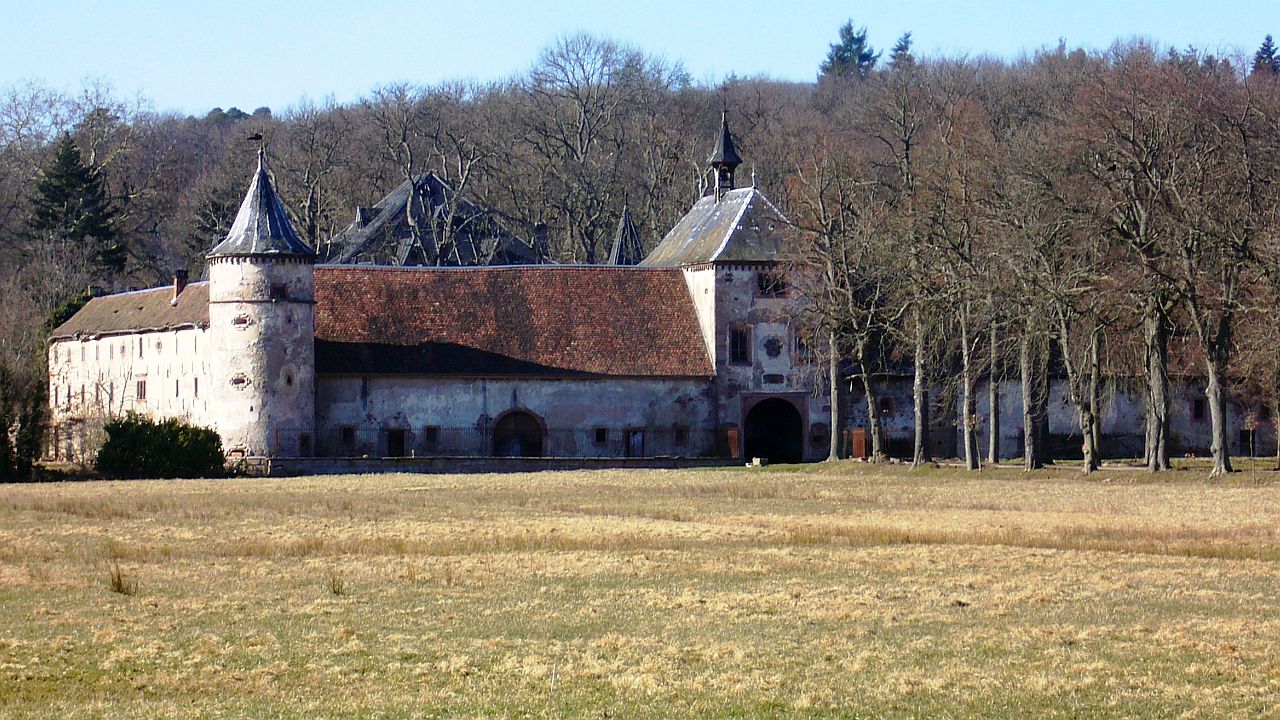
Chateau de Thanvillé aus Wikipedia

Chateau de Thanvillé aus Wikipedia

In Sélestat (deutsch Schlettstadt) , etwa 20 km nördlich von Colmar, man erkennt auf dem Foto den mächtigen Uhrturm (Tour de l’horloge).

In Saverne (deutsch Zabern) (die Stadt liegt 80 km nördlich von Colmar zwischen Vogesenwäldern und Weindörfern) gilt das Château des Rohan dank seiner 140 Meter langen Fassade aus rotem Sandstein als “Elsässisches Versailles”.

Mit dem Befehl vom 13.8.1940 wurde die Art.Abt.806 nach Mühlhausen zurückgeführt.
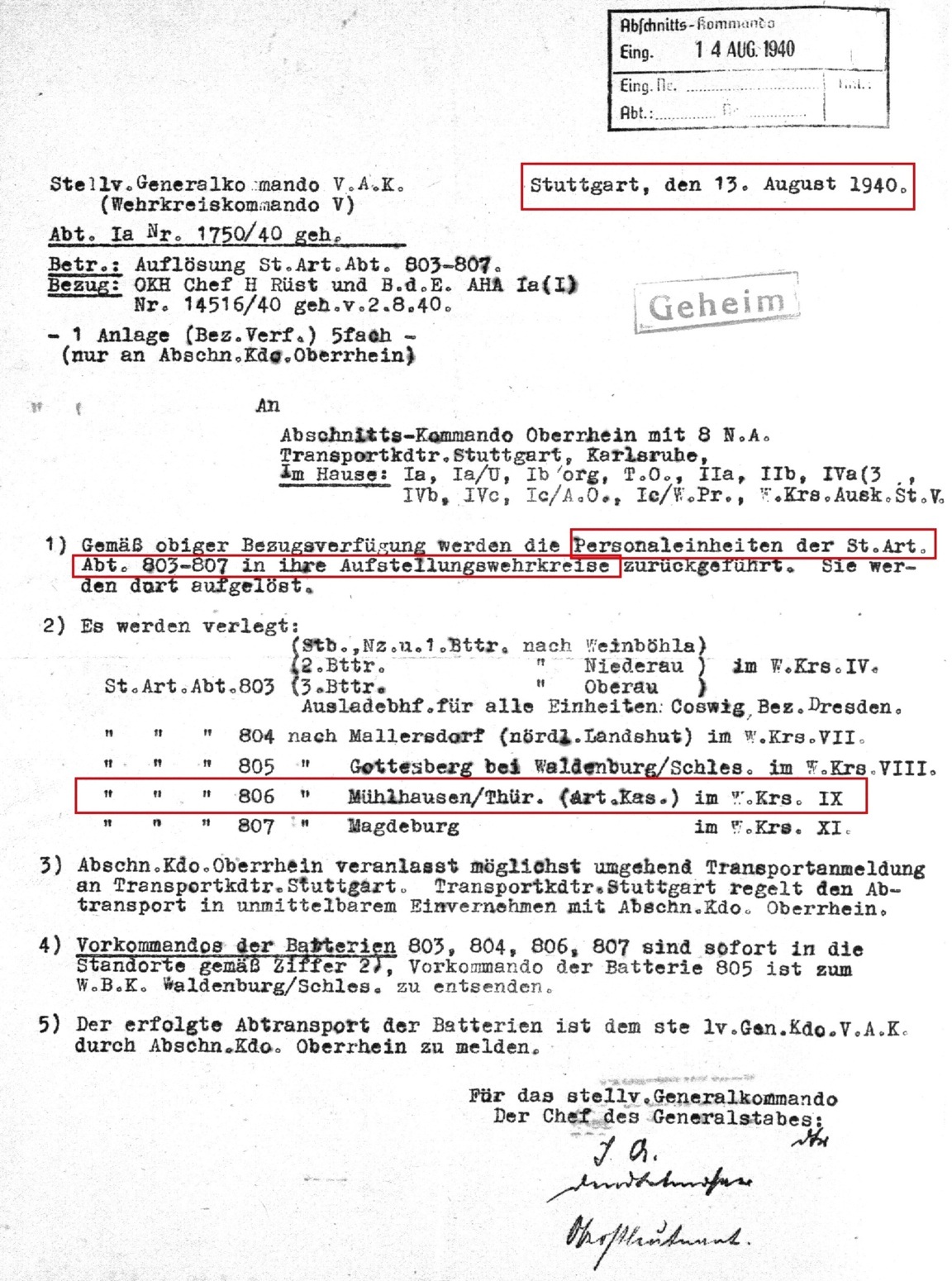
Rückführung 801 - 807

Rückführung 801 – 807

Die Artillerie Abteilung 806 wurde dort am 31.8.1940 aufgelöst.
Danach gehörte Rolf zur Stellungsbatterie 771/Küstenbatterie 771, ausgerüstet mit 4*15 cm Kanone 15/16 (t).
Diese Einheit wurde mit zusätzlichen Eingliederungen per Befehl vom 20.12.1940 zur 3.Batterie Heeres-Küsten-Artillerie Abteilung 788 in Le Havre.
Im Dezember 1942 kam die Batterie nach Mesnil Val, im Frühjahr 1943 an die Klippen von Mers-les-Bains bei Treport.
Als die Batterie im Dezember 1943 nach Südfrankreich verschickt wurde, kam mein Vater doch bald wieder nach Mers-les-Bains zur 3. Batterie der I./HKAR 1252 zurück. (Über seine “mystische” 3./788 gibt es eine Geschichte von Alain Chazette, dem 1.Atlantikwall-Kenner in Frankreich).
Am 9.7.1944 wurde er nach Fecamp zur 10./1252 versetzt, die etwa zu diesem Zeitraum zusätzlich mit Flak 8,35 (t) ausgerüstet wurde.
Alle Standorte liegen in der Region “Haute-Normandie des Somme” an der sogenannten “Alabasterküste”.
Das folgenden Fotos zeigen meinen Vater Rolf am 21.6.1944 (15 Tage nach D-Day) an seinem 25. Geburtstag und meine Eltern 1944 (am 12.6.1943 hatten sie geheiratet).

Nach dem deutschen Rückzug im September 1944 folgten Kämpfe in Holland (Schlacht von Arnheim, auch “Operation Market Garden” genannt).
Für ca. 3 Monate lag er mit dem 184.AR (84. ID) am Reichswald bei Kleve am Niederrhein.

Dort startete südlich von Nijmegen (Holland) am 8.2. 1945 die “Operation Veritable”, an der neben den Engländern auch kanadische Einheiten beteiligt waren
(1. Kanadische Armee unter Harry Crerar).

Operation Veritable wurde von General Crerar befehligt, er kommandierte 470 000 Mann mit 1000 Geschützen und 1000 Jagdflugzeugen bzw. Bombern, der Angriff am 8.2.1945 war der größte Artillerieangriff des 2. WK an der Westfront.
Mein Vater wurde am gleichen Tag am Galgensteeg in Kranenburg von den Kanadiern gefangen genommen. Er war in folgenden Kriegsgefangenenlagern in Belgien:

-Camp 2223 Brasschaat/Antwerpen
-Camp Waterschei
-Camp 2228 Overijse
-Camp 2221 Vilvorde
-dort am14.6.46 geflohen, nach 14 Tagen mit Hunden aus Versteck geholt
-28.6.46 wieder ins Lager gekommen
-25.7.46 Munster, Deutschland

Damit verbrachte er fast 8 Jahre seiner Jugend in RAD, Wehrmacht und Gefangenenlagern!

Die beiden folgenden Bilder zeigen General Crerar und bei einem Treffen mit dem englischen Feldmarschall Montgomery im Februar1945 bei Kleve.

Am 3./4.April 1945 wurde Nordhausen, Rolfs Heimatstadt, von der RAF unter Arthur Harris, genannt “Butcher”, 2 mal bombardiert, das Haus der Barges wurde zerstört, darin starben meine Großeltern Karl und Anna Barge , 2 Tanten und ein kleiner Cousin von mir. Nordhausen wurde zu 74% zerstört, 8800 Menschen kamen dabei um.

Das war 7 Tage vor dem Einmarsch der Amerikaner!.Für Harris wurde in London ein Denkmal errichtet.

Alle 4 Brüder überlebten den 2.WK, da waren es noch 7 Barge-Geschwister.

Mein Vater kam Ende Juli 1946 nach Mitteldorf, dem Heimatort meiner Mutter zurück, am 22.4.1947 wurde ein Junge geboren, der Beginn einer neuen Zeit.

Es ist mir nicht leichtgefallen, über teilweise fürchterliche Dinge zu berichten.
Ich glaube aber auch, dass wir die Aufarbeitung dieser schlimmen Zeit unseren Vätern schuldig sind, ich fühle mich dadurch meinem Vater sehr verbunden und möchte , dass unsere Nachkommen wissen, wie es unserer Familie in diesen geschichtlichen Ereignissen erging.
Schön, dass sich Frankreich und Deutschland immer mehr annähern und mit der heutigen Jugend der Teufelskreis von Feindschaft durchbrochen ist.

Bruno’s Last Days (in German)

Brunos Letzte Tage – Chart II a – II & IV

von Dieter Barge

Ich war sehr froh, in den Unterlagen der 218. ID einen 4-seitigen Bericht zu dem Vorauskommando zu finden, dem Bruno mit seinem Radfahrerzug angehörte. Zunächst der Berichtskopf mit einigen allgemeinen Angaben zum Vorauskommando, dann 2 Fotos zu Radfahrern in der Wehrmacht.

Das Vorauskommando hatte eine beachtliche Stärke: 10 LKW, 3*Flak, 3*PAK, 7 Motorräder, Küchen-, Munitions-, Funk-, Tank- und Krankenwagen, 3 Radfahrgruppen, 2 Radfahrerzüge. Im nächsten Bild wird begründet, dass die Gruppe wegen des schlechten Wetters nicht mit den schweren LKW an den Rhein heranfahren konnte und eine weitere Nacht vom 15.Juni zum 16.Juni in Tutschfelden übernachten mußte.

Bild 4 Bericht 2

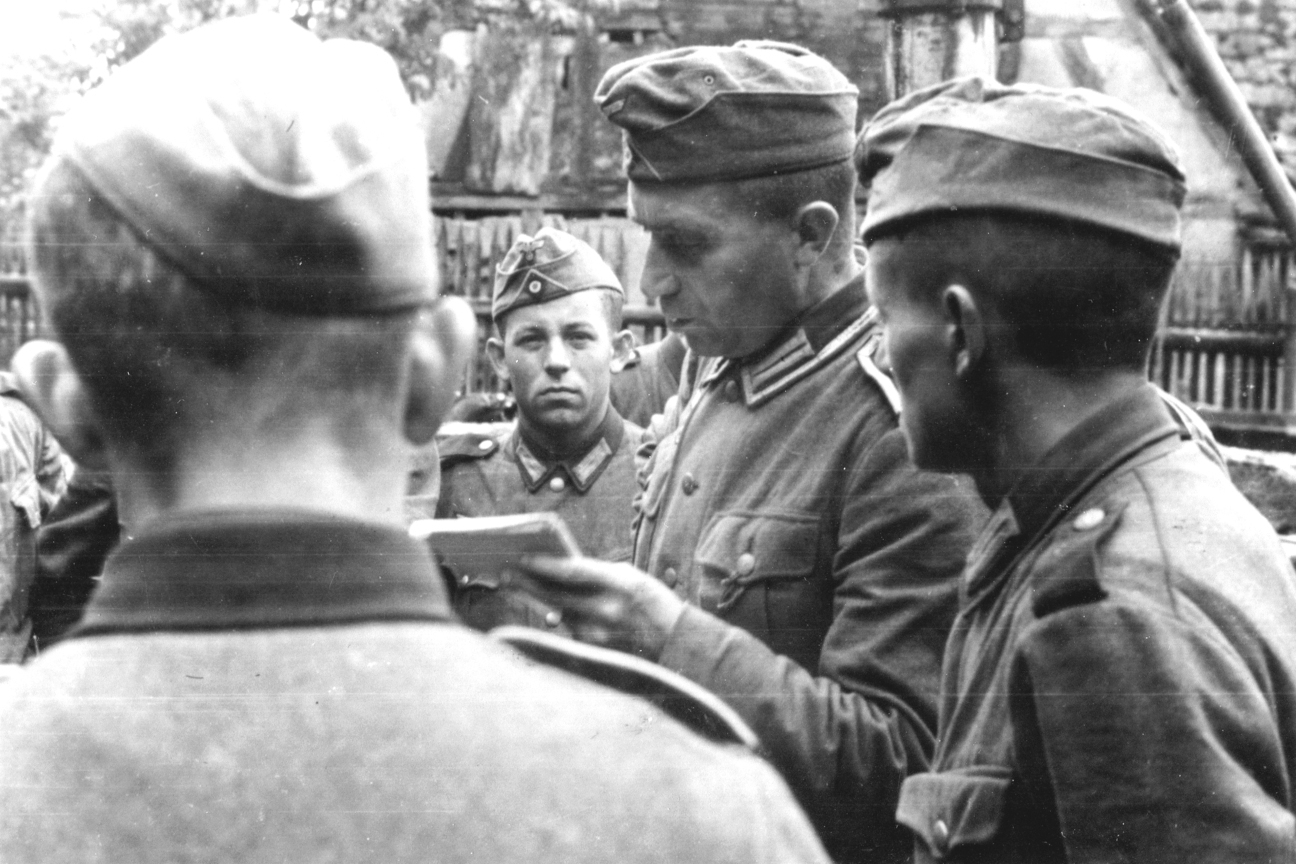
Der Abmarsch erfolgte am 16.Juni erst gegen 18 Uhr, deshalb konnte Bruno auch einen Brief an die Familie daheim schreiben und das folgende Bild beilegen, das auch noch entwickelt werden musste. Das Bild zeigt Bruno bei der “Bekanntgabe der Lage und der Aufgaben des Vorauskommandos” an seinen Radfahrerzug und ist mit 16.6.1940 datiert.

Bruno letztes Bild

Bruno letztes Bild

Das nächste Bild enthält die Erläuterung des Fahrweges von Tutschfelden bis Sigolsheim. Ich habe den Verlauf in 2 Google-Maps-Bildern eingetragen.

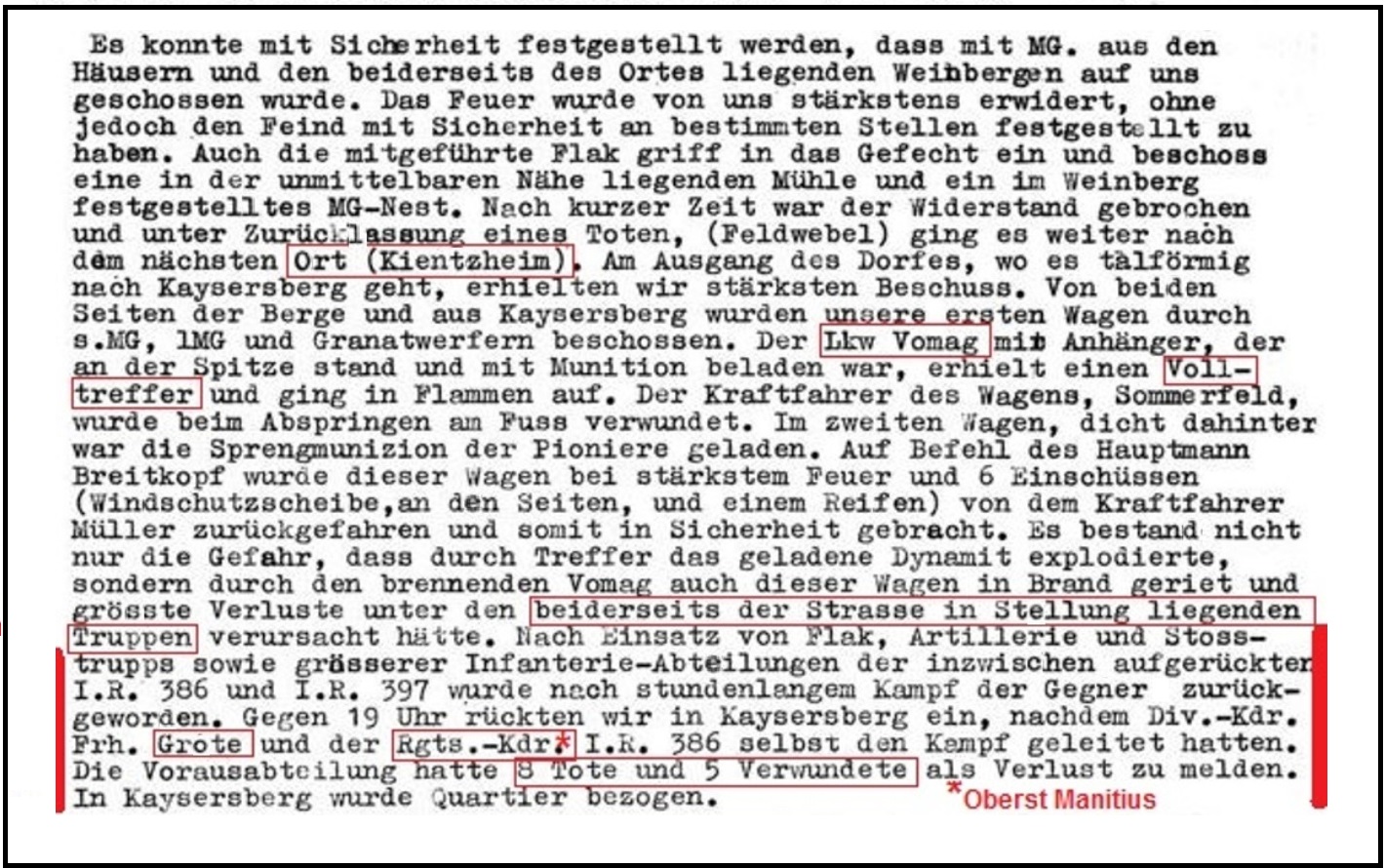
Der folgende Bericht schildert die Kämpfe in Sigolsheim und in Kientzheim, zu diesem Zeitpunkt war das Vorauskommando tatsächlich vor dem 386 IR, das sie vor Gemar einholten.

Bild 9 Bericht 4

Bemerkenswert, dass die Einheit direkt vom Divisions- und vom Regimentskommandeur geführt wurde! Die Kämpfe in Kientzheim dauerten ca. 9 Stunden !

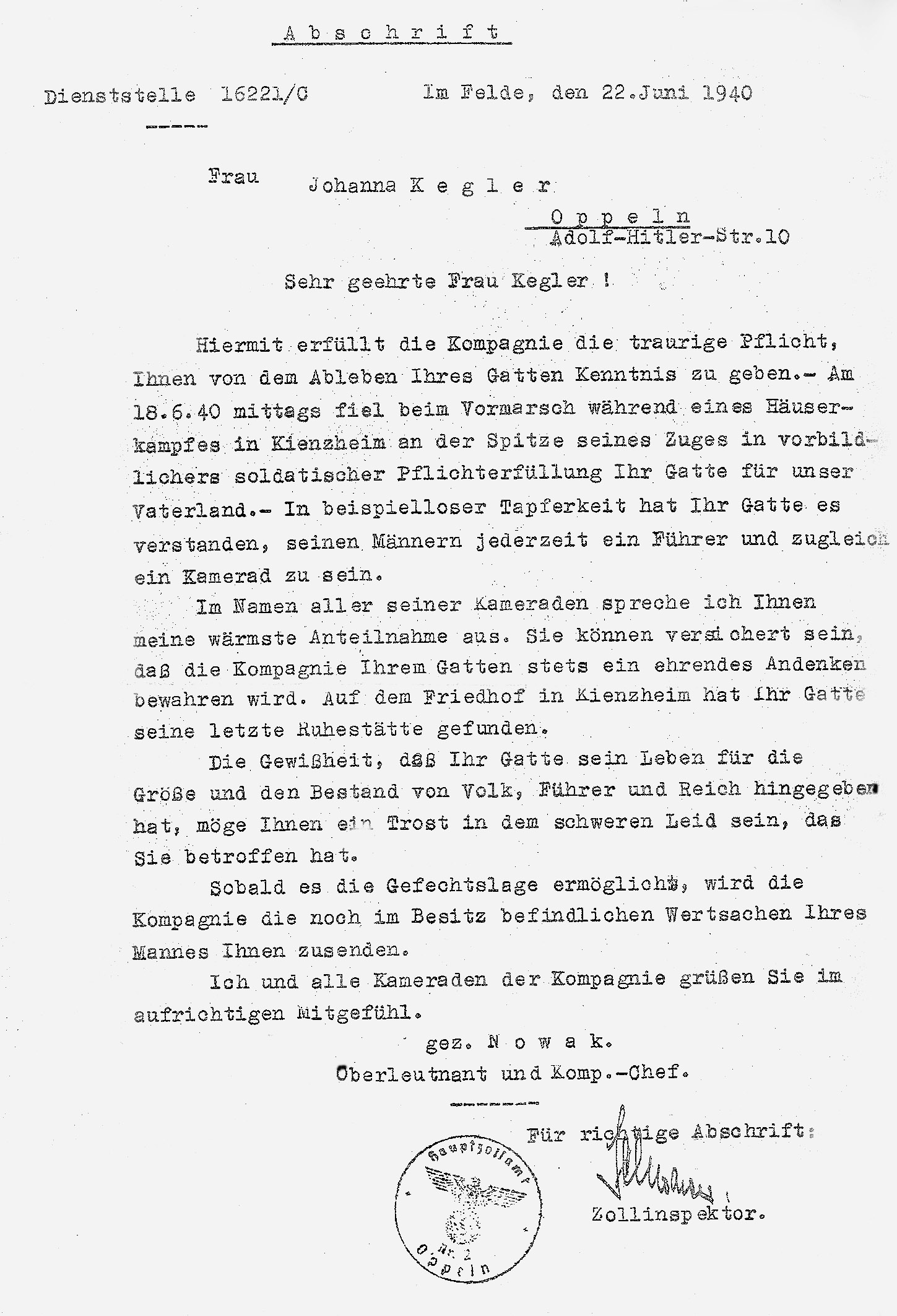
Gegen Mittag fiel Bruno, wie im Beitrag von Anke und Jürgen bereits von einer Augenzeugin beschrieben wurde. Der Bericht des Vorauskommandos ist damit stimmig mit der Augenzeugin und der folgenden Nachricht des Vorgesetzten Brunos an Johanna. Etwas verwunderlich für mich ist, dass von diesen schweren Kämpfen in Kientzheim nichts beschrieben wurde.

Bruno

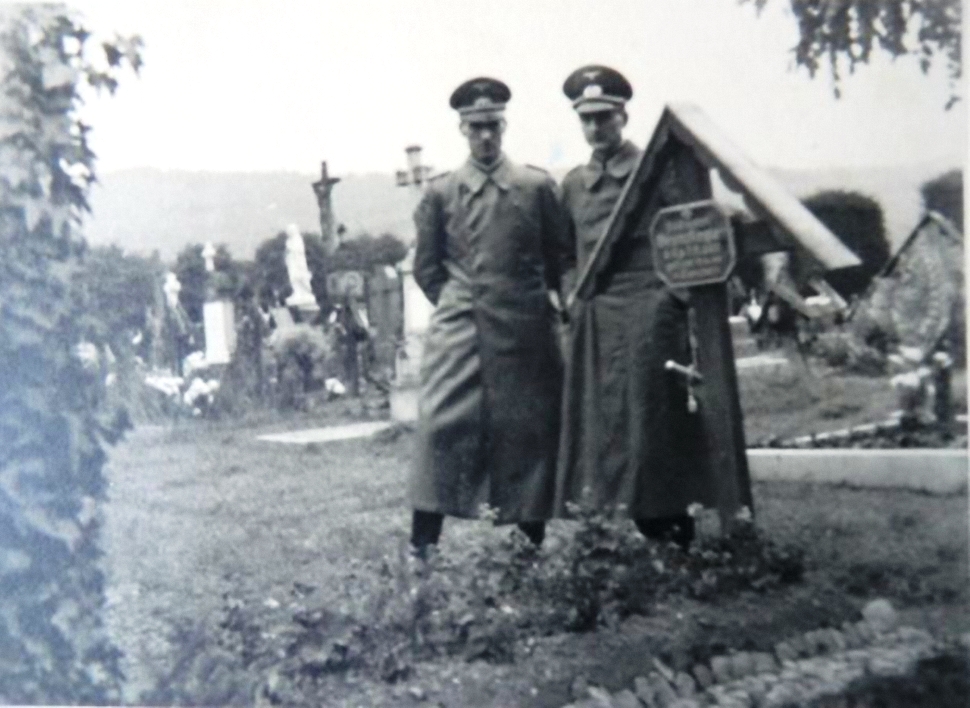
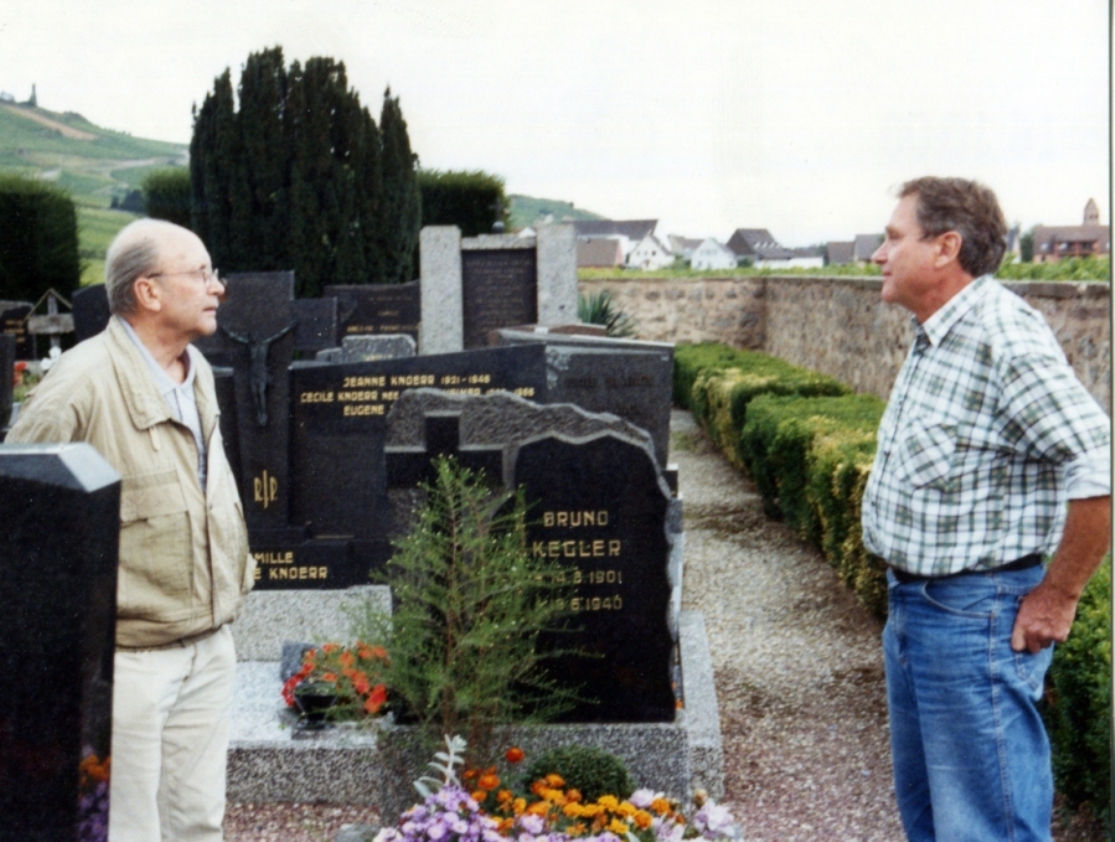
Die nächsten beiden Bilder zeigen das 1.Grabkreuz und das nach der offiziellen Trauerfeier errichtete 2. Grabkreuz.

Am 25.10.1940 besuchte die beiden Brüder Gerhard (später General) und Günther (Oberst) die Grabstelle.

Bild 13 Günther und Gerhard am Grab ihres Bruders am 25.10.1940

Die Söhne Jürgen und Hartmut konnten nach der Wiedervereinigung gemeinsam das Grab besuchen.

Bild 14 Jürgen und Hartmut am Grab ihres Vaters Bruno

Ich habe zur Erinnerung an Bruno 2 Bilder bearbeitet, das eine zeigt den jungen Bruno am Grab seines Vaters.


Falsely Accused and Smoking a Pipe

Conclusion of Chapter VII

One day as I was happily returning home from the Upper Village, a girl about my age crossed my path and placed herself in front of me.

“I want to show you something”, she said. To my surprise she quickly pulled down her panty and lifted up her skirt. Without waiting for my reaction, she demanded, “Now you pull down your pants!” Puzzled by this naughty request, I stared at her for a moment and then ran home as quickly as my legs could carry me.

Around supper time there was a knock at the door. When Mother opened it, I heard from inside the living room a soft, but ominous voice in a very accusing tone. Soon a woman, accompanied by the girl with whom I had just had this embarrassing encounter, entered and immediately continued to speak more menacingly than before.

“My sweet little girl was on her way home, when your naughty confronted her with the most indecent request. He asked her to expose herself. You can imagine, Mrs. Klopp, how shocked and disgusted she was with this display of improper behavior. When she turned around to run home, that brat grabbed her from behind and pulled her panty down.”

While the woman continued with the story about her ‘sweet little girl’ being harassed in broad daylight, I felt so stunned by the accusations that I was unable to utter a single word in my defense. We all know the old adage: silence is admission of guilt. And nobody got to hear my side of the story, not even my own mother. The shame I felt over something I did not do was so overpowering as if I had indeed done what I had been accused of. So I remained silent.

“Look, Mrs. Klopp, how guilty he looks! It was good I came by to tell you. Hopefully this will be teaching him a lesson.” And with that remark she took her ‘sweet, little girl’ by the hand and added, “We must go home now and fry our fish for supper. Good night!”

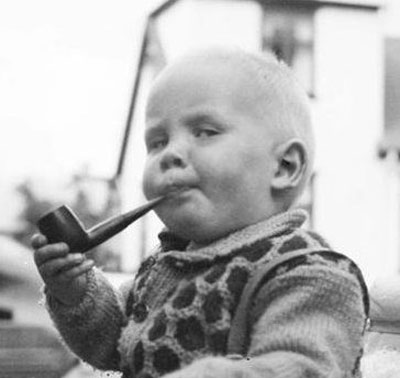
Father loved to smoke his pipe. I often watched him, as he was preparing to light it, a process that seemed to be like a relaxing ritual for him. With fascination I was watching him gather his pipe, tobacco bag and the matchbox. He opened the bag and held it under his nose to savor the aromatic delight in his nostrils. Then he grabbed a pinch of the brown fluffy stuff and loosely filled the pipe’s chamber. After he had carefully closed the tobacco bag, he struck a match to light the pipe. This was the moment I had been waiting for. With a few puffs the aromatic scent of smoked tobacco filled the entire room, and I vicariously participated in my father’s delight. Even though I never turned into a smoker in my later life, I do have fond memories of the cozy atmosphere surrounding Father and his pipe.

Kid Smoking Pipe - Photo Credit: smosh.com

Kid Smoking Pipe – Photo Credit: smosh.com

One day, when I came home from playing outside, I noticed to my great surprise Father’s pipe on the kitchen table. I was surprised indeed, because Father would always put it away in a secure place. Then there were also matches on the table, but what amazed me the most was that the pipe’s bowl was stuffed with bits of crumpled-up paper, leaves and old cigarette butts. The attraction to smoke Father’s pipe was irresistible like sweet honey to a bear. Within seconds I held Father’s pipe between my lips, lit a match and brought its flame near the bowl filled with that poisonous concoction of paper, leaves and cigarette butts. I sat on the chair like Father inhaling the disgustingly acrid smoke. A few puffs later, I suddenly felt sick to my stomach. Pale and green in my face I slid off the chair, on which I had just sat proud and strong like Father. Holding the glorious pipe in my hand, I landed on the floor with a thump, threw up and passed out all within less than a few minutes. It was then when my older brothers came rushing out from their hiding places, whence they had been watching the spectacle. They had set me up for their macabre entertainment. I was sick for a long time, so sick actually that this horrid experiment with tobacco served as a form of effective inoculation against nicotine addiction for my entire life. And for that I will be forever thankful to my brothers!

Rescue from Certain Death and Peter’s Perilous Bike Ride

Chapter VII – Part III

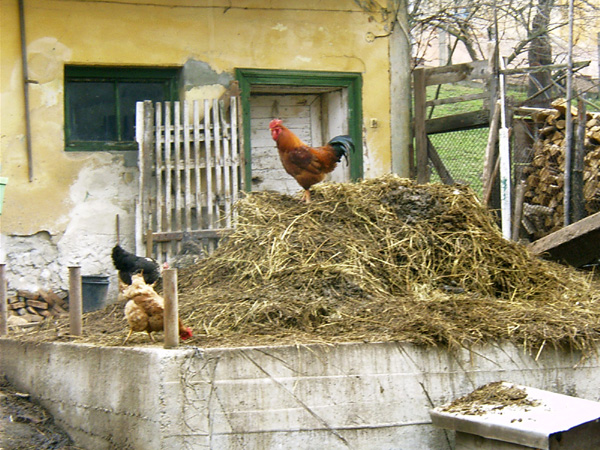
Misthaufen-large

Photo Credit: schnittpunkt2012.blogspot.com


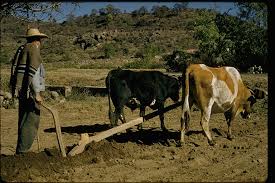
The farmers in Rohrdorf were relatively poor. But they were much ahead of their time by practicing what we now call organic farming methods. Their farmhouse was located in the village and their small fields often less than one ha in size were scattered in the outlying areas. With each plowing, rocks emerged from below the surface and needed to be picked up. Owning horses for pulling farm equipment was a luxury in this impoverished region between the River Danube and Lake Constance. Most farmers used cows for pulling their wagons and plows. Yet, they also expected them to give plenty of milk in the morning. Cow-barn and residence were located under the same roof. A giant manure pile decorated the front of the house right next to the stairway leading up to the main entrance. Conveniently the kitchen was right above the manure pile, so the farmer’s wife merely had to throw kitchen scraps and other organic refuse out of the window. Above the cow-barn the farmer stored hay for fodder and straw for the cows to rest on during the night. The architecture of the entire building was designed to save manual labor. During the winter months the farmer would simply take his pitchfork and throw down the hay into the long trough. From the rear end of the animals the cow pads mixed with straw would go directly onto the manure pile, while the urine would flow freely down the gutter into the holding tank outside the building. Nothing, absolutely nothing was wasted here. Well-rotted manure and aged slurry went back to the fields to revitalize the soil.

cows

Photo Credit: calphotos.berkeley.edu

At one of these farmhouses I was playing all by myself one day. I cannot remember what attracted me. To be sure, it was not the pungent smell or the questionable beauty of the manure pile. Spurred on by my childlike curiosity, I was simply exploring a place that was new to me. Boundaries have no meaning to little children. Trespassing is a foreign concept to them. As I was walking around, I stepped on the lid that did not completely close the opening of the holding tank. All of a sudden the lid tipped under the weight of my body. I lost my balance and slipped into the deep, smelly slurry underneath. Panic-driven I frantically thrashed around to keep at least my head above the smelly liquid. In vain I looked for a foothold or at least something to cling to with my hands. But there was nothing but the slippery, slimy wall surface. Soon I began to tire. I found it harder and harder to stay afloat.

The little light that had penetrated the darkness before suddenly grew dimmer. I could no longer see the walls. It seemed I was losing consciousness. Did the toxic fumes make me mercifully lose consciousness, before I would drown? Just as I was beginning to submerge in the infernal soup, I felt a strong grip at one arm, then on the other. I was no longer sinking, but going up instead. Centimeter by centimeter my body was dragged by an invisible force higher and higher towards fresh air, sunshine and life. With a thump I landed on firm ground and after I recovered a little, I looked at my rescuer’s smiling face. One of the older Pröbstel boys had heard the clang of the lid and saw me fall into the holding tank. It would have been my certain death, had he not acted immediately. The miracle of my rescue appears even greater to me now, when I consider that by chance the holding tank was filled almost to the top. For otherwise the boy would not been able to reach me.

I learned to ride a bicycle under somewhat unpleasant circumstances. One day my brother Karl lifted me up onto the saddle of his rather tall bicycle. I was all excited. Indeed I was very eager to experience the freedom of moving about on two wheels. My legs were barely long enough for my feet to reach the pedals. While Karl was holding the luggage rack to keep the bike in an upright position, I began to pedal and managed to gradually build up speed. Every once in a while my brother let go of the rack just for a few seconds to give me the feeling of the relationship between speed and balance. Under his caring guidance I was able to ride the bike independently for longer and longer stretches, until I had developed enough confidence to break from Karl’s helping hands. I pedaled so fast that I soon left him far behind. I was on my own now experiencing the exhilaration of traveling on two wheels. I was on that straight level stretch between the ‘Poorhouse’ and the public fountain at the junction.

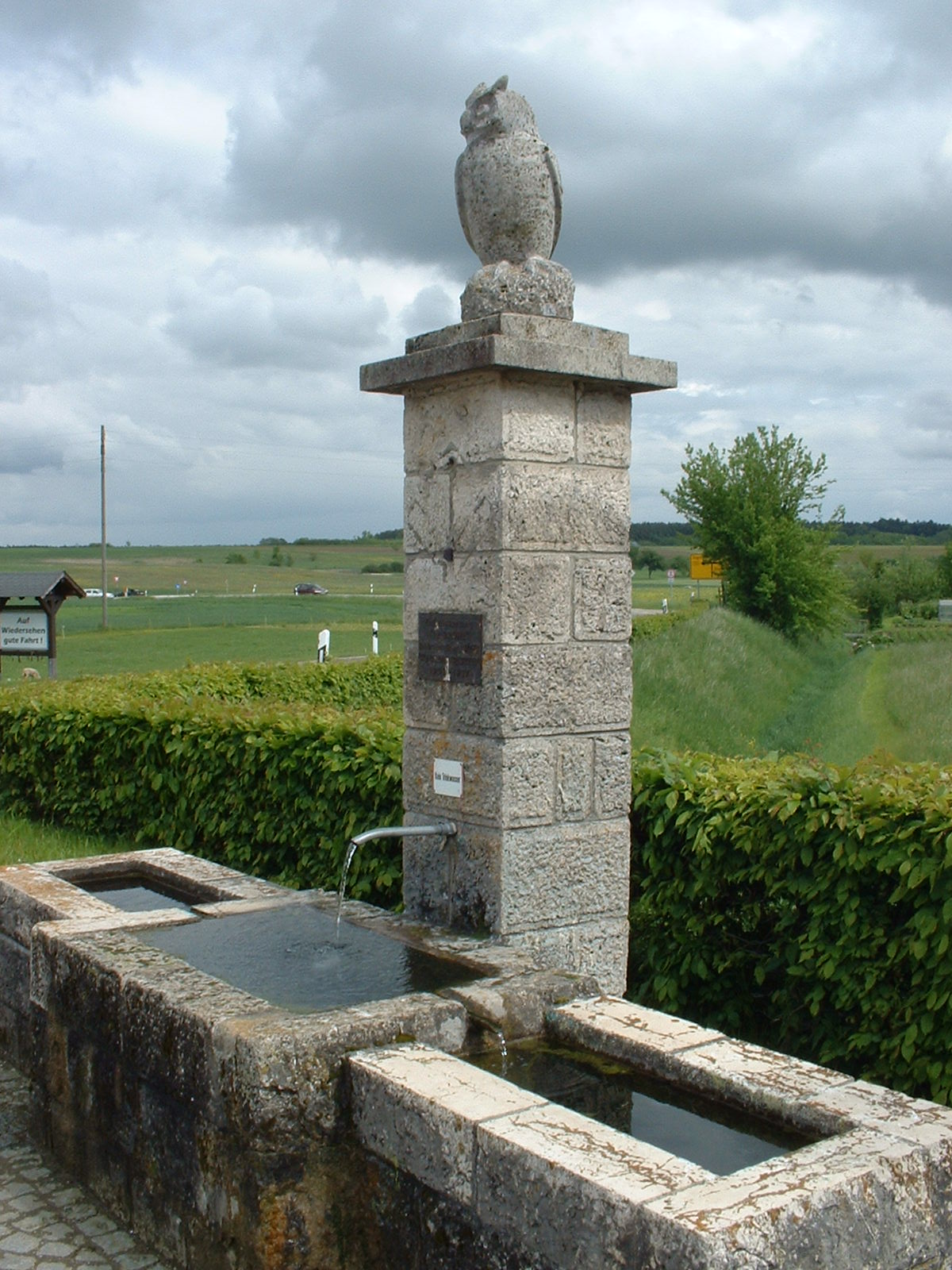
Fountain at Lower Village - Photo Credit: Stefan Klopp

Fountain at Lower Village – Photo Credit: Stefan Klopp

However, there was one problem. I had not yet learned to make a u-turn and what was worse I did not know how to stop the bike without falling and hurting myself. This meant that I was unable to turn around and get back to Karl who could assist me getting off the bike. The exhilarating sensation suddenly gave way first to mild anxiety, then to full-blown panic, as I realized that the only way to prevent a painful crash on the paved highway was to keep on pedaling. So I did, until after a few more minutes exhaustion set in and I could no longer move the bicycle fast enough to keep my balance. Fortunately, as the bike was just ready to fall on its side, I steered it into the ditch and thus avoided at least a major injury. If this had been a lady’s bike without that scary crossbar, I would have been all right. Roughed up a little in body and spirit I walked Karl’s bike back home crying all the way to express my hurt and misery.

OLYMPUS DIGITAL CAMERA

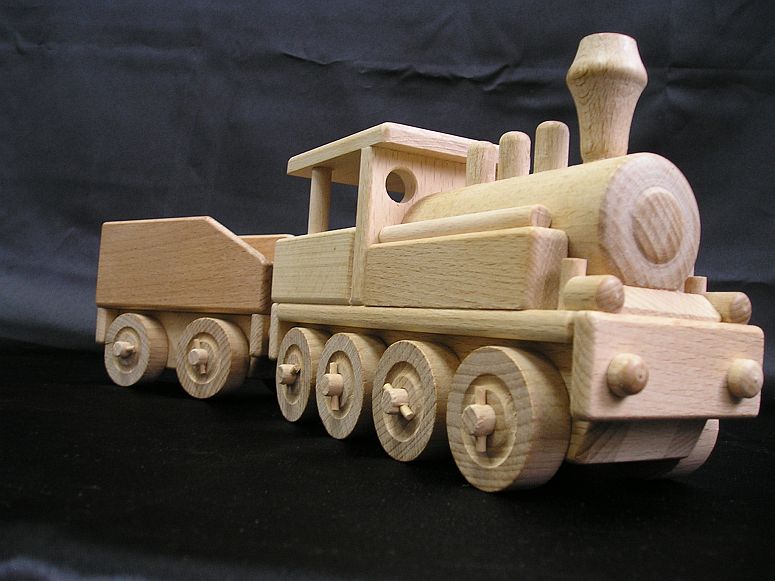
Photo Credit: lokschmiede.ch

There are two kinds of gifts, the one you buy and the one you make yourself. Although the former may be much appreciated at times for its usefulness or inherent thoughtfulness, it is the latter that is of greater value, because the giver has devoted so much time, planning, workmanship, and love to the gift. In a sense he has given part of himself to the recipient. So I feel today when I contemplate about the first Christmas gift that I can remember from the early days in the ‘Poorhouse’. Apart from the customary plate of nuts, sweets and cookies – truly highly esteemed luxury items during the rest of the year – I found under the tree a colossal wooden locomotive about half a meter long and big enough for me to sit on. It was equipped with a set of six or eight wooden wheels, which revolved smoothly around its skillfully crafted axles. It was a joy to look at and an even greater joy to play with. A lot of thought had gone into designing and building it. If I consider how few tools had been available and how primitive they were, it was truly a masterpiece. I do not know who was involved in the plan of creating this wonderful homemade toy. But it seems to me that the entire family had made a contribution to a project, which I cherished as the only true gift worth remembering all the way up to my teenage years.

Operation ‘Kleiner Bär” 1940 (in German)

Die Lebenslinien von Bruno Kegler und Rolf Barge treffen sich 1940 im Schwarzwald – Part II

 Von Dieter Barge (Chart II a – II & IV)

Die Division wurde am 31.5.1940 bei gutem Wetter in Marsch gesetzt, die Fahrt ging von Burg über Magdeburg, Halle , Naumburg nach Erfurt, das gegen Abend erreicht wurde.
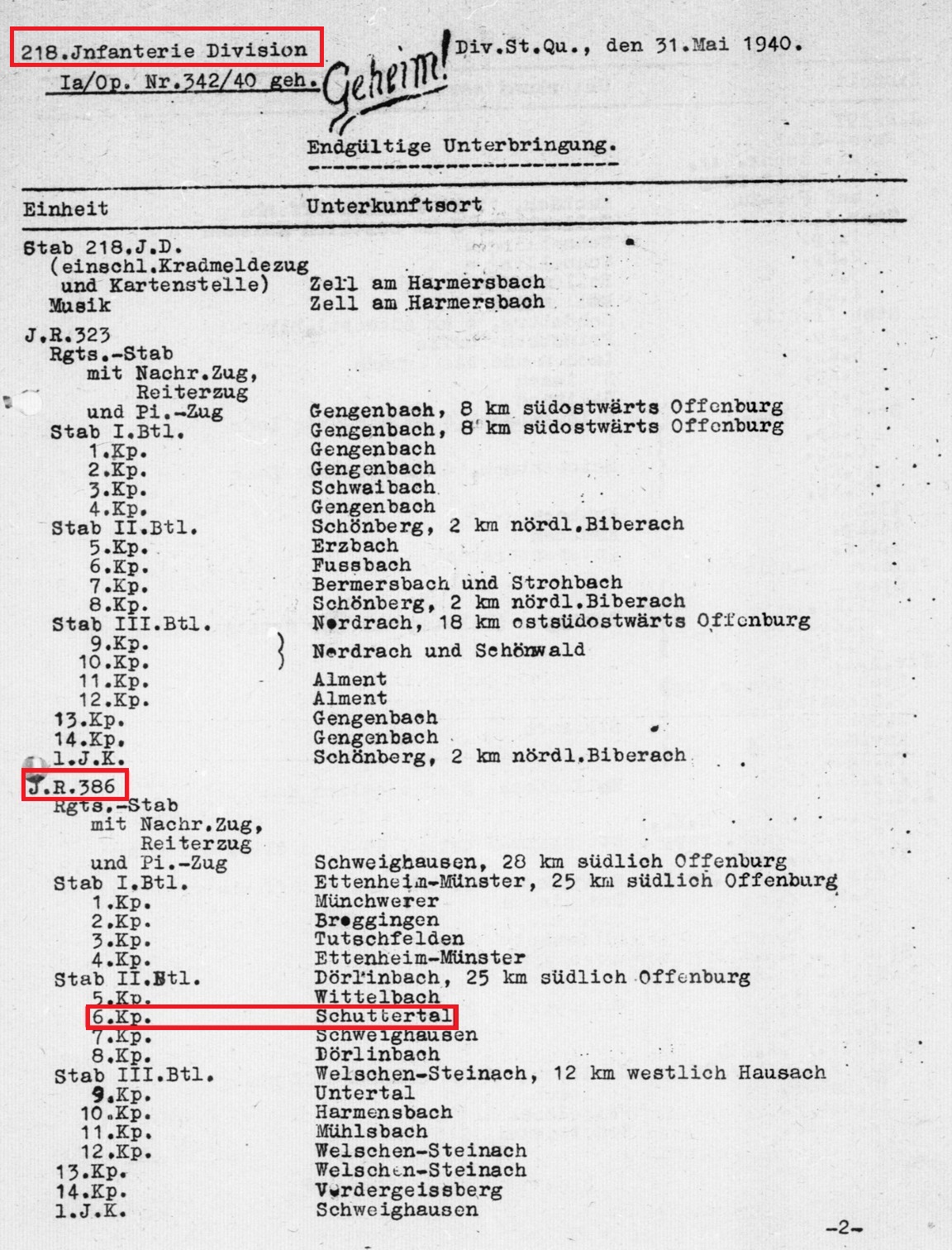
Von Erfurt ging es über die Rhön nach Frankfurt-Süd, von dort über die Bergstraße nach Heidelberg, das Neckartal hinauf bis Stuttgart. In Stuttgart (1.6.1940 abends) erfolgte die Ausladung und der Abmarsch über Freudenstadt nach Zell. Die endgültige Unterbringung der Einheit von Bruno erfolgte in Schuttertal.

Endgültige Unterbringung

Endgültige Unterbringung

Nach Tutschfelden kam die 3.Kompanie des IR 386 und die 2.Batterie des AR 216, nach Bleichheim die 3.Kompanie des IR 386, nach Schweighausen der Reg.stab des IR 386 mit Nachrichten-, Reiter- und Pionierzug. Der Regimentskommandeur des IR 386 war Oberst Manitius.

Laut Forum der Wehrmacht (FdW) hatte damals ein Infanterie-Regiment hatte ca. 3000 Mann, ein Bataillon ca. 860 Mann, eine Infanterie-Division über 10.000 Mann.
Die Unterbringung erfolgte bei den Einwohnern der Orte, in Schulen, anderen öffentlichen Gebäuden, oder es wurde biwakiert.
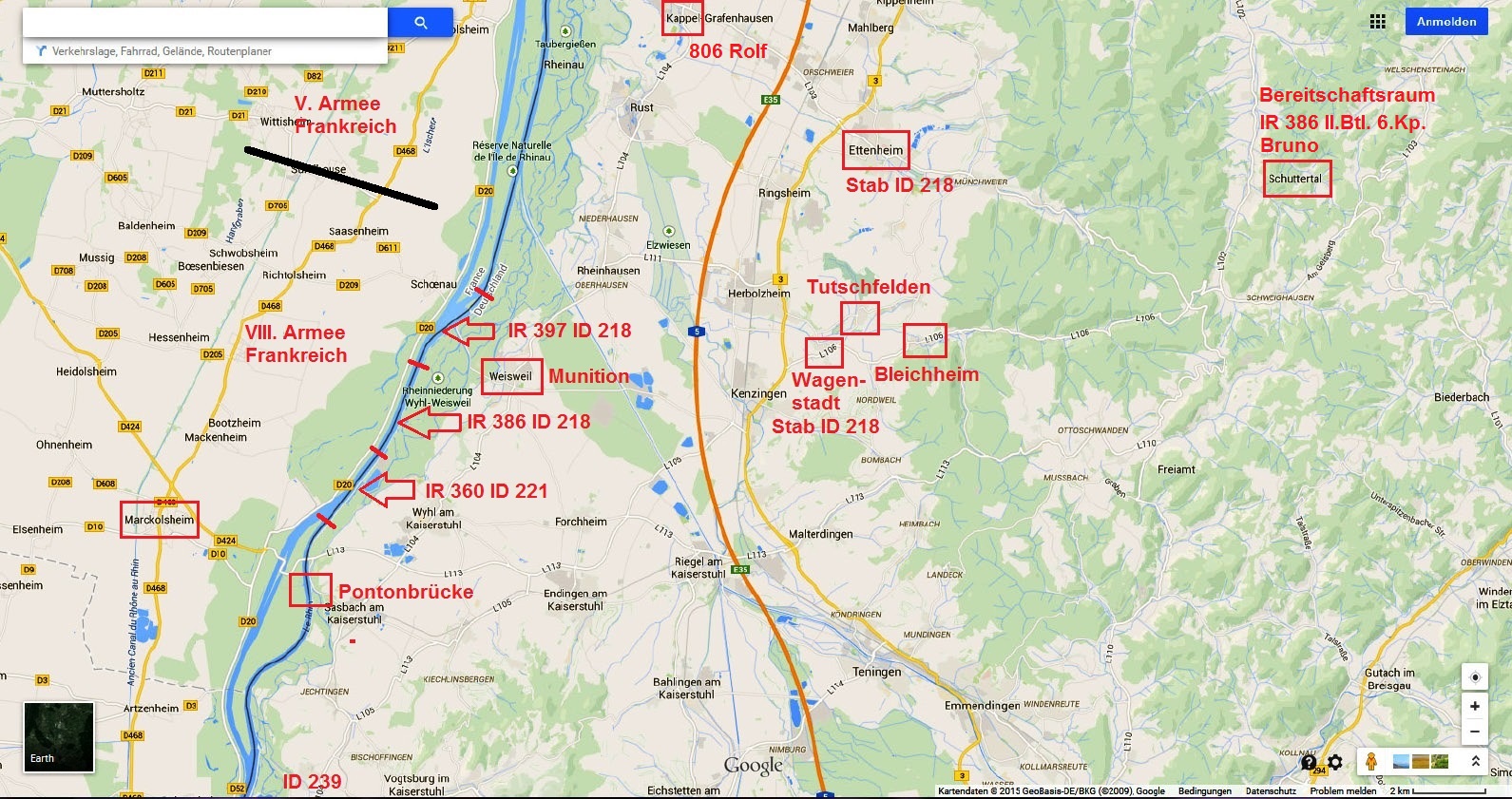
Eine Übersicht über den Oberrhein gibt das folgende Bild:

Übersicht Oberrhein

Übersicht Oberrhein

Der Angriff

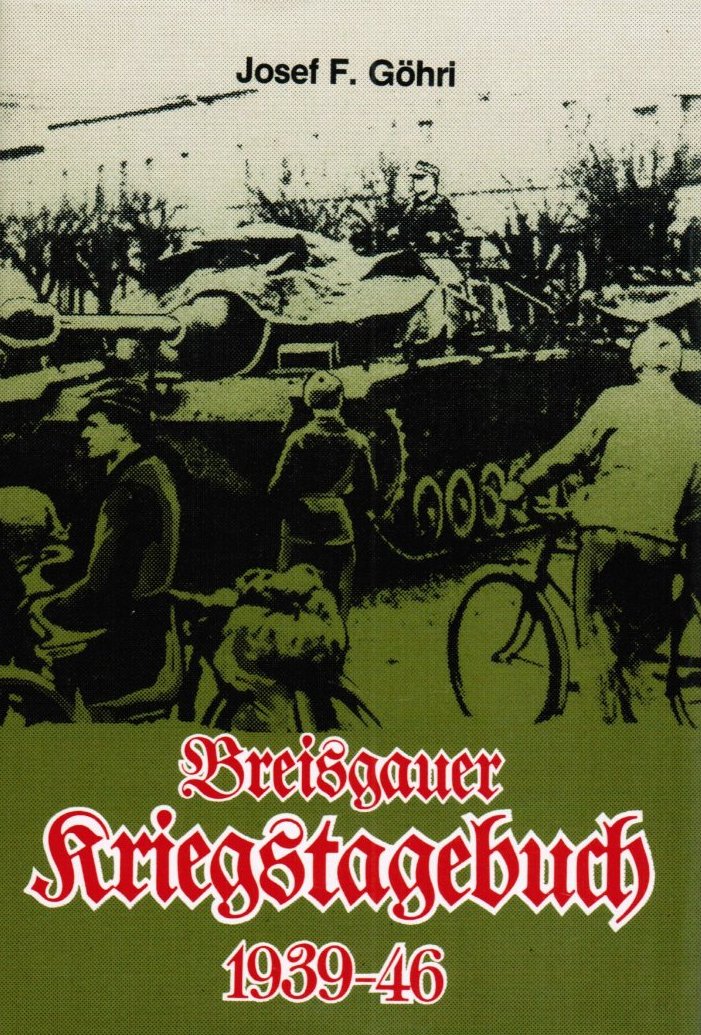
Hier der Bucheinband zu dem bereits genannten Buches von Josef Göhri:

Breisgauer KTB Göhri

Breisgauer KTB Göhri

Josef Göhri schreibt, dass die deutschen Angriffstruppen in Bleichheim in wenigen Tagen enge Freundschaft mit der Bevölkerung geschlossen hatten, aber die vollbehangenen Kirschbäume bald wie leergefegt waren. Die Dorfbewohner schauten mit einem lachenden und einem weinenden Auge zu, “wir Buben hatten das Nachsehen”.
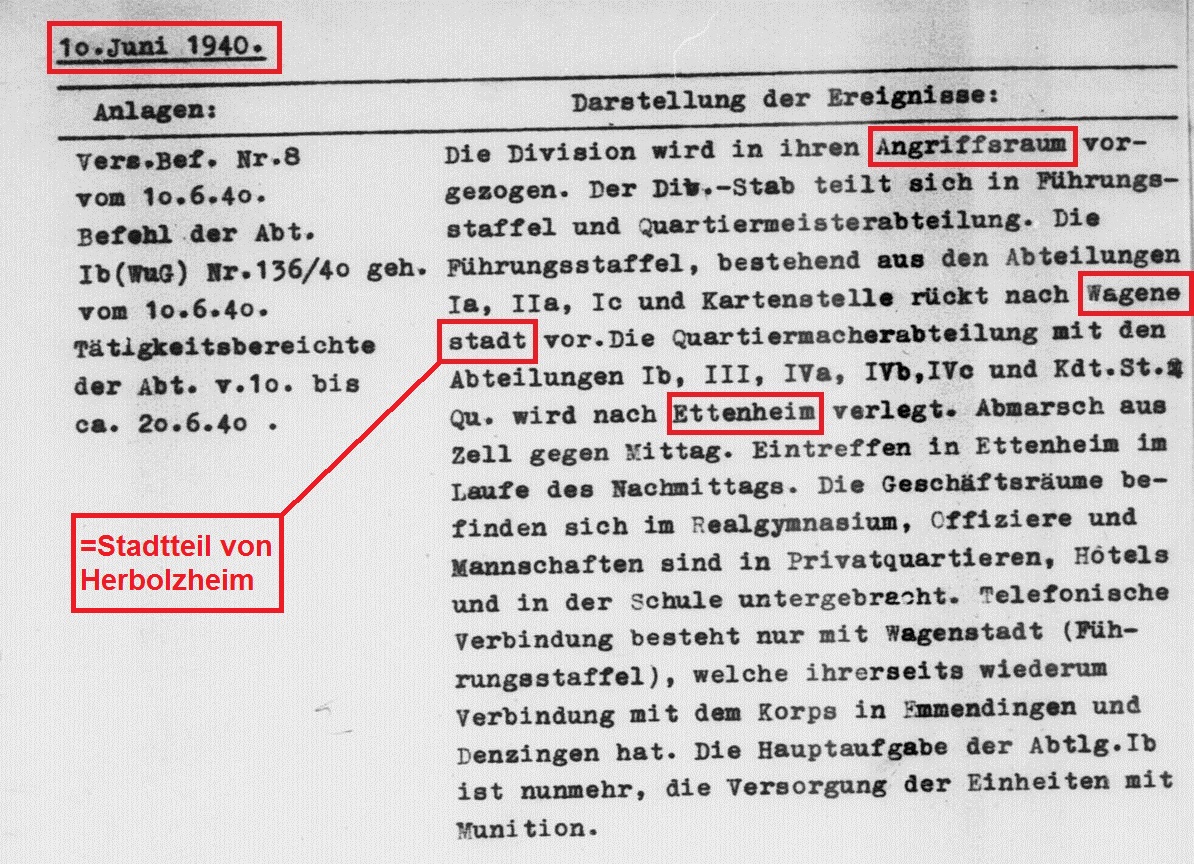
Am 10.Juni wurde die Division in den Angriffsraum vorgezogen, die Führungsstaffel der Division rückte nach Wagenstadt, einem Stadtteil von Herbolzheim, vor, der Rest des Stabes wurde nach Ettenheim verlegt.

Befehl Angriffsraum 10.6.1940

Befehl Angriffsraum 10.6.1940

Aus den beiden folgenden Dokumenten geht hervor, dass die schwere Artillerieabteilung 806 meines Vaters der 218.ID zugeordnet wurde, sie von der 218. ID verpflegt wurden und die Munition für den Angriff in Weisweil erhielt. Die 806 rückte am 14.Juni aus Oberachern nach Kappel vor.


Die beiden folgenden Bilder zeigen eine motorisierte Artillerie-Einheit bei Bleichheim, es handelt sich dabei um eine Batterie 15cm s F.H.18 (schwere Feldhaubitzen), diese Einheit kam wie Rolf auch aus dem Artillerie-Regiment 65 in Mühlhausen.

Die 218. ID gehörte ebenso wie die 221. ID und 239.ID zum XXVII. AK (Armeekorps)von General Alfred Wäger,
nördlich davon stand das XXV.AK von General Ritter von Prager mit der 555.ID und der 557.ID, südlich davon XXXIII. AK von General Brandt mit der 554.ID und der 556.ID.

Den deutschen Truppen in diesem Gebiet standen die V. und VIII. Armee Frankreichs gegenüber.

Im Vorgriff wurde die Bevölkerung in den Gemeinden zwischen Rhein und den geschützten Lagen im Schwarzwald evakuiert.

Im Rücken der französischen Armeen an der Maginotlinie war bereits die Panzergruppe Guderian unterwegs, um diese einzukesseln, am 9. Juni 1940 hatte die zweite Phase des Westfeldzuges mit der Durchbruchsschlacht durch die französische Aisne-Front begonnen. Am 12. und 13. Juni schloss sich der Kampf um Châlons s.M. und den Rhein-Marne-Kanal sowie bis zum 17. Juni die Verfolgungskämpfe über den Rhein-Marne-Kanal bis zur Schweizer Grenze bei Pontarlier an.

Am 15.6.1940 begann der deutsche Angriff auf die französische Maginotlinie um 10 Uhr mit schwerem Artilleriefeuer aus 300 Kanonen insbesondere gegen die feindlichen Bunker, um den Rheinübergang der deutschen Truppen vorzubereiten. Daran waren auch die Geschütze des Westwalls und das Eisenbahngeschütz “Kurzer Bruno” beteiligt.
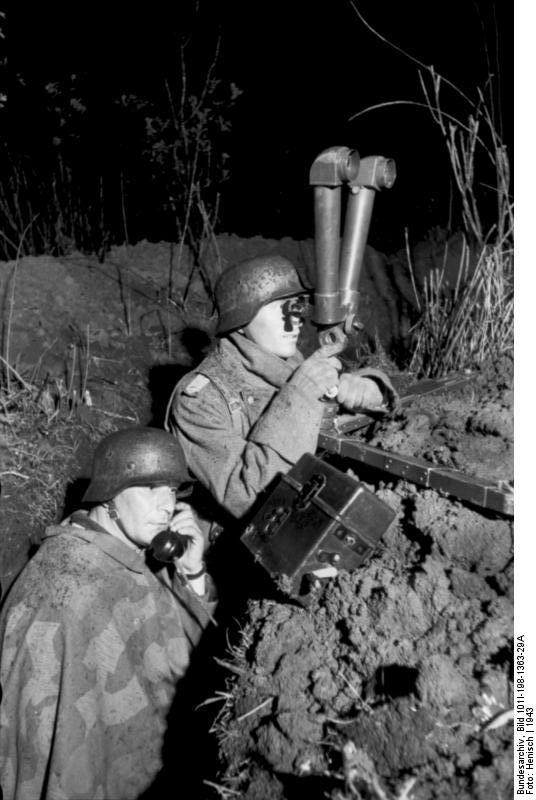
Den Tätigkeit eines vorgeschobenen Beobachters (VB), die mein Vater bei der 806 hatte, wird durch das folgende Bild vom Bundesarchiv veranschaulicht.

Russland, Artillerie-Beobachtung

Russland, Artillerie-Beobachtung

Nach dem Artilleriefeuer begann der Sturm der Einheiten über den Rhein, der geplante Einsatz von Stukas konnte wegen des schlechten Wetters nicht erfolgen. Der Rhein führte Hochwasser, Flußbreite ca. 210m, Wassertiefe 5-6 m, Strömung 3-4 m/sec, ca. 40 sec dauerte die Fahrt mit einem Sturmboot.
Ich habe die Übersetzstreifen der 218.ID einmal in der Übersicht dargestellt, vom IR 386 waren 2 Bataillone eingesetzt, Bruno war also nicht dabei. Eine Vorstellung über den Rheinübergang vermitteln die folgenden 3 Bilder von Josef Göhri, ein Bild des Bildarchivs zeigt ein Sturmboot im Einsatz.

Das IR 386 startete aus dem Raum westlich von Wyhl und sollte sich in Richtung Mackenheim vorkämpfen. Es wurden 500 Mann mit 60 MG in 6 Etappen übergesetzt. Die Fahrt über den Rhein war sehr verlustreich, vom Regiment wurden 33 Mann vermisst. Im Verlaufe des Tages wird ein kleiner Brückenkopf bis zu 500 m Tiefe gebildet.
Wenige Tage später erfuhren die Bewohner von Bleichheim von einem zurückgekehrten Unteroffizier, dass viele Soldaten in ihren Booten ums Leben kamen, “der Rhein war vom Blut rotgefärbt”!
Am 15.Juni begann durch das Pionierbataillon 685 (der 239. ID unterstellt) der Aufbau einer Pontonbrücke über den Rhein bei Sasbach, nahe den Überresten der Limburg.
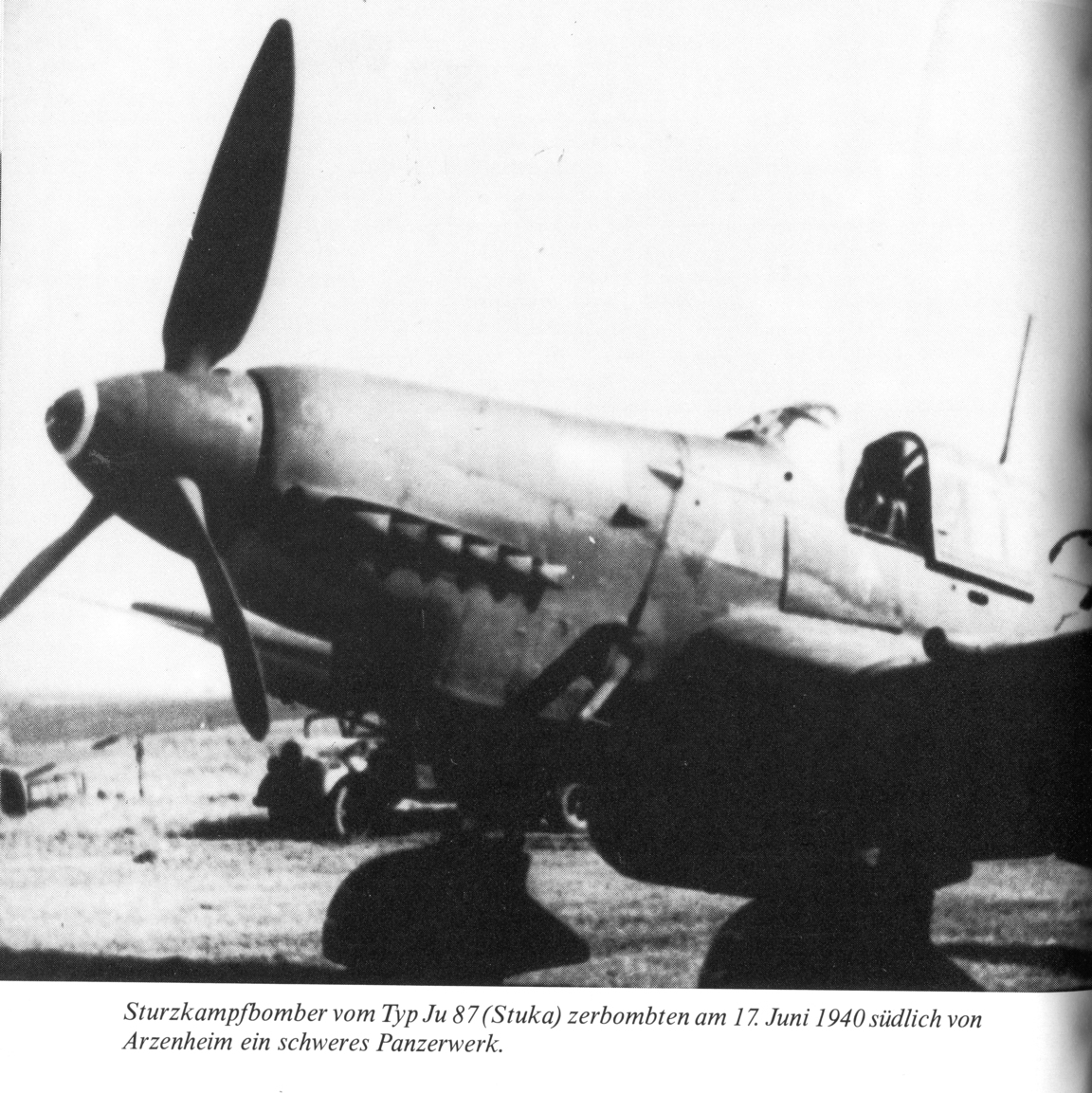
Am 16.Juni hat das IR 386 Marckolsheim erreicht, es gab Unterstützung durch Stukas.

Göhri Stuka

Göhri Stuka

Zerstörte Bunker aus dem Buch von J.Göhri:

Am Abend überquerten die Truppen den Rhine-Rhone-Kanal und eliminieren weitere französische Bunker.
Am 17. Juni wird Marckolsheim eingenommen, am 17.Juni 8 Uhr ist die Pontonbrücke fertig und schwere Waffen können übergesetzt werden. Am Abend des 17.Juni wird Colmar besetzt.

Bruno war in eine große Vorausabteilung, gebildet aus den IR 386 und 397, eingeteilt, diese Abteilung sollte eigentlich am 15.Juni übersetzen und die Spitze der ID 218 bilden, das hat nicht wie geplant geklappt. Ich berichte im 3. und letzten Teil meines Beitrages detailliert über einen Bericht, den ich in den Unterlagen der 218. ID darüber gefunden habe.

Die Einheit meines Vaters wurde, wie aus Unterlagen des XXV. Armeekorps hervorgeht, in der Nacht vom 16. zum 17.Juni der 557. ID zugeführt und unterstellt, am 18.Juni überquerte sie in der Dringlichkeitsstufe an 10.Stelle die Pontonbrücke Sasbach.
Diese 557. ID/ XXV. AK agierte im Raum Rhinau im Bereich der V. französischen Armee.
Von der Rheinüberquerung 4 Bilder meines Vaters:


Von der Operation “Kleiner Bär” gibt es einiges im Axis-History-Forum und bei Feldgrau zu lesen.

Es geht bald weiter.

Günther Kegler, Chief of the Kegler-Clan (Part II)

In 1919 Günther Kegler returned to civilian life after serving in the Imperial German army during World War I. There were two reasons for that. Having sustained severe injuries and having lost one kidney in the battles on the Western Front in 1917, he was considered unfit for active duty. However, he could have easily performed any sort of interior office functions. But following the decrees of the Treaty of Versailles, the German army had to be reduced to 100,000 men.

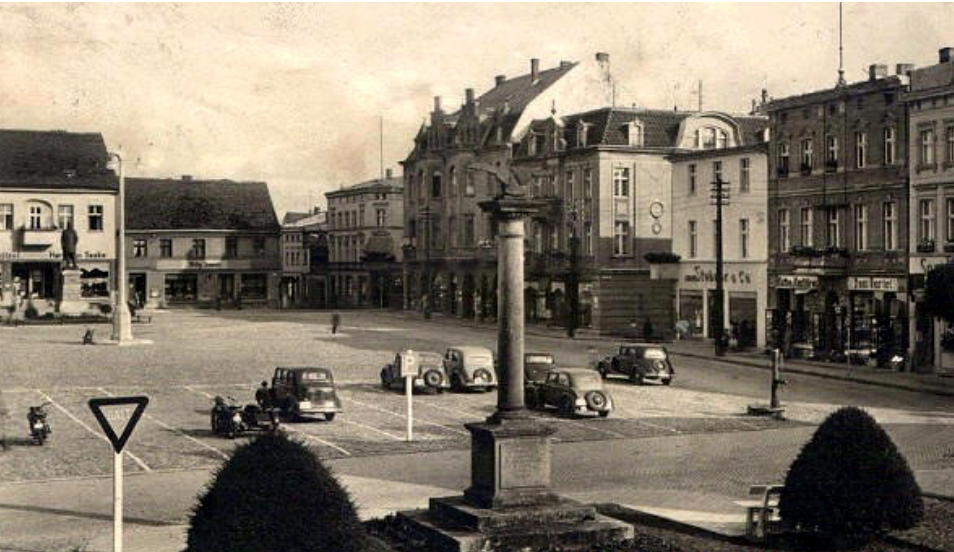
Bublitz

Bublitz Market Place 1941

So from 1919 to 1921 he took up an agricultural training program at the estate farm of Neuhütten at Bublitz, Pomerania (now Polish Bobolice). Since he was also knowledgeable in bookkeeping and accounting, he soon switched over to a more lucrative employment and worked as senior accountant at various large estates in the county of Sangerhausen about 50 km west of Halle. His income allowed him to save enough money to have a small house built in 1934, which sold next to nothing, when he left the German Democratic Republic in 1956.

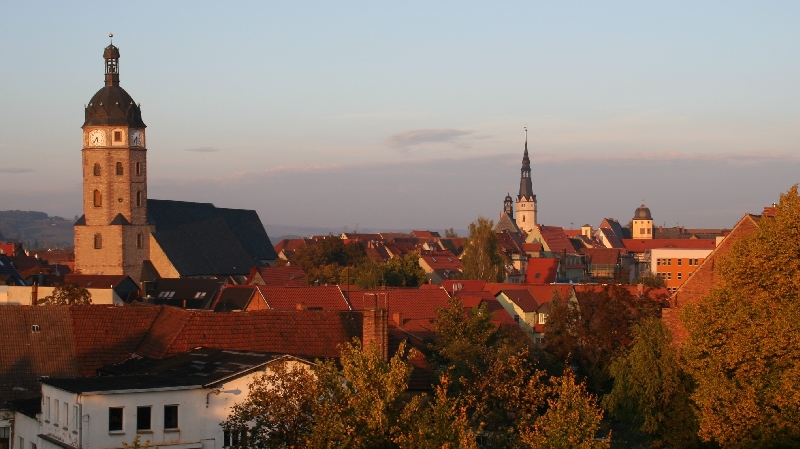
Modern Sangerhausen

Modern Sangerhausen

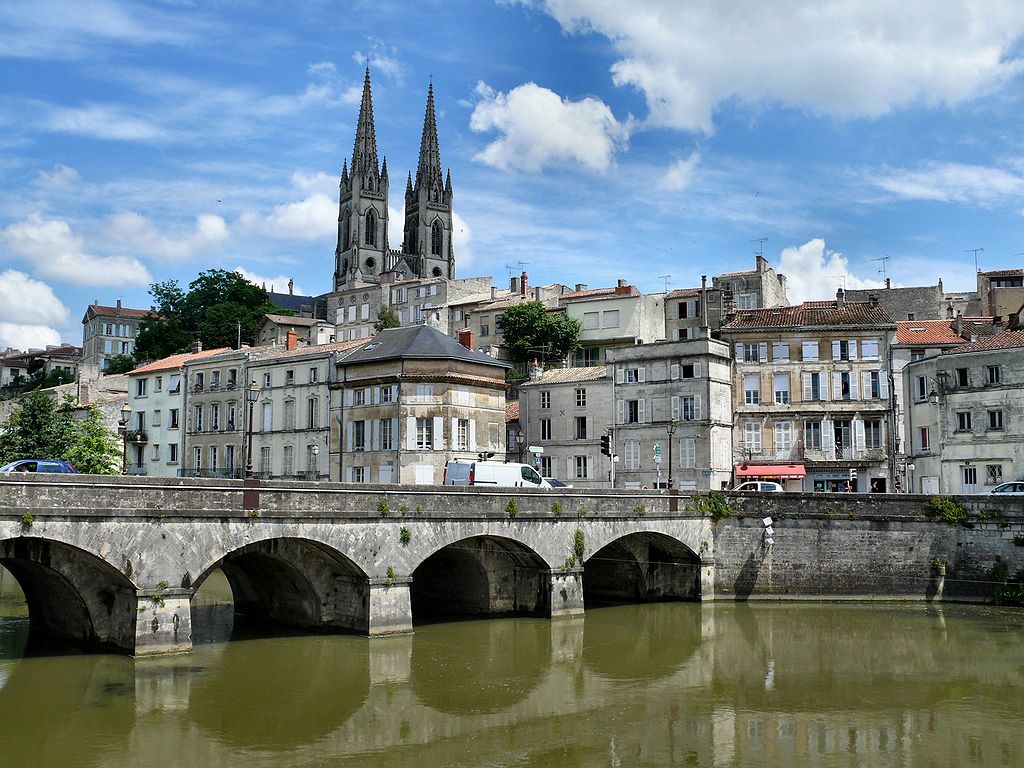
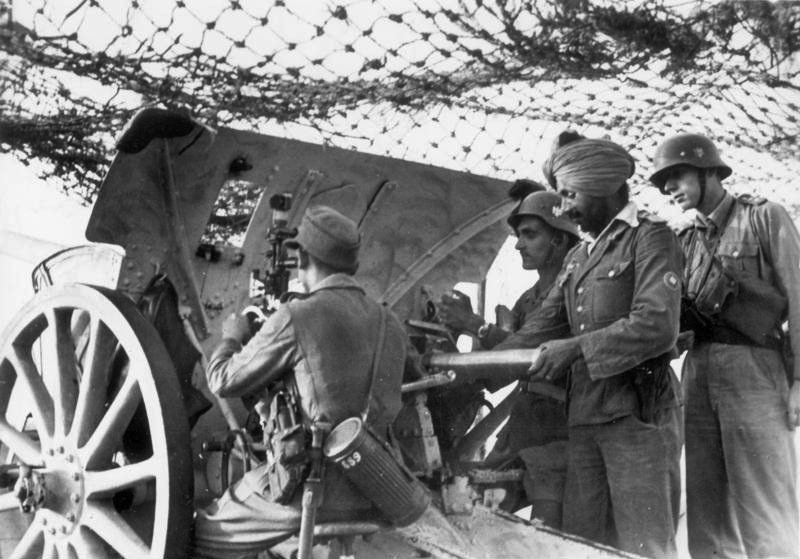
In 1938 he was ordered by the army to join and was assigned to work in the recruiting center of the reserve in Erfurt. He started out as major and quickly climbed up the ranks serving at centers in Erfurt, Kassel and Eisenach. Promoted to Lieutenant-Colonel (Oberstleutnant) he arrived in France on April 1, 1944 at St. Brieuc, Bretagne and Niort. He was primarily involved in the planning of effective defense strategies. Two months after D-Day he was responsible for the orderly withdrawal of Indian troops, Russian volunteers, railway workers, nurses etc. away from the battle fields.

Niort in Central West France - Photo Credit: Wikipedia

Niort in Central West France – Photo Credit: Wikipedia

Here I must digress and point out to a little known fact (perhaps suppressed out of embarrassment for the victors) that troops from India, Russia and volunteers from many Nazi occupied nations were fighting on the German side. See also the report of my brother Karl in Chapter 6 of the P. and G. Klopp Story, in which he wrote about young men from all over Europe willing to fight communism, which in their eyes was the greater evil. However, when I read about Indian troops as being part of the German army, I was in a state of disbelief and decided to check out the story on Wikipedia. And this is what I found and I quote,

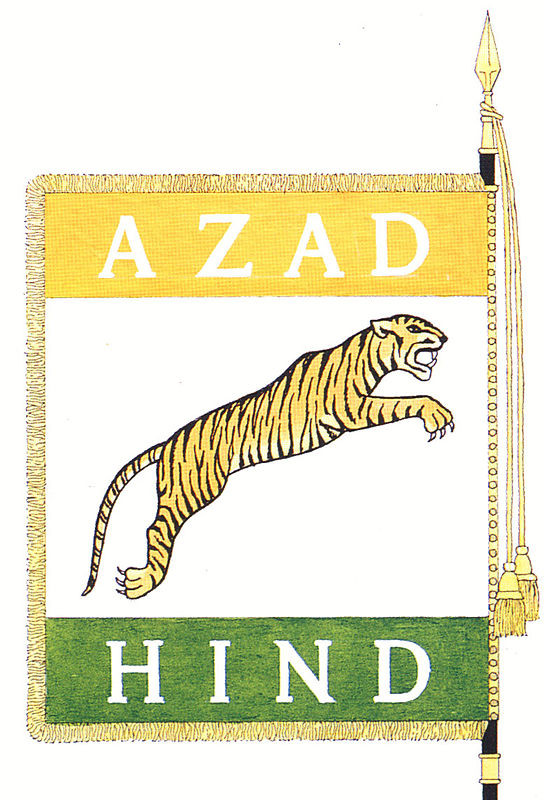
Flag_Azad_Hind

The Indian Legion (Indische Legion), officially the Free India Legion (Legion Freies Indien) or Infantry Regiment 950 and later the Indian Volunteer Legion of the Waffen-SS  (Indische Freiwilligen Legion der Waffen-SS), was a military unit raised during World War II in Nazi Germany.  Intended to serve as a liberation force for British-ruled India, it was made up of Indian prisoners of war and expatriates in Europe. Because of its origins in the Indian independence movement,  it was known also as the “Tiger Legion”, and the “Azad Hind Fauj”. Initially raised as part of the German army,  it was part of the Waffen-SS from August 1944. Indian independence leader Subhas Chandra Bose initiated the legion’s formation, as part of his efforts to win India’s independence by waging war against Britain, when he came to Berlin in 1941 seeking German aid. The initial recruits in 1941 were volunteers from the Indian students resident in Germany at the time, and a handful of the Indian prisoners of war who had been captured during the North Africa Campaign.  It would later draw a larger number of Indian prisoners of war as volunteers.

Soldiers of the Legion 'Free India'

Soldiers of the Legion ‘Free India’ – Photo Credit: Bundesarchiv Bild 183-j166

In the BBC news of September 23, 2004, we read the following:

In the closing stages of World War II, as Allied and French resistance forces were driving Hitler’s now demoralised forces from France, three senior German officers defected.

Members of the Free India Legion

Legionnaires were recruited from German POW camps

The information they gave British intelligence was considered so sensitive that in 1945 it was locked away, not due to be released until the year 2021.

Now, 17 years early, the BBC’s Document programme has been given special access to this secret file.

It reveals how thousands of Indian soldiers who had joined Britain in the fight against fascism swapped their oaths to the British king for others to Adolf Hitler – an astonishing tale of loyalty, despair and betrayal that threatened to rock British rule in India, known as the Raj.

The story the German officers told their interrogators began in Berlin on 3 April 1941. This was the date that the left-wing Indian revolutionary leader, Subhas Chandra Bose, arrived in the German capital.

Bose, who had been arrested 11 times by the British in India, had fled the Raj with one mission in mind. That was to seek Hitler’s help in pushing the British out of India.

He wanted 500 volunteers who would be trained in Germany and then parachuted into India. Everyone raised their hands. Thousands of us volunteered
Lieutenant Barwant Singh

Six months later, with the help of the German foreign ministry, he had set up what he called “The Free India Centre”, from where he published leaflets, wrote speeches and organised broadcasts in support of his cause.

By the end of 1941, Hitler’s regime officially recognised his provisional “Free India Government” in exile, and even agreed to help Chandra Bose raise an army to fight for his cause. It was to be called “The Free India Legion”.

Bose hoped to raise a force of about 100,000 men which, when armed and kitted out by the Germans, could be used to invade British India.

He decided to raise them by going on recruiting visits to Prisoner-of-War camps in Germany which, at that time, were home to tens of thousands of Indian soldiers captured by Rommel in North Africa.

Since all this was top-secret at the time my uncle just mentioned in passing the presence of Indian troops in his family chronicle in 1975, this would have been explosive news, if it had found its way into the international press.

To be continued