Eine ergreifende Liebesgeschichte – 6. Teil

Gespräch über „Gott und die Welt“

Gisela und Hartmut (Kegler Stammbaum Chart II a – III) lernten Albert während ihrer Verlobung kennen, die in Quitzöbel gefeiert wurde. Hier sorgten Vati und Jürgen, Muttis jüngerer Bruder, für lustige Unterhaltung. Hartmut führte an diesem Tag ein langes Gespräch mit Albert, das er bis heute nicht vergessen hat:
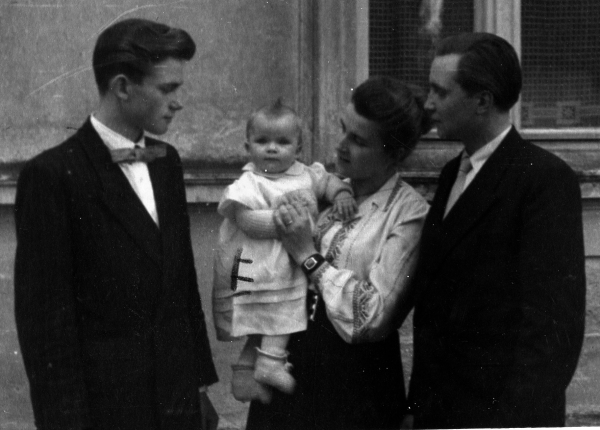
 

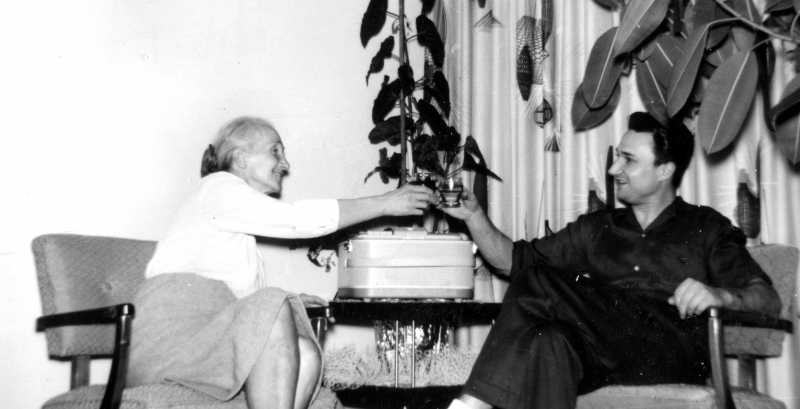
Eddas Taufe 1955 mIt Jürgen Hartmut Gisela

Eddas Taufe 1955 mit Jürgen, Hartmut und Gisela

Hartmut:

„An Eberhards Vater erinnert mich ein endlos langes, heftig geführtes Gespräch über „Gott und die Welt“. Ich vertrat damals die kirchliche Seite, er dagegen war überzeugter Atheist. Als ich später Ludwig Feuerbachs denkwürdige Schrift über das „Wesen des Christentums“ las, wuchs mein Respekt vor jenem streitbaren Gesprächspartner. Er erwies sich als ausgezeichneter Kenner der Bibel und argumentierte auf dieser Grundlage so folgerichtig, dass ich ihm mit meiner stümperhaften Theologie nicht gewachsen war. Das ärgerte mich auch gehörig, trug aber, als ich etwas vernünftiger wurde, auch zu meiner kirchenkritischen Einstellung bei. Ein einfacher Kutscher hatte einem jungen Akademiker geistig auf die Sprünge geholfen!“


Albert lebte vielleicht ein Jahr bei unseren Eltern. Als Eberhard an die Schule nach Baek versetzt wird und Familie Trampenau nach Gulow zieht, geht er in ein Altersheim nach Mecklenburg. Elisabeth hatte sich durchgesetzt!


In dieser Zeit hatte sich unsere Oma Hanna an der Hilfsschule in Bad Wilsnack als Lehrerin beworben und war auch dorthin versetzt worden. Sie bekam dort eine kleine Wohnung, zwei Zimmerchen mit Küche im ersten Stock, die nur über eine steile Treppe erreichbar war. Für Opa Manuel, der ja nur mit Krücken laufen konnte, war der Weg in die Wohnung sehr beschwerlich. Aber da es in der Ehe von Johanna und Emanuel ohnehin gerade ziemlich kriselte, wohnten Oma Hanna und Omchen zeitweise allein in Bad Wilsnack.

Edda 1956

Edda 1956

Auch Elisabeth, Eberhard und die kleine Edda besuchten sie hier von Zeit zu Zeit. Einmal, als auch Jürgen gerade dort war, wurde Edda, die gerade laufen konnte und daran gewöhnt werden sollte, ihr Geschäft auf dem Töpfchen zu verrichten, auf dasselbe gesetzt. Sie wollte aber nicht sitzen bleiben, stand immer wieder auf und tappelte zu Großmutter in die Küche. Jürgen setzte sie wieder hin, und als sie sofort wieder aufstehen wollte, brüllte er sie an: „Setz dich jetzt hin!!“. Edda, die sonst von Jürgen nur lustige Töne gewohnt war, plumpste mit fassungslos aufgerissenen Augen wieder auf den Topf, erledigte umgehend ihr Geschäft, und alle lobten Jürgen ob seiner pädagogischen Fähigkeiten.

Emanuel kam in Mellen sehr schlecht allein zurecht.
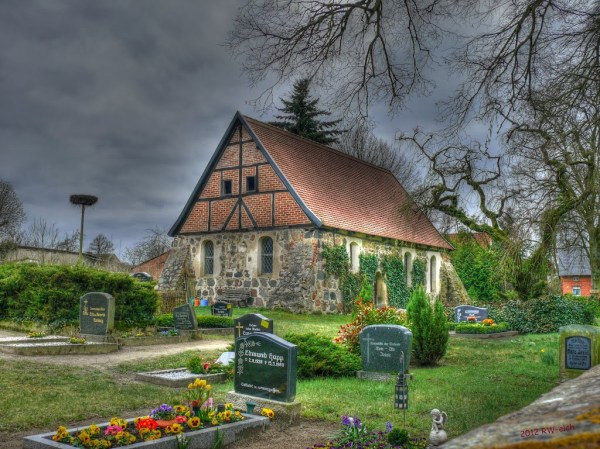
Dorfkirche mit Friedhofsansicht in Mellen - Photo Credit: Panoramio

Dorfkirche mit Friedhofsansicht in Mellen – Photo Credit: Panoramio

Jürgen(Kegler Stammbaum Chart II a – III) :

Nachdem Emanuel mit seiner ständigen Nörgelei allen die Nerven zersägt hatte, kam Hartmut bei einem seiner Besuche auf die Idee einer Scheidung. Wir, Elisabeth und ich, griffen das begeistert auf, Omchen schwieg sehr beredt dazu, denn Scheidung war in ihrem Lebensbild etwas Unanständiges. Hartmut drängte mit Argumenten, Elisabeth und ich emotional. Schließlich fuhr das scheidungswillige Ehepaar zum Amtsgericht in Perleberg vor den Scheidungsrichter. Ich war bei dem Termin dabei. Es gab keinen, der nach dem Gesetz schuldig war, und so wurde nach Scheidungsgründen gefragt. Weder Emanuel noch Johanna wusste so richtig darauf zu antworten, denn Nörgelei war kein Grund, und dass die Kinder es so wollten, auch nicht. Also entschied der Richter, sie mögen doch zu Hause noch einmal in Ruhe darüber nachdenken und schloss die Sitzung. Sichtlich erleichtert fuhren die Eheleute wieder nach Mellen zurück. Ich war überzeugt, wäre Emanuel nicht an Krücken gegangen, dann hätten die beiden das Amtsgericht Händchen haltend verlassen. Ich war natürlich enttäuscht, Elisabeth und Hartmut nicht minder.

Im Nachhinein, nachdem ich schon im Westen war und Emanuel verstorben, schien mir der Ausgang des Scheidungsversuches sehr glücklich, denn meine Mutter hätte sicher bis an ihr Lebensende an dem Selbstvorwurf gelitten, einen hilfsbedürftigen Menschen im Stich gelassen zu haben.


Oma Hanna und Omchen zogen – zu unserem Glück – wieder nach Mellen zurück.


Chapter 21 of the P. and G. Klopp Story – Part III

Storm Clouds on the Horizon

In the meantime Biene had an exciting vacation with her family in Bavaria, often went paddling on Lake Ammer with her parents’ folding boat. She and her twin brother Walter almost drowned, when their boat capsized in a violent storm. They traveled to the German Alps and even took a gondola ride up to the Zugspitze, which is with an altitude of 3000 m the highest mountain in Germany. She returned home filled with wonderful memories. There was so much to tell, but the flow of letters began to ebb. The intervals between them began to widen into two-week gaps. Something must have happened that made me worry. Had my letters lost its fervor? Were the thoughts expressed too philosophical, self-centered, out of touch with reality? I could not tell.

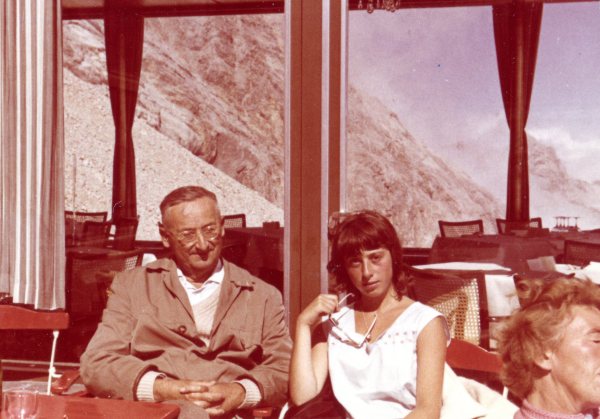
Biene and her father on the Zugspitze 1963

Biene and her father on the Zugspitze 1963

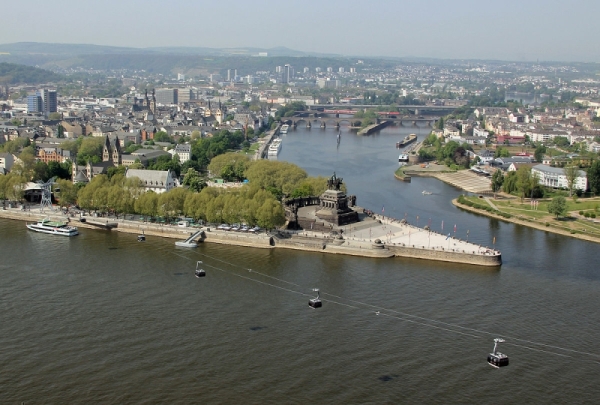
Fall was a beautiful time in Koblenz. The park at the German Corner, located at the confluence the Rivers Moselle and Rhine, was ablaze with brilliant red, yellow and orange colors. There I often sat on a park bench alone away from the noisy inner city and read about the fall and utter destruction of Rome’s rival Carthage in Mommsen’s History of Rome. I was fascinated to discover that the cause of the three Punic wars was the same as of most other conflicts in the history of mankind, namely the desire for economic power and growth at the expense of some other country. I gained important insights into the ways in which imperialistic expansions were intertwined with a general decay of the moral fiber of a nation. I saw so many parallels in our modern world that I contemplated writing a novella on the mighty city on the North African shore, if I could only add and weave in some personal experiences to the story to make it more interesting. These experiences were coming my way faster than expected, and in the end I got more than I had bargained for. Indeed I would have preferred not to write the novella in exchange for the pleasant status quo.

Deutsches Eck in Koblenz, Germany

Deutsches Eck in Koblenz, Germany – Photo Credit: wikipedia.org

I had just settled into the routine of orderly army life with its duties of monthly night watches, sessions of theoretical and practical instructions and the occasional maneuvers, which I enjoyed more and more, because they took place in the great outdoors away from the stuffy barracks in the city. Then a command from the newly formed signal corps at Maxhof in Bavaria went out to all army divisions to provide two truck drivers each. Our crafty commanding officer in Koblenz selected private Gauke and me for the transfer effective October 1st, even though we had no driver’s license for those colossal Mercedes communications trucks. Obviously, he wanted to keep his precious truck drivers for himself. We were told that we would receive professional training and certification that could be very useful later on, when we returned to civilian life. However, it was immediately clear to my that with the transfer to Maxhof, I would lose out on the chance of becoming part of the upcoming officer’s training program. It would upon successful completion raise me to the rank of a lieutenant of the reserve with a much higher pay-out at the end of my two-year term. The wheels had been set in motion. I had no recourse to an appeal process. The decision was final. I was devastated.

58

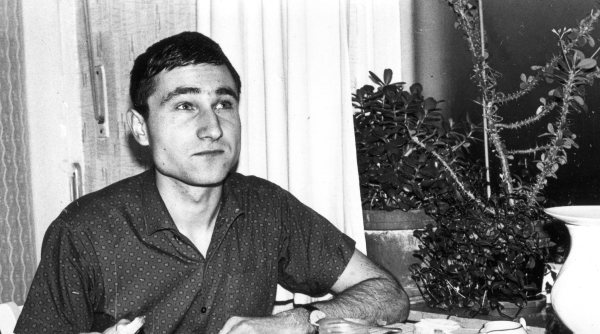
Peter in a contemplative mood at home in Watzenborn-Steinberg

Chapter 21 of the P. and G. Klopp Story – Part II

To my dear blogging friends: Please note there will be only two posts next week. The one on Tuesday will continue with Anke Schubert’s submission in German: Eine ergreifende Liebesgeschichte, and the one on Thursday will be the next episode of the P.and G. Klopp Story. Canada is celebrating Victoria Day with one extra holiday for the month of May.

Discussion with a Friend on the Nature of Love

Mother had just returned from a visit to Gerry, daughter-in-law Martha and her one-year old grandson Wayne in Medicine Hat, Alberta. It so happened that I was on a ten-days leave and spent a relaxing vacation with her and Aunt Mieze, Aunt Lucie and Uncle Günther at their wonderful house in Watzenborn-Steinberg (Pohlheim). Mother talked a lot about her exciting trip to Canada. The proud grandmother had traveled with Gerry’s family over the Rocky Mountains all the way to beautiful British Columbia. Gerry described the countryside with its lush valleys, wild rushing streams, spectacular scenery and mild climate as God’s country. True to a long family tradition in the Kegler branch of the family, Mother wrote a report of her experiences of her journey to the land of the beavers.

12

Mother Erika Klopp with Gerry on her visit to Canada

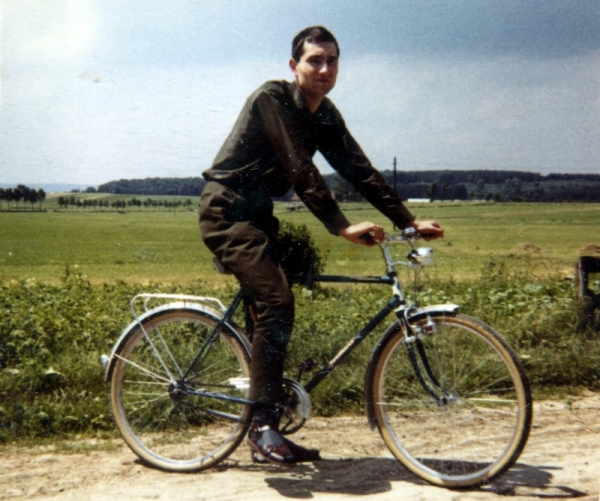
Biene’s school holidays were approaching. In 1962 her family had spent their vacation on the Mediterranean island of Corsica. Now they were planning to spend a couple of weeks at Lake Ammer in Bavaria. Even though I felt my love for Biene was getting stronger with every passing week, I did not openly declare it to her, because I erroneously assumed that she would already know. When she once asked me if I had ever been in love, I missed the golden opportunity to reveal what was on my heart. Instead I used a ride on my brand-new bicycle as a metaphor to describe in the most abstruse way the chaotic state of my inner being. I described how I got lost in the woods. I did not know which way to choose to get out. I dug deep into my psyche, too deep for comfort. Not yet realizing that the good and the evil lie close together within each and every human being, I criticized the world for failing to give me directions. Blind as a bat to my own flaws and weaknesses, I declared the entire world with its political systems, the church, and the army rotten and corrupt. These pathetic meanderings of my mind did very little to express my true feelings for her and would have been better left unsaid.

28a

Peter on his brand new bicycle

For the remaining three or four days I went on a bicycle tour with Dieter, my new army buddy. We traveled first up the River Moselle, then climbed up into the Eifel Mountains and stopped at a beautiful campsite named Pomerania, which reminded me of my grandparents’ lost home province in the east. At nightfall we sat in front of our tent looking at the rising moon in a cloudless sky. The day before I had bought a bottle of Moselle wine, a Riesling well-known for its distinguished qualities due to the grapes, which incredibly ripen more fully during extended periods of autumnal fog in the river valley. Gazing at the crescent of the rising moon I remarked, “If me girl-friend in Velbert also looked at the moon this very minute, our eyes would be fixed on the same heavenly object and in some esoteric way we would be connected with one another.”

X294

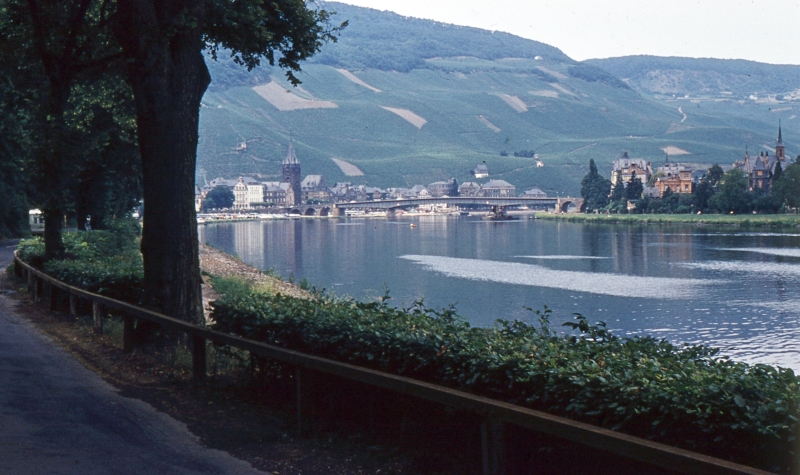
Famous Moselle Valley with Germany’s finest Vineyards

Dieter chortled a few times, before he retorted, “But my friend, don’t be an idiot. That is not the same as being physically present. When I kiss my beloved Heidi, I know real love, love that you cannot even fathom with your strange romantic ideas in your head.” And that was the beginning of a long discussion on the nature of love. When we had savored the last drop of the wine and were ready to crawl into the tent, we had moved away from our opposite points of view and found some middle ground. We agreed that in order for a relationship to be meaningful both the physical and spiritual dimensions would have to be present. We learned something important from each other. As for me, I resolved to arrange a rendezvous with Biene at the first opportunity that would offer itself in the near future. But you never know to start with, how things turn out in the end.

Eine ergreifende Liebesgeschichte – 3. Teil

Hochzeit ohne Familie

Es blieb nicht aus, dass auch das Schulamt Wind von der Sache bekam. Es gab ziemlichen Ärger und Elisabeth wurde „strafversetzt“, sie kam noch 1953 nach Rühstädt. Doch auch diese Maßnahme brachte ebenso wenig Nutzen, wie die häufigen Besuche von Elisabeths Großmutter, unserem Omchen, in Rühstädt, die dem Zweck dienten, die beiden zu trennen. Eberhard fuhr abends oft mit dem Fahrrad nach Rühstädt, um seine Elisabeth heimlich zu treffen. Einmal wäre er dabei beinahe Omchen in die Arme gelaufen, die gerade wieder in verlorener Mission unterwegs war. In letzter Sekunde erkannte er die Gefahr und machte sich schleunigst wieder auf den Rückweg.

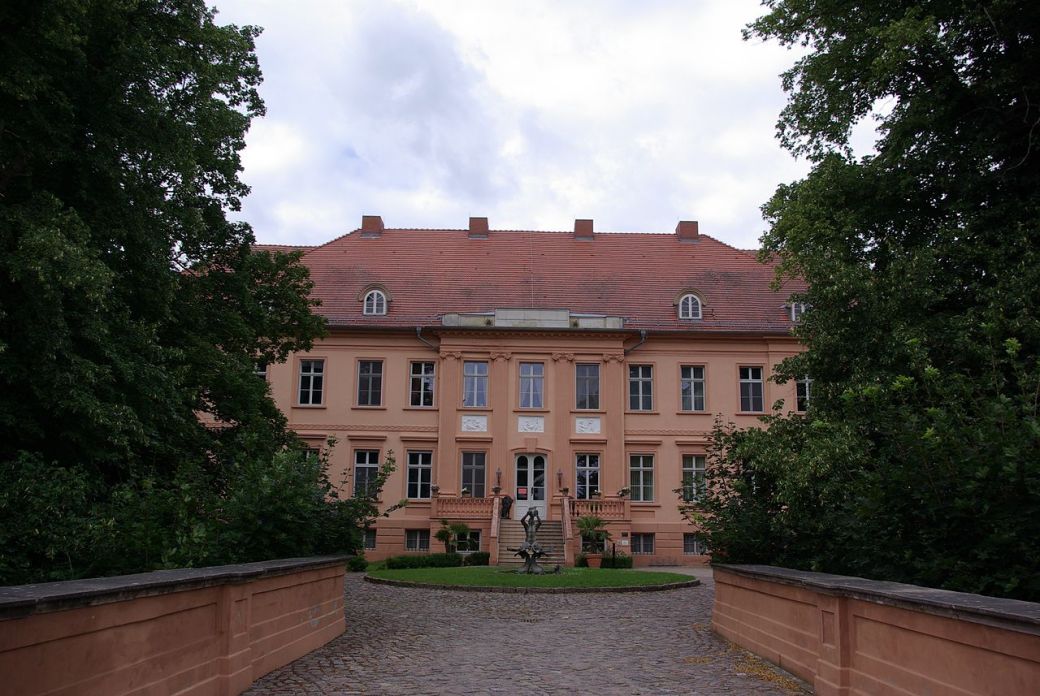
Schloss Rühstädt Photo Credit: wikipedia.org

Schloss Rühstädt – Photo Credit: wikipedia.org

Eberhard stand zu seiner Liebe und leitete seine Scheidung in die Wege, und als er auf diese Weise seine „Familienangelegenheiten“ in Ordnung gebracht hatte, wie es sich für einen Schulleiter gehörte, durfte Elisabeth wieder an die Schule in Quitzöbel zurückkehren.

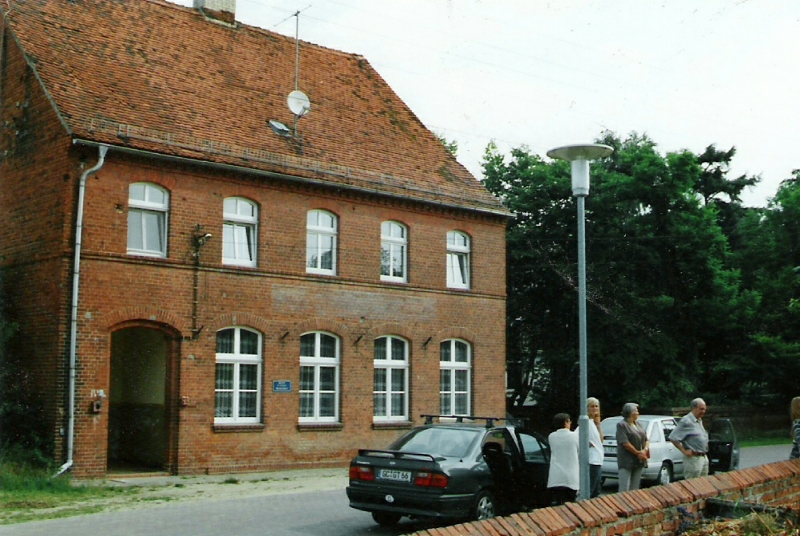
Die Lehrerwohnung in Quitzöbel 2003

Die Lehrerwohnung in Quitzöbel 2003

Nun gab es zwar dienstlich keine Beanstandungen mehr, aber Mutter Johanna und Omchen waren noch lange nicht mit der Beziehung einverstanden. Wenn ich heute zurückblicke, waren sie das wohl nie aus vollem Herzen. Elisabeth verstand sich gut mit ihrem Bruder Hartmut und dessen Freundin Gisela. Die beiden Frauen trafen sich oft in Bad Wilsnack, wo die Weiterbildungen zur Vorbereitung auf die Lehrerprüfungen stattfanden. Oft gingen sie nach dem Unterricht noch eine Bockwurst essen und unterhielten sich. Bei einem dieser Treffen war auch Hartmut dabei. Den beiden fiel auf, dass Elisabeth sehr schlecht aussah, und sie führten das auf die große seelische Belastung durch die Auseinandersetzung mit Mutter und Großmutter zurück. Elisabeth konnte sich jedoch leider nicht entschließen, Gisela und Hartmut von dem wahren Problem zu erzählen, das in ihr heranwuchs – mein Schwesterchen hatte sich auf den Weg gemacht, das Licht der Welt zu erblicken. Ich glaube nicht, dass sie befürchtete, ihr Bruder könnte sie zu Hause verraten, vielmehr wollte sie ihn sicher nicht vor die Entscheidung stellen, sich entweder der Schwester oder aber der Mutter gegenüber loyal zu verhalten. Elisabeth und Eberhard glaubten keinen anderen Ausweg zu sehen, als alle vor vollendete Tatsachen zu stellen, und so kam es dazu, dass sie am vierten Juni 1954 allein und ohne die Familie zuvor davon in Kenntnis zu setzen, heirateten.

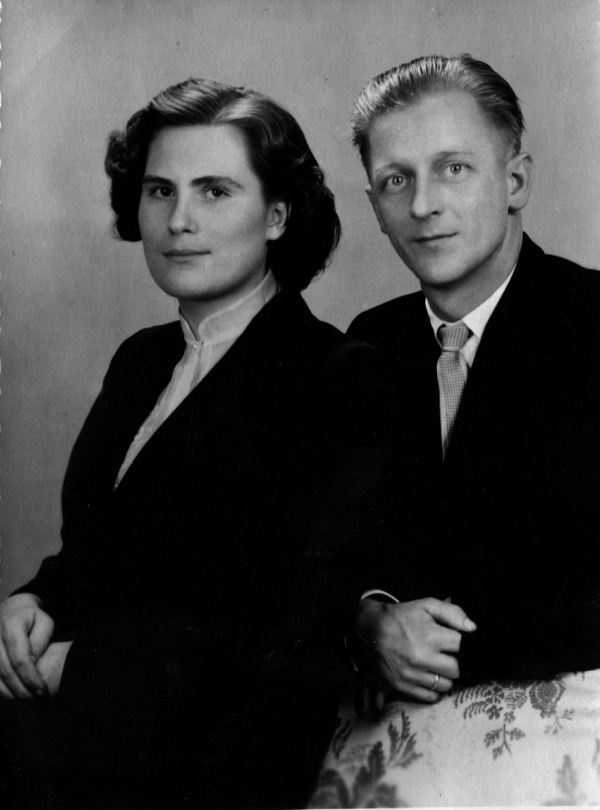
Elisabeth und Eberhard Trampenau am Tag ihrer Hochzeit

Elisabeth und Eberhard Trampenau am Tag ihrer Hochzeit

Chapter 21 of the P. and G. Klopp Story – Part I

Sorrows of Young Peter


“The Five W’s of Life:
WHO you are is what makes you special. Do not change for anyone.
WHAT lies ahead will always be a mystery. Do not be afraid to explore.
WHEN life pushes you over, you push back harder.
WHERE there are choices to make, make the one you won’t regret.
WHY things happen will never be certain. Take it in stride and move forward.”

Anonymous


With the transfer to the Falckenstein Barracks in Koblenz things were looking up for me. Our room was only slightly smaller than the one we had at the basic training camp, but instead of fifteen men only ten would share the sleeping facilities. The only drawback at the beginning was that the windows were facing one of the major north-south traffic arteries. The noise from the trucks and cars was considerable and lasted right through the night. At first I thought I could not sleep at all in a room inundated by the roar of engines and swishing of tires even with the windows closed. But little by little I got used to it and like the loud surf at the seashore at the Baltic Sea it no longer bothered me after a few days. I am sure that if the din below had suddenly stopped the silence would have woken me up.

80

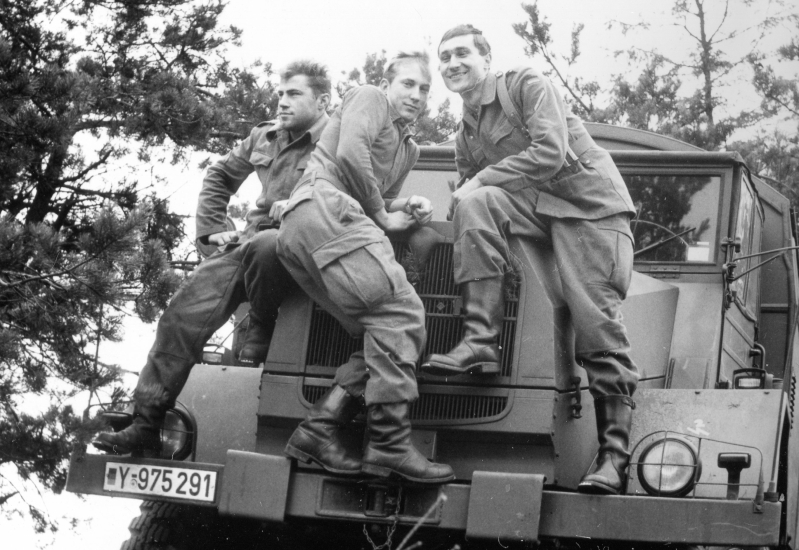
Peter on the right with truck driver and communication assistant

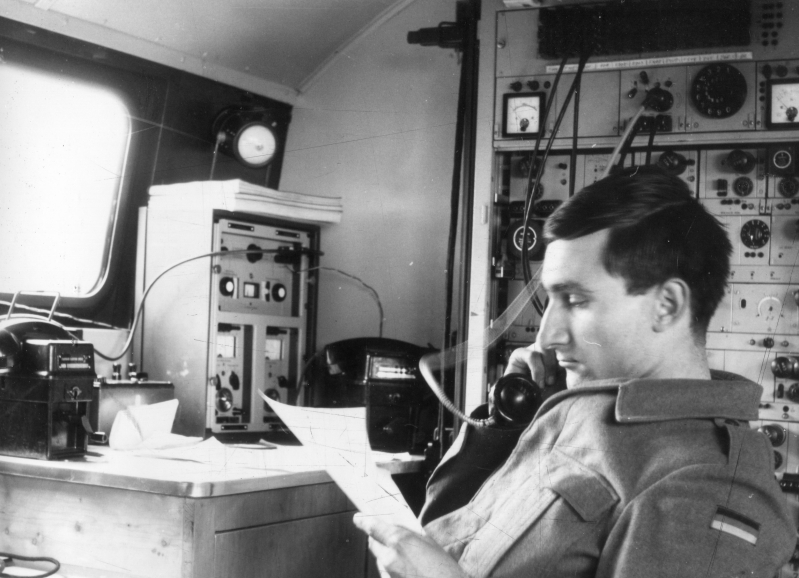
Also the pace of our daily routines significantly slackened. We still had to line up and stand at attention for the morning and noon announcements. But there were now more instructional sessions both theoretical and practical with emphasis on specialization depending to which of three major groups we belonged in the signal corps. The linemen were responsible for connecting the various field centers during military exercises. They had from a physical perspective the toughest job. Rain or shine, heat or cold, their task was to unroll miles of cable and when the maneuver was over roll it back onto the empty drums on their backs. I had the good fortune that I was assigned to the second group. I was working inside a Mercedes truck packed with electronic gear, which I had learned to operate during my training sessions. The linemen would arrive huffing and puffing after a strenuous march through forests and fields. All I had to do was to connect the wires to the carrier frequency sets, call up my counterpart at the other end and tune up the line so that it would be capable of carrying several channels at once. It was the latest technology in those days, but miniscule by today’s standards, where thousands of telephone calls can be placed over a single wire or a wireless connection. The third and most prestigious group consisted of the wireless operators trained to set up and maintain point-to-point, line-of-sight connections. To be useful, the linemen also had to connect them by cable to our stations. I liked maneuvers of this kind, especially the ones that lasted a whole week, and often as a bonus resulting in an extra long weekend pass. It was during these action filled times that I began to reflect on the career proposal the captain had made to me less than a month ago. During guard duty, which I had to do every three weeks or so, whenever my turn was announced on the company bulletin board, I had also some time to do some thinking on the purpose and meaning of military service in a world that lived under the spell of the Cold War and under the threat of a massive attack by communist forces to take over Western Europe. While walking inside the fenced perimeter of our barracks I was searching for answers to those questions that popped up in my mind during those boring two-hour shifts in the dead of night. I composed a poem, which I included here in the hope that not too much is lost in translation.

Peter at work at his 'home' packed with electronic gear

Peter at work at his ‘home’ packed with electronic gear

Night Watch

Drearily the rain is falling.

I am walking in monotone even steps.

Nothing is moving in the semi-darkness.

Radio trucks like monsters are staring at me.

They appear to mock me,

Indeed threaten to devour me.

You servants of men!

To what end are you being abused?

Abused?

Aren’t you defending freedom and peace?

If you prevent that

For which you have been built,

Then sacred is your presence.

Yeah, just stare at me!

Your power brings me joy.

And I am walking past them

In monotone even steps.


To avoid war, an army must be strong so that an aggressor will understand that nothing would be gained and much more would be lost. It was the balance of power that kept the peace in the Cold War period, in which I was a soldier.

Chapter 20 of the P. and G. Klopp Story – Part IV

Biene’s Moroccan Pen Pal

One Saturday morning, not long before the short weekend leave, the corporal nervously entered our room and told us that the captain himself would be checking out hallway, room and closets. “Don’t disappoint me,” he demanded half pleadingly, half threateningly. We were eager to oblige being interested only in one thing, the pass that allowed us to go home. So we scrubbed and polished the wooden floor, mopped the tiles of the hallway especially well. For weeks I had specialized in cleaning the windows. I discovered that the toilet paper available in large quantities worked best to give the glass that desirable sparkling look. Of course, the closet had to be immaculate. Over one speck of dust a grumpy sergeant could deny your weekend pass or at the very least cause a delay of several hours.

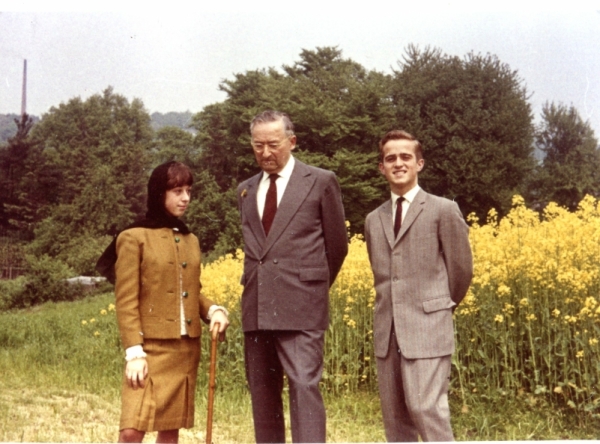
Biene, Papa Panknin, and Twin Brother Walter

Biene, Papa Panknin, and Twin Brother Walter

The captain, however, not only represented the kind and benevolent father figure to us, but also had recently become the proud father of twins, the event that among us soldiers earned him the title Scatter Gun (Streubüchse). He now entered the room. We stood at attention next to our closet. It was clear from the way the captain approached the first soldier that he was more interested in passing on a few words of wisdom than in the inspection of our open closets. So when it was my turn, I was quite relaxed. He must have gone through our personnel files, for he said, “Klopp, I see that you are a high school graduate. What are your plans for the future?” Without waiting for an answer, he continued, “When you are young, you must have a dream. Without a dream you are nothing but a hollow entity. Understand me right; I am not talking about a fuzzy dream about getting rich and famous. What I mean is the dream of becoming a valuable member of society and a contributor to the common good.” With about these words the officer, turned philosopher, spoke to me. Now he reminded me that he had not answered his question.

“I love electronics and would like to become a high frequency engineer,” I stated emphatically.

As if ignoring my reply, the captain went back to the importance of having a dream. “A dream is nothing but an idle pipe dream, if you cannot find the means to realize it. You must have a plan backed up by a number of concrete steps. You must always keep your goal no matter how distant before you inner eyes, so you don’t miss your target.”

Then he came to the point, “So you want to become a high frequency engineer. That’s your dream. Well, here is a plan for you to consider. The Bundeswehr (German army) will send you to a postsecondary technical institute all expenses paid. In return, you commit yourself for ten years of service or if you wish, you can opt for a permanent career as officer and instructor. Think about it and let me know when you are ready to talk.” With these words he moved on to the next soldier, who had a picture of a naked woman taped to the inside of his closet door. The captain took one look and to our surprise did not reveal the slightest trace of anger, when he addressed him with a soft voice, “Say, young man, how would you feel to see a photo of your sister in the nude on somebody else’s closet door?” and with that remark he moved on to the next soldier. Needless to say we all got our weekend pass including the one with the pornographic picture. In a general assembly of the company our leader once spoke about his dream to read and understand Immanuel Kant’s ‘Critique of Pure Reason’ before his retirement. To be sure, it was a far loftier goal than mine of becoming an electronic engineer. The book that he was referring to is to the understanding of philosophy what Einstein’s theory of relativity is to the understanding of physics.

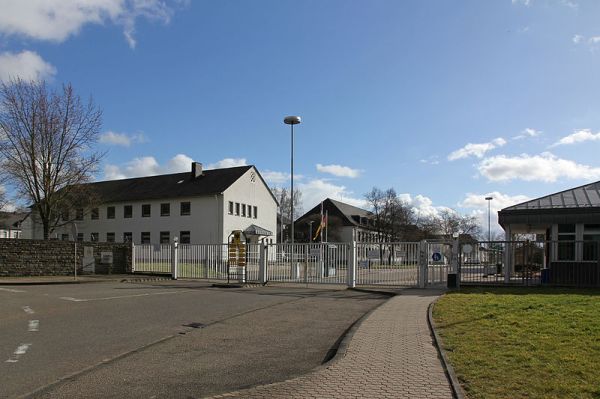
Falckenstein Barracks still in Use Today - Photo Credit: wikipedia .org

Falckenstein Barracks still in Use Today – Photo Credit: wikipedia .org

In the meantime Biene’s letters kept coming with the regularity of a clock and brought the sunshine of her empathy for the hardships of a soldier into my heart. We agreed to write one another in such a way as if we had known each other for a long time, to treat each other with honesty so that in the absence of face-to-face encounters no false impressions developed in our minds. Even secretiveness would be a form of dishonesty I noted in one of my letters. Being sincere was the necessary ingredient for the development of a true friendship leading so I was hoping to something more permanent. All Biene and I had for now were the letters, in which we expressed our feelings in the discussions of poetry, movies we had seen, or simply the daily obstacles that fate would throw into our path.

Up to this moment I had also maintained a loose correspondence with my dance partner Margret, who was working as a nurse’s aid in the Wesel hospital with the goal of becoming a registered nurse. The letters we wrote read more like newspaper reports and contained for the most part our criticism of the rotten world around us that we could not change. In short they were devoid of any feelings expressed or implied. In response to the dilemma that could only grow worse over time, I decided to write her a short note explaining to her in keeping with our sober writing style matter-of-factly as to why I did not wish to carry on with our correspondence. She acknowledged receipt of my message in a final postcard. I was relieved that she took my note with a sober mind and in the end did not get emotional about it.

Morocco's Beautiful Coastal City - Photo Credit: wikipedia.com

Morocco’s Beautiful Coastal City – Photo Credit: wikipedia.com

In the meantime Biene was raving about the sunshine, warmth, beauty of a rocky coastline in a distant land in North Africa. I attributed the sudden and unexpected passion for Morocco to the extended periods of rain and depressing overcast skies we had experienced of late. But later she wrote about her grave concern for her pen pal. He had suddenly become ill and wanted her to come and visit him presumably in the hope for a miraculous recovery. The news came like a cold shower and considerably dampened my spirits. I realized that while I had read perhaps too much between the lines, Biene might have read too little. But who was I to assume that just because I had broken off the correspondence with Margret, Biene should do the same with her pen pals? So I did the right thing and expressed my sympathy with the fatally ill young man of Morocco. ‘Thousands of people’, I wrote, ‘die every day and it does not affect us. But if a friend or close relative passes away it is as if our world is falling apart. The bridges we so lovingly and carefully built to reach across suddenly collapse and only memories remain at the end.’

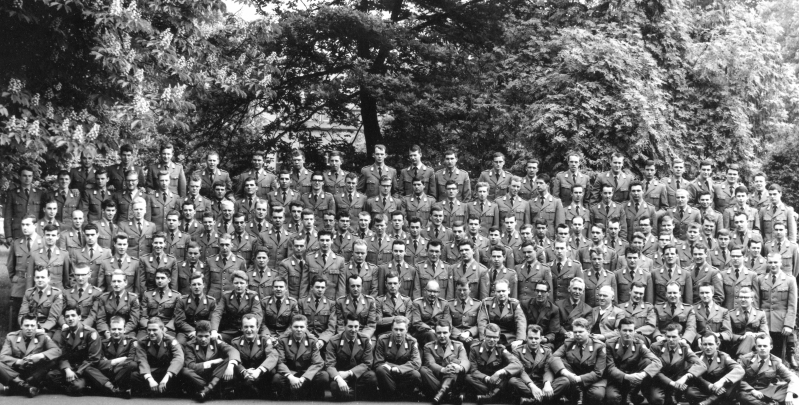
Final Photo of the entire Company - Who can find Peter?

Final Photo of the entire Company – Who can find Peter?

In the meantime my basic training was coming to an end and I was getting ready for the transfer to the Falckenstein barracks. There was a lengthy pause in the flow of mail. Biene’s high school class went on a field trip to Paris, which was intended to be a short immersion into French culture. Upon her return she sent me a long letter describing her exciting adventure with her class in France, but did not mention her Moroccan friend any more. I carefully avoided the topic. Instead, knowing that Biene was taking Latin classes at high school I boldly sent her a signal in Latin: Amor qui non agitur moritur, which means ‘Love that is not active dies.’