Günther Kegler, Chief of the Kegler-Clan (Part IV)

Günther Kegler Struggling Through the Postwar Era

From June 1946 to April 1975

Charts II a & b – II

In June 1946 former Lieutenant-Colonel Günther Kegler had the humiliating experience of two long years of unemployment, which in all likelihood was forced upon him by the new Soviet rulers of East Germany. On rare occasions he was able to hire himself out privately as a common laborer or as a helper in all kinds of pest control in and around Erfurt. During this time, as reported in Chapter 6 in the P. and G. Klopp Story, his nephews Karl and Adolf and later his niece Eka (Lavana) quite unexpectedly arrived at his doorstep. The Klopp children had no idea of the whereabouts of their parents. It was a miracle that the entire Ernst Klopp family was reunited in 1948 in the small village Rohrdorf in Southern Germany.
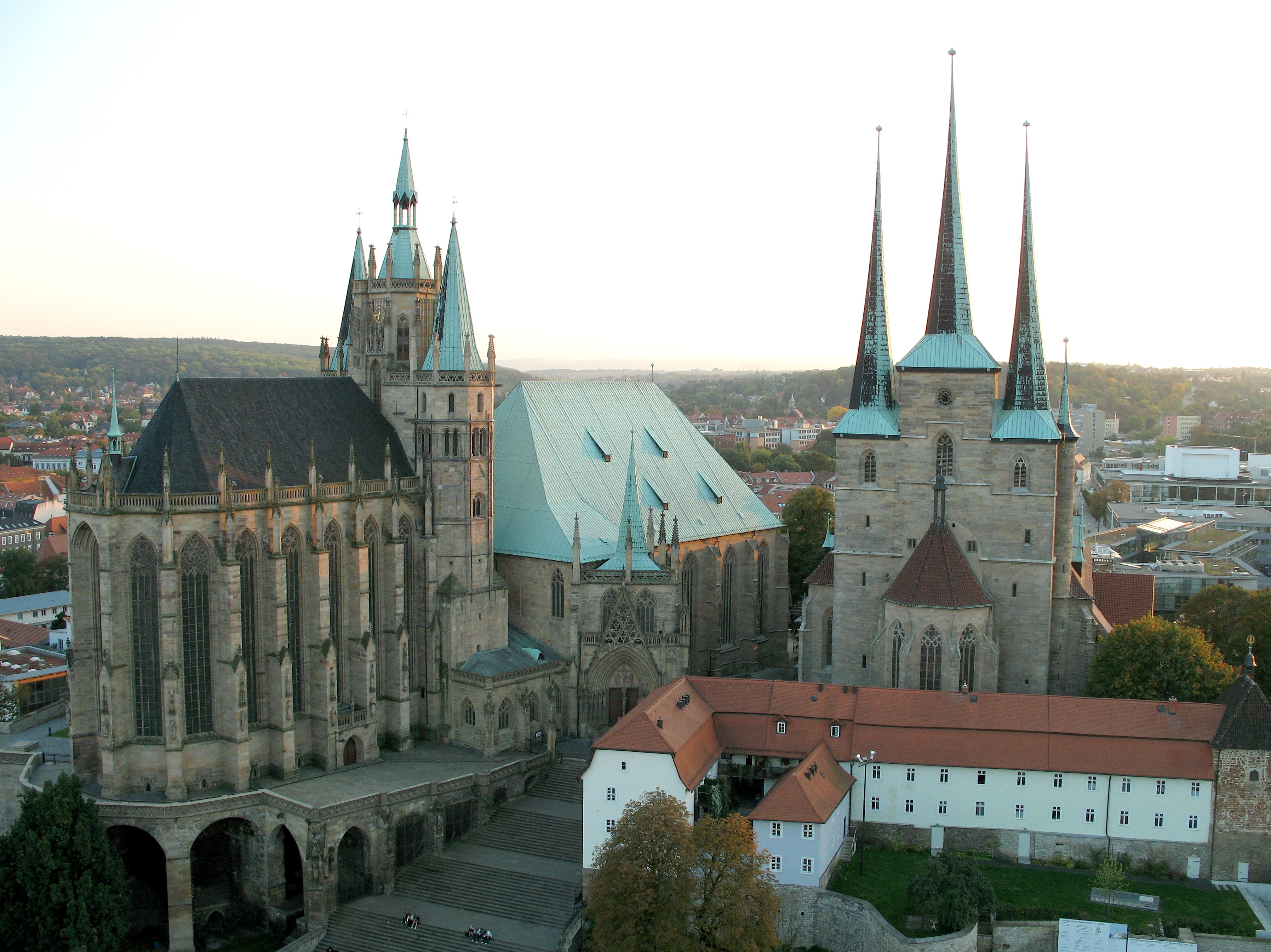
Erfurt Cathedral and Severi Church - Photo Credit: Wikipedia.org

Erfurt Cathedral and Severi Church – Photo Credit: Wikipedia.org

Finally in March 1947 Günther Kegler found employment at his son-in-law’s beverage plant in Erfurt and in 1950 within the same company became its bookkeeper. Thus, he could make use of his skills in accounting, which he had practiced between the two World Wars. On April 28, 1955 he fled with his wife Lucie to West Germany leaving behind all his furniture and other bulky belongings. Fortunately, he found immediate employment at the newly established beverage company that was owned by his son-in-law A. Lotz, who also had fled from East Germany. In 1956 his status as a refugee from the GDR was officially recognized. In the same year he was able to retire with a pension that at last provided a comfortable standard of living for the rest of his life.
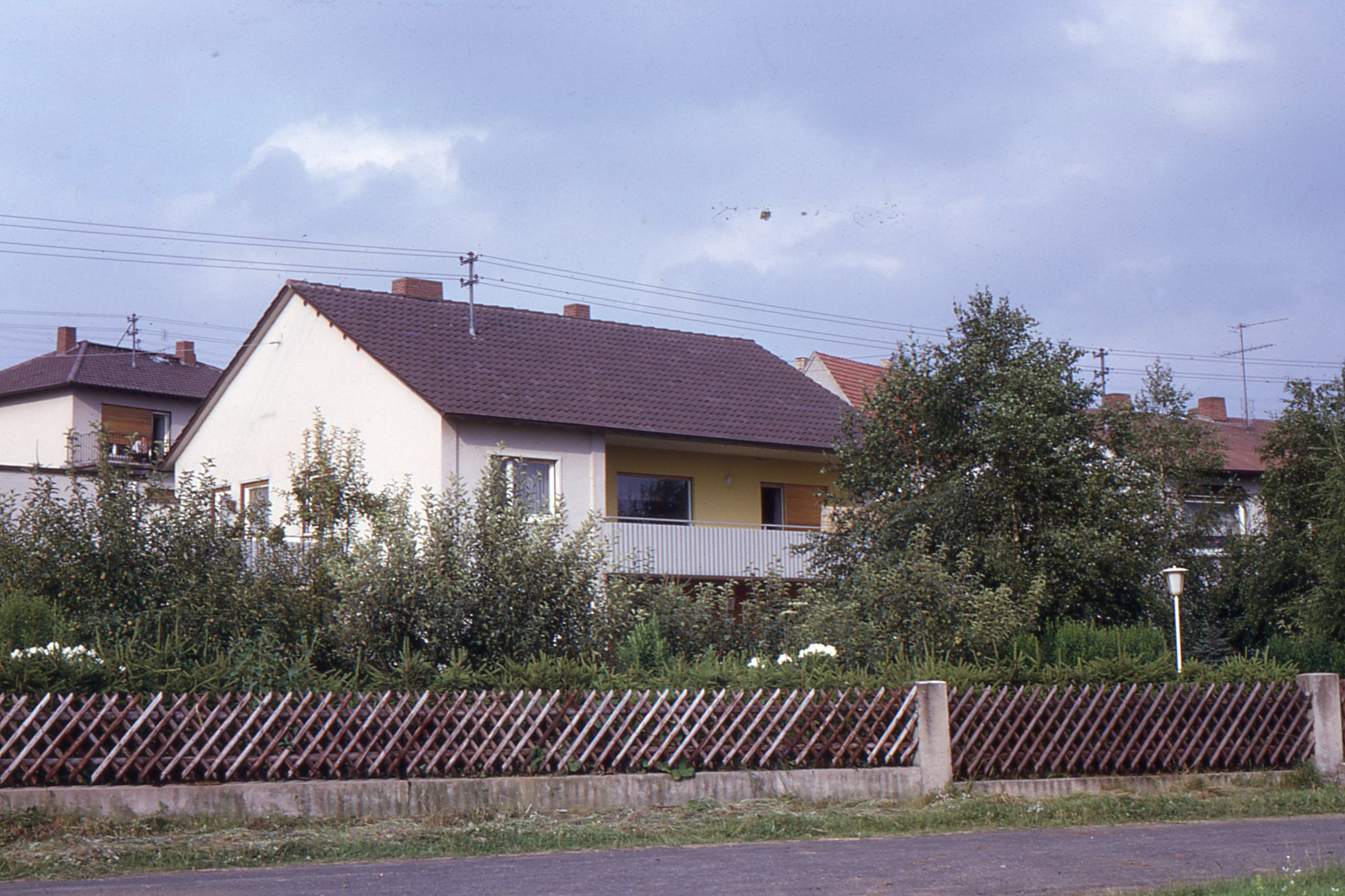
The Rental House in Watzenborn-Steinberg (now Pohlheim)

The Rental House in Watzenborn-Steinberg (now Pohlheim)

However, his plan was not to live out the remaining years in meaningless idleness. On the contrary, he helped many people with advice on legal issues, accounting problems, and above all he gave assistance in their struggle with the notoriously slow  bureaucracy of the West German government offices. In 1962 he invited his sisters Marie and Erika to join him and share a beautiful rental house in Pohlheim (former Watzenborn-Steinberg). That’s where his wife Lucie after a lengthy illness passed away in 1968. My uncle spent the next decade with his second wife Elfriede in their seniors’ apartment in Kassel-Wilhelmshöhe. I will write about Elfriede in another post.
65

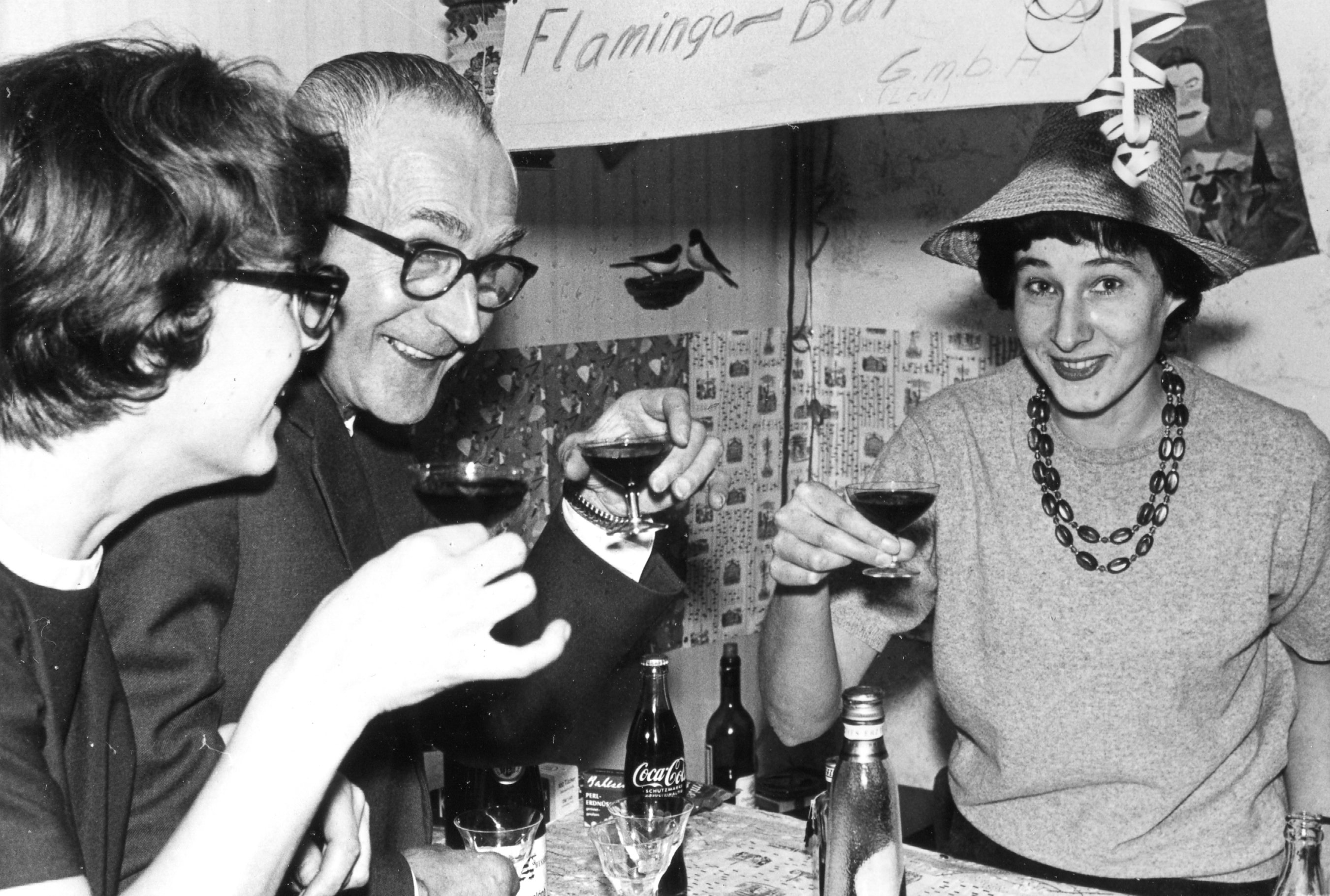
New Year’s Eve Party 1963 – Helga Kegler, Uncle Günther, and Eka (Lavana)

I remember Uncle Günther as a dear friend, who was also a fun loving individual. He enjoyed a good beer and passionately played the German card game ‘Doppelkopf’. In our correspondence we exchanged all kinds of humorous tales, while I was a soldier in the West German Armed Forces. He held the family together in a spirit of giving and outstanding hospitality. He truly deserved the prestigious title ‘Chief of the Kegler-Clan. Long after I emigrated to Canada, he sent me in keeping with his admirable Prussian sense of duty documents, which he had carefully arranged by date and importance. With the help of these papers I was able to draw some forty years later a small pension for my military service in Germany. Every month I buy two cases of beer with that money. And when I drink the refreshing brew, I often think of my dear old uncle in Germany.
The Klopp Grandparents VII

The Meddling of a Troublesome  Mother-in-law

Chart I – I & II

Adapted from Eberhard Klopp’s Family Chronicle

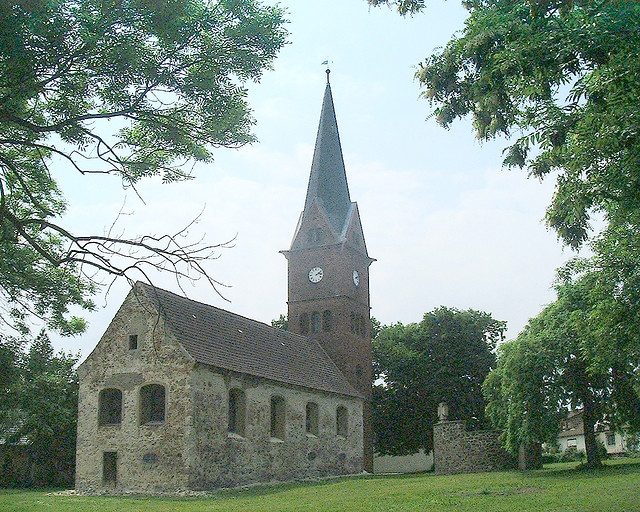
Zielitz Church

When Emma’s eldest son Friedrich married Auguste Weihe of Zielitz, he could not foresee how much trouble the new connection would bring to the entire Klopp family. The cause was not so much his young wife, whom he loved dearly, but rather his mother-in-law Luise Weihe, who had her own ideas about the way the couple should conduct their life and business. She insisted that her daughter should share with no one her new nest in Wolmirstedt. She was not exactly excited over Auguste’s choice of her son-in-law. So her daughter should at least be spared from Friedrich’s siblings and relatives. She viciously described them as the ‘vagabond and fugitive children of Cain’ with reference to the Bible verse in Genesis 4, 14.

Behold, thou hast driven me out this day from the face of the earth; and from thy face shall I be hid; and I shall be a fugitive and a vagabond in the earth; and it shall come to pass, that every one that findeth me shall slay me. King James Bible

With this remark Luise Weihe not only poisoned the climate of the newly established household, but also brought on the estrangement  of Emma and her younger children with the family of her eldest son.

Emma’s grandfather Johann Christian Bauer (1792-183) was of Jewish ancestry. It would go beyond the set limits of this blog to report in detail the colorful and eventful life of Johann Bauer. However, it is important to note here that his parents had already converted to the Christian faith and that their 14-year old son had been confirmed in Sudenburg-St. Ambrosius and also got married as a protestant groom on October 29, 1843 in the same place.

At the turn of the 20th century antisemitism was already a malignant phenomenon and spread like an epidemic throughout Germany. So far Friedrich’s mother-in-law had only hinted at her antisemitic sentiments against the Klopp family. But now she went too far with her unconcealed, racially driven diatribes, which she shamelessly showered on Emma and the rest of the ‘children of Cain’. The result was that even the young wife, her very own daughter, could not take it any more. She was by nature and temperament a resolute and energetic woman. In the end she too distanced herself from all connections to her parental home in Zielitz.

Her father Friedrich Weihe (1854-1944) suffered a great deal from his wife’s convoluted thoughts and attacks against the Klopp clan. But he was unable or unwilling to do anything about it except to contemptuously break wind on each step of the staircase he climbed to withdraw himself from the incessant and repetitive tirades in the living room below. This was in a sense his running commentary on his wife’s annoying and irksome prattle, which seemed to have no end.

To be continued …

A Relaxing Easter Outing at Taite Creek Campground

A Story entirely Written in Pictures

Peter and Gertrud Klopp (Chart I – III)

There are more pictures on my Flickr site. To view them just click on the tab with the blue and red dot above the header.

Günther Kegler, Chief of the Kegler-Clan (Part III), Charts II a & b – II

Günther Kegler at the Brink of a Mental Breakdown

The Boys and the Old Men – Cannon Fodder

January to May 1945

On September 19, 1944 Günther Kegler became leader of the military registration offices at Sangerhausen and Querfurt, Thuringia, about an hour’s drive northeast of Gotha, Biene’s place of birth.

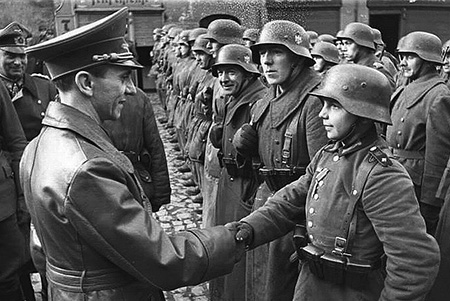
As he could clearly see the imminent collapse of his beloved country on the horizon, he did everything in his power to save what was in his mind the only resource left after Germany’s defeat. To spare young boys from the draft was foremost on his mind. After January 1945 even the diehards of the regime could see the writing on the wall. But instead of preparing for a quick surrender, which would have saved tens of thousands of lives, they obstinately clung to the glimmer of hope for final victory. Goebbels’ relentless propaganda machine fueled a patriotic fervor, especially among boys. Men capable of carrying a rifle or an antitank weapon were to be conscripted.

Goebbels congratulates a young recruit - Photo Credit: rarehistoricalphotos.com

Goebbels congratulates a young recruit – Photo Credit: rarehistoricalphotos.com

The leader of the NS district Querfurt started to meddle in Lieutenant-Colonel Kegler’s realm of authority and insisted that 16-year old boys be included in the draft procedures. They were to fill the gaps of the dwindling forces of the war machine. Against this directive Günther Kegler put up as much resistance as was in his power. But the constant pressure and harassment from above wore him out. Then he heard about Himmler’s horrific order of his court martialed brother General-Lieutenant Gerhard Kegler being demoted to a private and slated to be executed after the final victory.  (His amazing story will be published at a future post.) Günther Kegler broke down under the burden of these fateful events and was admitted to a sanatorium at Erfurt on April 1, 1945. He stayed until May 31, 1945 and recovered sufficiently to allow him to return to his family at Nonnenrain Street, Erfurt.

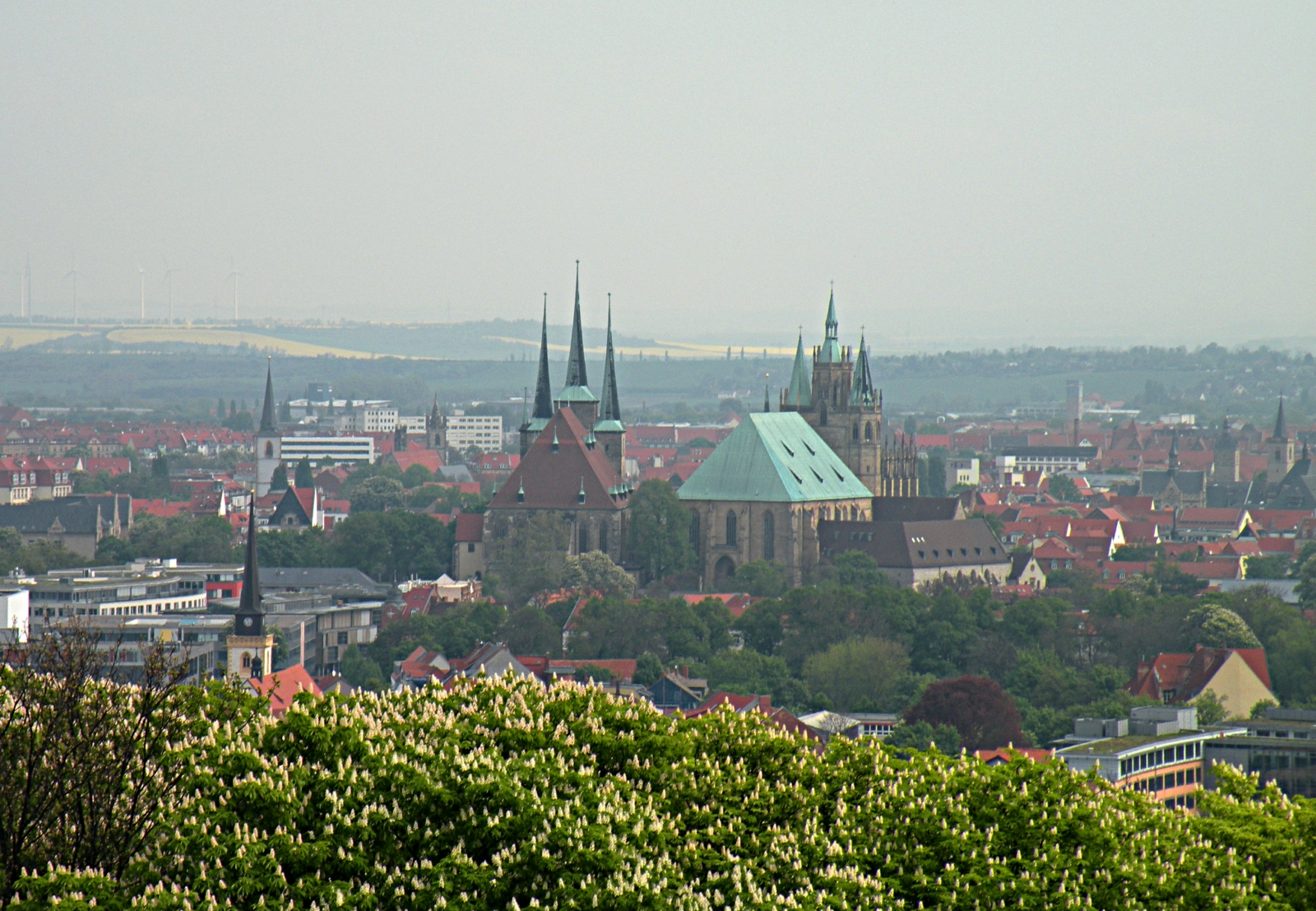
Erfurt, Thuringia - Photo Credit: Wikipedia.org

Erfurt, Thuringia – Photo Credit: Wikipedia.org

Unfortunately, his ordeal was far from over. By prior arrangement between the US and the Soviet Union, the American occupation forces withdrew from Thuringia and handed over the administration of the province to the Russians. Arrests, interrogations mostly conducted at night, closing of savings accounts and all sorts of other chicanery followed in quick succession. As my uncle stated in his family chronicle,  it was the fate of countless other German officers in the Soviet Occupation Zone.

To be continued …

Bloody War or My Father’s Continued Journey (in German)

Verdammter Krieg

Der Weitere Weg Meines Vaters

von Klaus-Dieter Barge – Chart II a – IV

Die 807 meines Vaters agierte mit der 557. ID ( XXV. AK) unter Generalleutnant Kuprion im Elsaß nördlich von Colmar und westlich von Rhinau im Bereich der 5. französischen Armee bis zur Kapitulation der französischen Truppen am 22.Juni 1940, da wurden etwa 200.000 Mann der französischen Heeresgruppe 3 (2., 3., 5. und 8. Armee) gefangen genommen.
Damit waren die deutschen Truppen noch einige Wochen beschäftigt.

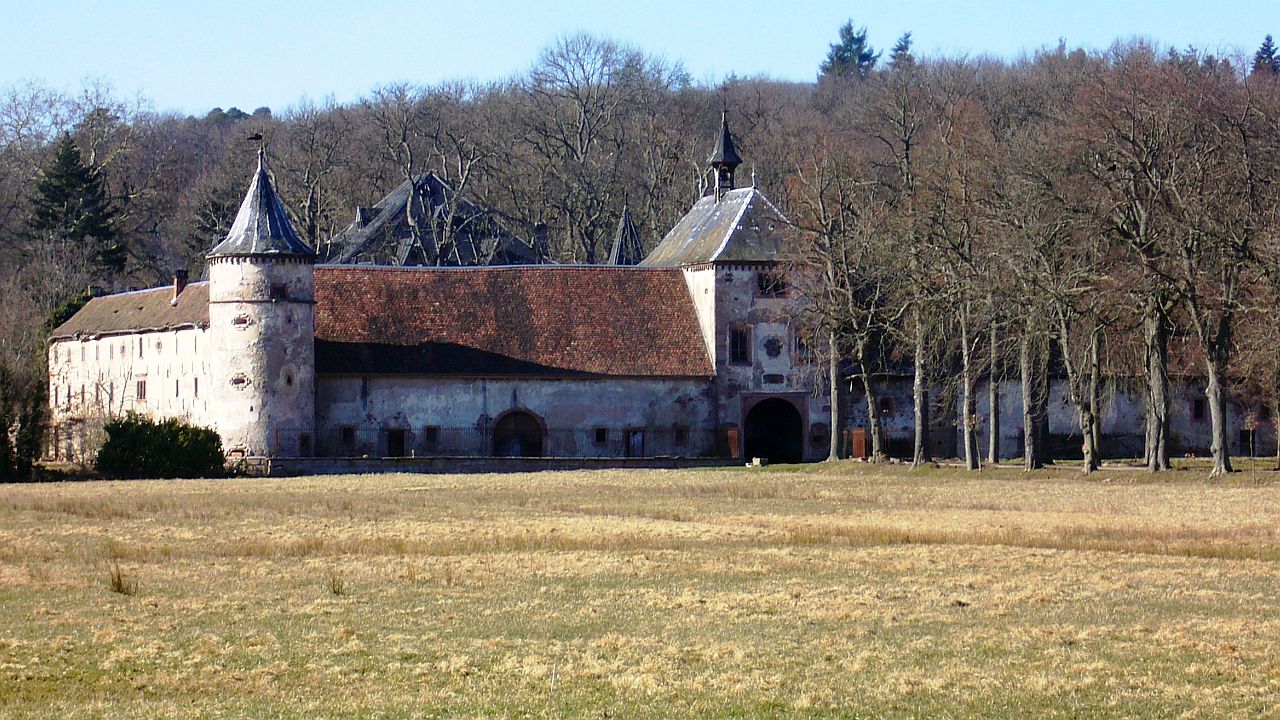
Es gibt verschiedene Fotos in Fotoalben von Soldaten der Abteilung 806 vom Chateau de Thanvillé (deutsch Tannweiler) und weiteren Orten.

Chateau de Thanvillé aus Wikipedia

Chateau de Thanvillé aus Wikipedia

In Sélestat (deutsch Schlettstadt) , etwa 20 km nördlich von Colmar, man erkennt auf dem Foto den mächtigen Uhrturm (Tour de l’horloge).

In Saverne (deutsch Zabern) (die Stadt liegt 80 km nördlich von Colmar zwischen Vogesenwäldern und Weindörfern) gilt das Château des Rohan dank seiner 140 Meter langen Fassade aus rotem Sandstein als “Elsässisches Versailles”.

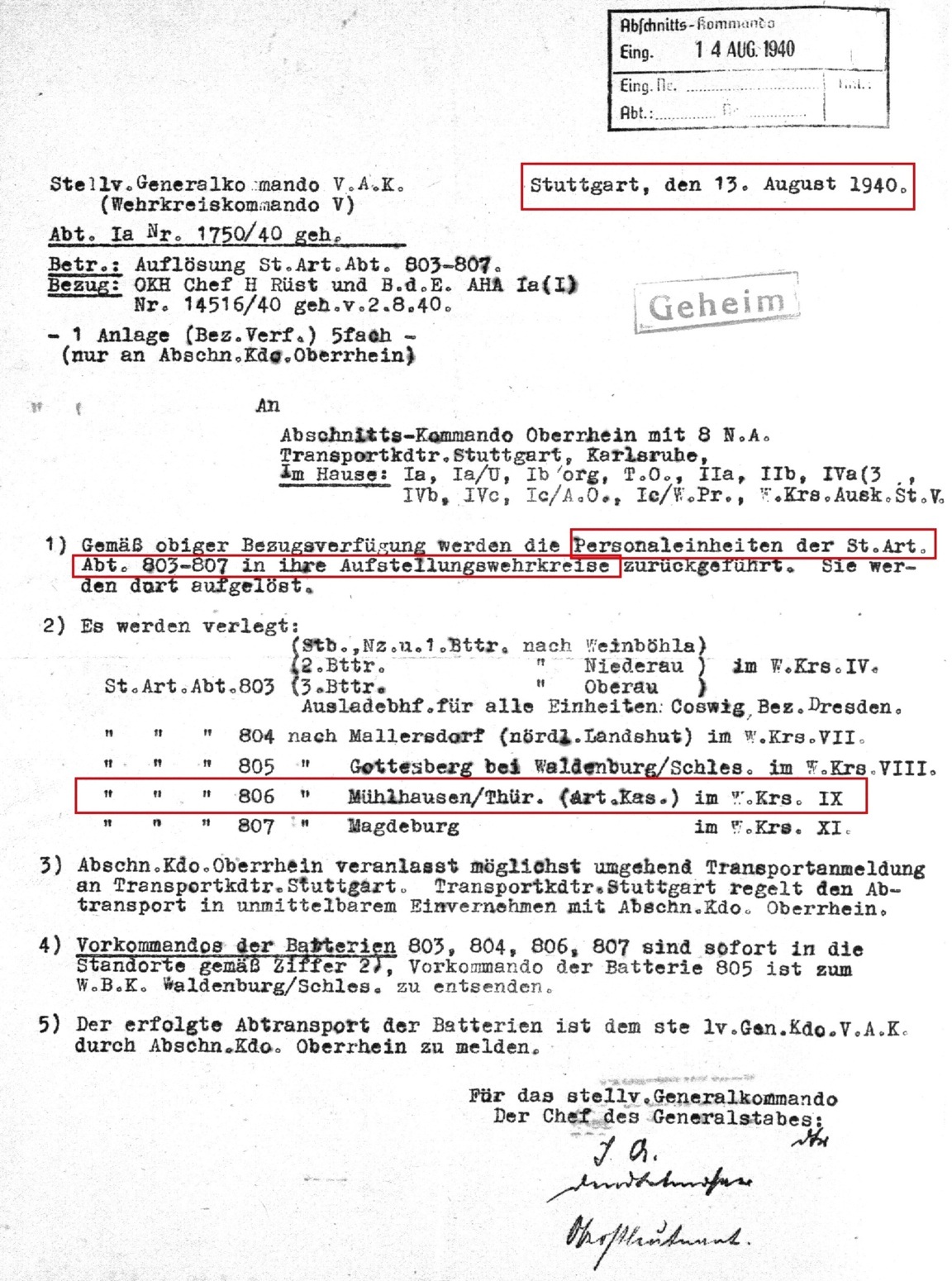
Mit dem Befehl vom 13.8.1940 wurde die Art.Abt.806 nach Mühlhausen zurückgeführt.

Rückführung 801 - 807

Rückführung 801 – 807

Die Artillerie Abteilung 806 wurde dort am 31.8.1940 aufgelöst.
Danach gehörte Rolf zur Stellungsbatterie 771/Küstenbatterie 771, ausgerüstet mit 4*15 cm Kanone 15/16 (t).
Diese Einheit wurde mit zusätzlichen Eingliederungen per Befehl vom 20.12.1940 zur 3.Batterie Heeres-Küsten-Artillerie Abteilung 788 in Le Havre.
Im Dezember 1942 kam die Batterie nach Mesnil Val, im Frühjahr 1943 an die Klippen von Mers-les-Bains bei Treport.
Als die Batterie im Dezember 1943 nach Südfrankreich verschickt wurde, kam mein Vater doch bald wieder nach Mers-les-Bains zur 3. Batterie der I./HKAR 1252 zurück. (Über seine “mystische” 3./788 gibt es eine Geschichte von Alain Chazette, dem 1.Atlantikwall-Kenner in Frankreich).
Am 9.7.1944 wurde er nach Fecamp zur 10./1252 versetzt, die etwa zu diesem Zeitraum zusätzlich mit Flak 8,35 (t) ausgerüstet wurde.
Alle Standorte liegen in der Region “Haute-Normandie des Somme” an der sogenannten “Alabasterküste”.
Das folgenden Fotos zeigen meinen Vater Rolf am 21.6.1944 (15 Tage nach D-Day) an seinem 25. Geburtstag und meine Eltern 1944 (am 12.6.1943 hatten sie geheiratet).

Nach dem deutschen Rückzug im September 1944 folgten Kämpfe in Holland (Schlacht von Arnheim, auch “Operation Market Garden” genannt).
Für ca. 3 Monate lag er mit dem 184.AR (84. ID) am Reichswald bei Kleve am Niederrhein.

Dort startete südlich von Nijmegen (Holland) am 8.2. 1945 die “Operation Veritable”, an der neben den Engländern auch kanadische Einheiten beteiligt waren
(1. Kanadische Armee unter Harry Crerar).

Operation Veritable wurde von General Crerar befehligt, er kommandierte 470 000 Mann mit 1000 Geschützen und 1000 Jagdflugzeugen bzw. Bombern, der Angriff am 8.2.1945 war der größte Artillerieangriff des 2. WK an der Westfront.
Mein Vater wurde am gleichen Tag am Galgensteeg in Kranenburg von den Kanadiern gefangen genommen. Er war in folgenden Kriegsgefangenenlagern in Belgien:

-Camp 2223 Brasschaat/Antwerpen
-Camp Waterschei
-Camp 2228 Overijse
-Camp 2221 Vilvorde
-dort am14.6.46 geflohen, nach 14 Tagen mit Hunden aus Versteck geholt
-28.6.46 wieder ins Lager gekommen
-25.7.46 Munster, Deutschland

Damit verbrachte er fast 8 Jahre seiner Jugend in RAD, Wehrmacht und Gefangenenlagern!

Die beiden folgenden Bilder zeigen General Crerar und bei einem Treffen mit dem englischen Feldmarschall Montgomery im Februar1945 bei Kleve.

Am 3./4.April 1945 wurde Nordhausen, Rolfs Heimatstadt, von der RAF unter Arthur Harris, genannt “Butcher”, 2 mal bombardiert, das Haus der Barges wurde zerstört, darin starben meine Großeltern Karl und Anna Barge , 2 Tanten und ein kleiner Cousin von mir. Nordhausen wurde zu 74% zerstört, 8800 Menschen kamen dabei um.

Das war 7 Tage vor dem Einmarsch der Amerikaner!.Für Harris wurde in London ein Denkmal errichtet.

Alle 4 Brüder überlebten den 2.WK, da waren es noch 7 Barge-Geschwister.

Mein Vater kam Ende Juli 1946 nach Mitteldorf, dem Heimatort meiner Mutter zurück, am 22.4.1947 wurde ein Junge geboren, der Beginn einer neuen Zeit.

Es ist mir nicht leichtgefallen, über teilweise fürchterliche Dinge zu berichten.
Ich glaube aber auch, dass wir die Aufarbeitung dieser schlimmen Zeit unseren Vätern schuldig sind, ich fühle mich dadurch meinem Vater sehr verbunden und möchte , dass unsere Nachkommen wissen, wie es unserer Familie in diesen geschichtlichen Ereignissen erging.
Schön, dass sich Frankreich und Deutschland immer mehr annähern und mit der heutigen Jugend der Teufelskreis von Feindschaft durchbrochen ist.

Falsely Accused and Smoking a Pipe

Conclusion of Chapter VII

One day as I was happily returning home from the Upper Village, a girl about my age crossed my path and placed herself in front of me.

“I want to show you something”, she said. To my surprise she quickly pulled down her panty and lifted up her skirt. Without waiting for my reaction, she demanded, “Now you pull down your pants!” Puzzled by this naughty request, I stared at her for a moment and then ran home as quickly as my legs could carry me.

Around supper time there was a knock at the door. When Mother opened it, I heard from inside the living room a soft, but ominous voice in a very accusing tone. Soon a woman, accompanied by the girl with whom I had just had this embarrassing encounter, entered and immediately continued to speak more menacingly than before.

“My sweet little girl was on her way home, when your naughty confronted her with the most indecent request. He asked her to expose herself. You can imagine, Mrs. Klopp, how shocked and disgusted she was with this display of improper behavior. When she turned around to run home, that brat grabbed her from behind and pulled her panty down.”

While the woman continued with the story about her ‘sweet little girl’ being harassed in broad daylight, I felt so stunned by the accusations that I was unable to utter a single word in my defense. We all know the old adage: silence is admission of guilt. And nobody got to hear my side of the story, not even my own mother. The shame I felt over something I did not do was so overpowering as if I had indeed done what I had been accused of. So I remained silent.

“Look, Mrs. Klopp, how guilty he looks! It was good I came by to tell you. Hopefully this will be teaching him a lesson.” And with that remark she took her ‘sweet, little girl’ by the hand and added, “We must go home now and fry our fish for supper. Good night!”

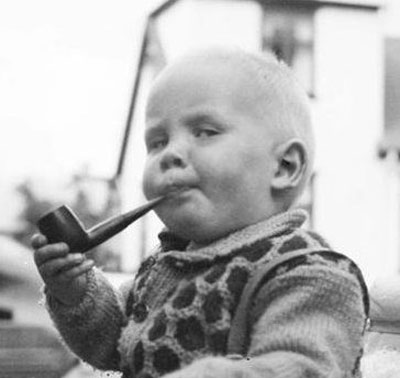
Father loved to smoke his pipe. I often watched him, as he was preparing to light it, a process that seemed to be like a relaxing ritual for him. With fascination I was watching him gather his pipe, tobacco bag and the matchbox. He opened the bag and held it under his nose to savor the aromatic delight in his nostrils. Then he grabbed a pinch of the brown fluffy stuff and loosely filled the pipe’s chamber. After he had carefully closed the tobacco bag, he struck a match to light the pipe. This was the moment I had been waiting for. With a few puffs the aromatic scent of smoked tobacco filled the entire room, and I vicariously participated in my father’s delight. Even though I never turned into a smoker in my later life, I do have fond memories of the cozy atmosphere surrounding Father and his pipe.

Kid Smoking Pipe - Photo Credit: smosh.com

Kid Smoking Pipe – Photo Credit: smosh.com

One day, when I came home from playing outside, I noticed to my great surprise Father’s pipe on the kitchen table. I was surprised indeed, because Father would always put it away in a secure place. Then there were also matches on the table, but what amazed me the most was that the pipe’s bowl was stuffed with bits of crumpled-up paper, leaves and old cigarette butts. The attraction to smoke Father’s pipe was irresistible like sweet honey to a bear. Within seconds I held Father’s pipe between my lips, lit a match and brought its flame near the bowl filled with that poisonous concoction of paper, leaves and cigarette butts. I sat on the chair like Father inhaling the disgustingly acrid smoke. A few puffs later, I suddenly felt sick to my stomach. Pale and green in my face I slid off the chair, on which I had just sat proud and strong like Father. Holding the glorious pipe in my hand, I landed on the floor with a thump, threw up and passed out all within less than a few minutes. It was then when my older brothers came rushing out from their hiding places, whence they had been watching the spectacle. They had set me up for their macabre entertainment. I was sick for a long time, so sick actually that this horrid experiment with tobacco served as a form of effective inoculation against nicotine addiction for my entire life. And for that I will be forever thankful to my brothers!