Albert Schweitzer – Seminar #8

8. Seminar

Die Geschichte vom kleinen Orgelspieler Albert

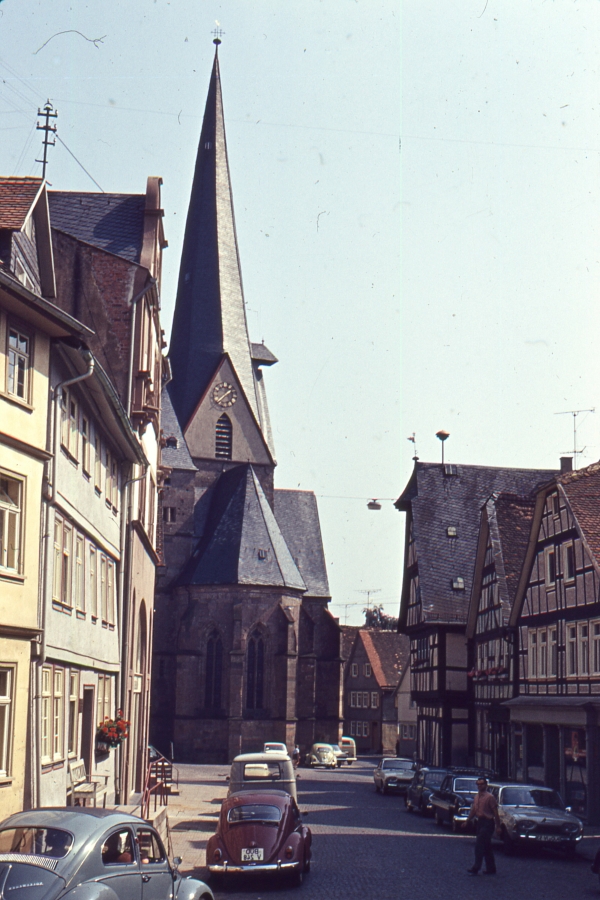
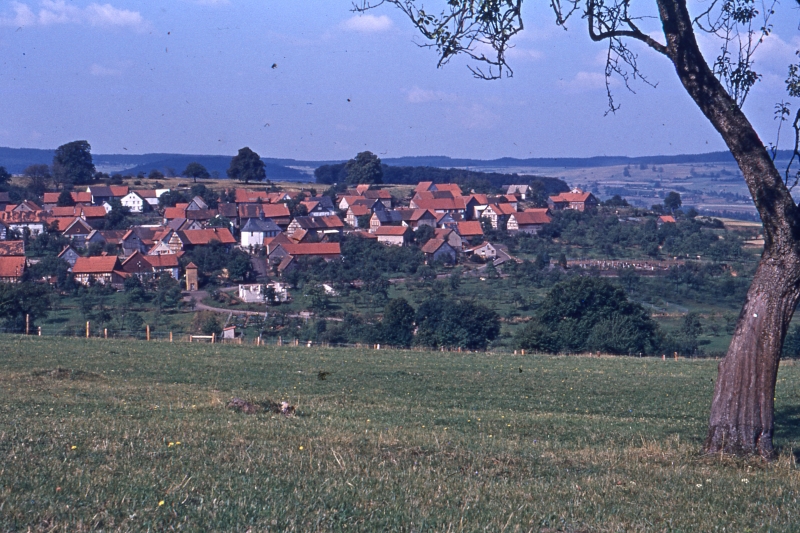
Albert war inzwischen schon neun Jahre alt geworden. Er besuchte die 3. Klasse seiner Dorfschule in Günsbach. Der Ort liegt im französischen Elsaß inmitten von den Bergen der Vogesen.

Eines Tages fragte ihn sein Lehrer: „Albert, möchtest du einmal Orgelspielen lernen?“ Albert pochte das Herz bei dieser Frage, denn er hätte zu gern ,ja“ gesagt. Er hatte ja schon mit vier Jahren begonnen, Klavier zu spielen. Sein Vater hatte ihm den ersten Unterricht erteilt, weil er frühzeitig erkannte, dass sein Albert sehr musikalisch ist. Schließlich antwortete Albert dem Lehrer und sagte ihm, dass er gerne auf der Orgel spielen würde. Er träumte schon lange davon, oben auf der Empore auf der Orgelbank sitzen zu können und Lieder und Choräle zu spielen.

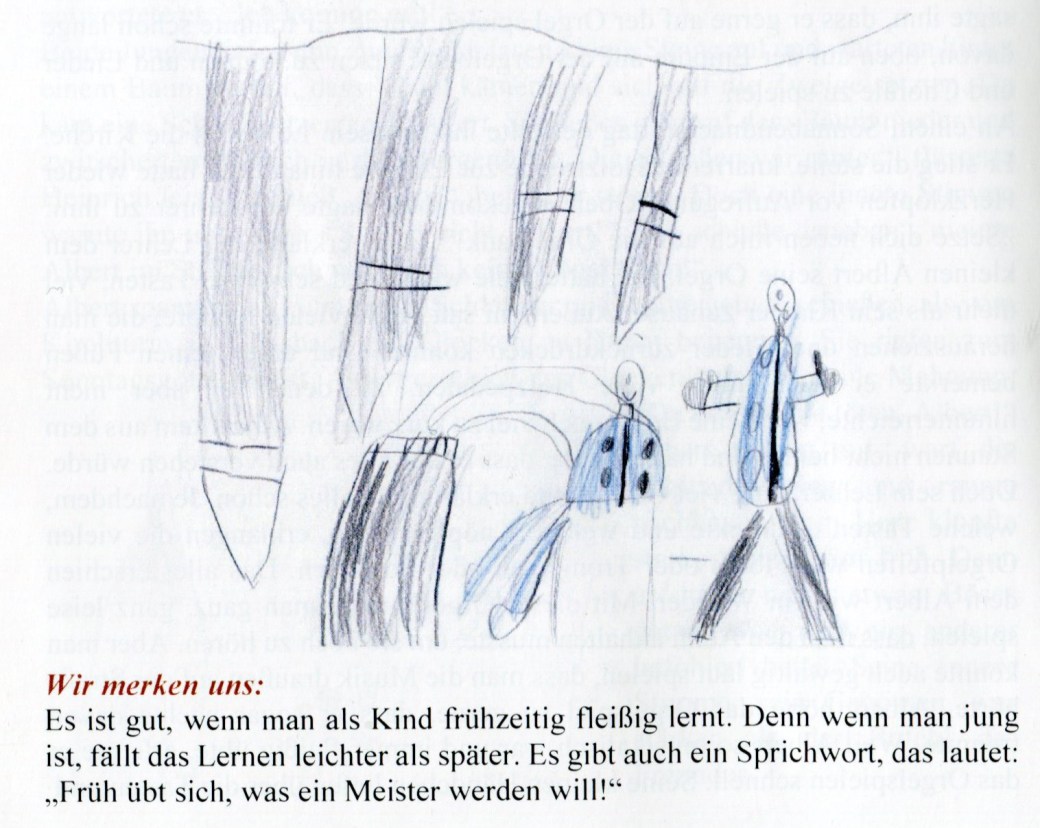
An einem Sonnabendnachmittag bestellte ihn nun sein Lehrer in die Kirche. Er stieg die steile, knarrende Holztreppe zur Empore hinauf und hatte wieder Herzklopfen vor Aufregung. Oben angekommen, sagte der Lehrer zu ihm: „Setze dich neben mich auf die Orgelbank!“ Dann erklärte der Lehrer dem kleinen Albert seine Orgel. Sie hatte viele weiße und schwarze Tasten, viel mehr als sein Klavier zuhause. Außerdem sah er die vielen Knöpfe, die man herausziehen und wieder zurückdrücken konnte. Und unter seinen Füßen bemerkte er auch noch viele Holzpedalen, zu denen er aber nicht hinunterreichte, weil seine Beine noch viel zu kurz waren. Albert kam aus dem Staunen nicht heraus und hatte Angst, dass er das alles auch verstehen würde. Doch sein Lehrer hatte viel Geduld und erklärte ihm alles schön. Je nachdem, welche Tasten er drückte und welche Knöpfe er zog, erklangen die vielen Orgelpfeifen wie Flöten oder Trompeten oder Posaunen. Das alles erschien dem Albert wie ein Wunder. Mit dieser Orgel konnte man ganz, ganz leise spielen, dass man den Atem anhalten musste, um sie noch zu hören. Aber man konnte auch gewaltig laut spielen, dass man die Musik draußen auf der Straße hörte. Albert hörte das Orgelspiel so gerne, dass er sogar nachts davon träumte. Weil Albert so musikalisch war und immer fleißig übte, erlernte er das Orgelspielen schnell. Seine kleinen Händchen liefen über die Tasten und ließen die Flöten schön erklingen. Nur die Fußpedalen konnte er noch nicht bedienen. Deshalb sagte sein Lehrer aus Spaß zu ihm: ..Du musst immer tüchtig essen, damit du schön groß wirst und bald an die Pedalen reichst!“ Schon nach wenigen Wochen konnte Albert Stücke seines Lieblingskompo­nisten Johann Sebastian Bach spielen. Er erinnerte sich daran, dass im Arbeitszimmer seines Vaters ein Bild von diesem großen Komponisten und Musiker hing. Als die schöne Musik durch den Kirchenraum schallte, wurde dem kleinen Albert ganz warm ums Herz.

Eines Tages kam sein Vater ganz aufgeregt zu Albert. Der Organist seiner Kirche war plötzlich erkrankt und es gab keinen, der zum Gottesdienst die Orgel spielen konnte. Da fragte ihn der Vater: „Albert, würdest du es dir zutrauen, am Sonntag in der Kirche die Orgel zu spielen?“ Albert bekam einen richtig roten Kopf vor Aufregung. Doch er sagte: „Ja!“ Endlich ging für ihn ein langer Traum in Erfüllung. Tatsächlich spielte Albert Schweitzer bereits mit neun Jahren im Gottesdienst zu Günsbach die Orgel und alle Leute lobten ihn, weil er so gut gespielt hat. Später wurde Albert ein weltberühmter Orgelspieler, der sich auch mit der Technik der Orgel so gut auskannte, dass ihn Orgelbauer um seinen Rat baten und er auch Bücher über den Orgelbau schrieb.

seminar 8

THE MINING ERA OF THE CANADIAN COLUMBIA by Bill Laux – Chapter 6

THE THOMPSON AND FRASER RUSH

Contrary to popular opinion which centres all B.C. history on the Europeans of the Lower Mainland and Vancouver Island, the Fraser River rush began with a discovery by an Indian on the Thompson River.  Governor Douglas wrote to Colonial Secretary Labouchere in 1856,

“Gold was first found by an Indian on the Thompson River 1 mile below the Nicomen.   He is since dead.   The Indian was taking a drink out of the river.   Having no vessel he was quaffing from the stream when he perceived a shining pebble which he picked up and it proved to be gold.   The whole tribe forthwith began to collect the glittering metal”

William Peon, the chief of the Fraser Band, set his people to work gathering the gold, and took $500 worth of flakes and nuggets he had found to Chief Trader Mc Lean at Ft. Kamloops.   Mc Lean, a brutal man who hated Indians, refused to buy the gold declaring he had no means to weigh such small quantities.   On his reporting the find, however,  Governor Douglas ordered him to buy all gold brought in, and sent him a supply of long handled iron spoons to enable the Indians to extract the nuggets from the underwater crevices.

Chief Peon, on being rebuffed by Mc Lean, took the tribe’s gold to Ft. Colvile, in the Washington Territory, and presented it at the general store operated by Francis Wolff, a discharged American soldier, some miles southeast of the HBC post   The fact that Chief Peon took his gold all the way to Colvile, an 800 mile round trip,  rather than the 80 miles down the Fraser to the HBC post at Hope is instructive.   Chief Peon had learned that the Americans, in this case, Wolff and his partner J. T. Demers, would pay more for gold than the stingy HBC’s $12 per ounce.   

The Columbia and Pend Orielle placers were by that year nearing exhaustion and being sold to the industrious Chinese who would work patiently for another ten years.    Wolff and Demers, excited by Chief Peon’s new find, recruited 18 prospective miners from their cronies, outfitted them with supplies from their store, and set out for the Thompson River country where Chief Peon had said he had found his gold.   The party took the old Indian trail that led from Kettle Falls on the Columbia, up the Kettle River valley past Rock Creek.   At the forks they continued up the West Kettle River to Kettle Bar, near what is now the Spruce Grove Cafe on the Monashee Highway.    Crossing into the Shuswap drainage past Mc Intyre Lake, they descended Cherry Creek to the Shuswap River which led them to the Thompson and Ft.Kamloops.    At least one other packer and another party of miners followed the same route, and were on the Thompson with Wolff and his men that year. 

The Thompson River Indians opposed the American miners’ attempts to take over their placer grounds.   Governor Douglas, who preferred that the mining be done by Indians, wanted no Americans at all on the Thompson.   The danger of annexation exercised his mind.   He “..admire(d) the wisdom and foresight of the Indians” and instructed Mc Lean at Kamloops to restrain the Indians (from violence)  and discourage the Americans.   More than this he could not do, as the British had set up no government at all for the mainland territory; no one had legal powers there.    Wolff’s party persevered, and in the spring of 1858 Wolff was in The Dalles with $5,000 of gold he had recovered from the Thompson.    Governor Douglas, for the HBC, had sent in February 800 ounces of gold to the San Francisco mint.  The arrival of that gold spread the news in California and a rush began.2    

In California, by 1858, the placer mines were nearly exhausted, and the miners, unable to make the “ounce a day” which was considered by them a decent return, were restless and bored.   The stagnant situation at the Mother Lode mines was much as Mark Twain described in his The Celebrated Jumping Frog of Calveras County.   The men of ‘48 and ‘49 who had struck it rich had gone home to buy farms and businesses.   The remainder who had drunk or gambled away their stakes, or never achieved much at all, were at the dead point of betting on frogs or how many flies would settle on a dead dog.   

When the news broke of the strike on the Thompson and Fraser, it generated wild excitement; here was a second chance for the unsuccessful and the improvident.   The irrational “gold fever” struck at once.   Newspapers reported a general exodus, stage coaches crowded with miners headed for the Fraser although the roads ran only to Chico and Red Bluff.   Some went via San Francisco and chartered vessels for Victoria.   Others hoping to avoid the British customs duties, chose the inland route.  One paper recorded 250 miners bound for the Fraser on foot by the inland route passing  through Oroville, California  on the way north, moving at “… a perfect rush, whooping and yelling as they pass along the road…”    A party of 500 French Crimean War veterans, mounted and armed, and divided into companies in military fashion, were on the road north via Shasta, Klamath Lake and Peter Ogden’s old route to The Dalles on the Columbia.   

It could not have happened at a worse time for the Indians.    During that summer Governor Stevens of the new Washington Territory had held a Council at Walla Walla where he had met with the Columbia Basin Chiefs, and maneuvered them into signing a series of treaties which ceded certain Indian lands to the government, and set aside certain large tracts as Indian homelands or reservations from which whites were barred.   But even as the ink on the treaties dried, armed and bellicose miners, hurrying north from California and Oregon to join the Thompson rush, entered those lands now closed to them.   They arrogantly dug up the creeks for gold, shot the Aborignals’ game, and abused the Indian women.    Finding that the signing of the treaties was followed by even greater incursions and depredations than before, the Chiefs lost all trust in the promises of the whites, closed their lands, and prepared for war.

A GOLD RUSH THROUGH A WAR

Invading miners were shot by Indians in the Yakima Valley, and the U.S. troops sent to punish them were defeated by the Indians at Toppenish.   Open warfare began.   General Wool, commanding the army’s Department of the Pacific had issued an order in 1855 closing the lands east of the Cascades to white settlers, 

“No emigrants or other whites, except the Hudson (sic) Bay Company, or persons having ceded right from the Indians, will be permitted to settle or remain in the Indian country, or on land not ceded by treaty, confirmed by the Senate and approved by the President of the United States.

“These orders are not, however, to apply to the miners engaged in collecting gold at the Colville mines.   The miners will, however, be notified that should they interfere with the Indians, or their squaws, they will be punished or sent out of the country.”

The exemption of the miners probably had a shaky basis on remarks made in 1853 to General Alvord at the Dalles by the Chiefs of Yakimas, Cayuses, and Walla Wallas, that,

“They always liked to have gentlemen, Hudson(sic) Bay Company men or officers of the army or engineers pass through their country, to whom they would extend every token of hospitality.   They did not object to persons merely hunting, or those wearing swords, but they dreaded the approach of whites with ploughs, axes, and shovels in their hands.”

These chiefs of 1853 had never seen the bellicose California miners in full cry; they soon would.    Possibly General Wool chose to identify the miners as “gentlemen.”    From his post in San Francisco, he should have known better.    

  In 1858, with white settlement still forbidden, and the war in progress, The Dalles was the main outfitting centre for the inland route.   It was reached from Portland and the Pacific by sternwheel steamer with a short portage at Cascade, and from inland California by trail from Shasta via Klamath Falls.    At The Dalles, a regular  “hurrah camp,” as Charles Frush called it, pack trains and wagon trains prepared to strike out into the largely unknown and now definitely hostile country of the Columbia Basin.   To the end of May, 300 men were estimated to have passed through The Dalles headed north, and another 400 to 500 were fitting out for the trip.  Bands of Cayuse and Nez Perce Indians had brought herds of horses, and were offering them for sale at The Dalles to the miners.   Then the news came that Colonel Steptoe and his men had been defeated by the Indians in the Palouse country to the east.    The army was attempting to quell the Indian hostilities that had begun with the depredations of the Columbia River rush in 1855; at the same time armed Californians were forming into bands at The Dalles, preparing to move into the Indian lands, even though a war was in progress.    

  The Indian’s changed attitude of 1858 was reported by a party of miners who encountered them at the mouth of the Yakima River.   They were told that the important Indian chiefs had met, and decided that the soldiers and “Bostons” (Americans in the Chinook jargon, a trade language) should not pass, but that the French and the Hudson Bay men could.     The years of cultivation of fair and friendly relations with the Aboriginals by the Hudson’s Bay Company and their French-Canadian employees were evident here, as were the outrages and sorry history of pillage and rape by the Americans, individualism’s dark side.

While some of the miners turned back at the news of Col. Steptoe’s defeat, and the determination of the Indians to block them, most pressed on grouped in armed companies, usually with an Indian or an ex- HBC man as guide.    The passage of the Mc Loughlin party to the Thompson was perhaps the most difficult.

It was led by David Mc Loughlin, son of Dr. John Mc Loughlin the former Chief Factor at Ft. Vancouver, 36 years of age, and one who had known the Columbia country intimately from his years with the HBC.   The McLoughlin Brigade consisted of 150 to 185 men, with 400 horses and mules carrying provisions for three months.   They had among them, 90 to 100 rifles and 20 to 25 other “heavy arms.”    Most were from California and included Oregonians, Frenchmen, Metis, and “camp followers,” as in any quasi military expedition.

They left The Dalles on July 5, and reached Walulla, or old Fort Walla Walla, after several days march along the river.  But even before reaching Walulla, stealthy Indians had managed to drive off some of their horses.   This  horse stealing by night had been a recognized practice among the Northwest tribes for more than a century.   Horses would be stolen from the whites or from other Indians, and then sold back to their owners as a regular thing.   Then, if possible, the horses would be stolen again, and again resold.   Among the Indians it was a recognized honourable vocation, a means of acquiring wealth and prestige.   The HBC custom was to mount guard on their horses at night, pursue any thieves, and insist on restitution which was generally forthcoming.   The American fur traders had done the same.   The miners, however, too intent on getting to the gold fields in the quickest possible time, seldom pursued thieves; rather they frequently shot any lone Indians as presumed thieves, violating the traditional ethics of the Aboriginal Northwest.    Thus, for the Americans, once the miners entered the west, implacable Indian hostility would result, and the U.S. Army would have to be be called upon to quell the outraged Indians.

On July 13, the Mc Loughlin party left Walulla to head north on the old HBC trail David Mc Loughlin knew so well.    They kept to the right bank of the Columbia, hired the local Indians to ferry them across the Snake river at its confluence with the Columbia, and continued along the shore to the White Bluffs landing.   From there they took the HBC trail northeast to Scootenay Springs, and headed north, around the eastern nose of the Saddle Mountains to Moses Lake, a route that afforded grazing for the horses and mules. 

The HBC trails were well marked,  some miles of them still survive along the benches back of Okanagan Lake in British Columbia.    The trails were about four feet wide, pounded into the ground  by the hooves of thousands of horses and pack mules for half a century.   Each trail had several diverging routes for use in different seasons.   The fall and  winter routes were the shortest, along the river and lakesides.   The Spring and Summer routes had to avoid the soft, marshy ground and the swollen creek mouths carrying the runoff from the high mountains behind.   They were located higher up on the gravel benches on dryer ground, and where the creeks afforded easier crossings.    Crucially important were the grazing meadows.    A Hudson Bay Fur Brigade of 400 or so horses and mules, could strip the forage from the grasslands in a single  passage.  Campsites and trail detours were therefore arranged to access the best and deepest meadows along the route.  As well, springs that might be flowing in June and July, would frequently be dry by September, and detours would have to be made to permanent water sources for campsites.

For the Mc Laughlin party, the trail from Moses Lake struck across the plain to Soap Lake, the south entrance to the Grand  Coulee.   They followed the chain of lakes and marshes up the Coulee, being spied on by fifty Sinkiuse Indians under Qual- chan, hoping to give battle or steal the miner’s horses.   The Indians found the Mc Loughlin party too large to attack, but followed, hoping for an opportunity to steal some horses.    In the account they gave later on, the Indians observed one persistent straggler, a Mr. Hillburn, in the party, lagging behind the main body each day.    They decided not to kill him hoping that if the party saw that one of their members could follow behind in safety, they would relax their vigilance.    David Mc Loughlin, however, was too experienced to allow any slackening of discipline; the horses were well guarded, and the Indians gave up.  As an expression of their frustration, before they turned away they crept up behind the party and shot the straggler at what is now Dead Man’s Spring, just south of present Coulee City.   As it was determined by the Indians that Qual-chan’s bullet killed the Californian, he was entitled to the scalp, the man’s horse, and his equipment.

While the Mc Louglin party made their way up the Grand Coulee, the chiefs of the Chelan, Sinkiuse and Okanogan Indians conferred and decided to join all their forces to do battle with the miners.   They agreed to meet at the mouth of the Okanogan River to spy on the party and decide on a place to ambush it.   The HBC trail climbed  out of the Grand Coulee by Barker Canyon and led across the rolling tableland of the Columbia Plateau to Foster Creek and down to the Columbia a short way upstream from Fort Okanogan and the mouth of the Okanogan River.   Here Chief Moses and his Indians met them in parley.    Moses was in a vengeful mood since his brother Quil-ten-e-nock had been killed by miners turned back earlier that spring near the mouth of the Wenatchee River.   He now chose to believe that the killers were in the Mc Loughlin party.   

A parley was held lasting all night with Mc Loughlin, the canny trader, offering to pay the Indians to ferry his men across the the river to the fort.   Finally Moses agreed, but stipulated, that once across the river the miners would be subject to attack and killed.

The next day the miners were ferried over, while the packstock swam the Columbia, some few being swept away and seized by the Indians.    Now in imminent danger, Mc Loughlin formed an  advance and a rear guard of 25 heavily armed men each.   The entire party stretched out for a mile on the HBC trail north.   The Okanogan river flows through a narrow canyon between present Riverside and the rail siding of Janis.   There, at the mouth of Tunk Creek, the Indians set up their ambush.   They felled trees across the trail and piled up rocks for a breastworks on the bluffs above the river.   Francis Wolff, who was in the party, recounts what happened,

“We entered the mouth (of the canyon) with the guard in advance and had proceeded about 100 yards when one of the men noticed some wilted bushes and thinking strange of it went to examine them when the Indians behind it suspecting that we had noticed their ambush, fired.   Then shots came from the sides and rear of us, evidently trying to drive us into the Canyon.   Men threw themselves from their horses and those not killed or wounded retuned the fire.

My horse on which I had my cantenas (a money box) with $2000 gold dust … got away from me and ran up the canyon about 75 yards toward the Indians.  I went for him, and got him and returned to our line.”

The miners were trapped by the Indians in the narrow canyon, and spent an anxious night.   The Indians made an attempt to burn them out by setting fire to the grass and brush, but the miners made rafts and ferried their baggage across to the west bank of the river where they could climb the canyon wall and escape.  The horses on the following day we led to a ford downriver and brought across, and the party proceeded for a couple of miles and camped.    While some made litters for the five wounded, others returned to the canyon to find the Indian positions abandoned.   They buried their three dead and returned to camp. 

On the following day, the party made another ten miles north and camped, making a protective circle of packs around them.   Again the Indians returned to try to stampede the horses, but only succeeded in running off a few.   A parley with the war chiefs was held and  Mc Loughlin arranged a  kind of treaty.   Tobacco, blankets and other gifts were given to the chiefs who promised no more shooting., and the party was given permission to pass.    Still, the Chiefs could not promise to control some of their more eager warriors.  The next night more shooting broke out, and the Indians made another attempt to drive off horses.   Francis Wolff had arranged with his partner at Colville that a band of cattle would be driven over the Colville Trail to join  the McLoughlin party at Osooyos Lake to supply meat for the miners.   When they were but four miles from meeting,  the Indians stampeded the cattle and drove them off.    Miners of the Mc Loughlin party, testing the Similkameen River for gold, found some of the Indians drying meat from the stolen cattle and captured them.    One, however, escaped and told the other Indians that the captives were to be hung.  Another conflict seemed inevitable, when Chief Trader Angus Mac Donald, from Ft. Colvile, arrived with an HBC party, taking furs to Ft. Hope.   Mac Donald had been told  by the Indians that his party would be attacked and two “Bostons” killed if the captive Indians were not released.   Again the Indians were specifically targeting the Americans in the party, not the French or British.   It was the Americans who had been identified by the Sinkiuse as malefactors and murderers.    American bad behaviour in the Washington Territory probably resulted from the large percentage of Mexican War veterans among them.   In California, the Americans had only to intimidate the Indians there who had been demoralized and made dependent on a white society by decades of Mission indoctrination.    Only in the Shasta country, beyond the reach of the Mexicans, had the Americans encountered armed resistance by the Indians.   For most of the miners this fierce opposition by the Sinkiuse and Yakimas acting as Nations and owners of the land, was a shock and an outrage.   They attempted to intimidate what they believed was a degenerate society; the Indians, to their consternation, fought back.   

Mac Donald who had the respect of the Sinkiuse who knew him well, promised that if the Americans would release the Indian captives, he would accompany the party to the Thompson and ensure their safe passage.   This was done, the captives were let go,and the party reached the Thompson River unmolested.   The Americans later complained, that all through the trip, the French packers and the Metis had kept almost entirely out of the fighting.   Of course.    Steeped in the traditions of the HBC, they could see that it was the belligerent Americans who had outraged the Indians, and the American Army which was conducting a war against them.     The most prudent course was to not ally oneself with this Yankee policy of intimidation and conquest. 

Another party of miners on the same route left an inexcusable trail of blood and destruction behind them.   Herman Francis Reinhart recalled that after crossing into British territory about the beginning of July in 1858,

For a few days we traveled along with great care, constantly on the lookout for an Indian attack.

We crossed several nice streams and fine looking farming and grazing land, and got to the British line…   In a few days we got to Okanogan Lake.   Our advanced guards saw some Indians just leaving their camp and cross the lake in their canoes in fear of us.   The boys saw a couple of their dogs at their old camp ground, and shot them down, and they saw some old huts where the Indians had stored a lot of berries for the winter, blackberries and nuts, fifty or a hundred bushels.    They helped themselfs to the berries and nuts, filling several sacks to take along, and the balance they just emptied into the lake, destroying them so that the Indians would not have them for provision  for winter.   I and a great many others, expressed the opinion that it was very imprudent and uncalled for, and no doubt the Indians would retaliate.   But they only laughed and thought it great fun to to kill their dogs and destroy and rob them of their provisions.   Most everyone but those who had done it disapproved of the whole affair.

“The next night we camped on the bank of Lake Okanogan, which is about 150 miles long and from one to six miles wide.   Next morning a man named White, of Company B, could not find his horse.  Some of his friends helped hunt for it, but as the train went on the men were coming down the hill, and someone fired a shot at White, and some men above him on the hill saw some Indians trying to cut White

off from his companions.   The men called to White to go down as the Indians were after him.   So they gave up the horse, and did not look any more for the train had already started on.

“We traveled along the lake all day and camped on the banks at night.   Every morning after we left camp some Indians would come across the lake in canoes and look over our camp grounds to look if we had left or thrown away anything (sometimes we threw away old clothes, hats, shoes, shirts, or old blankets or crusts of bread or meat, and they would come and get them after we left…  That morning the advance guard planned to punish the Indians if they should come to camp a usual after we left. So right after breakfast some 25 men concealed themselves in a gulch close to camp, and the train went on as usual.  We were passing along a high trail close to the lake and we soon saw three or four canoes start to come across from the other side, with seven or eight Indians in each canoe, to go to our camping place.   I  had gone with the train some one and one fourth to one and one half miles, when we heard some shooting.    I stopped to listen and counted over fifty shots.  In course of  half an hour our advance guard that had formed the ambush came up to us and related how they were all lying down in the gulch, to be out of sight, and they got talking to each other and forgot about the Indians to be ambushed, and they were surprised as well as the Indians, for the Indians had landed and were coming toward camp right where the white men lay concealed.   They had no idea of danger from the whites, so some whites happened to raise up to see if the Indians had landed yet, when behold! the Indians were within eight or ten feet from him, and they did not see the whites till they all raised and made a rush for the Indians with their guns and pistols all ready to    shoot.   As soon as the Indians saw the whites, they were so frightened that some turned back and ran towards their boat, some fell down on their knees and begged for (them) not to shoot, as they had no arms at all, and they threw up their hands and arms to show that they had nothing.   But the whites all commenced to fire and shoot at them, and ran out to the lake after those who were getting in their canoes, and kept shooting till the few that had got into the canoes got out of the reach of their guns and rifles.   And lots jumped into the lake was not in the water before they could swim out of reach of their murderers- for they were nothing else, for it was a great slaughter or massacre of what was killed,  for they never made an effort to resist or fired a shot, either gun or pistol, or bows and arrows, and the men were not touched, no more than if they had shot at birds or fish.   It was brutal affair, but the perpetrators of the outrage thought they were heroes, and were the victors in some well-fought battle.   The Indians were completely dumfounded to see a lot of armed men when they expected no one, and ran toward their canoes to get away, and the Indians knelt down and begged for life, saying they were friends.   There must have been 10 or 12 killed and that many wounded, for very few got away unhurt.   Some must have got drowned, and as I said before, it was like killing chickens or dogs or hogs, and a deed Californians should ever be ashamed of, without counting the after consequence.   We traveled on, but many of us expected some revengeful attack.

“We could hear Indians, nights, and saw smoke and signals of lights and smoke on every hill and in every direction to each other in the mountains some forty or fifty miles away.  About a week after the Indian slaughter, in the night ( the guard had seen Indian tracks in the evening close to camp) the guard brought in two Indians.   A mass meeting was called and the Indians were questioned by an interpreter.   They were friendly Shuswap lake, British Columbia, Indians on their way to Colville, in Washington Territory (one of their wives lived there)  and with the permission of the old chief Nick at the Fort   Kamloops or Thompson on Shuswap Lake.   He was on his way to visit his wife; they had walked into camp without fear or evil intention.   They said they had been at the Hudson Bay store at Fort Thompson and old Nick’s tribe were friends to the English, French and scotch living there, trapping and many were married to Indian squaws.  At first our men were for taking them out and shooting them right off for spies, expecting we would be attacked, but they kept denying , and said they were good, peaceable Indians…

At last we came to the conclusion to take them back with us as prisoners to Shuswap Lake, and took their arms from them and always kept guard over them.

“One morning Company F (Dancing Bill’s) took leave and went ahead.    They said we did not travel fast enough for them.   Next day a part of the French company started on ahead.   They thought they would do better by not traveling with the bloodthirsty Americans.   They understood the Indians better than us, and by their intermarriage with the Indians, expected the Indians on and around the Thompson River would favor them with what they knew of the locality of the gold. 

“Some new discoveries had been made north of the Canoe Country, or above the forks of the Fraser river..  Sidolia, the Italian, wanted me to go; he still had all three of our horses.   I told him to go on, and after I got to the Fraser River, I could come up to where he was.   Next night the French company had only gained about one and one half miles, and after they had camped an old Frenchman that had traveled with us a day or two in the Cascade mountains…had left a partner in our train, Company B, and he concluded to come back to his partner, stay all night, and catch up to the balance of is company early in the morning before they packed up, and then go on with them again.   So at break of day he started ahead to catch up to the part of the French company he was going with, but after going about half  way the Indians intercepted him and killed and shot him through the head, three or four shots, and his body was all shot full of holes.  They stripped him and rolled him out of the trail into a gulch alongside of the trail.   He had a shotgun; they took that, and no one, it seems, heard the firing at either ours or his camp.  We started after breakfast and some of our advance guard saw the blood in the road, and Indian footprints or tracks, came to look close, and followed the blood.   A few yards below, they found the body, still quite warm he could not have been dead twenty minutes.  So the train stopped and we loaded his body, naked, across a riding saddle, and some men led the horse, and other held on the body, went over the point of the hill where he was killed.

“When we saw the body, we knew the old Frenchman and sent some horseback men ahead to hurry and stop the French train or company to bury their man.   It took us three or four miles to catch up to where they had stopped, and we all stopped and dug a grave and buried him.   He was perfectly helpless and harmless.    

“We kept on till we came to Fort Thompson.   The Indians kept on the hills and making smoke signals all night, and kept speaking to each other in their own language.   Our two prisoners said they were Okanogan Lake Indians, and had been following us ever since the slaughter of the Indians at the Lake.   They had killed the old Frenchman and were trying to get the Indians on the Thompson River to help them kill us all, but the Indians around the Fort were a sort of civilized, and under old Nicholas, and he was a good Catholic, and Capt. Mc Lean of the Hudson Bay Company Fort was his friend   The friendly Indians were all Catholics and had priests at the fort.

“The next day at noon we camped right opposite the fort.   There were lots of houses, the first we had seen after leaving Fort Okanogan.   It made us feel more cheerful and more like civilization, and here the French Company parted from us.   We kept down the Thompson River to [Kamloops] Lake , where we had to cross over with rafts and canoes, and swim the horses and mules.   Some would have to be held up by the the heads and out of the canoes.   It was a wide, rough place to cross.   Some ten or twelve head of horses were drowned and strangled by not being held up properly at the crossing of the lake.

“Old Nicholas the head chief of the Indians around that country, came to see us about the two prisoners we had brought back from Lake Okanogan.   He was an old man about 65 or 70 years old, wore a stove pipe hat and citizen’s clothes, and had a lot of medals of good character and official vouchers of good conduct for many years.   He was quite angry and said he was surprised to see 300 men take two Indian prisoners and bring them back two or three hundred miles because we thought they were spies, and it was mighty little in us and did not show great bravery.   And about the Okanogan Lake massacre, that it was brutal, and he could not think much of the Bostons, or Americans, that would do the like.   Some of our boys were awful ashamed and some angry to hear an old man tell them so many truths, and some were mad enough to kill him for his boldness in his expressions to us all.   But it was fact none could deny, and Maj. Robinson (Maj. Mortimer Robertson) let the to prisoners go.   I think some of the men gave them some clothing and provisions, with some money to satisfy them for their loss of time and trouble.”

“Major” Robertson (there is no record of his title in any of the Territorial militias) was, like Francis Wolff, making a business of leading parties to the Fraser mines.   In addition to his fee for leadership, he used the armed parties he recruited as an escort to guard the provisions he was taking to the placer grounds.   On arriving at the Fraser, he disbanded the company and set up a store to sell his supplies to the miners at starvation prices.     

In the summer of 1858, as the miner’s brigades were passing north to the Thompson, the U.S. Army received reinforcements and a double campaign as mounted to end Indian hostilities.  Major Garnett with 350 men left fort Simcoe (near present Goldendale) and  moved through the Yakima and Wenatchee River valleys up the west side of the Columbia to fort Okanogan.   Of the 25 Indians wanted for attacking miner’s parties, Garnett’s men “executed” ten and reported the rest had fled either north to the British Possessions or east to the Blackfoot country across the Bitteroots.

Colonel Wright’s men at the same time moved north out of Fort Walla Walla with 700 men into the Palouse defeating the Indians in battles at  Four Lakes and Spokane Plains.   Capturing the Indians’ horses in these battles, Col Wright had some 700 animals shot, depriving the Indians of their ability to steal them back, and reducing them to moving on foot.   Qual-chan, and others who had come into Wright’s camp to parley with him were seized as leaders of the “insurrection” and immediately hung.   

Some eight to ten thousand miners went up the inland trails to the Thompson and Fraser Rivers that summer, by contemporary accounts.    And most returned down the same route in late Fall, to spend the winter in Walla Walla, Portand or the Dalles.   The cost of provisions, packed in over the trails, was just too great to make over wintering on the placer grounds practical.  The U.S. Government was petitioned by the miners to provide Army protection along the trail to the Thompson south of “Forty Nine.”    In response, the Army sent Major Pickney Lugenbeel with two companies of infantry to establish a fort in the Colvile area to protect the miners and the American Boundary Commission which was to arrive the following year to survey and monument the border.   The fort, originally, “Harney’s Depot,” became known as “Pinkney City” and later, “Fort Colville.”    As with “Okanogan,”  and  “Kootenai,” the Americans chose to deliberately adopt a non-British spelling,  symbolic of the closing of the border between British and American soil.   The British Boundary Commission, when they arrived, set up a headquarters and barracks on the banks of the Columbia, four miles north of the HBC post, Fort Colvile.   This, after their departure, would be named Marcus, after the merchant who supplied them, Marcus Oppenheimer.        

The Colville Indians, Sinixt (Lakes), and Kootenais tribes had traditionally traveled up the Columbia and other rivers in the summer to hunt and fish in the Lakes and rivers of the Kootenay District.   They wintered in the drier and sunnier grasslands around Colville.   After the rushes of 1855 and 1858, the miners followed their example.   The Pacific Tribune (Olympia) of July 8, 1865 reported of Pinkney City,

“The permanent population of the place consists of about ten whites, ten Indians, the same number of Chinamen, and from seventy-five to one hundred Cayuse horses.   During the winter, however, it is usually the headquarters of quite a mining population from the Kootenai and Columbia, at which time it is said to be very lively.”

Thus the American miners and prospectors in the Northwest duplicated exactly the Mexican miner’s technique of wintering in warm and sunny Chihuahua, and moving north across the border in the spring to explore the empty lands for gold.   The town of Colville which was to grow up next to the American Army post and replace Pinkney City, became their Chihuahua City, with comfortable and steam heated hotels as a wintering haven.   The more primitive mining camp hotels would heat only two rooms in the winter: the lobby and the bar.   Guest rooms were for sleeping only, with the blankets piled on thickly in winter.   Upon arising, residents would hurry downstairs to claim a chair in front of one of the two roaring wood stoves.   It made for a long and cramped winter.

  Successful miners turned their gold into small hotels like these in the wintering towns, Colville, Spokane Falls, Walla Walla, installed steam heating plants, and put up their cronies for the long winter  season, often on credit.   The lodging and board bills would be redeemed by the transfer of a mining claim or a portion of it to the hotel owner.   In this way Eastern Washington businessmen would gradually became unintentional investors in mines as they were being discovered in Stevens County and across the line in British Columbia.    The presence of bored and idle miners and prospectors throughout the Washington Territory winters ensured, as had the Mexican miners in Chihuahua City, a lively time.
Natural Splendour of the Arrow Lakes

Wednesday’s Photos

Mushroom Fever in the Fall


The mushroom season is over now. The local buyers have closed their shops. It has been a good year. The Pine mushrooms have been bountiful in spite of the extremely dry conditions in the summer and early fall. In the basket you see a very fine collection of No. 1 rated mushrooms (buttons) that were selling this year for about $20 a pound. It always brings excitement and joy to us after Gertrud (Biene) has been combing the local forests for these precious fungi. To highlight the season I wrote this poem a few years ago. Enjoy.

The Peter and Gertrud Klopp Story – Chapter XXVI

Of a Young Man’s Needs and Faithfulness

Do not spoil what you have by desiring what you have not; remember that what you now have was once among the things you only hoped for. Epicurus

Biene’s Second Visit to Gotha

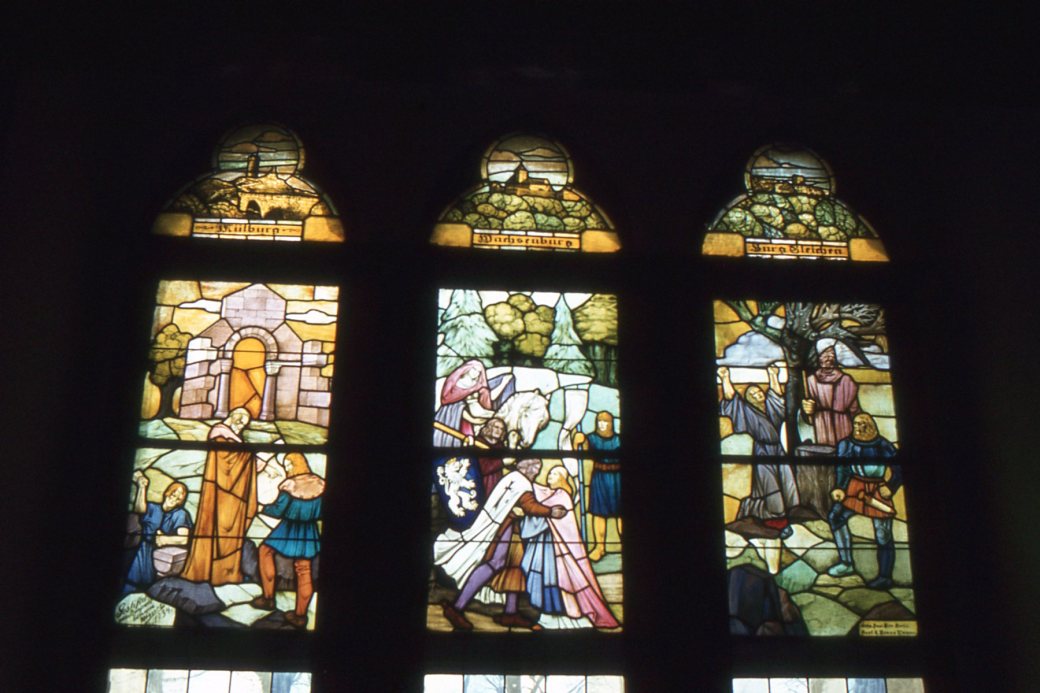
Beautiful Stained Glass Windows at the Erfurt Cathedral

During the last three weeks of my military service I took the time to write a report on my army experiences. I intended to mail it to the ombudsman, whose job was to receive and act on the written complaints from soldiers about alleged abuses and injustices in the West German army. Having gained the much-needed distance from the upsetting transfer episode and having received fair and respectful treatment at my final army post at Marburg, I was in the right frame of mind to describe in an emotionally neutral and objective manner some of the deplorable conditions at the Koblenz barracks, where low ranking army personnel were fraternizing, drinking, and getting drunk with common soldiers and thus tarnishing the public image of the Armed Forces. I also pointed out the errors, which the officer in charge – whether intentionally or not I could not say – committed to bring about my transfer to Maxhof. Furthermore I made it clear that while I lost out on a chance of becoming a lieutenant of the reserve, the army itself would suffer in the long run from such careless and wasteful practices. Biene helped me by typing up the handwritten draft copy of the report.  She was quite impressed how I managed to control my anger and yet decidedly communicated my legitimate concerns to the ombudsman. Being aware of the fact that for the first time we worked together to address and solve a problem, she remarked in her letter that all her thoughts were directed to a time in the future with me. She wanted to do her part that our life would not turn to be something, upon which we would look back with regret, rather a life that was perhaps difficult, but would fill our hearts with joy, because we mastered it together.

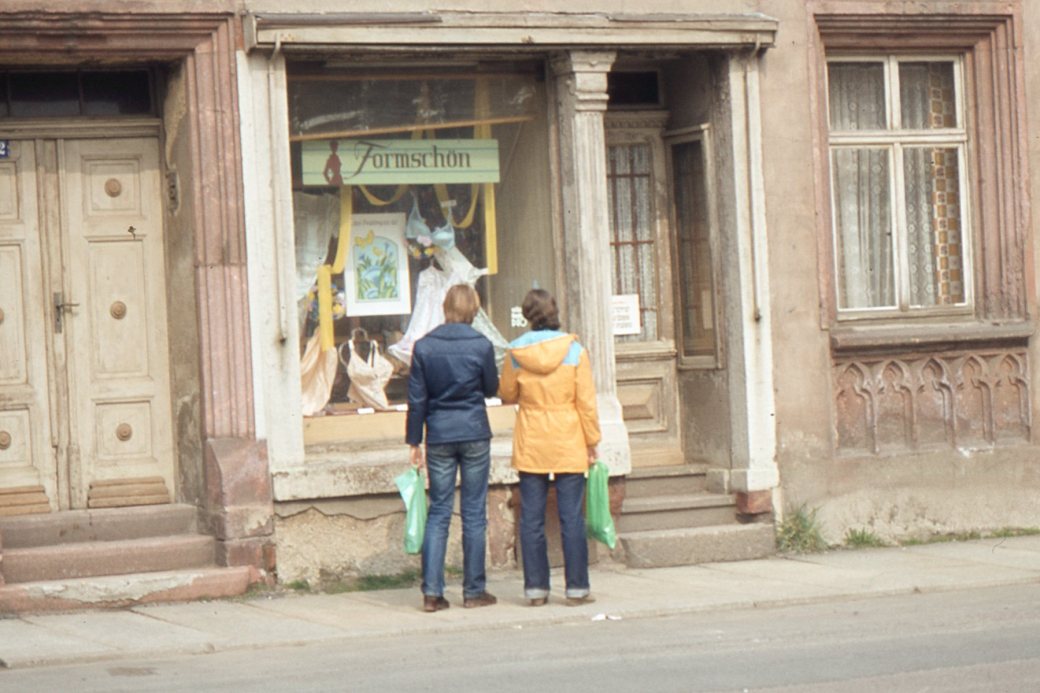
Lingerie Boutique in East Germany 30 Years after the End of World War 2

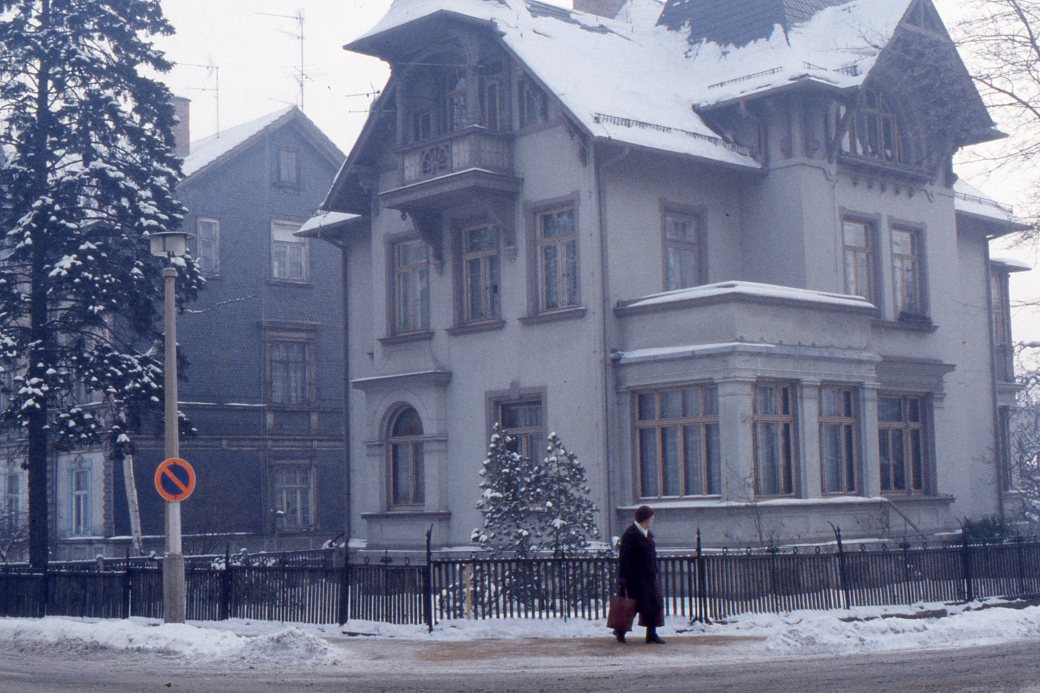
About a week before my birthday Biene and her twin brother Walter traveled to Gotha to visit their sister Elsbeth in the GDR behind the Iron Curtain. In those days, when a fence heavily guarded by the National People’s Army (NVA) divided the two Germanys, a person needed a traveling visa and a residence permit in order to cross the border and visit close relatives. What made the application process so frustrating for so many West Germans was not the hefty fee they had to pay, but the arbitrariness in the approval process by the East German authorities. Only in the event of a severe illness or death of a close relative could one be fairly sure to get that all important entry document. So Biene and Walter were lucky indeed to make their journey to their former hometown Gotha and to be together with sister Elsbeth and her family at their birthplace. The apartment, where Elsbeth, her husband Paul Werner, and their two sons Norbert and Christian lived, was located in a beautiful house that had escaped the destruction of the Allied bombing raids during the war. The home offered the warm, cozy feeling of a secure harbour, where the family found refuge from the desolation of the outside world, the depressing sights of dilapidated houses all around the neighbourhood. While West Germany had experienced an incredible economic boom with an unprecedented growth in prosperity during the past twenty years, not much had changed on this side of the border and large parts of the major cities still lay in ruins. There was a shortage of the most basic consumer goods that forced shoppers to buy, whenever and wherever they happened to be available in the drab city stores.

Biene and her two Nephews Norbert and Christian – 1965

On Biene’s previous visit in the summer of ’64, the two sisters had already formed a close bond with each other. Now Elsbeth was jealously watching that nobody spent too much time with her cherished guest. Together they traveled to Erfurt to visit the famous cathedral, where Martin Luther was ordained in 1507. Inside the 1200-year-old Gothic church they marveled at the beauty of the altar. Biene was impressed by the rich colors of the stained glass windows that let the vibrant light stream into the interior. In the evening the entire family would sit around the table and play a round of the German card game Doppelkopf, which was also our favorite game at the Kegler Clan. Of course, her two nephews were delighted, when they were allowed to spend a little bit of time and go for a sightseeing tour around town with their elegantly dressed and pretty Aunt Biene from the West.

Biene’s Birth Place in Gotha

Elsbeth had watched on East German TV many interesting documentaries on the landscapes and people of Canada. She confided to Biene that if she could live her life over again and had the freedom to travel, she would immigrate to this fascinating country with its magnificent scenery and its promise of a better future. When Biene told her that I was going to Canada in a matter of a few weeks and that we had promised to be faithful to each other, Elsbeth voiced her skepticism and did not mince words in sharing her opinion on what a man of my age needed. She warned her younger sister that I would be looking for a girl who would offer more than she had been able to give. Biene was quite troubled by her sister’s pessimistic views on men’s desires for sex and their  potential lack of faithfulness. True to our promise of always sharing our thoughts and concerns with each other, she immediately communicated her worry regarding these disturbing insights in a letter directly from Gotha and asked me to respond and hopefully reassure her.

A Delicate Question Answered

Gertrud (Biene) Panknin’s Graduation Class – Who can find her?

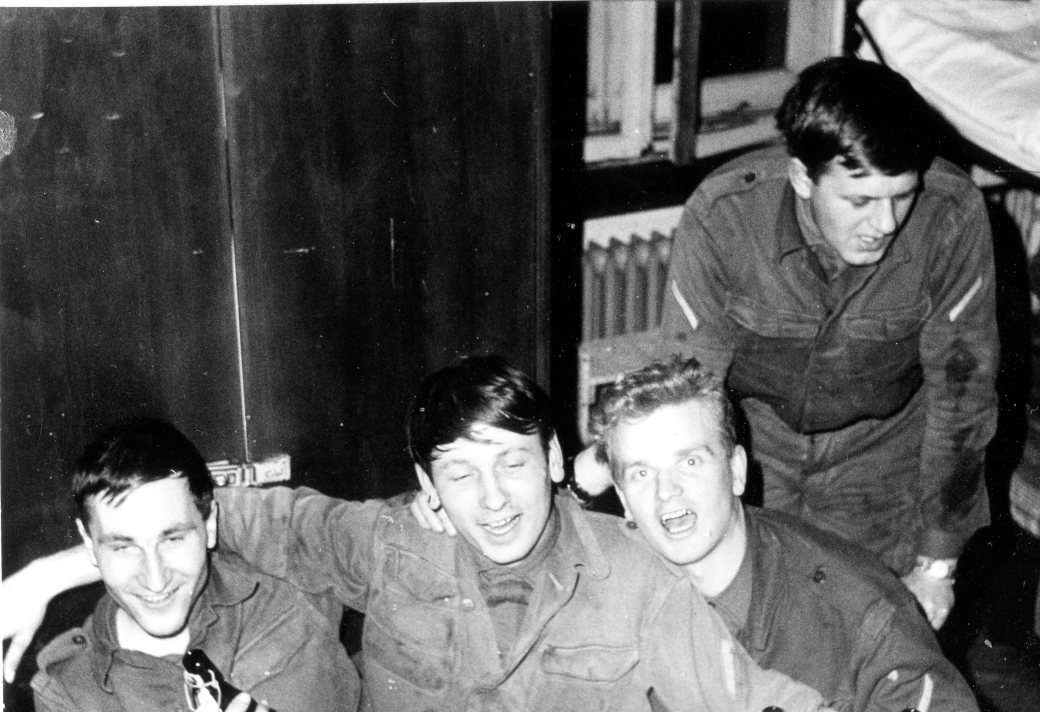
On my 23rd birthday with less than a week left before my release from the military service, I sneaked away from the electronic maintenance job, which had been completed long ago and only existed for one purpose to keep us busy and to kill time. I sat alone at the table of Room 328. No sergeant, drillmaster or officer would bother me here. The carrier frequency equipment, for which I had been responsible for its smooth operation, was in top shape and my absence would not be noticed anywhere at the Falkenstein Barracks. I wanted to do something special on my birthday. The daily celebrations, the drinking and carousing to mark the remaining ‘glorious’ days in the army were not that special anymore.

43

Endless Celebrations: Less than Ten Days Left of Military Service

I longed for quiet, a time to reflect on this idle Wednesday morning. I wanted to respond to Biene’s anxious questions and genuine concerns. Here at the soldiers’ simple living and sleeping quarters no loud talking and singing were distracting me, I found the ideal space to grapple with the contentious issue raised by Biene about faithfulness. It was good to know that Biene trusted me to provide an honest answer. I was proud of her courage to touch on the topic of sexuality, which we two had been too shy to discuss at our few encounters. I took out from my closet pen and paper and began to write down my thoughts. It turned out to be a very long letter, in which I, trusting Biene as much as she trusted me, did not hesitate to truthfully lay bare my innermost feelings. The following are excerpts taken from my lengthy reply.

33

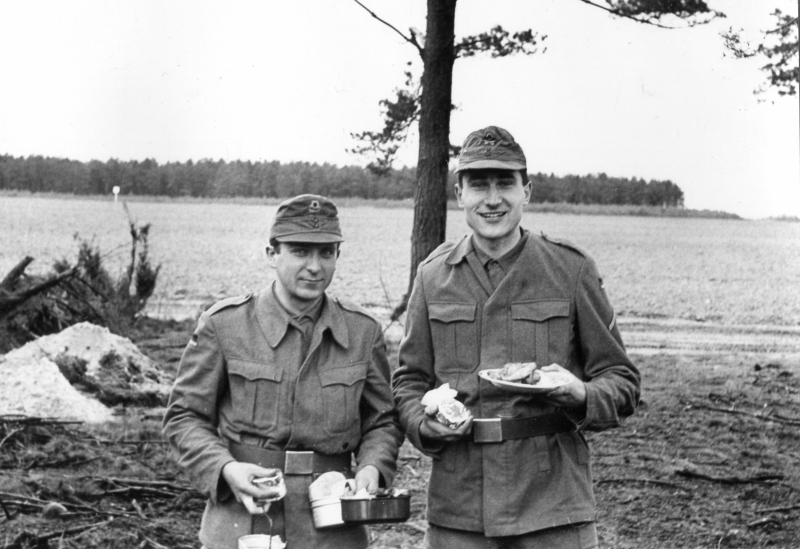
Peter and his Buddy at the Last Military Exercise – March 1965

“March 24th, 1965

 My dear Biene,

Yesterday I received your letter from Gotha. Your sister seems to have a rather strange opinion on men. I am glad that you broached the delicate subject of sexuality. But I found it a little troublesome  that you let yourself get so easily misled. But I don’t want to reproach you; for I myself had often to deal with opinions of young married and unmarried men who asserted that a girl could only be faithful and true to her partner, after she had gone to bed with him. Please forgive me this drastic manner of expression, but why should I beat around the bush? You see the accusations are coming from both sides. As for me, I refuse to accept any form of generalization, when people say, that’s how women are, that’s how men are.

 But now to your concerns! You would like to know how I think about it, dear Biene. Like in all men there is undoubtedly a force that drives me to the opposite sex. Yes, furthermore I concede that the drive is not necessarily directed to a particular person. Dear Biene, you must absolutely believe in what I am writing you now. Let no ever so bold opinion throw you off balance again, if you truly love me. Sexuality does not stand on its own, otherwise we would be like animals, but it is intertwined most intimately with the entire personality of the human being. There will always be tensions, in which we have to struggle to maintain the balance and keep this vital force under control.

 Whoever surrenders in this battle and needs to run to a woman to relieve his tensions is in my opinion a weakling and a coward no matter how assertive and self-assured he might otherwise appear. And in what comes now, you can totally put your trust. Since we love each other, this battle for me is over. I have been able to have this uncanny force coexist in harmony with myself. It is always there, lurking behind the scenes, surprising me at times, but it does not bother me any more. When I read a book, look at pictures, walk in the streets or watch a movie, it often and unexpectedly flares up, and then in full awareness of control I have to smile at myself. Don’t you think that one has overcome much, if one can smile at oneself? Do you still worry about me, even when I tell you that I am strong enough to wait for you and through you alone I have become so strong? As long as I can hope for the fulfillment of my ideals, which I have set for myself, you may chase your worries away. You stand in the midst of this sphere, dear Biene, whether I am in Canada or at the end of the world.

 How beautiful it is that we are so frank with one another! This will not only keep us together, but also bring us ever closer together. Do we want to show this spiteful world that one can wait for one another for years without so-called ‘side leaps’, do we want to, dear Biene, do we want to?

 Finally I would like to say one thing, your sister will one day have to concede that there are some exceptions among men, who will turn out to be ‘miracle men’. Now you will smile; thank you so much! Be completely reassured!

          Your Peter”

The modern reader may scratch his or her head over the outdated notions about love and faithfulness expressed in our letters over fifty years ago. Yet, in our mind they remain completely unchanged and have been our beacon of hope even through the darkest and most turbulent times in our life-long relationship.

Last Rendezvous in Germany

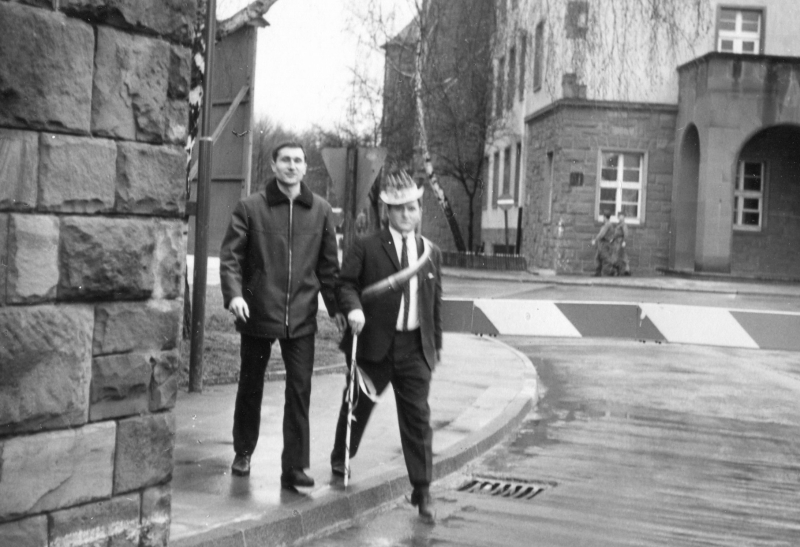
Peter on the Left Walking out of the Falckenstein Barracks

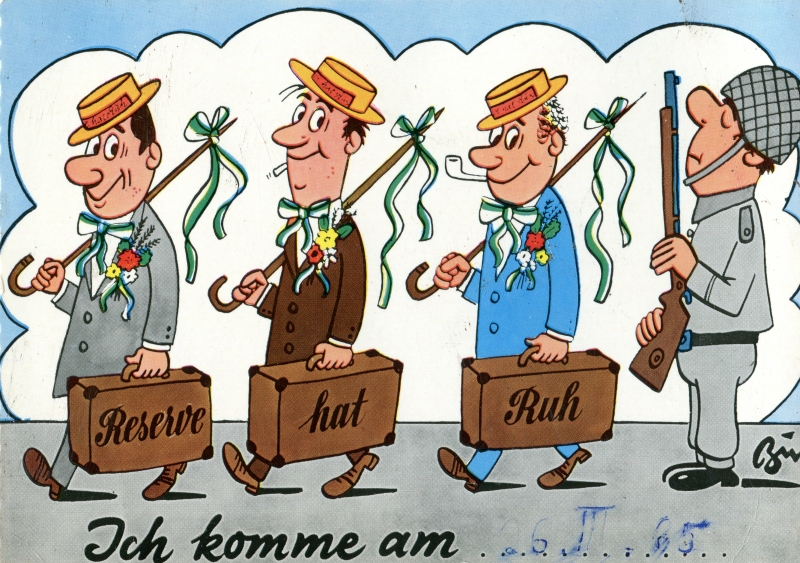
The day of our official release from the West German Army had finally arrived. For the last time we stood in attention in front of the main building. One could easily spot the reservists and distinguish them from the soldiers on active duty by just looking at their clothes. We wore civilian clothes, while the others were standing in their uniform. In spite of all the drudgery during the past two years, it now felt good to have served one’s country. To prevent a war through the presence of a strong army as a deterrent to a would-be attacker was in my opinion far more important than being involved in a conflict with its horrors at the front line and with its casualties among the civilian population. I was grateful for the opportunity to spend my final six months in Marburg. I felt enriched by the outstanding technical training, blessed with a company of cheerful comrades, respected by a competent staff of officers and sergeants. Last but not least I was awarded a fine testimonial, which gave credit to my successful teaching assignments. Soon after the brief farewell speech and words of encouragements and good wishes by the commanding officer we walked through the open gate into momentary freedom until new duties and responsibilities – some of our own choosing, others forced upon us by circumstances beyond our control – would limit our choices all over again. But at this very moment we were truly free. I took the very first available train to take me home to my mother in Watzenborn. In an almost nostalgic mood I hummed in my mind: Parole heißt Heimat, Reserve hat Ruh!

Card Sent Home to announce my Coming

Biene’s reply to my long-winded exposition on love and faithfulness was very encouraging. She also confided to me that only two years prior to meeting me she was not even allowed to step outside the door. Her mother, to whom I will remain for ever grateful, worried a lot about her, kept a watchful eye, and thoroughly investigated, where she was going and with whom she was getting together. At that time quite a few dramas were rolling over the home stage. Biene admitted that during that time she was often in danger of being swept up by her impulsive and passionate feelings. Mother Panknin kept her from getting lost on the wrong path and made sure that her precious daughter would not be led astray by false emotions. But now it seemed that she had trust in her daughter. And even though she had never really got to know me, through the eyes of her daughter she seemed to have developed a favorable image of me. How else, so I asked myself, could she let her travel to me and allow her to stay overnight at a distant location? On Biene’s last visit, before I departed for Canada, with full support of her parents, she came to visit me for an entire week. Perhaps Herr and Frau Panknin shared Biene’s older sister’s view believing that once I was off to another country far away from Biene, our relationship would eventually fizzle out and die a natural death.

Peter and Biene in Front of Erna’s House in Michelbach

On Monday, April 5th, Biene arrived by train in Giessen, where I met her at the station. From there we traveled together to Michelbach near Schotten at the foot of Mount Vogelsberg. The week before I had given Erna, Father’s second wife, advance notice that we were coming for a visit. She knew that this would be the very last time Biene and I would be seeing each other before my voyage to Canada. Even though she was still mourning over Father’s sudden and unexpected death the year before, she did her best to make us feel welcome in her so typical cheerfulness. Everything was prepared for a comfortable and enjoyable stay for us. I was going to sleep in Father’s bedroom upstairs, while Biene was sleeping in the guest room.

Erna, Father’s second Wife, on the Left with her Friend Friedchen Langlitz

After a good night’s rest and a hearty breakfast, Biene and I decided to hike up to the Hoherodskopf, one of the higher peaks of the Vogelsberg Mountains, a 2500 square km terrain that was formed totally from volcanoes some 19 million years ago. This volcanic region has been long extinct. It had created one of the most amazing basalt rock formations anywhere in the world. But on this wonderful April day we were not going to study geology, we had better things in mind. We were more interested in each other’s company, living in the here and now, savouring each precious moment. It was cool, but the sun shone brightly over the park like landscape. Thunderclouds arising above the western horizon lent the vernal panorama a dramatic effect. We were grateful that we encountered very few people on our leisurely stroll, as it was early in the season. There was nothing that would disturb the warm, tender feelings we felt for one another. This was also not the time to look back at all the obstacles, challenges, and problems that we had to deal with in the past. We had mastered them and had set them aside not allowing them to interfere with our blissful state of mind.

Biene on our Hike to the Vogelsberg Peak

There was no need to talk. Our hearts and souls felt at one. We reached the top just in time to find some shelter from a heavy downpour that was threatening to spoil our outing. Near the peak of the Taufsteinhütte we stepped into a cozy restaurant by the same name, when the first raindrops began to fall. The dining area created that special kind of ambience so conducive for a romantic get-together, each table place at a window with a view over the spectacular scenery. Just then lightning lit up the dark clouds. Then followed the rumbling of thunder in the distance. I ordered a bottle of Mosel wine to celebrate and drink to our love that had carried us so far and would help us bridge the long time of separation ahead. For on this day we had not only climbed Mount Voglsberg, but even more importantly we had also reached a new pinnacle in our relationship. The rain was now coming down in buckets. Thunder and lightning engendered an electric atmosphere. In a strange mixture of fear and passion it made us move closer together. In the spirit of ‘carpe diem’ we did not gulp down our wine as if in hurry, instead we sipped the sweet wine from the Mosel valley to make the moment last. We almost wished that the storm would last forever. At least for the moment, time appeared to stand still. When we tasted the last drop, the storm and rain had subsided and had moved on. Erna, having worried about us, had sent a neighbour to pick us up in his car. We reluctantly got up and with a feeling of regret let the neighbour drive us back to Michelbach.

Schotten – April 1965

On the following day Biene and I promenaded down to the quaint town of Schotten with their timber-frame houses so typical of this region. Biene was quite excited and full of anticipation. For I had announced that I would buy her a mystery gift. Of course, I could not tell her what it was; after all it was supposed to be a mystery gift. Biene behaved as if she knew the secret. Therefore, she kept her innate curiosity for all things unknown to her in check. If I had a picture of us two walking into town, I would in a comic-book-like fashion place two speech bubbles above our heads. The one above Biene would say, ‘Today is the day Peter will buy me an engagement ring. I will be so happy!’ And my bubble would say, ‘Today is the day I will buy her a genuine Hohner harmonica. She will be so happy!’ Had I not played the mystery game, had Biene said just one word, I would have bought the ring and put it on her finger for everyone, her parents, friends and all would-be suitors to see that she was engaged. Instead she was now in possession of a fancy harmonica that could be played on both sides in keys C and G. Biene looked pleased and even appeared happy, but I am sure that deep inside she was also a bit disappointed. What I could vaguely at the time was that we could have saved ourselves a lot of pain and agony in the not too distant future, if we had been able to communicate with each other just a little better.

Michelbach, the Little Village, between Schotten and Vogelsberg Mountain

It was the night before we had to head back to Mother’s place at Watzenborn Was it the moon, or the noisy cats prowling and meowing in the attic, or fear of the unfamiliar surrounding, or romantic passion stirring in us? Perhaps all of these things! The plain fact, however, was that we could not sleep. With the two upstairs bedrooms so close to each other it would have been so simple on any of the three nights to yield to temptation. But we did not. I would be a hypocrite, if I was going to explain our conduct in terms of a moral victory. It just happened, almost certainly for our own good.

Albert Schweitzer – Seminar #7

Die Geschichte von der Angst, ausgelacht zu werden

Früher haben die Kinder gerne mit einer Schlappschleuder geschossen. Man spannte einfach Gummibänder an eine kleine Zweiggabel, legte einen Stein oder eine Erbse in die Lusche, spannte und ließ den Stein fliegen. Man zielte auf einen Baumstamm oder eine Blechbüchse oder in die Luft. Doch war es verboten, auf Menschen oder Tiere zu schießen, denn man konnte sie damit verletzen oder sogar töten.

Auch Albert besaß eine solche Schleuder. Er kniff das linke Auge zusammen, schoss auf einen Ball und traf ihn auch. Da kam sein Freund Heinrich hinzu. Er schlug ihm vor, doch nicht auf einen Ball, sondern in den Wald zu gehen und auf Vögel zu schießen. Da könnte Albert zeigen, ob er wirklich ein guter Schütze ist. Aber Albert wollte nicht auf Tiere schießen, denn sie taten ihm leid. Ganz gleich, ob es Amseln oder Spatzen sind, sie alle wollen ja leben. Außerdem hatte er die zehn Gebote gelernt, in denen es heißt: Du sollst nicht töten!

Doch Albert traute sich nicht, „nein“ zu sagen. Er fürchtete, dass ihn sein Freund Heinrich auslachen und einen Angsthasen nennen würde. So antwortete er: „Ich komme mit!“

Beide Jungen liefen nun zum Wald, lasen kleine Steine auf und warteten hinter einem Baum darauf, dass Vögel kämen und sich auf die Zweige setzten. Da kam eine Schar Spatzen angeflattert. Sie ließen sich auf dem Baum nieder und zwitscherten fröhlich in die Morgenluft. „Die schießen wir runter“, flüsterte Heinrich leise. „Schieß, Albert!“, befahl er streng. Doch eine innere Stimme warnte ihn und sagte: “Schieß nicht. Albert!“ „Ich schieße daneben“, meinte Albert im Stillen. „Ich will doch keine Vögel töten!“

Albert spannte den Gummi der Schleuder und wollte gerade schießen, als vom Kirchturm in Günsbach die Glocken zu läuten begannen. Sie riefen zum Sonntagsgottesdienst. Albert erschien das Glockenläuten wie eine Mahnung: „Du sollst nicht töten, Albert!“ Albert sprang auf, warf die Schleuder weg und rannte nach Hause. Sein Herz klopfte stark, doch er war froh. Denn er hatte nicht etwas Böses getan, was ihm ein anderer befohlen hatte. Seine innere Stimme, sein Gewissen, war stärker als der Befehl des Freundes.

family194

THE MINING ERA OF THE CANADIAN COLUMBIA by Bill Laux – Chapter 5

CHAPTER FIVE

GOLD ON THE COLUMBIA

The first report of a mineral occurrence in the Upper Columbia Basin was that of British naturalist, David Douglas.   While accompanying an HBC trading party in 1825, he reached Kootenay Lake and either observed, or more likely was shown, the prominent outcrops of “chicamon rocks” by the local Indians.    British Columbia historians have assumed that the Hudson’s Bay men had shown the local Indians how to break off chunks of the galena outcrop above the lake on the Riondel peninsula, and melt them in a fire to cast bullets for their muskets.    It may have been that the Sinixt and Kootenay Indians had shown the HBC men.   The fact that the Indians had mined galena from outcrops east of Northport, WA before they were “discovered” by American miners, suggests that it was the aboriginals, rather than the HBC men who began the mining of galena in a small way.   All of these deposits of galena (lead sulfide), they called “Dead Medicine,” their term for musket balls.

The chief factor at Fort Colvile from 1833 – 1844 was the educated and energetic Archibald Mc Donald.   Learning of the Kootenay Lake lead deposit from his men, he visited it personally in September, 1844 to determine its value.   He drew a map of the location, collected  a number of samples, and sent them down the river to Dr. John McLaughlin at Fort Vancouver to be forwarded to England for assay.   In his letter to HBC Governor James Douglas,  he describes the location.

“The ore is picked up on the 2nd eminence of the Presque-Isle at “A”, about 100 feet high.   There is something of a crater at top, and ‘tis from the debris or heaving up of old, covering the land side of  the conical hill that the ore is found in loose lumps among the earth…I cut my initial in a large tree along side…”

Chief Factor McLoughlin forwarded the samples to Archibald Barclay, the Secretary of the Company, in London with his observations in a letter of November 23, 1844.

From a small portion of the metal tested here, a considerable  quantity of very fine soft lead was obtained; but our mode of analysis was not sufficiently accurate to detect the traces of any more precious metal.   

“It is not probable that mining operations could be carried on to advantage at Flat Bow (Kootenay) Lake,  the distance being about 600 miles from the sea coast, and the water navigation so difficult and dangerous that the metal would have to be transported with pack horses more than half the distance by land.   The mine is also on the south side of the Columbia River, and will therefore, in all probability, eventually fall within the limits of the United States Territory, and, if the reported mineral wealth of that part of the country becomes known to the Americans, it will raise its value, and may become an additional motive with their Government to make good their claims.”

Several things are clear from this letter.   Mc Loughlin, if not Governor Simpson and the  HBC, already accepted that the British would eventually have to cede the land south of the Columbia to the Americans.   But as long as the status of dual sovereignty endured, it would be best to keep knowledge of any mineral deposits in the District of Columbia confidential, lest it arouse the cupidity of the Americans.   

A source of lead for musket balls was a significant find in the Northwest.   All HBC lead was coming from England by ship, and a local source would be a source of considerable profit for the company.    But the letter also indicates the impracticability of exploiting the deposit since the Bonnington Falls and rapids of the Lower Kootenay River blocked the usual HBC transport by bateaux, and a portage of about 30 miles by pack animals would be required around these obstructions. 

A discovery of lead might be kept confidential within the Company, but gold was a different matter.   The news of the rich gold strikes in California was being discussed all over the Northwest in the 1850s.   Dozens of HBC employees deserted to join the parties of men heading south for the California diggings.   A few, still loyal to the company, or unwilling to leave their families and ranches in the Washington Territory,  wondered.   Was it worth heading south to join the rush, or might there be gold on the Columbia or its tributaries?   The HBC posts in the Interior had been supplied with small sample of gold nuggets from the California diggings.  These were shown to employees and Indians and the question asked:  Had they ever seen anything like this?  The possibility induced Fort Colvile teamster Joseph Morel, who was gathering driftwood on the shore of the Columbia in 1854, to experimentally wash out a few pans of gravel.    

In the Northwest 1854 was one of those years when one era comes to a close and new one opens.   In that year the fur trade in the Northwest was dwindling owing to a reduced demand for beaver pelts.  The HBC was more and more turning to its farms, coal mines, and sawmills to try to develop a trade in flour, coal and lumber with the growing market of Americans to the south.    Two events in the same month metaphorically signalled the change.   On September 27, in Oregon City, that most intrepid of all the HBC fur traders, Peter Skene Ogden slowly slipped from life.    In the same month, HBC teamster Joseph Morel and his fellows found placer gold in the gravel bars and rock crevices of the Columbia River near Ft. Colvile.   

Placer gold consists of the particles and nuggets eroded out of the quartz ledges in the mountains by glacial and water erosion.    They are carried downstream by any fast running current of water, but being heavier than sand or rock, are dropped to the bottom whenever the current slows down.   What had been found in the California rivers in 1848 were the accumulated nuggets and grains of gold that had been caught in rock crevices on the bottoms of the river, and underneath gravel bars on the insweep of curves of the river where the water runs more slowly than on the outsweeps.    This was what Morel and his fellow miners were looking for in the late summer of 1854 as they probed the rock crevices of the Columbia during low water and and dug into the gravel bars at the river bends.

  The first few flakes of gold shining up from the HBC men’s pans were enormously and immediately consequential for the region.   A gold strike could not be hidden, no matter what the HBC policy might be.   Gold miners (the secretive Mexicans aside) cannot be silenced; they will pour out their take for the day on the saloon bar to impress their cronies.    All that fall, excited men from Fort Colvile dug into the Columbia river bars, working slowly upstream.   The treaty of 1846 had set the British – American boundary at the Forty-Ninth Parallel.   Exactly where that line intersected the Columbia was a matter of guesswork.   The crude instruments available to Colvile Chief Factor, Angus Mc Donald suggested that border would fall somewhere close to the confluence of the Pend Orielle and the Columbia, but a precise determination would have to await the arrival of the Boundary Commission surveyors.   Meanwhile, a man named Walker, part Indian, found gold on the Pend Orielle, a large tributary of the Columbia.    The swift running Pend Orielle, on joining the Columbia, slows down to the rate of the larger river, and drops its gold.   Here the richest bars were found.   Men digging these gravels were making  $4 to $10 per day, better than a month’s wages for most.  Two hundred ounces were taken from the Columbia that season.   It was bought by Chief Factor Angus Mc Donald at Ft. Colvile for $12 per ounce.   That autumn it was discreetly sent overland by pack train on the 1849 HBC trail to Ft. Hope, and on to Victoria the next year.    As it turned out, the Pend Orielle diggings were a bare half mile inside British territory, and became the first mining entry into the Canadian portion of the Upper Columbia Basin.     Just across the Columbia from these rich diggings and a quarter mile upstream, the HBC men began construction of a new post, Fort Shepherd, in 1856, on British soil, from which they hoped to control any commercial entry into the British Columbia.        

The post was needed at once.  The news was out: there was placer gold on the Upper Columbia.   Men rushed north from Walla Walla and from the exhausted diggings in California, and in the spring of 1855 the first Colvile Gold Rush was underway.   That year the Columbia, the Pend Orielle, and their tributaries were lined with men, almost all Americans, digging the gravels for the gold that lay along the bedrock.  The mining era on the Upper Columbia  had begun.

   But this Columbia mining was being carried out by a largely American force, in an area chiefly served by American merchants whose merchandise came up the easy military wagon roads from Walla Walla and White Bluffs on the navigable Middle Columbia.    The isolated HBC Fort Colvile (and after 1856, Ft. Shepherd), were linked to Victoria only by the old HBC Brigade trails over the rugged Cascades, one from Osoyoos Lake and the other from Kamloops.   These were crude horse trails with no bridges, no easy switchback gradients, and dangerous in the extreme.   The fur brigades and special expresses always took extra horses along; it was not uncommon to lose half their stock on the terrible mountain descents which were taken by the Indian packers straight down in a wild slide.   Until some dependable, year round, link with the Coast could be established, the Columbia mines would remain largely an American operation.

The Pend Orielle diggings were located approximately where the boundary was believed to be located, as the river ran east from its mouth on the Columbia and no one possessed an instrument capable of accurately establishing latitude within a few hundred yards.    However, in 1859, British Army Captain John Palliser’s “British North American Exploring Expedition” was making its way west into British Columbia with the intention of reuniting its scattered parties at HBC Fort Colvile.  Captain Palliser himself came down the Kootenay River from Kootenay Lake to the Columbia.   Traveling down river he stopped at Fort Shepherd where he was asked by the HBC men at the fort and the miners from the Pend Orielle to take an observation to determine definitively whether the Fort and the placer grounds were actually in British territory as supposed.   Palliser took his observation and finding Fort Shepherd to be 3/4 of a mile ( 1.2 Km) within British Columbia, reported,

“While I was observing, a circle of Scotchmen, Americans, and Indians, surrounded me, anxiously awaiting my decision as to whether the diggings were in American territory or not; strange to say, the Americans were quite as much pleased at my pronouncing in favour of Her Majesty, as the Scotchmen, and the Indians began cheering for King George.”

George III had been dead thirty-nine years, but was still fixed in the Indian imagination as their protector against the “Bostons.”    The Americans’ gratification had much to do with the fact that many of the Pend Orielle miners were deserters from the U.S. army.   The long tradition of the Kootenays as a refuge for disaffected Americans begins with the Pend Orielle miners in 1859.