STEEP AND CROOKED: THE MINING RAILROADS OF THE CANADIAN BORDER
By Bill Laux
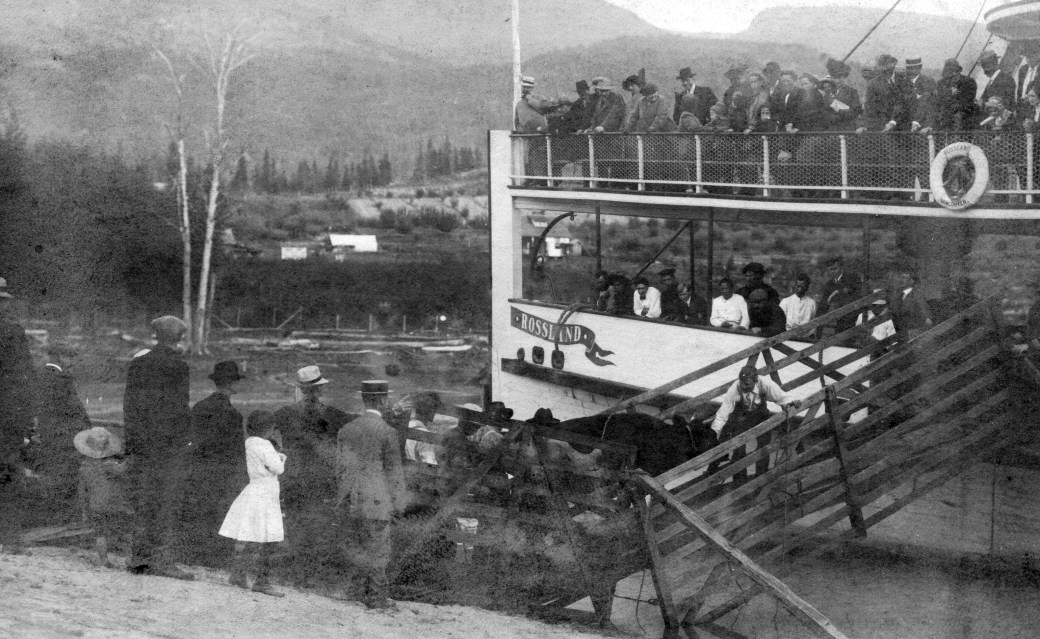
Loading Cattle on the Rossland at Fauquier
CHAPTER SIX
THE COLUMBIA AND WESTERN (1896 – 1900)
Fritz Heinze let his first contract for the first section of his new railway on December 9, 1896. It was to be a standard gauge line, 21 miles long, from Smelter Junction to the foot of the Arrow Lakes at Robson West. A dock, to be built there, would put his rails a short barge trip across the Columbia from the CPR’s Columbia and Kootenay terminal at what was called “Low Water Landing.” The C&K’s original dock at Sproat’s Landing, at the confluence of the two rivers, had been abandoned because of the difficulty of docking sternwheelers there during low water periods. The new terminal was built three miles upstream where year round deep water was available. This “Low Water Landing” became the town of Robson, and Heinze named his C&W terminal on the other side of the river “Robson West.”
Heinze had his original C&W charter, which called for a line running west from Rossland, amended. By building north from Trail to Robson, instead of west from Rossland, Heinze avoided the double summit crossing to the Kettle Valley, and its 5000 foot pass. At Robson West, his line would be in a position to connect to the CPR line from Alberta when it should be completed. That he intended such a connection, is clear from his half interest with a Canadian, Albert McCleary, who had preempted the 320 acres which now forms the townsite of Castlegar. McCleary’s preemption included the best site for a Columbia River bridge, and Heinze, in buying an interest, secured it for his C&W. From his new terminal at Robson West, his amended charter authorized him to continue his line west to Dog Creek, and to ascend it to McRae Pass. From the pass, it would be relatively easy construction down McRae Creek to the Kettle River Valley at Christina Lake. This, of course, would preempt the CPR location for the line to Penticton Van Horne had promised to build. . It was a shrewd move. Heinze had the charter and the lowest pass into the Kettle Valley. Van Horne was now blocked at the Columbia.
The Columbia and Western was received with extreme disfavor by the Canadian Pacific. It was building its line in to the Kootenays from Lethbridge, Alberta, and planned to link up with its subsidiary, Columbia and Kootenay at Nelson. To build its line west from the Columbia, the CPR would now have to buy Heinze out.
The Robson West line was laid with 56 pound rail lifted from the Northern Pacific’s Columbia and Palouse Railroad in Washington. The C&W grade followed a bedrock bench a few hundred feet above the the river. At China Creek, the line had to descend from the bench to cross the creek on a 3.6 percent grade and climb out on the other side at 2.85 percent. These two grades were to require doubling of heavy trains until a new alignment and a steel trestle was constructed in the 1940s. C&W construction was done with leased CPR 2-8-0 No. 351 and some leased CPR flats. The work was bid in by a Butte, Montana contractor at $600,000, and work began on January 1, 1897
Heinze could not afford to buy equipment for his new line. His trip to England to raise money for it, with Lt. Governor Dewdney in his party, had been a complete failure. No one wanted to invest in a railroad between two places which could not be found on any British map. Heinze had to build the C&W using his own money, until on completion he should receive the land grants. In these difficulties, he would not be able to continue his C&W west over Mc Rae Pass unless he could obtain further subsidies. His engineers had reported to him that the line to the Boundary over McRae Pass would cost him $30,000 per mile. His land grant of 20,000 acres per mile would bring in but 25 cents per acre at the prevailing prices: $5,000 per mile. He went to the B.C. legislature to present his engineers’ estimates and request assistance. The members were forthcoming, and granted him a cash subsidy of $4,000 per mile for that part of the line between Robson West and Greenwood. For the remainder of the line, where it was thought construction would be easer, he could have the land grant or the cash subsidy, but not both. He next tried the Dominion government for further assistance.
On June 8, 1897, he appeared before the parliamentary Railroad Committee in Ottawa to solicit a federal subsidy of $8000 per mile. However, to his consternation, appearing the same day was Dr. Milne, of Victoria, for the Vancouver, Victoria and Eastern Railway, seeking a subsidy for that line. The committee testily pointed out that Heinze was asking for a subsidy for a line west to the Coast from the Columbia River, and that Dr. Milne was asking for a subsidy for what would be a parallel line running east from the Coast to the Columbia. They suggested that the two men should join their separate lines somewhere in the middle, and ask for a single subsidy for a joint line. Milne and Heinze very reluctantly agreed to collaborate. On the 16th, they reappeared before the committee with a hastily cobbled up joint proposal. But in discussing it before the members, a dispute broke out between the two of them: Heinze would let the VV&E build its line, but he wanted the subsidy for himself.
The argument grew heated, and the committee, in disgust, adjourned for its summer holidays. The matter could not be reopened until the committee sat again the following year. When it considered the matter again in 1898, it granted a Federal charter for the C&W but no subsidy. Interestingly the Federal charter proposed, in addition to the line to Penticton, a line from Trail to Columbia Gardens. This location was also known as Sayward, where Heinze could join his line, as promised, to Daniel Corbin’s Nelson and Fort Shepherd line. Without the Federal subsidy Heinze would be obliged to mortage more of his Montana mines to begin construction. But at this very moment a concerted attack on his Butte copper properties was begun by the Rockefellers whose Amalgamated Copper now dominated Montana by aquiring both Marcus Daly’s and W. A. Clark’s holdings. Only Heinze’s United Copper stood in their way of owning all the significant Butte mines and smelters. The Rockefellers, having created a Standard Oil monopoly in oil, were now goingto attempt it in copper. To fight them off, Heinze would need every bit of cash he could raise.. He decided to cash out his Canadian enterprise to finance the 7 year legal battle with the Rockefellers that followed.
Back on the Columbia, the C&W line to Robson West was nearly complete, when, on September 10, 1897, the sternwheeler, Nakusp, grounded broadside to the current on a gravel bar at Kootenay Rapids, 17 miles above Trail. The Nakusp was firmly stuck, blocking all river traffic. The Lytton and the Kootenay were at once dispatched to try to pull her off. They put lines to her and churned their great sternwheel furiously, but the Nakusp would not budge. It was September, and every day the river level was dropping. Soon the Nakusp was high and dry; no boat could move past her, and the smelter needed its coal deliveries. The railroad was frantically rushed to completion and opened on the 27th, hauling passengers and the urgently needed coal to Trail. The unfortunate Nakusp eventually had to be jacked up onto an improvised launching ways and relaunched into the river. It was November before she could be put into service again.
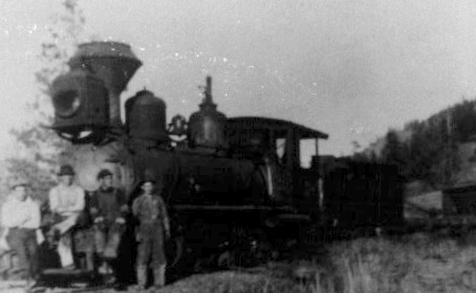
To operate the new line, Heinze leased four CPR 2-8-0 locomotives, Nos. 401 to 404, a single coach and some freight cars, and had them barged down from Revelstoke. Three rail track was laid in the smelter yards, and by the end of 1897 a third rail allowed standard gauge service down to the Trail city station and the waterfront landing. Leased Consolidation 404 had been built with blind second and main drivers, as did the others. Once Heinze chose standard gauge for his C&W extension to Penticton, it was his intention to standard gauge the Rossland Hill as well. The leased CPR Consolidations with blind drivers, would have been able to run through those tight curves above Anable and Warfield and handle the Rossland passenger runs.
With the completion of the C&W to Robson West, there was no long any need to run steamers down the Columbia from Robson to Trail. And, except for the occasional summer excursion boat to Deer Park or Syringia Creek, this river service was discontinued. Since the Red Mountain Railway now handled the passengers and freight from Northport, the boat service below Trail was also withdrawn, and the waterfront station closed. A new Trail city station was built near the corner of Cedar and Farwell, the site of the present Super Valu market. A wye was laid just east of the station, extending to Victoria Avenue, to enable engines to be turned.
With the whole Kootenay district developing mines, and two Canadian smelters operating, at Trail and at Nelson, the CPR was determined to establish its transportation monopoly in the district, and shut out the American competition. It planned its own smelter at Blueberry Creek, and a line west to the new copper-gold discoveries in the Monashee Mountains. Closely tied to the Federal Government, it sought to preserve the entire Kootenay mining industry for Canada, British investors, and itself.
Its first move was to buy out the independent Columbia and Kootenay Steam Navigation Company which operated the largest fleet of sternwheelers on the Columbia and on Kootenay Lake. The strictly neutral CKSN boats had been calling at everybody’s wharf, delivering and accepting traffic from all. Once the CPR took over, however, orders went out that they were no longer to serve Dan Corbin’s Nelson and Fort Shepherd rail to steamer transfer at Five Mile Point, and to discontinue their run up the Kootenay River to Jim Hill’s railroad dock at Bonner’s Ferry. Heinze’s connection at Trail, and later at Robson West, was still to be served, since he possessed that valuable and generous C&W charter which the CPR needed to build west to Penticton and the Coast.
If the CPR thought that they had shut the Americans out by refusing to serve their docks, they did not know James J. Hill. As soon as the CPR boats ceased running up the Kootenay to his Bonner’s Ferry transfer dock, Hill bought up a parcel of land on the southern end of Kootenay Lake called Kuskonook, and chartered a branch line to run down the Kootenay River Valley from Bonner’s Ferry to this new steamer landing and transfer point. The American portion of the line was called the Kootenai Valley Railway, the Canadian section was the Bedlington and Nelson. To counter the CPR boats, which would, of course, be forbidden to serve his new branch, he bought up the International Navigation and Trading Company which had been operating sternwheel steamers on Kootenay Lake in competition with the CPR. Now, with his own boats, Hill competed at every lake point , and as soon as he could get his rails to Kuskonook, the CPR would face a mighty rival for Kootenay trade.
Hill’s Great Northern was not the only American railroad making a move on the Kootenays. Dan Corbin was in Greenwood in the fall of 1897 buying the King Solomon mine, and had his surveyors locating a route from Marcus, Washington, up the Kettle River into Canada and following the river west to Grand Forks, dipping into the U.S. at Carson, and continuing to Midway. From there, the line was to follow Boundary Creek upstream to Greenwood and the mines. From its headquarters in St Paul, the Northern Pacific was watching developments in the Kootenays and Boundary country, and wanted an entry into these rich mineral lands north of the border. It began surreptitiously buying up shares in Corbin’s Spokane Falls and Northern Railway. Dan Corbin soon became aware that someone was buying into his railroad; he suspected the CPR. He wired financier J. P. Morgan in New York to buy up all the SF&N stock he could, lest the CPR gain control of his line and enter Spokane. Morgan did, but as financier to the Northern Pacific, he knew very well that they were behind the stock purchases, not the CPR. However, he did not tell Corbin, and continued to accumulate shares in the expectation that when the time came, he would decide who got the SF&N.
The results of this rivalry of the transcontinentals were exciting for Kootenay Lake residents. Sternwheel steamers raced each other regularly to see which boat and which company could get its passengers from Kaslo or Riondel to Nelson in the shortest time. On the Arrow Lakes the CPR built a powerful new sternwheeler, the Rossland, with huge, 22 x 96 inch cylinders and a more deeply molded hull shape. The new design was intended to produce a sternwheeler that could make the 256 mile round trip from Arrowhead to Robson West and back in one day. She was launched in August, 1897, 183 ft. long by 29 ft. wide, and 884 tons. The Rossland was the fastest boat on any of the lakes, capable of 22 miles per hour, an astonishing speed for a sternwheel steamer. However, her deeper hull, which made her more stable in a crosswind, could not clear the sandbars in the winter low water season. So, while she raced her passengers up and down the lakes all summer long, she had to lie idle during the winter months while the shallower draft Kootenay or Minto took over the run.
Though he had finished his first section of C&W line, and had surveyors out locating a route from Robson West to Penticton, the new copper war in Butte, drew Fritz Heinze back to Montana. H.H. Rogers and William Rockefeller, of Standard Oil wished to duplicate that successful monopoly in oil with a new one in copper. They formed the Amalgamated Copper Mining Company, bought up all the major copper operations and all but one newspaper in Montana ( Heinze’s Butte Reveille). With that power they began to manipulate the price of copper, by withholding large quantities from the market to drive up the price.
The adversaries they could not crush were Fritz, Arthur and Otto Heinze and their two companies, Montana Ore Purchasing and United Copper Company. The savagery of the contest was unparalleled, culminating in an attempt by Amalgamated to bribe a judge to testify that Fritz Heinze had bribed him. Heinze, as the lone Butte holdout against a corporation with unlimited power, had the support of the miners and won victory after victory in politics and the law courts. Underground his miners fought Amalgamated miners in the dark, dangerous galleries with picks, clubs and dynamite. The Amalgamated lured away to their side Heinze’s Butte manger with his confidential papers and maps. This was a serious blow. Heinze had 27 lawyers simultaneously fighting Amalgamated lawsuits, and needed huge amounts of money for these court battles. He would have to cash out his B.C. holdings.
As a last effort to secure a federal subsidy, the only hope for completing his Columbia and Western, he sent out Colonel Topping to canvas the Okanagan and Boundary districts for signatures to a petition to Parliament to grant him the Federal subsidy he urgently needed. Colonel Topping’s trip was a disaster. The Boundary Creek Times of January 29, 1898, gives a detailed account of the Colonel’s appearance before the assembled citizens in Rendell’s hall in Greenwood.
“Colonel Topping came down from Vernon, having visited Fairview, Camp McKinney and other points. When he reached Greenwood he had about 75 signatures to the petition, and when he left Greenwood he had the same number of signatures.”
It was not a warm reception. The people of the Boundary were outraged at the subsidies and grants Heinze had already extracted from the Provincial legislature and had not yet built so much as a mile of track in the direction of Greenwood. The line to Robson West, was, in their view, but a device to connect his works to the CPR. They voiced their distrust of Heinze in blunt terms. Mayor Wood opened the meeting.
“What we want is a competitive railway and we should do everything to assist Corbin and getting a charter. (Applause.) He failed to see” the paper reported, “what claim Mr. Heinze had on the people of Boundary Creek. (Hear, hear.) He never built an inch of road for us. He does not think Mr. Heinze ever intended to build a road. He boasted about how he had ‘flim-flammed’ the Victoria government, but, said, Mayor Wood, don’t let him ‘flim-flam’ us. (Loud applause.)
There was considerable prejudice against Fritz Heinze, as his Amalgamated enemies in Montana had given out in their newspapers that he was Jewish, which was untrue. Three years later, Mayor Wood would charter a railway from Midway to Vernon and attempted to “flim-flam” the legislature and public that he was actually “prosecuting continuous construction,” as his charter required, by hiring a foreman and man with a wheelbarrow to dig some few hundred feet of grade south of Vernon.
In Rendell’s hall that winter night, Alderman Galloway took up the attack on Heinze.
“He doubted that Heinze intended to build. He first asked for a charter only, then a grant, then a cash subsidy, and now he is asking for another cash subsidy, and if he gets this he will simply be in a position to sell out at a higher figure. (Hear, hear.)”
A resolution was then introduced enjoining the people of the Boundary district to refuse to sign Colonel Topping’s petition.
Colonel Topping then rose before them and opened his remarks by saying, “It was indeed a pleasant thing to face a meeting thoroughly hostile, fearfully hostile…”
Topping went on to present Fritz Heinze as their champion against the the CPR, which he painted as, “…a monopoly, no more cruel one existed… The fight was between Heinze and the CPR… If the CPR was supported it would crush any other road that attempted to get into this district. He had no quarrel with Mr. Corbin; he was entitled to his charter. (Hear, hear.) The Columbia and Western was not antagonistic to Mr. Corbin…the Columbia and Western was an all-Canadian road… He had the assurance that Mr. Heinze intends to build it if granted a subsidy.”
The crowd was unimpressed. The miners and businessmen of the district had already put 700 of their names to a petition favoring Dan Corbin’s Kettle River Valley Railway. Corbin was popular in Greenwood. He owned mining properties west of town. He had come personally and assured the citizens that, “…the time has come when it is not necessary that the government should give away more money or land in this direction and I do not intend to ask for either.”
Alex Wallace, a prospector, spoke for the majority when he said, “…he had heard of Mr. Heinze before. The people of Boundary Creek were a long suffering humanity. He would like to see Mr. Heinze visit this district — the Commander in Chief –but he sends only his Colonel: that was good enough for the people of Boundary Creek. The Columbia and Western was a gigantic humbug. (Hear, hear.) The people should oppose such a subsidy to any such boodling scheme… He was only prospector, but he was tired of being humbugged and therefore wished to give expression to his opinions. (Applause.)”
The assembly voted, “without a dissenting voice,” a resolution to be forwarded to Parliament, “…that the residents of the Boundary Creek District urge upon the Dominion Parliament to grant said charter to the Kettle River Valley Railway Company.” (Corbin’s line).
Faced with this united hostility, and the accusation that Heinze would only use the cash subsidy to raise his selling price to the CPR, Colonel Topping became heated and unwisely remarked to the assembled citizens that, “…he hoped they realized the gravity of the position they had taken. Mr. Heinze is a strong friend or a strong enemy. He is going to build into this district and the chances are he will reciprocate for this.”
With accusations of making threats, and promises to let Parliament know that “General Heinze” was trying to intimidate the population via his “Colonel,” the meeting broke up in anger.
Colonel Topping did not know it, but Fritz Heinze was already in Montreal negotiating the sale of his B.C. assets to the CPR. The CPR wanted the railroad and its charter with those generous land grants, but not the smelter which they considered crude and jerry built. They intended to build a modern and efficient smelter at Blueberry Creek and dominate the Kootenay mining industry. Brash and impulsive, Fritz Heinze was not an easy man to deal with. If the CPR wanted the C&W, they would have to take his smelter as well. At this all or nothing insistence, the negotiations stalled, and the CPR hired Walter Aldridge to deal with Heinze and become manager of what they proposed to call their Canadian Smelting Works which was to be built at Blueberry Creek. Walter Aldridge was also a Brooklyn boy, had been a classmate of Heinze at Columbia, and knew him well. From his post as a smelter manager in Colorado, Aldridge had followed Heinze’s career in Butte with interest. He unbluffable by his former classmate was the ideal man to deal with Heinze.
But while Aldridge hurried to Trail to inspect Heinze’s holdings and estimate their fair value, Fritz Heinze was in Montreal, dealing personally with CPR President Thomas Shaughnessy, and asking two million dollars, cash for his Canadian holdings. Out in Trail, Aldridge was furious. His inspection had convinced him that such a price was much too high. He wired Shaugnessy to stall Heinze while he prepared a device worthy of Fritz Heinze himself. He telegraphed the Fraser and Chalmers Company in Chicago for quotations on a complete smelter delivered to Robson, B.C. He next optioned a plot of land at Blueberry Creek for a smelter site, and began negotiating for ore contracts with the Red mountain mine owners. He was sure Fritz Heinze would be informed of these preparations. The actions had the expected effect. From Montreal, Shaughnessy wired Aldridge that he had now been able to close a deal with Heinze for half of what the American had been previously asking.
Having thus acquired Heinze’s C&W charter Shaughnessy began to rush a railroad into the Boundary country. On February 1, the first CPR surveyors landed at Renata on Lower Arrow Lake and headed up Dog Creek for McRae Pass. Shaughnessy had learned that someone was buying heavily into Dan Corbin’s SF&N stock, and he suspected the Northern Pacific. It was essential to get rails into the Boundary and preempt it for the CPR before Corbin, or whoever was buying his stock, could get there.
In Trail, Aldridge was annoyed that the purchase of Heinze’s holdings had been settled over his head. Suspicious that Heinze had bamboozled Shaughnessy, he asked to see a copy of the contract. He found what he had expected. The document failed to transfer Heinze’s mining interests, the rolling stock of the two C&W lines, and the smelter machinery. Without these vital components, the CPR could operate neither the smelter nor the railroads.
When an outraged CPR Board of Directors confronted Heinze with these omissions, he blandly informed them that they could have those items for another $300,000. The Directors wired Aldridge in Trail. He told them to hold up payment on the original contract, and give him full authority to deal with Heinze in Trail. This was done, and Aldridge, knowing from his contacts in Butte, that Heinze was pressed for cash, simply sat tight and waited for Fritz Heinze to come to him. Heinze did. He came to Trail on February 10, and asked Aldridge why the CPR had not honored its contract with him. Aldridge told him the company had no intention of paying his extortionate demands. Heinze could sue if he wished, but the Company would not budge, and a Canadian judge was not likely to sympathize with Heinze’s violating the spirit, if not the letter of the original contract. Heinze was uncertain that Canadian judges were to be bought as easily as Montana judges, and after remonstrating with Aldridge to no effect, he finally suggested that the two of them sit down together and play a hand of poker for the Canadian holdings not mentioned in the contract. Aldridge refused, saying that there were too many Methodists on the CPR Board for the Directors to countenance any such arrangement.
The suggestion of a hand of poker convinced Aldrige that Heinze was at last ready to compromise. Aldridge suggested the matter be submitted to J.S.C. Fraser, manager of the Rossland branch of the Bank of Montreal, for arbitration. Fraser had the full confidence of both men, Heinze insisted that the matter be settled without delay, so a buggy was called and a driver to take them on a midnight ride up the mountain to Rossland. On their arrival, Fraser was wakened out of bed, and sat down at his desk to arbitrate. By dawn, on February 11, 1898, a deal had been struck. The CPR paid $600,000 for the C&W railway and its rolling stock, plus $200,000 for the smelter and $6,000 for smelter supplies on hand, for a total of $806,000.
Heinze, however, kept one very valuable asset. He retained a half interest in all of the C&W land grants (which would amount to 307,000 acres), to be transferred to him when the grants were earned by construction of a railroad to Penticton. Heinze left B.C. and never returned. With his $800,000, he won all of his Montana lawsuits, quite possibly “sweetening” a number of judges in that process. Though winning his suits against the Amalgamated Copper trust, that corporation used its ultimate power. Complaining that Heinze’s lawsuits had prevented it from operating its mines, it closed all of its operations in Montana, throwing 3/4 of the wage earners in the state out of work. Though partisans of Heinze, whom they regarded as one of themselves, the Montana miners could not live on enthusiasm. Their need to go back to work eroded their support for Heinze. He saw himself in an untenable position and sold out to Amalgamated for twelve million dollars. Leaving Montana, he moved to New York, and against the advice of this brothers, bought a bank, planning to expand it to a nationwide chain of banks which would lend to small businessmen and tradesmen. His bank was overextended when the panic of 1907 stuck and the hostile New York bankers forced him from its presidency. Fritz Heinze died in disgrace, of cirrhosis of the liver, at the age of 42, a lifelong boozer and womanizer, but a man who faithfully wrote his mother a letter every week.
Dan Corbin, confident that J.P. Morgan was looking after his interests, went ahead with his proposed line to the Boundary mines. On March 19, he incorporated the Kettle River Valley Railway in Washington State to bridge the Columbia at Marcus and build up the Kettle River into Canada at Cascade. He then went to Ottawa to secure a federal charter for the Canadian portion of his line. He brought lengthy petitions from the citizens of Grand Forks and Greenwood supporting his application. The parliamentarians were favorable, especially when an opposition member accused the CPR’s telegraph department of fabricating telegrams opposing Corbin’s application. The Railway Committee approved the application and sent it to the full house. But there, on April 15, a telegram arrived from the British Columbia Government vigorously opposing Corbin’s charter. This swung the undecided votes against Corbin; his application was defeated. This defeat, which was thought to have been engineered by the CPR, aroused fury in the British Columbia interior. The CPR, from distant Montreal, was again pulling the strings in B.C. politics to protect its monopoly.
The CPR, under President, Shaughnessy, had made a location survey west from the Columbia. The river would be bridged at Castlegar, a line run up the bluffs on the south side of Arrow Lake, Bulldog Mountain would be tunneled to enter Dog Creek which would be followed upstream to Mc Rae Pass. From the pass, the line would go down Mc Rae Creek to the Kettle River and then west to Grand Forks. From Grand Forks, the line would either go over the mountain to Greenwood, or dip into the U.S.., following Corbin’s route, to Midway and Rock Creek. From Rock Creek, the line was to climb over the Okanagan Highlands at Anarchist Summit, and descend into the Okanagan Valley at Oliver to run up to Penticton. The CPR operated the Columbia and Western as a subsidiary company, leased in perpetuity to the CPR. While the activities of the C&W will be described under that title, it should be remembered that it was always the creature of the CPR.
The people of B.C. were willing to back whomever, American or Canadian, would tie the Kootenays to the Coast. Vancouver businessmen, however, opposed Corbin’s Kettle River Valley scheme as an American grab for Kootenay and Boundary business. They opposed the CPR plan as well. It looked to them like a dark plot to draw off the business of Southeast B.C. for the hated East. Neither Corbin, nor the CPR, they noted, had given any but the most vague declarations to continue their lines past Penticton to the Coast. Vancouver, therefore, supported the Vancouver, Victoria and Eastern scheme to build from Vancouver east to the Kootenays on the route of the Dewdney Trail. But the VV&E was a paper railroad, with a charter, but no money, and no tracks. As well, the Dewdney Trail route, with its succession of summits to be climbed, might suffice for mules, but would be an engineering nightmare for a railroad, as the CPR was later to find. Still, in hopes that someone would build it, the charter had been sold for $75,000 to McKenzie and Mann, reputable railroad contractors. However, in 1898, with the Klondike excitement at its height, McKenzie and Mann stuffed the VV&E charter in a drawer, and began promoting their own creation, a railway from Vancouver to the Klondike.
Now British Columbia politics stepped firmly into the railroad situation in the southeast and began shaking it vigorously. Politics in B. C., in 1898, was railroad politics. Party politics did not come to the province until 1903. Until that year, the members of the legislature were either “The Government” or “The Oppositionists.” The election of 1898 was largely concerned with railroads. Premier Turner promised the electorate a “Coast to Kootenay” railroad, and a line to the Yukon as well. That respected team of McKenzie and Mann would build both. McKenzie and Mann took the Premier aside and informed him of the realities. The VV&E, they told him, would be formidably expensive to build through the Cascade Mountains on the Dewdney Trail route. They would not undertake it unless they could be guaranteed exclusive rights to the Boundary copper traffic. If Corbin was allowed to build his line in from Marcus to haul out copper, they would absolutely not build the VV&E. Further, they assured him, that if Corbin was allowed to build his line, the CPR would surely build in as well to block him. The B.C. Government’s choice, they explained, was to either back Corbin, and have the CPR in as well, or refuse him his charter, which would make it unnecessary for the CPR to build west of the Columbia. In that case, and only in that case, with the absolute assurance of a monopoly of Boundary traffic, would they build the VV&E. Premier Turner deliberated, decided to back Mc Kenzie and Mann, and then sent the famous telegram to Parliament in Ottawa opposing Corbin and destroying his hopes for a charter. Now, Turner told the electorate, McKenzie and Mann could build the VV&E.
Suddenly, the news came, stunning everyone, that Jim Hill had bought out Corbin’s SF&N. The Northern Pacific had indeed bought a majority of SF&N stock. But Jim Hill invoked a prior agreement he had had with J. P. Morgan. Morgan, as financier to both the Great Northern and the Northern Pacific, had insisted, as a condition to supporting them, that both railroads refrain from invading one another’s territories with branch lines. Everything from Hill’s Great Northern north to the Canadian border was agreed to be Great Northern territory; the NP was not to trespass. Hill now demanded that Morgan enforce the agreement, and require the Northern Pacific to turn over all of its shares in the SF&N to Hill at the price they had paid for them. This was done. In British Columbia, the railroad situation was instantly changed.
The CPR, facing this threat from its implacable rival, J.J. Hill, made a midwinter rush to get rails to the Boundary before Hill. Mc Kenzie and Mann told Premier Turner that their deal was off. There was no way that they would build the VV&E in competition with both the CPR and Jim Hill. Premier Turner was desperate; he had an election coming up, and could lose it if he could not promise that the VV&E would be built. He called a conference between himself, Shaughnessy of the CPR, and Mc Kenzie and Mann. The parties stated their positions. Mann said that since the CPR was already grading toward Penticton, he was not in a position to build a parallel VV&E. Shaughnessy replied blandly that the CPR had promised Parliament it would save the valuable Kootenay – Boundary traffic for the people of Canada. (He meant, of course, the CPR.) Premier Turner suggested a shaky compromise: the CPR should build to Midway only, and the Province would consider that would fulfill its obligation to save Boundary traffic for Canada. At the same time, the VV&E would build east from Vancouver to Midway to meet the CPR rails. Mann objected. What guarantee was there that the CPR would turn over Kootenay traffic bound for the coast to the VV&E at Midway, when it could carry it back on its own lines to Calgary and from there to the Coast? Turner suggested, that with their rails in Midway, the VV&E could counter any such CPR move by turning its Kootenay bound traffic over to the Hill lines which the VV&E could easily reach down the valley of the Kettle. A perfect standoff, the Premier suggested; both lines would have to play fairly with each other. The principals pretended to be satisfied with this, and signed the agreement.
Premier Turner then drew up three contracts with McKenzie and Mann. The first was to grant a subsidy of $4,000 per mile for the VV&E to begin building at once from Penticton to Midway. The second was for the section from Penticton to the Coast, and the third was for the Yukon railway. Turner insisted that the VV& E forces be seen on the ground building railway, particularly in the Okanagan where his support was weak, while he fought the election. At the end of June, a force of nine men and a team of horses, much ridiculed by the opposition, was indeed on the ground, grading roadbed south from Okanagan lake through Penticton on what is now Main Street. This was probably mere window dressing. McKenzie and Mann were too experienced to commit substantial resources to the VV&E until the crucial election had been won. This was prudent. Turner lost the election. The incoming government canceled all the contracts. The “nine men and a mule” were paid off, and the VV&E was as dead as any political promise could be.
Up in the snowbound Monashees, the CPR worked frantically. In deep snow, sixteen survey parties spread themselves along the route to stake a grade from Robson West to Grand Forks and on to Greenwood and Midway. Location surveys had been made by both Heinze and the CPR on this route, but this was a construction survey.
A location survey merely located the most feasible route which would avoid costly obstacles, rock bluffs which might require tunneling, and canyons which would need bridges. It would be carried out by a single party. A construction survey had to examine every hundred foot section of the located route (called a “station”), and from each, estimate the number of cubic yards of earth to be moved, the volume of rock to be drilled and blasted. From these figures, a cost estimate could be made for each station. With this information, bids could be advertised and awarded.
In the Monashees that winter each survey party was led by an assistant engineer, and comprised an instrument man with his transit, a chain man with his hundred foot chain, an axe man to clear sight lines, and that most essential fifth, a cook. It must have been brutal work with the soft February snows silently cascading off the firs at the least disturbance of the air. They must have had to rig up some sort of portable shelter to protect the instrument from the heavy clots of snow falling from sixty feet or more above them, a sudden blow that will knock a man to his knees as the author knows from experience. The record shows a hundred pairs of snowshoes worn out by the time spring arrived.
There was need for haste. The C&W charter required completion of the line by 1900, or the $50,000 bond would be forfeited. There was also Jim Hill. He had taken over Dan Corbin’s Kettle River Valley surveys and was preparing to build on that line to Greenwood.
By midsummer, 1899, the C&W construction estimates were complete, the bids were let, and 3000 men were at work grading. The engineers’ estimate was an alarming $40,000 per mile. There were 101 miles to build to reach Midway. The subsidies would return them 20,000 acres and $4,000 per mile, but only on completion of the track.
The climb out of Robson West was blasted through the granite bluffs along the south shore of Lower Arrow Lake on a 2.2 percent grade. At Bulldog Mountain, a long tunnel had to be driven to get the line into Dog Creek. To avoid delaying the work, a series of twelve switchbacks, six to a side, was built over the ridge while the miners tunneled underneath. Narrow gauge Hinkley No. 1, from the Trail Creek Tramway, had been bought by the contractor, Mc Lean Brothers, to haul waste rock out of the tunnel and cuts and distribute it in the fills. A new development, compressed air drills, were being used in the Bulldog Tunnel. These required a boiler and steam powered air compressor to be hauled up the steep and difficult wagon road from Brooklyn, the construction camp on the lake. As well, a full complement of woodcutters were employed to keep the boiler fed. Six shorter tunnels were drilled in the old way, with hand steel and sledge hammers. The construction town of Brooklyn comprised hotels, saloons, restaurants and stores. It lasted only until the tunnels and grades were done. In 1900, abandoned, its buildings were carried off, board by board to nearby Renata and Broadwater by the settlers to build houses and barns.
Track was laid as fast as the grade could be completed, beginning in November, 1898. By the time winter shut down the work with continuous snow slides, ten miles of steel were in place. When the snow had melted in May, 1899, the crews returned to the grade. By July, the steel crews had laid the switchbacks over the tunnel, passed the summit at Farron, and were descending past Gladstone (later Coryell) toward Christina Lake. A rock and snow shed was built at Orion Creek where a long, high talus slope shed boulders on the right of way with every summer rainstorm and avalanches in winter. West of Coryell, another snowshed shielded the track from a perennial avalanche chute.
Descending Mc Rae Creek, the line emerged above Christina Lake on a high granite ledge. This ledge was widened by blasting and stabilized with retaining walls of cut stone, each block three feet long by 1 foot wide and 1 foot deep. They were laid without mortar with the walls reaching ten to forty feet high in sections up to 1409 feet long. They are an impressive sight today, looking up from the highway below. This was not the quick and flimsy construction of Heinze’s or Dan Corbin’s lines, where an improvised crib of logs or a quick and shaky trestle would have sufficed. This was CPR mainline construction, built for the centuries, and fearfully costly, as was being discovered, back in Montreal. The author has inspected a culvert, at the Coryell water tank, drilled and blasted through solid rock, rather than risk a softening of an earth fill during spring freshets. No one else built like the CPR, and the grade will be there long after people forget what it was.
The line reached the valley bottom and the Kettle River just a few hundred feet short of the U.S. boundary. Here, at the foot of the grade, it curved out on an enormous trestle of 62 bents (supporting timber frames) and two Howe truss bridge spans 80 feet above the river. A further 19 bent trestle carried the line to solid ground at Cascade. Two million board feet of timber went into that crossing.
Two more crossings of the Kettle were required to bring the line into Grand Forks, the hub of the Kettle Valley. The CPR was a tough negotiator with the municipalities on the route. The Grand Forks Miner of November 18, 1900, observed, “Not being satisfied with receiving one of the largest land grants ever known in the history of the Province and a cash bonus of $4,000 per mile, they sent representatives to visit every town. Unless they would turn over a large portion of their holdings to the C.P.R.., the names of the towns would not be on the C.P.R. map. These threats proved successful in most cases.”
Grand Forks was not such a case. The town gave no concessions, and the CPR punished it by building its Grand Forks station in the small settlement of Columbia, a mile to the west. Columbia organized itself around the depot, and solicited the businesses of Grand Forks to move out to Columbia where it suggested the action would be. Grand Forks scornfully declined. They were thinking of building a railroad of their own, they said, with a downtown depot. This acrimonious rivalry, with newspapers, the Miner in Columbia and the Gazette in Grand Forks, each black guarding the other community, and rejoicing in whatever disasters befell it, lasted until amalgamation in 1903. Rail passengers, however, were doubtless puzzled to find the Grand Forks station in the town of Columbia.
The first C&W train entered Grand Forks on September 18,1899. From there the route west would run either beside the Kettle River into the U.S. on Corbin’s route, or over the Boundary Range at Eholt’s pass. That the C&W surveyed the route though the U.S. is clear from British Columbia Mineral Reference Map No. 6. This shows a located C&W grade running west from the Grand Forks station (in Columbia) and approximately on present highways 3 and 21 to the border at Carson. The CPR was barred by its charter from building into the U.S.A., but its subsidiary, the C&W, was not, and could have built this easy, water level grade. However, such a line would have by-passed the mining centers of Phoenix and Greenwood, and Aldridge badly needed their copper-gold ores for his Trail smelter. The output from the Red Mountain mines was dwindling; they were never able to hoist more than 300 tons per day; Aldridge needed 500 tons to keep his furnaces running at full capacity.
The urgent need to get rails to the mines on Montezuma Ridge and Knob Hill before Jim Hill showed up, decided the CPR to have the C&W build over the Boundary Range to Midway instead of around it. The 1400 foot climb was difficult and the grade, much of it blasted from rock bluffs, was costly. The C&W graded on a 2.2 percent grade up Hardy Mountain northwest of Grand Forks with more cut stone retaining walls and a tunnel to enter Brown’s Creek . At the head of Brown’s Creek, the range was crossed at Eholt’s ranch, 3100 ft. It then descended Eholt Creek to Greenwood at 2500 feet, and down Boundary Creek to Midway at 1900 feet. By the end of November, service was extended to Greenwood, and Midway was reached by the deadline, the end of the year. Here the C&W stopped. The cost had been appalling, $4 million, but they had beaten Jim Hill.
Construction crews were sent to Eholt and to Greenwood to begin grading two steep and crooked mine branches, one to Phoenix, and one to Motherlode. The CPR would have to recoup its costs from hauling Boundary ore before it would build any farther toward the Coast. It stuck to its agreement with former Premier Turner; it was obliged to go no further. The VV&E was to meet them at Midway. But the VV&E was dead. Or so everyone thought.
In June the anti-VV&E Semlin government which had canceled the contracts, was defeated. Dunsmuir, the new Premier, offered government aid to the C&W to complete a Coast to Kootenay Railway. Shaughnessy, of the CPR, dreading more expensive construction, replied that the CPR would not be able to proceed “for some years.” With that, die-hard VV&E supporters sprung once more to life, and in October Mc Kenzie came to Vancouver to suggest that he would build the VV&E if ex- Premier Turner’s aid package were reinstated. This offer raised instant suspicions that J.J. Hill was behind it. The suspicions were correct. Hill had begun to negotiate with McKenzie and Mann for an interest in the VV&E charter.
On December 24, 1900, Premier Dunsmuir reinstated the $4,000 per mile VV&E subsidy. The dead railway was now very much alive. In March of 1901, the VV&E supporters were able to announce that J.J. Hill was now an equal partner with Mc Kenzie and Mann in the VV&E. The CPR countered this by pointing out that the VV&E charter had lapsed, and was no longer legal, since the promised construction had never taken place, and the deadline had not been met. Further, Laurier, the Prime Minister, announced definitively that no Coast to Kootenay Railway could expect any subsidy from the Federal Government. At this, McKenzie and Mann lost heart and sold the questionable charter outright to J.J. Hill on June 16.
Just five days later, Hill’s American charter for the Washington and Great Northern Railway was granted. He sent his crews at once to begin grading on Dan Corbin’s route from Marcus up the Kettle River to Canada. On July 12, his men crossed the border into Canada and began slashing a right of way west along the Kettle River under the possibly illegal charter of the Vancouver, Victoria and Eastern Railway.
In Trail the sale of Heinze’s smelter was a disaster for the town. Walter Aldridge closed the smelter which he deemed to be hopelessly inefficient. All its machinery had been run with old time rope drives from a central Corliss steam engine with the moving ropes running overhead on a multitude of sheaves from building to building. Aldridge prepared to convert all this to electricity from the new West Kootenay Power and Light dam at Bonnington Falls. He ordered 2 million bricks with which to build a new 175 foot stack with 48 roasting stalls venting into it. This was to end the notorious outdoor ore roasting heaps and dissipate the noxious fumes into the surrounding mountains. He would use the old stack to vent the new lead smelter he was planning, since now, with CPR ownership, he could smelt those Slocan silver-lead ores denied to Heinze.
Aldridge promised to reopen in a year, but smelter men could not live on air, and many of them departed. To keep some of them in Trail, and to deal with ore still coming down the tramway from the Centre Star, War Eagle and Iron Mask, he fired five outdoor roasting heaps that summer. Still, the population of Trail was dwindling. With more and more of the Red Mountain ores going to Northport, many of the residents followed.
Aldrige and his men worked as speedily as possible. New water cooled furnaces were installed, and a lead smelter was erected. In addition, work began, converting the narrow gauge tramway to Rossland to standard gauge. In Rossland, the yards were moved west to a flat between Second and Third Avenues and a large new station and freight shed built there. When the standard gauge rails were in place, an oversight came to light: the CPR had no ore cars at all, and the little 12 ton narrow gauge cars were inadequate, even if put on standard gauge trucks. Hastily, wooden ore boxes were built on standard flat cars at Trail, little more than staked sides and sloping ends. Capacity was 20 tons. An order to the East finally produced a number of all wood 22 foot cars with an outside braced box, sturdy and serviceable. Capacity was 30 tons. With their arrival, the improvised boxes on flats were shifted to the Boundary mine branches where they ran for years. Later, a group of 50 ton all steel cars showed up and served until mid century.
With a standard gauge ore haul and a modern, electrically powered smelter, the pioneering phase was over. Financed from Montreal and London, the bankers were now in charge of Trail, Rossland and the Red Mountain mines. Sourdough Alley was razed and rebuilt on a sober, rectangular grid. Most of the miners had married, and now lived with their families in small bungalows, going to work like anyone else. The gaudy days were over, the all-night saloons and gambling halls closed down, and the Rossland began to look like any other British Columbian. mountain town.
 The Peter and Gertrud Klopp Family