The P. and G. Klopp Story – Chapter IX Part III

Stress-Free Summer Holidays in Freiburg


The summer holidays came as a relief from the mounting anxieties that I felt in school and at the Stoll’s. My parents put me on the train to Freiburg, where Aunt Meta lived at Maria-Theresia-Str. 4.

Freiburg - Photo Credit: newline-magazine.com

Freiburg – Photo Credit: newline-magazine.com

The city has now a population of 200,000 people. Historically, Freiburg has acted as the hub of the Breisgau region on the western edge of the Black Forest in the Upper Rhine Plain. One of the famous old German university towns, archiepiscopal seat, the city was incorporated in the early 12th century and developed into a major commercial, intellectual and ecclesiastical center of the region. Freiburg is located in the heart of a major wine-growing area and serves as the primary tourist entry point to the scenic beauty of the Black Forest.

When I arrived at my aunt’s apartment, I immediately felt that a great burden had been taken off my shoulders. Aunt Meta, Father’s youngest sister, cheerfully received me into her pleasant home and the love, which I had been so sorely missing for the last three months, she lavished upon the youngest child of her youngest brother Ernst. Her husband, Professor Vincenz Mülbert, had been suffering from a lengthy illness and was in the hospital during my entire stay. Meta Emma Klopp made me feel right away at home, and even though she had no children of her own, she was like a mother to me. And when I needed correcting for something in my conduct that she strongly disapproved of, her kind words flowing from a warm and understanding heart accomplished much more than the harsh treatment that I had endured at the carpenter’s house in Messkirch.

Aunt Meta

Aunt Meta

In the spacious living room stood a grand piano. Tante Meta allowed me to play on it, even though I had never received any lessons. What attracted me were not its sheer size and unusual shape and the looks of the mysterious white and black keys. Rather I was fascinated by the discovery that by simply pressing the keys of the piano I entered a world hitherto unknown to me, the amazing world of musical sounds. Each individual note or sequence of notes created a pleasant sensation, which made me search for other notes to reinforce it. I once sang Kindergarten songs to seek comfort from the fear of darkness, I played the kazoo to express the joy of being part of a group, but the notes I played on the piano had a more profound impact. They provided a first glimpse into the power of music to open the doors to my inner being, the very gateway to my soul. However, for someone else, especially for Aunt Meta my musical explorations on the keyboard must have been horrible to listen to. Her patience and understanding were truly admirable.

Freiburg Cathedral - Photo Credit: wikipedia.org

Freiburg Cathedral – Photo Credit: wikipedia.org

On Sundays, Aunt Meta took me to the church service in the famous Münster of Freiburg. Everything in the cathedral, the towering stone columns, the stained glass windows, the altar, indeed the entire building itself inside and outside pointed heavenward towards God. You stand there in awe of the splendour created to the glory of God by generations of craftsmen. The priest delivered a sermon whose content I have long forgotten. It must have been a very simple homily. For almost every sentence emphasized the need to pray and the need to be thankful. And that was I guess the essence of what the priest conveyed to his flock in church.

A Colorful Personality of the Kootenays

The Gunner of Galway

Article from the Arrow Lakes Historical Society

Another real character but withal a very able man was a Scot from Galway who became known as The Gunner from Gal­way. The Gunner was a miner, not of the pick and shovel variety but a promoter and owner of mines. When he first arrived in the Kootenays at the turn of the century he drank considerably and when under the influence sang an unlimited number of verses of a song called the Gunner from Galway, hence his nickname.

 1918 Paddlewheeler S.S. Slocan docked on Slocan Lake, East of the Arrow Lakes 1918 - Photo Credit: CBT.org

Paddlewheeler in 1918 docked on Slocan Lake, East of the Arrow Lakes – Photo Credit: CBT.org

Shortly after his arrival in the Kootenays he began prospecting in the Slocan dis­trict for mineral claims. One weekend he became violently intoxicated and was arrested. The magistrate sentenced him to a term in the provincial jail, but since there was no lock-up in the Slocan district he was sent to Nelson. The trip involved a short train journey and the prisoner was put in charge of a rookie policeman. To everyone’s astonishment, when the pair reached Nelson the culprit had on the policeman’s uniform and delivered the policeman as the prisoner.

Sometime afterward the Gunner went on a bit of a spree in Toronto and was admitted to hospital for treatment. He recovered favorably and one Sunday morning was allowed up in his dressing gown to walk in the corridor. The visiting physicians in those days wore frock coats and silk hats, which they removed in the lobby and donned suitable garb for the ward visit. The Gunner spotted one of the doctor’s outfits. With his thirst still not under control he commandeered the frock coat and silk hat and slipped out the back stairs. Right before him was a horse-drawn milk delivery wagon with the driver absent. The Gunner, always a resourceful man, mounted the cab and drove into town, where he was later apprehended.

These and many other escapades are truly told of this remarkable man. Upon his return, however, he had changed mightily and I don’t think he ever went on a spree again but settled down as a regular mining operator. He was a close friend of the late John McMartin of cobalt fame and, in conjunction with other mining men, operated successfully more than one mining property in the Sheep Creek district of B.C.

The Gunner continued his mining operations for many years and then moved to Manitoba where he became interested in the Flin Flon district. He evidently still prospered, for he lived in a suite in the Fort Gary Hotel, where he died. Many friends and acquaintances mourned his passing, for despite his eccentricities the Gunner from Galway made an excellent contribu­tion to mining development in Canada.

Günther Kegler, Chief of the Kegler-Clan (Part VI)

The Golden Years

After Elfriede Diesselhorst’s husband suddenly and unexpectedly passed away, widow Elfriede continued to work as pharmacist’s helper until 1963. She then moved back to Sangerhausen.

On June 1, 1970 Günther and Elfriede, having both lost their spouses, married in Watzenborn-Steinberg (now Pohlheim) and moved into  the aforementioned Seniors’ apartment complex in Kassel-Wilhelmshöhe. In spite of the many blows that fate had dealt her during her childhood and later years, she never lost her innate cheerfulness and thus brought much joy into my uncle’s life.

The Acropolis Hill - Photo Credit: wikipedia.org

The Acropolis Hill – Photo Credit: wikipedia.org

Adventurous and still youthful in spirit they often traveled abroad, taking in the sights of cultural centers in Europe. They journeyed to Athens and visited the Acropolis. Along with Günther’s sisters and brother Gerhard they ventured in a  family excursion to the Mediterranean Sea in Southern France.

My brother Adolf and his wife Mary visiting the Keglers in Germany

Picture taken while my brother Adolf and his wife Mary were on visit to Germany

A highlight in their sunset years must have been their trip overseas to the distant ‘tribe’ of the Klopp-Kegler Clan in Canada. In the early 70’s they visited  their nephews Gerhard and me and our families in Calgary and Consort, Alberta. Like having been on a military inspection tour, he could accurately report back to the entire family on both sides of the Atlantic that ‘All is well on the Western front’. With such visits, which included family members of Uncle Bruno’s descendants  behind the Iron Curtain, he greatly contributed to a deep sense of family in spite of huge distances and political boundaries.


Günther  and Elfriede1976 Kassel-Wilhelmshöhe

Günther and Elfriede1976 in Kassel-Wilhelmshöhe

Like-minded People of Applegrove Road – Part III

LIKE-MINDED PEOPLE

A BRIEF HISTORY OF APPLEGROVE ROAD

By late Bill Laux

In 1962, another pair of Americans, Bill and Adele Laux, arrived. They were joined by their friends, Jack and Janie Wise, who had been running a production art studio in Mexico. The four of them bought the Scribe property from the dispersed Quaker group and set up Vaki Studios to produce batik wall hangings most of which they sold in the US.

Burmester Horse Ranch with Log Boom in Front

Burmeister Horse Ranch with Log Boom in Front (former Funk property)

In 1962 or 1963 Columbia Cellulose, which held the Tree Farm License, extended the Applegrove road across Taite Creek and down to Octopus Creek to open up more timber harvesting areas. They were obliged to lease and then purchase the right of way, where it crossed the Gebelein property.

Applegrove Road from Fauquier to Taite Creek is a public road, maintained by the Department of Highways. From Taite Creek south it is a Forest Industrial Road owned and maintained by the holder of Tree Farm Licence 23.

Richard Eichenauer, from Germany and New York, arrived in 1964 – and shortly joined Mead and Freedman on their property. Richard and Jimmi married and raised a daughter, Cedra, who now lives in Nakusp.

The buildinq of the dam in 1967 and the consequent flooding wiped out Appleqrove completely and submerged most of the old orchards along the lakefront. It did in fact destroy the small farm and orchard economy that the first settlers had created. What was to follow, once high-speed paved roads to the Okanagan and Calgary were in place, was something none of the Arrow Lakes residents had imagined. Their valley was now considered to have “recreational” or “retirement” potential and at once their taxes reflected this change.

That might be the future, but for the time being life along Applegrove Road continued much the same. Some changes had to be made. The Fauquier lakeshore road that served the Orcutt and Laux properties was fIooded out and the power line that served them was removed as well. Lauxs and Orcutts rebuilt Len Funk’s old horse trail to connect themselves to Applegrove Road. Potockis, Hell and Gebelein moved back uphill to new locations above the new high water line.

The era of the Hippies came next. Each week idealistic young people from the cities would make the trek up Applegrove Road weekly seeking like-minded others and that mythical plot of free land where everything would be peace and love. Just as with the wandering Albertans in the 1910s, those willing to work on the Applegrove homesteads were fed and sheltered until they had enough and moved on. Some stayed for a few weeks, some for a summer.

In 1965 the Provincial Government announced its plans for the High Arrow Dam and the reservoir to be created behind it. In the project was included $6 million for a Needles-Fauguier bridge and $7 million for a new highway from Fauquier to Passmore along the power line route. This highway would have destroyed Applegrove Road and ended the quiet and isolation of its residents. There was great relief when the Department of Highways, which was experiencing the first of many difficult winters on the new Kootenay Pass road, announced it would build over no more than 1800 meter (6000 ft.) passes. A ferry was substituted for the bridge, the road was not built and the moneys saved were diverted to the Peace River Dam project.

Looking North: Logging Truck Leaving Needles Ferry at Fauquier

Looking North: Logging Truck Leaving Needles Ferry at Fauquier

Tony and Nancy Netting bought the Gaustein place in the 1960s and began an orchard nursery and gardening enterprise. They raised three children, spending summers on the homestead and winters teaching in Kelowna. Kurt and Mary Hilger joined with the Mead and Eichenauer community and began a house. They did not finish it but sold to the Canons, Randy and Dharma, who created a unique octagon structure all lovingly hand-finished. Cannons too, left and sold to Nila Campbell, whose intention was to convert the property into a meditation and healing centre.

Martin and Shelly Glasheen joined the group as well and with great energy began developing a homestead. They raised two children and a great number of animals. As serious and ambitious mountaineers they are now planning a mountain lodge high in the Valhallas. (It is now a very successful and popular enterprise. By the name of Valkyr Adventures)

Others came, stayed a while and then moved on. One group, arriving from California in a van, took up residence in the Orcutt house and turned themselves into a Rock Band, “The Flying Hearts.”

In 1970 an American, Logan Bumpus, arrived from near Prince George with his horses. He and Ruth Orcutt married and began ranching beef cows and breeding horses on their property.

The like-minded people of the Sixties and Seventies were not all that different from the British arrivals at Applegrove in the first years of the century. All were leaving an urban and consumer-dominated society they found disturbing and were seeking a rural seclusion on which to create self-sustaining homesteads.

The following decades would bring a very different group of land-seekers. These were older, often affluent and looking for recreational or retirement properties. These were concepts that would have been unthinkable to Applegrove Road residents in the dirt-road Sixties. But with paved roads to the Okanagan and to Calgary and the extension of telephone and hydro lines, the Arrow Lakes had now become a recreational destination.

Sometime in the early years Len Funk had sold the north half of his lot, 7125, to Earnest Bruner. Bruner built a house and tried to farm the property but found the soil too sandy to hold water. The place was rented out variously until 1967 when it was bought by Peter Makar, a High School Shop Instructor from Penticton. Makar, seeing the resale potential of Arrow Lakes properties, bought several farms from persons wanting to leave the area and became the Nakusp High School shop instructor. As well, he founded Loma Lumber in Nakusp. When the lakeshore road was flooded out in 1968 Makar built a road up the steep bluff to tie into Applegrove Road.

Ferdinand’s Return from America and Challenges to Friedrich’s Inheritance

The Widening Gulf within the Klopp Family

Chart I – II

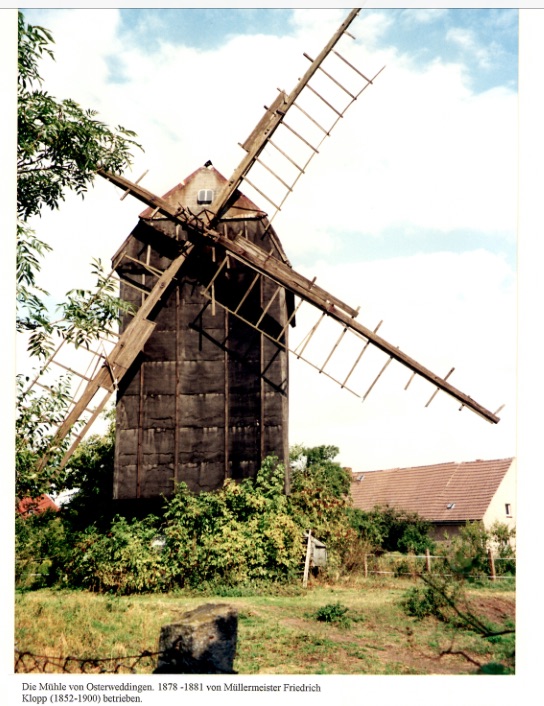
In 1903 or at the latest in early 1904 Emma Klopp had relocated in distant West Prussia. One is tempted to interpret the move as flight from unpleasant family relations regarding the ownership of the house in Wolmirstedt. Then in June 1905 her third son Ferdinand unexpectedly showed up in town. He had just returned from the United States. His brother Friedrich passed on the property to him presumably on the basis of unclear and unresolved inheritance issues. He retreated to the neighboring village of Loitsche. It appears, however, that within the year rope maker Ferdinand must have ceded ownership back to his disgruntled brother. He followed his mother Emma to West Prussia.

Under almost unbearable chaotic  conditions Friedrich managed to bridge the short time gap in Loitsche through masonry work. It provided adequate income during the building boom period at that particular time. In the fall of 1905 the Friedrich Klopp family returned to the Wolmirstedt house. A few months before on July 15, 1905 his son Friedrich was born in Loitsche. It appears his father Friedrich had finally won the battle for the house and the rope making factory. In reality it was a Pyrrhic victory. Malice and viciousness from family members accompanied Friedrich’s private attempts to disentangle the often chaotic financial and inheritance problems that he was facing. Without any legally binding papers he had to put up with the never ending claims made on the property in Wolmirstedt. Thus, under such fruitless prospects he took over his father’s business. The cost of his return to the rope making business was high. It led to the irreparable break-up with nearly all his siblings and his mother Emma.

To be continued …

Biene’s Studio and Art Gallery

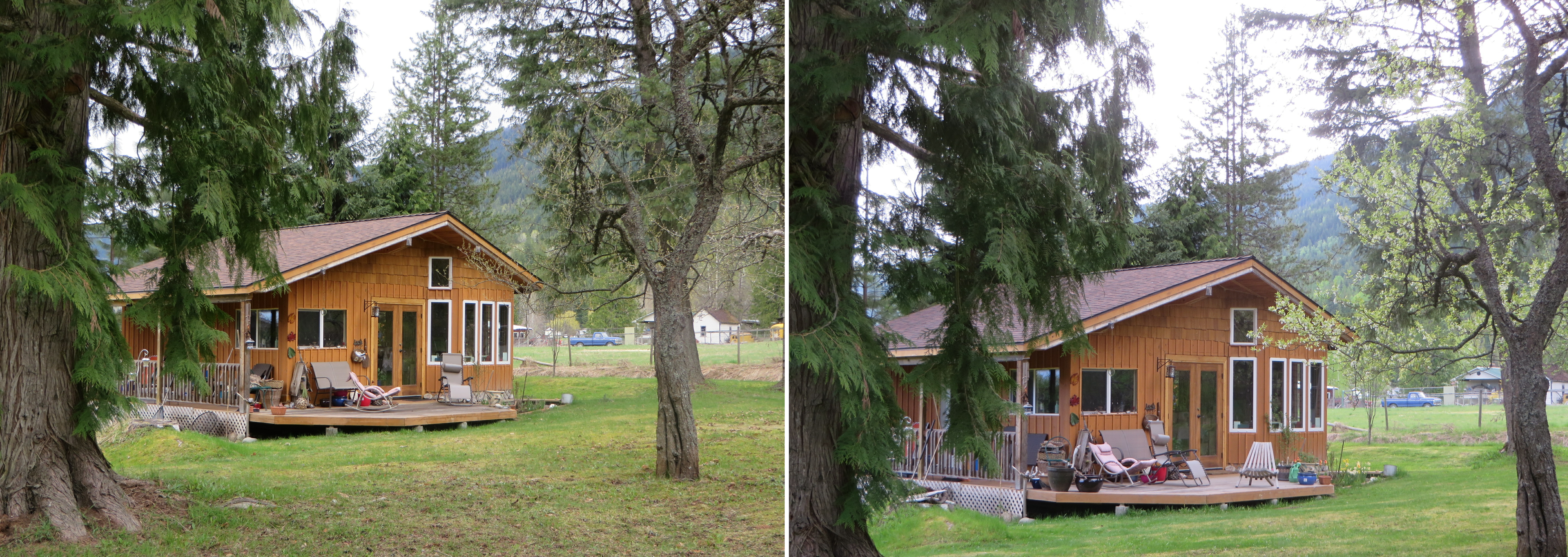
Last week we took a walk through our yard, which ended with a view on Biene’s cabin and studio. Today we take a look inside. The pictures with their titles are self-explanatory. Some day Biene will present her pictures and rock paintings individually at her blog bieneklopp.com.

Biene's Studio in our Backyard

Biene’s Studio in our Backyard


Look Inside Through the Front Door

Look Inside Through the Front Door

Biene's Work Area

Biene’s Work Area

Gallery and Sleeping Area

Gallery and Sleeping Area

Stained Glass Window

Stained Glass Window

Gallery and Reading Area

Gallery and Reading Area

Some Samples of Biene's Art Work

Some Samples of Biene’s Art Work

Mini Kitchen and Room for Plants

Mini Kitchen and Room for Plants