The Klopp Grandparents IV

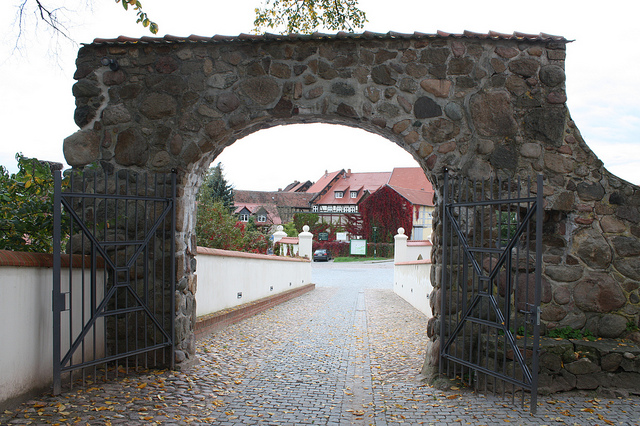
Heraldry of Wolmirstedt

Heraldry of Wolmirstedt

Emma’s Father, Friedrich Wilhelm Bauer

1818 – 1868

Adapted from Eberhard Klopp’s Family Chronicle

F. W. Bauer’s job description ‘factory inspector’ goes back to government regulations, which were based on laws pertaining to safety and protection at the workplace. Factory inspectors with the authority of the local police ensured the prevention of child labor, enforced the labor law regarding the maximum number of hours permitted for day and night shifts, and generally were there to protect the safety and health of the workers. In addition to these duties, they made sure that all workers were provided with proper ID cards and that logbooks be kept with their employment records.

In other words my great-grandfather F. W. Bauer in Jersleben now belonged to that special organization of state employees, who in the interest of factories took up control functions for the protection of the workers. The scope of his responsibilities as a commercial policeman may have included the supervision of mills, sugar and starch plants of the region around Jersleben and Wolmirstedt.

About three years after their move from Rottendorf F. W. Bauer died in Jersleben on April 20, 1868 at the age of only 50. His wife Sophie Bauer (née Wegener), a woman of exceptional beauty in the memory of her descendants, outlived her husband by thirty years and died in 1898 at the age of 76 in the Wolmirstedt house of her grandson Friedrich Klopp (1875-1946).

Photo Credit: Museum Wolmirstedt

Photo Credit: Museum Wolmirstedt

Needles – a Town that is no More Part II

A Tractor Snowplow Crossing the Lake

A Tractor Snowplow Crossing the Lake

Story and Photos contributed by Annette Devlin

Also, as the lake froze over in the winter, mail was transported by horse and sleigh from Burton over the ice.

A403

Needles had also been a logging centre. In 1922, it had a large log flume for logs that ran for four miles from the Whatshan to the Arrow Lakes, at one place where it crossed the road it was 12 feet above.

Log Flume Four Miles Long

Log Flume Four Miles Long

Due to the flooding of the Arrow Reservoir the town site of Needles no longer exists. However, the properties both north and south above the high water line are still occupied.

Ferry Service in the early 1920's

Ferry Service in the early 1920’s

As reported the first ferry to cross the Arrow Lakes between Needles and Fauquier was a 6 HP launch in 1919. In 1922, a raft towed by Mr. O.J.Aspinall’s rowboat was used. By 1924, hourly daily service was started by Mr. George Craft consisting of a boat for foot passengers and a raft for vehicles powered by a small boat called the “Kathleen.” In 1928, Claude Rollins was engaged to give better service with a larger boat. In 1931 a three-car ferry was installed. 1941 saw an eight-car cable ferry put into use. As the years went on, the increase in traffic warranted larger ferries and more hours of operation.

Fauquier as seen from the Needles Side

Fauquier with its Large Orchard as Seen from the Needles Side

The P. and G. Klopp Story


Chapter 6

Flight and New Beginning


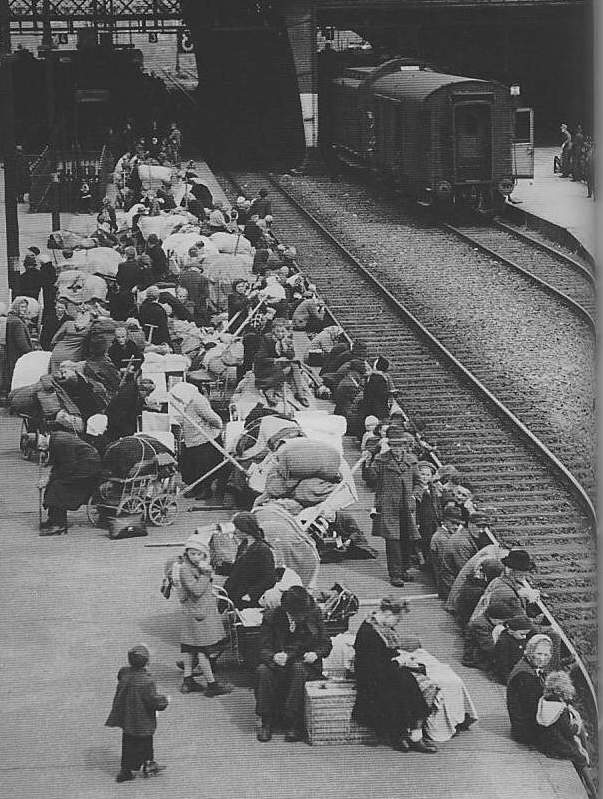
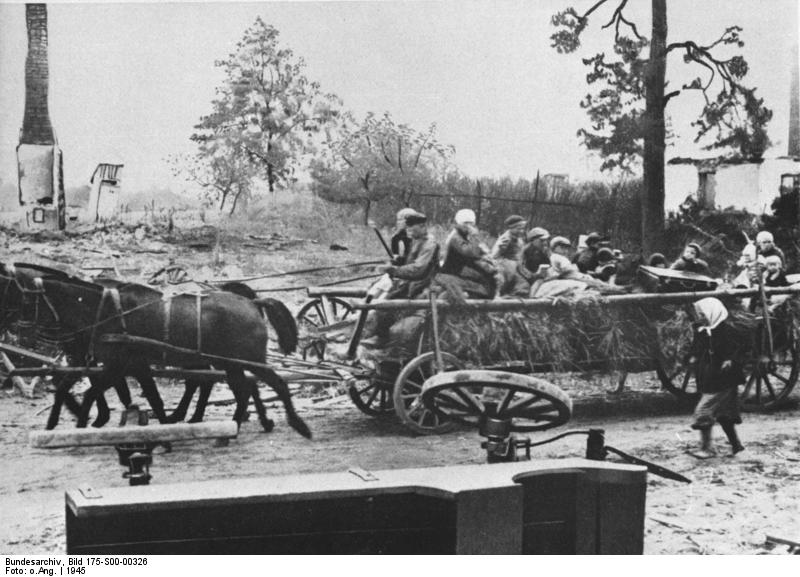
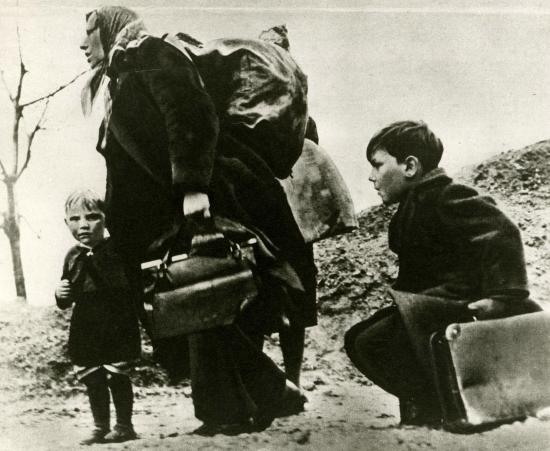
Trek of Fugitives

Trek of Fugitives January 1945

Desperation is the raw material of drastic change. Only those who can leave behind everything they have ever believed in can hope to escape.  William S. Burrows


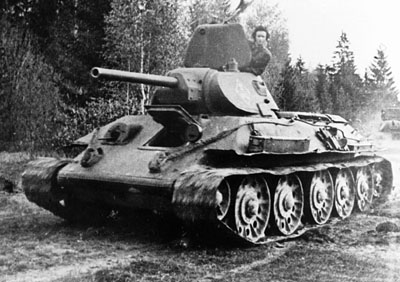
           The German management of Gutfelde under my father’s administration abruptly ended on the 12th and 13th of January 1945 with the family’s flight from the advancing Red Army. A few hours before, the attack began, which turned out to be the most massive offensive ever-recorded in international military history. Under the command of Marshal Schukow and Konjew the Soviet army groups conquered Warthegau and advanced within days all the way to Sagan, Silesia. Panic and chaos spread among the defending forces and the civilian population. The flight with as little baggage as possible succeeded in the direction of Landsberg in spite of bitter cold temperatures and icy, snowed-over roads, which were hopelessly overcrowded with people, horses and wagons. There was an agreement between the NS leader (Ortsgruppenleiter) in Seebrück (Rogowo) and the German farmers including all administrators of the region to join together in order to escape in one single trek. My father found out that the party leaders and NS officials had secretively taken off to safety on their own. He became quite enraged over this lack of leadership on the part of the very people who through courage and fearless guidance were supposed to set an example. While the lonely three trek wagons (Klopp, Kegler, and Dwinger) were slowly heading west, my father on a fast one-horse buggy was racing from farm to farm to warn stragglers of the impending danger and say good-bye to his Polish friends.

Arnswalde 1930

Arnswalde 1930

The trek managed to get as far as Arnswalde (Choszczno), Pomerania, where the family found temporary shelter in the forestry Kühnemühle. As the place appeared safe at least for the time being, Father decided to stay there longer than warranted by the critical circumstances created by the Soviet armies advancing westwards at lightning speed. Precious time was being wasted with useless discussions and playing Doppelkopf. Perhaps a trace of unfounded hope that the enemy on the eastern front could still be thrown back through a heroic effort by the German troops lingered at the back of everybody’s mind and caused them to dawdle. Suddenly in early February Red Army soldiers arrived at the forestry and took Father as prisoner of war although he was no combatant and assigned him to hard labor in the Soviet Union. In a forced march he returned to Posen (Poznan), to the very region whence he had escaped. Then the Russians shipped him by train to the Donbas area, where somewhere between Charkow and Rostow on the River Don he had to work in the coalmines.

AnordnungThe decree  above states that the German population is not allowed to have their hands in their pockets nor to gather in groups of more than two people. Persons  who act against this regulation  face the death penalty or will be deported to a labor camp.

      In the following weeks and months, Mother had to endure indescribable hardships. Escape across the River Oder, where the area was still in German hands, was no longer an option. The Russian troops were heading in that direction and there was heavy fighting. She was left behind at the forestry with my brother Gerhard and me and the four orphans, whom she had taken along during the arduous trek from Gutfelde. That she and thousands of other women from West Prussia and Pomerania did not despair, did not give up and did not fatalistically slip into a state of utter hopelessness gives me cause for great admiration. After the forestry building burned to the ground, Mother wandered around in search of food, shelter, and relative safety. Eventually she obtained permission from a commanding Russian officer to travel with us children to Belgard in the hope of finding my brothers Karl and Adolf. To her great disappointment she discovered that they had decided to leave school and town, when they had heard that the Red Army would be in Belgard within days. While the town of Belgard remained relatively unscathed from the ravages of war, Mother had to suffer under the harassment and abuses of the new masters in town. In the secret treaty between Nazi Germany and the Soviet Union Stalin had acquired control over the eastern parts of Poland and wanted to keep them in compensation for the stupendous losses in life and material during the German invasion of Russia. So he ordered the Poles to leave their homes and their farms and settle in the German provinces east of the Rivers Oder and Neisse. Now in an ironic reversal of roles, the Poles were now the masters of former German farms and exercising control over the towns and cities. For the Germans, who wanted to stay or could not escape in time, it was now their turn to experience harassment and abuse. Mother refused to be forced into a role in which she would lose her dignity, especially, as it often occurred, if she felt that she was confronted with injustice. She knew about the century old animosity between the Russian and the Polish people. So whenever she felt that the Polish authorities had unfairly treated her, she would go straight to the Russian officer in charge of the district and complain about the incident. To her great satisfaction she received justice ironically from the hands of an enemy officer. Apart from her inner strength that allowed her to show courage where others would have meekly knuckled under, one must also consider the fact that Russian officers had a heart for the plight of little children. One could dismiss this thought as stereotypical and sentimental bias, if what Mother had experienced in Belgard with the six children in her care had been an isolated case of kindness. But such tender feelings on the part of Russian soldier had been documented so frequently as to attest to their truth.

Through Snow and Ice

Through Snow and Ice towards the Baltic Sea

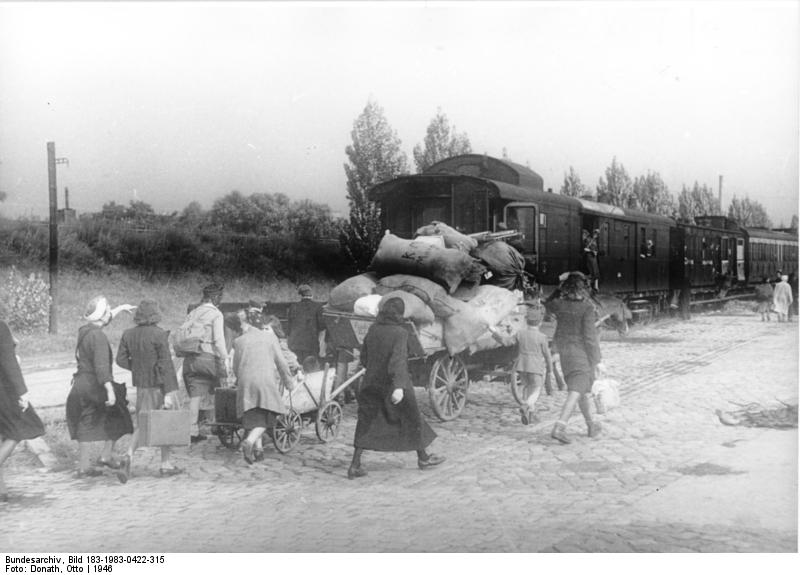
         The war came to an end with Germany’s unconditional surrender on May 8th, 1945. But nothing changed in Mother’s life for more than a year, until early in the summer of 1946 she was expelled along with tens of thousands of other Germans from her homeland. In a well-calculated program of ethnic cleansing all German nationals were forced to leave in order to make room for the Polish people who had been displaced in turn by the Russians in their eastern provinces. Thus, the Pomeranian lands that had once been settled and cultivated for a period of over 500 years by industrious German pioneers and farmers were put under permanent Polish administration.

         By now I was a little over four years old. What I have been writing about myself, I had gleaned from Mother’s diary, from my second-generation cousin Eberhard Klopp, who did extensive research on the Klopp family going back some four hundred years, from Uncle Günther’s Kegler Chronicles and other sources. I am especially thankful and greatly indebted to my brothers Karl and Gerhard (Gerry) and my sister Eka (Lavana) for their personal accounts of their incredible ordeals. I decided to insert them here as documents of a tumultuous period and as a testimony to their inner strength and courage without which they would not have survived.

To be continued …

Marie Kegler, Stalwart of Christian Faith

Aunt Marie (Tante Mieze)

Chart II a – II

13

Erika Klopp, Peter, Aunt Marie – Wesel 1955

Of all the relatives in the Kegler family Aunt Marie was closest to me. But before I go into the details, I need to go back a few years to provide the background for a better understanding of the circumstances that made her for more than a year my loving caretaker.

After my father’s failure in a small-scale farming venture  in Southern Germany, he was financially ruined. My mother had to go out and find work as housekeeper first at Sigmaringen, a small, picturesque town on the River Danube and then later in 1955 at a Senior Citizen home at Rudersberg not far from the city of Stuttgart, Father’s health while being a POW had been severely affected by the intolerable working conditions  in a Russian coal mine.  He suffered from a number of psychological and physical ailments. His recurring back pains prevented him from taking up any meaningful employment. It is sad to say that after the miraculous  survival and coming together again of the entire Ernst Klopp family in the village of Rohrdorf, there were signs of disintegration written on future’s gloomy horizon. Karl had gone off to university at Göttingen, Adolf emigrated to Canada, Eka (Lavana) took up nurses’ training at Hamburg, Gerhard entered a toolmaker’s apprenticeship program in Switzerland, and I, barely 12 years old, had to nobody to look after me.

This is where Aunt Marie comes in. She had just taken up employment as elementary school teacher in Brünen, a short bus ride away from the city of Wesel. Its  claim to fame is that it is known as the most destroyed city of  Germany  (almost 98% turned into rubble by two consecutive Allied bombing raids near the end of World War II). For almost 5 years my aunt was not permitted under the rules and regulations of the occupation authorities to carry out her teaching profession. As former state employee of Nazi Germany, she like many thousands of other civil servants was suspected of harboring pro-Nazi sentiments and was consequently classified as unfit and dangerous for the teaching profession. This happened in postwar Germany under the so-called denazification program. The injustice was that all former teachers were given the same label and that there was no exception to the rule.

Finally the Allied authorities saw it fit to lift the ban. And Tante Mieze, close to  her retirement age, was able to resume her work and do what she liked best, to teach. How I am connected to her and what impact she had on my life will be the topic on one of my following posts.

Needles – a Town that is no More Part I

The ferry at Fauquier is generally known as the Needles ferry. One may wonder why this is so. Before the valley was flooded for the BC Hydro project in 1967 there was Needles, a prosperous little town on the other side of the lake. Mrs. Annette Devlin describes the early beginning in a report with pictures, which with her kind permission I have taken from her own personal archive.

Minto at Needles Photo Credit:Provincial Archives, Victoria, B.C.

Minto at Needles  – Photo Credit:Provincial Archives, Victoria, B.C.

Why did many old timers always speak of Needles as “The Needles”? This was due to the long sand points that reached out into the lake. In the late 1800’s and early 1900’s there was a rapidly growing district surrounding the town site of ‘Needles’. Amongst the early settlers of Needles were Mr. & Mrs. Robert Shiell and brothers, Jim and George Shiell who arrived in 1900. They first lived in some of the early day miner’s buildings at the Monashee mines. In 1903 there were only four names on the voter’s list.

A401

The settlers at that time working in the district had over 1500 acres of highly approved land cleared, cultivated and planted to orchards. Within a year’s time Needles became a large fruit-distributing centre. In one season there were over 3000 boxes, crates and trays of all kinds of the highest quality fruit sent to prairie markets. One of the most valuable additions to the town was the large packing house, which was completed in 1913. A government wharf was also built at that time. The first schoolhouse was built in 1908 and the first teacher was Mr. Freeman. The first post office was at Mr. J. Bang’s place in the Inonoaklin Valley (then Fire Valley) and was moved to the Shiell’s home in 1902.

Needles General Store after a Flood

Needles General Store after a Flood

In 1908 a general store was built by Mr. A.W.Lift. A hotel was built by Mr. G. Craft and was completed in 1923. Mail service was daily by C.P.R. boat.

The P. and G. Klopp Story

From Mother's Diary

From Mother’s Diary

Chapter 5 – Part III

In the last week of August I gave Mother another scare when I came down with my first illness, an especially severe case of intestinal catarrh. She had to change diapers constantly. The diarrhea just did not want to go away. Mother was really worried by now. She immediately stopped giving me milk, cooked a sort of rice porridge sweetened with saccharin and gave me three times daily crushed carbon tablets. That seemed to help. After three days I had recovered and was my usual cheerful self again relieving Mother from the stress of worry and sleepless nights. Now I was ready again to entertain the never ending stream of visiting relatives with my laughter, smiles and beaming eyes: Karl back from high school to help with the harvest during the fall break, grandmother Elisabeth and Aunt Mieze (Maria) from Stolpmünde, and many, many more. Shortly before Christmas the measles were going around among the Klopp children, but to Mother’s great relief I did not get them, even though I had also shown some of the symptoms, a few of those scary red spots on my skin. But in the end we could all enjoy the Christmas season. Although we were now into the fourth year of the war, there were still plenty of gifts for everyone under the beautifully decorated tree. I was only interested in the baby rattle Grandmother had given to me for Christmas. There I had something concrete in my little hands that I could touch, handle, and make noise with. Karl was playing piano and the others were reciting poetry for the family. At year’s end I was proud to be able to stand up in my crib, showed off my first tooth, ate well, was toilet trained, and best of all I was happy to grow up in such a wonderful family.

Aunt Alma from Berlin

Aunt Alma from Berlin

In the New Year Karl and Adolf left Gutfelde to continue their education in Belgard. With Eka and Gerhard also away to attend a local elementary school during the day, it became very quiet around our house. But Mother still had me and I made sure with my increasing demands for food and attention that she would not get bored. We had a brief cold snap and the temperature plunged to minus 20. Nevertheless, Mother felt that even in this frigid air I must be outside and ‘toughen up’. Janina, the young Polish assistant in the Klopp household, who had taken a real liking to me, took me often for a quick stroll in my baby carriage. In the evening, when it was time for me to go to bed, friends would drop in to spend a few hours in the comfort and cozy atmosphere of the Klopp residence. Invariably discussion would turn to politics and, of course, to the war that was raging and after the surrender of the 6th Army at Stalingrad was no longer progressing in Germany’s favor. Out here, far away from police-informers and free from the fear of being denounced to the Gestapo, they voiced their opinion on the gloomy prospects of the war and even dared to make sarcastic remarks like: ‘The Führer (Hitler) has gotten us into this crappy hole, he will also take us out of it again.’ As for me, the world was still intact. I enjoyed the triple benefit of good food, shelter, and love. On that solid basis of early childhood nurturing I was being prepared to withstand the traumatic events that were to follow later with the major offensive of the Red Army in January 1945. But for the time being, even for the grown-ups with their depressing views it was still safe to live in our corner of the world. When the noisy discussion abated a little, someone suggested playing a round of Doppelkopf, the second most popular German card game. Forgetting their worries at least for a few hours, Father, Mother and her guests played the game of a long family tradition. They had a few drinks for good cheer, smoked a cigarette or two and were having a good time, while I was dreaming about my next wintry outing with Janina.

Peter in his Pram

Peter in his Pram

Spring came early in 1943. I spent a lot of time outside exploring the world around me. I learned to stand up on my own and ventured to make my first stumbling steps. Jupp, the friendly family dog, was my steady companion and my best friend for a while. Unlike my older siblings I refused to take the bottle and from my first birthday on I proudly drank my milk from the cup. When people were watching, I did my best to entertain them and show off my newly acquired skills. With the good weather also came a stream of visitors to enjoy the peaceful environment and the hospitality they found at Gutfelde: Grandmother Elisabeth and Aunt Mieze ((Maria) again from Stolpmünde (Ustka), Aunt Alma from Berlin, Aunt Margot (wife of Uncle Gerhard, General-Lieutenant in the German army) with her three children Helga, Nati and Dieter, and finally my cousin Arthur Thiess from Berlin and his three daughters Ingrid, Gerlinde and Anje. These visits spread over a couple of months were quite enjoyable for hosts and guests alike, even though some stayed for as long as three weeks or even longer. On top of it all, Karl and Adolf came home for the Easter holidays. Karl had acquired a certain degree of stardom with his excellent performance at the Belgard High School and his rapid development of his piano playing skills. As always, when he was home, he was asked to demonstrate his progress at the family piano. This went over very well, especially as his music teacher was also present and accompanied him on Father’s violin.

Gerhard Holding his Kid Brother

Gerhard Holding his Kid Brother

Mother was honored for the second time, since I was born, on Mother’s Day in Seebrück (Rogowo), a near-by town southwest of Gutfelde. With her five children, four of whom were male, she ranked very high among all the mothers in the region. Apart from the fact that Mother’s Day was a state supported festival, upon which a lot of emphasis was given to the meaning of motherhood mostly for ideological reasons – I would say for mythical reasons from ancient Teutonic folklore as well – women in general were considered not weak, but precious entities that had to be protected at all cost from any involvement in war activities. Germany was the only nation that did not employ women in the war effort in any shape or form. Young girls in colorful dresses presented flowers to the mothers. This year it was Father’s turn to make a speech to the assembly. What he was saying about motherhood and family came straight from the heart and with his genuine admiration left a lasting impression on all those who were present.

Peter and his Friend Jupp

Peter and his Friend Jupp

Mother’s diary of the first 15 months of my life came to an unexpected sudden end, because she had simply reached the last page and did not want to start another booklet. If one considers that this diary with the many tiny photographs pasted into it and written in beautiful Sütterlin handwriting was from among all the other precious goods the only object that she managed to bring safely to West Germany, one must concede that we are dealing with a little miracle. The far greater miracle, the survival of the entire Klopp family in the closing days of  World War 2 and afterwards, will be the subject of the next chapter.

Peter Sitting on Gutfelde Staircase

Peter Sitting on Gutfelde Staircase