The Peter and Gertrud Klopp Story – Chapter XXX

The Incredible Journey of Biene’s Engagement Ring
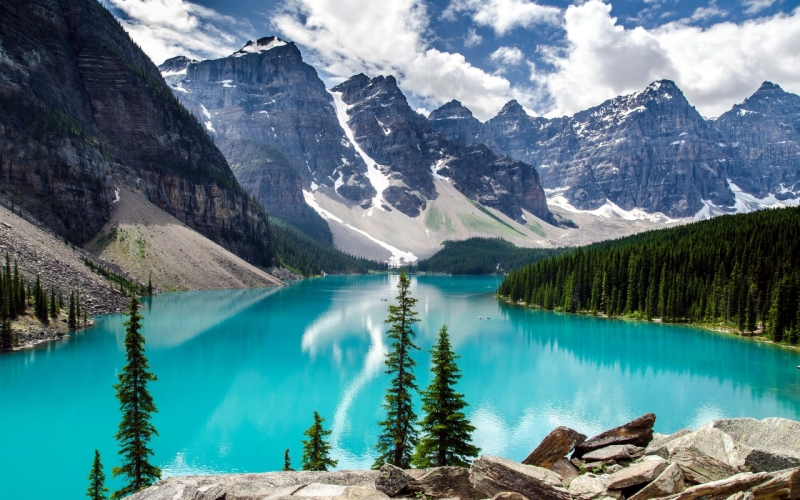
 banff

“When you realize you want to spend the rest of your life with somebody, you want the rest of your life to start as soon as possible.”  Nora Ephron

Peter worries about the Future

This chapter contains a highly condensed version of our correspondence. Only parts that seemed relevant to the theme of the initial challenges facing us on either side of the Atlantic are included here. I reorganized some paragraphs only to enhance the flow of the narrative and sometimes added a sentence or two to make for better transitions. What remained is the fascinating account of the incredible journey of Biene’s engagement ring.

May 29th

My dear Peter,

Your latest letter has made me so happy, and all your plans have touched my heart. I would love to write, o Peter, commit such a great ‘foolishness’, landing a job with the IBM Company and let me soon come to you so that through our closeness we can give each other strength to do all the things that you have described to me. But Peter, you are right; we must not be unreasonable. And perhaps time will pass more quickly and more easily than we think. I am so eagerly waiting for the moment, when your letter to my parents will have arrived. I cannot put into words at all how much I miss you. But because I know that you love me I can bear the long wait…

My dear Peter, now that I am going to England to work as an a-pair girl, I have a special wish. I can hardly overcome my fear to ask you for something that I so fervently desire. But I will directly ask you, because you love me. So I really don’t need to be bashful about it. You know, Peter, I would very much like to wear a ring from you, especially now as I am going to England. Not that I couldn’t be as faithful without the ring. You certainly know that, Peter! I wish that everyone could see that I belong to you and that I promised to be faithful to you. You know, Peter, it is a peculiar feeling, but I believe that I would feel like having some kind of protection, because everyone could see that I have you. Can you understand this, Peter? If I didn’t know how much you love me, I would have never found the courage to write you this…

In Love,  Your Biene

 “May 31st

My dear Biene,

If I had to report on my search for work or my planned studies at the university, I would have nothing to write today. I hope you do not get impatient that the questions about my job and teachers’ training have not been settled yet.

Gradually I am beginning to worry about us and the more I think about the future the more anxious I get. You know, I have a restless heart that is incessantly driving me, even at times troubling and tormenting me, especially when things are not going the way I had planned. This restlessness engenders a yearning for inner peace and security. Dear Biene, you are my alter ego. In you I found everything I did not have. Without you I would be nothing. Because I love you so much, I also want you to be always happy when you are with me. Out of love you are willing to follow me no matter where I live. You emphasized in your last letter that you would even go and cut trees with me if necessary. But did you consider how much you would have to give up not just for a few days, but rather for a lifetime? You would no longer see your dear friends, your classmates, your brother, your father, and your mother. Later I cannot be the substitute for all these dear people. Instead I would like to be your husband and life’s companion. Dear Biene, to put it frankly I fear you will leave far more behind in Germany than what you will gain in Canada. You see, this is how I feel right now. You are on my mind all the time. You walk with me, you talk with me, and I hear warning voices. Perhaps I am totally off base, and one day we will meet again sharing the desire for happiness, security, and contentedness, for which your restless heart is yearning just as much as mine is. However, never would I want that my wish become an obligation on your part. Think it over thoroughly and give me your honest opinion. Please don’t be sad that I have given so much thought to this matter. I am only thinking about what I can do for you to make you happy…

Greetings from the heart, Peter

Biene Withdraws her Wish for an Engagement Ring
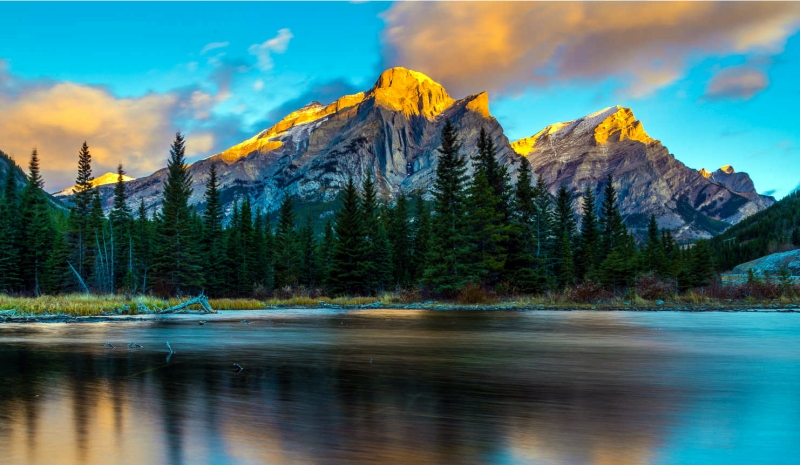
Pristine Lake in the Rockies

Calgary, June 2nd

My dear Biene,

I must quickly write you this letter, and indeed for three reasons. Some very pleasant events have come up during the past two days. First and foremost I must ask you not to take my last letter too seriously. I had no work and I was worrying about our future. I missed you so much, and then I began to ponder about how it would be for you to meet me again poor and penniless. At such moments I worry too much. I believe that you already know that part of me well enough.

Today I came home rather exhausted. Yet I was happy and content. In my mind I saw you receive me tenderly in your arms, perhaps because I looked so very dusty and tired. Now I must let the cat out of the bag. Right on the first day of my search I found work. I have a good, but tough job with a construction company, and I am getting $1.80 an hour. Isn’t that a good beginning? Here I will stay until I find something better.

Yesterday I paid a little visit to the University of Calgary. From the bus stop I walked the last mile up the hill. You would not believe, dear Biene, how the people were gawking, because I was not driving a car. At the registration counter they gave me a very friendly reception. They retained my high school diploma for translation into English. Everything that I needed to know for the teachers’ training program in the Department of Education was in the book that the receptionist handed to me together with the application forms. There you have the latest information from me. I will write you again, whenever I can spare another hour.

Be kissed a thousand times! Your Peter

Velbert, June 4th

…Yes Peter, and then I read your letter. When I came to the line, where your expressed your concerns, a strange mood suddenly took hold of me, as if I was lying with closed eyes on my back bathing in brilliant sunshine. All at once a shudder seized me, because a dark cloud had drifted over the sun and for a moment withdrew all warmth from me. But this really happened only in the twinkling of an eye, because I could not understand why you were writing me this. I thought, ‘Why do you want me to be afraid of the future?’ Now I feel ashamed of these thoughts and I am sad that I even allowed them to surface in my mind. Peter, please, you must forgive me. There are certain days, when I am a little sensitive. So I did not recognize at first why you wrote me about your doubts. It was because you care so much about me and worry about my future happiness. I only saw the words, ‘ Did you consider all this very carefully?’ and ‘I don’t want that my wish become an obligation to you.’ I did not notice all the other words at all, which were so much more important. Fearfully I thought, ‘Doesn’t Peter no longer believe that our love can be much stronger than all the bonds of family and friends put together, and would he resign himself to the fact that I would no longer be willing to come to him any more?’ But immediately I felt sorry that such thoughts occurred to me, and all of a sudden I understood with my whole heart what had motivated you to lay all the possible future problems before my eyes. I am not ignoring them, Peter! I know exactly what it means to leave everything behind one day.

I talked to my mother about it and asked her, if she could bear to see me leave, because you wanted me to become your wife. You will see how great my mother’s love is. I regret more and more that you were unable to come for a visit before you left for Canada. She said it would be quite natural that I would leave her one day. But a mother would only let her children go with a light heart, if she knew that they would be happy…

Dear Peter, I feel just as strongly as you do that I could not be without you! Therefore, you must not ponder and mull over such thoughts any more. They put brakes on your zest for action and initiative. And in the end I would even believe that you cast doubts on our love, and that I could never endure. Peter, please promise me to put these depressing thoughts aside. You know that it is so simple for you to make me happy.

Now I would like to say something regarding my last letter. But I do not want to hurt you, and therefore understand me correctly. I would like to tell you that I am sorry that I had asked you for a ring. Perhaps you are not yet able to fulfill this wish, because you do not have the money or you believe that it isn’t the right time for it yet. Therefore, let us do as if I had never asked for it. I thought it would be nice to wear a ring from you, I also thought that perhaps you would be glad that I would want it. Peter, right from the beginning we two ran a course, which was quite different from the ordinary, and for that reason it is sometimes a bit complicated between us. And yet it could be simple, because I sense from every word from you that in your innermost being you are so closely connected to me. Oh Peter, don’t you understand? You must be able to understand that it is easy to give up something if one loves one another. And never would I like to make you unhappy again as I once did, when I had not yet recognized it.

Greetings with all my heart!

Your Biene

Accident at the Construction Site and a Painful Walk to the Jewelry Store
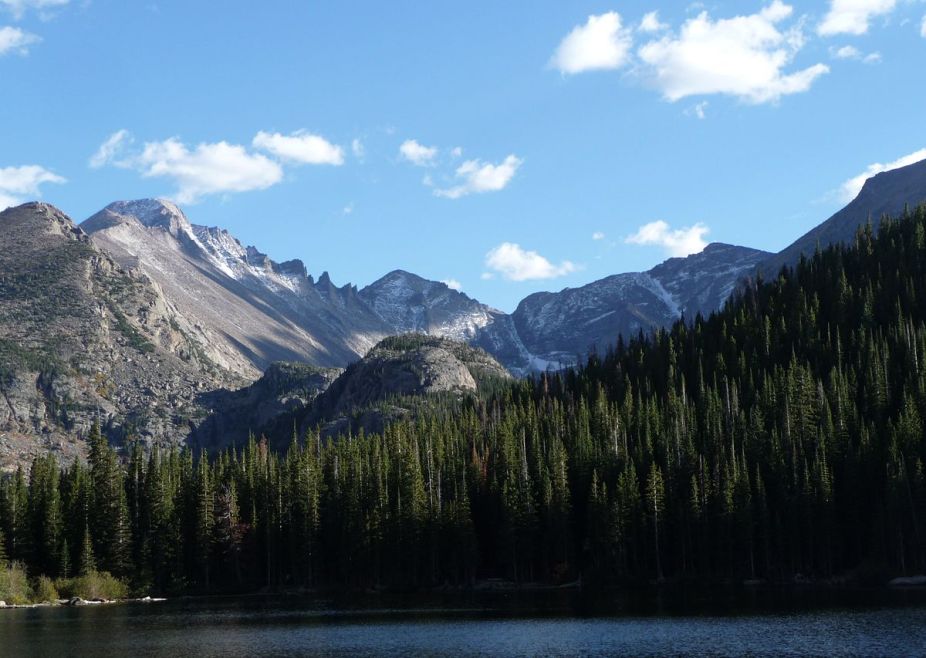
1200px-Rocky_Mountain_National_Park_in_September_2011_-_Glacier_Gorge_from_Bear_Lake.JPG

On Friday, June 18th, I had an accident at the construction site. One of the bricks slipped off the upper board on the scaffold and hit my left knee, which almost immediately swelled up. It could have been much worse. The law did not require safety helmets in the mid 60’s. As I found out much later, I wasn’t even insured and therefore would not have received financial assistance from the Workmen’s Compensation Board. Our boss had deducted the laborers’ insurance and pension contributions from the pay cheques, but kept the money for himself.

Unable to work with so much pain from my swollen knee, I had to call it quits for the day. I promised the foreman that I would report back the following Monday. Instead of returning to my brother’s place, I stepped on the bus, which took me to downtown Calgary. Very close to the bus station stood the building of the Hudson’s Bay department store. With its three stories it was then the highest building in downtown Calgary. From there I limped two and a half blocks on Seventh Avenue to the jewelry store. There on the previous weekend I had ordered Biene’s engagement ring, on account of which so many tender, bitter-sweet feelings had already welled up in our hearts.

I was lucky. Although I had come sooner than planned, the ring was ready. Yet I felt timid and embarrassed in my dirty work clothes and with bloodstains on my pants. I felt oddly out-of-place in this opulent place laid out with red carpets, the walls covered with oak paneling, spotlights illuminating the sparkling wares for the wealthy, with every imaginable piece of expensive jewelry securely placed behind glass cabinets. My heavy German accent was in stark contrast to the polished Oxford English of the gentleman, who was wearing a formal suit. I pulled out four twenty-dollar bills from my back pocket and put the folded bundle on the counter top. It was one week’s worth of hard work. On that very same day Biene’s engagement ring began its odyssey half way around the globe, but never arrived at its intended destination in Germany.

For the longest time I did not know that the letter with its precious content had gone missing, presumably lost in transit somewhere between Calgary and Velbert. Week after week I waited for Biene’s thankful and happy response, while Biene was desperately yearning for a sign of life from me. For her, as we have seen, the ring meant protection, a signal to all that she belonged to me. But perhaps more importantly she perceived it as concrete assurance of my love and faithfulness. Wearing, seeing, touching and feeling it on her finger would have imbued her with a sense of security from within and without. But there was no ring, no letter, not even a card, which would have immediately ended her distress and despair…

Biene Close to Despair
 

1200px-Moraine_Lake-Banff_NP

Velbert, June 24th

My dear Peter,

Now I cannot be so long without any mail from you and therefore quickly write me again, and even if there are only a few words! You see, it is the only thing we have of each other. I told you that I would understand if you couldn’t write as often as before. Now I start worrying again and wonder what may have happened to you, if you are doing well or are perhaps sick. Since your last letter it seems like eternity, and I am fervently awaiting a letter from you.

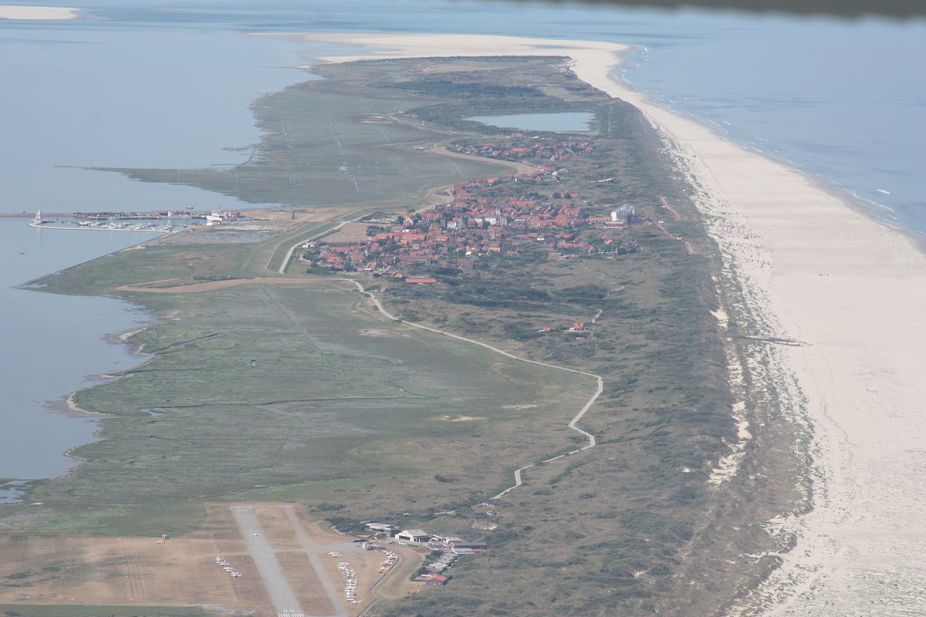
I hope that you received my letters and my card from the Island of Juist. There we spent four carefree and happy days at the North Sea. Every year the Department of English organizes an introductory get-together for the participants in the first semester. More than ever before I had wished you were here to share all these beautiful experiences with me. I met many new friends, but as nice as they all were, nobody can replace you!
1200px-Flug_Juist_2010_PD_223

The sea, when it is stormy, is so captivating and contributed a great deal to the atmosphere of friendship and harmony in our group, which was of course also the goal of this excursion. One cannot speak any idle words when walking along the beach, struggling against the storm, or viewing the playful waves in motion. If one talks at all, then only words, which come from the heart and reveal a small aspect of one’s inner being. I had to talk about you; for every thought is somewhat connected to you. All my companions wanted to look into the locket with your picture in it. Now they all know you a little, and the boys kept teasing me, ‘How is Canada?’ Whenever I saw one of them coming my way, I already expected a question like that. But I wasn’t cross with them; for they meant it well.

What can I tell you about the sea? You already got to know it certainly much better than I on your voyage to Canada. However, one thing you could not do like I did, that is running into the surf and then being carried by the waves. That was an incredible feeling! We were so relaxed that we sang from morning to evening. Our American exchange student, Pete, who had an almost inexhaustible repertoire of songs, taught us many of them, which we sang with never-ending enthusiasm. It was truly a genuine music festival! Peter, you would have very much liked it too. But I promise you to learn all the songs so that later on we can sing them together. O Peter, if only you had been present! Every time they were singing ‘My Bonnie lies over the ocean, my Bonnie lies over the sea, oh bring back my Bonnie to me!’, I ardently wished the wind just like in the song would carry you to me.

Now I wish from the bottom of my heart that you are doing well. And if something troubles you, dear Peter, please write it to me. I am waiting so longingly for your letter. I even asked after school at the post office, but it was all in vain.

Greetings in love and many hugs, Your Biene


Still no letter from Peter …

Velbert, June 30th

My dear Peter, I don’t know what to do any more! I feel so helpless and powerless, because I don’t know what I should do to get an answer from you. What might have happened that you don’t write to me? It is so terrible having to wait so long, when out of worry my heart is almost breaking. Oh had I only not written that I could understand if you wouldn’t be able to find much time to write. So I don’t know at all, if you don’t write on account of my remark or if there is a more serious cause. But since your last letter so much time passed by that in my inner turmoil and anxiety I turned into a veritable bundle of nerves and I am frightened by the darkest thoughts. Oh Peter, tell me as quickly as possible that all is well! Peter, let me come to you! There must be some work for me there too. I am really not afraid of anything except our separation. I did not want to tell you this, but for the moment I have lost all my courage. How much would I gladly endure, if only I could be with you! Dear Peter, if there is somehow a way, then let us take it. It should not be any more difficult than our long separation. How often did you tell me that we must take our ‘fate’ into our own hands! Surely it will turn out well, if we do it together. I firmly believe this.

Please, dear Peter, quickly write me or else I believe that you are gravely ill. I am constantly praying for you. And if I should have written something in my letters, which hurt your feelings, please forgive me. If I did, it would certainly be, because you are so far away from me and not, because I want to hurt you.

I love you, Peter! Your Biene
Rocky_Mountains_banner

Peter finally Breaks his Silence

July 2, Calgary

Dear Biene,

I cannot let you wait any longer. You are like me. You speculate and worry more than it is necessary. Today it was extremely hot again, and yet I had to work for eleven hours. We have to catch up now on the time we lost during the rainy days. But it is not because of my extreme tiredness after work that I did not write to you. The true reason is far more important.

Today, since I know for sure that fate wanted it differently, I can tell you about what happened. Every day I had been waiting for a special message from you. And when you wrote on Monday about your experiences on the Island of Juist and you asked me to write how I was doing, I was already a little concerned, but in spite of your urgent plea I decided to wait for just few more days. But then today on Friday I lost all hope that you actually received my previous letter.

On the German or Canadian side a letter carrier must have stolen it perhaps assuming that it contained something valuable. I am so sad, for he was right. In it I described to you that on the 18th of June, a year and a day after our first date a brick had fallen on my knee and that I was limping to the jeweler’s store. There I picked up the ring I had ordered for you. You can easily imagine the rest of the story. I wanted to give the ring to you, because I was convinced that you truly desired it with all your heart and everything you wrote afterwards was only a renunciation mixed in with painful regret. I saw you in my mind how it first you were perhaps a little angry with me, but then at the end how gratefully and happily you would have acknowledged the receipt of my precious gift. Yes, I am sad that the letter with the ring apparently is lost, but I console myself with the feeling of having turned a good thought immediately into action. Whatever happened on the postal route was beyond my control and we had to accept the bitter fact that the letter was lost.

For more than four weeks Biene and I tried in vain to track down the letter that had gone astray. Obviously it was almost impossible to locate a piece of mail, which I had failed to send by registered letter. After I provided all the particulars, such as type and size of the letter, postage paid and the date, on which I had put the letter in the mailbox, even the thorough and efficient German Post Office was unable to help. Suddenly a ray of hope entered our hearts when I pointed out the possibility that perhaps because of the extra weight and because of insufficient postage the letter had been sent by surface mail, and therefore was still on its way to Germany. This thought occurred to me when I checked the mail I had received from my friend Hans, who had never sent his letters by air. They often took more than a month to arrive. But by the end of July that last glimmer of hope had completely faded. We had indeed resigned ourselves to not seeing the letter with the engagement ring ever again. Besides other things were pressing heavily on our mind. During the long, desperate wait for each other’s reply it became abundantly clear to us and then, when we had resumed our correspondence, even more so that we needed to end our separation much sooner than originally planned. However, shortening the wait time meant that I had to have something concrete, on which to build our romantic aspirations. To find a meaningful job or to enter the teachers’ training program at the university these were the options I was contemplating.
family438

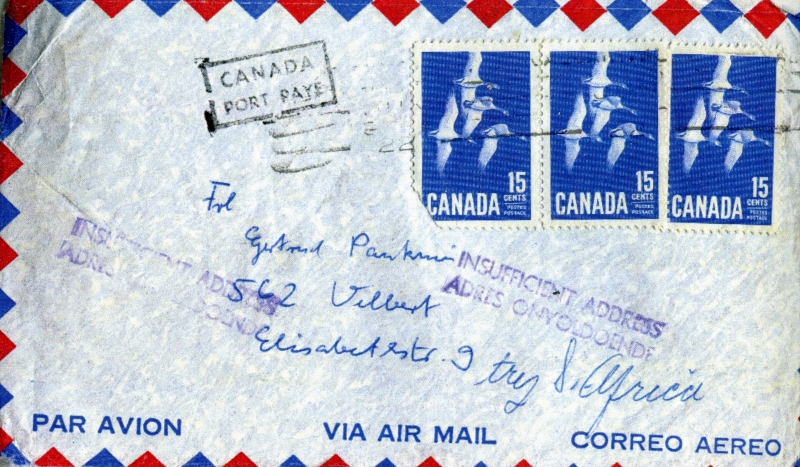
Then a letter arrived that looked strangely familiar. And familiar indeed it was, because it was the missing letter with the ring. In my excitement to fulfill Biene’s wish and dream and perhaps my attention numbed by the pain from my swollen knee, I had forgotten to write Germany on the envelope. Now had Canada Post promptly returned the letter, Biene would not even have noticed the small delay of a day or two. But the overly zealous employee tried to be helpful by second-guessing its destination. To him Velbert sounded Dutch, Elisabethstr. appeared to be British. So our dear postal employee concluded that the country in question had to be South Africa. Thus the letter had traveled half around the globe all the way to Johannesburg by air and had come back ever so slowly by surface mail.

Exactly two months after I had originally mailed this precious letter I put the unopened envelope into a larger one, added a passionately written letter and forwarded it all to Manchester, England, where Biene had already been working as an au-pair girl at the Landes family for a few weeks. But I am getting too far ahead in my story and I must regretfully leave her reaction, her work and her studies for another chapter.
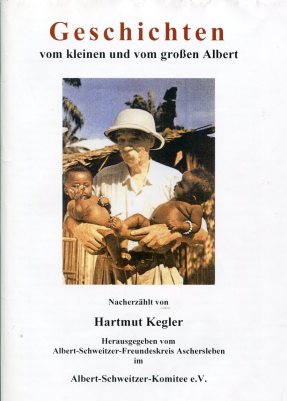
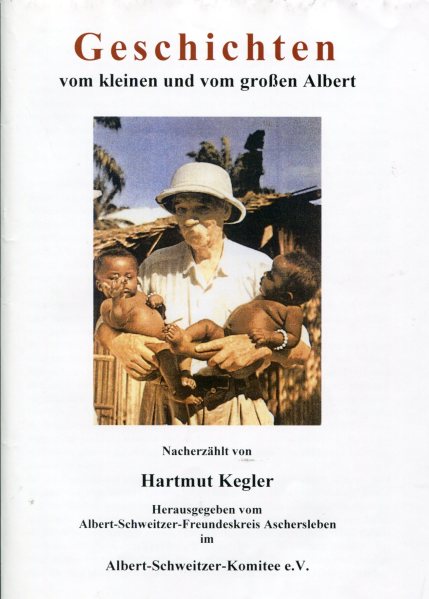
Albert Schweitzer – Seminar #12

AS01

Die Geschichte von Albert und Helene Schweitzers Schiffsreise nach Afrika

Wisst ihr, was der Karfreitag bedeutet? Es ist der Freitag vor dem Osterfest. An diesem Tag soll Jesus am Kreuz gestorben sein. Er hat den Menschen gesagt und gezeigt, was Nächstenliebe bedeutet: Man soll nicht nur seinen Nächsten, sondern auch seine Feinde lieben. Trotzdem haben ihn seine Feinde getötet. Wer etwas Gutes will und tut, wird nicht immer dafür belohnt und manchmal sogar bestraft.

Der Karfreitag ist ein großer Feiertag, nicht nur für die Christen, sondern eigentlich für alle Menschen, für die Jesus gestorben ist. An einem solchen Karfreitag des Jahres 1913, also vor über 90 Jahren, begann für Albert und Helene Schweitzer die weite Reise nach Afrika. Um dorthin, ganz weit im Süden und mitten im Urwald, zu kommen, mussten die Menschen verschiedene Verkehrsmittel benutzen. Flugzeuge gab es damals für solche weiten Reisen noch nicht. So bestiegen Albert und Helene auf dem Bahnhof von Günsbach einen Eisenbahnzug. Die Glocken der kleinen Dorfkirche läuteten wie zum Abschied. Alberts Mutter, Vater und Geschwister hatten die beiden zum Zug begleitet. Alle waren sehr traurig. Aber Albert tröstete sie und sagte, dass sie in zwei Jahren wiederkämen. Doch es dauerte leider viel, viel länger, und seine Mutter hat er nie wiedergesehen.

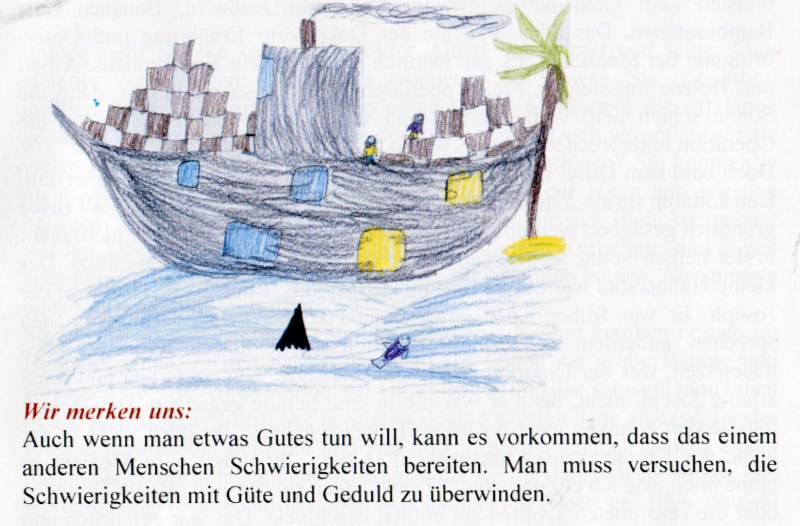
Langsam fuhr der Zug an. Dann verschwand das Heimatdorf hinter den Bergen. Die Eisenbahnfahrt dauerte mehrere Tage, denn sie mussten ja quer durch ganz Frankreich fahren, bis sie in der großen Hafenstadt Bordeaux ankamen. Am Hafen mussten sie zuerst die 70 Kisten ausladen und den Zöllnern zur Kontrolle zeigen. Die Zöllner prüfen immer, ob die Reisenden auch nichts ein- oder ausführen, was verboten ist. Doch an diesem Tage arbeiteten die Zöllner nicht, weil Ostern war. Da wurde Albert sehr böse und rief: „Die Kisten müssen unbedingt auf das Schiff! Morgen früh soll die Reise losgehen. Wenn wir dann nicht kontrolliert sind, können wir nicht nach Afrika fahren und dort arbeiten!“ Doch Helene beruhigte ihn. Schreien und Schimpfen hilft nicht weiter. Sie war für Geduld und Güte. Endlich war der Zöllner bereit, die Kisten mit den Medikamenten und Instrumenten auf das Schiff zu lassen. Albert aber entschuldigte sich beim Zöllner, dass er so laut geschimpft hatte. Er hatte es ja nicht so böse gemeint. Aber die Kisten waren eben sehr wichtig.

Als die vielen Kisten endlich auf dem Schiff waren, konnten auch Albert und Helene über einen schmalen Laufsteg auf den Dampfer gehen, der den Namen „Europe“ trug.

Ihre Seereise dauerte über drei Wochen. Unterwegs gerieten sie in einen schweren Sturm. Das Schiff schaukelte hin und her. Albert musste darauf achten, dass die Kisten im Schiff nicht umfielen und zerbrachen. In ihrer Kabine, wo Albert und Helene schliefen, rutschten die Koffer von den Schränken und fielen auf den Boden. Im Speisesaal rutschten die Teller von den Tischen und zerbrachen. Allen Passagieren wurde übel und keiner konnte etwas essen.

Am nächsten Tag war der Sturm vorüber und die Sonne schien. Albert und Helene schauten auf das Meer und beobachteten die Möwen, fliegende Fische und sogar Haifische. Dann gingen sie zurück in die Kabine, wo Albert Briefe und Bücher schrieb und Helene las, was Albert geschrieben hatte. Beide unterhielten sich auch oft mit dem Schiffsarzt, der ihnen von den Krankheiten erzählte, unter denen die Menschen in Afrika litten. Das war für beide sehr wichtig, denn sie wollten ja dort die Kranken heilen.

Nach drei Wochen kam ihr großes Schiff endlich in dem afrikanischen Hafen an. der vor Kap Lopez lag. Dort mündete der große Fluss Ogowe in das Meer. Nun hieß es wieder umladen. Die vielen Kisten wurden vom großen Seedampfer in einen kleinen Flussdampfer umgeladen. Dieses Schiff hatte keine Schraube zum Fortbewegen, sondern wegen der geringen Flusstiefe Schaufelräder. Mit diesem Schiff fuhren sie nun ganz langsam den Fluss hinauf. Aus dem Schornstein kam dunkler Rauch, weil die Dampfmaschinen mit Kohle geheizt wurden. An beiden Seiten des Flusses sah man den dichten Urwald mit seinen großen Bäumen, Schlingpflanzen und Palmen. Zwischen den Baumkronen flogen bunte Vögel hin und her und auf den Ästen saßen viele Affen mit langen Schwänzen.

Am zweiten Tag ihrer Schiffsreise erreichten sie endlich den Ort, zu dem sie wollten. Er hieß Lambarene. Das bedeutet in der Sprache der Einwohner „Ort des Lichtes“. Dort befand sich eine Missionsstation, in der die Menschen über das Christentum unterrichtet wurden. Der Missionar Herr Morel und seine Frau besorgten nun ein paar Boote, die aus Baumstämmen hergestellt worden waren. Sie heißen deshalb Einbaumboote. Mit ihnen ruderten junge Burschen auf dem Fluss hin und her und schafften die Kisten des Doktors vom Flussdampfer an das Land. Dort luden sie sie aus und stellten sie in eine Holzhütte. damit sie bei Regen nicht nass wurden.

Endlich waren Albert und Helene nun an ihrem Ziel und konnten mit ihrer Arbeit beginnen.

THE MINING ERA OF THE CANADIAN COLUMBIA by Bill Laux – Chapter 10

THE BIG BEND RUSH

By the end of 1864 the placer grounds on the creeks flowing into the upper Kootenay were becoming exhausted.   The miners of the day reckoned that $10 per man per day was a decent return.   Anything less was termed “not white men’s diggings” and was sold to the patient Chinese who had been entering British Columbia from the first Colonial days.   These Chinese, working in groups, would pay from $2,000 to $7,000 for a good claim, and work it for years down to barren rock.   A few companies were formed by Montana or Washington merchants with the resources to bring in and build water wheels and machinery, particularly on Perry Creek, and continued extensive work through the Seventies.   But the single, restless miner was eager to move on whenever a rich strike might be reported. 

In 1861 those Colville miners working the Columbia and Pend Orielle bars were finding their returns diminishing, and proposed an expedition to ascend the Columbia to prospect for further gold occurrences.   However, the Kootenais and Sinixt (Lakes) Indians who had been told that the boundary line then being surveyed across the mountains would keep “the Bostons”  from crossing into their lands, were hostile.   Skirmishes had already occurred on the Pend Orielle.  The Indians told the miners that any attempt to move farther up the Columbia would be opposed by force.

On September 14, 1861, Gold Commissioner William George Cox, at Rock Creek, received the following letter, reproduced in the original orthography,

September 6, 1861, Dominick Flat – 12 miles above Ft. Colvile

“Comissioner Cox – Sir

“We the undersigned miners at this river is anxious to prospect the upper Columbia River – the Indians are oppose to miners going high up than Pen De O’Reelle River – What the miners wishes is for you to come on to the river and make some arrangement with the Indians so that miners can go up the river in safety – We are perfectly satisfide that withan the power that is vested in you it will be impossible to do any mining to any advantage untille some arrangement is made with the Indians – Hoping that you will view the matter in the same light that we do we sign ourselves yours respectfully”

The letter was signed by seventy miners including Jolly Jack Thornton, Dancing Bill (Latham, of the murderous Okanagan Company in 1859), and Dutch Charley,  Tenas (little) George (Runnels), Whistling Bill, Wild Goose Bill (Wilbur Condit or Condon).   These were all Americans from near present Brewster, Washington.   They were contemptuously called squaw men by the farmers and ranchers of the Territory for having taken Indian wives and living in a state of boozy intimacy with the aboriginals along the Columbia.   These men had participated in each of the gold rushes as they had occurred, Rock Creek, Similkameen, Colville, Fraser-Thompson rivers, Cariboo.   Dancing Bill operated a ferry at the site of present Bridgeport.   Tenas George Runnels was a man of some education and had his Indian marriage to Skocom Analix confirmed by U.S. law in 1872.   He was the author of poems and ballads and was stockman, storekeeper, as well as a prospector, and located the Mountain Lion claim in the Republic Camp in 1896.   In 1904 he kept a store and horse ranch at Keller and was involved in the silver mines there.   His best claim he called the Iconoclast, a clue to character of the man and his cronies.    Many of these squaw men were self exiled refugees of conscience from the moral hypocrisy of a society that preached rectitude and practiced greed.  No doubt many had fled prosecutions they chose to feel unjust, and had taken their pseudonyms for the sake of anonymity in the west. 

Cox had dealt with such men before.   In 1861 a Indian at Rock Creek had murdered a French Canadian, Pierre Chebart, and as a Colonial Official. It was Cox’s duty to seize the culprit and take him to New Westminster to be tried, 200 miles distant by crude horse trail.   The  Indian had confessed to his Chief who turned him over to Cox.   In a quandary, and with no one to assist him, Cox pushed him over the border at Osoyoos where the squawmen, acting as vigilantes, promptly marched him to a pine tree and hung him, relieving the Gold Commissioner of a difficult case.

  Now the men who had rendered such rude service some months before were asking his assistance.    Cox at once went to Fort Shepherd where the miners met him, and put their case.   He reproached them for their efforts to push the Indians off the Pend Orielle by force, and pointed out that in that case six Indians with nothing but bows and arrows had driven them from their claims.   If they attempted to ascend the Columbia they would have to use the most conciliatory behaviour with the Indians they might meet.   As well, any depredations they might commit would be rigorously dealt with by a British Magistrate as soon as one could be appointed for the district.

He then traveled to Kootenay Flats (below present Creston) to meet the Kootenais and Sinixts, and enjoin them to keep the peace.   The miners and the Indians would have equal government protection, he promised, but the Indians must refrain from liquor, and “do not steal, no matter how tempting the opportunity may be.”   He also urged the Indians to disregard the harsh language the Americans used, “they sometimes speak so to me.”

On the Ninth of October 26 miners in seven boats left Fort Shepherd for the upper Columbia, accompanied by the Sinixt  Indians, Mocklain and Qui-Qui-lasket, as observers to report any misbehaviour.    Cox then went down river to Marcus where another group of miners met him in Wheelock’s Restaurant and questioned him closely on what arrangement had been made with the Indians.    Cox made the same speech that he had to the Pend Orielle miners, cautioning them strongly, and then returned via the Kettle River to his station at Rock Creek.   On the 19th of October, he heard from the Kootenais Indian, Teneese, that coarse gold had been discovered some miles above Boat Encampment at Big Bend.

  After his report was read in Victoria,  Cox was sharply reprimanded by Governor Douglas for seeming to bind the government to protect the Americans.   Old Squaretoes, still apprehensive of annexation, feared that should the miners be attacked by the Sinixt Indians, the Americans would take it as evidence that the Colonial Government was unable to protect U.S. citizens in its territory and might send in a military force from Fort Colville to guard the miners and police the region.    Since this was precisely what had been happening in the many gold fields south of the line for twenty years, the Governor’s anxiety had some basis.

The Colville miners went up the Columbia that fall, followed, on Nov. 20 by William Fernie and eleven others.    This second group was halted by ice on the Columbia on December 15.   They then proceeded on foot to within 3 miles of present Revelstoke, and wintered there.    Their ascent of the river so late in the year was deliberate.    Extreme low water in the Columbia comes in March and April when the gravel bars are exposed and placering can take place.   By June the river is in flood, the bars underwater, and only lesser creeks can be worked.   By going in late in the year, they would be on the bars when the water went down.

In succeeding years a few Colville men continued to prospect the Big Bend country with inconclusive results.     However, when the British Boundary Surveyors brought in their specimens of gold from the Upper Kootenay River in the fall of 1862, all thought of the Columbia was abandoned, and the rush the next spring was to Wildhorse.    Wildhorse boomed, but not everyone was successful.   By 1864 Wild Horse miners were returning to those previous discoveries on the Big Bend.   There, in that year, placer ground, richer than previously discovered, was found, and when the miners came out in the fall, the news was spread.   Colville and Marcus merchants ordered in new stock and prepared for a new stampede.    In September, these merchants had a six wagon train on the road from Wallulla with 50,000 pounds of merchandise, costing them 15¢ per pound for haulage. 

The Cariboo Rush had passed its peak in 1864.   Men were leaving the diggings, and the merchants’ warehouses of Victoria and New Westminster were overstocked with goods.   The news from the Big Bend filled the small Colony with hope.   The difficulties of packing over the Dewdney Trail, “An unbroken chain of horrors,” as one traveler had termed it, had not captured the trade of Wild Horse.   But transportation into the Big Bend would not require the use of that dreadful Dewdney Trail.   Supplies could go by steamer to Yale, on the Fraser, and then up the Cariboo Wagon Road to Cache Creek where there was a branch road leading to Savona’s on Kamloops Lake.   From Savona’s boats could carry men and supplies up through Kamloops Lake and up the South Thompson River to Shuswap Lake.   At Seymour Arm on the lake there was that old HBC trail that George Turner’s party had followed, across the mountains to the Big Bend .   This could be brushed out, and an All-British route would be ready for the miners.

In the Okanagan a feckless idler, the British Captain Houghton, had taken advantage of his army discharge to take up a veteran’s land grant at the head of Okanagan Lake.   Charles Frederick Houghton was born at Castle Glasshare, Kilkenny, Ireland.   When his cousin, Lord Houghton was killed in the Crimean War, Charles inherited his commission.   He went into the army and rose to the rank of Captain, never getting to the Crimea, before being mustered out in 1863.   Along with his two friends, Forbes and Charles Vernon, he emigrated to British Columbia to stake out the military grant of land he was entitled to as a discharged soldier.    The three friends liked the look of the country at the head of Okanagan Lake and Captain Houghton staked his grant along Coldstream Creek.   He then went to Victoria to record his claim.    When Houghton had left England the Emigration Commission had advertised that a grant of 1440 acres of Crown Land would be available to officers.   But by Governor Douglas’ proclamation of January 1, 1863, which was not published in England, military settler’s grants in British Columbia had been reduced to 300 acres.  Believing he was entitled to the grant he expected to receive on leaving England, Captian Houghton wrote the Duke of Cambridge in England asking that his claim be put before the Foreign Office for resolution.    In his letter he cited the great expense he had gone to in hiring labourers and packers to carry his belongings and provisions, including furniture and farm implements up the Cariboo Road and  by pack train from Cache Creek to Kamloops and Okanagan Lake.   Apparently, pressure brought from England influenced the B.C. Legislative Council, and in 1864 it recommended to Governor Douglas that Captain Houghton’s original grant, now grown to 1500 acres, be approved.    However, his going over the Governor’s head to friends in England did not please James Douglas.   When, in February 1864, Captain Houghton found a stake on his land set by Gold Commissioner W. G. Cox in 1861 marking the corner of the Kalamalka Indian Reserve, he wrote the Colonial Secretary urging that the reserve be done away with stating it was “too valuable to be left as such.”    Governor Douglas left a handwritten note on this letter directing that the reserve be maintained as such.   

Clearly, Captain Houghton needed to ingratiate himself with the Governor to acquire title to his full 1500 acres.   When the Big Bend news broke in 1864 he proposed to the Governor that he be funded to lead an expedition to explore a route from the Okanagan cattle ranches to the Big Bend so that local ranchers could get in on the demand for fresh meat.   In August 1864, the inept Captain Houghton set out with his neighbour, Vincent Duteau, and spent two months “exploring” before returning without having found “the gold diggings.”   There was a fairly straightforward route via Cherryville, Mable Lake and a broad, low pass to Three Valley Gap leading to the Columbia at Revelstoke, which Walter Moberly’s party examined in the following year as a possible route for the Great Coach Road to the Red River Settlement, but the Captain did not seem to have been able to find it.

In April of 1865 he was off again with Vincent Duteau and another neighbour on his search.     This time it seems that he was trying to find the Indian trail that Gold Commissioner Cox had reported existed up Cherry Creek to the Columbia.   But while Commissioner Cox, who had excellent relations with the Indians, would likely have had no trouble locating the trail, Captain Houghton dismissed his Indian packer at the Monashee Silver mine, and pressed on with his neighbours.   By his letter to Governor Douglas he claimed to have reached the ridge running southwest from Monashee Mountain, where he was obliged to take shelter from a late April snowstorm.    His report asserted that he could see both Okanagan Lake and Lower Arrow Lake from his viewpoint, a complete impossibility.     Further, he claimed he could see the sought-for pass directly below him.    However, alleging frozen feet, he then turned back, having seen a route, but not tested it.   

Judge Haynes, writing from Fort Shepherd in 1865 where he was laying out town lots, mentions that Turnbull and Homan of Walter Moberly’s party seeking a route for Coach Road from the Pacific to Lake Superior, had stopped with Captain Houghton at the head of Okanagan Lake and took directions from him to reach the pass he had seen from Monashee Mountain.  Turnbull and Homan crossed the Monashee then via Cherry Creek, the Indian trail, and the Captain’s pass, reaching the Columbia, and travelling down it to Fort Shepherd to replenish their supplies. 

The persistent Captain Houghton got up a third expedition in 1866, this time actually finding his pass, and blazing the trail to Lower Arrow Lake.   He named his trail head on the beach “Killarney” to honour his birthplace.   But like the Dewdney Trail, reaching Wild Horse as its miners were leaving, Col. Houghton was too late.   By 1867 the Big Bend was over, and there is no record of a single cow making the crossing in the Sixties or Seventies.   One conclusion could be that Captain Houghton and his neighbours, Vincent and Nelson Duteau, were  simply prospecting for gold at government expense.

In the spring of 1865, 200 miners who had worked the Wild Horse the summer previous, and believed its placers to be worked out, made their way north from Walla Walla to the HBC Fort Colvile.    Encouraged by Chief Trader Angus Mc Donald, they bought boats, and paddled their way up the Columbia, testing the creeks on both sides on their way.   Gold showings were found at Joseph Morell’s diggings at the mouth of the Pend Orielle, on the Salmon (Salmo)

River, the Slocan River, the Incomappleaux (Fish) River, and particularly on all of the Columbia River bars above the Illecillewat River (Revelstoke).   At Death Rapids, 65 miles above present Revelstoke,  bars were found paying 25¢ to $1 per pan, and skillful panners were making $100 a day.   These were termed “poor man’s diggings,” as the gold was close to the surface and the bars could be worked with pick and shovel.

This news got out quickly as men returned to Colville to replenish supplies.   Except for the few rich mines, the remaining Wild Horse miners deserted to the Big Bend country of the Columbia that summer, and soon there were 5000 men working its creeks and bars.   Going and coming, the Columbia and Arrow Lakes were full of rafts, canoes, home made boats, looking almost like the Fraser seven years before.   The excitement was so great that the entire garrison at the U.S. Army’s Fort Colville deserted, taking their weapons with them with which they fired a triumphal salute when they reached the diggings.    These desertions across the border were common during the years of the American Civil War.    The Regular Army troops that had manned the western posts had been sent to the battlefields of the East and their places taken by reluctant “Terrotorial Volunteers,” mostly idlers and petty thieves drafted in the western territories.    Unhappy with military life and without the stimulus of battle, desertions across the line were frequent.

Both Colonies made preparations for the rush of men expected in the spring of 1866.   Having learned from the Fraser rush of 1858, and the Wild Horse Rush of 1864, which had enriched American merchants, but found most of the Island and Mainland merchants unprepared,  they this time made elaborate preparations to cash in.   B.C. and Victoria merchants that winter flashily advertised the Big Bend in San Francisco as “The Greatest Gold Field Yet!,” and two vessels were subsidized to run miners up from San Francisco to Victoria  where they would catch one of Captain Irving’s or Captain Moore’s steamers for Yale and the Cariboo Road.   Funds were appropriated to improve the wagon road from Cache Creek to Savona’s, and the HBC built the small steamer, Marten, at Chase’s Ranch (now Chase, B.C.) on the South Thompson River where boat timber was available.   When she was launched, she was taken down to Savona’s on Kamloops Lake and her machinery installed.   On May 26 she made her maiden run under Captain William Mouat, from Savona’s to Seymour City at the head of the Seymour Arm of Shuswap Lake.    She arrived at Seymour City on the 27th.   Already, in anticipation of the miner’s rush, a growing town with six saloons, thirteen stores, five bakeries, three restaurants, eleven shoemakers, two breweries, and a coffee and doughnut stand, all awaited the free spending miners.   When, at sunset, the Marten came in sight with the first load of gold seekers, the entire population abandoned their suppers and crowded to the dock to cheer the miners.   Blacksmiths fired continuous anvil salutes, and a cask of  HBC rum was broached with free drinks for all.       Contracts were let to brush out the old HBC trail from there to the Columbia.   Billboards were erected to advertise the route, newspaper reporters were briefed; all was ready for a business-managed and orderly Gold Rush in the best British manner.

All of these preparations were calculated to draw the Americans to the carefully prepared British route, in place of the unruly and improvised rush up the Columbia from Walla Walla of the year before.  If all went well, the incoming miners would find British stores and British merchants on the diggings, ready to provision them when they arrived.   

When spring came, the miners came with it, thousands of them.   Many arrived much too early before the snows had melted, and crossed Kamloops Lake on the ice.   “Thousand Dog Joe” made a small fortune hauling supplies with his dog sleds up the frozen river and lakes to Seymour Landing.    In April Walter Moberly, a man more dependable by far then the inept Captain Houghton, got to Seymour to brush out the old HBC trail and construct bridges over its creeks.   He found the place full of men impatient to cross the Monashees to the Columbia.   “Old Bill Ladner” had gone on ahead on the snow, cutting his own trail, and arriving first at Big Bend with a sledge load of supplies which he sold to the overwintering miners there at starvation prices.

However, the Americans were not going to let the British Columbians have this rush to themselves.    In Portland, Captain John C. Ainsworth was closely following the news from British Columbia, and hoped to repeat the profits his company had made in 1858-59 with their boats on the Fraser.   His  Oregon Steam Navigation Company made preparations in early 1865 to be ready with its own American route to the new diggings.   In late Spring, once the snow had gone, Ainsworth  sent Captain Leonard White who had been running boats on the Upper Snake, to Colville to build a steamer to serve the new rush.   In August, 1865, the keel of the sternwheeler Forty Nine, was laid in Marcus, the settlement that had grown up around the British Boundary Commission barracks.    Captain Ainsworth took the boiler and engines with 12” x 48” cylinders out of his beached Willamette. River steamer, Jennie Clark, and sent them by ox drawn wagons from the landing at Wallulla to Marcus, where they were installed in the Forty Nine.   The light, shallow draft western river steamers were expected to pay off their construction in three trips to the bonanza camps.   In rough service they were not expected to have long lives.    When they were beached, the boiler, engines and steam capstan would be removed and installed in another steamer.    The same set of engines would over their lifetime propel some three or four different steamers.   The Forty Nine with its second hand machinery, was 96 feet long by 18 wide, 219 gross tons, and had engines for a boat twice her size.   News of her construction reached Fort Shepherd and the magistrate there anxiously wrote the Colonial Secretary,

“A steamer is now being built near Ft.Colvile by a company represented by one, Captain White, which will, I am told, be ready to start in about six weeks.   I would beg for instructions as regards U.S. steamers running up here.”     

          On  December 9, 1865, Captain Leonard White,  First Mate Albert Pingston, Purser Charles Briggs, and Engineer Washington Eldridge, began the sternwheel steamer era on the Upper Columbia by winching their boat with her steam powered capstan through the Little Dalles Rapids.   A cable was run out and made fast to a big yellow pine on the cliff.   Then steam was fed to the capstan engine and the boat winched her way up through the turbulent water.    Loaded with miners eager to get to the diggings in style, the Forty Nine crossed the border into British Columbia the next day and proceeded upstream.    

In the low water of December, Captain White had to line the Forty Nine through Rock Island and Tincup rapids with the capstan.   Passing the mouth of the Kootenay River, he took his boat into the broad waters of Lower Arrow Lake.   Up the past forest clad mountains plunging steeply into the water, they steamed, entirely alone in this mountain fastness.  However, when they reached the narrows between Upper and Lower Arrow Lakes, (present Burton) Captain White found his passage locked by early winter ice.   Again the miners wanted to be on the placer grounds during the April low water so they unloaded their supplies and put them on improvised sleds.   They then set off on foot, pulling their sleds up the river ice to make the rest of the 150 miles, and winter on the placer grounds. .   Captain White turned the Forty Nine downstream, and beached his boat for the winter at Little Dalles, a few miles above Marcus.

As soon as the ice went out in the spring of 1866, Captain White set out again with the Forty Nine and a full load of 73 miners, merchants, and their freight on April 15.   Among the passengers were Dan McCulloch, James May, George Weaver, D. Carley, Old Man Minnetto, Hauser (for whom the town of Howser was named), Downie (of Downie Creek), the merchant Marcus Oppenheimer with his stock of goods, Neuberger, Ben Bergunder, William Fernie (who had been foreman on the Dewdney Trail), and Nels Demars (later to settle at Nakusp).   In addition, the Colville packers, Wade and Gardiner were aboard with their pack string to take the freight from the landing at La Porte to French Creek, charging 40¢ per pound.   Passage on the Forty Nine cost $50, with freight carried at $200 per ton.  The passengers were fed, but the sleeping accommodations were extremely primitive.    Stipendary Magistrate H. M. Ball, inspecting the boat as it cleared customs at Fort Shepherd, described it to his superiors, as “a mere shell with powerful engines”   

Moving cautiously up the uncharted river and lakes, it took Captain White ten days to steam as far as La Porte, at the foot of Death Rapids, 60 miles above present Revelstoke.    Except for Old Bill Ladner, they were the first men in.   The HBC trail from Seymour was still blocked by snow, with Walter Moberly and his crew still at work on it.

Captain White discharged his passengers and freight, and returned down river at once to board more waiting miners.   Most of those passengers on that first trip up the Canadian Columbia did well.   Dan Mc Culloch, picked a creek, gave it his name and took $27,000 out of it.   Downie named his creek, and it proved to be one of the richest in the Big Bend.   Ben Bergunder set up his store in a tent and was soon joined by R. Lamphere.   These Colville merchants, resupplying themselves by subsequent trips of the Forty Nine, dominated the Big Bend trade with the largest stocks, the best prices.   When the HBC trail over the Monashees was finally opened, the New Westminster and Victoria merchants, with more costly transportation, proved to be ineffective competitors.    

On her second trip to the Big Bend, the Forty Nine carried 87 men and 25 tons of freight.  Charges for merchandise from Portland to the the mines were 21¢ per pound: 3¢ Portland to Walla Walla, 8¢ Walla Walla to Little Dalles, and 10¢ Little Dalles to Death Rapids.  The Forty Nine paid for herself that first season, but by late summer the number of penniless miners wanting passage out began to outnumber those going in.   The Big Bend, which had looked so promising was proving a bust.   The placer deposits, while rich, were shallow, and most of the gold was lodged in crevices on the bedrock.   The bedrock in the Big Bend creeks was vertical and its crevices could only be opened by hard rock mining techniques and the use of steam pumps to keep the holes pumped dry.     The simple placer miner with his pan, had to find a good gravel bar or give up.  It was Captain White’s absolute policy not to carry any man upstream who did not have  sufficient supplies to carry him through the season, but he also took downstream gratis any man going out broke.  It became the rule on the isolated Canadian Columbia that you did not abandon a penniless miner on the beach.

Alerted by the reports of the men of 1865, the Colonial Government sent in Magistrate O’Reilly to take charge.   He came in across the snows on the Seymour City trail to find that the Forty Nine had delivered her first passengers and freight a few days earlier.   Some 1200 men were already on the various creeks.   When he tried to hire a constable, Magistrate O’Reilly found that the $2.75 daily pay allowed a constable by the Colonial Government was less than the cost of a single meal in the Big Bend camps.    Nevertheless, O’Reilly found his new district,

“…perfectly quiet and free from outrage of any sort.”

By the end of that 1866 season it was clear that except for some closely held diggings on Downie, Gold  and French Creeks, the Big Bend was bust.   About three quarters of the men leaving the diggings as the first snows came in November, could not pay their fares on the Forty Nine to Little Dalles.   The Forty Nine Company (named for the steamer) and a few other companies had the resources to bring in pumps and boilers to run them, and sink shafts below the rivers to mine out the gold bearing bedrock.   But the average placer miner could not afford such an operation, and headed back to the diggings at Wild Horse, or reputed new easy diggings in Idaho and Montana.

The year following, the Forty Nine made fewer trips to Downie Creek, but a new strike on the lower Kootenay River’s Forty Nine Creek (again, named for the steamer), a few miles west of present Nelson, brought a demand for passage to the mouth of the Kootenay, and a trail was cut to the new diggings.    Richard Fry, one of the early miners on Forty Nine Creek reported that for the next three years,the creek was paying $4 to $5 per man per day.    Not a bonanza, like some of the best spots on the Big Bend, but enough to hold a small group of miners and induce further prospecting in the area.

Although, the Big Bend failed to support a scheduled boat service on the Canadian Columbia for the Americans, the British Columbians failed dismally to cash in on even the glory days of the boom.   The trip from Victoria or New Westminster was costly, long and arduous by boat, stagecoach, steamer and pack horse.    Little trade went by that route; the wagon road from Walla Walla to Colville and Little Dalles and the Steamer Forty Nine took the biggest share.   The townsite of Seymour City, laid out at government expense as a trading centre for the Kootenays, was abandoned in 1867.   The Hudson’s Bay Company post closed, boarded up its windows and doors, and took all its stock back to Kamloops.  In a few years the encroaching forest had covered the site, leaving scarcely a trace.   Today, hikers on the Seymour trail are amazed to find near the summit,  a pile of polished slate slabs.    They were intended for a pair of billiard tables to be set up at one of the Big Bend camps.   The packers, taking them over the trail on their mules, had been met by miners coming out with the news that the Big Bend was a bust.   The packers dumped their slates there and then, and turned around.

With little business for the HBC steamer Marten, she was sold to the Kamloops merchants J.A. Mara and W. B. Wilson who ran her on the North and South Thompson delivering supplies to the settlers.   In 1879 she was wrecked on a rock and sunk.

  Governor Seymour had done his best to save the Big Bend trade for the British Columbia merchants, but for the second time, Kootenay geography had worked against him.   The elaborate preparations were largely wasted, the money invested in the townsite and commercial establishments lost.   A depression seized  Vancouver Island, businesses closed, people were “blue with consternation.”    As a money saving measure the two nearly bankrupt colonies were united.  The two bitter disappointments at Wild Horse and Big Bend were to prejudice the mercantile community and the government against the Kootenays for the next forty-five years.    The Cariboo, all the coastal businessmen remembered, had made them rich, Wild Horse and the Big Bend had been borrasca.    They would take out their frustration by turning their backs on Kootenay, leaving it to the merchants of Colville and Spokane Falls to risk their money there.   

This was probably shortsighted, for while the population of the Kootenays was declining precipitately in the Seventies, that of Northeastern Washington was increasing.   In 1860 Northeast Washington Territory claimed 279 persons, plus Chinese, Indians, the men of the Boundary Commission and the Military Road builders.   By 1870, that number had doubled to 519, and to ten times that by 1880 with 5,507 residents.  By comparison in 1875 the Kootenay district cast but 32 votes in the Provincial Election, and in 1878 there were only 47 names on its voter’s list.   These numbers reflect only British Subjects in Kootenay; there were probably twice as many Americans present, plus several hundred Chinese still working the bars of the Columbia and the Wild Horse Creeks.

When the two colonies of Vancouver Island in British Columbia were united in 1867 as a money-saving measure Peter O’ Reilly was appointed magistrate for the Kootenay district and R.T. Smith appointed  member of the Legislative Council which was supposed to advise Governor Seymour.   In 1868 voting “No” on an address to the Queen to join British Columbia to Canada were all three Kootenay officials, O Reilly, Cox, and Smith.    As educated colonial civil servants, they would have lost their positions if  B.C. joined Canada, and been replaced, they feared, by coarse Upper Canada Methodists.    

In December 1868 Edgar Dewdney was selected to represent the district.   However either by negligence or the badness of the trails, Dewdney was not notified of his appointment until late 1869, missing the entire year of council sessions.   It probably made little difference.    Once the Big Bend excitement was over, the Kootenays were off the Colonial agendas.

When British Columbia was united with Canada in 1870, an elective  Legislative Assembly was convened.  In the first elections in 1871, John A. Mara, businessman of Kamloops,  and Charles Todd were chosen to represent Kootenay, serving until 1875.   From 1875 until 1878 Arthur W. Vowell and Charles Gallagher sat for Kootenay.   From 1878 until 1882 it was Gallagher, and Robert L. T. Galbraith of the Wild Horse ferry. 

From 1866 until 1868, Captain White kept the Forty Nine running up the Columbia to service the well financed mines on Downie and French Creek.  But by 1869 most of the miners had left the Columbia and the Forty Nine made but two trips that season.   Broken in health and weakened by disappointment, Captain White beached his boat and left for the Coast to die.

His mate, Albert L. Pingston, took over the boat and operated her whenever a call came for a load of supplies and machinery to be delivered up to the Downie Creek mines which were still in operation.   On one of those trips in 1869, he had the misfortune to run her onto a rock below Downie Creek (thereafter known as Steamboat Rock.) and smash a hole in her light hull.   Pingston beached the boat in a shallow backwater below present Revelstoke, and sent to Captain Ainsworth in Portland for instructions.

For Captain John Ainsworth the Big Bend boom was over, and the Forty Nine, which had more than paid for herself, was now a liability.   He wrote Captain Pingston,

“…as far as our interest in the boat is concerned, we are willing to dispose of it, or do most anything in reason that would enable the boat to be raised, except it be to pay out any money…”

But Captain Pingston, not so easily discouraged, patched up the Forty Nine with his own resources, relaunched her, and continued to make trips whenever cargo or passengers offered. His first trip in 1871 carried but seven passengers, six of whom were Chinese; clearly, the Americans had abandoned all but two of the creeks to the more industrious Orientals.   On another trip that year, the Forty Nine was hired to carry supplies up the Columbia to Walter Moberly’s survey party which was seeking a route for the Canadian Pacific Railway.   But these hired trips became more and more infrequent.   From the point of view of the Oregon Steam Navigation Company, the Forty Nine’s machinery was idle except for a few weeks of the year.    Since it could be profitably used on the Snake River where the gold camps on the Clearwater were in need of service, the Forty Nine was dismantled at Little Dalles in 1879, and her boiler and engines hauled off in wagons to the Snake River to be installed in another steamer.

Nothing whatever remains of Marcus or Little Dalles today.   Both are submerged under the Franklin D. Roosevelt Reservoir behind Grand Coulee Dam.   A financial panic in 1873 dried up the source of capital with to develop mines.   The Kootenays emptied of miners except for a few small parties of Chinese.   Brush grew over the trails, the creek bridges collapsed or were washed away by the spring runoff.   When British Columbia entered Confederation in 1870, the Yale – Kootenay district was allowed to sent one member to Parliament in Ottawa.   The nomination convention was held in Yale in 1871.   Captain Houghton, the inept explorer, came over from Vernon to stand for election.   Only two registered voters could be found; the miners had not heard or could not be bothered to attend.  With two votes cast, Captain Houghton took the nomination and was elected by acclamation.   

Some sense of what that remote and empty region was like in the Seventies can be found in Lieutenant Symon’s report to Congress of 1881.

“The Little Dalles is situated by river fifteen miles south of the point where the Columbia crosses the British line, and about twenty-six miles above Kettle Falls.   The cañon of the Columbia is here deep and narrow, and no bottom lands lie along the river.   The Dalles are caused by a contraction of the channel, the limestone bluffs from which the banks of the river are formed projecting into the stream, and damming back the water into a deep, quiet stretch above.    The fall here is inconsiderable, and I believe the place could be improved for navigation during the low and medium stages of the river by clearing away some of the projecting  points of the bluffs and small rick islands in the stream.

Sounding almost like a contemporary nostalgia piece, Lieutenant Symons continues, (remember, this is 1881):

“Years ago, when the excitement about the gold mines on the upper waters of the Columbia and Fraser Rivers was at its height,  a steamer was built here (actually at Marcus, there was not yet a wagon road to Little Dalles) and ran from the Little Dalles up the rive for a distance of about 225 miles to Death Rapids, transporting supplies and carrying passengers.   This steamer, the “49,”  during low stages of the water, used at times to be taken down to Kettle Falls, going through the Little Dalles, and being lined back over them.   The tree was pointed out to me which she used to make fast in ascending the rapids.

“A good portage road now exists around these Little Dalles.

“The road to the Little Dalles leaves Fort Colville and follows down (up is meant) the valley of Mill Creek to its junction with Echo Valley, up which it goes as far as Bruce’s ranch.   From this latter point it bears westward through a gap in the hills and reaches the Columbia River by an easy descent, and follows along its left bank to the rapids.   During the old mining excitement (i.e. 1864- 1866) quite a town was started here, which has been completely destroyed by fire, the principal vestige of its former grandeur being the numerous signs still remaining along the road telling travellers where to buy their merchandise.   

“The road is very good all the way, the principal travellers over it being the Chinamen who are

engaged in mining on the upper river and who go to Colville for their supplies…

“The country through which the navigable portion (of the Columbia) flows is mountainous as a

general thing.   There are, however, large areas of rather level ground especially along the enlargements of the river known as the Arrow Lakes.   I have been informed that along these Arrow Lakes lies one of the finest belts of timber known to man — cedar, white pine and fir of large size and of the most excellent quality growing in abundance…

“Concerning the interior of the country away from the river in this extreme upper portion very little is known.”    

While Lieutenant Symons was musing on Northeast Washington’s first ghost town, the absent miners had been drawn to new camps in Idaho and Montana.   Two or three successful and well funded operations continued hydraulic mining in the Wild Horse region, and the Chinese worked the scantily yielding creeks and bars of the Big Bend abandoned by the Americans.   With the Forty Nine dismantled on the beach at Little Dalles, it is believed that the Chinese rowed their way each spring up the Columbia 260 miles to their diggings, captained by Albert Pingston.   But for these summer incursions, the great empty land was once again as the fur traders had found it in 1805, remote, densely forested, hemmed in by high mountains, and once snow had closed the trails, and ice the lakes and rivers, a formidably difficult place to winter.

The Colonial Government, having spent so much to access the Wild Horse and Big Bend mines, and to so little effect, was content to leave the Kootenays to its Indians.   In 1870, the Kootenays, which had briefly supported a population of 5,000 during the mining rushes of the ‘60s,  comprised in the words of the Langevin Report, only “103 white males, 5 white females, 2 coloured males, 139 Chinese males.”    Of these 6 were in agriculture, none in manufacturing, 20 in trading, and 222 in mining.   By numbers, if anything , it was a Chinese district.

All through those empty Seventies, snows smashed the deserted miner’s cabins, bears and coyotes scavenged the abandoned campsites, the ubiquitous devil’s club, alder and snowberry reclaimed the laboriously cleared ground, we had our first ghost town at Seymour City, Washington had its at Little Dalles, and the Kootenays were once more virtual wilderness that the Fur traders had found in 1811.

The Drop Hunters

Wednesday’s Photos

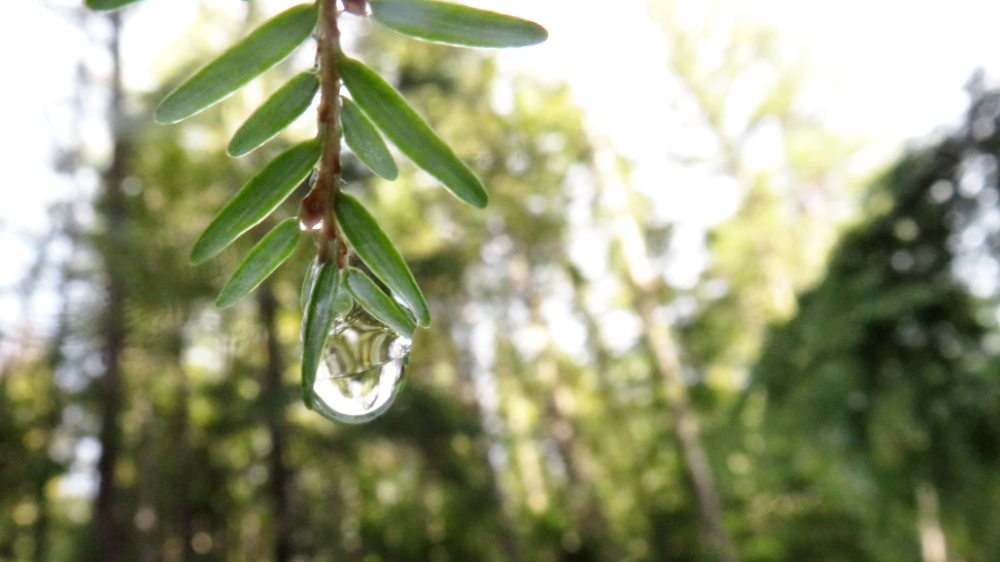
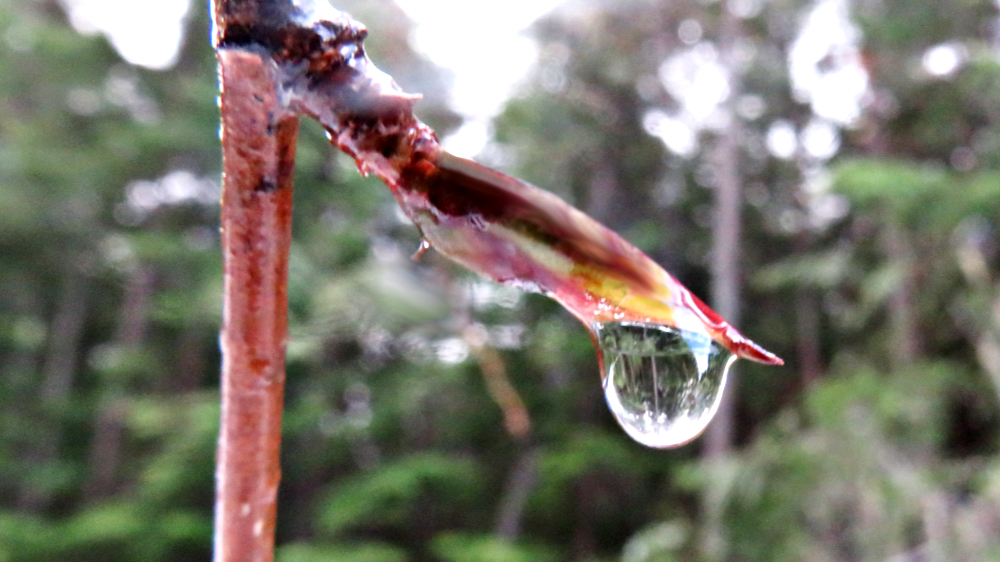
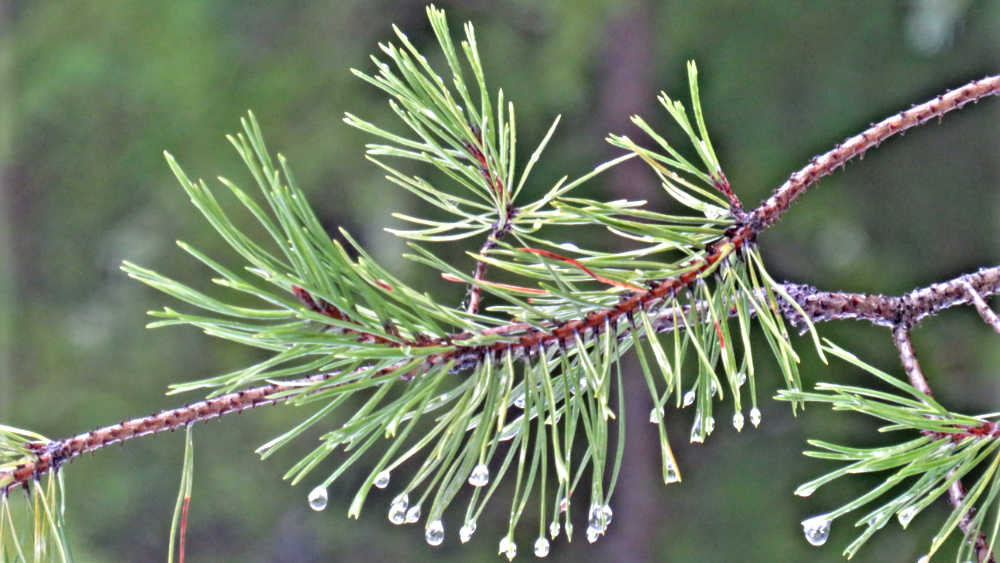
Last week my wife and I drove out to our favourite site, the Taite Creek campground, to escape the winter blues, which invariably set in, when we are cooped up for too long within the confines of our four walls. The effect was gratifying and we felt refreshed from our walk down to the lake. We also were rewarded by the many different drops we were able to catch on our cameras. Enjoy!

img_5448a

img_5458aimg_5484aimg_5489aimg_5457a

The Peter and Gertrud Klopp Story – Chapter XXIX

Working from the Bottom Up

“Without ambition one starts nothing.

Without work one finishes nothing.

The prize will not be sent to you.

You have to win it.”

Ralph Waldo Emerson

My First Job – Painting my Brother’s House


X324

The three Brothers from Left to Right; Peter, Adolf and Gerry

Arriving in the late afternoon at Gerry’s place on Fyffe Road in Calgary, I felt as if I was receiving a warm welcome way back home in Germany. Gerry greeted us in German. He introduced me to his wife Martha, who also spoke German in a strong southern dialect. The only one I could practice my English language skills with was their three-old son Wayne. Gerry, always straightforward and forthright, told me that he had some work for me. He wanted me to paint the house, while I was searching and applying for a paying position on the job market. I was eager to get my hands dirty and do something real useful after all this loafing around during the past two weeks. I really surprised him with my cheerful reply, “Why, can I start tomorrow?” Well, it turned that he had to buy paint, brushes and other equipment first, before I could start doing the paint job.

X342

Gerry and his Beautiful Wife Martha

My sister Erika, who had come by train a few days before us, had already run afoul of Gerry’s house rules, not the least of which was that he and Martha alone were in charge of their son’s upbringing. Any criticism no matter how constructive that might seem to be to our sister was therefore not welcome. As I have indicated in previous chapters, as long as I could remember, she was always inclined to speak her mind, indeed a valuable attribute of one’s character. However, when her tongue was faster than her mind that was supposed to control the former, the problem could easily escalate to a downright family feud. Fortunately for her, she soon moved out, as she had found work as a nurse’s aid in a rural hospital in the small prairie town of Bassano 143 km southeast of Calgary. She had found out that recognition of her German qualifications as an RN would depend upon the successful completion of her senior matriculation. So she had a long arduous road ahead. Tenacious and ambitious like all of us Klopp children she went back to school, attended night classes and studied hard to obtain her grade 12 diploma. This was all the more remarkable, as she did not have the advantage of having learned English in school.

195

Painting my brother’s house was more involved than I had anticipated. First, I had to sand the old flaky paint off the wood sidings, which was a dusty and laborious task that would take days to complete. While the job was time consuming, standing on a ladder and holding the electric sander above my head to reach the soffit boards was very tiring and not altogether pleasant with paint and dust particles flying into my face. The thought occurred to me that Gerry definitely got his money’s or, more accurately stated, his food’s worth of work out of me. Yet, I was enthusiastic about a job, where one could see its result for years to come. The best part of it was that I could take as many breaks as I felt necessary during which I drank some refreshment, which my sister-in-law so kindly provided from time to time.

Everyone was at work. When Gerry came home from work, he checked the progress I had made during the past eight hours and most of the time commented approvingly on the quality of my workmanship.

On the second week since our arrival in Calgary I was ready to paint. I enjoyed that part the most, because with each passing day the new white color had advanced a noticeable distance on its tour around the house. Not familiar with the use of brush and roller, I stained myself at the beginning with the paint dripping and splattering on my hands, face and clothes. But as my work progressed, I gradually looked more like an experienced painter at the end of the day. By the time June came around I had put on the second and final coat and Gerry’s home turned out to be most beautiful among the bungalows on the Fyffe Road loop.

Occupational Dreams and a Trip to the Dairy Queen

Calgary-1960s

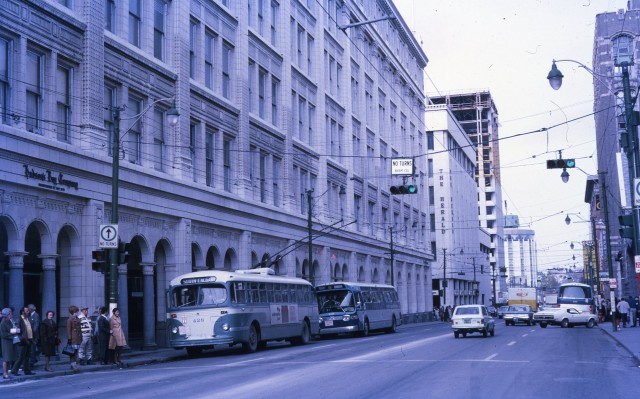
Downtown Calgary in the Mid 1960’s

Every morning before breakfast the newspaper boy came by on his bicycle and dropped off the Calgary Herald at the front entrance. Actually he only dropped it off on rainy days, which happened very rarely in this semiarid climate. On all other days he would not even get off his bike. He would grab a paper from his bag and in a precisely calculated arc would land it right in front of the door. Before you knew it, he was already on the way to the next house. Later in the morning, when I granted myself a break from painting Gerry’s house, I would rush into the house and grab the Calgary Herald, which my brothers had left on the kitchen table. There was only one section in which I was really interested. I did not care about local, national or international news. Instead I quickly thumbed through the thirty odd pages of this massive newspaper until I reached the classifieds. There I soon found out what was hot on the job market. Day after day I noticed that there was an incredible teachers’ shortage in the province as evidenced by the large number of teaching positions in practically all subject areas, but especially in math both at the junior and senior high school level. The children of the baby boomers were flooding the school system, while many teachers were retiring.

187.jpg

Peter’s Nephew Wayne 1965

But I did not ignore the ads from the mining, oil and other resource based companies, which were trying to attract high school graduates offering free training in their respective fields with pay. Reading about all these promising positions was like entering a dream world. In a sense it actually was a dream world, more accurately put a fantasy world. I did not recognize in my unrestrained enthusiasm that it was a long, hard road from the effortless reading of an ad to landing the job of my dreams. I found out much later that the positions had often been filled at the time, when they finally appeared in the newspaper. However, as to the openings in the teaching profession, I had a fairly realistic picture in my mind. I further learned that the farther one was prepared to move away from the few major cities into isolated areas, where young city slickers would not be eager to live, the greater were the monetary and housing incentives that school boards were willing to offer. It was not uncommon in those days to offer $500 up front for each year a candidate would commit himself to teach with subsidized housing and isolation allowances to sweeten the pot.

Of course, in spite of Biene’s and my agreement we had made with each other to wait for two or even three years, deep inside we were always hoping for a quicker way of getting us two back together again. The first hint that Biene shared the same desire perhaps even more so came when I wrote her that I had almost made a foolish mistake in my career planning by responding to an ad from the IBM Company, which was looking for trainees in the fledgling computer industry. Indeed I felt, I would be the right candidate with my high school diploma and aptitude in math and analytical thinking. From Biene’s reaction expressing regret that I did not commit such foolishness, I could see that she too was counting on a shorter waiting period for our wedding date. In spite of these occasional flights of fancy that I allowed myself to paint a different future for Biene and me in Canada, I squashed any ideas that smacked of immediate gratification with regrets to follow in its footsteps. I realized that I could only be a good husband, father and family man, if I found fulfillment and satisfaction in my professional life. As one of Gerry’s friend so correctly once stated, work you enjoy doing is not work at all, rather it could become a source of relaxation and happiness. It was my hope and aspiration that one day teaching would do the same for me, and so also for Biene and the family.

216

Peter’s Brother Gerry and his Wife Martha – 1965

One day, after I had finished my paint job to Gerry’s complete satisfaction, he drove the family and me to the nearest Dairy Queen. He mentioned to me that I had a special treat waiting for me. I did not quite understand what he was ordering and wondered as to why he kept repeating the word Sunday. ‘What a strange world, in which one had to order a dairy product two days in advance’, I thought to myself. But then what a delightful surprise it was first for my eyes, then for my taste buds, after Gerry handed me on a large cardboard tray with a gorgeous ice cream sundae served with syrup, whipped cream, chopped nuts and strawberries! It was truly a heavenly treat, even richer, creamier and more delicious than my grillage torte my mother used to order for my birthday parties in Germany.

Splendour of the Rocky Mountains and Disappointment at the Employment Office

217

On the weekend before I began to actively look for work, Gerry took his family and me for a ride into the Rocky Mountains. Even though the mountains were partially concealed in a shroud of low clouds and fog, the stark unspoiled beauty of the wild scenery was stunning. Half way up to Banff, Gerry suddenly stopped the car at a viewpoint at Lac des Arcs. There we took a long admiring look at the majestic beauty of the Three Sisters, a trio of peaks in the Rockies named Faith, Charity, and Hope. Then my brother handed me the car keys and encouraged me with his peculiar tone of voice that did not leave much room for refusal, “Now Peter, you drive.”

Except for one day of driving lessons in an army truck I had never sat behind a steering wheel before. I received a one-minute lesson on the use of the power brakes, gas pedal and the simple way of putting the automatic transmission into gear. As it turned out, driving an eight-cylinder American car was a piece of cake. I enjoyed it so much that I did not notice how fast we were going on the four-lane superhighway, until Gerry remarked, “Watch your speed, Peter. For a greenhorn like you this is way too fast.”

At the gate of the Banff National Park Gerry took over the driving again, and I had time to marvel at the mountains that began to close in on us from either side of the highway. Words cannot describe the splendour of the landscape with its rivers, mountain streams, lakes, and forests. I mailed Biene a booklet about the park, so she would be able to experience vicariously what I had seen with my own eyes.

X327

Peter at Lac des Arcs – June 1965

On Monday morning bright and early I joined the ranks of the job seekers at the Canada Employment Office. While waiting in the long line-up for my turn to register, I listened in to the conversations among the men in front of me. What I heard and what little I understood was not very encouraging. The government workers here received daily memos from companies, which were looking for skilled, certificated workers, preferable journeyman ticket holders with years of experience.

“How would I ever get experience, if nobody hires me?” I heard one man in his thirties complain.

“They drop your name and application form into a file and tell you that if anything comes up they will notify you. It’s like playing in the Irish Sweepstakes. If you are lucky, they pull your name out of the hat,” said another.

“Then tell me you know-it-all. Why are you wasting your time here?”

“Because I sometimes get lucky playing the lottery!” was his smug reply.

When I had finally advanced to the front desk, I had from all the talking around me the distinct impression that I would be going nowhere with my search for work at least not here, where the only people who had work were the government employees. In a sudden surge of sarcasm I felt that they were being paid for the number of applications they processed in any given day, for shuffling papers from one stack to another, and then burying them in their gigantic filing system, thus squashing the hopes and aspirations of people like me. I filled out the forms that the main clerk had handed to me and filled them out as well as I could. I wondered who would ever find the time to look over the detailed responses we were expected to provide. With a feeling of gloom and doom I stepped out of the Canada employment office into the sweltering heat.

X306

Happy Family Life at Gerry’s Place in Calgary

“Welcome to the Calgary slave market!”

Learning the Difference between Up and Down

Calgary Hudson’s Bay Department Store 1965

Leaving the office building, I noticed a commotion at the street corner to the left. Someone near me shouted, “Quick! They are hiring over there.”

I ran as fast as I could to see what was going on. Half a dozen men were standing on the back of a half-ton truck, which was parked at a slant with two wheels on the sidewalk. The brawny looking men apparently were the lucky ones, who had been hired. A short man with the looks of an aggressive army sergeant was carefully examining those left standing on the sidewalk as to their suitability for hard labour. His keen eyes immediately spotted me and noticed that I looked healthy, well fed, and physically fit for the kind of work he had in mind. He merely pointed to the six men on the truck and said, “Up you go!”

In utter surprise by this speedy hiring process all I could do was stammer questions in my peculiar Oxford English mixed in with a strong German accent, “What kind of work is it? What is the pay? Aren’t there papers to be signed?”

Instead of answering my questions he barked, “Do you want a job or not?”

When I climbed onto the truck, he only answered my last question in a vague sort of way, “We will do the paper work later.”

When the man, who turned out to be my future boss, had collected altogether eight strong men, he critically looked them over once more weeding them out in his mind and fired half of them before they even had done any work. I was not among those who had to jump off the truck.

“Welcome to the Calgary slave market!” whispered a husky young fellow with a heavy foreign accent into my ear. I had just become a labourer in the work crew of Milne Construction Limited.

Barely thirty minutes later we arrived at the construction site, where an upscale apartment building was to be encased by a wall of bricks instead of the usual wood panel sidings. Mr. Milne assigned me to the foreman for placement at the site. He was from Yugoslavia, as were most of the steady labourers, who spoke only a few words of English, and therefore, as far as I could see, had been enslaved to provide cheap labor within the narrow confines of a construction company. Two masons were already clamouring for bricks and mortar. It did not take very long to recognize that this was not merely an introduction to my work routine, after which I could go home to have lunch, put some work clothes on and report for work in the afternoon. No, I was expected to start my job immediately and provide mortar and bricks to the impatient looking masons. Apparently my predecessor had been fired or did not show up for work this morning. After I had with the help of a pulley hoisted up a pail of mortar, I picked up the first two bricks with my bare hands and laid them on the heavy board, on which the masons were standing. In no time at all I had figured out the rhythm of providing a pail of mortar followed by twenty or thirty bricks in thirty-minute intervals. By the time lunchtime came around, I was very hungry and thirsty. One mason with a heart seeing that I had nothing to eat threw me a bologna sandwich over to the pile of lumber where I was sitting. I wolfed it down with plenty of water from the tap. He also talked to me in detail of what my job was all about. This was not a union outfit. If I didn’t like it, the only way for me to file a complaint was to quit. Also this was the beginning of a new building project. So at first, work would be relatively easy. But he warned me that once the wall would grow higher, the masons would continue building it at the same pace. That meant only one thing, with all my climbing up the scaffold I would still have to provide the same number of bricks within the same time frame. Mr. Milne came by to tell me that I was hired at $1.80 an hour and could keep it for as long as the masons weren’t complaining about me. That was indeed good news. For the next day I decided to buy some durable work pants and a pair of leather gloves to prevent my hands from bleeding.

Peter during Happier Times in the Canadian Wilderness

A few days later my mason friend entrusted me with the preparation of the mortar. That gave me a little break, because during that time another labourer had to move the bricks to the ever increasing new heights on the scaffolding. I also received my first lesson on the proper use of language on a Canadian construction site. My school English, especially when presented with a strong German accent, would just not do around here. My friend almost had a laughing fit, when he heard me ask, “Sir, shall I fetch a bucket of water and shed it on the mixture to soften the mortar?”

Good-naturedly he replied but with the intent of teaching me a valuable lesson. “Peter, you don’t talk like that. Your Yugoslav coworkers will not understand a single word you saying in your stilted Shakespearian language. This is how you should put it, ‘Hey you! Should I get a pail of water, pour it over this f…g mix, and stir till it turns into that soft sh*t the masons like to work with?’ I got the drift. This was the real world with hardworking people with both feet on the ground without that highfaluting talk raining down from academic ivory towers.

Another time, when the midday heat was almost unbearable, I was dragging two heavy boards up the rickety scaffolding frame. I was standing on the third tier taking a short break to catch my breath. Standing near the new stone wall with its heat radiating back, I was about to lift the boards one level higher into the steel frame above my head, when the boss looked up and to his dismay saw me what he thought to be loafing on the job. Pointing to the load I was carrying, he hollered, “Up!”

Noticing my hesitation to respond to his simple command, he shouted all the louder, “Up!”

What he did not realize at that very moment was that I was engulfed in a state of total confusion. ‘Ab’ means ‘down’ in German. I was thinking, ‘Even if the order makes absolutely no sense at all, I must obey. After all he is the boss. He must have his reasons’. By now the boss was seething with anger about the delay and he screamed at the top of his voice one more time, “Up!”

What happened next, he had not expected at all. “There,’ I cried and let the boards drop to the ground. It turned out that Mr. Milne in spite of his stern, autocratic style also had a sense of humour. He laughed and laughed, as he walked away from the scene of my embarrassment, ordering a little more kindly, “Of course, Peter, it goes without saying, you still have to deliver these boards all the way UP there”, pointing to the masonry people on the fourth level.

The three brother at a pretend poker game

Albert Schweitzer – Seminar #11


Die Geschichte von Albert Schweitzers Vorbereitung auf die Reise nach Afrika

In unserer vorigen Geschichte erfuhren wir, dass Albert Schweitzer sich entschlossen hatte, nicht weiter Wissenschaftler, Pastor und Orgelkünstler zu sein, sondern leidenden Menschen zu helfen. Jesus hatte ihm das Beispiel gegeben und gesagt: „Du aber folge mir nach!“

So wollte er nach Afrika gehen und dort kranke Menschen wieder heilen und von ihren Schmerzen befreien. In Afrika gibt es nämlich viele böse Krankheiten, die besonders die Kinder befallen. Sie bekommen hohes Fieber, Ausschlag oder Geschwüre. Viele Kinder müssen daran sterben, weil ihnen kein Arzt hilft.

Vor seinem Studium hatte Albert Schweitzer eine ganz liebe Frau kennen ge­lernt. Sie hieß Helene und sorgte sich um junge Mütter mit ihren Kindern. Sie half auch den Kindern, die keine Eltern mehr hatten. Sie gab ihnen Essen und Unterkunft. Während Albert studierte, erlernte Helene den Schwesternberuf, um später ihrem Mann helfen zu können. Auch kaufte sie schon Medizin, Salben, Fieberthermometer, Instrumente zum Operieren und Verbände. Das Geld bekam sie durch ihre Arbeit und von Albert, der neben dem Studium noch Orgelkonzerte gab. Außerdem schrieb er an einem Buch über den großen Musiker Johann Sebastian Bach. Auch für dieses Buch erhielt er Geld, mit dem er sein späteres Krankenhaus bezahlte.

So halfen sich beide, Albert und Helene, gegenseitig, ihr großes Ziel zu erreichen und in Afrika ein Hospital zu errichten. Helene und Albert waren nicht nur füreinander da, sondern auch miteinander für andere Menschen. So sollte es immer sein.

Eines Tages traf Albert eine Frau, die mit ihrem Mann in einer Missionsstation in Afrika arbeitete. Eine Missionsstation ist so etwas Ähnliches wie ein Pfarrhaus. Die Frau erzählte ihm, dass diese Station mitten in Afrika an einem Fluss liegt, der Ogowe heißt. „Es gibt viele Kranke dort, viele von ihnen sterben, weil ihnen keiner helfen kann“, sagte die Frau. Der Mann dieser Frau war Missionar und hieß Morel. Er erzählte Albert Schweitzer, wie die Menschen dort leben, was sie essen und womit sie sich beschäftigen.

Da sagte Albert Schweitzer dem Missionar, dass er mit seiner Frau nach Lambarene kommen werde: „Wir werden es versuchen!“ „Das ist ja wunderbar“, rief Herr Morel aus. „Ich werde ihnen ein Stück Land, eine kleine Holzhütte und einen Hühnerstall geben, womit sie ihr Hospital errichten können! Mehr kann ich leider nicht für sie tun.“ „Das lassen sie meine Sorge sein“, antwortete Albert Schweitzer. Meine Frau Helene und ich werden das schon schaffen“. Doch wie schwer das alles sein würde, ahnten beide noch nicht.