Happy New Year

All’s Well That Ends Well

It has been a turbulent year-end for the Klopp family in the Interior of BC. One of our sons had to call off their visit. Just a few days before Christmas, he and his wife had come down with severe flu. I drove into the nearby town to buy a few extra groceries for the other son and family’s visit. The road was extremely treacherous. I had to navigate our car on the narrow tracks left behind by the vehicles before me. On the way home, I drove on a stretch of slush to avoid an oncoming vehicle. You probably guessed. Attempting to return to the tracks, I landed in the ditch and was stuck in one metre of deep snow. The insurance company wanted to declare a write-off. But in the end, it turned out that the damage was repairable. Some good Samaritans gave me and the groceries a ride home. I am so grateful that I was able to come home uninjured. After the accident, things were looking up, and we had a wonderful Christmas with our other son, wife and granddaughter. One of the highlights was the singing of German Christmas songs and playing the ukulele with our youngest son. Below is a brief excerpt of our mini-concert. We played Ihr Kinderlein Kommet.
Merry Christmas and Happy New Year

Wednesday’s Photo

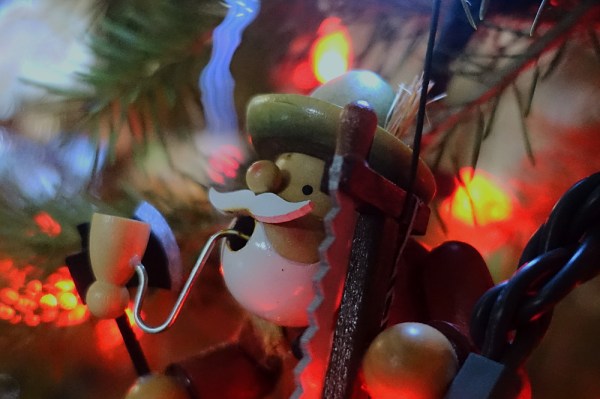
Besides the Christmas tree with the symbolic meaning of hope through its evergreen quality, many other things are associated with the German Christmas tradition. One of them is the nutcracker that is often found under the tree. Another costum is the use of real wax candles to illuminate the tree and its ornaments. Perhaps a little less known is the ‘smoker’, das Räuchermännchen that usually resides on the festive table. Inside, you find a cone-shaped piece of incense. When lit, it burns and emits its aroma for about 15 minutes. During this time, it sends smoke through its open mouth. For a special effect, I attached the smoker to our Christmas tree and took a picture of the Räuchermännchen. The smoke went straight up. So I confess that I cheated a little with my photo editor and made the rising smoke curl for you. Merry Christmas and a Happy New Year to all my blogging friends! I will resume my blogging activity, God willing, in the second week of 2023. Best wishes and blessings to you all.

Walter Panknin (1898 – 1977) and His Family Ch6 Part 6

Success in the long Battle for Justice

Eventually, Walter Panknin’s persistence paid off. Acting on a friend’s advice, he directed his request for justice to the governing president of the West German State of North Rhine Westphalia. In his 3-page letter, he logically and respectfully outlined his family’s dire financial situation. Reading his correspondence, I was surprised that he could directly address by letter the state president. When people wish to present their concerns to the upper authorities, they have to use the proper channels set up for them. Apparently, Papa’s letter went to the right place and got the ball rolling. However, another five years passed within the notoriously slow mill of the German bureaucracy. After many more letters, documents, and court hearings, all his key requests were finally granted. In 1962, promoted to the rank of a major in retirement, he could collect the pension payments that he was entitled to. He had his refugee status fully recognized and could move into a modest but modern apartment in the City of Velbert near Essen.

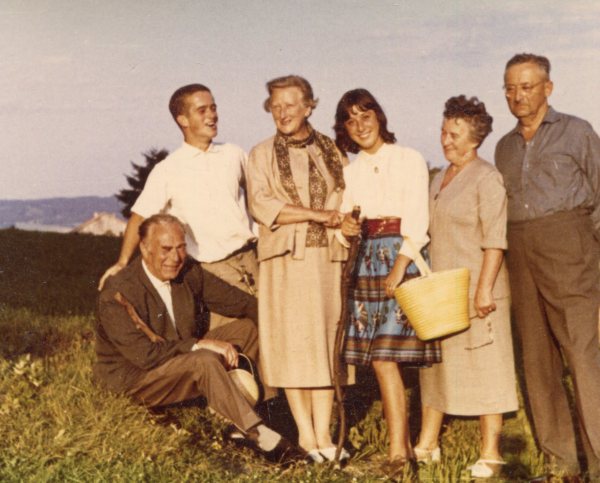
Family Panknin – All Smiles after the Successful Court Battle

We should not think that Papa’s struggle was an isolated case. In a previous publication, telling the story of my Mother’s family, I reported that my uncle Lieutenant-General Gerhard Kegler was sentenced to death by a Nazi military tribunal for disobeying Himmler’s order to defend an eastern town and for leading his poorly equipped and exhausted division to the relative safety of the eastern front. Shortly before the execution was to take place, the death sentence was put on hold. My uncle was degraded to the rank of a private and sent to fight the Soviets near Frankfurt, Oder. Severely wounded, he was shipped by train to a military hospital in Schleswig-Holstein, where the surgeons amputated his left arm to save his life from a virulent infection. As a POW, he survived the war and was reunited with his wife and family in 1947. But when he applied for a pension, the authorities, under the influence of old Nazi lawyers, tried to reject his application because he had been demoted to the rank of a common soldier. There was such a public outcry over this form of injustice made public in all major newspapers that the president of the German Republic stepped in and exonerated my uncle and granted him the full pension as required by law.

Natural Splendour of the Arrow Lakes

Wednesday’s Photo

A Selfie in a Christmas Ornament

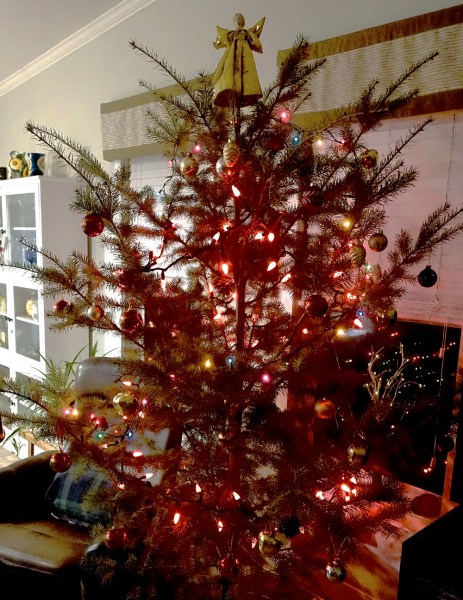
On the weekend, my wife and I went into the snowy and chilly outdoors and located a beautiful fir tree under the power lines. Fortunately, the snow was not too deep to walk the 50 metres from the road. With a small hand saw, I had the tree cut in no time while Biene cheered me on. Yesterday, I brought the Christmas tree into our living room and decorated it with ornaments and lights. Later on, when the day was fading into darkness, I took a few pictures. One photo shows a shiny ornament, where later on to my great surprise. I discovered myself in its reflection.

Walter Panknin (1898 -1977) and His Family Ch7 Part 5

The Judiciary That Sentenced 50,000 People to Death

Walter Panknin’s Fight for Justice – Part 2

I chose the title from the West German News Magazine as the heading for this post. It confirms what my father-in-law had described in a letter to a friend. The title reveals a dark chapter in the judicial system of postwar West Germany. The article, as quoted in the previous post and continued here, is an eye-opener for the legal battles Herr and Frau Panknin had to fight in their struggle for justice.

“Now the halls of justice were even staffed with judges who had once served on the Nazis’ People’s Court (Volksgerichtshof), which was set up in 1934 to handle “political offenses” and became notorious for the frequency, arbitrariness and severity of its punishments. Nevertheless, the civilian courts handling the de-Nazification process merely classified them as “hangers-on.” In 1953, at least 72 percent of judges on the Federal Supreme Court, Germany’s highest court for criminal and civil law, had former Nazi connections. The number increased to 79 percent by 1956 and, in the criminal division, it was at 80 percent by 1962.”


Now we understand the anger and frustration my in-laws experienced for more than five years. Poor Papa Panknin, having demonstrated and documented through his actions before and during WW2 his anti-fascist position, encountered, in an ironic twist of fate, one humiliating rejection of his applications after another. The former Nazi judges were back, making ideologically motivated decisions. In Papa’s correspondence, I found names such as Franz Schlegelberger – Minister of Justice (1941 and 1942), Hans Globke (he participated in drafting the Nuremberg race laws), and Theodor Oberländer – as an academic laying the foundation of the Final Solution. Many were found guilty in the Nuremberg trials, and some were sentenced to life imprisonment, then released after a few years, going into judiciary service or early retirement with a pension six times higher than the average worker in the Federal republic.

https://www.spiegel.de/international/germany/from-dictatorship-to-democracy-the-role-ex-nazis-played-in-early-west-germany-a-810207.html

https://en.wikipedia.org/wiki/Franz_Schlegelberger

https://en.wikipedia.org/wiki/Hans_Globke

https://en.wikipedia.org/wiki/Theodor_Oberl%C3%A4nder

Natural Splendour of the Arrow Lakes

Winter Wonderland

The wood bridge is part of the Fauquier Golf Course and allows the players to cross Heart Creek to access one of the more difficult tee-offs. Now the golf course is inviting a few hardy individuals like my wife and me and the occasional gaggle of geese looking for the green stuff under the snow.