On the weekend, my wife and I went into the snowy and chilly outdoors and located a beautiful fir tree under the power lines. Fortunately, the snow was not too deep to walk the 50 metres from the road. With a small hand saw, I had the tree cut in no time while Biene cheered me on. Yesterday, I brought the Christmas tree into our living room and decorated it with ornaments and lights. Later on, when the day was fading into darkness, I took a few pictures. One photo shows a shiny ornament, where later on to my great surprise. I discovered myself in its reflection.
The Judiciary That Sentenced 50,000 People to Death
Walter Panknin’s Fight for Justice – Part 2
I chose the title from the West German News Magazine as the heading for this post. It confirms what my father-in-law had described in a letter to a friend. The title reveals a dark chapter in the judicial system of postwar West Germany. The article, as quoted in the previous post and continued here, is an eye-opener for the legal battles Herr and Frau Panknin had to fight in their struggle for justice.
“Now the halls of justice were even staffed with judges who had once served on the Nazis’ People’s Court (Volksgerichtshof), which was set up in 1934 to handle “political offenses” and became notorious for the frequency, arbitrariness and severity of its punishments. Nevertheless, the civilian courts handling the de-Nazification process merely classified them as “hangers-on.” In 1953, at least 72 percent of judges on the Federal Supreme Court, Germany’s highest court for criminal and civil law, had former Nazi connections. The number increased to 79 percent by 1956 and, in the criminal division, it was at 80 percent by 1962.”
Now we understand the anger and frustration my in-laws experienced for more than five years. Poor Papa Panknin, having demonstrated and documented through his actions before and during WW2 his anti-fascist position, encountered, in an ironic twist of fate, one humiliating rejection of his applications after another. The former Nazi judges were back, making ideologically motivated decisions. In Papa’s correspondence, I found names such as Franz Schlegelberger – Minister of Justice (1941 and 1942), Hans Globke (he participated in drafting the Nuremberg race laws), and Theodor Oberländer – as an academic laying the foundation of the Final Solution. Many were found guilty in the Nuremberg trials, and some were sentenced to life imprisonment, then released after a few years, going into judiciary service or early retirement with a pension six times higher than the average worker in the Federal republic.
The wood bridge is part of the Fauquier Golf Course and allows the players to cross Heart Creek to access one of the more difficult tee-offs. Now the golf course is inviting a few hardy individuals like my wife and me and the occasional gaggle of geese looking for the green stuff under the snow.
Bit by bit, in an all-out power grab, the Nazis were taking control of the various institutions, such as the justice system, local and regional police forces, the banks, as well as the army, navy and air force. In a letter to the Minister of Interior Affairs in 1959, Walter Panknin wrote that membership in the NSDAP was mandatory for every police department in Germany. At a time when even foreign ministries initially recognized the legitimacy of the Nazi government, Papa Panknin was forced to join the party in 1934. However, he resisted joining the SS that all the higher-ranked officers were expected to become part of. Despite a barrage of threats and chicaneries, he steadfastly refused to become part of the infamous SS or to quit the Lutheran Church of Germany. Most officers in the armed and police forces had incredible advancements waiting for them, climbing up the rank ladder at a great speed, especially after the start of WW2. My father-in-law never moved any higher than his actual rank of captain during the entire war years. He had to take a punitive transfer to a battalion stationed in Croatia, which turned out as a blessing in disguise. (see chapter 3).
Herr Panknin described, while dealing with the federal and provincial government departments, his battles in army-like terms, his quest for justice. He fought a paper war on many fronts:
His right to fair and equal treatment as a former officer of the regular armed forces compared with officers of the former members of the SS of the same rank,
Recognition of his refugee status C, which was denied because, as an anti-fascist, he had no reason to leave the Soviet-controlled Zone of East Germany as he was told,
Entitlement to a Pension as a former officer or at least granting a meagre old age pension,
Compensation for the well-documented bicycle accident in the early 1930s (somewhat like the BC Workmen’s Compensation Board), which he was eligible to receive and did not get.
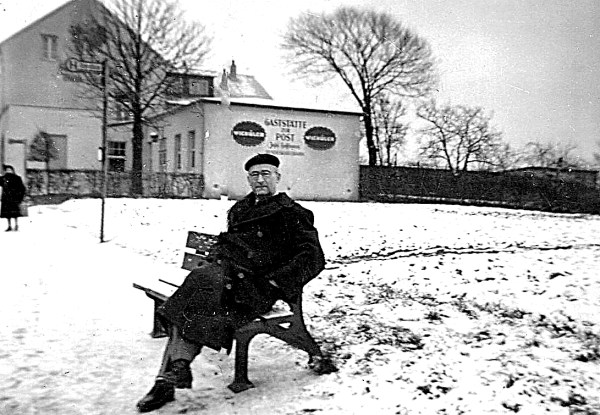
Papa Panknin
The reason why Papa Panknin and his family had so much trouble finding justice in West Germany as a refugee from the former German Democratic Republic can be found in an article published by the German News Magazine ‘Der Spiegel.’
“Roughly 80 percent of the judges and prosecutors who had served Hitler’s regime of terror until May 8 were soon dispensing justice once again — but this time in the young Federal Republic. “Perhaps there is truly evidence,” wrote Nazi expert Jörg Friedrich, “that a constitutional state can stand on a judicial mass grave.”
In the misery of the postwar era, lawyers were urgently needed. Although the crime rate skyrocketed in the era of black markets and refugees, there was a shortage of judges to hear cases. To make up for the deficiencies, the occupiers of the western zones appointed judges who had retired before 1933, or they hired lawyers untainted with Nazi connections. Starting in October 1945, the British practiced the so-called “piggyback procedure” in the recently established judicial administration: For each judge without a Nazi past, one judge with former Nazi connections could be appointed. But, by the summer of 1946, even this restriction had been dropped.
Leaves that had fallen off our giant hazelnut tree plugged up our eaves troughs forming in sub-zero temperatures an icy mess. Before more snow is falling, I need to clean the troughs. Climbing up and down the long ladder is not an easy task. Despite the gloves I am wearing my hands quickly become cold and numb. Standing on top of the ladder and shoveling down leaves and ice, my thoughts wander back in time. I see images in a nostalgic dream-like state of mind. Here are three photos. Enjoy.
Born and raised in Kalthof, West Prussia, steeped in the traditional work ethics of his time, Walter Panknin perceived his employment as a police officer as a contract between the state and the individual. The state offers the individual a permanent position with an income commensurate with his rank and the prospect of a pension providing security and a comfortable living for retirement. In return, the individual faithfully and honourably delivers a service to his country.
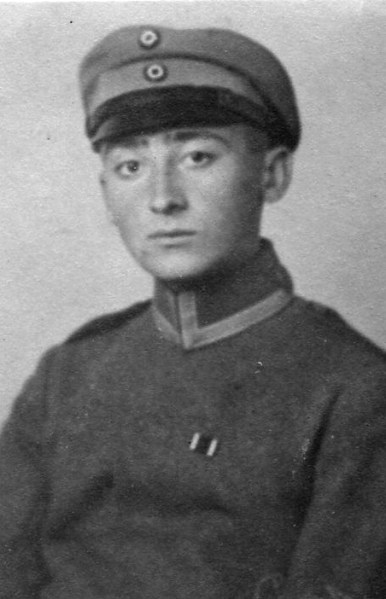
Walter Panknin 1918
In 1915, barely seventeen years old, Papa volunteered and served as a soldier in the Great War. When the German army was reduced to 100,000 men in 1919, he embarked on a career in the police force in North Rhine-Westphalia. His leadership qualities were soon recognized, and he moved quickly up the ranks, becoming a leader of a police detachment in a small town near Dortmund during the turbulent time of the Weimar Republic. One day, while riding his bike to work, he took a spill and fell to the ground. Unfortunately, as he landed on the cobblestone street, his service pistol went off and sent a bullet through his abdomen. At the hospital, the surgeon discovered that the shot had destroyed his left kidney. So Papa had to spend the rest of his life with only one kidney.
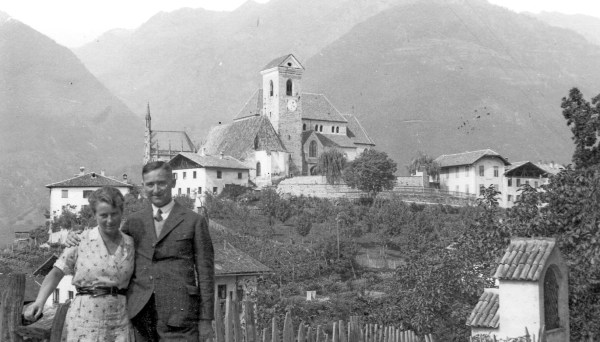
Walter and Elisabeth Pankin on their Honeymoon in Italy
The night before the Nazis seized power in 1933, rowdy Brownshirts (SA stormtroopers) terrorized the townspeople with their unruly behaviour in the streets. Walter Panknin, responsible for law and order, sent out the police force and had the troublemakers arrested. The very next day, a call came from the Nazi headquarters, demanding his immediate resignation. His career as a police officer would have ended if some influential friends had not put in a good word for him. That was his first brush with the new dictatorial regime.