From the archives of the Arrow Lakes Historical Society
Author Unknown
On Thursday, the 7th of October 2004, Bill Laux, resident of 42 years on the lake shore south of Fauquier, succumbed to advanced lung cancer. Bill, when first diagnosed with the dreadful disease, had resigned himself that his life was nearing its end, but picked up a hopeful attitude again when chemo-therapy and blood transfusions gave him back some strength. He even went to visit some friends again, albeit with the oxygen bottle in a little backpack. He could continue to write some more on the early Kootenay mining and railroad ventures, which had been subjects close to his heart. He had been an avid collector of historical facts about the Kootenays.
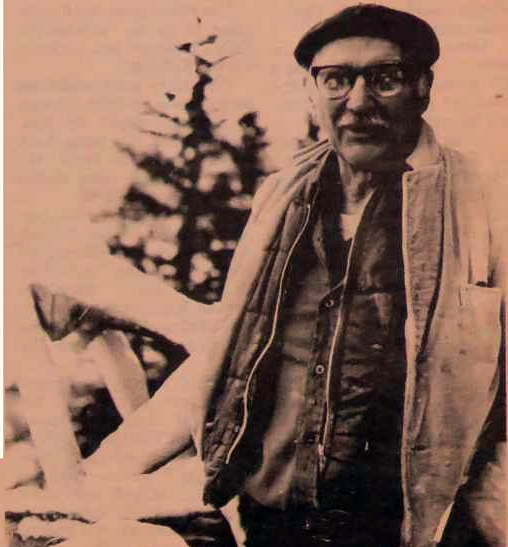
Bill Laux
Bill was bom in La Crosse, Wisconsin, 28th Feb. 1925. He served in the American Army in the last two years of the Second World War and then studied various subjects, majoring in English. His father had been a professor for European history. While Bill’s brother James followed their father’s footsteps and became a history professor too, Bill ventured out into the great outdoors, taking employments in the US Forest and National Parks Service, in particular in Yosemite Park, where he met his wife Adele. They both had artistic inclinations, which came to the fore when they met Jack and Janie Wise, who were running a batik factory in San Miguel de Allende, Mexico.
The militarily charged atmosphere in the US drove the two couples in the early 60’s to British Columbia, where they settled on the shores of the Lower Arrow Lake south of Fauquier, building up a new Batik workshop and studio under the name “Vaki Batiks”, in which they designed and produced many fine batiks, which were sold at first mostly to California and later also in Vancouver, Banff, Calgary and other art markets.
The first batik workshop, then on what is now Cedar Springs Farm, was located in an old chicken brooder house that had a masonry stove with a large platform, ideal to keep dye vats at the right temperature. One day hot melted wax must have leaked onto the red-hot heating elements of a little hot plate and set the whole building ablaze in seconds, a great loss for the hard-working artists.
Bill and Adele not only did their art and crafts work, but all the other chores associated with “living off the land”: a large garden, firewood, fences, waterline, road work, hauling in supplies and shipping off art supplies; for over the years, Vaki had become a trademark not only for batik but also for the fine aniline dyes, that were imported from Switzerland and sold out of Fauquier to batik makers over all of North America to give batiks those subtle or brilliant colors.
Jack and Janie Wise left after the initial years (Jack becoming a renowned painter on the west coast, known for his holistic miniature mandalas), while Bill and Adelle continued with Vaki Batiks. In late fall of 1967 Bill suffered the tragedy of the death of his wife Adele, who succumbed to a virulent infection before the illness was correctly recognized and antibiotics could be administered.
The following year Bill was joined by a young woman, Lynne Gilroy, who had worked in a bio-technical laboratory and was familiar with meticulous work. She got into the craft of Batik very quickly and became Bill’s right hand helper, not only in the batikery but also in constructing the large home-made brick structure, that is locally known as Bill’s castle. Indeed, Lynne was so inspired that she, after 8 years with Bill, entered UBC’s School of Architecture and became a graduate architect.
Bill, with and without various apprentices, also gave workshops in several towns and cities of BC and Alberta, teaching the art of batik. To the local people of Fauquier, Bill must have appeared quite a bit as a recluse, because he was so taken up with his work and projects (as well as his studies, to which his extensive book collection attests).
For one, the “castle”, built of home-made bricks, must have taken hundreds and thousands of hours of hard work. The bricks were made from a mixture of clay and sand with a small amount of Portland cement, that was pressed under 50000 lbs. in a little ingenious hand press, imported from South America. The sand and clay not only were mixed by hand, but had to be screened, which in the case of clay meant pulverizing dry clay lumps first to mix evenly with sand and cement. After the moist mixture was pressed into over-sized bricks, they were cured by turning and wetting again, until they were strong and ready – a very time-consuming effort, but a technique, which Bill embraced whole-heartedly as an alternative to “cookie cutter” construction.
Once the bricks were mortared into the structure, they were then painted on the outside with hot waste wax from the batiking process, which made the wall water-repellent. As the waste on a farm goes onto the compost pile, so Bill’s waste from the art studio went onto his architectural structures. Recyling: organic or ceramic? Bill also branched out into sculpturing, adorning his castle with over-life-sized figures.
Bill’s other constant job and concern was his water supply – over 2 km all the way from Heart Creek, via board flume on small trestles, plastic pipe and ditch to his, literally, “home and castle”. To keep this flow going, he battled not only the bears, who every now and then would rip apart flume sections, but the ups and downs of Heart Creek. Over the years, the intake on Heart Creek was destroyed several times by spring run-off or log-jam floods. When Heart Creek rose 3 meters high over its regular banks following last June’s cloudburst, it totally washed out Bill’s most elaborate intake structure of cemented stones. Bill’s immediate neighbor Logan Bumpus, with the help of several friends, was able to rebuilt a new intake within days, restoring the flow of water.
Bill at times had help with the flume project, since several neighbors drew water from the same aqueduct, it was basically his effort and constant vigilance that kept the water flowing towards those shores of Lower Arrow Lake, which are not blessed with abundant mountain runoff because Mineral Ridge is a barrier to those flows between Heart Creek and Taite Creek.
BC Hydro had not reinstalled the power supply along the lake shore south of Fauquier after die flooding of the valley in 1969. So Bill installed a small turbine and generator and made his own electricity. Here we have a man who did not ask what his government can hand him out for free, he simply helped himself.
And Bill helped others. Until the illness cut him down, Bill had been walking the hills and mountainsides with much younger men in the effort to prevent logging or road building in places that could impair the community watershed of Fauquier. He will be missed in the Fauquier Watershed Committee.
Possibly his longest lasting contribution to the valley is Bill’s introduction of the California Redwood tree, the sequoia gigantea. Several grow around his place as well his neighbors’ and I hear one is doing just fine right down in Fauquier
Although Bill was at times perhaps a grumpy recluse, he has many friends and as he aged, he made more in the local community. I believe none of us ever fathomed his depth completely. I got an inkling of his soul when we talked about music that we both loved. So here is to Bill a verse inspired by Mahler’s last song from the “Songs of a Wayfarer”:
By my house there stands a maple tree, there I worked many hours and I felt so free,
And that maple tree that spread its broad leaves over me.
Then I knew at last how life can be.
All was well, all was well, all was well with me.
Well my pain, well my love, well my world and dream.
By the castle now stand some Sequoia trees they grow in freedom and they grow in peace. And those Sequoia trees they’ll grow for a many hundred years.
A tea in honor of Bill Laux will be held Sunday, October 31st, 1 pm, at the Fauquier Hall.
When writing about the Fauquier Communication Centre in a future post, I will return one more time to Bill Laux and his work. He donated much of his historical research material and the remaining batiks to the Centre. I also need to report here that a few years after Bill’s death his castle burned down. More than ten years later people traveling through still inquire about the castle that is no more.