Four Grandchildren of D. and E. Barge

Alessia, Frederik, Matti and Jonni

Chart II a – VI

Captured on Video by Dieter Barge

The family tree project is not just about our ancestors of whom we are indeed proud for their accomplishments. It also very much focuses on the living members of our family that are spread half way around the globe. Thus, the project serves the important purpose to get to know one another, to connect and to enhance the feeling of belonging together. I am delighted to be able to report that since our humble start at the end of last December I recorded more than 2000 hits indicating a high degree of interest among our family members.

While I have plenty of materials drawn from Uncle Günther’s Family Chronicle, from Eberhard Klopp’s ‘Brief an die Nachfahren’, from the archives of the Arrow Lakes Historical Society, from local archivist Annette Devlin, and last but not least my own collection of hundreds of letters, documents, videos and photos, I would like to continue to appeal to all of you to make contributions to the blog.

I am delighted to welcome some more information on the very youngest members, Frederik, Alessia, Matti and Jonni, grandchildren of Dieter and Edda Barge. On this YouTube upload you can see them learn, snack and play.

The Klopp Grandparents Part II

Peter Friedrich Klopp (1852-1900) – Chart I -I

Adapted from Eberhard Klopp’s Family Chronicle

The Magdeburg period of our family line was ill-fated right from the beginning. In spite of hopeful attempts it remained  in its vocational prospects at a relatively low level. The family of the former Prussian soldier and, later on, of the ‘carting entrepreneur’ Heinrich Friedrich Klopp of Jübar painfully experienced the low-bourgeois and proletarian social conditions in the city of Magdeburg of the 19th century, which the GDR historians had later so dramatically, but accurately described in their annals. Already before 1860, the most dire poverty of all family related epochs controlled the history of our Klopp family line. Since the catastrophes of the Seven Years’ War this particular time frame represents a social and existential low point beyond all comparison.

The early death of the father at the young age of 40 and the passing of his mother at the age of 44 indicate that the change of the Klopp line from farming into the commercial and industrialized realm of business of a big city had exacted a high price  in terms of health and vitality. At the death of his mother Peter Friedrich Klopp (10th generation) was 18 years old. Perhaps out of concerns for the health of her eldest son she may have made arrangements ahead of time for employment back to the country with one of the three mills at Jersleben near Wolmirstedt.


Photo credit: Bergfels Flickr

Photo credit: Bergfels Flickr

2007 Wolmirstedt Schäfergruppe von Werner Bruning

The P. and G. Klopp Story – Chapter 5 (Part I)

Chapter 5

Gutfelde (Zlotniki)


Home is people. Not a place. If you go back there after the people are gone, then all you can see is what is not there any more. Robin Hobb


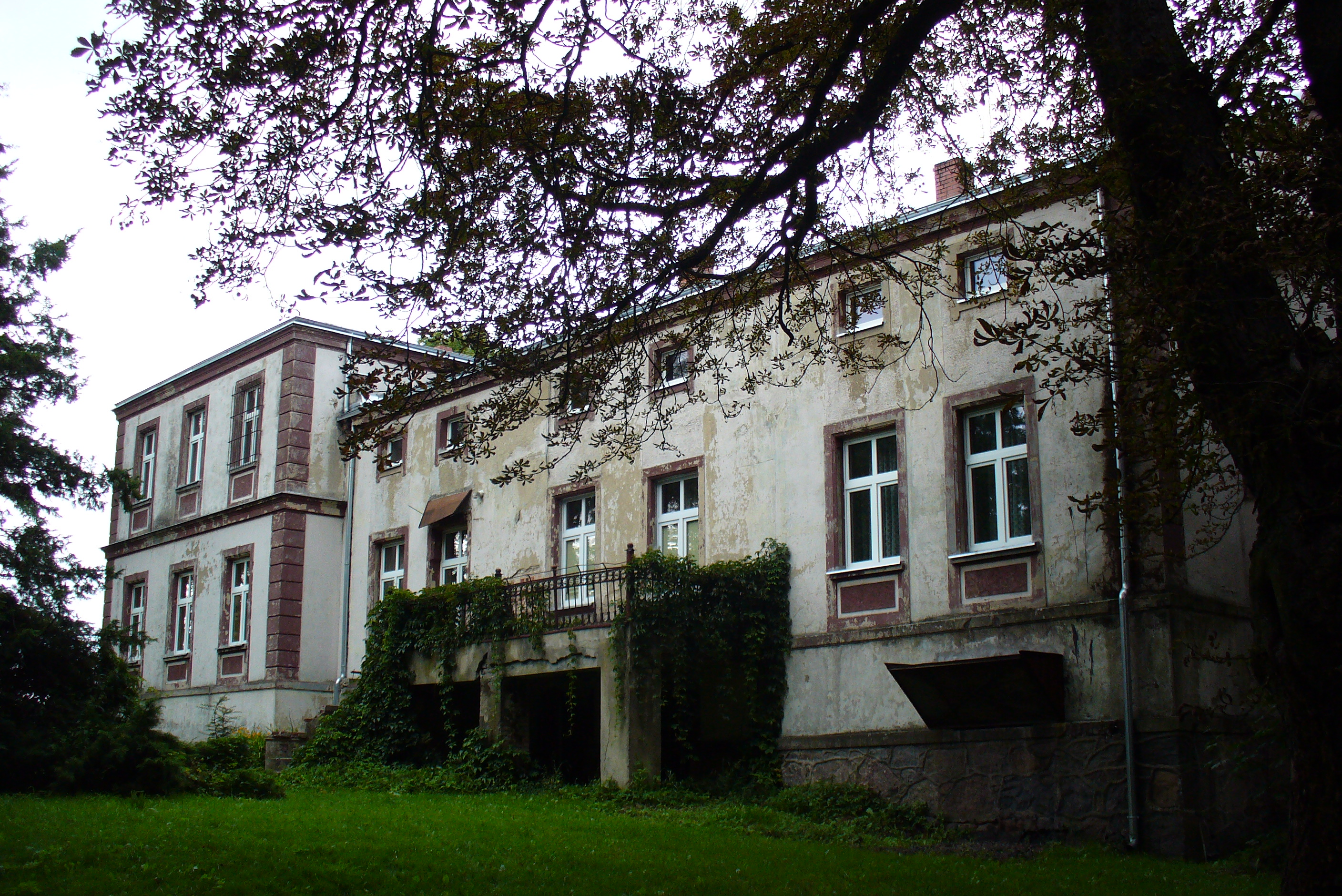
At the time of my birth, Father as manager and inspector was in charge of the estates Silberberg, Oberhof and Gutfelde totaling an area of approximately 3000 ha. Although he must have been thankful to the authorities for landing him such challenging and prestigious position and therefore may have harbored a favorable disposition towards the Nazi regime, he always strove to keep his humanity in dealing with his fellow human beings, Germans and Poles alike. In particular, through his actions he distanced himself from the policy that forbade German citizens to fraternize with the defeated enemy. It is a great testimony to his moral independence from the dark and sinister sides of Nazi Germany that he allowed Polish men and women to live and work closely and cordially with the Klopp family at the Gutfelde residence and the agricultural headquarter for the region. He maintained an excellent working relationship with the former Polish estate manager Haluda, who after WW2 took over as director of the communist run state farm. From the stories I picked up from my mother I speculate that Father owed his survival to his reputation of treating fairly and equitably all the people who worked for the large estates under his directorship. Other inspectors notorious for their arrogance, cruelty and injustice in dealing with the Polish population were rounded up, lynched, hanged or shot in the closing months of the war. On a  Polish website with special focus on mansions, manors, and castles of Poland, I found an entire page devoted to Gutfelde – now an agricultural training center with orchards, wheat and corn under cultivation, 800 cows and 8000 pigs. The same page to my great surprise mentioned my father’s name as an administrator during WW2! The mansion-like imposing building was built around 1880 in the late-classical style and consisted of a body with a higher wing and ground floor extensions. It has not changed much in the last seventy years.

Family Photo 1941

Family Photo – The Klopp Children from Right to Left: Karl, Adolf, Gerhard and Eka

My three brothers Karl, Adolf and Gerhard and my sister Eka (short form of Erika) (now Lavana) were all born in Pomerania, whereas I began my life’s journey in the town of Dietfurt (Znin), Warthegau. There I spent the first eight days with four other babies in a warm hospital room. There were also two Polish babies born in the same county hospital. Later on in my early childhood I had to take quite a bit of good-natured teasing with made-up stories of a nurse who had accidentally placed a Polish baby into my crib, while I was being examined in another room.

First Page of Mother's Diary

First Page of Mother’s Diary about her Fifth Child Peter

When I arrived with Mother at Gutfelde, I received a truly royal reception. Karl, who attended a boarding school in Belgard (Bialogard), would see me a few months later at the beginning of his summer holidays. But the others including my proud father did everything to welcome the fifth child in the family. Flags were waving. Fir branches and a big welcome sign decorated the door to my very own room was. Inside the sunny and warm room several pots with beautiful flowers created a cheerful atmosphere for the latest arrival in Gutfelde. Continue reading

Vacation 1942 in Gutfelde (Zlotniki) Part I

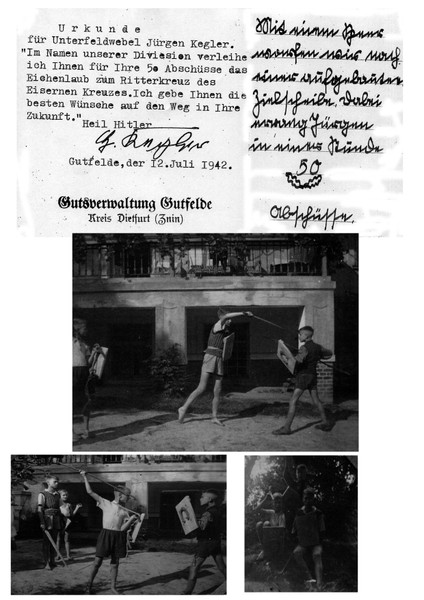
Report by Hartmut Kegler – Chart II a – III

Copy of the original German diary and transposition of the Sütterlin text by Dieter Barge

From Wikipedia.org: The Prussian ministry for culture commissioned graphic artist Ludwig Sütterlin to create a modern handwriting script in 1911. His handwriting scheme gradually replaced the older cursive scripts that had developed in the 16th century. The word Sütterlin is nowadays often used to refer to all varieties of old German handwriting, although only this specific script was taught in all German schools from 1935 to 1941.


Bild Gutfelde 01a

Wir freuten uns sehr, als wir eine Einladung von Onkel Ernst und Tante Erika erhielten. Wir waren noch nie auf so einem großen Gut gewesen. Endlich war es soweit. Am 8.Juli 1942 war der Reisetag. Um 4 Uhr ging es los. Und gegen 13 Uhr waren wir da. Als wir ausstiegen, war Karl mit der Sekretärin auf dem Bahnsteig. Danach fuhren wir eine Stunde nach Gutfelde. An der Haltestelle stand Tante Erika mit den Kindern Adolf, Eka und Gerhard. An dem schönen Aufgang begrüßte uns Onkel Ernst.

We were very happy, when we received an invitation from Uncle Ernst and Aunt Erika. We had never been on such a huge estate before. Finally we were on our way. The traveling day was July 8, 1942. At four o’clock we departed. And around 13 hours we arrived. When we got off the train, Karl with the secretary were standing on the platform. Then we traveled for an hour to Gutfelde, Aunt Erika and the children Adolf, Eka, and Gerry were waiting at the stop. At the beautiful staircase to the entrance Uncle Ernst greeted and welcomed us.

Bild Gutfelde 02a

Wir Jungens schliefen zusammen. Karl, ich, Adolf und Gerhard. Zuletzt kam noch Jürgen dazu. Meine Mutter und Elisabeth hatten unten ein schönes Zimmer.

We boys slept together: Karl, I, Adolf and Gerhard. Finally Jürgen was added to our gang. My mother and Elisabeth had a nice room downstairs.

Bild Gutfelde 03aGenesung nach der Gelbsucht.

Recovery after jaundice.

Bild Gutfelde 04a

Viel Freude macht uns auch der Teich. Wir fuhren auch mit der Waschwanne (Zinkbadewanne), die uns während eines Kampfes versuppte (versank). Nach einem tüchtigen Tauchen gaben wir das Suchen auf.

We had lots of fun on the pond. We also cruised on the washtub, which later during a ‘naval’ battle sank. After much thorough diving we gave up the search.

Bild Gutfelde 05a

Eines Tages kam Tante Trude (Gertrud). Sie blieb leider nur zwei Tage bei uns. Mit dem kleinen Jürgen hatten wir sehr viel Spaß. Oft sind wir nach Dietfurt (Znin) baden gefahren. Natürlich nutzten wir gleich die Gelegenheit aus, als wir Tante Trude nach Dietfurt zur Bahn brachten.

One day Aunt Trude (Gertrud) arrived. Unfortunately, she stayed only for two days. With little Jürgen we had lots of fun. Often we went swimming at the Dietfurt Lake. Naturally we made good use of the occasion, when we took Aunt Trude to the Dietfurt railway station.

Bild Gutfelde 06a

An einem kleinen Tümpel, der an einer Sandgrube war, bauten wir uns einen Bunker aus Steinen und Lehm, unsere Kompanie war acht Mann stark.

Near a tiny pond at a sandy ditch we built a bunker out of rocks and clay. Our company was eight man strong.

To be continued …

The Klopp Grandparents Part I

Peter Friedrich Klopp (1852-1900) – Chart I -I

Adapted from Eberhard Klopp’s Family Chronicle

It was my goal to restrict the family research to our grandparents. Yet, to get a well-rounded picture of Peter Friedrich Klopp and to enhance our understanding of his colorful personality, I need to go back to his parents, Heinrich Friedrich and Charlotte Wilhelmine (neé Hoppe) Klopp. They got married in the St. Catherine Church on July 6, 1851 in Magdeburg, where they lived until Heinrich’s early death in 1861, most likely brought on by consumption, the most common cause of death in those days.

Magdeburg_province_map

In the few years, which Heinrich had after the wedding, he was barely able to eek out a living for his growing family. For a short while he managed to run an independent business as hauler and carrier of goods, mail and people. With horse and buggy he provided a service to the people of Magdeburg very much akin to a modern taxi service. During this time three children were born, the first born being my grandfather Peter Friedrich Klopp. The location where he worked and lived with his family was the former shopping street ‘Breiter Weg’ (Broadway), known as the popular social center complete with pubs, inns, breweries, stores, various governmental establishments and offices, for which Heinrich could provide a service in the fledgling transportation business, enough at least to feed his family. Alas, he passed away too soon, and widowed Charlotte had to endure many hardships raising her children and working as seamstress and washerwoman. On October 27, 1862 she gave birth to the illegitimate son Franz Karl August, whose father remained unknown. In 1864 she married Ferdinand Pielert, who, having been born in 1836, was ten years younger and worked as deckhand on one of the boats plying the waters of the Elbe River. Due to the transitory nature of his work the two rarely saw each other. When he finally settled down with a permanent address in Magdeburg, Charlotte had already died on October 28, 1870.

Magdeburg on the Elbe River

Magdeburg on the Elbe River – Photo Credit: Wikipedia.org

Little Peter Friedrich Klopp (born on January 23, 1852) was barely nine years old when his father died. As the eldest he experienced how his mother after the loss of the bread earner plunged into deeper misery and abject poverty. Since his stepfather Pielert was rarely at home with no permanent address in Magdeburg, the responsibility for her son’s education and trade lay entirely upon the shoulders of the single mother. The circumstances, under which Peter Friedrich Klopp found his way to the mills at Jersleben, could probably be guessed from his mother’s connections with relatives and acquaintances in her hometown Wolmirstedt, a short distance north of Magdeburg.

Auerbachsmühle_Wolmirstedt

Auerbach Mill near Wolmirstedt – Photo credit: Wikipedia.org

Fauquier on a Foggy and Drizzly Morning …

Dreary days in February often make me feel sad and even depressed, when the sun refuses to show its cheerful face. The iron man with his snow-capped head at a neighbors’ fence seems to express that melancholy feeling as if to say, “Is winter not over yet?”

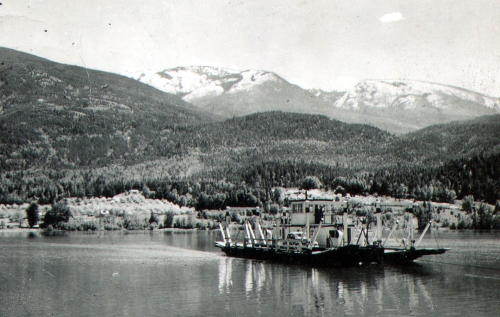
Last Sunday morning I went for a walk taking the big loop around our little town. Armed with my camera I was determined to show and to prove that there is beauty even under an overcast sky with dense fog hanging heavily over the Arrow Lake.

The air was mild, almost springlike. While there was still lots of snow, it was plain that winter was on the retreat. Melt water had formed many puddles on the street, which intrigued me with their beautiful reflections. Water droplets were hanging like precious pearls from the slender twigs of wild rose bushes. To a casual observer there is nothing special about them until one discovers the images that their tiny frog lenses produce. Having captured these wonderful impressions with heart and camera, I felt cheerful in spite of an otherwise gray and dreary February morning in Fauquier, BC.