Chapter 25 of the Peter and Gertrud Klopp Story -Part IV

The Vision

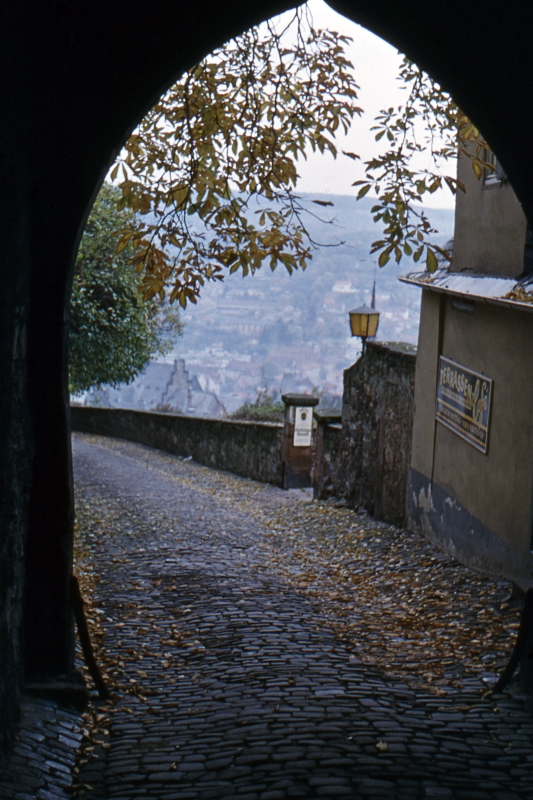
Romantic Medieval Town of Marburg

Romantic Medieval Town of Marburg

In a letter to Biene I wrote: “A long period of time will come, when we can no longer quickly step on a train and come for a visit. We will have to wait for a long time, before we see each other again. Yet I am confident, dear Biene. For you are no longer afraid you could lose me. One day I will ask you to come. Haven’t we written each other for two years without seeing each other? How much easier will I be able to endure everything, when I know for whom I work and also know that you will come! Dear Biene, you wrote so kindly that it wouldn’t matter to you whether I am poor or rich, if you could be with me and help me. I do not yet know for sure what to expect in Canada. But one thing I know; it is a thousand times more beautiful, if we start our life together than if I could immediately present you with a house and a car. The joy will be much greater, when you can say, ‘Peter, we deserve this sliver of happiness, which we were able to secure for ourselves, because we love each other and you without me and I without you would be unthinkable. In my mind I am propelling us so wondrously into the far away country but without danger, because I firmly believe in our future.

Since you have made your decision. I am looking farther still, beyond Alberta, where I will study at the University of Calgary, over and beyond the mighty Rocky Mountains westwards to British Columbia into the land, which like Germany lies between the mountains and the sea. It is not without reason that people call this province God’s country. Far away from the big cities, nature is still unspoiled by city life and industrial pollution. It appears to me incomparably more beautiful than Germany. Dear Biene, do not believe that I shut out our home country from my heart. Not only, because you need to stay behind for a while, do I depart reluctantly, but also because I must depart from people, who are dear to me. However, the world has become too crowded for me. I am searching for freedom, in close contact with nature, and for meaningful work in my future teaching profession. And should I not find them, I would be bitterly disappointed. But dear Biene, we both want to believe that I shall find after an eager search this envisioned, yes, almost ideal world in the reality of our life.”

Banff National Park, Canada

Banff National Park, Canada – Photo Credit: wikipedia.org

Biene replied: “My dear Peter, do you still remember your words, when you asked me to write to you one last time so that our friendship, which threatened to end in a discord, would dissolve in harmony. Sometimes I have to think about these words; for at that time they touched me deeply. For me it was as if this melody, which had always been in my heart, since I know you, must never fade away. Sometimes it only sounded rather timidly, but now my heart is full of music. I cannot express it in any other way. Was our correspondence during the two years not a good test whether the voice in our hearts that drove us together was genuine and true? Say, was it not also good that we had hurt each other and were saddened over it? I would rather be sad over you than feel nothing for you! Pain often carries the seed of deeply felt happiness. If we had never before been sad over each other, could we now fathom the happiness of having found each other?

I am hoping with you that you will find in Canada the freedom, for which you are longing, to be able to develop your abilities. But my dear Peter, you must not despair if you will be a little disappointed in certain things. Yes, you speak from my heart and soul when you say that it is far more rewarding and satisfying to build a future together based on our own strength than when everything just falls into our lap and one lives like in a golden cage. Through you I can now believe in a future, as I have always desired it. If we firmly believe in it and apply our strength, then our dreams, which we have always been dreaming, will become true.”

Biene had already written her final written exams before Christmas and sensing that she did well on them began the New Year in the knowledge that a major hurdle lay behind her and that her high school diploma was almost certainly within reach, although she still had to contend with a lingering anxiety about her upcoming oral tests in February. In contrast to the previous year when due to the emotional turmoil during her engagement with Henk and its sudden break-up her marks had dropped and for the first time in her entire school life she had been facing the spectre of failing the second last grade, now she was looking with a new sense of optimism into the future. She claimed that our love and the wonderful prospect of a life together as husband and wife in Canada gave her the strength and determination to face the challenges of the six remaining weeks at school.
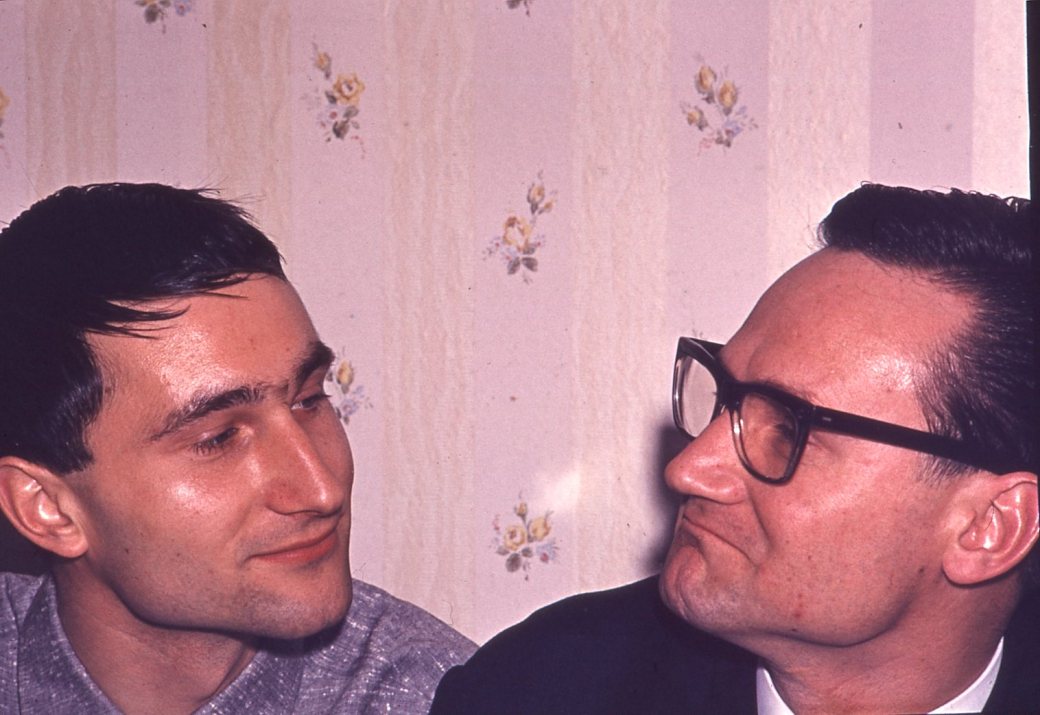
The Two Brothers Peter and Adolf - 1965

The Two Brothers Peter and Adolf – 1965

Of course, the ring, Biene’s most precious possession, which she had sent to me by mail and which I wore on my little finger at night, occupied front and center our thoughts and feelings and gave rise to reflections in our letters on its deeper meaning apart from being an heirloom from Biene’s great-grandmother. The first and foremost meaning, which Biene now openly declared, was that it symbolized faithfulness to which both of us from now on were committed through our love for each other. But there was also a hidden meaning, which I in my blindness for Biene’s subtle and unexpressed stirrings of the heart failed to see. I am certain that my roommates with their keen sense of perception would have immediately noticed the ridiculous reversal of roles I would have put openly on display with the ring, if it had indeed fitted on my ring finger. I was blind as a bat to Biene’s unspoken desire to receive an engagement ring in response to her precious gift. I could have prevented a lot of pain in the months that followed, if I had chosen to take the conventional route and on our next rendezvous in March had bought two rings for us. That way at least privately we would have had a semblance of a formal engagement. Alas, this thought never occurred to me.
Chapter 25 of the Peter and Gertrud Klopp Story – Part I

An Unconventional Engagement

“Love does not consist of gazing at each other, but in looking together in the same direction.”Antoine de Saint-Exupery

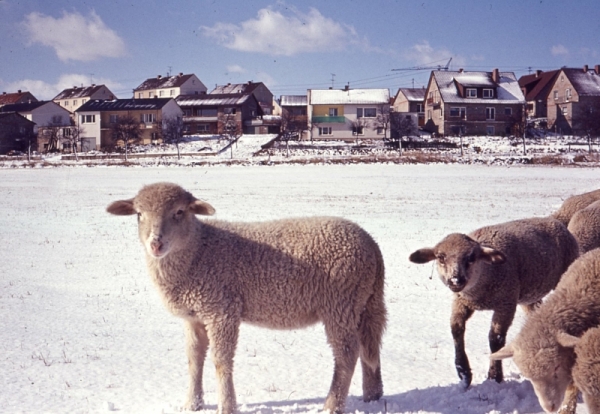
Pastoral Scene of Watzenorn-Steinberg (today's Pohlheim) near Giessen - January 1965

Pastoral Scene of Watzenorn-Steinberg (today’s Pohlheim) near Giessen – January 1965

Tense Moments on a Train Ride

On January 8th, 1965 I took the train to Cologne, where the Canadian Consulate was located. In those days it was relatively simple to become a landed immigrant of Canada. One had to be in good health, have useful skills or at least demonstrate to have the potential. In addition, one needed sponsors, who were willing to vouch for the new immigrant’s good character. My brother Gerry and sister-in-law Martha in Calgary were willing to take the risk of sticking their neck out on my behalf. So it happened that on that momentous Friday I received the official permission to enter as landed immigrant the country of my dreams.

On the same day I traveled to Wengern on the River Ruhr, where on account of Mother’s kind arrangements I received at her acquaintances a warm welcome, a fine meal and accommodation for the night. Frau Wolpert, a war widow, had a daughter about my age, who was still living with her mother in the small apartment. I was not too happy, when I heard that the young lady was taking the same train in the morning. Courtesy required that I sat with her in the same compartment. Lacking my brother Adolf’s outgoing character and social skills, which he could so easily employ in any situation, I kept mostly quiet except to ask where she was heading. And when she replied that she was attending a trade school in Siegen, I was dumbstruck and became more and more apprehensive, since I had made the arrangement with Biene that I would join her  on the train to Siegen with the plan of traveling together to my Mother’s place. The thought of being in the same compartment as Fräulein Wolpert greatly troubled me and a long embarrassing silence followed this shortest of all dialogues. While I was frantically searching for a way out of my dilemma, she may have been perplexed over my sudden shyness or may have wondered whether there was something about herself that I may have found offensive. I would have had plenty of time to explain to her that my girlfriend is already waiting for me in the train from Essen to travel home with me to meet my relatives. But unable to talk about things that I considered too private to share, I remained silent. However, when at the transfer station in Hagen she followed me hot on my heels and boarded with me the express train to Giessen, I couldn’t think of a good excuse to get rid of her and considered it best to tell the truth.

“Excuse me”, I spoke rather timidly, “I must say good-bye now. My fiancée is sitting somewhere in this train and I must go and find her.”

With this more than cryptic remark I hurriedly left Fräulein Wolpert in the compartment where she had just sat down on the bench and was in all likelihood puzzling over my strange behavior and the even stranger excuse. Regaining my calm I ambled from carriage to carriage, until I finally found Biene at the far end of the train.

Mother (better known as Mutter Köhm)

Mother (better known as Mutter Köhm)

We were so happy to see each other that we forgot to talk about what was so important to us. On the three-hour train ride to Giessen we missed in our rapture the golden opportunity to make concrete plans, on which we could confidently hang our dreams and aspirations. Adolf picked us up at the station and took us to Watzenborn, where Mother, Aunt Lucie, Aunt Mieze and Uncle Günther gave us the customary  royal reception that made Biene instantly feel right at home. She was originally supposed to stay overnight at Philip XI, a small bed and breakfast establishment, but Mother insisted that Biene would sleep in the guest room, thus having a better chance to get to know her. Adolf and I were delighted to cede our bedroom to the finest and most beautiful young lady and we gladly slept on the downstairs sofas instead.

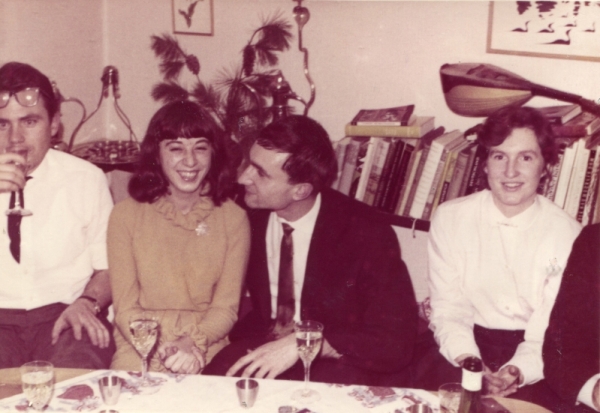
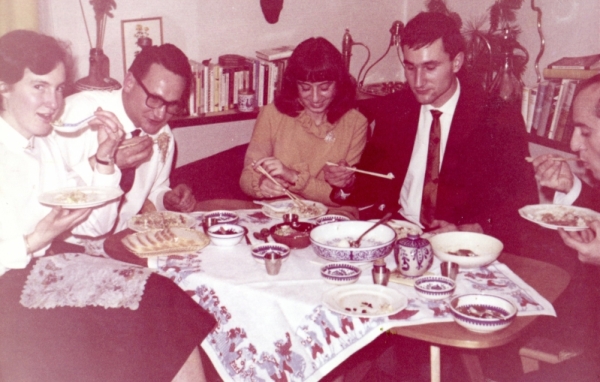
In a mysteriously worded note to Biene I had announced that I would take her, perhaps on a flying carpet, to a distant land and return home during the same evening. The distant exotic land turned out to be a Chinese dinner at my cousin Jürgen and his fiancée Inge. Jürgen impressed me with his sharp wit and exuberant jolly manner, with which he entertained his guests. I could see why he and Adolf got along so well with each other. He cracked a few jokes about the West German army, which I found as a member of the armed forces less amusing. For even though I had had bad experiences until very recently, I felt too much a member of the body to which I belonged to ignore my sensitivities about his jocular attacks. Like many of my friends in Wesel, Jürgen was exempt from military service, because his father Bruno had been killed in action at the beginning of WW2 in Alsace-Loraine.

From left to right: Jürgen, Biene. Peter and Inge

From left to right: Jürgen, Biene. Peter and Inge

The Chinese dinner was a great success. Biene and I enjoyed every minute of it. It was here at Jürgen’s apartment that Adolf took the first photos of us two being together. Near the end of the party another guest probably from Egypt said that he had a culinary surprise for Biene. He wanted her to guess a mystery food from his North African country. He asked her to close her eyes and open her mouth. When she complied in great anticipation, he slid the mysterious object into her mouth. All eyes were focused on her facial expression. Having crunched it and tasted its flavor, she asserted that it was quite delicious and pleasant to eat. Great was her amazement when she learned that she had just swallowed a chocolate covered grasshopper, considered to be a delicacy in some African countries. Merrily we returned home to Watzenborn over the snowy wintry roads in Adolf’s old faithful Volkswagen beetle.

From left to right: Inge, Adolf, Biene, Peter and a Friend- January 1965

From left to right: Inge, Adolf, Biene, Peter and a Friend- January 1965

Chapter 24 of the Peter and Gertrud Klopp Story – Part III

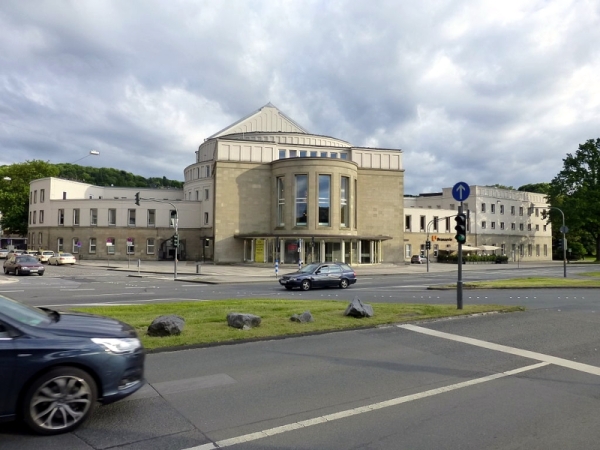
Rendezvous at the Wuppertal Opera House

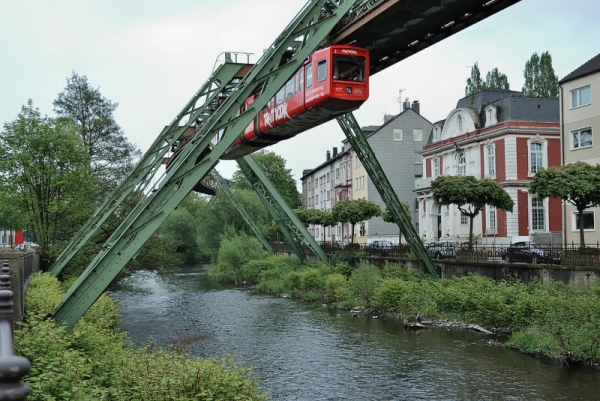
On the Sunday morning of November 15th, I boarded the train at Giessen and was on my way to Wuppertal, where I was to meet Biene at the train station.

Floating Tram in Wuppertal - Photo Credit: wikipedia.org

Floating Tram in Wuppertal – Photo Credit: wikipedia.org

During the three-hour train ride I had ample time to reflect on the strange nature of my relationship with Biene. In the angry exchange of words with my friend Hans I had allowed the word ‘marriage’ to slip out of my mouth, which must have seemed totally ridiculous to him and seemed to me now as well. Hadn’t she set new boundaries for the two of us? Hadn’t I acknowledged them in my letters and promised to respect them? And what was the purpose of friendship in the light of my planned emigration to Canada? Hadn’t I lost within less than a year friends and classmates, who were living closer than a half-day’s train ride from me? Would any of my friends sit for hours in a train just to attend an opera in a distant city on a Sunday evening and then in a grand loop, including annoying late night transfers, return home at eight o’clock in the morning? Why was I doing this? It seemed to me that in spite of my promises to the contrary I still wanted to climb over the wall that Biene had erected between the two of us.

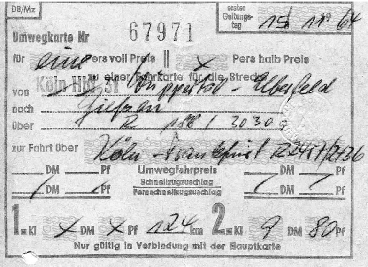
Return Ticket of November 15, 1964

Return Ticket of November 15, 1964

As the express train was approaching my destination, I put myself in Biene’s shoes and began to ponder what had made her so eager to meet me. Why would she go through the trouble of traveling to Wuppertal to buy tickets and then exchange them a few days later, because I had postponed the date of my arrival? Would anyone do this for a mere friend? In spite of my disagreements with Dieter, Gauke and Hans, they had been right in one thing. An actual face-to-face encounter is worth more than a hundred beautifully written love letters. I remembered how annoyed I was in my grief, when Private Gauke romanticized about that happy moment when he saw his sweetheart waiting for him at the end of the platform with her hair undulating in the evening breeze. After our transfer back to Koblenz we had lost sight of each other. I felt thankful now for the care and compassion of a true friend and for the romantic image that was almost identical to the one that I envisioned now. It had vividly come back through Biene’s instructions in her postcard, “I will be standing under the railway clock near the exit behind the ticket gate.”

Opera House Wuppertal - Photo Credit: wikipedia.org

Opera House Wuppertal – Photo Credit: wikipedia.org

Then we met. During the afternoon we immersed ourselves into the mellow sensation of togetherness that resisted any attempt to spoil it with talk about how we felt about each other and what destiny held in store for us. In my memory the exuberant feeling, which I experienced while being together with her so powerfully dominated my heart that all else was drawn into a blissful blur. Later on I could not tell where and how we had spent the twilight hours before we entered the opera house to take in the sights and sounds of Mozart’s ‘Don Giovanni’. For me, who had never gone out on a date before, the experience was almost overwhelming. We were thankful for the silence imposed upon the audience by the theater’s etiquette. Any casual conversation would have ruined our sense of happiness. Instead we communicated the feeling of physical closeness to each other by the gentle squeezing of our hands. Too soon the three-hour long opera came to an end. I had to catch the last train to take me home in a veritable odyssey. By German traveling standards the round trip of more than ten hours with its many stopovers and waiting times had been an ordeal. Although I arrived at Mother’s place tired and exhausted, I felt happy. I sensed that our late night rendezvous at the opera had sprung a hairline crack in the invisible wall that Biene had erected.

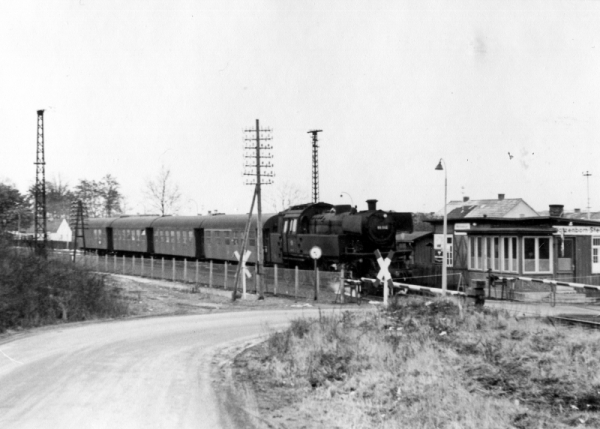
Train Arriving at Home Base: Watzenborn-Steinberg (Now Pohlheim) near Giessen

Train Arriving at my Home Town Watzenborn-Steinberg (Now Pohlheim) near Giessen (1964)

While the monotonous click clack of the train lulled me into sleep, I was blissfully unaware of the profound sadness and feelings of desperation, which had gripped Biene the very moment my train had vanished like a phantom into the darkness of the night.


Chapter 23 of the Peter and Gertrud Klopp Story – Part II

Biene’s Visit to her Birthplace in Gotha

and her Vacation on the Island of Majorca, Spain

In the meantime Biene traveled to Gotha, where her half-sister Elsbeth and husband Paul Werner with their two children Norbert and Christian lived. Biene grew up in Gotha, until her parents and family escaped to West Germany. After a lengthy ordeal at the refugee camp in Aurich her parents eventually succeeded in receiving a decent apartment in Velbert.

Castle Friedenstein, Gotha - Photo Credit: thueringerschloesser.de

Castle Friedenstein, Gotha – Photo Credit: thueringerschloesser.de

Biene reported enthusiastically about her former home province Thuringia. They made many excursions into the surrounding area of Gotha, even visited the famous castle, the Warthburg, where Martin Luther within the safety of the massive walls translated the Bible into German. But what mattered most to Biene was that she and Elsbeth became close friends. They spent as much time as possible together.

While everyone was sound asleep, Elsbeth, twenty years her senior, would share her most precious memories with her. The two would often talk into the wee hours. Biene learned that Elsbeth loved to pen stories and even contemplated writing a book. After the wedding she was deeply saddened that her husband did not share her passion for writing. He was a very practical man with both feet on the ground and was focusing only on what had to be done to survive in the postwar communist society, where most basic consumer commodities were scarce. Paul ignored what was dearest to his young wife’s heart and treated with contempt what was in his eyes useless, sentimental tripe. He callously burned her entire portfolio of creative and much cherished writing leaving her nothing of her priceless collection except for a very few stories, which she managed to save from the senseless destruction. Their son Norbert kindly contributed for my blog one of her story in German entitled Sein Letzter Besuch (His Last Visit – Christmas 1942). Overall, Biene had spent a wonderful time at her birthplace, that quaint house and apartment, where little had changed, since Biene and her family had escaped from the socialist ‘paradise’ in 1954.

The House in Gotha - Biene's Birthplace

The House in Gotha – Biene’s Birthplace

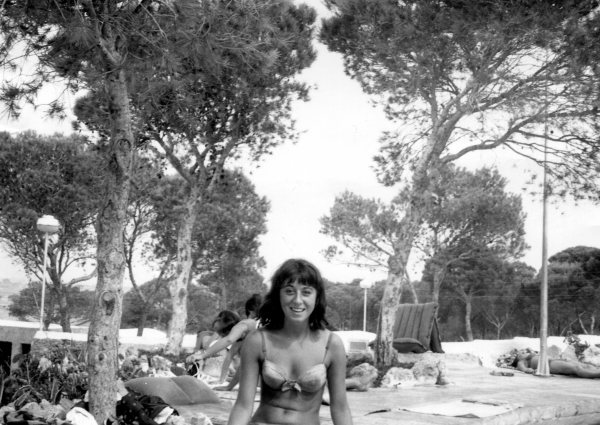
Within barely a week upon her return to Velbert she was getting ready to fly with her friend Gisela to the Spanish Isle of Majorca. There in the company of other young girls and boys she enjoyed two relaxing weeks at the sandy beaches of the Mediterranean Sea. This was the first time Biene was allowed to travel alone without parental supervision. Her mother had always kept a watchful eye on her stunningly beautiful and romantically inclined daughter, who had given her in the past much grief with her dangerous, almost fateful attractiveness she exerted on her male admirers. But as it turned out, Biene returned home safe and sound, tanned by the southern sun so dark she could have easily been mistaken for a Spanish senorita.

Biene on Vacation on Majorca Summer 1964

Biene on Vacation on Majorca Summer 1964

Apart from lounging at the beach and going swimming, Biene had once gone scuba diving in the crystal clear waters to explore the mysterious seascape, which gave her quite a thrill. However, as she soon discovered, diving and depending on the vital air supply from the oxygen tank on her back was not entirely without danger. While she took in the wonders of the strange world under the sea, the air supply suddenly dwindled forcing her to quickly surface. There was plenty of oxygen left in the tank. Perhaps Biene had put a kink into the connecting hose. Fortunately she had kept her cool and after being confronted with imminent danger did not panic. After this scary experience Biene decided that it was safer to stick with the more relaxing beach routine. Their flight back to Germany had been delayed by more than a day due to the loss of a plane, which the small tourist airline had suffered in a plane crash elsewhere. When they finally arrived in the dead of night at the Düsseldorf Airport, no busses were running any more to take them home. Biene and her friend were stranded. They were waiting at the dreary railroad station for the morning to come. Then a small miracle happened, which I let Biene describe in her own words.

Beach on Wild Coastline of Majorca - Photo Credit: wikipedia.org

Beach on Wild Coastline of Majorca – Photo Credit: wikipedia.org

          “In the bungalow village was also a young girl who was teased by all, especially by the boys. She was strutting about in an extravagant attire entirely too dressed up. Nobody liked her. I had only once exchanged a few words with her. When Gisela and I were now waiting at the station for the morning and had gone outside to catch a little bit of fresh air, she suddenly walked up to us. She knew that our plane had landed late. When she learned that our bus would arrive only in the early morning, she took us without hesitation to her place not far from the station. She gave us each a couch, where we totally exhausted slept until she woke us with coffee and buns. You wouldn’t believe how lovingly she cared for us. I had never before noticed so prominently how much one lets outer appearance deceive oneself. I was really stunned by such kindliness.”

Chapter 22 of the P. and G. Klopp Story – Part II

Challenging Times at Maxhof

In these turbulent days I now and then pulled out Biene’s letter and carefully read it over looking for a sign of encouragement, a key to her heart, but there was none except perhaps that she had written to me at all. Again I was in a dilemma. One side of me said, ‘In view of her engagement and promise of marriage to another, it is unfair for me to keep writing. Let her go! Leave her alone!’ The other more irrational side, which by definition is not persuaded by reason, urged, ‘You loved her; and you love her still. Cling to her as long as you can.’ So unable to keep the two warring parties apart within me, I wrote a short note intended to show that I was still thinking of her, but at the same time emphasizing that we were hopelessly drifting apart.

Feldafing - Photo Credit: immo-vilalta.com

Feldafing – Photo Credit: immo-vilalta.com

In a poisonous blend of regret and resignation I wrote, “From month to month our tracks are more and more drifting apart, and what is left, as you write so correctly is the pain. But also pain eases over time. What seemed so devastating at first does not hurt as much any more. Only from time to time when I look at your pictures, melancholy sets in and spreads its debilitating influence. But even that will end like a river disappearing in the parched sands of the desert…”

Kegler Family: Helga. Gerhard, Günther, my mother Erika Klopp, Marie and Lucie Kegler

Kegler Family: Helga. Gerhard, Günther, my mother Erika Klopp, Marie and Lucie Kegler

Picking up Biene’s very own words I continued, “Will we see each other again? Perhaps. But may Fate prevent this from happening! We met, played and laughed at Lake Baldeney. We were dreamy idealists, when we wrote each other! It was good that things turned out this way for you and also for me. We would have deeply disappointed each other; I would have certainly disappointed you. Believe me, there are a thousand sides to my personality, and in my letters I showed only one. Until next time! Farewell, dear Biene! Your Peter.” As soon as I had dropped off the letter in the mailbox, I called myself a fool. For I was sure that Biene after reading these confusing, despairing, heartless lines would not consider me worthy of another reply.

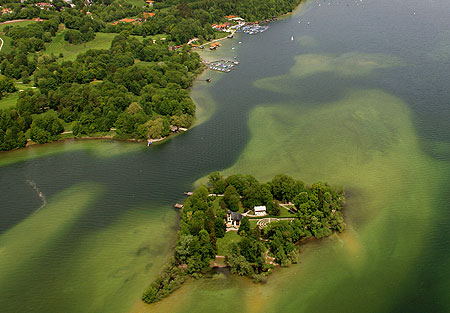
Feldafing from above = Photo Credit: bayern.de

Feldafing from above – Photo Credit: bayern.de

The response to our complaint was swift, and realizing that most things in my life lately have turned out to be a surprise, I began to expect the unexpected. The way the army brass dealt with the transfer grievance was no exception. I wanted the major of the signal corps to deal directly with our problem, invite us to respond to more questions, and eventually serve justice by reinstating us into the driving school or even put us into the officer-of-the-reserve program. Instead, we were called in to see the very same officer we had filed our complaint against. If he was angry at the system on our first visit, he was now openly hostile at us. He resented that we had the audacity to bypass him and that we had gone straight to his superior to complain about him, even though we had not even mentioned him in our letter. With a calm voice calculated to instill fear he told us while pointing to our letter on his massive desk that we had two choices. Either we withdrew our grievance with no disciplinary action taken against us or we foolishly insisted on following through with our complaint before a hearing committee with most unpleasant consequences if it is determined that we had made false accusations. Barely concealing the intended threat he nevertheless spoke matter-of-factly almost in a conciliatory, amiable tone, “You must know, young fellows, we merely spoke of the possibility of getting you into the driving school. The office staff for some reason or other did not inform you of the impending transfer. That’s the whole story, regrettable for you, but true.” Gauke and I looked at each other. The threat had worked. We would have no leg to stand on, even if the hearing committee was going to lend us a sympathetic ear. Thus, we signed the document certifying the withdrawal of our grievance.

“Listen,” the officer said with a triumphant smirk on his face, “Enjoy your stay at Maxhof. You have more than two months left here. Most soldiers would only be too happy to trade with you.” So Gauke and I had accomplished nothing. We returned to our living quarters deeply disappointed.

Note: This was the last post of the Peter and Gertrud Klopp Story. The Klopp Family Blog will continue later in the fall. There are just too many events coming up that will have priority over my blogging activity, such as a major family reunion, traveling through BC, demolition of our old house and its replacement by a modular home. Hopefully, I will reconnect with all my readers and followers. Thank you for all your encouraging comments! They were all very much appreciated.

Chapter 21 of the P. and G. Klopp Story – Part IV

One Misfortune Never Comes Alone

I was still reeling under the blow of the unexpected military transfer to Maxhof, Bavaria, when another one hit me like a bolt out of the blue. Biene wrote that she had met a young Dutch man by the name of Henk, to whom she was now engaged. They were dreaming about their own home at the edge of a forest near the city of Arnhem and were planning to get married. The news nearly tore me apart, all the more as Biene described our relationship as merely a nice correspondence between friends. Although my emotions were running high, I immediately responded to her letter and thanked her for being honest. It was a miracle of sort that I agreed to keep writing her. That promise was so terribly out of character, so contrary to what my pride and sense of honor would have allowed me to do that there was only one explanation. I was still in love with her.

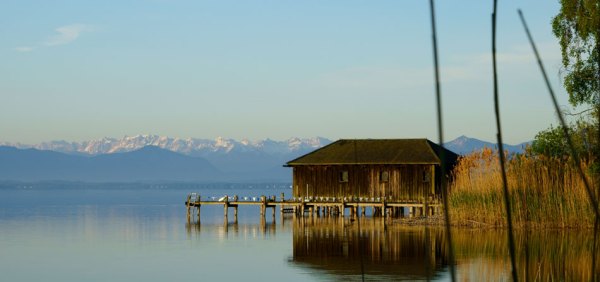
Biene on Vacation at Lake Ammer 1963

Biene on Vacation at Lake Ammer 1963

Sleepless nights followed. I held endless conversations with myself. At times I would place the entire blame on my shoulders. Dieter was perhaps right, when he said that a kiss is more powerful than words, passion stronger than tender sentiments expressed merely in letters. Then the American folk song ‘On Top of Old Smokey’ was going through my mind during those agonizing hours of wakefulness. The apparent truth of the line ‘I lost my true lover for courting too slow’ hit me especially hard. Suddenly the pendulum swung into the opposite direction. For a short while, I found relief by putting the blame on Biene. ‘Surely, one does not get engaged overnight’, I argued. ‘Why didn’t she write me sooner? Why did she allow the correspondence to drag on so long? What about her other pen pals, the young man from Morocco for example? Does she want to keep all her options open? Is she like a bee, as her name implies, flying in a kind of romantic dance from flower to flower to see where she would find the sweetest nectar?’ Having experienced both ends of the emotional spectrum, I finally settled for a more balanced view. The wildly swinging pendulum was coming to rest in the middle. Concern for Biene pushed anger and jealousy aside; she might have responded to the lure of marital bliss too quickly. These internal monologues went on and on through several nights, at the end of which I was completely exhausted. But I had calmed down enough to finish my letter to Biene with the words, “Just one thing you must promise me. If you perceive a danger for your happiness in that you cannot distinguish between true friendship and love between a man and a woman or if your future husband does not like our correspondence, then have the courage to say goodbye. For I do not want to destroy your happiness.”

Frauenkirche, Munich, Bavaria - Photo Credit: wikipedia.org

Frauenkirche, Munich, Bavaria – Photo Credit: wikipedia.org

With my Phillips tape recorder in one hand and a heavy suitcase in the other, train tickets and army papers in my wallet, I stepped on the Intercity train to Munich. Private Gauke, whose first name I no longer recall, accompanied me to our destination. We were both in uniform, as this was a requirement when traveling on official assignments. While the high-speed electric train was rushing toward the Bavarian capital, Gauke tried to cheer me up by pointing out all the advantages of the prestigious truck driver’s license later in civilian life. But he succeeded only partly in pulling me out of my morose taciturn shell. He did not yet know about the other problem, for which the possession of a driver’s license offered no solution. In Munich we had to catch a local train to Starnberg. Thousands of passengers were milling about the main station. At the crowded automated billboard announcing arrival and departure times I spotted the wrinkled face of my former scout leader, Günther von A. He was as surprised to see me, as I was to see him. What were the chances of this occurring? Once in a million or less. And what were the chances of still being in love with Biene? The question made me think about fate and destiny, a topic that philosophers and theologians great and small have been grappling with for centuries, a can of worms, which I decided in my present state of mind to leave unopened.