I would like to share this post by photographer Leanne Cole, who brings up a very important question about choosing the right image size and also explains how camera data are embedded in your digital photography.
Author: Peter Klopp
Chapter 20 of the P. and G. Klopp Story – Part I
Basic Military Training
The soldier is the Army. No army is better than its soldiers. The soldier is also a citizen. In fact, the highest obligation and privilege of citizenship is that of bearing arms for one’s country.
George S. Patton Jr.
The train wound its way through the picturesque Lahn valley to my destination in Koblenz, where I was to receive my basic army training. I had celebrated my 21st birthday in the new home that Mother, Aunt Mieze, Uncle Günther, Aunt Lucie were renting in Watzenborn-Steinberg. After the traditional coffee and cake party we played several rounds of our favorite card game ‘Doppelkopf’ in the evening.

Chief of the Kegler Clan, Mother, Aunt Lucie, and Aunt Mieze- Pohlheim 1963
Aunt Mieze was not fond of playing cards, so I had become a valuable game partner now and for all future occasions when I came for a visit. My aunt would rather sit a good distance apart from the noisy bunch in an easy chair and read a book. Often she would fall asleep in spite of the racket we made around the card table. Then the book she was reading would slip out her hands and fall on the wooden floor with a loud thud. Mother suggested to her to go to bed. However, she rather wanted to have the feeling of being part of the family than to give in to nature’s urgent call to sleep. Now on my way to the barracks I had the train compartment all to myself and while passing by ancient castles on the hillsides above the lazily meandering river below I had time to contemplate about the military service that I was about to render to my country. I was now of age, had the right to vote, could do things on my own, I was free, and yet, as I was approaching the city of Koblenz, I felt that I was not. I had simply traded one set of responsibilities for another. And I wondered whether that would always be that way.

German Corner (Deutsches Eck) Koblenz – Photo Credit: wikipedia.org
In the early afternoon of April 1st I walked through the barracks gate carrying my suitcase with the few personal belongings we were allowed to bring during the training period. After I identified myself to the guards on duty as one of the new recruits, I proceeded to the building, where I was told I would find further instructions on the bulletin board located on the ground floor. There were about a dozen buildings all in the nondescript shape of rectangular boxes placed around a huge yard that served as the ‘playground’ for the military practice and drill sessions. The entire area was almost devoid of people. The previous generation of soldiers had been successfully ‘calved’ and been transferred for further training to the three major technical companies of the Signal Corps located in the city. Expecting the place to be brimming with activity where there was none gave me an eerie feeling as if I had erred perhaps on the start-up date or worse had fallen victim to a nasty April Fool’s trick. When I looked through the names list of some 120 men, I found it somewhat reassuring that Klopp was indeed on the roster. I even had a rank, which I shared with the other newcomers. From now on until I had advanced to the rank of a private, I would be Fu Peter Klopp, Fu not standing for a four-letter word, but rather more appropriately for ‘Funker’ (radio operator). I was assigned to Room 203, which meant Room 3 on the second floor in the three-story building. The extremely wide staircase surprised me and I wondered about the waste of space until I discovered that there was a method to the madness of the architect’s design of the overly generous width of the staircase and of the hallways. How else during an alarm could 120 soldiers rush out of the building in the required three minutes?

Peter as Civil Servant in Uniform 1963
I was the first to enter Room 203. Although later on I had sometimes regrets about my eagerness to report for duty, my early arrival had the advantage that I could pick and choose the best location for my bed and closet. The room was definitely not set up for comfort. In the middle of the austere room stood a long table, around which 15 chairs were placed. Five bunks with three beds each were pushed against the walls. Each soldier would have for his personal belongings, army clothes and equipment a lockable wooden closet. The placement of these lockers was such that they formed a partial visual barrier between some of the bunks, thus granting a modicum of privacy. I chose the bottom bed of the bunk nearest to the left window and the closest locker for easy access. I was happy about my choice. The window would provide fresh air and the bottom bed would to some modest degree protect me from the disgusting bodily fumes permeating the entire room, especially after the soldiers returned from the local pubs, where low quality beer was being served.

Crest: Fifth Tank Division – German NATO Forces in Koblenz
I opened up the closet and stowed away my clothes, toiletry items, Mommsen’s ‘History of Rome’ and a few other books, which I intended to read during the weekends, during which we were not allowed to leave the barracks. There was plenty of room left. The empty shelves were waiting to be filled with army garb from the quartermaster on the very next day. When my belongings were neatly put away in the closet, I locked it securely with a padlock. It was considered just as great a crime to tempt your fellow soldier with an unlocked closet, as it was to steal from it. I put a pocketbook on the pillow of my spartan bed as a sign that I had claimed it as my own. Then I went outside and enjoyed sitting on the retaining wall of large circular pond in the late afternoon sun watching as the other recruits came trickling in at first, then eventually swelling to a human flood, as the deadline of the arrival time was rapidly approaching. Today we were still civilians. Tomorrow we would be soldiers wearing uniforms (derived from Latin ‘una forma’, meaning one form, one shape), individuals still on the inside, but a gray mass of young men pressed into the same mold of dress code, rules, military routines and activities. With the total uniformity of regulated daily life came the assault on our individuality with its profound effect on character and soul. Life in the army became the crucible, in which our character was put to the test, and for me, even though very painful at times, the process brought about refinement, which prepared me well for the many challenges further down the road in my personal life.
Anna Rosa Klopp (1881 – 1924) – Part II
Futile Rescue Mission for Brother Friedrich
Klopp Family Tree – Chart I – II
Already in the middle of 1919 the Diesing family resettled in Gommern near Magdeburg. Mother Emma, having to abandon her place in West Prussia, which now belonged to Poland, found temporary shelter with the Diesing family. From here according to a postcard written from the inn “Gasthof zum Stern” Emma made contact with her son Ferdinand in Elbeu.
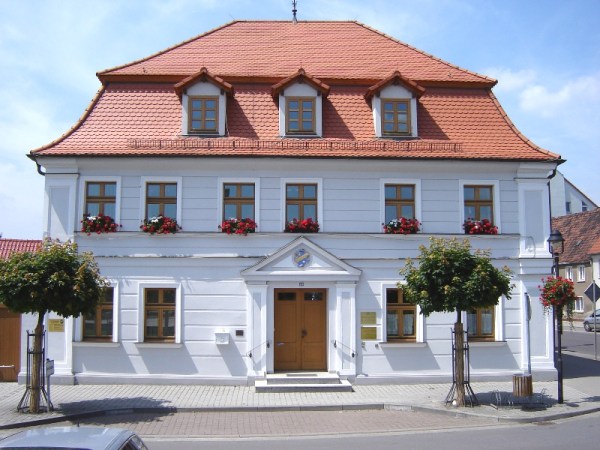
City Hall of Gommern – Photo Credit: wikipedia.org
In 1921 Rosa made a last-ditch attempt to seek reconciliation between the family members most of them leaning towards the Emma Klopp faction and the few others of Emma’s eldest son Friedrich (see the Klopp Grandparents VIII for more details on the bitter family feud that lasted half a century). Friedrich had been written off and treated as an outcast by the rest of the family.

Magdeburg – Monastery of Our Lady – Photo Credit: wikipedia.org
So August Diesing, acting on Rosa’s urgent plea, got together with his brother-in-law Friedrich Klopp. He acquired by auction an abandoned school building with the intention to open up a construction business. The plan seemed to be a promising one, since August with the expertise in masonry and carpentry was well qualified for the envisioned new venture. Friedrich, however, in view of his impoverished financial situation, could at best offer merely his good will and hands for this new type of business.
In a time, when August faced the fate of many others in Germany and struggled with financial problems and increasing unemployment, he gave up his noble plan to help out his wife’s eldest brother with employment and a modest income. Instead, he turned to the other financially more robust members of the Klopp family to support his business. This treachery according to an oracle pronounced by Friedrich’s mother-in-law in Zielitz could not be left unpunished. “Whoever gets involved with the Klopps should know exactly, what he is letting himself into.” How this oracle is being fulfilled will be the subject of the next post on Anna Rosa Klopp.
As We Forgive Those Who Trespass Against Us
A Story by Hartmut Kegler
Kegler Family Tree (Chart II a – III)
(Translated by Peter Klopp)
To the ethics of reverence for life all leniency and all forgiveness is a deed that has been forced upon oneself through truthfulness. I must practice unlimited forgiveness, because through my unforgiving I would be untruthful towards myself by acting as if I was not guilty in the very same way as the other person has become guilty towards myself. I do not forgive at all, I do not even let it come to judgment. – Albert Schweitzer
Senior secondary teacher Kern entered the classroom of his senior secondary grade. He had been in charge of the class from the lowest Junior High grades onward. He was so familiar with each of the twenty-one faces as if they had been his very own children. However, he no longer had his own, because one already counted the third year of war, and his two sons lay buried under foreign soil. The war was also the reason why Mr. Kern had not yet been in retirement long time ago, although he was already over seventy years old. The young teachers were at the front or did not live any more. Since Kern was a man, who did not permit the propaganda to form his convictions. There would have been often enough cause to send him off into retirement. Mildly put! But the young teachers were at the front or did not live any more.
Ludwig Kern entered the classroom, made a slight bow and greeted his students with a friendly “Good morning”. This would have been also a reason to send him off into retirement, but young teachers were lacking, you see. His students had jumped up, stood in attention, and returned the greeting by raising their right arm and by shouting “Heil Hitler”. They did not know it any other way, and they did not want it any other way. Senior teacher Kern knew it and ignored it. He loved his class dearly, for the boys were industrious and gifted. Some of them especially so. Therefore, the instruction brought him joy, even though it was less than an instruction than a conversation, at times almost a scholarly discussion.
Yes, ‘Papa’ Kern, as his students secretly called him, had to make use of all his control registers, not of the volume control, but of his intellect to answer tricky questions or settle differences of opinion. His secondary high school students knew how to use their heads; they had not lost their ability to think. ‘Strange’, Kern sometimes thought, ‘they are able to think, to logically and sharply think things over. In the morning, in the school, in Math and Latin … and in the afternoon they march in step in uniform and sing, ‘Führer, give orders, we follow you’ or also ‘Bombs on England’. As if they had left behind their minds at school. Sometimes Kern was annoyed about it. But only sometimes; for he had already become accustomed to this inner conflict, which had overcome so many people all around. ‘Their eyes will be opened one day’, he thought full of bitterness and distanced himself with his inner being from what was called the ‘German people’. Indeed there were only a few who were opposed. At any rate before the collapse.
The students had taken their seats and opened their biology books. The commotion that had arisen subsided when senior teacher Kern had stepped from his lectern and walked between the rows of benches. He felt discomfort about this hour every year, for it touched on awkward subject matters. Until now things had gone rather smoothly, because in previous classes fewer questions had been raised. But these boys? The others have rarely shown themselves as bright and open-minded like these. He was really a little bit afraid.
“This week in connection with the theory of evolution,” Kern started, “we will be discussing natural selective breeding. We had already clarified that this natural process caused by the struggle for survival represents a selection, by which those species survive that have adapted best to the environment, while others were unable to compete. Also additional changes in the environment are followed by subsequent adaptations, which through mutation are bringing about new traits or make them disappear as well, when the organisms no longer need them. This continuous adaptation is also the key toward the understanding of the evolution from lower to higher life forms, from the primitive to the more complex ones.”
One more time Kern presented examples for the development or decline of organs and organisms and explained the concepts of homology and analogy by making use of these examples. Then he turned to the topic of today’s lesson that covered artificial selective breeding and racial development. “Man applies the laws of natural selective breeding to domestic animals and cultivated plants by crossing those with special traits and reproduces their offspring, if they possess the desired characteristics. We call this process selection by artificial breeding. In the final analysis we owe to it the existence of productive species in the animal kingdom and in the realm of cultivated plants. Without them mankind would be starving to death.”
“How then does one picture the racial development of man?” asked Jochen Borsdorf.
Ludwig Kern sensed that this question would set the ball rolling. After all there were the ‘racial laws’ that stated the opposite of what he wanted to pass on to his class.
“Of course, by natural selective breeding”, he responded to his student. “Today’s human races are the populations that have best adapted to their particular environmental conditions. In addition, special features have also developed that have no direct connection to the environment. Along with the progress in civilization, natural selective breeding began to decline. Humans accustomed to warmth and loving it can also live today in cooler regions, because their dwellings can be heated.”
“Yes, but that relates only to the biology of man”, Jochen objected, “otherwise all human beings would be equal.”
Kern knew what Jochen was driving at and answered him. “Nature and environment decide over the biological value of a human race, in which it is living. In each region the particular indigenous race is the best in the biological sense, because it has adapted best. There is no intellectual or moral evaluation. In that sense all races are equivalent. At the equator black people have the advantage, while white people are greatly endangered by the intense solar radiation. No black person needs a sun helmet, while white people must wear one. In the north a black person cannot live there for any extended period of time, because he lacks the UV radiation, etc. Other standards of value regarding human races are impermissible. Actually, when it comes to living organisms, one must not use any value judgments at all. Whether earth worm or German shepherd, whether oak tree or field pansies, all have their value and importance, where it is living. And all have a will to live and a right to live. Man just has not correctly recognized that yet.”
The humanistic educated senior teacher, an ‘old Latin scholar’ as he was called, had occupied himself with the ‘jungle doctor’, who some time ago had been invited with the ‘German salute’ by the propaganda minister of the Reich to come to Germany, and he in turn had rejected the invitation with the ‘Central African salute’. His wife had to flee from Germany, because she was Jewish.
Kern avoided the word ‘inhuman’, for he had learned to say things without calling them by name. Besides, this word had lost its meaning long time ago. ‘Humanity’ sounded almost decadent if not even worse. Heroism was in demand; death was more honorable than life.
“Well, that may be true about domestic animals!” Herman Koch supported his friend Jochen. “My father also believes that cattle from higher elevations are not worth anything down here and in the mountains cattle from the valleys are useless.”
“Correct”, interrupted him the teacher, who wanted to lead the dispute back again to the safer realm of biology.
But Herman did not allow him to get away from the subject, “Yes, but man is not a domestic animal, he has after all intelligence and character!” ‘If it was only so’, thought Kern silently. Yet, his student continued, “For one is stupid and another is smart, one is a bastard and another a hero.”
“That has nothing to do with race”, Kern retorted a little annoyed, “the stupid and the smart, the bastards and the heroes can be found in every human race, just as there are more or less productive individuals in every animal species.” Again he wanted to get off that slippery topic and switch to the neutral subject of biology.
But Herman did not give up. He did not continue out of malice, for he had nothing against his teacher. He even respected him very much. He overlooked this bourgeois ‘Good morning’ instead of the German ‘Heil Hitler’ and excused it on account of his advanced age. Seventy years! My God, no teacher gets that old. Well, you know what I mean! Herman just wanted to get an explanation from his teacher that indeed there are valuable and less valuable and even inferior races. Until now nobody has given him any satisfactory explanation. There had been constant talk though that the Russians are subhuman, the black people are no human beings at all and the Jews are pests. That is what the propaganda minister had said himself, he who had a doctor’s title. There must be something to it!
Thus Herman continued asking, “But is not so that a particular race has more heroes and another more bastards and cowards! Aren’t the Germans considered industrious and the black people lazy, the Slavs treacherous and the Jews you know what?”
“Could you name for me one statistician who has just once gone through the trouble of enumerating all the bastards and all the heroes in the various races, all the lazy-bones and all the hard workers and of proving by statistical means that one is a race of bastards, the other a race of heroes, one a race of hard workers, the other a race of lazy-bones. And vice versa!”
“But when one compares the Jews with the Aryans”, retorted Jochen, “one does not have to count to know which race is worthier!”
In front of Kern’s inner eyes appeared countless names, names of Jewish doctors, scientists, writers, artists, business people, whom in part he had personally known or whose works he had read and who had suddenly disappeared. Where to? Emigrated? Killed? He suspected horrible things. ‘What was Germany without the Jews’, he wanted to reply to the stubborn student. But he held back. The slippery ice was already too thin. He was already seventy years old, but still wanted to survive.
Because he could not to say everything that he wanted to say, indignation grew within, and turned almost to anger. It was like having a lump in his throat, when he almost pleadingly admonished Jochen and Herman, “No man has the right to raise himself above any other human being for whatever reason. We were all given the same rights! For everyone wants to live, and we must simply respect this will for life. And where there is a bastard, we have to help him and lead him onto the right path and not to push him away from us or even kill him.”
Kern was breathing deeply. His heart was pounding all the way to his neck. Depressing silence reigned in the classroom. The students were staring at their teacher in amazement. Only a few suspected why he only said ‘Good morning’, when he entered the classroom.
This suspicion let them forget the respect that they normally displayed towards their old home room teacher. Were not all the Jews responsible for Germany’s downfall? Did they still have a right to …? Here some did not dare to think any further, but many did it anyway. Even with a ‘good ‘ conscience! For it had lost its standard, perhaps it had never known the real standard. Reverence for life was foreign to them. They did not even have it for their own life; otherwise they would have thought about ‘death in action on the fields of honor’ still waiting for them after graduation.
The lesson carried on with the discussion of Mendel’s laws about the heredity of traits. Now one was dealing with peas again and that was less incriminating indeed.
The recess bell was ringing. Senior teacher Kern left the classroom with a moist forehead and a feeling that was more uncomfortable than when he entered the classroom. But it was not fear. It was more like an aching uncertainty, for he sensed that the lesson was not yet finished.
Meanwhile the impressions of this lesson were seething among the students. This did not happen, because they did not want to understand their teacher. They just wanted to be right in their ‘good conscience’. Good was their conscience when it was in agreement with their Führer. It was not the result of their independent moral thinking. After all, they were singing every Wednesday during service, “… we follow you!”
“Just another Abraham Silberfuss”, one of them growled. His name was Adolf and was called Bully, because he was so huge and pompous.
“Shut up!” protested others, not because they were pro-Jewish, but they sided with their teacher in spite of everything.
“Then the Führer has perhaps thrown them out without cause, those hook-nosed?” yelled Bully. Now nobody was saying anything any more, perhaps because they now noticed that secondary teacher Bernhard was standing in the classroom and had listened to the dispute.
When the latter saw all the eyes focused on him, he only shouted, “Out!” The students had to leave the classroom during recess. Bernhard, whom they contemptuously called Egg Man because of his wobbling gait during history instruction, was on supervision duty.
“What was that ‘Silberfuss’ talk all about”, Bernard asked the Bully, who had made that angry remark about Abraham. The rascal was still too excited to recognize what would come out of his answer that he had to give his teacher now. Further, one was trained to be honest. A German boy does not lie, so they said. Surely, he was also way too young and above all too fanatical to recognize how much depended on his answer. Fanatics are like blind animals. So he reported the incident to his teacher, whom he did not actually like very much.
“Kern asserted that the Jews had the same rights as we and that we should even help them!” It escaped him and his teacher that he had simply said ‘Kern’. That’s how absent-minded both were, and yet they both showed presence of mind.
“That is Bolshevism!” Secondary teacher Bernhard let it slip out and left the student to himself.
Bolshevism? Had the Bolsheviks themselves not persecuted the Jews?
The student sensed something evil, when he, sobered up, saw secondary teacher Bernhard dash off. This somber mood, however, did not last very long, because his conscience was all right after all. His good conscience with the standard set by his Führer, which consisted of a substance of semi-solid consistency, like rubber or chewing gum.
After he had entered the teachers’ lounge, Bernhard did not say anything for the time being, because there were not yet enough listeners present. When the staff had completely gathered and above all the ‘direx’, as the principal of the secondary school was called, Bernhard addressed Kern in a tone, as if he wanted to have a casual chat with him, but so loud that everyone could and should hear, “Comrade Kern, you don’t seem to fully comprehend the deeds of our Führer!”
Kern was composed and calmly replied, “At any rate I still feel open-minded enough to let you lecture me.”
With that Bernhard resumed his turn to talk. Because some gentlemen sensing something sinister had turned away seemingly uninvolved. He spoke even more loudly than before, “Whoever grants the Jews the same right as to an upright German, is not only in opposition to the measures of the Reich’s government and of our Führer, but also corrupts the German national character. You seem to keep this horde closer to your heart than your own national comrades, don’t you.”
“They are both equally close to my heart. I said nothing else, Mr. Bernhard!” senior secondary teacher Kern replied very calmly.
This calmness got Bernhard even more wound-up, “Your soft attitude is totally inappropriate in a time, in which the Greater German Reich is in a life and death struggle. Yes, it is even treason!”
Phantom-like silence gripped the staff room. Kern only thought, ‘We are already closer to our non-existence than existence.’ But he did not say another word.
Meanwhile Bernhard went to his seat at the large table and only murmured, “But that is not my business.” He would hand this matter over to the authorities, took his books and left the room, for the bell for the next class had rung.
This had been the last period of instruction for Ludwig Kern, for the time being anyway.
***
Sweltering heat lay over the little town that had become even smaller, before the last siren had finished wailing and the last artillery shell had struck. The horrible war had come to an end two years ago and had left behind nothing but rubble and ruins. Some rubble made of stone and some ruins of the mind.
Almost half of his former senior secondary students did not live any more. Four of them had joined the SS division ‘Hitler Youth’ and got caught in an enemy artillery attack during the Ardennes offensive. There had been no trace of them since. Jochen and Hermann had participated in the battle. Two other boys wanted to stop as dashing infantrymen the tanks of the Red Army and were crushed in their trenches. Three perished by a direct hit from a bomb that destroyed their antiaircraft position. And the one with comment on the ‘crooked noses’, Bully, got shot in the back. He belonged to a scouting patrol that consisted of soldiers of the front. They were already sick and tired of the war and wanted to surrender rather dying senselessly five minutes before midnight. Only Bully rushed forward. Thus he found his end. All of them were not quite twenty years old.
Kern desired nothing more ardently than peace. Never again should there be such orgies of slaughter and destruction. Never again should a man touch a gun; never again should tanks be built. Perhaps most people had the same desire at the time. He was hoping from the bottom of his heart that future generations would be spared from standing physically and mentally at attention.
The old senior secondary teacher Kern slowly walked along the street and saw nothing but ruins everywhere. Dark gaps in the basements were staring at him, so were the empty, starving eyes of innocent children. He walked slowly, very slowly, because he had not only become older. Perhaps the previous years were counting double. Worry, sorrow and fear were just as bad as the lack of daily bread.
Yet Kern was strong enough to one more time put a piece of chalk into his hand. Who else should do it? The young teachers were gone, dead or incriminated. Who wanted, who was indeed permitted to take on this responsible teaching position? Most everything was in shambles anyway. Who should convincingly teach humanism and own ethical thought, develop through independent thinking a true personality, indeed for him the destiny of man? Who should teach about human beings who no longer just follow orders, but the dictates of their own conscience, which takes its orientation from and is based on reverence for life?
Ludwig Kern directed now the school that once had rejected him. He guided it in the spirit, because of which he had once been dismissed. This spirit was his hope, because it proved to be stronger than all force. And hope lends strength.
“There is as much energy in the world as there is hope in it”, that ‘jungle doctor’, Albert Schweitzer, had once said, who also stood often in life before ruins, and always full of hope started all over again. Although through knowledge he was a pessimist; in hope, however, he remained an optimist.
The past should remain the past. Nevertheless it turned again into the present. For Kern received a letter. It came from a teacher, who once was a teacher and wanted to become a teacher again, yes had to, because he had three hungry children and a sick wife. The family had been ‘bombed out’, as it was called. An aerial mine had hit their house and had destroyed everything. They were left only with what they were wearing. Their surname was Bernhard.
When Ludwig Kern was reading this name, something within him cried out NO! And once again NO! After all he was now directing in the spirit that Bernhard had rejected. Should this now happen all over again? Should again like in thirty-three the pernicious ideology triumph over the spirit? Not right away of course, but some time down the road? Should all the sacrifices have been in vain, which had to be made to make this evil ideology disappear?
Kern read once more the letter written on gray, woody paper, on which the ink had spread. Once more he heard the voice that called out, “You seem to keep this horde closer to your heart.” And again he said NO!
But the spirit, for which he had also suffered, urgently reminded him of that word, ‘… for they do not know what they are doing.’
‘They should have known!’ he protested in his mind. But this protest did not come from the spirit he was fighting for.
And ‘eye for eye’, his old self kept nagging him.
‘But ‘eye for eye’ leaves you only with blind people’, retorted persistently the spirit. ‘Therefore, don’t judge.’
‘Am I guilty?’ asked the good conscience. ‘Whom have I ever wronged?’
‘Who knows?’ answered the spirit. ‘Perhaps you never wanted or noticed it.’
‘Are there any innocent people at all?’ it continued to ask, ‘especially in these times?’
‘Indeed, nobody is innocent!’ the good conscience was triumphant again.
‘Exactly’, answered the spirit. ‘Do you remember the one who called out to the crowd, ‘If any one of you is without sin, let him be first to throw a stone.’ And they began to go away one at a time.’
Bernhard was standing again in front of a class and was teaching. But he taught a totally different history than before.
Long after Ludwig Kern had succumbed to a stroke attack, Bernhard fully comprehended the spirit that he had once cast away and betrayed, but that now had finally forgiven him.
And each time he was thinking about it, he shuddered, for he felt ashamed.
P.S. This text originated in the 1950’s under the influence of my personal experiences during the Hitler period, after I had occupied myself for the first time with Albert Schweitzer’s life and philosophy and had become so acutely aware of my own misconceptions and errors.
H.K.
Evening Ballad
Abendballade
Guest Contribution by Dieter and Edda Barge
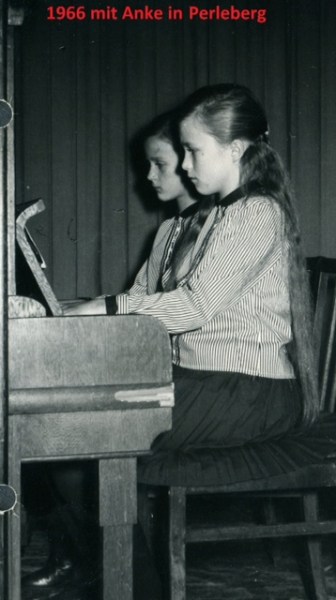
Edda and her sister Anke having a Practice session
This week our friends from Germany put a little surprise video into my Dropbox. It was originally intended as a special birthday greeting from Germany. My wife and I were so deeply touched by its beauty both musical and visual that I decided to post it on my blog with the contributor’s permission, of course. Abend Ballade means Evening Ballad. Its music was composed by Edda’s second youngest brother Andreas Trampenau, grandson of my uncle Bruno Kegler. Edda played the composition on her Kawai E-Piano and her husband presented the wonderful images of clouds in the form of a slide show further enhancing the festive mood.
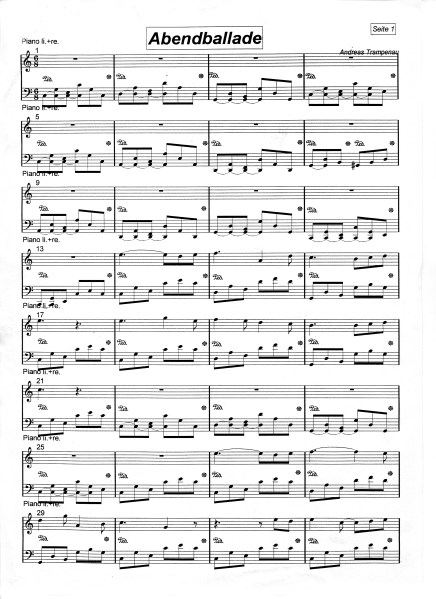
First Page of the Composition ‘Abendballade’
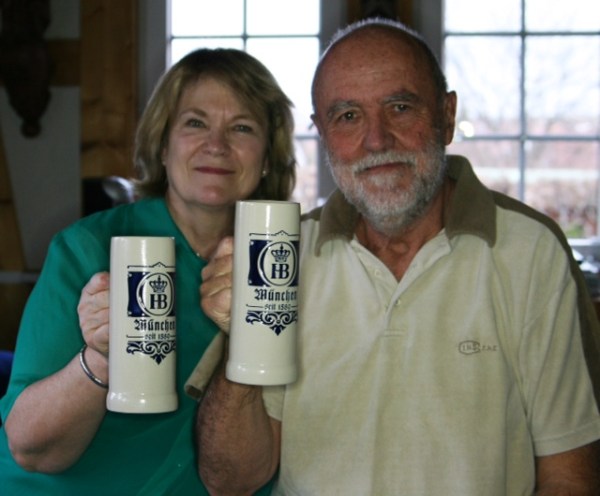
Dieter and Edda Barge raising their mugs to say ‘Happy Birthday!
With this musical and visual treat I would like to wish you all a Blessed and Happy Easter. Please note ‘The P. and G. Klopp Story’ will continue with Chapter Twenty next weekend.
Anna Rosa Klopp (1881 – 1924) – Part I
Introducing the Fifth Child of Friedrich and Emma Klopp
Klopp Family Tree Chart I – II
Rosa’s Marriage with August Diesing
On June 6, 1881 Rosa was born in Jersleben. Her father P.F.W. Klopp had just given up the mill at Osterweddingen due to an interim phase at his trade. In his home town Jersleben he recovered sufficiently to prepare the short-lived enterprise of the ‘Düppler’ mill at Olvenstedt. Since the family returned in 1885 via Magdeburg-Neustadt to Jersleben, Rosa was introduced to the school in 1887 either there or in Wolmirstedt.

Stassfurt-Atzendorf – Photo Credit: wikipedia.org
She did not resettle with her mother Emma in Elsenau, West Prussia, but married in 1903 the carpenter and later construction master August Diesing (1875-1939) of Atzendorf near Staßfurt. At the time of the wedding he was employed at a local construction company.
Rosa and August had seven children: Werner, Elsbeth, Rosa, Alice, Erika, Willy, and Fritz. The eldest son, most likely born in 1903, wears a marine uniform on a photo from 1920.
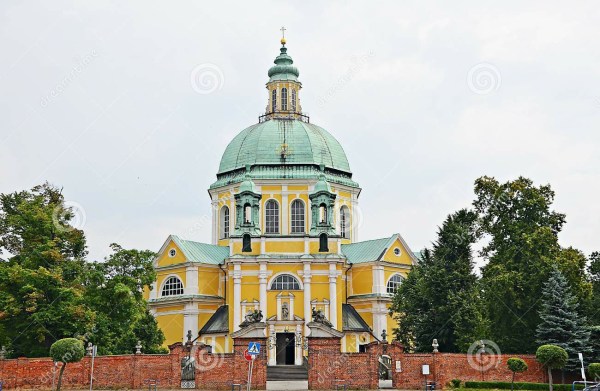
Monastery of Gostyn – Photo Credit: dreamstime.com
Since 1905 at the latest, the family was residing in Gostyn, Posnan and participated in 1908 in the acquisition of a dairy business lease with brother-in-law Ferdinand Klopp (1879 – 1952, see previous posts). Daughter Rosa, known as Rosel, was born there in 1905. Also all subsequent children were born there, before the region became part of the re-established country of Poland.
In 1919 the Diesing family established themselves on a temporary basis at Lebus west of the River Oder. Carpenter Diesing also appeared to have acquired land and worked on it for a while in the agricultural domain.
 The Peter and Gertrud Klopp Family