The following video should be entitled: Natural Horror of the Arrow Lakes. About 20 km south of where we live a wildfire caused by lightning is raging through steep and inaccessible terrain. The residents of Fauquier have received evacuation alerts from the provincial government. The smoke is so dense that the sun is hidden for most of the day. We can barely see the other side of the lake. I let the camcorder run for half an hour and then accelerated the video so it would fit into a 40 second runtime. Let us hope that the fire does not spread into our direction.
Fauquier has been evacuated. We now live in a trailer across the lake.
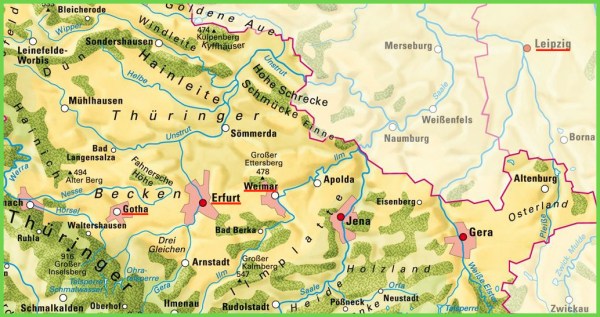
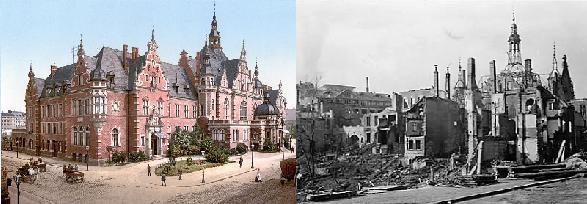
The following night Jepson invited Captain Panknin to sleep at his place. For the first time in weeks, Papa had a good night’s rest. Refreshed from a deep sleep, having recharged his internal batteries, he set out to go to the police HQ to receive further instructions. He had barely walked a few steps when Leipzig came under a sudden and unexpected aerial attack. The bombs were already falling when the sirens belatedly began their alarming howling in the city. An incendiary bomb plunged into a neighbour’s house, which almost immediately burst into flames. Papa helped the poor inhabitants with salvaging valuables from the burning inferno. His clothes singed by the fire and exhausted from the hard work, he arrived at the HQ, where to his greatest surprise, he was presented with yet another marching order, this time to Dresden-Hellerau. He had hardly received his provision for this eastern journey when the order was replaced by yet another, which sent him back to the latest hotspot at the western front near Weimar, where the Americans had launched a major offensive under General George Patton.
On April 8, shortly after midnight, he arrived by train at Weimar, where he went straight to the police HQ. By 06:15, he was climbing with a small troop under his command onto an army truck, which took him straight to the provisional front line near Erfurt. From there, they marched to Schmira amidst a barrage of shellfire and attacks from the air. Upon arrival, Papa looked in amazement at the bewildering array of the hastily set up feeble defence measures, most peculiar-looking anti-tank obstacles, and highly questionable battle preparations. It was dead quiet; the shellfire had suddenly ceased. Was it the calm before the storm? In the ominous stillness of impending doom, Papa found time in a nearby inn to write a letter to Mutti and family, which he passed on to a female communication aid to deliver it if at all possible to his wife in nearby Gotha. All day long, he could hear the droning of enemy planes over Erfurt. After a restful sleep in the basement of the police HQ, he felt his confidence returning, especially regarding Mutti and the children. He began to contemplate the best strategy to survive during the remaining few weeks of the war. In anybody’s reasonable mind, the fighting should stop. However, the regime-loyal fanatics were bent on dragging the German people into even greater misery than they had already suffered so far. Should he stay at the frontline and count on becoming a POW of the American forces? Or should he follow the marching order to Dresden, which was most likely already occupied by the Red Army and try his luck as a POW of the Soviet forces? As a higher ranking police officer, not quite fitting into the overall scheme of an increasingly chaotic defence plan, he had, in contrast to the common soldier, at least some freedom to move.
Last week, I presented a video on the prairie dogs. At that time, they were still shy and a kept a considerable distance from us, the intruders of their territory. One week later, we have become part of their family. Indeed, they have become quite aggressive. They know exactly our mealtimes and demand with a shrill sound that they be fed with the delicacies from our table. Corn, bread crumbs, and tiny morsels of the cinnamon buns at coffee time are their favourites. Our furry friends have excellent table manners and appear to fold their hands in prayer before starting to eat. Upon seeing each other for the first time in the morning, they run and meet halfway and give a quick kiss before parting again. Anyone who thinks I am telling a tall tale should go out into the woods where these critters live and stay long enough. I promise you will make the same observation. They also love playing games, of which peekaboo is their favourite. Enjoy.
Small army units had found temporary shelter and accommodation in private homes. Opa and his war-weary comrades slept in a basement from 22 hours till three in the morning when enemy shellfire woke them up. The barrage lasted for three hours. Some shells exploded in close vicinity of the house, where he was staying. At 7:30, a series of fierce skirmishes erupted while Allied dive-bombers were pounding their position at Steigerwald, a district of Erfurt. One bomb hit their temporary home. It smashed through the roof and exploded inside, causing the building to collapse like a house of cards. Fortunately, the civilians had all been evacuated, thus preventing unnecessary injury and loss of life.
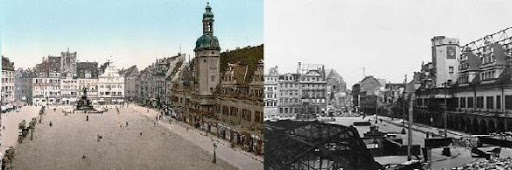
Incendiary Bombing of Leipzig – Before and After Photo Credit: Leipzigbuch
On Wednesday, April 5th, following the first marching order, Opa arrived by train in Leipzig at 22 hours. He quickly hid the wooden box filled with food supplies intended for his family while sirens were announcing another bombing raid. He managed to find shelter in a private basement room, from where he made a phone call to his superior and old acquaintance by the name of Jepsen. The German signal corps was still able to keep the lines of communication open, whereas the public telephone system had been out of order for some time. Opa received a heart-warming reception from his former colleague and friend. While he was being brought up to speed on the current frontline situation, he also received instructions about his role in the constantly shrinking space being held by German troops. Another bombing raid rained terror, fire and death from the unprotected sky. At three in the morning, Opa finally went to bed and found some much-needed rest. But he could not fall asleep.
Incendiary Bombing of Leipzig – Before and After Photo Credit Leipzigbuch
Worries about his family kept him awake. Hundreds of questions occupied his mind, to which he had no answers. Had the Americans already reached Weimar? Was the rumour true that their tanks have pushed their way to Gotha? How was his wife faring under these chaotic conditions? Was she still alive? And what about his stepdaughter Elsbeth? Then his thoughts turned to his twins Gertrud and Walter, whom he had held on his arms only two months ago? How were they doing? Was Mutti able to take care of them? When seen through the eyes of a caring and loving father, who must serve as a soldier fighting for his country, war takes on a new horrific dimension that goes beyond killing the enemy, worrying about getting killed, about death and destruction all around you. For every soldier killed in action, a mother will mourn the loss of her son. A sweetheart will never meet her lover again. A wife will have lost her husband and the father of her children. But when a soldier survives the horrors of the killing fields and returns home from a POW camp, and discovers that his entire family had perished in one of the horrendous aerial attacks, then what more is there to say about the utter and total senselessness of war? Having been a conscientious police officer and army captain faithful to country and convictions, Opa meditated deeply about things of concern to him. He often liked to share his views with friends and relatives in his massive correspondence later in the early sixties, from which I derived a lot of valuable information.
“A picture is worth a thousand words” is an adage in multiple languages meaning that complex and sometimes multiple ideas can be conveyed by a single still image, which conveys its meaning or essence more effectively than a mere verbal description. Wikipedia If this is so, then a video should be worth a million words. To escape the intense summer heat, my wife and I are camping at our son’s property where he set up our travel trailer for the summer. Located directly at the Arrow Lake it is at least 10 degrees cooler than at home. We have been barely a few days at this relaxing place when prairie dogs, very curious rodents by the way, came to visit us and were looking for grub. I took out my camcorder and recorded them. Here is the video. Enjoy.
Near the end of March 1945, SS-Colonel Josef Dietrich had taken over the defence of Vienna. A few days later, artillery fire was thundering and warning that the Soviet frontlines were moving closer. Opa fortuitously recalled his marching orders commanding him to report for duty at his hometown Gotha. So with these documents on hand, it was in the eyes of the military authorities quite proper and legitimate for him to leave the endangered Austrian capital and not be considered a deserter. Yet, with his keen survival instinct, he saw a golden opportunity to be near his family in his leaving the city. Papa also saw a chance to get through the final stages of the war alive. To fall into the hands of the Americans as a POW was, in his mind, the lesser evil. He managed to reach Erfurt by train a short distance east of Gotha, which was already under attack by US troops and tanks. This event prevented him from taking on his new assignment there. So on the highway to Gotha, where he was walking, he joined the German forces in full retreat from the enemy. Papa did not indicate in his notes the army units under his command in the final stages of the war.
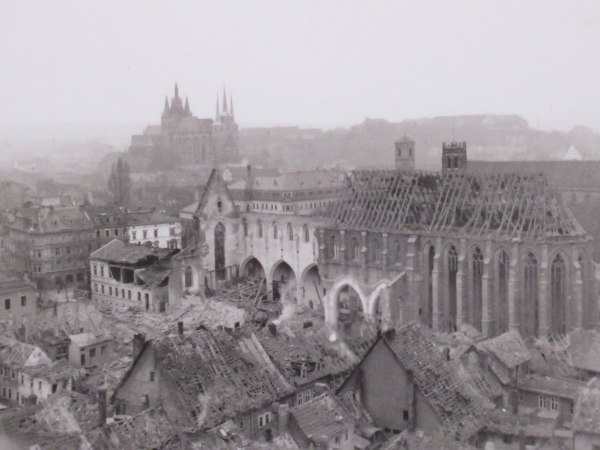
Erfurt 1945 – Photo: Wikimedia
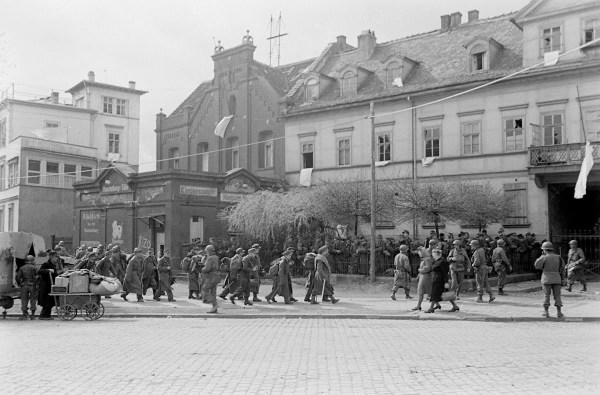
Later, on a beautiful sunny April morning, when he would have preferred to take a relaxing hike with his family through the Thuringia Forest, he walked instead in the direction of the Central Station in search of provisions. When he passed by the railway station, the ordinarily busy and often overcrowded place was utterly deserted. Enemy tanks had bypassed the town during the afternoon on the previous day and threatened to cut off the local defence lines set up for the region around the city. Rumour had it that an order would come that very same night regarding a desperate attempt to hold the town with troops drawn from the so-called ‘Volkssturm’ brigades long enough for the bulk of the battalion to reconnect with the German defence lines farther east. Despite the town mayor’s opposition to the inevitable house-to-house combat and the danger of more destruction to his beloved city, the order was carried out to the effect that the regime-loyal Nazi officials had also taken flight together with a remnant of the retreating army. Expecting the arrival of the American vanguard of tanks and troops at any time and being no longer afraid of their oppressive regime, audacious town folks tore down the pictures of Adolf Hitler from public buildings and the walls inside the railroad station.
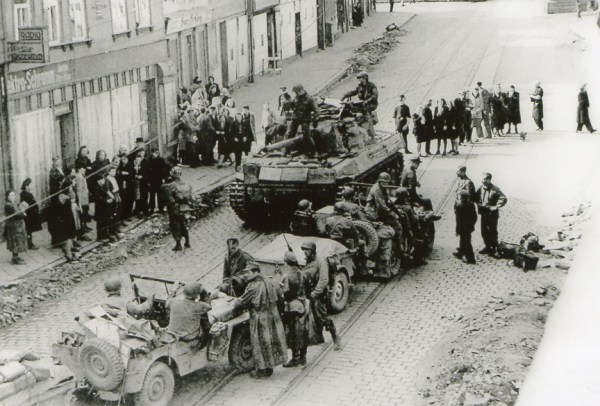
American Troops in Erfurt April 12, 1945 – Photo: erfurt-web.de
For Papa, these were turbulent times. With a small company of soldiers, he stayed behind, having received an order to fight as long as possible to delay the advance of enemy units converging on the city of Erfurt. On April 2nd, 1945, he recorded on his notes that the lines of command and communication were in a complete state of disarray. In the chaos and the rapid disintegration of the command lines, coordination of troop movements became increasingly more challenging to maintain. Often conflicting orders were sent out by the high command resulting in total confusion for the officers in charge down the military hierarchy. For instance, since his return from Vienna, Opa had received two marching orders, one for Leipzig and another for Dresden, while at the same time, he was supposed to provide leadership in the defence of Erfurt.