Splendour of the Arrow Lakes

Wednesday’s Photos

Two Moose Having Breakfast

Last Sunday my wife and I went to our favourite outlook to capture a few wildflowers. We were very happy with the results and were eager to rush home to view and edit the photos for publication. On our way home, we drove by the nearby duck pond. To our great surprise, we spotted two moose leisurely munching away at the delicious leaves. It was unbelievable luck to see them so close and to have my movie camera with me as well. So I decided to publish the video instead and leave the wildflower photos for next Wednesday. Enjoy.

Walter Panknin (1898 – 1977) and His Family – Part 11

A Gruesome History Lesson

No Photos Here – Let The Words Suffice

In response to the wartime atrocities committed by the Nazis, the partisans stilled their thirst for revenge first on members of the Waffen-SS. According to a report, on Pentecost Sunday, 450 soldiers were shot near Reichenberg, their arms tied together with telegraph wire in groups of six, all shot in the back. At the capture of Krusevac, 2,000 soldiers of the “Prinz Eugen” division were murdered. In Reichenegg, the partisans forced POWs into a bunker and dynamited it. When the stench became too intense, survivors had to cover the bunker with dirt. At Susegrad, partisans undressed 90 soldiers and chased them into the Sava River. Whenever possible the inmates buried the dead and marked the graves with stones or wooden crosses. In 1948, after the last POWs had left the provisional camps, locals dispersed the rocks, gathered the crosses and burned them.
Most of these former regular Wehrmacht troops perished in postwar Yugoslavia in three stages. As already mentioned above, during the first stage more than 7,000 captured German troops died in Communist-organized “atonement marches” stretching 1200 km from the southern border of Austria to the northern border of Greece. During the second phase, in late summer 1945, many German soldiers in captivity were summarily executed or thrown alive into large karst pits along the Dalmatian coast of Croatia. In the third stage, 1945-1955, an additional 50,000 perished as forced labourers due to malnutrition and exhaustion.
The total number of German losses in Yugoslav captivity after the end of the war including ethnic “Danube German” civilians and soldiers, and “Reich” Germans, may therefore be conservatively estimated at 120,000 killed, starved, worked to death, or missing. One may wonder why I would go to such length to describe the gruesome details of past events in an area of seemingly minor importance to us. There are two reasons. Firstly, I noticed so many similarities in the brutal treatment of the German civilian populations in East Prussia and Pomerania, where my parents and grandparents had their roots, and Yugoslavia, where Biene’s Papa spent most of the war years. I found it appalling that so little can be found in today’s historical literature about these events.

Additional information on the treatment of other ethnic groups in Yugoslavia: https://en.wikipedia.org/wiki/Bleiburg_repatriations


Splendour of the Arrow Lakes

Joyful Canoe Ride across the Lower Arrow Lake

My wife and I decided to cross the lake for a photo and video session. We launched our canoe conveniently equipped with an electric motor at the Fauquier boat dock. Our first destination was the mouth of the Whatshan River. It was very turbulent because of the recent heavy rainfalls and the meltwaters feeding the river. So we kept a safe distance. Then we circumnavigated ‘our’ tiny island that I have written about many times on this blog before. We landed at a sandy beach and watched the Needles ferry travelling between Fauquier and Needles. Coaxed by the hot sun, we spontaneously jumped into the lake for a quick refreshing swim. It is not an exercise for timid people. The lake, being part of the Columbia River, is cold even during the hottest part of the summer. I measured 14 degrees C (47 F). We felt great. What a pleasant way to live through the Covid-19 pandemic! Enjoy the video.

Walter Panknin (1898 – 1977) and His Family – Part 10

Papa’s Miraculous Escape

In the first week of January 1945, Papa took the train to Zagreb, the capital and largest city of Croatia, from where he began the long train ride to Vienna. The resistance forces under the leadership of Josef Tito were cutting off all the supply lines from the north, which included the rail connections to Germany. So when Papa arrived in the capital of Austria, he heard that he had been on the very last passenger train that succeeded in leaving Yugoslavia. If we consider all the horrific atrocities that Tito’s guerilla army revengefully committed against German ethnic groups living in Yugoslavia in general and against German officers and ordinary soldiers in particular, it is fair to say that the birth of the twins had saved Papa from certain death.

On May 6, 1945, General Kesselring told Colonel-General Löhr, the commander of the southeast army, that Germany would capitulate on May 9. Löhr then contacted Tito to work out the capitulation details. The Yugoslavs ignored anything agreed upon as soon as the Germans had surrendered and had laid their arms down. They forced the POWs to march in so-called Sühnemärsche (atonement marches). The Geneva Convention states that POWs can march no more than 20km (12.5 miles) a day. One of the POW groups walked 75 km in 20 hours. Whoever straggled or was begging for water or food was shot. Ten thousand perished during those marches.

Picturesque Modern Day Croatia

Camp life was no better. Hardly any food was available. The prisoners had to gather herbs and cook them. The result was diarrhea and dysentery. “Death worked with a scythe” in Belgrade Camp # 1. The dysentery barracks housed eight hundred; it was called the death barracks. The death count was at least ten corpses each day. The camp masters worked the inmates to death in lumber camps and mines. They also forced them to clear minefields without the proper equipment. At times, at the end of a shift, hundreds of POWs were chased onto the cleared field to ensure that no mines remained. Those who died were buried in unmarked graves. The camp authorities did not attempt to record their names.

Natural Splendour of the Arrow Lakes

Fresh New Look after the Rain

Last week my wife and I paid a return visit to one of our favourite outlooks overlooking the Lower Arrow Lake. After a long dry spell so early in the spring season, Nature was quite a bit behind. But now it had a new fresh look after a much needed rain. Apart from capturing the landscape in the clear air with the clouds forming a dramatic background, my focus was on the colourful flowers and bushes that attracted my attention. The pictures turned out to be so stunning and beautiful that I make no apologies for going over my limit of five photos per post. Enjoy.

Walter Panknin (1898 – 1977) and His Family – Part 9

The Good Life in Zavidovici

Papa, who had recently advanced to the rank of a captain, enjoyed an excellent rapport with his staff. He carried out his business in a strict but fair manner, which earned him the respect of his officers and the people of the Bosnian district around Zavidovici. They were grateful for the security that his troops provided. Tito’s bands and the German army alike were terrorizing towns and villages elsewhere in their attempts to gain control over the enemy. For Captain Panknin, there was just one fly in the ointment. He also had to deal with troublesome disciplinary matters arising from a company of volunteer soldiers under his command soon after Germany attacked the Soviet Union in June 1941. The company mainly consisted of exiled Russians, former Belorussians or their children. As Papa described them in a letter to a friend after the war, they were drunkards, thieves, and good-for-nothings. In his opinion, the military police should have arrested them and put them in an army jail for all kinds of significant infractions. Breaking military rules and criminal activity within and outside the barracks were examples that Papa mentioned in his report. But documenting all the individual cases and summoning witnesses to support the evidence would have taken too much valuable time. The little episode corroborated what I learned from my brothers’ reports in Book I.  It may come as a surprise to most readers that many young men from European countries were willing to fight for Germany against the Bolshevik threat to take over all of Europe.

This image has an empty alt attribute; its file name is c08d752f9f621d92cf384efb5278b638.jpg
Picturesque Landscape near Zavidovici, Croatia

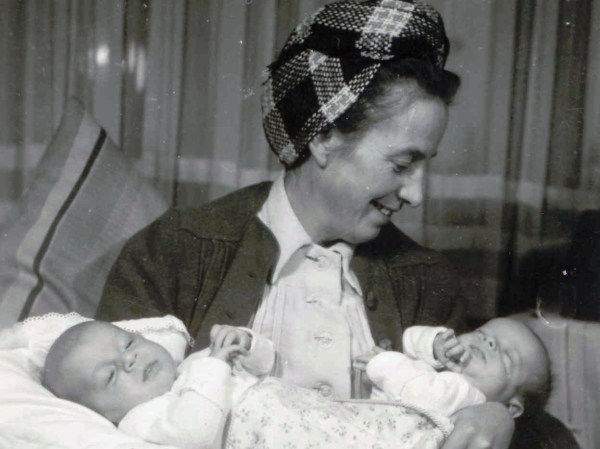
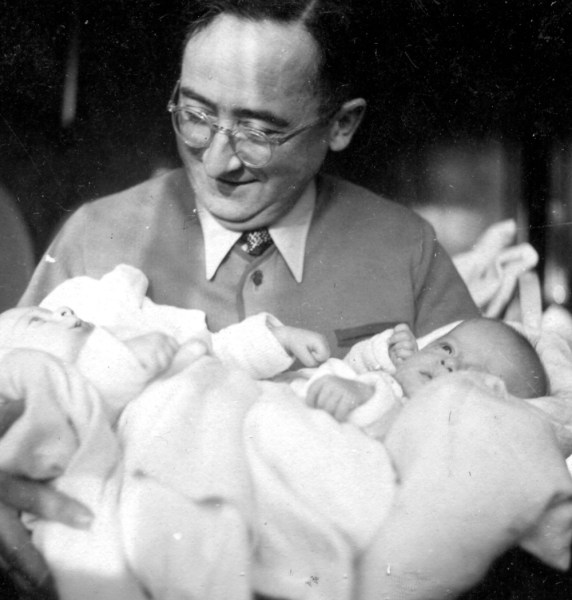
On October 30th, 1944, a telegram arrived from the Gotha police headquarters informing Captain Panknin of a very joyful event back home. The message read as follows: TWINS ARRIVED ON 29/10 44 BOY AND GIRL MOTHER AND CHILDREN ARE WELL. Great was Papa’s joy. What a blessing to have twins when it had appeared that he would not have any children of his own after fourteen years of marriage! His staff was equally delighted and created for their boss the most beautiful congratulatory card I have ever seen.

This image has an empty alt attribute; its file name is birth-congrat-44-cropped.jpg

There must have been an artist among the officers. No commercial card could have matched the quality of the picture depicting two storks delivering the babies, the touching message for their dear commandant, and a lovely poem to boot signed by the entire staff. Of course, this extraordinary event called for celebration. But the best part for Papa was that he was granted a rare leave in the New Year from war-torn Yugoslavia to travel home to see his wife and children.

This image has an empty alt attribute; its file name is birth-congrat-44_2.jpg