Ernst Klopp (1900 – 1964) and his Family – Part 32

The Ös Farm

Then suddenly in the summer of 1950 an opportunity presented itself to Ernst Klopp. An elderly farmer by the short name of Ös decided to retire and leased his farm house and a few parcels of land not more than 6 ha in size to my father on credit. By comparison to the 3,000 ha Ernst had administered in Gutfelde, the total of arable land available for farming was minuscule. The house was adequate and a vast improvement over the upstairs dwelling of the ‘poor house’.  It came with a large barn with a hay loft, a sufficient quantity of farm implements, a fair-sized kitchen, the ubiquitous manure pile in front of the kitchen window and an outhouse. The only luxury item that I recall was the large tile stove (Kachelofen in German) providing warmth and a cozy ambience for the entire dwelling. Many of my sweet childhood memories are going back to the Ös farm, as we often irreverently called it.
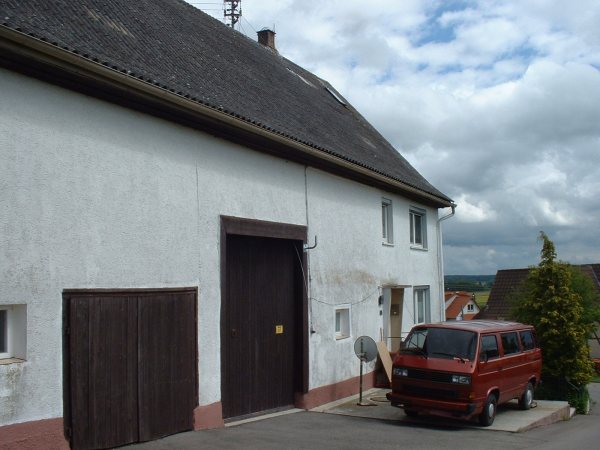
The Ös Farm – 2003

So here my father Ernst Klopp tried with little prospect of success to pick up his life-long dream again to running a farm under his very own management. Having no capital to spend on much needed supplies, he heavily depended on loans, which created a heavy financial burden. He must have counted on the help from my older siblings for turning the farming operation into a successful venture. 
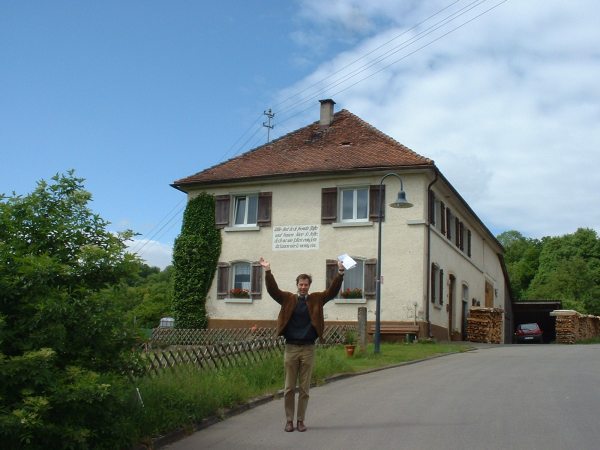
  The Farm House opposite to the The Ös Farm – Visit by our sons Robert and Stefan in 2003

Soon after his high school graduation Karl left home to study economics at the university of Braunschweig. Adolf, my second eldest brother, barely 18 years old found work at the Bizerba Factory in Meßkirch. Since that time in the early 1950s the Bizerba Company GMBH has developed into a world leader in weighing technologies for industry and trade. Adolf had to contribute most of the money he earned in order to keep this fledgling farming operation financially afloat. Three years later, Adolf was getting tired to support what in his opinion was a hopeless enterprise. Together with another refugee son by the name of Waldemar Klein he immigrated to Canada. Soon thereafter, my sister Erika also left home to take up nurses’ training in the City of Hamburg. In 1954, Gerhard managed to get an apprenticeship placement in a prestigious institute of technology in Switzerland.
Natural Splendour of the Arrow Lakes

Wednesday’s Photos

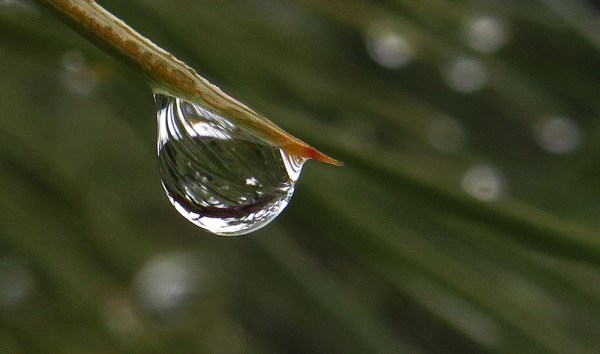
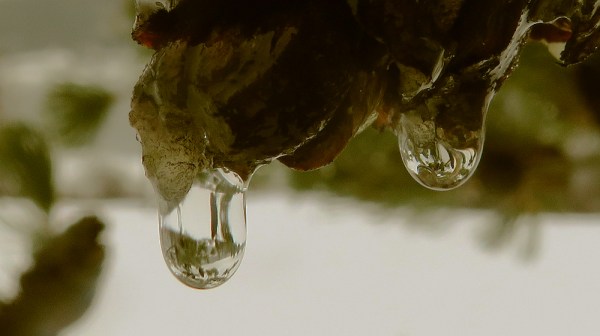
Rain, Rain, and more Rain

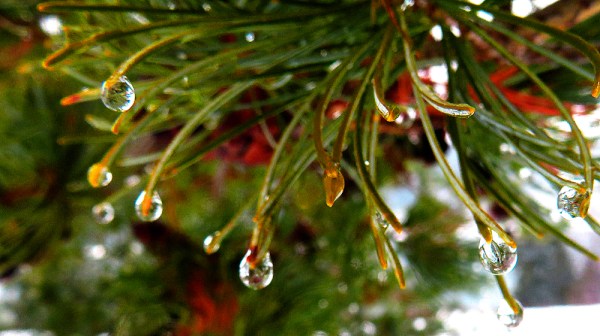
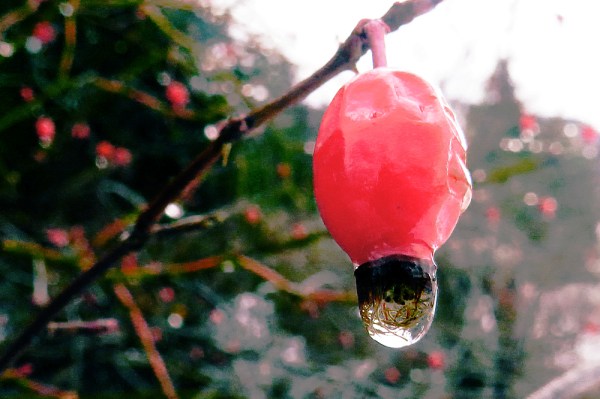
This has so far been the mildest winter, since we moved here over forty years ago. In the early 1980′, we experienced massive snowfalls with snow piling up all the way to our kitchen window. In the extreme cold weather often lasting several weeks in a row, the lake would occasionally freeze over and our ferry barely managed to break the ice in the morning. It seems that such extreme weather is now part of the past. After a night of wet snow covering the ground with a white blanket, rain, quite heavy at times, returned to our area at the Arrow Lakes. When it let up a little, my wife and I went out for our daily walk equipped with our cameras hunting for rain drops. Here are the results. Enjoy!

Ernst Klopp (1900 – 1964) and his Family – Part 31

A New Beginning in Southern Germany

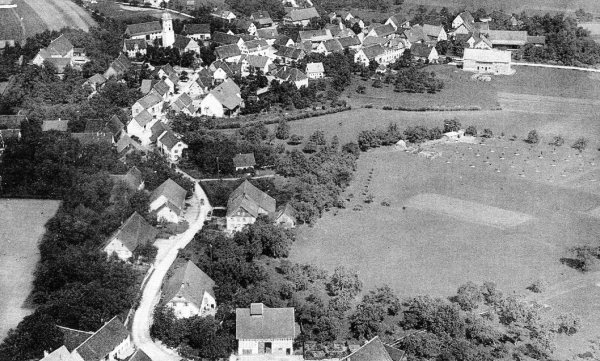
Rohrdorf as seen on an old postcard – about 1950

In June 1947, Ernst Klopp established himself anew in Rohrdorf , a small village near Meßkirch in Southern Germany. After finding employment as a forestry worker of the Fürstlich-von-Fürstenbergischen Forestry Administration located at Donaueschingen with a branch office in Meßkirch, he was able to reunite with his wife Erika and children. Adolf and Erika (see my sister’s report in an earlier chapter) joined them after a two- years interim with Uncle Günther in Erfurt.

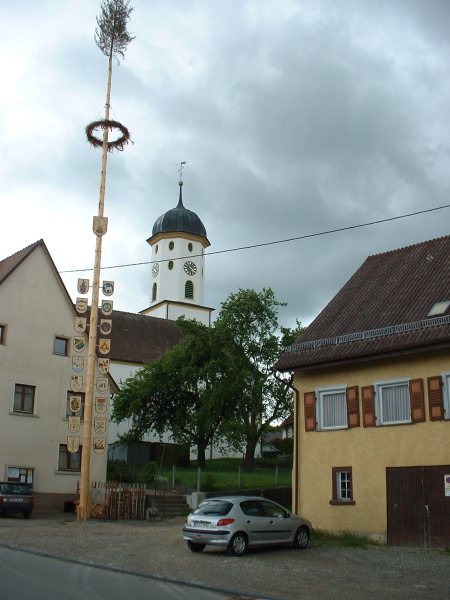
May Tree with St. Peter and Paul Church in the background – 2003

Karl, the eldest son, was the last one to join the Ernst Klopp family. The von Waldenfels couple, having to flee from their Panwitz property, had settled at their newly acquired estate Pentenried near Munich. In February 1948, they took the 19 year-old Karl into their care and provided food and shelter  for about a year. After an agricultural apprenticeship in Nellenburg near Stockach, Karl was finally able to join his family.

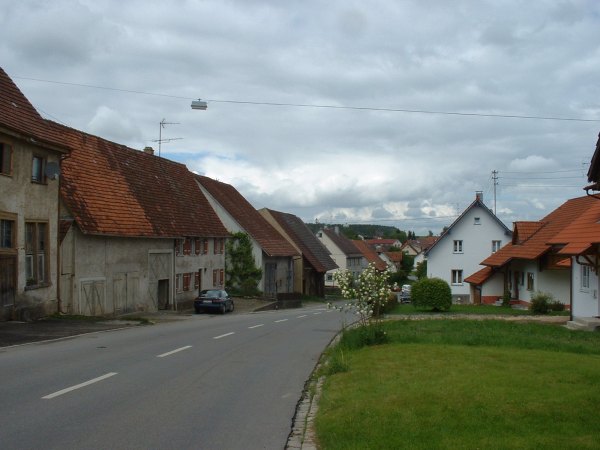
Street connecting the Upper and Lower Village of Rohrdorf – 2003

Rohrdorf consists of a long drawn-out assembly of farms and houses divided into a lower and an upper village. In the upper village we find the places where most of the social activities took place in the late 40s. There were at least two inns, a grocery store, a branch of the Credit Union, a dairy operation on the road to Meßkirch, an elementary school and the catholic St. Peter and Paul church. Our family lived in the lower village in the upstairs portion of a house, which my siblings called the ‘poor house’. Its primitive tight living quarters were a far cry from the spacious and luxurious estate in Gutfelde. Being the youngest child, I felt nothing of the stress that the other family members experienced during these difficult times of the postwar era.

Ernst Klopp (1900 – 1964) and his Family – Part 30

Karl and Adolf’s Perilous Journey March 1945

Karl’s Report – Part 4

When we arrived at the town on the evening after the attack, where we had wanted to stay overnight, visibility was almost zero, the stench horrific, most certainly the smell of corpses. How we got over the relatively wide arm of the River Oder, by the name of Swine, I cannot recall. On account of the smoke I was unable to see.

In the middle of the night we reached Ahlbeck and found some rest in a vacation guesthouse, where a compassionate woman with a little son took us in. For the first time in ten days we slept in a real bed. Only now we began to discuss to which destination we should proceed. There were relatives, whose addresses we had in our heads due to a very active correspondence, in Freiburg and Erfurt. The latter was closer. Therefore, we decided to pedal on in a southeastern direction. Since we had neither maps nor compass, we did not choose the direct way, kept on pedalling six more days all the way to Neubrandenburg, where we became sick and tired of biking. We needed a rest, because the most recent journey went over the Pomeranian ridges, over hills and through valleys and into our bones.

We used a savings account booklet filled with entries from our saved pocket money to buy train tickets to Erfurt and pay for the shipping of the bikes. The savings account organization had made life easier for the refugees with the set-up of a generous transaction policy. It was a strange feeling to sit in a train, where to be sure there was incredible crowdedness, to be able to watch the landscape, to read the names of the cities of Mecklenburg-West Pomerania, of Brandenburg, and then of Saxony-Anhalt, places whose names until now had been unknown to me or about which I had a different perception.

Once in a while the train stopped in a hollow to await a bomber formation. Often enough low flying aircraft attacked trains or blocked the route in order to target troop transports. A friendly place-name sign ‘Wolmirstedt’ indicated to us that we were passing through the birthplace of our father Ernst Klopp. Slowly we were approaching Thuringia, where Uncle Günther and Aunt Lucie lived. It was an unknown place to us. A long trip in our childhood, especially during the war, was out of the question. Then came the giant railroad station that destroyed all small town Pomeranian perceptions, then the walk to the probable town section, the search in the long street with the name Nonnenrain and the confusion about the house number, 70 instead of 17. Aunt Lucie was speechless. Of course, she could not answer our first question about the whereabouts of our parents. That we looked like dirty pigs must have affected her rather badly as it would have anybody else. At mealtime there was information on the conditions in the city, above all on the almost daily aerial attacks and on the air raid shelters. Besides the American front was approaching from the west.

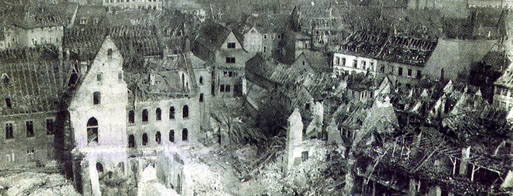
Erfurt after a Bombing Raid
Erfurt after a Bombing Raid – Photo Credit: TLZ.de

At first we did not heed the warnings of the aerial attacks, until a powerful explosion of a bomb taught us otherwise. Uncle Günther, who was at the time hospitalized due to health issues going back to WW1, was sent home, and we met again, himself looking quite worried. With the arrival in Erfurt the flight had come to an end, and the thread to our homeland and to the parents was totally cut off. What came next was completely different. End of Karl’s report

Natural Splendour of the Arrow Lakes

Wednesday’s Photos

Juniper Berries, Moss, and Oregon Grapes

Last week a major wind and rain storm was pounding the Southern Interior of BC knocking out a number of power stations and leaving thousands of households without electricity. With temperatures rising to 10 degrees C in some areas most of the snow has melted away in our valleys. When the sun came out last Thursday, January 15, my wife and I went to our favourite look-out to capture some of the plants covered with sparkling hoarfrost and dew drops. I brought so many photos home from the foray in the early morning light that I decided to break my 5-picture rule. I know you don’t mind. Enjoy.